Brand & Content Strategy
Best AI Agents for Content Creation: Evaluation Checklist
A buyer checklist for choosing AI content creation agents on brand control, review steps, asset rights, labelling and measurement.
 Simran Rawat1 Nov 202618 min read

The best AI agents for content creation keep your brand rules intact, add a human approval step before publishing, give you clear rights to outputs and let you measure results. Score each candidate on brand control, review steps, asset rights, disclosure and measurement, and veto any tool with no review step or no written rights terms. For video, UGC and creator-led content, Nia by Nurdd is an AI-native creative studio with influencer marketing built in.
The best AI agents for content creation are the ones that keep your brand rules intact, put a human approval step before anything publishes, give you clear rights to what they produce, and let you measure results. Pick by those tests, not by the number of templates. This checklist scores any agent, text or video, against them.
Key takeaways
- Score every candidate on five gates: brand control, review steps, asset rights, disclosure and provenance, and measurement. Reject any agent that fails the review or rights gate.
- “AI agent” covers four different jobs: drafting text, optimising for search, running workflows, and producing video or creator content. Decide which job you are buying before you compare.
- Prompting alone may not give you copyright in the output. The US Copyright Office says human control over the expression decides that, case by case.
- Labelling rules are tightening: the EU's Article 50 applies from 2 August 2026, Meta shows “AI info” labels on ads, and YouTube requires disclosure of realistic synthetic content. Ask each vendor how its files are marked.
- Run a two-week trial with one real brief, one reviewer and one metric, then score it with the table below.
- If your content is video, UGC or creator-led, put Nia by Nurdd on the shortlist and use the demo to close the gates that Nurdd has not published facts for.
Which tools are people comparing, and what do the top articles leave out?
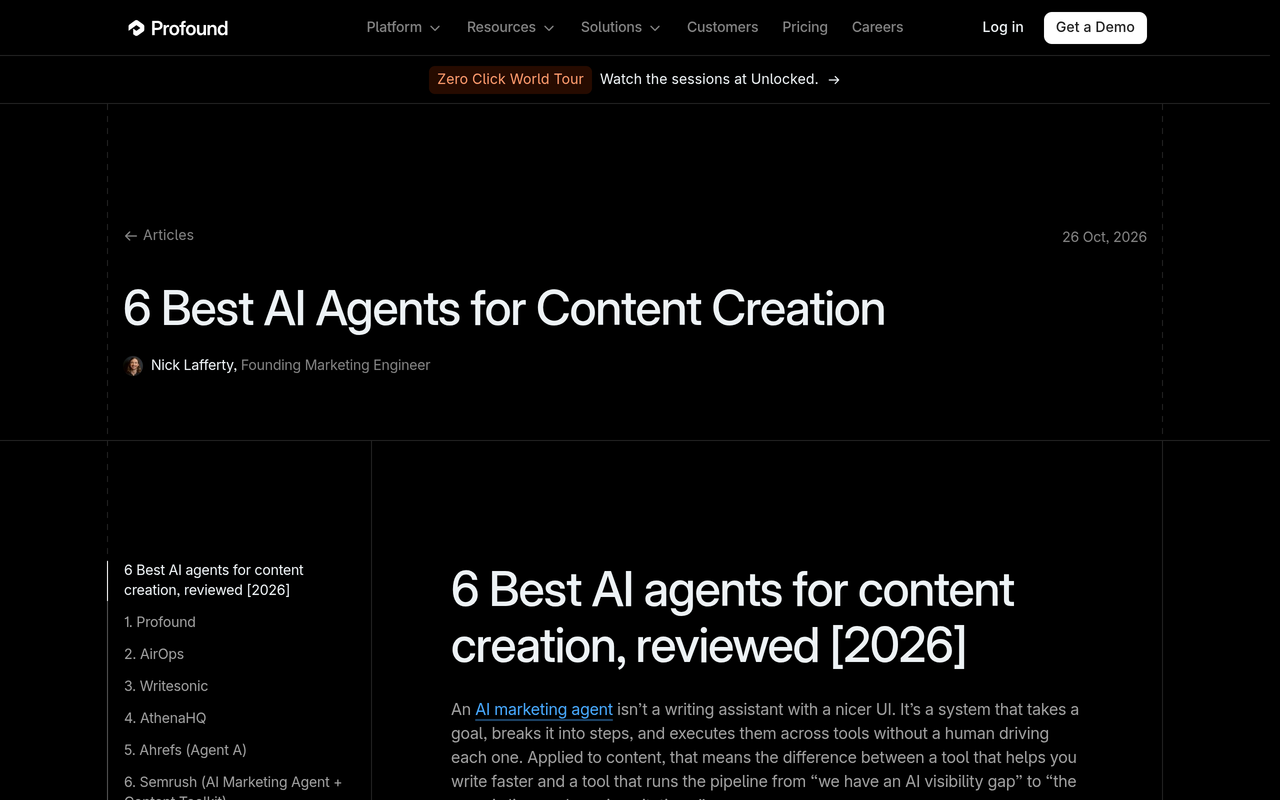
Search the primary keyword and the results are mostly ranked lists. I reviewed three top-ranking articles that are not on nurdd.club, using the page text available to me, to see what they cover. Each is useful for a shortlist, and each seems to stop before the questions a buyer has to answer in procurement.
| Article | What it covers | What it leaves out (in the text reviewed) |
|---|---|---|
| Profound, “6 Best AI Agents for Content Creation” | Six tools in a comparison table, a how-to for using Profound for content creation, and an FAQ. It says the strongest agents start from real user prompt data. | A vendor-neutral scoring method, asset ownership, and labelling rules. |
| ClickUp, “13 Best AI Agents for Content Creation” | A 13-tool ranked list with a “what to look for” section and per-tool “best for” labels. | Review workflows, rights to outputs, disclosure, and how to prove an agent worked. |
| Built With Agents, “Best AI Agents for Content Creation” | Picks by use case (blog, social, video, ads), a table of autonomy level and entry price, and a tools-versus-agents explainer. | A scoring framework, copyright and ownership questions, and platform labelling rules. |
Two gaps stand out. The lists lean towards text and tool roundups, so a marketer who needs a product film, a UGC ad or a creator campaign gets little help judging risk. And none gives a way to score tools against your own requirements. The rest of this post fills both gaps.
What is an AI agent for content creation?
An AI agent for content creation is software that takes a goal, such as “produce a launch ad for this product”, and carries out several steps toward it with limited prompting: researching, drafting, revising, formatting and sometimes publishing. A chatbot answers one prompt at a time. An agent chains steps and acts on tools or data.
In practice the label covers four different jobs, and mixing them up is the most common buying error.
- Drafting agents write blog posts, emails and captions from a brief.
- Search-led agents find gaps in what AI engines and search results cite, then write or refresh pages to fill them.
- Workflow agents route work between people, apply brand rules and trigger publishing.
- Production agents make visual content: video ads, UGC, short films, and creator-cast campaigns.
This four-job split is deliberately coarse, because it maps to different budgets and different owners inside a brand. Other writers slice agent types more finely; use whichever split helps you assign an owner.
How do I choose an AI content creation tool for my brand?
Choose by scoring each candidate on five gates, then testing the top two on a real brief. The gates are brand control, review steps, asset rights, disclosure and provenance, and measurement. A tool that writes well but fails on rights or review will cost you more later than a plainer tool that passes.
Below is the scorecard. Give each gate 0 (absent), 1 (partial or manual) or 2 (built in and documented). Treat any 0 on rights or review as a veto, whatever the total.
| Gate | Question to ask the vendor | Evidence that earns a 2 | Veto? |
|---|---|---|---|
| 1. Brand control | Where do our voice, claims and banned phrases live, and does the agent apply them every run? | A stored brand profile or style guide the agent reads on each task, with examples of enforced rules. | No |
| 2. Review steps | Who must approve before content leaves the tool, and can we see what changed? | Role-based approval, version history, and no auto-publish without sign-off. | Yes |
| 3. Asset rights | Who owns outputs, what was the model trained on, and what do we get for likeness and music? | Written terms on commercial use, indemnity or clear limits, and creator or likeness consent. | Yes |
| 4. Disclosure and provenance | Are files marked as AI-made, and can we apply platform labels easily? | Content Credentials or equivalent metadata, plus guidance on platform disclosure toggles. | No |
| 5. Measurement | Can we tie a piece of content to a result? | Tagging, UTM support, citation tracking or sales attribution that you can export. | No |
The maximum score is 10. As a working rule, shortlist anything at 7 or above with no veto, and cut anything under 5. This is a method of ours, not a published standard. The rest of this post explains each gate and what evidence is public.
Gate 1: How much brand control does the agent really give you?
Brand control means the agent applies your rules without being reminded, every time. Many tools offer a “brand voice” field, but a field is not enforcement. The test is whether the agent can refuse, flag or rewrite when a draft breaks a rule.
Governance is now a selling point across the category, so ask for it in writing and ask to see it working on your own rules rather than a demo script.
How to test brand control in 30 minutes
- Write five rules you actually enforce: two tone rules, one claim you can never make, one word you never use, one required disclaimer.
- Give the agent a brief that tempts it to break each rule, for example a request for a “guaranteed results” headline.
- Run the same brief three times and count how many outputs break any rule.
- Score 2 if all three obey, 1 if you had to repeat the rules in the prompt, 0 if they were ignored.
For visual content, add a second test: does the agent keep your product accurate? A UGC ad that shows the wrong pack, shade or logo is a brand failure that no caption can fix.
Gate 2: What review steps should sit between the agent and publishing?
At minimum, one named human should approve every external asset, and the tool should record who did. Agents that can publish on their own are useful for low-risk refreshes and risky for anything with a claim, a price or a person's face in it.
Use a risk ladder to decide how much review each content type needs.
| Content type | Risk | Review step |
|---|---|---|
| Internal summaries, outlines | Low | Spot check by the requester. |
| Blog posts, product pages | Medium | Editor checks facts, claims and links; owner signs off. |
| Paid ads, emails with offers | High | Editor plus compliance check on claims and disclosure. |
| Anything showing a real or synthetic person | High | Rights check on likeness, disclosure label decided before export. |
| Health, finance, or regulated claims | Highest | Specialist review; no agent auto-publish. |
Ask three concrete questions in the demo. Can I require approval before export? Can I see a change history between the agent's draft and the approved version? Can I limit who may approve? A vendor that cannot show these in the product is asking you to build the review process in spreadsheets.
Gate 3: Who owns what the agent makes, and what are the rights risks?
Ownership has two layers: what the vendor's terms grant you, and what the law lets anyone own. The second layer surprises buyers. The US Copyright Office issued Part 2 of its AI report on 29 January 2025, on the copyrightability of AI outputs. Law firm Finnegan, January 2025 summarises the finding: copyright does not extend to purely AI-generated material, but outputs can be protected where a human author has sufficient control over the expression.
The same report says prompts alone do not provide that control on current technology, and that works are assessed case by case. The Copyright Alliance, February 2025 adds that human selection, coordination or arrangement of AI output, and creative modifications to it, can be protected. The practical reading for a brand: a clip generated from one prompt is weaker to protect than a film where people write, select, arrange and edit. Keep records of your human edits.
Rights checklist for any content agent
- Commercial use: do the terms allow ads, resale and paid distribution on every plan you will use?
- Likeness: if the agent shows people, are they licensed creators, AI-generated characters, or your own talent, and is consent documented?
- Music and fonts: are they cleared for paid media, or only for organic posts?
- Training data and indemnity: does the vendor state what it trains on and whether it covers claims against you? If silent, score 0.
- Export and portability: can you download source files and projects if you leave?
- Testimonials: does the product let you generate fake customer reviews or endorsements, and does it prevent that? Fabricated testimonials are a legal and reputational risk, not a feature.
Gate 4: How should AI-made content be labelled and marked?
Label by default where the content could be mistaken for a real person, place or event, and keep the file's provenance data intact. Platforms and regulators are moving the same way, so a tool that strips or ignores provenance creates work for you later.
Three public signals matter for buyers:
- EU AI Act, Article 50. The European Commission's FAQ on Article 50 sets out transparency duties that apply from 2 August 2026, including machine-readable marking of AI-generated content by providers of generative systems. Read the FAQ and take legal advice on how it applies to you.
- Meta ads. Meta, February 2025 said “About this ad” would include “AI info” labels for ads made or significantly edited with its generative tools, and that it would detect ads made with third-party AI tools through industry-standard signals.
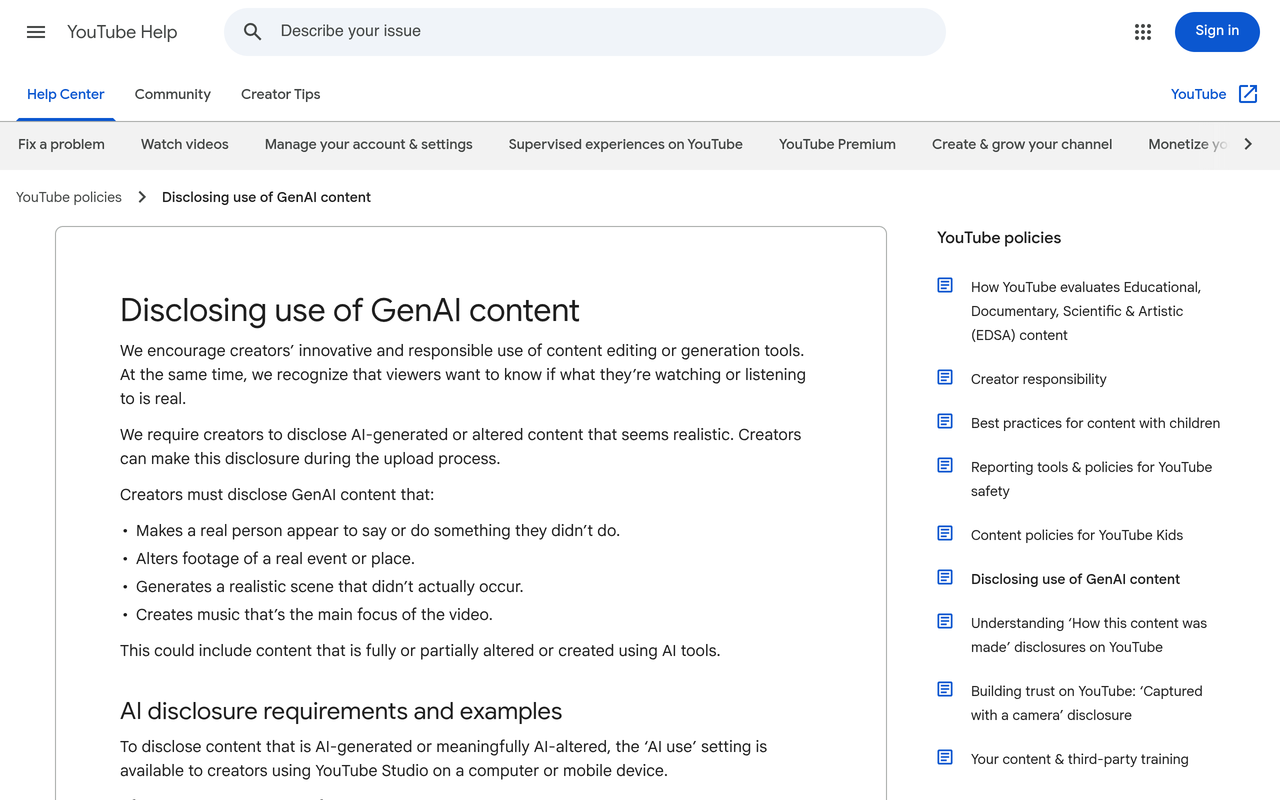
- YouTube. YouTube's own Help page on disclosing altered or synthetic content says creators must disclose AI-generated or altered content that seems realistic, using the “AI use” setting in YouTube Studio.
The technical layer is Content Credentials, the C2PA open standard. The C2PA implementation guide describes using Content Credentials to identify synthetic and non-synthetic content. Ask each vendor whether its exports carry them.
Score 2 if the vendor documents how its files are marked and how to apply platform disclosure; score 1 if it leaves labelling entirely to you; score 0 if it strips metadata or cannot answer. Authenticity also has a brand dimension: our post on how brands are beating AI slop with authentic content covers when audiences push back on synthetic output.
Gate 5: How do you measure whether the agent's content worked?
Measure at the content level, not the tool level. “We published 3x more” is activity. A useful agent lets you tag each asset and trace it to one of three outcomes: engagement, citations in AI answers, or sales.
| Content goal | What to measure | What you need from the agent |
|---|---|---|
| Be cited in AI answers | Whether your brand appears for category prompts across AI engines | Page-level tracking, and a way to match refreshed pages to prompt results. |
| Paid or organic video and UGC | Cost per engagement, view-through, ROAS | Asset naming and UTM-ready exports. Use the Google + Meta ROAS calculator to check break-even. |
| Creator campaigns | Engagement, fake-follower share, product-level sales | Creator discovery, vetting and attribution inside the same workflow. |
For AI search content, start from a prompt list: our guide to which prompts to track for AI search visibility shows how to build one, and AI search share of voice explains the metric. Profound's article says the strongest AI content agents start from real user prompt data rather than a keyword database. That is a vendor's claim about its own approach, so treat it as a question to ask every vendor: what is your demand signal, and can I inspect it?
For creator content, set tracking up before launch. The UTM structure guide for influencer campaigns and the post on influencer performance attribution show how to keep the data clean.
How do the main kinds of content agent compare?
The table compares agent categories rather than individual vendors, because the gates behave differently by category. Each row reflects general patterns, not a verified claim about any one product; always verify a specific product on its own pages. I did not capture rival pricing from vendors' own pages for this post, so no rival prices are listed.
| Category | Typical output | Brand control | Review steps | Rights and likeness questions | Measurement |
|---|---|---|---|---|---|
| Text drafting agents | Blogs, emails, captions | Voice profiles, style guides | Usually editor-in-the-loop | Training data and plagiarism | Rarely built in |
| Search-led content agents | Pages, refreshes, FAQs | Guided by prompt and citation data | Often draft-then-publish | Sourcing and accuracy | Citation and visibility tracking, in some |
| Enterprise workflow agents | Governed content across teams | Encoded brand standards | Approvals and roles | Contract-level terms | Via integrations |
| General-purpose AI assistants | Anything, from a prompt | Only what you paste in | None by default | Depends on plan terms | None |
| Creative production studios (video, UGC, creators) | Films, product ads, UGC | Product and scene control | Human edit and approval | Likeness, creator consent, music | Varies |
The pricing question is separate, and the second table shows what to demand, because “per seat”, “per credit” and “per asset” models give very different bills at scale.
| Pricing model | What to ask | Cost risk |
|---|---|---|
| Per seat | Do reviewers and approvers need paid seats? | Review roles inflate seat counts. |
| Credits or usage | How many credits does a finished ad cost, including retakes? | Regenerating drafts burns credits. |
| Per asset or per video | Are revisions and formats included? | Resizes and variants may be billed separately. |
| Platform or enterprise | What is excluded from the quote: SSO, API, indemnity? | Rights terms often sit in the enterprise tier only. |
Prices change frequently and were not checked on vendors' own pages for this post, so request a written quote with the exact scope and date it.
Which agent fits which brand scenario?
Match the job to the category before you match it to a vendor.
- A content team publishing weekly articles needs a drafting or search-led agent with strong review steps. Gates 2 and 5 matter most.
- A beauty or skincare brand needing UGC-style ads needs a production tool. Gates 3 and 4 matter most, because faces and claims are involved. See our beauty industry page for how that category works.
- A brand running creator campaigns needs discovery, vetting and attribution next to production. Gate 5 matters most.
- An agency needs multi-client approvals and exportable work.
What does the evaluation look like on a worked example?
This is an illustrative walk-through, not measured data. A fictional skincare brand needs 12 short product ads for Instagram, and compares a text-and-image agent against a video production studio using the scorecard.
| Gate | Candidate A (text and image agent) | Candidate B (video studio) |
|---|---|---|
| 1. Brand control | 1: voice profile, no product-accuracy check | 2: product-based generation from a link |
| 2. Review steps | 2: approvals and history | 1: manual export review |
| 3. Asset rights | 1: terms found, no likeness detail | 1: terms found, creator consent to confirm |
| 4. Disclosure | 1: no guidance | 1: guidance to confirm |
| 5. Measurement | 0: none | 1: export names, UTMs by hand |
| Total | 5, no veto | 6, no veto |
Neither passes the 7-point shortlist. The scorecard did its job: it produced a list of exact questions to send each vendor (likeness consent, label guidance, tracking exports) before anyone signed. Re-score after the answers arrive.
Checklist: how to run a two-week trial
- Pick one real brief with a real deadline and a named approver.
- Write your five brand rules and run the 30-minute brand test from gate 1.
- Send the vendor the rights questions in gate 3 and get answers in writing.
- Produce three assets and send them through your normal approval path. Record the time spent editing.
- Check each exported file for provenance data and decide the disclosure label for each platform.
- Publish one asset, with tracking tags set before it goes live.
- Compare against your current workflow on time to approval, edits needed and the one metric you chose.
- Score the five gates, apply the vetoes, and record the decision and date.

What are the most common mistakes when buying a content agent?
- Buying on template count. A library of 100 templates says nothing about brand enforcement or rights.
- Letting agents auto-publish. Fine for a refresh of low-risk pages, risky for claims and people.
- Assuming you own the output. Vendor terms and copyright law are separate questions.
- Skipping labelling until a platform flags you. Decide your disclosure approach before export.
- Measuring output volume. Track citations, engagement or sales per asset.
- Using one tool for every job. A text agent will not cast creators; a studio will not rank your pages.
Fake audiences are a special case in creator work. Before you pay anyone, run the steps in the fake follower audit checklist or try the fake follower checker.
Why does Nia by Nurdd belong on the visual and creator side of the checklist?
Nia by Nurdd is an AI-native creative studio at getnia.studio, also on iOS and Android, with influencer marketing built in. Brands use it to make short films, micro dramas and commercials from an idea, and product and UGC ads from a link, casting real creators and AI creators in the same production. It is priced below comparable plans.
Book a demo at nurdd.club/demo and we will walk through your own product link and category, so you can score Nia against the five gates with your brand rather than a sample.
The table separates what Nurdd has published about Nia from what you must confirm yourself. Nurdd has not published facts on approval roles, change history, commercial-use terms or label guidance, so those gates are open questions for the demo, not claims.
| Gate | What Nurdd has published about Nia | What to confirm in the demo |
|---|---|---|
| 1. Brand control | Makes product and UGC ads from a product link, so output starts from your actual product. | How your brand rules are stored and applied. |
| 2. Review steps | No published facts on approval roles or change history. | Whether you can require approval before export, and who can approve. |
| 3. Asset rights | No published facts on commercial-use terms or likeness consent. | Written commercial-use terms and creator consent for your plan. |
| 4. Disclosure | No published facts on file marking. | Whether exports carry provenance data and how platform labels are handled. |
| 5. Measurement | Pre-spend ROI forecasts, and product-level sales attribution to specific creators after campaigns close. | How exports map to your analytics. |
| Creator vetting | Discovers influencers from a database of 10M+ profiles, and detects fake followers with TruAI, Nurdd's proprietary technology. | Filters for your niche and brand match. |
The distinguishing point is scope. AI video tools make footage; influencer platforms manage creators. Nia by Nurdd does both: it makes the production, casts real and AI creators in it, and covers the campaign lifecycle of discovery, fake follower detection, ROI forecasting, campaign management and sales attribution. You can read the head-to-head pages for Nia vs Arcads, Nia vs Creatify and Nia vs HeyGen.
Nia is a separate product from Noma, the other Nurdd product relevant here. If your content goal is citations in AI answers, Noma by Nurdd tracks 13 AI engines, including ChatGPT, Gemini, Perplexity and Claude, at nomahq.app, and has a 3-day free trial; a card is taken at signup and billing starts on day 3, with no charge if you cancel before then. See Noma vs Profound for that comparison. For a quick self-check first, use the GEO readiness scorecard.
What is the verdict?
For text-only publishing, score drafting and search-led agents on gates 1, 2 and 5 and choose the one with the clearest review trail. For video, UGC and creator-led content, Nia by Nurdd covers production from a link, mixed real and AI creators, fake follower detection, ROI forecasting and sales attribution, at a price below comparable plans. On review steps, rights and disclosure, the demo is how you close the open questions before you buy.
For tools to use alongside this checklist, see our marketing tools, the influencer ROI calculator, and the guide to briefing a creator for AI-cited content.
How we researched this
We reviewed the top-ranking articles for the keyword (from Profound, ClickUp and Built With Agents) using the page text available through search, regulator and standards-body pages (the European Commission, C2PA), platform pages (Meta, YouTube Help) and legal commentary on the US Copyright Office report (Finnegan, Copyright Alliance). Sources were checked at the time of writing. We did not hands-on test the third-party tools, interview anyone or use customer data. The worked example is illustrative, not measured. Rival pricing was not verified, so none is quoted.
Ready to score Nia against your own brand?
In a demo you will see Nia by Nurdd build an ad from your product link, cast creators for your category, and show how vetting and attribution work for your campaign. You can also ask the review, rights and labelling questions from this checklist live. Book a demo at nurdd.club/demo.
Frequently asked questions
What are the best AI agents for content creation?
It depends on the job. Text drafting agents suit articles and emails, search-led agents suit pages meant to be cited, workflow agents suit governed enterprise teams, and creative studios suit video and creator content. Score each against brand control, review steps, asset rights, disclosure and measurement. For video, UGC and influencer-led work, Nia by Nurdd is built for that job.
How do I choose an AI content creation tool for my brand?
Write your brand rules, choose one real brief, and score two or three candidates on the five gates in this post. Apply a veto to any tool that has no review step or no written rights terms. Then run a two-week trial with one metric.
Is AI-generated content protected by copyright?
Partly. The US Copyright Office said in January 2025 that purely AI-generated material is not protected, but outputs can be where a human author has sufficient control, and prompts alone may not provide it. Keep records of your edits, selection and arrangement, and take legal advice for high-value assets.
Do I have to label AI-generated ads and videos?
Often, yes. Meta applies “AI info” labels to certain ads, YouTube requires disclosure of realistic AI-generated or altered content, and the EU's Article 50 transparency rules apply from 2 August 2026. Check each platform's current policy and your local law before publishing.
What is the difference between an AI writing tool and an AI agent?
A writing tool responds to one prompt with one output. An agent chains steps toward a goal, such as researching, drafting, revising and formatting, and may act on connected tools. The more an agent can do alone, the more important your review step becomes.
Can AI agents publish content without human review?
Many can, but you should limit that to low-risk updates. Anything with a claim, price, offer or person should pass a named reviewer first, and your tool should log who approved it.
How do I measure whether AI-made content works?
Tag each asset, then track the outcome that matches its goal: citations across AI engines, engagement and ROAS for ads, or sales per creator. Noma by Nurdd tracks AI-engine citations; Nia by Nurdd offers sales attribution for creator campaigns.
How much does Nia by Nurdd cost?
Nia by Nurdd is a paid product, priced below comparable plans. Book a demo to see the studio working on your own product link.