Brand & Content Strategy
AI Marketing Agents for SaaS: How to Evaluate Them
A checklist for SaaS marketing leads to evaluate AI marketing agents on data access, approvals, measurement and cost, and to decide what humans keep.
 Simran Rawat1 Nov 202619 min read

To choose AI marketing agents for SaaS, score each candidate on data access, approvals, measurement and cost, then pilot one narrow workflow for 30 days. Let agents handle reporting, research, monitoring and drafts, and keep positioning, pricing claims and spend with people. Noma by Nurdd covers the AI search visibility monitoring job across 13 AI engines.
To choose AI marketing agents for SaaS, score each candidate on four things before any feature: what data it can read and write, which actions need a human's approval, how its output is measured against pipeline, and what it costs per finished outcome. Pick one narrow workflow, run it for a month, and keep strategy, positioning and spend decisions with people.
That is the short version. The rest of this guide gives a SaaS marketing lead the scorecard, a worked cost example, a pilot checklist and a plain list of jobs agents should not own. It also places AI search visibility, where Noma by Nurdd fits, in that picture. If you want to see where your own brand stands in AI answers first, the free GEO readiness scorecard takes a few minutes.
Key takeaways
- Evaluate on four axes in this order: data access, approvals, measurement, cost. Features come last, because most demos look alike.
- Start with one workflow that has clear success criteria and a reliable data source. Do not buy a "do everything" agent for your first quarter.
- Ask what the agent can change, not just what it can read. Write access to ad accounts, CRM records or your website is where the real risk sits.
- Compare the billing unit (credits, actions, outcomes, seats), then price your own monthly volume rather than the entry plan.
- Keep positioning, pricing, budget allocation and customer-facing claims with humans. Let agents draft, monitor, summarise and flag.
- AI search visibility is a monitoring job first. Track whether ChatGPT, Gemini, Perplexity and Claude recommend you before automating anything that tries to change it.
Why is choosing an AI marketing agent for a SaaS company so hard?
The label "agent" now covers everything from a chat box that drafts copy to software that logs into your accounts and acts. A SaaS team can buy two products with the same name and get very different risk and value. Analyst firm Gartner said in a June 2025 press release that over 40% of agentic AI projects will be canceled by the end of 2027, citing escalating costs, unclear business value or inadequate risk controls.
The same release says Gartner estimates only about 130 of the thousands of agentic AI vendors are real, and that many use cases positioned as agentic do not need an agentic implementation. For a buyer, that is a reason to test a claim rather than trust a demo.
Adoption is also uneven. McKinsey's marketing workflows article, October 2026 says nearly 90 percent of CMOs are experimenting with AI use cases, but less than 10 percent have captured value across end-to-end workflows. Experimenting is easy. Capturing value needs a workflow, a data source and an owner.
SaaS adds its own wrinkles: long sales cycles that hide cause and effect, product usage data that sits outside the marketing stack, free trials and PLG funnels where the "conversion" is a product event, and buyers who now ask AI assistants for shortlists before they ever visit a site.
What do the top-ranking pages on this topic cover, and what is missing?
Before writing this guide, I reviewed the three pages that currently rank for the keyword. Each is useful, and each leaves a gap a buyer will hit.
| Page | What it covers | What it leaves out |
|---|---|---|
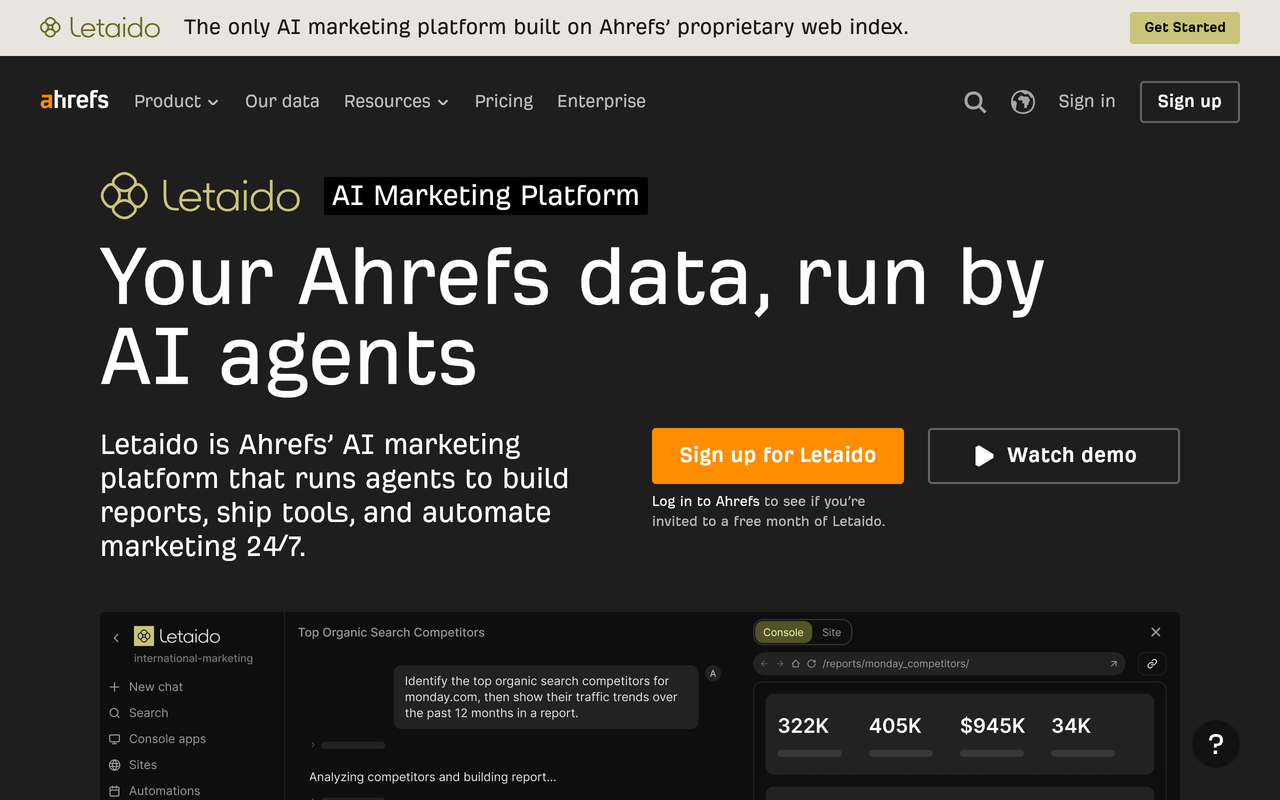
| Ahrefs, SaaS agent page | A vendor page for its own agent: programmatic pages, battlecards, lifecycle email, positioning research, with full access to Ahrefs data. | No buyer scorecard, no approval model, no discussion of tasks an agent should not do. |
| Chatbase, September 2026 | Nine agents grouped by use case, plus sound advice on finishing the job, context, autonomy and billing units. | Aimed at support and operations rather than marketing. No measurement plan and no AI search visibility. |
| The AI Agent Index | A directory of marketing agents across content, email, social, visuals and paid media, with cost ranges and selection factors. | No worked cost example, no pilot design, no ownership split between agent and human. |
This guide adds a weighted scorecard, a decision table for what to automate, a worked cost-per-outcome example, a pilot checklist, and a section on the AI search visibility job that none of those pages treats.
What is an AI marketing agent, and how is it different from an AI tool?
An AI marketing agent is software that pursues a marketing goal across several steps, using tools and data you connect to it, and in some cases takes actions without being asked each time. An AI marketing tool, by contrast, produces one output when you prompt it: a draft, an image, a summary.
The useful test is whether the product can act in another system. Drafting an email is a tool behaviour. Reading your CRM, picking a segment, writing the email, scheduling it and reporting on results is an agent behaviour. The second is more valuable and carries more risk, which is why the evaluation below spends so long on access and approvals.
As Chatbase's guide puts it, many products called agents are good at generating text but still depend on another system or person to finish the work. That matches what buyers should check in a demo: ask the vendor to show the action completing, not the text describing it.
How do I choose an AI marketing agent for a SaaS company? A four-axis scorecard
Use the scorecard below. Score each candidate from 0 to 3 on every row, multiply by the weight, and compare totals. The weights are a starting point I suggest for a SaaS marketing team; change them to match your risk tolerance.
| Axis | Question to ask | 0 (fail) | 3 (strong) | Suggested weight |
|---|---|---|---|---|
| Data access: read | Which sources can it read, and at what scope? | Generic web browsing only | Native, scoped connections to your CRM, analytics, ad accounts and search data | x3 |
| Data access: write | What can it change? | Can change anything with one shared login | Per-action permissions, read-only by default | x3 |
| Approvals | Which steps pause for a person? | None, or all-or-nothing | Configurable per action type, with an audit log | x3 |
| Measurement | How do I know it worked? | Activity counts only (posts made, emails sent) | Ties output to pipeline, signups or citations, with a baseline | x2 |
| Cost | What is the billing unit and my expected volume? | Unclear units or usage caps that are hidden | Published unit, spend cap and a per-outcome estimate | x2 |
| Workflow fit | Does it finish a job end to end? | Hands off to another tool for the last step | Completes and confirms the result | x1 |
Maximum score is 42. A candidate that scores 0 on any of the three x3 rows should be a no regardless of total, because those are the rows that cause incidents rather than disappointments.
Axis 1: What data can the agent access?
Ask for two lists: what it reads and what it writes. Chatbase's guidance separates context from integrations and notes that an integration logo does not tell you how much useful context the agent receives. Take that further for marketing: an agent that reads your analytics but not your CRM can report on traffic and cannot tell you whether the traffic became pipeline.
Check how the connection is granted. Read-only OAuth for ad accounts is a very different risk from an agent holding an admin login. Ask where your data is stored, whether it is used to train models, and how you revoke access. Ask whether the agent can see customer personal data and whether you can exclude fields.
Data quality matters as much as access. If your lifecycle stages in the CRM are inconsistent, an agent that reports on funnel conversion will confidently report nonsense. Fix definitions first; agents amplify what is already there.
Axis 2: Which actions need approval?
Approval design is the most under-asked question in vendor demos. OpenAI's Agents SDK documentation on guardrails and human review draws a useful line: guardrails validate inputs, outputs or tool calls automatically, while human review pauses a run so a person or policy can approve or reject a sensitive action. It lists pausing before side effects, such as cancellations and edits, as the case for human-in-the-loop approvals.
You can borrow that structure for marketing even if the vendor uses a different stack. Sort every action the agent could take into three tiers:
- Auto: reversible, internal and low cost. Examples: pulling a report, tagging records, drafting a brief.
- Approve: visible to customers or touching money. Examples: publishing a page, sending an email, changing a bid, editing a pricing-page claim.
- Never: irreversible or reputationally sensitive. Examples: deleting data, changing budgets above a set limit, replying publicly to a customer complaint.
A good vendor will let you set these tiers per action and will log who approved what. A weak one offers a single "autonomous mode" switch.
Axis 3: How will you measure it?
Agree the measure before the pilot. "Hours saved" is the vendor's favourite metric and the least convincing one on its own. Pick one output measure (for instance, pages published and indexed), one quality measure (edits per draft, factual errors found) and one business measure (demo requests, trial signups or citations in AI answers) with a baseline from the previous 8 to 12 weeks.
For paid work, see how to read performance without an analyst in Meta Ads vs Google Ads: how to read performance and why dashboard numbers can mislead in Why Meta ROAS looks great but your bank account disagrees. For a cross-channel view, the marketing measurement framework shows how to keep one system of record.
Axis 4: What does it really cost?
Chatbase warns that vendors charge for different units: messages, resolutions, completed actions or workflow executions. Compare the unit first, then price your own volume. The AI Agent Index publishes cost ranges for marketing agents, but your workload decides what you pay.
Include the costs that never appear on the pricing page: the person who reviews outputs, integration setup, extra seats, and the cost of a bad action caught late. Ahrefs, for example, describes its agent as built on Ahrefs data with no extra API cost for that data, which is the kind of specific cost statement you should ask every vendor to make about their own data.
What should AI marketing agents automate, and what should humans own?
Agents should own work that is high volume, rule-bound and reversible; humans should own work that sets direction, makes promises or spends meaningful money. McKinsey's marketing article says brands will need top-down leadership and strong governance to scale adoption while limiting brand and legal issues, which is the same split seen from the executive side.
| Marketing job | Agent role | Human role | Why |
|---|---|---|---|
| Reporting and anomaly alerts | Own | Review weekly | Rule-based, reversible, high volume |
| Keyword and competitor research | Own the first pass | Choose priorities | Agents gather quickly; priority needs market judgement |
| Draft content and briefs | Draft | Edit and approve | Accuracy and voice need a person; see Google's guidance below |
| Content refresh and internal links | Propose changes | Approve publish | Changes are public and hard to track after the fact |
| Lifecycle email variants | Draft and test | Approve sends | Customer-facing, brand risk |
| AI search visibility monitoring | Own | Act on findings | Polling and comparison is repetitive; fixes need product knowledge |
| Ad budget changes | Recommend | Own | Direct spend; set limits first |
| Positioning and messaging | Support research | Own | Defines what the company stands for |
| Pricing and packaging claims | None | Own | Legal and revenue exposure |
| Customer replies in public or on reviews | Flag | Own | Reputation, nuance |
This table is a starting point, not a rule. A mature team with strong review processes can move rows towards the agent; a small team with no editor should move them back.
What does Google say about AI-generated content?
Google Search's guidance on generative AI content says that if you use generative AI content, your work must meet Search Essentials and spam policies, and that outputs can contain inaccuracies. It also suggests explaining how automation was used when content is automatically generated. That is a direct argument for keeping an editor in the loop on anything an agent publishes.
How do you evaluate an agent step by step?
Follow these steps in order. Each ends with something you can show a colleague.
- Pick one workflow. Action: choose a job with meaningful volume, clear success criteria and reliable data, such as weekly search-performance reporting or competitor monitoring. Result: a one-line scope. Why: Chatbase's advice is to start with the workflow, not the vendor, and narrow scope makes failures visible.
- Write the access list. Action: list every system the agent must read and write, and the minimum permission for each. Result: a permission sheet you can hand to IT or security. Why: access is the largest source of avoidable risk, and vendors often ask for more than they need.
- Assign approval tiers. Action: sort each action into auto, approve or never. Result: a tier table you can configure or test. Why: it forces the human-ownership question before the tool is live.
- Set the baseline. Action: record the last 8 to 12 weeks of your chosen output, quality and business measures. Result: a before number. Why: without it, any improvement is a story rather than evidence.
- Run a two-vendor pilot. Action: give two candidates the same workflow, data and review time for 30 days. Result: side-by-side outputs scored with the scorecard. Why: a single trial cannot tell you whether the agent is good or the task is easy.
- Audit errors, not just wins. Action: log every wrong, off-brand or unapproved output. Result: an error rate per 100 outputs. Why: Gartner's cancellation reasons include inadequate risk controls, which surface as errors.
- Price per outcome. Action: divide all-in monthly cost by accepted outputs or business results. Result: a comparable cost per outcome. Why: it converts different billing units into one number.
- Decide, then widen scope slowly. Action: keep, replace or stop; if keeping, add one workflow at a time. Result: a go or no-go memo. Why: scope creep without measurement is how projects end up on the cancelled list.
What does a worked cost example look like?
The numbers below are assumptions to show the arithmetic, not market data. Replace them with your own.
Suppose a pilot runs for 30 days. Agent A costs $400 in total for the month and produces 40 outputs that a reviewer accepts after edits, with a reviewer spending 6 hours at a loaded cost of $60 an hour. Agent B costs $250 and produces 25 accepted outputs, with 10 reviewer hours at the same rate.
| Line | Agent A | Agent B |
|---|---|---|
| Subscription and usage | $400 | $250 |
| Review time (hours x $60) | $360 (6 h) | $600 (10 h) |
| All-in cost | $760 | $850 |
| Accepted outputs | 40 | 25 |
| Cost per accepted output | $19.00 | $34.00 |
Agent B looks cheaper on the pricing page and costs about 79% more per accepted output once review time is counted. That is the point of pricing per outcome: the cheaper subscription can be the more expensive agent.
What are the most common mistakes when buying AI marketing agents?
- Buying on the demo. Demos use clean data and chosen prompts. Ask to run your own task on your own data.
- Granting write access on day one. Start read-only and add write permissions per action.
- Counting activity as results. Fifty posts published is not fifty posts that rank, convert or get cited.
- Letting the agent publish unreviewed content at scale. Google's generative-AI content guidance still applies spam policies to automated output.
- Ignoring the review cost. If review time grows faster than output, the agent is moving work rather than removing it.
- Treating AI search as one engine. Semrush found that only 25% of cited sources overlap between ChatGPT's different reasoning modes, per its ChatGPT reasoning study, October 2026. A single manual spot check misses most of the picture.
- Automating before defining. If your ideal customer profile and messaging are unsettled, an agent produces more of the wrong thing, faster.
How do you get an agent to improve AI search visibility for a SaaS brand?
Start by measuring, because the evidence says citations behave in ways that are hard to guess. The Semrush ghost citations study, October 2026 analysed 3,981 domain appearances across ChatGPT, Gemini, Google AI Overviews and Google AI Mode, and reported that 62% of AI citations do not lead to brand mentions. For ChatGPT it reported an 87% citation rate and a 20.7% mention rate. A source can be cited and your brand still not be named.
For a SaaS marketing lead, that changes what to track. Rankings and traffic do not show whether an AI assistant names your product when a buyer asks for the best tool in your category. You need regular polling of category prompts, across engines, with competitors alongside.
Google's own guide to generative AI features says content must be crawlable and points site owners to the Generative AI performance report in Search Console. That covers Google, though not ChatGPT, Perplexity or Claude, which is why teams add a cross-engine monitor. Semrush's SaaS AI search playbook also starts with auditing current citations and tracking share of voice against competitors, which is the same measure-first sequence.
Noma by Nurdd is a web dashboard that tracks whether a brand appears in answers from 13 AI engines, including ChatGPT, Gemini, Perplexity and Claude, polled daily. It shows citation frequency by category, a competitor comparison and recommendations for improving AI visibility. For a SaaS team, Noma covers the monitoring job an agent would otherwise have to do by hand, so you can see whether a content change moved anything.
Book a demo at https://www.nurdd.club/demo and you will see your own brand's visibility across AI engines, how competitors appear for the same category questions, and which recommendations Noma would prioritise first.

Where does an AI search agent help, and where should a human step in?
| Step | Agent or tool | Human |
|---|---|---|
| Choose category prompts | Suggest from your keywords | Approve the list; see which prompts to track |
| Poll engines daily | Own (Noma) | None |
| Spot visibility drops and competitor gains | Flag | Investigate cause |
| Rewrite pages for clear answers | Draft | Edit for accuracy; see how to write content AI engines quote |
| Publish and claim product facts | None | Own |
| Review results monthly | Summarise | Decide next quarter's focus |
Noma is a monitoring and recommendation product, not an autonomous publisher. That is deliberate in this guide's framework: tracking is a job an agent can own, while changing what your site says about your product stays in the approve tier.
Which AI search checks can you run this week?
This is a checklist you can follow without any paid tool, then repeat with one.
- List 15 questions a buyer would ask about your category, such as "best tools for [job]" and "[your product] alternatives".
- Run each in ChatGPT, Gemini, Perplexity and Claude, in a fresh session, and record whether your brand is named, cited as a source, or absent.
- Note which competitors are named and which sources are cited.
- Check that your pricing, integrations and category description are stated plainly on a crawlable page; the guide on brand descriptions AI engines can read shows how.
- Repeat weekly for four weeks and compare, as in the weekly ChatGPT tracking experiment.
- Move the same prompts into a daily monitor once the manual process becomes tedious.
For the deeper method, read how to measure AI search share of voice, why your brand isn't showing up in ChatGPT answers and the broader comparison of AI search visibility tools. If you are weighing Noma against specific vendors, see Noma vs Profound and Noma vs Semrush.
How does Noma fit alongside other AI marketing agents?
Treat your stack as three layers. Execution agents draft content, build pages or run lifecycle flows. Measurement tools show whether the output changed pipeline. Visibility monitoring shows whether AI engines recommend you. Most SaaS teams shop for the first and forget the third.
Noma by Nurdd sits in the third layer. It does not try to be your content agent or your CRM, and it can sit beside agents from an SEO platform, a CRM vendor or an automation tool. The question it answers is simple: after your agents ship work, do AI engines mention your brand more, less or the same, compared with the competitors you care about?
Noma has a 3-day free trial. A card is taken at signup and billing starts on day 3; if you cancel before then, you are not charged. That is long enough to load a set of category prompts and see a first read of your visibility.
Two sister products cover adjacent jobs, kept separate on purpose. Pulse by Nurdd reads Meta Ads and Google Ads performance and is in private access, so you book a walkthrough rather than start a trial. Nia by Nurdd is an AI-native creative studio with influencer marketing built in, relevant if your SaaS brand works with creators.
Which questions should you put to every vendor?
Use this list on a vendor call. A confident vendor answers each in a sentence; a vague one reveals itself quickly.
- Show me the full list of actions this agent can take in my systems.
- Can I make permissions read-only by default and add write access per action?
- Where is the approval step, who sees it, and is there an audit log?
- What happens when the agent is wrong, and how do I roll back?
- What is the billing unit, and what would my expected volume cost?
- How do you measure success, and can it tie to signups, pipeline or citations?
- Is my data used to train models, and how do I export or delete it?
- Which of your claims can I test in a 30-day pilot?
The Gartner estimate that only about 130 of the thousands of agentic vendors are real is a reason to ask question 8 seriously. If the answer is "only after an annual contract", treat that as information.
How we researched this
I reviewed public sources only: vendor pages for marketing agents, a buyer guide and a directory that currently rank for the keyword, analyst and consulting publications from Gartner and McKinsey, documentation from OpenAI and Google, and published studies from Semrush. Each was opened and checked in October 2026, and numbers are quoted as the sources state them. Where a page did not show a clear publication date, the month shown in the link is when I checked it.
I did not run hands-on tests of the third-party agents named here, and the cost example and scorecard weights are illustrative assumptions, not measured data. Facts about Noma, Pulse and Nia come from Nurdd's own product information.
Ready to see your AI search visibility?
The agents you choose will change how much your team ships. Noma shows whether that work is changing what ChatGPT, Gemini, Perplexity and Claude say about your brand. Book a demo and Nurdd will show you your own brand's results across 13 AI engines, your competitors in the same answers, and the first recommendations to act on.
Selling to developers? See how Nurdd works with developer tool companies, including getting recommended in AI answers.
Frequently asked questions
How do I choose an AI marketing agent for a SaaS company?
Pick one workflow, then score candidates on data access, approvals, measurement and cost. Run two vendors on the same task for 30 days and compare cost per accepted output. Reject any agent that cannot show what it can write to, or that has no approval step for customer-facing actions.
What should AI marketing agents automate and what should humans own?
Agents suit reporting, research first passes, monitoring, drafting and variant testing. Humans should own positioning, pricing claims, budget decisions, public customer replies and final approval of anything published. A useful rule is that anything irreversible, costly or promise-making stays human.
Are AI marketing agents worth it for a small SaaS team?
They can be, if you start narrow. A small team benefits most from agents that remove repetitive reporting and monitoring. The risk is review time: with no editor, unchecked output can harm quality. Gartner's warning about unclear value and costs applies to small teams too.
What is the difference between an AI marketing agent and an AI marketing tool?
A tool produces an output when prompted, such as a draft. An agent works through multiple steps and can act in connected systems, sometimes without a prompt each time. The extra capability is why agents need permissions, approvals and audit logs that tools do not.
Can an AI marketing agent track my brand in ChatGPT and Perplexity?
A general agent can run prompts, but daily, repeatable tracking across engines is a specific job. Noma by Nurdd tracks 13 AI engines, including ChatGPT, Gemini, Perplexity and Claude, polled daily, with citation frequency by category and competitor comparison.
How much do AI marketing agents cost?
Costs vary by billing unit: seats, credits, actions, resolutions or outcomes. Price your own monthly volume, add reviewer time and setup, and divide by accepted outputs. Directories such as The AI Agent Index publish ranges, but your workload decides the real figure.
Is Noma free?
Noma has a 3-day free trial. A card is taken at signup and billing starts on day 3, so you are not charged if you cancel before then.
Do I need human approval for every agent action?
No. Low-risk, reversible internal actions such as pulling reports can run automatically. Require approval for anything public, anything involving money and anything hard to undo. Review the tiers quarterly as the agent earns trust.