Brand & Content Strategy
AI Agents for Marketing: What They Do and Where to Start
AI agents for marketing already handle monitoring, drafting and diagnosis well; approvals, spend and brand judgement still need people.
 Simran Rawat31 Oct 202616 min read

AI agents for marketing are software systems that take a goal, gather data, decide on steps and complete tasks such as monitoring, drafting and diagnosing, with people approving the outcomes. Today they are strongest at watching AI search visibility, producing creative drafts and explaining ad performance. Humans should still approve spend, claims, brand voice and anything customer-facing.
AI agents for marketing are software systems that pursue a goal on their own: they pull data, reason about what it means, pick next steps and carry out tasks such as monitoring, drafting or diagnosing, while a person stays responsible for the result. In practice, today's agents are most reliable at watching, drafting and explaining, and least reliable at deciding what a brand should say or spend.
This guide maps the work to three areas where agents are useful right now: search visibility, creative production and paid ad analysis. It also says plainly where human review is still needed, and how Noma, Nia by Nurdd and Pulse fit as three separate products, not one interface.
Key takeaways
- Start with tasks that are repetitive, data-heavy and reversible: monitoring, reporting, first drafts and diagnosis.
- Keep a person on anything that spends money, makes a claim about your product or speaks to customers in your brand voice.
- Sort each task into three levels: observe, draft, act. Give agents more freedom at observe, less at act.
- Fix your data and definitions first. Salesforce, 2026 reports that teams with unified data were 60% more likely to use AI agents to scale their efforts.
- Pilot one agent on one workflow for a month, with a written pass mark, before adding a second.
- Include AI search in the plan: customers now ask assistants for recommendations, so being named in those answers is a measurable job for an agent.
What are AI agents for marketing?
An AI agent for marketing is a system that works toward a marketing goal with some autonomy. Unlike a chatbot that answers one prompt at a time, an agent connects to data sources, breaks a goal into steps, uses tools and reports back. Salesforce describes marketing agents as assistants that use data to build and execute plans, reasoning through next steps for tasks such as generating content, optimising campaigns and analysing results.
Three traits separate an agent from ordinary marketing automation:
- Goal-driven: you state an outcome (for example, find out why cost per result rose) rather than a fixed rule.
- Tool-using: it reads dashboards, queries platforms or generates assets without a person copying data between tabs.
- Accountable to a human: it reports what it did and why, so someone can approve, correct or reverse it.
Many products use the word agent loosely. A scheduled report is not an agent. A model that drafts one caption is a generator. The useful test is whether the system gathers its own inputs, chooses among steps and explains its reasoning in a way you can audit.
Why are marketers turning to AI agents now?
Two pressures meet. First, teams carry more channels and more data than a person can read. Second, discovery itself is shifting toward AI answers. Salesforce, 2026 reports that 75% of marketers have adopted AI, yet 84% admit to running generic campaigns, from a survey of nearly 4,500 marketers. Adoption is high; good use is not.
On the investment side, BCG, 2026 surveyed 300 chief marketing officers and found that 43% invested more than $15 million this year, with nearly half of CMOs leading marketing AI investment. BCG also reports that leaders redesign connected workflows that combine AI agents with human oversight rather than removing people.
Analysts expect the shift to continue. Gartner, January 2026 predicts that by 2028, 60% of brands will use agentic AI to facilitate streamlined one-to-one interactions. IBM, 2025 cites a Gartner forecast that at least 15% of day-to-day work decisions will be made autonomously through agentic AI by 2028, up from 0% in 2024. Forecasts are not results, but they explain why budgets are moving.
What do the top guides on AI marketing agents cover, and what is missing?
Before writing this guide, the three highest-ranking non-Nurdd articles for this keyword were read: IBM's topic page, Salesforce's agents page and a Botpress guide. Each is useful, and each leaves gaps that matter to a team deciding where to begin.
| Source | What it covers | What it leaves out |
|---|---|---|
| IBM, 2025 | Definition, conversational engagement, hyperpersonalization, ad execution, strategic insight, workflow orchestration, governance risks | No task-by-task split of what to automate versus review; nothing on AI search visibility |
| Salesforce | Human and agent collaboration, briefs, content, audiences, journeys, testing, FAQs | Written around one vendor's suite; no honest limits, no search visibility or ad diagnosis workflow |
| Botpress | Use cases, cost tiers, implementation steps, platform list, centred on sales conversations | Little on creative, ad analysis or review points; leads to its own platform |
This guide adds two things none of them has: a three-level autonomy framework (observe, draft, act) with a review rule for each task, and a worked example of an AI search monitoring workflow with the arithmetic shown. It also treats AI search visibility as a first-class agent job, which the three sources do not.
Which marketing tasks can AI agents handle today?
The fair answer depends on how much damage a wrong output can do and how easily it can be reversed. Monitoring and drafting are low-risk and reversible. Changing budgets or publishing claims is not. The framework below sorts tasks by that logic.
A three-level autonomy framework: observe, draft, act
- Observe: the agent collects, compares and flags. Nothing leaves the building. Safe to run daily with light review.
- Draft: the agent produces something a person will edit: a creative concept, a report summary, a recommended fix. Review every output before use.
- Act: the agent changes something live: budgets, bids, published content, outreach. Require explicit approval, a log and an easy way to undo.
| Marketing task | Level | Agent handles well | Human review needed |
|---|---|---|---|
| Tracking brand mentions in AI answers | Observe | Repeating the same prompts daily, logging which brands are named, comparing competitors | Choosing which prompts matter; judging whether a mention is accurate and favourable |
| Recommending fixes for AI visibility | Draft | Spotting gaps against competitors, suggesting pages and topics | Deciding what is true and publishable about your product |
| Creating product and UGC ad concepts | Draft | Producing variants from a product link or an idea | Brand voice, product claims, legal and platform rules |
| Influencer discovery and vetting | Observe and draft | Screening large creator lists, flagging suspicious audiences, forecasting returns | Fit, relationship, contract terms, content approval |
| Explaining ad performance changes | Observe and draft | Reading Meta and Google data, finding what changed, writing it in plain language | Whether the cause is real; judging trade-offs with business context |
| Changing budgets or bids | Act | Proposing changes with reasons | Approval before anything spends money |
| Customer-facing replies and outreach | Act | Drafting on-brand responses | Review of tone, promises and compliance |
The pattern is simple: the closer a task is to money or reputation, the more review it needs. That matches what practitioners report. Digiday, 2026 notes that marketers struggle to decide how much control to hand to machines and say they need a manual kill switch to account for issues such as hallucination.
How can AI agents help with AI search visibility?
AI search visibility is the cleanest first use case because it sits entirely at the observe level. Customers ask ChatGPT, Gemini, Perplexity and Claude which brand to buy, and the answers change daily. A person cannot ask hundreds of questions across many engines every morning. An agent can. Salesforce, 2026 states that half of all Google searches now feature AI summaries that bypass brand websites, and that customers increasingly consult large language models for purchase decisions.
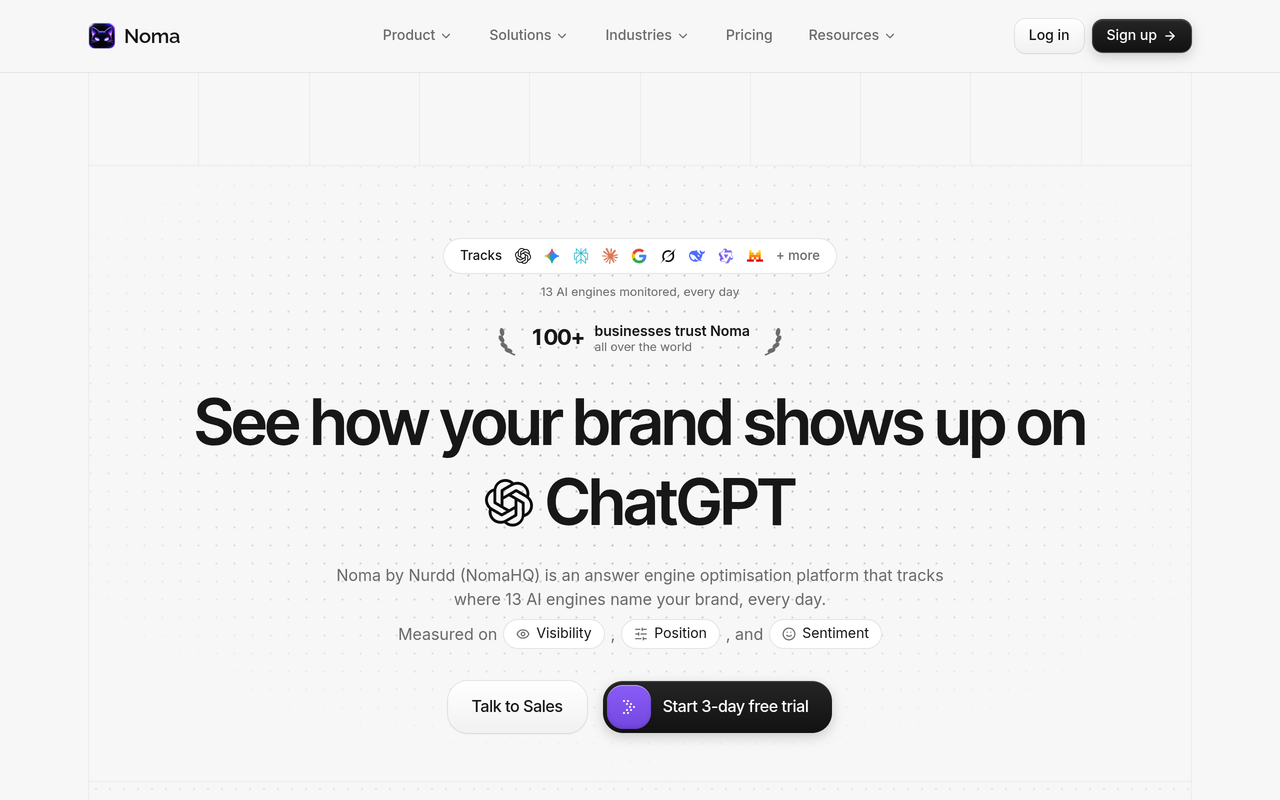
Noma by Nurdd is a web dashboard that tracks whether a brand appears in answers from 13 AI engines, including ChatGPT, Gemini, Perplexity and Claude, polled daily. It shows citation frequency by category, a competitor comparison and actionable recommendations for generative engine optimisation (GEO). For background on the discipline, see the complete guide to GEO.
What the agent does and what you still do
- Agent: polls the engines daily, records whether your brand is named, compares you with competitors and lists recommended changes.
- You: choose the prompts that reflect real buying questions (see which prompts to track), check that the answers about you are accurate, and decide which recommendations to publish.
Worked example: sizing a daily monitoring job
This example uses simple arithmetic, not a customer result. Suppose a skincare brand chooses 20 buying-intent prompts such as which sunscreen suits sensitive skin. Across 13 engines, that is 20 × 13 = 260 answers to read each day, or 1,820 a week. Reading them by hand is not realistic; reading a summary of share of mentions and the three biggest competitor gaps is.
The brand's weekly routine becomes: review the visibility trend on Monday, open the three prompts where a competitor is named and you are not, check why the competitor's pages are cited, then assign one content fix. The agent produced the evidence; the marketer made the decisions. For a metric to track over time, see AI search share of voice and tracking your visibility score week over week.
Noma offers a 3-day free trial. A card is taken at signup and billing starts on day 3; cancel before then and you are not charged. You can also run the free GEO readiness scorecard first to see how ready your pages are.
How can AI agents help with creative production and influencer work?
Creative is a draft-level job. An agent can turn a product link or an idea into a first cut far faster than a production crew, but a human decides whether it is on brand and truthful. The value is volume of testable options, not unreviewed publishing.
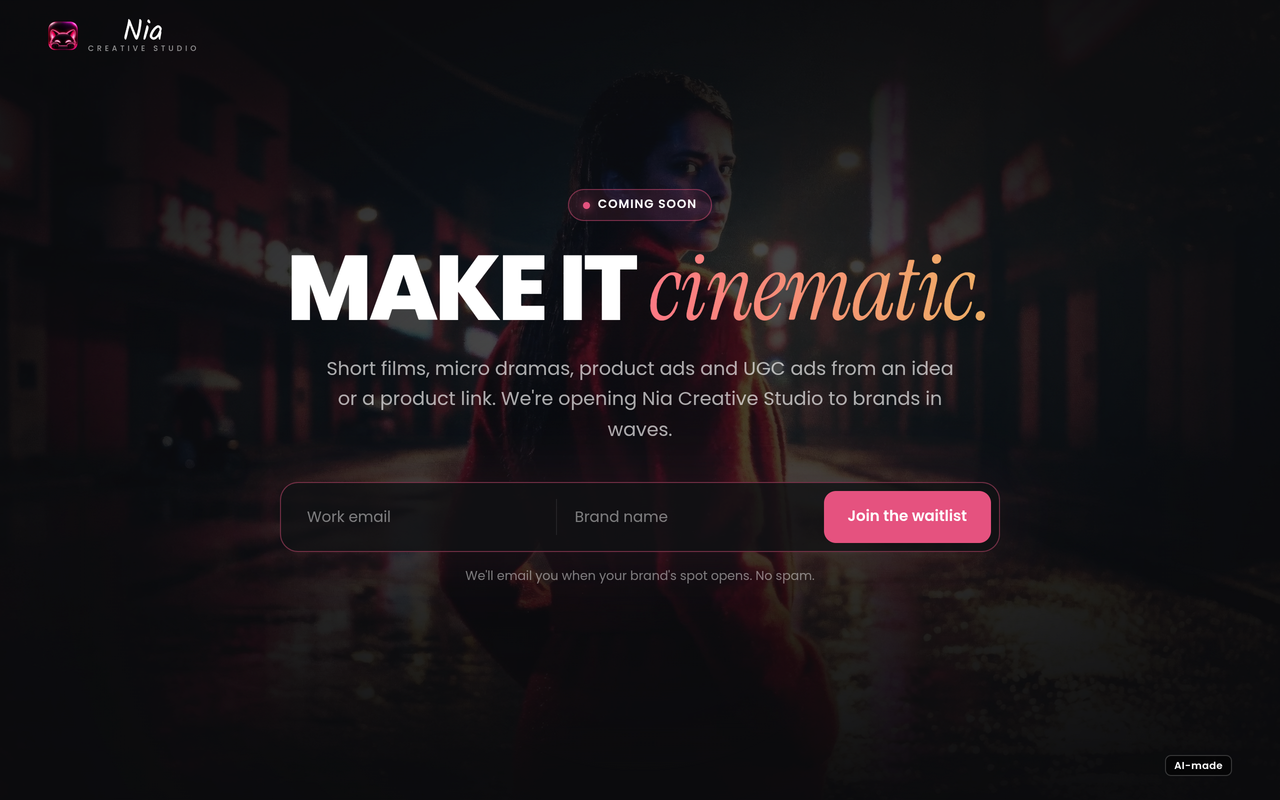
Nia by Nurdd is an AI-native creative studio at getnia.studio, also on iOS and Android (search Nurdd on either store). Brands, marketers and filmmakers use it to make short films, micro dramas and commercials from an idea, and product and UGC ads from a link, casting real creators and AI creators in the same production. It is priced below comparable plans.
Influencer marketing is built into Nia. It discovers creators from a database of 10M+ profiles across Instagram and other platforms, filters by niche, audience quality, engagement authenticity and brand match score, and detects fake followers with TruAI, Nurdd's proprietary detection technology. It also generates pre-spend ROI forecasts and attributes product-level sales to specific creators after campaigns close.
Where humans stay in the loop on creative
- Approving every product claim, ingredient statement and price in an ad.
- Checking that an AI-cast creator and a real creator are disclosed as your platform rules require.
- Choosing which creators to contact and negotiating the deal.
- Reading the forecast as an estimate, then comparing it with results after the campaign.
To see what a creator audience is worth before you pay, try the fake follower checker and the influencer ROI calculator. The reasoning behind forecasts is covered in how to pick influencers based on predicted sales.

How can AI agents help with ad analysis?
Ad analysis mixes observe and draft work: read the account, find what changed, explain it, suggest a fix. It is where marketers lose the most time to dashboards. Google itself is moving this way. Adweek, 2025 reports that Google's Ads Advisor can make suggestions and, with advertiser consent, implement changes directly in accounts, and that the agents began rolling out to all English-language Google Ads and Analytics customers.
Notice the phrase with advertiser consent. That is the act level, and it is why review matters. Digiday, in the piece cited above, also says Google's agentic tools raise transparency concerns echoing the Performance Max black box.
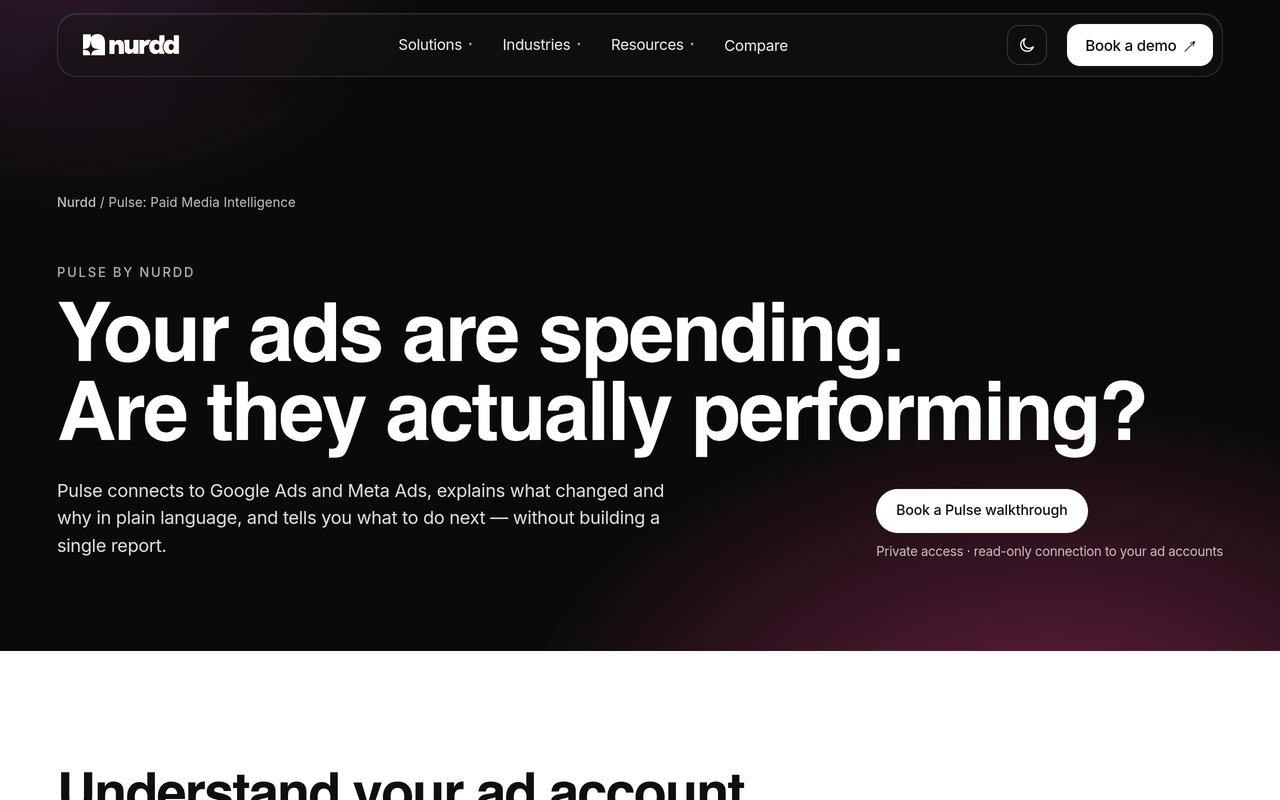
Pulse by Nurdd is a web dashboard that connects to Meta Ads and Google Ads through read-only OAuth. It explains campaign performance in plain language, diagnoses what changed and recommends specific actions without the user building reports. Because the connection is read-only, Pulse stays at the observe and draft levels: it cannot change your budgets. Pulse is paid and has no trial; it is in private access, so you can book a walkthrough at the demo page.
If you read your own accounts today, these guides explain the common traps: why Meta cost per result jumped, why dashboard ROAS can mislead and how to audit a Meta account in 30 minutes. The Google and Meta ROAS calculator checks results against break-even.
Which Nurdd product fits which job?
Nurdd is the parent company of three separate products, each with its own site and login. They solve different problems and you can use one without the others.
| Job | Product | Level | Where | Access |
|---|---|---|---|---|
| Know whether AI assistants recommend your brand | Noma | Observe, draft recommendations | nomahq.app | 3-day free trial; card taken at signup; billing starts on day 3 |
| Make films, ads and run influencer campaigns | Nia by Nurdd | Draft, with human approval | getnia.studio, iOS, Android | Priced below comparable plans |
| Understand Meta and Google Ads performance | Pulse | Observe, draft recommendations | nurdd.club/pulse | Paid, no trial, private access |
Noma by Nurdd belongs in this guide because AI search visibility is the marketing job that agents suit best and people suit worst: the same questions must be asked every day across 13 AI engines, including ChatGPT, Gemini, Perplexity and Claude. Noma runs that monitoring, compares your brand with competitors and lists what to change, leaving you to decide what is accurate and worth publishing.
Want to see this for your own brand? Book a demo and we will show how your brand appears across AI engines for your category questions, where competitors are named instead, and what to fix first.
How do you start with AI agents for marketing? A step-by-step checklist
- Pick one workflow, not a platform. Action: choose a task that is repetitive and reversible, such as weekly AI visibility checks or a Monday ad review. Result: a pilot small enough to judge. Why: broad rollouts hide which part worked.
- Write down the outcome and the pass mark. Action: state the question the agent should answer and what good looks like, for example named in answers for at least half the tracked prompts. Result: a test you can fail. Why: without a mark, every pilot looks fine.
- Fix inputs and definitions. Action: agree on your prompts, product names, conversion events and competitors. Result: consistent data. Why: Salesforce, 2026 links unified data with greater use of agents, and agents inherit your mess.
- Assign each task to observe, draft or act. Action: use the table above. Result: a review rule per task. Why: it stops autonomy creeping past what the team has approved.
- Name a human owner. Action: one person reviews outputs and signs off changes. Result: accountability. Why: IBM, 2025 lists human oversight among the safeguards organisations should adopt for agentic systems.
- Run for four weeks and log corrections. Action: note every time a person overrode the agent and why. Result: a real error rate for your use case. Why: this is your evidence for expanding or stopping.
- Expand one step at a time. Action: add a second workflow or raise autonomy on one task. Result: controlled growth. Why: you learn which risks appear at each level.
What are the common mistakes with marketing AI agents?
- Automating before defining. If nobody agreed what counts as a good result, an agent speeds up confusion.
- Giving write access too early. Start read-only, as Pulse does with Meta and Google Ads, and add approvals before any live change.
- Treating generic output as finished. Salesforce, 2026 reports that 84% of marketers run generic campaigns despite widespread AI adoption. Speed is not quality.
- Ignoring AI search. If customers ask assistants for recommendations and you never check the answers, you cannot see a growing part of discovery. See why your brand may not show up in ChatGPT answers.
- Buying a vendor build you cannot run. Gartner, September 2026 predicts that by 2028, 70% of enterprises will abandon agentic AI built by vendor forward-deployed engineering, citing soaring costs and inability to evolve it themselves. Check who owns and can change the system.
- Measuring only activity. Counting outputs says nothing about outcomes. Use one measurement framework across influencers, paid ads and AI search.
Where is human review still needed?
Human review is needed wherever a wrong answer costs money, trust or compliance. Agents can be wrong with confidence, and they do not carry accountability. As Gartner's Emily Weiss stated in the January 2026 release, marketers must put strong data governance in place and integrate agentic systems into their martech stacks for secure, ethical personalisation.
A practical review rule: the higher a task sits on the observe, draft, act scale, the more checks it needs.
- Always review before publishing: product claims, health or financial statements, pricing, comparisons and anything that names a competitor.
- Always approve before spending: new budgets, bid strategies, creator payments.
- Spot-check regularly: AI visibility readings and diagnoses. Re-run a few prompts by hand each week to confirm the dashboard matches what a customer would see.
- Audit periodically: fake follower flags and forecasts against actual outcomes once campaigns close.
For content that AI engines are likely to quote correctly, write plainly and specifically; the sentence structure that gets cited and a step-by-step AEO audit help.
Examples by team role
Head of growth at a D2C brand
Uses Noma to see which category prompts name competitors, Pulse to read Meta and Google performance and Nia to produce ad variants. Reviews all three weekly and approves all spend personally. See the ecommerce industry page for context.
Influencer marketing manager
Uses Nia to screen creators by audience quality, check for fake followers with TruAI and forecast returns before briefing. Keeps negotiation and content approval in human hands. The influencer rate card estimator helps set expectations.
Agency account lead
Uses an agent to prepare a client's weekly AI visibility summary and ad diagnosis, then adds judgement and recommendations. The agencies page covers this work.
How we researched this
We reviewed published vendor guides (IBM, Salesforce, Botpress), analyst and consultancy research (Gartner, BCG), trade press (Digiday, Adweek) and Nurdd's own product information. Sources and figures were checked on the publication date of this article. We did not run hands-on tests of rival tools, and we have no customer data or results to report; the worked example is arithmetic, not a measured outcome.
Frequently asked questions
What are AI agents for marketing?
They are software systems that work toward a marketing goal by gathering data, choosing steps and completing tasks such as monitoring, drafting and diagnosing. A person stays accountable for the result. They differ from simple automation because they reason about what to do next rather than following one fixed rule.
How can marketing teams use AI agents?
Start with observe and draft tasks: tracking brand mentions in AI answers, producing first-draft ad concepts, screening creators and explaining ad performance changes. Keep approval with a person for spend, claims and customer-facing messages. Pilot one workflow for about a month before expanding.
Are AI agents the same as marketing automation?
No. Automation runs fixed rules, such as sending an email when a form is filled. An agent is given a goal, works out the steps and may use several tools. Many products blur the two, so check whether the system chooses its own steps and explains them.
Will AI agents replace marketers?
Current evidence points to redesigned workflows, not removal. BCG, 2026 reports that leaders combine AI agents with human oversight across campaign development and optimisation. Judgement, brand voice and accountability remain with people.
Which AI agent should a brand try first?
Choose the lowest-risk, highest-repetition job. For many brands that is AI search visibility monitoring, because it only observes and reports. Noma by Nurdd tracks 13 AI engines, including ChatGPT, Gemini, Perplexity and Claude, and has a 3-day free trial with a card taken at signup.
Are Noma, Nia and Pulse one platform?
No. Noma tracks AI search visibility, Nia by Nurdd is a creative studio with influencer marketing built in and Pulse explains Meta and Google Ads performance. Each has its own site and access terms. You can use any one without the others.
Can an AI agent change my ad budget by itself?
Some platforms can, with consent. Adweek, 2025 reports that Google's Ads Advisor can implement changes in accounts with advertiser consent. Pulse is read-only: it connects to Meta and Google Ads through read-only OAuth and recommends actions for you to apply.
What data do AI agents need to work well?
Clean, connected data and clear definitions. Salesforce, 2026 reports that teams satisfied with their unified data were 60% more likely to use AI agents to help scale their efforts. Agree on conversion events, product names, competitors and prompts before starting.
Start with one agent and one workflow
AI agents for marketing pay off first where work is repetitive, data-heavy and reversible, and they need human review where money, claims or reputation are involved. Begin with one workflow, set a pass mark and keep a named owner.
If AI search visibility is your first job, book a demo and we will show how your brand appears across 13 AI engines for your own category questions, which competitors are named instead, and the first fixes to make. You can also browse Nurdd's free tools or read the comparison of AI search visibility tools.