Attribution & Measurement
Influencer Performance Attribution: Track Sales by Creator
Connect creator links, codes and post-purchase surveys to real sales, then rank each creator with an evidence ladder instead of guesswork.
 Simran Rawat30 Oct 202616 min read

Influencer performance attribution ties each sale to the creator who influenced it. Give every creator a unique link and code, add a post-purchase survey that names creators, and review results against a fixed window and a holdout. Nia by Nurdd supports the influencer campaign workflow, from fake follower checks and pre-spend ROI forecasts to product-level sales attribution after a campaign closes.
Influencer performance attribution is the practice of tying each sale to the creator who influenced it, so you can judge creators one by one rather than as a campaign average. You do it by giving every creator a unique link and code, adding a post-purchase survey that names creators, and reviewing results against a fixed window and a holdout. This guide shows each step and the rules that keep the numbers honest.
Key takeaways
- Track per creator, never per campaign. A single blended number hides which creators earned their fee and which did not.
- Give every creator both a unique tracked link and a unique code. Each one covers the gap the other leaves.
- Add a post-purchase survey with creator names as answer options. It catches sales that no click or code recorded.
- Use the evidence ladder in this guide: pay on order-level and customer-stated proof, and use lift and branded search only to steer budget.
- Write the crediting rules into the creator contract before anything goes live: one order, one creator, and a stated attribution window.
- Judge each creator on cost per acquisition, then re-book, adjust, re-brief for content, or stop.
Why is influencer performance attribution so hard?
A creator's audience rarely buys through a single clickable path. Someone watches a Story, thinks about it for days, searches your brand name and buys directly. The sale is recorded as organic or direct, and the creator gets no credit.
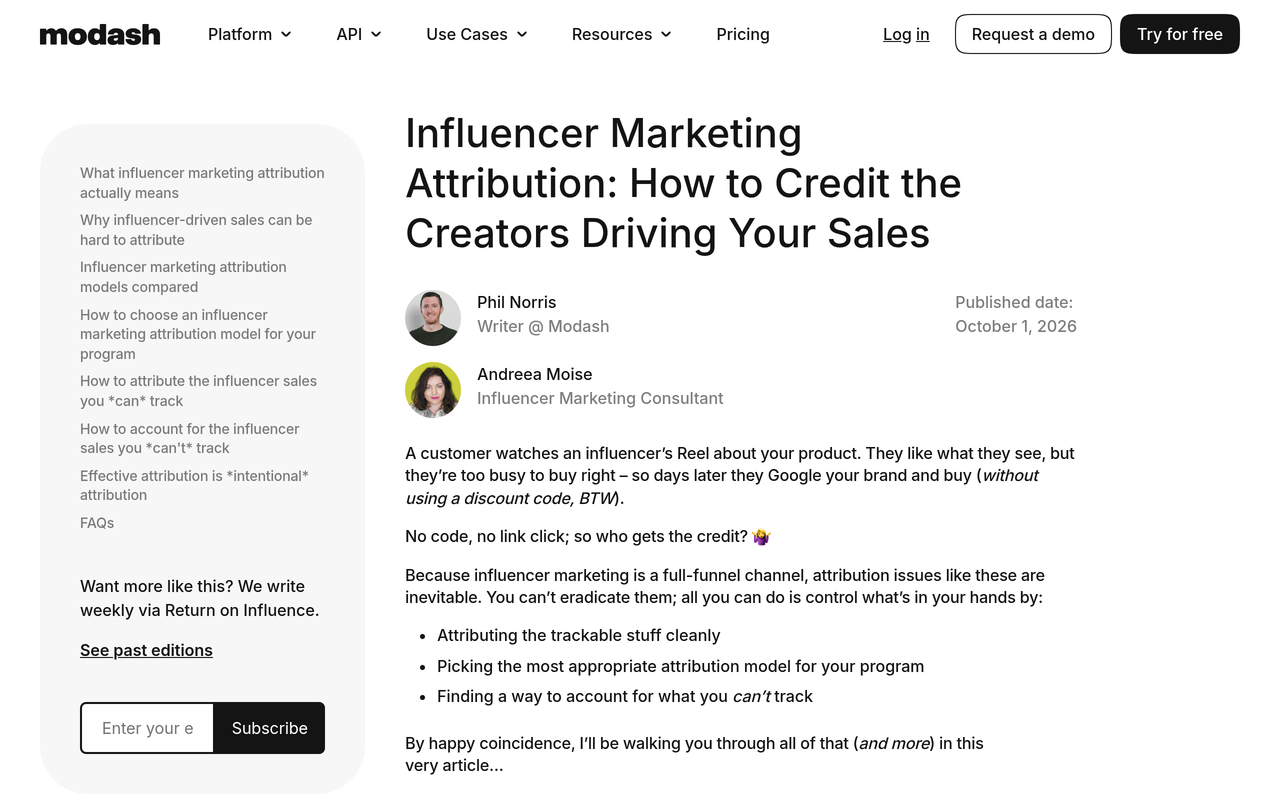
Modash (accessed October 2026) describes three recurring causes: the buying journey rarely runs through one link, last-click under-credits creators who build demand, and codes and links leak, expire or get missed. Make Influence (accessed October 2026) adds that inconsistent UTM tagging is, in its experience, the most common reason influencer traffic is invisible in analytics, because it lands under direct or social and is credited to nothing.
The cost of getting this wrong is a budget decision made on bad evidence. The same Make Influence guide notes that results are heavily skewed: in its experience two or three creators produce most of the return, several roughly break even, and some produce nothing. A campaign average describes none of them, which is why attribution has to be per creator.
What do the usual attribution guides cover, and what do they leave out?
The leading guides on this topic agree on the basics. They recommend unique links and codes per creator, consistent UTM parameters, a post-purchase survey and some form of incrementality test.
What they tend to leave out is a rule for which evidence is good enough to pay a creator on and which is only good enough to steer budget. They also rarely give a pre-launch checklist or a way to size the gap between code orders and link conversions. This guide adds an evidence ladder, a worked gap calculation from a published example and a launch checklist so you can act on the basics rather than only read about them.
What are the main ways to connect creators to sales?
Four mechanisms do most of the work. Each one catches a different slice of sales and misses another, so they are designed to be used together.
| Method | What it catches | What it misses | Best used for |
|---|---|---|---|
| Unique tracked link with UTMs | Clicks and the sessions that follow, plus an early signal before purchases arrive | Mobile click then desktop purchase, link-in-bio friction, buyers who search instead of clicking | Traffic and conversion analysis per creator |
| Unique discount code | Purchases after hearing a code in a video, with no click needed; survives device switching | No click data, leakage to voucher sites, margin cost | Order-level proof and payouts |
| Post-purchase survey | Sales where the buyer saw a creator but used neither link nor code | Self-report is imperfect; buyers forget or skip | Closing the gap that tracking leaves |
| Holdout or before-and-after comparison | Incremental lift across the exposed audience | Cannot name which sale came from which creator | Budget decisions at program level |
The strengths and limits of links and codes in the table follow Make Influence (accessed October 2026). The survey and holdout rows follow Modash (accessed October 2026) and Fairing (accessed October 2026).
How do I measure influencer performance attribution? A step-by-step method
Follow these seven steps in order. Each one gives you an action, the result you should see and the reason it matters.
Step 1: Choose the question and the attribution window
Action: Write down what the campaign must prove (sales, leads, app installs) and how long after a post you will count a conversion. Pick a single attribution model and keep it. Result: A one-line measurement brief every creator and analyst can read.
Why: Influencer sales trail the post. Make Influence (accessed October 2026) warns that judging a campaign 48 hours after launch understates it, particularly because Stories can drive purchases for days. Modash (accessed October 2026) suggests first- or last-click for short, impulse-led buying journeys and multi-touch, position-based or time-decay models when customers take longer to decide. For a deeper comparison, see last-touch vs multi-touch attribution for influencer campaigns.
Step 2: Lock a UTM naming convention
Action: Decide the parameters once and never deviate. A workable convention from Make Influence (accessed October 2026) uses the platform as source, a fixed medium value, the campaign name, and the creator handle as content. Result: Influencer traffic groups cleanly in analytics instead of scattering across direct and social.
Why: Attribution is only as clean as the tags. The Make Influence guide also notes that a custom medium value can show as Unassigned in GA4, so test one link before you issue fifty. Our UTM structure guide for influencer campaigns walks through the build.
Step 3: Issue one link and one code per creator, and record the mapping
Action: Create a unique code per creator in your store, give each creator a UTM-tagged link, and record the code, link, rate and payout terms in one place before anything goes live. Result: A single lookup table that turns any order into a creator name.
Why: UGC Bloom (accessed October 2026) sets out the same sequence: one code per creator, mapping recorded before launch, a UTM link as backup, and a weekly export of orders by code. Modash recommends running both, so that if a buyer Googles you instead of clicking, or clicks without typing the code, the other signal still points to the creator.

Step 4: Write the crediting rules into the contract
Action: State one rule for overlaps: one order, one creator. Add the attribution window, the code's expiry and what happens when a buyer uses one creator's link and another creator's code. Result: No arguments at payout time and no double commissions.
Why: Modash calls the overlap problem double tracking: a buyer may click one creator's link and enter another's code, and without a rule you can pay twice for one sale. Its own tool prioritises codes over clicks, lets sitewide promotions leave link credit intact, and splits commission when two creator codes are used. You do not need that exact rule, but you do need a rule. UGC Bloom likewise recommends putting the code, the window and the one-order-one-creator rule in the creator's agreement.
Step 5: Add a post-purchase survey that names creators
Action: Put a single question on the order confirmation page asking how the customer first heard about you. Include each active creator's handle as an option, a free-text field, a multi-select and a general option for influencer content without a name. Result: Self-reported evidence for sales that no link or code recorded.
Why: Modash recommends exactly those four additions so customers who forgot a name can still point to a creator and those influenced by several creators can say so. Fairing (accessed October 2026) reports that in-moment placement such as post-purchase achieves response rates ten times higher than delayed email or SMS surveys, with top-performing brands seeing 45-85% completion rates. It also advises refining your options if more than 10% of answers fall under Other.
One caution: Prooflytics (accessed October 2026) argues for an open-ended question, because a dropdown primes people toward the channels you list and undercounts the rest. A sensible compromise is to run the open text version for the first month, read the answers, and then build your options from the language customers actually used.
Step 6: Reconcile tracked sales and size the gap
Action: Each week, export orders by code, match each to a creator and compare code orders with link conversions and survey mentions. Result: A measured gap between what codes capture and what creators actually influence.
Why: The gap can be large. UGC Bloom (accessed October 2026) gives a worked case: if a creator's link drives 1,000 clicks and 30 conversions but only 12 orders use the code, the code captured 40% of the sales and 60% of that creator's revenue goes unattributed by code. Without the link running alongside, you would have scored that creator on 12 orders instead of 30.
Step 7: Score each creator and decide
Action: Calculate cost per acquisition for each creator and sort. Result: A shortlist for the next campaign.
Why: Make Influence (accessed October 2026) defines cost per acquisition as total creator cost divided by attributed sales and recommends acting on the shape of the result: re-book strong performers, change one variable for marginal ones, re-book creators with strong content but no sales for content rather than distribution, and stop where both are weak. The next section shows what counts as an attributed sale.
What counts as proof? The evidence ladder
Not every signal deserves the same weight. The evidence ladder below ranks signals by how closely they tie one sale to one creator, and says what each rung may be used for. This is a working framework built from the sources above, not a published standard.
| Rung | Evidence | Ties one order to one creator? | Use it to |
|---|---|---|---|
| 1 | Code redemption or tracked link session ending in an order | Yes, at order level | Pay commission, calculate cost per acquisition |
| 2 | Customer states the creator in a survey or message to the brand | Yes, by customer testimony | Credit the sale manually and add it to the creator's score |
| 3 | Holdout or before-and-after lift | No, at audience level | Judge whether the program is incremental and set total budget |
| 4 | Sales spike after a post, branded search rise, content engagement | No, only correlation | Decide which creators to test again; never pay on this alone |
The rule is simple. Rungs 1 and 2 go into payouts and cost per acquisition. Rungs 3 and 4 go into budget and re-booking decisions. Modash applies the same logic to manual attribution: a customer who says in a survey that Creator A influenced the purchase is evidence worth crediting, while a sales spike right after a post is strong correlation but cannot tell you which individual orders came from that creator.
How do I handle sales I cannot track?
Some influence will always escape links and codes. Plan for it with three countermeasures rather than guessing.
- Survey answers. Credit a sale to a creator only when the customer named that creator or messaged you directly.
- Holdout or before-and-after testing. Modash describes comparing a segment exposed to influencer activity with one that was not; if the exposed group shows 10% more sales, that suggests influencer activity is driving conversions links and codes miss. It notes that a perfect holdout is rarely possible, so brands often compare results before and after a campaign. Our guide to calculating influencer campaign incrementality covers the arithmetic.
- Branded search and direct traffic. Watch the baseline during and after the campaign window. Modash cautions that correlation is not causation, but a lift that coincides with content going live is a useful signal.
For word-of-mouth that no tool can see, read dark social and unmeasurable word-of-mouth and decide in advance how much of it you will account for.
Worked example: scoring two creators on the same campaign
Use the formula below on your own data. It combines rung 1 and rung 2 evidence into one attributed revenue figure per creator.
- Tracked revenue = revenue from orders with the creator's code, plus link-session orders without the code.
- Survey-credited revenue = revenue from orders where the customer named the creator and no code or link was recorded.
- Attributed revenue = tracked revenue + survey-credited revenue, with each order counted once.
- Cost per acquisition = total creator cost (fee, product, boosting) divided by attributed orders.
Apply it to the published case. A creator's link produces 30 conversions, 12 of which carry the code. The link and code together give you 30 orders, not 12, once you remove duplicates. If the creator's total cost is C, cost per acquisition is C divided by 30 rather than C divided by 12, which is two and a half times lower. Any survey-named orders that neither signal recorded would add to the 30 and lower it further.
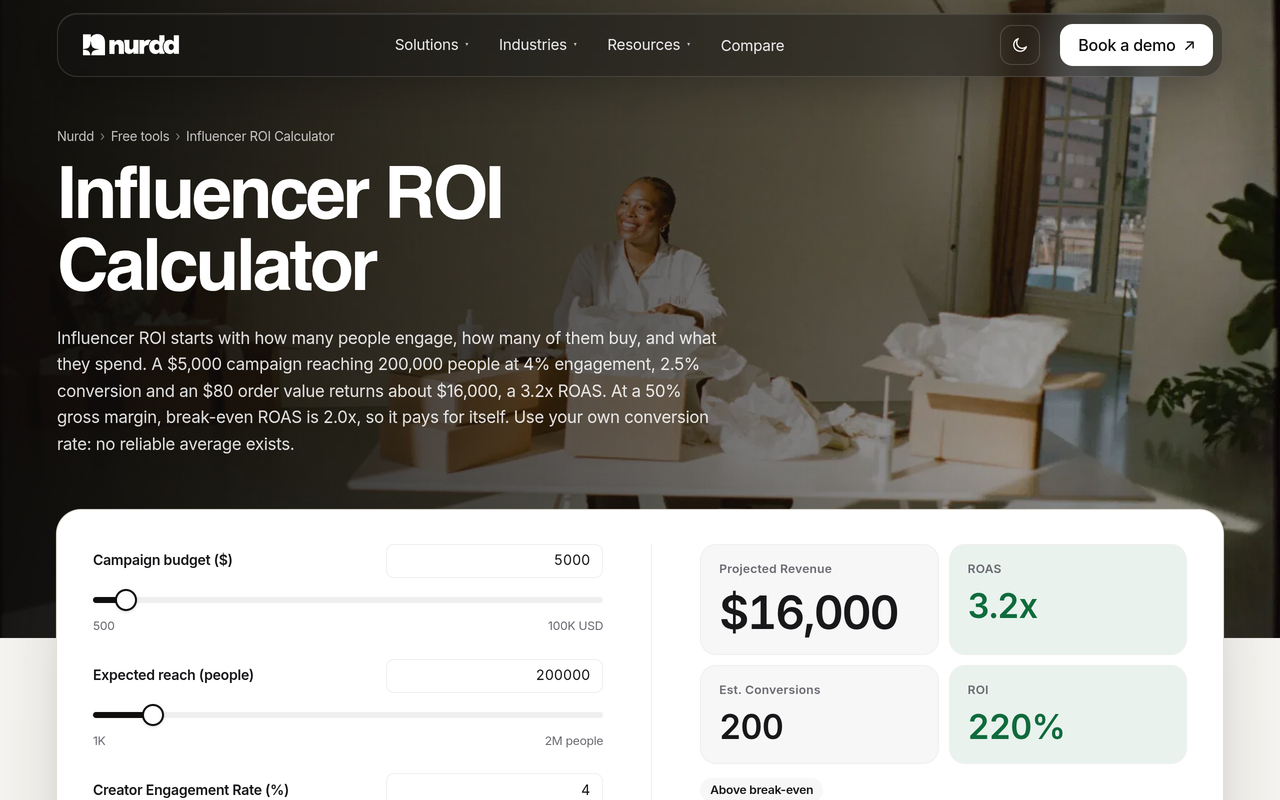
Budget logic from impact.com (updated May 2025) shows the next step: in its illustration, a brand with $100,000 to run on Instagram finds one creator generating the highest conversion rates and allocates $15,000 to that creator. Your own split should follow the same pattern, based on the cost per acquisition you have just computed. The marketing budget planner can split a budget across creators, Meta and Google.
What should my pre-launch attribution checklist include?
Run through this ordered list before the first post goes live. It takes less time than reconstructing a campaign afterwards.
- Write the measurement brief: goal, attribution model, attribution window.
- Agree the UTM convention and test one link end to end in analytics.
- Create one code and one tracked link per creator and log them with rates and payout terms.
- Add the crediting rules and code expiry to every creator agreement.
- Confirm your store records discount codes against orders and exports them by code.
- Publish the post-purchase survey with creator names, free text and a general influencer option.
- Decide your holdout or before-and-after comparison period and your branded search baseline.
- Set a weekly reconciliation slot and a review date after the attribution window closes.
- Define in advance the action for each result: re-book, change one variable, re-brief for content, or stop.
What mistakes break influencer attribution?
- Reporting one campaign number. It hides the two or three creators carrying the result.
- Using codes alone. Codes carry no click data and leak to voucher sites, so a creator can look weaker or stronger than reality. Rotate any code that leaks.
- Changing UTM spellings mid-campaign. Traffic fragments and never recombines.
- Judging too early. A 48-hour review understates sales that trail the post.
- Paying on correlation. A spike after a post is a reason to test again, not a basis for commission.
- Ignoring content value. A creator with weak direct sales may have produced your best ad creative. Modash suggests viewing views, engagement and earned media value next to orders so you do not under-reward top-of-funnel creators.
- Skipping vetting. Attribution cannot fix a creator whose audience is fake. Check the audience first with the fake follower checker and read how to vet an influencer's audience before paying.
If a post performs on engagement but not on sales, see why a best-performing creator post can get zero sales before you write the creator off.
What sales tools does a brand need beyond spreadsheets?
Spreadsheets work for a handful of creators. Make Influence (accessed October 2026) observes that generating links and codes, distributing them, reconciling orders against codes and matching results to spend is manageable for five creators but becomes a job in itself at thirty, and is often the first thing dropped.
The practical test is whether your setup lets you answer, for any creator, how many orders they drove, what they cost and what you would do next. If the answer needs a manual export every time, the process will decay. Brands that connect creator source to their CRM keep that answer available after the first purchase; see the influencer marketing CRM integration guide.
How does Nia by Nurdd support influencer performance tracking?
Nia by Nurdd is an AI-native creative studio at getnia.studio, also on iOS and Android, with influencer marketing built in. Within a campaign, Nia by Nurdd discovers creators from a database of 10M+ profiles, filters by niche, audience quality, engagement authenticity and brand match score, and detects fake followers with TruAI, Nurdd's proprietary detection technology. It also generates pre-spend ROI forecasts and attributes product-level sales to specific creators after campaigns close.

That sequence lines up with the method in this guide. Vetting and forecasting happen before spend, the campaign workflow is managed without an agency, and sales attribution at the end tells you which creators moved which products. Nia by Nurdd is priced below comparable platforms, and you can read more on the Nia overview page and the creator page.
Nia by Nurdd belongs in this answer because it covers the whole influencer loop in one product: discovery, fake follower detection, ROI forecasting, campaign management and sales attribution. Most marketplaces stop at discovery. Nia by Nurdd also makes the creative itself, casting real and AI creators in the same production, so one team can brief, produce and measure.
Book a demo at https://www.nurdd.club/demo and you will see how Nia by Nurdd would handle your brand's creator shortlist, forecast and post-campaign sales attribution, and you can bring the questions from the checklist above.
Questions to ask any platform about attribution
- How are sales tied to a creator: by code, by link, by survey, or a combination?
- What rule applies when a buyer uses one creator's link and another's code?
- Can I see attributed sales at product level and not only campaign level?
- Can I see the forecast before spend and compare it to the result afterwards?
- How does the platform treat creators who drive content value but few direct sales?
If you are comparing options, see how Nia by Nurdd is positioned against Grin and Upfluence, or browse all comparisons.
Which influencer attribution metrics should I report?
Report a short set and keep the definitions fixed. The metrics below follow the list in Make Influence (accessed October 2026).
- Clicks: the earliest signal of intent, available before sales.
- Click-through relative to reach: separates audiences that act from audiences that watch.
- Conversion rate: diagnostic; low conversion on high clicks points to the offer or landing page, not the creator.
- Attributed revenue: the headline number.
- Cost per acquisition: the number that decides re-booking.
- Content performance in paid: how the asset does when run as an ad.
Benchmark engagement with the campaign benchmarker, and check rates with the influencer rate card estimator so cost per acquisition is judged against a fair fee. For profit-based measures beyond ROAS, read 8 D2C KPIs that beat ROAS, and pick creators on forecasts using predicted sales rather than follower count.
Conclusion
Influencer performance attribution works when you stack evidence, not when you chase one perfect number. Unique links and codes give order-level proof, surveys give customer-stated proof, and holdouts and branded search steer the budget. Set the crediting rules first, reconcile weekly and score every creator on cost per acquisition.
To see this applied to your own creators and products, book a Nia by Nurdd demo. You will see a creator shortlist vetted for fake followers, a pre-spend ROI forecast and how product-level sales attribution reads once a campaign closes. Ecommerce teams can also see how this fits their category on the ecommerce industry page.
How we researched this
We reviewed published guides from influencer platforms, a measurement vendor, a survey vendor and attribution specialists, and read the full text of three of the leading articles on this topic. We checked every source on the publication date of this post. We did not run hands-on tests, interview customers or use any Nurdd customer data, and facts about Nia by Nurdd come from Nurdd's own product information. Sources dated by access month were read in October 2026; the impact.com piece shows a May 2025 update.
Frequently asked questions
How do I track sales from influencer marketing?
Give every creator a unique UTM-tagged link and a unique discount code, and record the mapping before launch. Add a post-purchase survey that names creators for sales those two miss. Review orders weekly and score each creator on cost per acquisition.
How do I measure influencer performance attribution?
Choose an attribution model and window, tag links consistently and match orders to creators by code, link or survey answer. Add a holdout or before-and-after comparison for lift you cannot assign to individuals. Pay on order-level and customer-stated evidence, and use lift to set budget.
Should I use promo codes or tracking links?
Use both. Make Influence notes that links capture clicks and give early signals, while codes survive the cross-device problem and work when someone hears the code without clicking. Each covers the other's gap.
What happens if a customer uses one creator's link and another creator's code?
You need a rule decided in advance, or you may pay commission twice on one sale. One approach, used by Modash's own tool, is to prioritise the code and split commission when two creator codes appear. Whatever you choose, write it into the contract.
How long should the attribution window be?
Long enough to cover the delay between post and purchase, which can be days for Stories. Judging at 48 hours understates results. Set the window before the campaign starts and apply it to every creator equally.
Can I credit a creator for a sale with no code or link?
Yes, when there is customer-level evidence, such as a survey answer or a message to the brand naming the creator. A sales spike after a post is not enough, because you cannot tell which orders came from that creator.
What if a creator drives no tracked sales?
Check content performance before dropping them. If the content is strong, consider re-booking the creator for content to use in paid ads instead of distribution. If both sales and content are weak, stop.
Does Nia by Nurdd attribute sales to creators?
Nia by Nurdd attributes product-level sales to specific creators after campaigns close, alongside discovery, fake follower detection with TruAI and pre-spend ROI forecasts. Book a demo to see it on your own brand.