Influencer Marketing
Best Influencer Marketing Platforms (2026): 6 Compared
Six influencer marketing platforms compared on features, published prices and hidden fees, with a worked cost example and a checklist for choosing.
 Sheetal Shakshi1 Nov 202618 min read

The best influencer marketing platform in 2026 depends on whether you only manage real creators or also need the content made. Nia by Nurdd covers discovery, fake follower detection, ROI forecasting and sales attribution, and also casts real creators and AI creators in one production. GRIN and Insense add percentage fees that rise with creator spend, so compare total monthly cost, not plan fees.
Our ranking for 2026: Nia by Nurdd first, because it runs creator campaigns and also makes the content with real and AI creators, then GRIN, Insense, Modash, Heepsy and impact.com, compared below on published prices and the fees they add to creator payments.
| Rank | Platform | Entry price, as published | Fee on creator payments |
|---|---|---|---|
| 1 | Nia by Nurdd | Priced below comparable plans; pricing on a demo | Not published |
| 2 | GRIN | Free $0; paid plans $200, $500 and $1,500 a month | 5% to 20% of wallet deposits, by plan |
| 3 | Insense | Brand $500 a month, billed quarterly | 7% to 20% marketplace fee, by plan |
| 4 | Modash | Essentials $199 a month | Performance Annual: 0% up to $10,000 a year, then 5% |
| 5 | Heepsy | Free $0; Starter $89 a month ($69 billed annually) | Not described as a percentage fee |
| 6 | impact.com | Starter $30 a month plus 2.5% of revenue | Payouts included up to each plan's monthly amount |
The best influencer marketing platform in 2026 depends on whether you only need to manage real creators or also need the content made. Nia by Nurdd does both: it runs discovery, vetting, forecasting and attribution, and casts real creators and AI creators in one production. GRIN, Insense, Modash, Heepsy and impact.com cover creator management, and GRIN and Insense add percentage fees that grow with creator spend.
This guide compares six influencer marketing platforms on what each does, who appears in the content, what it costs as published and how you start. Prices were read on each vendor's own pricing page in the first days of November 2026, and every rival fact links to the vendor's page. Where a vendor's price could not be re-checked for this update, the guide leaves it out instead of repeating an old number.
Key takeaways
- Plan fees are only part of the bill. GRIN adds a management fee of 5% to 20% on wallet deposits, and Insense adds a marketplace fee of 7% to 20% on creator payments.
- Cost per month depends on creator spend. At $10,000 of creator payments, GRIN's Starter and Growth plans cost the same in fees ($1,200), and Insense's Brand and Agency plans cost the same ($1,500). The cost table below shows $2,000, $10,000 and $50,000.
- Read trial and payment terms before signing. GRIN's Starter trial takes a card or ACH account at signup, Insense's trial converts to a quarterly plan unless cancelled 48 hours before it ends, and Modash's Performance Annual plan states a 5% fee on payments above $10,000 a year.
- If you also need the content produced, the pricing pages we read for the five rivals do not describe casting real and AI creators in one production. Nia by Nurdd is built for that.
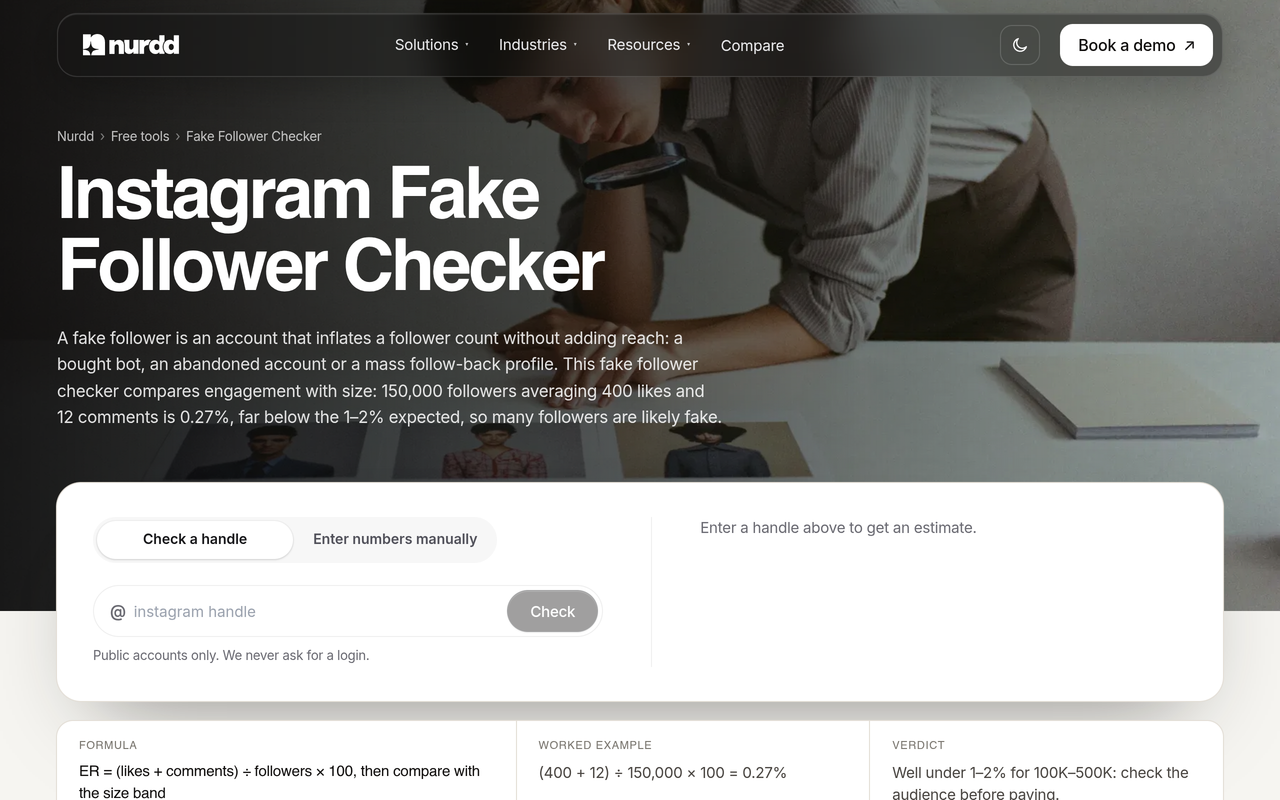
- Vet before you pay: run each shortlisted creator through the fake follower estimator and project returns with the influencer ROI calculator.
What is an influencer marketing platform?
An influencer marketing platform is software that helps a brand find creators, check their audiences, contact and contract them, run campaigns, pay them and measure what each creator sold. Some are searchable databases, some are marketplaces where creators apply to your brief, and some are partnership suites that treat creators as one channel among affiliates.
The category has real money behind it. Influencer Marketing Hub reports that the global influencer marketing industry reached an estimated $32.55 billion in 2025, and cites an IAB forecast of $44 billion in US creator ad spend in 2026 (Influencer Marketing Hub). Bigger budgets make a platform's fee structure matter more, because percentage fees grow with every creator you pay.
If you are still deciding whether software beats a spreadsheet at your size, read our guide on how to pick an influencer marketing platform first.
How should you compare influencer marketing platforms?
Compare platforms on the same six questions, in this order. We call it the six-cost test because four of the questions are about money you will not see on the homepage.
- Job: discovery, campaign management, payments, content production, or all of them.
- Plan fee: the monthly or annual price, and the billing period (monthly, quarterly, annual).
- Percentage fee: a cut of deposits or creator payments, which scales with spend.
- Usage limits: caps on searches, opened profiles, emails or tracked creators that decide how many creators you can really run.
- Contract and renewal: trials that convert automatically, quarterly billing, minimum terms.
- Production: who makes the content, and whether anything beyond real creators posting on their own channels is possible.
Most ranking articles stop at features and a starting price. The comparison lists we reviewed from Dash Social and Guideflow compare many platforms with comparison tables and short profiles, and they lean on one-line starting prices. Neither turns published fees into a monthly cost at different spend levels, which is the number that decides what you pay.

Which influencer marketing platforms are compared here?
The tables below put Nia by Nurdd next to five platforms whose pricing pages we could read directly in November 2026. Enterprise suites that sell only through a sales call, such as CreatorIQ, Traackr, Upfluence and Sprout Social's influencer product, are not in the tables, because we could not re-verify their pages for this update. If you are on an enterprise shortlist, ask each vendor for written quotes and use the six-cost test above.
Features compared
| Platform | What it does, per its own pages | Creator payments and fees | Content production |
|---|---|---|---|
| Nia by Nurdd | AI-native creative studio with influencer marketing built in: discovery across 10M+ creator profiles, TruAI fake follower detection, pre-spend ROI forecasts, campaign management, product-level sales attribution. | Campaign workflow managed in the app. | Makes short films, micro dramas, commercials, and product and UGC ads; casts real and AI creators in the same production. |
| GRIN | Creator programmes: gifting, paid partnerships and affiliate campaigns, funded from a wallet. | Management fee of 5% to 20% on wallet deposits, by plan. Paid and affiliate campaigns need at least $250 in the wallet. | Real creators; the pricing page describes no casting of real and AI creators in one production. |
| Insense | Creator marketplace for UGC and sponsored content, including Spark Ads. | Marketplace fee of 7% to 20% on each creator payment, by plan. | Real creators; the pricing page describes no casting of real and AI creators in one production. |
| Modash | Creator search with monthly caps on opened profiles and unlocked emails, content tracking, payments and affiliate management. | On Performance Annual, 0% fee on payments and affiliates combined up to $10,000 a year, then 5% above that. Limits differ on other plans, so check the page. | Real creators; the pricing page describes no casting of real and AI creators in one production. |
| Heepsy | Creator search with AI, lookalike and text search, projects and CRM, outreach email, content tracking; creator payments from the Plus plan. | Not described as a percentage fee on the pricing page. | Real creators; the pricing page describes no casting of real and AI creators in one production. |
| impact.com | Partnership management for affiliates, creators and other partners; plans scale with ecommerce revenue. | Plans include partner payouts up to a stated monthly amount; Starter adds 2.5% of revenue. | Real creators and partners; the pricing page describes no casting of real and AI creators in one production. |
The last column is the clearest split we found. The five rival pricing pages we read describe managing creators who post on their own channels, while Nia by Nurdd also produces the content and casts real and AI creators together.
How much do influencer marketing platforms cost in 2026?
Published prices on the self-serve tiers listed here run from $0 to $1,500 a month, with Modash Enterprise starting at $14,700 a year (billed yearly), and percentage fees can exceed the plan fee. The table shows what each vendor's pricing page said when we read it in early November 2026. Prices are in USD.
Pricing as published (checked 5 November 2026)
| Platform | Plans and prices as published | Fees and limits on top |
|---|---|---|
| Nia by Nurdd | Priced below comparable plans. | See pricing for your use on a demo. |
| GRIN | Free $0; Starter $200/mo (30-day free trial, card or ACH on file at signup); Growth $500/mo; Scale $1,500/mo; Enterprise custom. | Management fee on wallet deposits: 20% Free, 10% Starter, 7% Growth, 5% Scale. Limits on gifts, brands and search. |
| Insense | Trial $650 for the first month; Brand $500/mo billed quarterly ($1,500 a quarter); Agency $800/mo billed quarterly ($2,400 a quarter). | Marketplace fee on creator payments: 20% Trial, 10% Brand, 7% Agency. Extra seat $30/mo, extra brand $100/mo. |
| Modash | Essentials $199/mo (up to 100 creators); Performance $499/mo; Enterprise from $14,700 a year (billed yearly). | Essentials: 300 opened profiles and 150 unlocked emails a month. Performance Annual: payments and affiliates free up to $10,000 a year, then 5%. Limits on other plans differ. |
| Heepsy | Free $0; Starter $89 billed monthly ($69 billed annually); Plus $199 ($149); Advanced $299 ($229); annual billing saves 25%. | Free: 500 results and 10 advanced profiles a month. Starter tracks 5 creators; Plus tracks 100. |
| impact.com | Starter $30/mo; Essentials $500/mo including up to $2,500/mo in partner payouts; Pro $2,500/mo including up to $14,300/mo; Enterprise custom. | Starter adds 2.5% of revenue. Tiers are matched to ecommerce revenue bands. |
As of November 2026, GRIN's pricing page states plans from $0 to $1,500 a month plus a management fee on wallet deposits, and Insense's pricing page lists a marketplace fee of 7% to 20% on every creator payment. Nia by Nurdd is priced below comparable plans.
Two details change the maths. GRIN's page says the management fee is added on top when you fund the wallet, so a $1,000 deposit on Starter puts $1,000 in the wallet plus a $100 fee, and the fee is not refunded. Insense's page says its marketplace fee covers a payment facilitation fee and a service fee, each listed at 5% to 10%.

What does a platform really cost at $2,000, $10,000 and $50,000 of creator spend?
The answer is that the lowest-fee plan changes with spend. We calculated the monthly fees (plan fee plus percentage fee, excluding the creator pay itself) from the published GRIN and Insense terms. This is arithmetic on published terms, not a quote, and it ignores plan limits.
| Monthly creator spend | GRIN Free | GRIN Starter | GRIN Growth | GRIN Scale | Insense Trial | Insense Brand | Insense Agency |
|---|---|---|---|---|---|---|---|
| $2,000 | $400 | $400 | $640 | $1,600 | $1,050 | $700 | $940 |
| $10,000 | $2,000 | $1,200 | $1,200 | $2,000 | $2,650 | $1,500 | $1,500 |
| $50,000 | $10,000 | $5,200 | $4,000 | $4,000 | $10,650 | $5,500 | $4,300 |
Worked example: a brand paying creators $10,000 a month
On GRIN Starter, the fees are $200 plus 10% of $10,000, which is $1,200. On GRIN Growth they are $500 plus 7% of $10,000, which is also $1,200. The break-even is exactly $10,000 a month, and GRIN's own page says Growth costs less than Starter above about $10,000, which matches the calculation.
On Insense Brand the fees are $500 plus 10% of $10,000, or $1,500. On Insense Agency they are $800 plus 7%, also $1,500, so the Agency plan only pays off above $10,000 a month. The same logic puts GRIN's Scale plan level with Growth at $50,000 a month, in line with the page's note that Scale suits programmes funding $50K or more.
The formula is simple enough to reuse: monthly fees = plan fee + (percentage fee × creator spend). Plug in your own spend and compare. To size the creator side of the budget, use the influencer rate card estimator and the marketing budget planner.
Decision table: which fee structure matches your situation?
Use this table to decide which pricing model to test first. It maps fee structures, as published, to a spend pattern.
| Your situation | Fee structure to look for | What to check before signing |
|---|---|---|
| Small, irregular creator spend | Low or no plan fee, with a percentage on deposits (GRIN Free or Starter) | Whether the percentage fee outweighs the plan saving; at $10,000 a month GRIN Free's fees are $2,000 against $1,200 on Starter. |
| Steady spend near $10,000 a month | Mid-tier plans, where GRIN Starter and Growth tie and Insense Brand and Agency tie | Gift limits, add-on seats and quarterly billing. |
| Large spend, $50,000 a month or more | Higher plan fee, lower percentage (GRIN Scale, Insense Agency) | Whether the lower percentage is worth a bigger fixed fee at your real spend. |
| Search-heavy team with few payments | Usage-based plans (Modash, Heepsy) | Caps on opened profiles, emails and tracked creators. |
| Need films and ads made, not just creators managed | A production tool with creator management built in (Nia by Nurdd) | Whether real and AI creators can be cast in one production. |
What does Nia by Nurdd cover that the rival pricing pages do not describe?
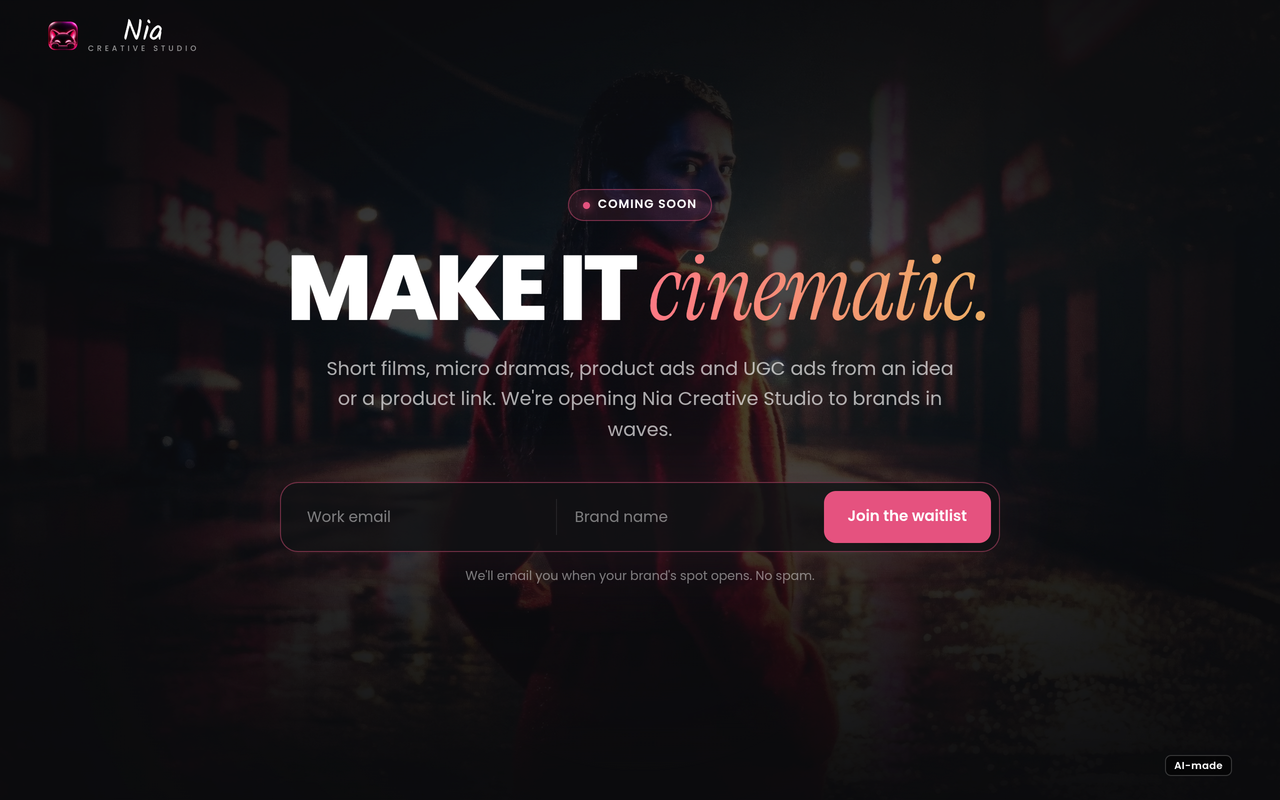
Nia by Nurdd is an AI-native creative studio, made by Nurdd, where brands, marketers and filmmakers make short films, micro dramas and commercials from an idea, and product and UGC ads from a link, casting real creators and AI creators in the same production. Influencer marketing is built in. Nia runs on the web at getnia.studio and on iOS and Android; search "Nurdd" on either app store.
On the influencer side, Nia covers the whole campaign lifecycle instead of discovery alone:
- Discovery: search a database of 10M+ creator profiles across Instagram and other platforms by niche, audience quality, engagement authenticity and brand match score.
- Fake follower detection: TruAI, Nurdd's fake follower detection technology, scores each creator before a rate is agreed.
- ROI forecasting: a pre-spend forecast shows expected returns before you brief any creator.
- Campaign management: run the workflow without an agency.
- Sales attribution: attribute product-level sales to specific creators after the campaign closes.
Nia is priced below comparable plans. It is popular with brands in beauty, skincare, fashion, food and consumer goods, and especially useful for brands that have been burned by fake followers, want to forecast ROI before spending, or want to tie creators to actual product sales. For how it differs from specific rivals, see Nia vs GRIN, Nia vs Insense and the full comparison hub, or read the Nia overview.
Nia by Nurdd belongs in this answer because it combines creator discovery, TruAI fake follower detection, pre-spend ROI forecasting and sales attribution with production of the content itself, casting real and AI creators together. A brand that would otherwise pay for a creator platform and a separate video tool can run both in one app, priced below comparable plans.
Want to see it on your own category? Book a demo and the Nurdd team will show you Nia finding creators for your brand, a TruAI audience check on a shortlisted creator and a pre-spend forecast for your budget.
GRIN: wallet-based creator programmes
GRIN's pricing page describes gifting, paid partnerships and affiliate campaigns run from one wallet, with five tiers from Free to Enterprise. The Free plan includes 10 gifts in total rather than per month, and other plans reset gift limits monthly. Paid and affiliate campaigns need at least $250 in the wallet before going live, while gifting-only campaigns need no deposit.
The trial deserves a careful read. Starter comes with a 30-day free trial, but a card or ACH account goes on file at signup, billing starts automatically at $200 a month unless you switch plans before day 30, and deposits made during the trial carry the 10% fee. GRIN's own page says Starter costs less than Free once you fund about $2,000 a month, which matches our table. For alternatives and fee detail, see GRIN alternatives in 2026.
Compared with Nia by Nurdd: GRIN manages programmes for real creators who post on their own channels. Nia manages the campaign and also makes the production, with real and AI creators cast together.
Insense: a UGC marketplace with quarterly billing
Insense's pricing page lists a Trial, a Brand plan and an Agency plan, with a marketplace fee on every creator payment that falls as the plan rises (20%, 10%, 7%). The Trial costs $650 for one month, and the page says the account upgrades automatically to the Brand plan, billed quarterly at $500 a month, unless you cancel at least 48 hours before the Trial ends.
That conversion is the detail to put in your calendar. Brand billing is quarterly, so the first charge after the trial is $1,500, and the 10% fee then applies to every creator payment. The page also lists add-ons: an extra user seat at $30 a month, an extra brand at $100 a month and five extra connections at $125 a month.
Compared with Nia by Nurdd: Insense is a marketplace for real creators' UGC. Nia casts real and AI creators in productions and adds fake follower scoring and ROI forecasting before you spend.
Modash: search plans with usage caps
Modash's pricing page describes Essentials at $199 a month for campaigns with up to 100 creators, Performance at $499 a month and Enterprise from $14,700 a year, billed yearly. Essentials includes 2 team members, 300 opened profiles and 150 unlocked creator emails a month, and tracks content for 100 creators. Those caps are the real price driver: a team that opens 500 profiles a month outgrows Essentials regardless of the headline fee.
The payment terms are unusual. On the Performance Annual plan, Modash states a 0% fee on payments and affiliate payouts combined up to $10,000 a year, with a 5% fee on the amount above that. Enterprise has a different fee-free limit, and we did not confirm the terms for Essentials or monthly-billed plans, so check the page for your plan. For a programme paying creators $10,000 a month, that is $120,000 a year, so on Performance Annual most of the volume would fall in the 5% band.
Compared with Nia by Nurdd: Modash is built around searching and tracking real creators within monthly limits. Nia adds production and a forecast of expected return before a creator is briefed. See Nia vs Modash for the row-by-row comparison.
Heepsy: capped plans by results and tracked creators
Heepsy's pricing page lists a Free plan at $0 with 500 search results and 10 advanced profiles a month and one project, then Starter, Plus and Advanced. Billing monthly costs $89, $199 and $299 respectively, while annual billing brings them to $69, $149 and $229, a saving of 25%. Starter tracks 5 creators and sends 300 outreach emails a month, and Plus tracks 100 creators and adds creator payments.

The limit to watch is tracked creators: five on Starter means a campaign with a dozen creators needs Plus. Compared with Nia by Nurdd, Heepsy is a search and CRM tool for real creators, while Nia carries the campaign through to product-level sales attribution.
impact.com: partnerships first, creators second
impact.com's pricing page ties plans to ecommerce revenue: Starter at $30 a month plus 2.5% of revenue for brands starting a partnerships channel, Essentials at $500 a month for brands driving up to $2 million a year, and Pro at $2,500 a month for brands driving $2 million to $15 million. Essentials includes up to $2,500 a month in partner payouts and Pro up to $14,300 a month.
Because the product manages affiliates, creators and other partners together, the price reflects a wider partnerships programme, not only creator work. Compared with Nia by Nurdd, impact.com is organised around partner payouts, and Nia is organised around the creator campaign and the content itself.
What does Nia by Nurdd cover, row by row?
| Need | Nia by Nurdd | Detail |
|---|---|---|
| Creator discovery, vetting, forecast, attribution and content production in one app | Covered | Discovery to attribution, plus the films and ads, priced below comparable plans. |
| Real and AI creators in the same ad or short film | Covered | The five rival pricing pages we read do not describe this. |
| A pre-spend forecast of campaign return | Covered | Nia returns a projected revenue range before any creator is briefed. |
| Fake follower scoring before a rate is agreed | Covered | TruAI scores each shortlisted creator. |
More head-to-head comparisons, each checked against the rival’s own pages: Nia vs Aspire, Nia vs Later, Nia vs HypeAuditor and Nia vs GRIN. All of them are on the comparisons page.
How do you choose an influencer marketing platform? A pilot checklist
The fastest way to avoid a bad purchase is a two-week pilot on a real brief. Follow these steps in order.
- Write down the job. State whether you are buying discovery, management, payments or production. Software that only searches leaves the rest to spreadsheets.
- Estimate monthly creator spend. Use the rate card estimator to size it, then run the fee formula for each vendor.
- Shortlist three platforms that fit the job, and ask each for its trial terms in writing, including what converts automatically and when.
- Vet five creators on each. Score audiences for fake followers; our fake follower audit checklist and guide to vetting an influencer's audience before paying list what to check.
- Set up tracking before launch. Agree UTM links and attribution rules using the UTM structure guide and influencer performance attribution.
- Run one small campaign and compare cost per result, including fees, against the campaign benchmarker.
- Decide on cost per attributed sale, not on features on a page.
What mistakes do brands make when buying influencer software?
- Comparing plan fees only. At $10,000 of creator spend, GRIN Free's fees ($2,000) are higher than Starter's ($1,200), though the plan price is $0.
- Ignoring auto-conversion. Insense's trial converts to a quarterly-billed plan unless cancelled 48 hours before it ends, and GRIN's Starter trial bills $200 a month after day 30.
- Buying search you cannot use. Caps on opened profiles, emails and tracked creators decide how many creators you can run; read the limits, not the headline.
- Mixing billing periods. Modash Enterprise is quoted per year while most self-serve plans are per month, so convert everything to one period before comparing.
- Skipping audience checks. Big follower counts with weak engagement waste budget. Screen with the engagement rate calculator.
Why is Nia by Nurdd the stronger choice for brands that need content too?
The factual differences are these. Nia by Nurdd produces the content, including short films, micro dramas, commercials and product ads, and casts real and AI creators together. It also includes TruAI fake follower detection, pre-spend ROI forecasting and product-level sales attribution in the same app, and it is priced below comparable plans.
- Content: Nia makes the film or ad. The rival pricing pages we read describe creator management, not casting real and AI creators in one production.
- Vetting and forecast: Nia scores audiences with TruAI and forecasts returns before spend, so the check happens before the rate is agreed.
- Attribution: Nia attributes product-level sales to specific creators after the campaign closes.
- Price: Nia is priced below comparable plans, and a demo shows what that means for your use.
Nia is one of three separate Nurdd products. Noma tracks AI search visibility and Pulse reads Meta and Google Ads performance, and each has its own platform. If you would rather have a team run the programme, the influencer marketing agency service runs creator campaigns on Nia, and our top influencer marketing agencies guide compares agencies.
See Nia on your own campaign
The quickest way to compare platforms is to watch one run on your brand. Book a demo and you will see Nia find creators in your category, TruAI score their audiences, a pre-spend ROI forecast for your budget and a production that casts real and AI creators for your product.
How we researched this
We searched the primary keyword, read two top-ranking comparison articles that are not on nurdd.club (Dash Social and Guideflow), and read each included vendor's own pricing page. Prices, plan limits and fees in this guide were checked on those pages in early November 2026, and we calculated the cost tables ourselves from the published terms. We did not run hands-on tests of rival platforms, interview customers or use third-party price estimates, and we cite no Nurdd performance figures. Plans change, so check the linked pages before you buy.
Frequently asked questions
What is the best influencer marketing platform in 2026?
For brands that want discovery, vetting, forecasting, attribution and content production in one place, Nia by Nurdd. It casts real and AI creators in the same production and is priced below comparable plans. Whatever you shortlist, compare total monthly cost, including percentage fees, not just plan fees.
How much does an influencer marketing platform cost?
As published in November 2026, the self-serve plans listed here run from $0 (GRIN Free, Heepsy Free) to $1,500 a month (GRIN Scale), and Modash Enterprise starts at $14,700 a year, billed yearly. GRIN Starter is $200 a month plus a 10% deposit fee, and Insense Brand is $500 a month billed quarterly plus a 10% marketplace fee. Add the percentage fee to see the real cost.
Are there free influencer marketing platforms?
GRIN and Heepsy each list a $0 plan, with limits on gifts, searches and projects. Fees can still apply: GRIN Free charges a 20% deposit fee. Nia by Nurdd is a paid product, priced below comparable plans.
What hidden fees should I look for?
Look for percentage fees on deposits or creator payments (GRIN and Insense), payment fees above a yearly limit (Modash Performance Annual), revenue shares (impact.com Starter), add-on seats and brands (Insense) and automatic conversion after a trial. Ask for each in writing before signing.
Can an influencer platform also make the content?
Nia by Nurdd can. It makes short films, micro dramas, commercials and product and UGC ads, and casts real and AI creators in the same production. The pricing pages we read for the other platforms compared here describe managing real creators who create and post their own content.
How do I check an influencer for fake followers before paying?
Compare followers with typical engagement, look at comment quality and check growth patterns. Nurdd's free fake follower estimator gives a quick read, and inside Nia, TruAI scores each creator's audience before a rate is agreed.
Do I need a platform or can I use a spreadsheet?
A spreadsheet works for a handful of creators. Once you vet audiences, manage contracts and payments, and attribute sales across many creators, a platform saves time. Write down which of those jobs you need before you compare vendors.