Influencer Marketing
Free Fake Follower Check: What Each Method Misses
A free fake follower check gives an estimate, not proof. Learn what each method misses and which signals to verify by hand before paying a creator.
 Sheetal Shakshi31 Oct 202616 min read

A free fake follower check estimates how many of a creator's followers look like bots or inactive accounts, using public data only. It cannot see who actually buys, how reach is delivered, or whether comments are paid for. Use it as a first filter, then verify engagement, audience location and growth history by hand before paying.
A free fake follower check is a quick screen that estimates how many of a creator's followers look like bots, inactive accounts or purchased audiences, using only public profile data. It is a useful first filter, but it is an estimate, not proof. This guide shows what each free method can and cannot detect, and which signals to verify by hand before you pay a creator.
Key takeaways
- Treat any free fake follower check as an estimate built from public data. It flags patterns; it does not verify that a real person saw or acted on a post.
- Run two different free checkers and compare them. If their percentages disagree widely, the account needs a manual review.
- Cross-check the follower figure against engagement, audience location and growth history. Each one catches fraud the others miss.
- Ask the creator for a live screen share of their Instagram Insights before signing. Public checkers cannot see reach, saves or audience data that only the account owner can see.
- Make the deal depend on tracked outcomes (link clicks, codes, sales), so a clean audit score is never your only protection.
- Do the manual checks on shortlisted creators, not on everyone. A free check is for narrowing, the deeper review is for deciding.
What does a free fake follower check actually do?
Most free checkers take a public username, pull what Instagram shows publicly, and apply a scoring model. The inputs usually include follower count, recent likes and comments, follower growth over time and some profile traits of a sample of followers. The output is an estimated percentage and sometimes an audience quality score.
The tools do not log in as the creator, so they never see private analytics. Phyllo's free checker page says it uses only publicly available Instagram data and needs no credentials. That is good for privacy and speed. It also defines the ceiling: anything not public is invisible to the check.
Vendor pages describe their tools in confident terms. HypeAuditor's free tool page says its checker works on accounts with at least 1K followers, which means smaller creators are outside its scope entirely. Collabstr's free checker page describes its approach as monitoring suspicious behaviour across profiles, without publishing the thresholds behind a flag.
Neither page publishes an error rate, a test set or a definition of what counts as "fake". That is the first limit to keep in mind: the percentage on screen is a model output, and the model is not open to inspection.
What are the limits of free fake follower checkers?
The limits fall into five groups. Knowing them tells you which manual check to add.
1. They only see public data
A free checker cannot see reach, impressions, saves, shares, story views or the real audience breakdown. Those numbers live in the creator's own Instagram Insights, which the account owner can open and a third party scanning from outside cannot reproduce. This is why Step 6 below asks the creator to show them to you.
2. "Fake" is defined differently by every tool
Some tools count only obvious bots. Others bundle in inactive accounts, mass-following accounts and accounts with no profile photo. The Influencer Marketing Hub checker page speaks of real, suspicious and likely fake followers, three buckets rather than two. A creator can look clean on one tool and borderline on another without anything changing in the audience.
3. They struggle with well-made fakes
Academic work shows why this is hard. A technical paper on Instagram fake and automated account detection on arXiv frames the problem as separating bot accounts and fake accounts from real ones, and cites a 2018 Ghost Data figure of nearly 95 million automated Instagram accounts. Detection models rely on features that sellers keep adapting around, such as profile completeness and posting rhythm.
4. They miss paid engagement that is not followers
A creator can have a genuine following and still buy likes, comments or views, or join engagement pods. A follower-focused scan will not flag those. This is why engagement checks matter as much as audience checks.
5. They say nothing about buying intent
A real audience is not the same as a relevant audience. A creator whose followers are real people in the wrong country, language or age group will pass every bot test and still sell nothing. No free checker tells you whether those followers will buy your product.
A free fake follower check answers one narrow question: do the public patterns on this account look automated? It does not answer whether the audience is real, relevant, or reached by the post you are paying for.
How common is the problem, and what do the studies say?
Published rates of fake or suspicious followers vary widely, and many come from vendors whose samples and definitions differ. This guide does not quote a single headline percentage, because we could not trace the figures circulating in vendor blogs back to their original studies. The safer reading is that the problem is real and uneven, and that mid-sized creators are not safe by default.
The one figure we do cite comes from the arXiv paper above: a 2018 Ghost Data estimate of nearly 95 million automated Instagram accounts. It shows scale, not the share of any one creator's audience. Platforms also keep removing accounts: a May 2026 report from AIN describes mass removals of fake accounts on Instagram and Threads, which can change a creator's follower count overnight.
Why this is also a compliance question
Buying fake followers is not only a waste of money. The US Federal Trade Commission's rule on consumer reviews and testimonials, finalised in August 2024, also addresses fake indicators of social media influence. The Federal Register text lists followers, views, likes and comments among those indicators. A brand paying for a creator it knows has bought followers should talk to legal counsel.
Which free method catches what? A comparison table
No single method covers everything. This table maps each free approach against what it can and cannot detect, so you can combine them.
| Free method | What it can detect | What it misses | Time per creator |
|---|---|---|---|
| Online fake follower checker (public data) | Bot-like follower patterns, inactive accounts, odd growth spikes | Paid likes and comments, reach, real audience location, buying intent | Under 2 minutes |
| Manual engagement rate check | Audiences that follow but do not react | Pods and bought likes that inflate the rate | 5 minutes |
| Follower list sampling | Obvious bot clusters, empty profiles, repeated usernames | High-quality fake accounts, inactive real accounts | 10 minutes |
| Comment review | Generic, repeated or off-topic comments from pod or bot accounts | Paid comments written to look natural | 10 minutes |
| Growth history review | Sudden follower jumps, then flat or falling lines | Slow, drip-fed purchases | 5 minutes |
| Creator's own Insights screen share | Real audience location, age, reach and saves | Edited or old screenshots, unless you request a live screen share | 10 minutes, creator-dependent |
| Trial post with tracked link or code | Actual clicks and purchases | Only tells you after you have spent something | 1 to 2 weeks |
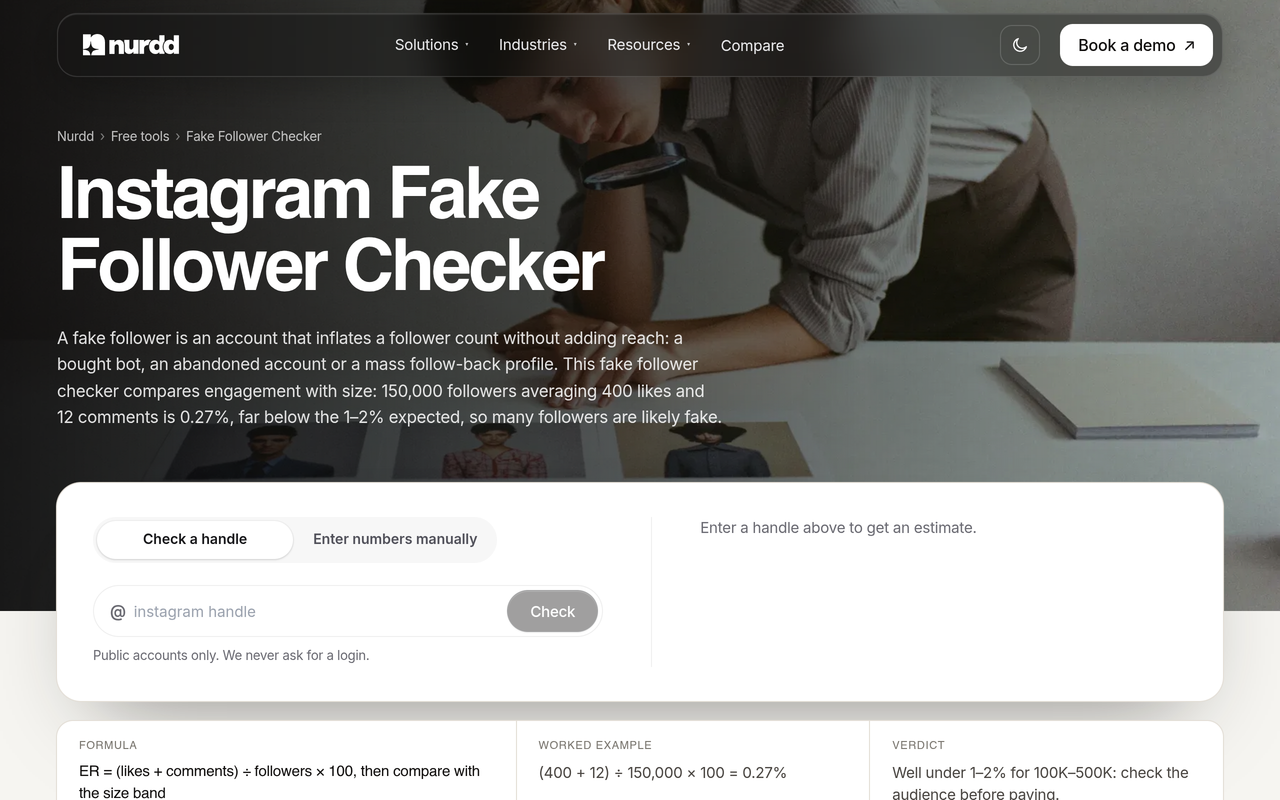
Read the table from top to bottom as an escalation ladder: cheap checks first, evidence of real outcomes last. Our own fake follower checker sits at the first rung and estimates fake or inactive followers from engagement. It is built to help you decide who to look at more closely, not to give a verdict.
How do I check for fake followers for free? A step-by-step process
The following seven steps combine the free methods in the order that wastes the least time. Each step states the action, the result you should expect and why it matters.
Step 1: Run two free checkers and compare
Action: enter the same public username into two different free checkers, for example the ones from Phyllo and HypeAuditor. Note the estimated percentage and any quality score from each.
Result: two estimates. If they land close together, you have a consistent signal. If one says low risk and the other says high, flag the creator for manual review.
Why: each vendor defines "fake" and scores differently, so disagreement is information, not noise.
Step 2: Calculate engagement rate from the last 10 to 12 posts
Action: add likes and comments for recent posts, average them, and divide by the follower count. Our engagement rate calculator and Instagram engagement rate calculator do this and compare against tier ranges, including by reach when you have Insights.
Result: a percentage you can set against the creator's size tier.
Why: a large audience with very little reaction is the classic sign of followers that are bots or ghosts. Use the same posts you will review in later steps, so you are not mixing a viral outlier with typical output.
Step 3: Read the comments, not the count
Action: open five recent posts and read every visible comment. Look for repeated phrases, emoji-only replies, comments in unrelated languages and replies that do not match the caption.
Result: a feel for whether people are actually talking about the content.
Why: automated tools struggle with context. A person reading the comments spots mismatches in seconds, such as a cooking post praised in generic terms by accounts that never post food.
Step 4: Sample the follower list
Action: open the followers list and scroll through about 30 accounts picked at different depths, not just the top. Note empty profiles, strings of digits in usernames, no posts, and accounts following thousands of people.
Result: a rough count of how many sampled accounts look automated or abandoned.
Why: it is a small sample and cannot be projected onto the whole audience with precision. It does show you the character of the audience, and it can contradict a checker's clean score.
Step 5: Review the growth curve
Action: look at follower growth over the past 6 to 12 months in the checker's growth chart. Mark sudden vertical jumps and look at what the creator posted around those dates.
Result: an explanation for each jump (a viral Reel, a giveaway, a feature) or a gap with no explanation.
Why: real growth is lumpy but traceable. Unexplained jumps followed by decline are consistent with purchased followers that were later removed by the platform.
Step 6: Ask for a live Insights screen share and check audience location
Action: request a screen share of Instagram Insights for audience (top countries, cities, age and gender) and for the last 30 days of reach. Compare the top locations with where your product ships.
Result: the data public checkers cannot access, from the source.
Why: a creator whose audience sits mostly in countries you cannot serve is a poor buy even if every follower is human. Ask for a live screen share instead of a static image, because static images are easy to edit or recycle.
Step 7: Pay against outcomes, not the audit score
Action: start with a smaller paid test, a unique link or discount code and agreed deliverables. Our UTM structure guide for influencer campaigns shows how to tag links so results are clean.
Result: clicks, add-to-carts and orders attributed to that creator.
Why: every audit step reduces risk but none removes it. Tracked results are the only check that proves buyers exist.
A worked example: reading two conflicting checker results
The numbers below are hypothetical and exist only to show the arithmetic. They are not data from any real creator or tool.
Imagine a beauty creator with 80,000 followers. Checker A estimates a low share of suspicious followers; Checker B flags a high share. Their last ten posts average 640 likes and 25 comments.
- Add likes and comments: 640 + 25 = 665 interactions per post.
- Divide by followers: 665 ÷ 80,000 = 0.83%.
- Compare against the tier range in the engagement rate calculator. If that tier's typical range is clearly higher than 0.83%, the audience is under-reacting.
- Sample 30 followers. Suppose 11 look automated or empty. That is 11 of 30, roughly 37%, from a small sample, so it suggests a problem but does not prove a specific rate.
- Request Insights. Suppose 55% of the audience is in a country you do not ship to. Even with real followers, the effective reachable audience is about 45% of 80,000, or 36,000.
The verdict in this made-up case: the two checkers disagreed because the account sits in a grey zone of inactive and mismatched followers. A fixed fee priced on 80,000 followers would overpay. Pricing against the reachable audience, or switching to a performance-based deal, protects the budget. You can model the commercial effect in the influencer ROI calculator and cross-check the fee against published rates in the influencer rate card estimator.
What should I check before paying a creator? A checklist
Use this list as a go or no-go gate. Work down it in order and stop if a step raises a serious concern.
- Confirm the account is public and has enough followers for your chosen checkers to work (HypeAuditor states a 1K minimum).
- Run two free fake follower checkers and record both percentages.
- Calculate engagement rate from the last 10 to 12 posts and compare with the creator's size tier.
- Read comments on five posts for repeated, generic or off-topic replies.
- Sample 30 followers across the list and count obvious bots or empty profiles.
- Review the 6 to 12 month growth chart and ask the creator to explain every spike.
- Get a live screen share of Insights: audience location, age, gender and 30-day reach.
- Compare audience location with where you sell and ship.
- Check that prior sponsored posts perform similarly to organic ones.
- Set payment terms that tie part of the fee to tracked outcomes, with a unique link or code.
For a deeper look at this process, our guides on spotting fake audiences on Instagram and vetting an influencer's audience before paying go through the buying-intent side in more detail.

What are the common mistakes when running a free fake follower check?
- Trusting one tool. A single percentage looks precise but hides the vendor's definitions. Two tools beat one.
- Treating a low fake percentage as approval. A clean follower scan says nothing about paid likes, pods, relevance or reach.
- Using a round-number threshold blindly. Many articles suggest an acceptable percentage, but definitions differ between tools, so a number that is safe on one scale is risky on another. Decide a threshold per tool and apply it consistently.
- Assuming mid-sized creators are safe. Fake audiences are not limited to small or huge accounts, and mid-sized creators are where many brands shop, so check them as carefully as anyone.
- Checking only one platform. A creator may be clean on Instagram and inflated on another platform you are also buying. See our note on why Instagram results do not carry to YouTube.
- Accepting screenshots. Static images can be old or edited. A live screen share is harder to fake.
- Skipping tracking. Without a code or tagged link you cannot tell whether a good-looking audience bought anything.
- Confusing follower quality with sales impact. Posts can go viral and still drive nothing, as covered in why a best-performing creator post got zero sales.
How can Nia by Nurdd help vet creators?
Nia by Nurdd is an AI-native creative studio at getnia.studio, with influencer marketing built in. Inside that workflow, brands can discover creators from a database of 10M+ profiles, filter by niche, audience quality, engagement authenticity and brand match score, and run TruAI, Nurdd's proprietary fake follower detection. It also generates pre-spend ROI forecasts and attributes product-level sales to creators after campaigns close. Nia is priced below comparable plans.
Book a demo and bring a creator you are considering: you will see how that creator is assessed inside Nia by Nurdd for audience quality, a pre-spend forecast and how sales would be attributed afterwards.
No detection method is perfect, and Nurdd does not claim a specific accuracy rate for TruAI. It is a screening layer in a workflow that still relies on the manual checks above: Insights from the creator, comment review and a tracked test. What the workflow removes is the tab-hopping between a checker, a spreadsheet and a rate sheet. You can read more about Nia by Nurdd on the product overview and see how it compares with other influencer platforms such as Collabstr and Upfluence.
If your creators are drawn from a specific category, our industry pages for beauty and fashion and apparel show how brands in those sectors structure influencer programmes. To build a spend plan around vetted creators, try the marketing budget planner, and for forecasting by predicted sales, read how to pick influencers based on predicted sales.
What is the limit of any audit, free or paid?
Paid platforms may see more than free ones, for example through creator-authorised data, but they share a core constraint with free tools: a model cannot prove intent. Because platforms remove fake accounts in waves, a follower count can shift quickly. That is a reason to run your check close to the signing date, not weeks before.
Treat every audit as a snapshot with a shelf life. Re-run the quick checks (checker, engagement rate, growth chart) before each new brief to the same creator, and keep a record of what you saw so a drop in performance can be traced.
Decision table: what to do with each result
This table turns the audit into an action, so the outcome of each check feeds a clear next step.
| What you see | What it probably means | What to do |
|---|---|---|
| Both checkers low risk, engagement in range, Insights match your market | Audience looks genuine and relevant | Proceed with a tracked test post |
| Checkers disagree, engagement in range | Definitions differ, audience likely fine | Request Insights, then proceed with tracking |
| Checkers agree on high risk | Consistent signs of bots or inactive accounts | Decline, or renegotiate to a performance-only deal |
| Low risk, but engagement far below tier range | Real but disengaged audience, or a silent audience | Lower the fixed fee or switch to affiliate pay |
| Normal engagement, but comments look generic | Possible pod or paid engagement | Ask for reach and story data; test with a code |
| Real audience, wrong country | Brand mismatch rather than fraud | Pass, or limit to a market-matched campaign |
What should you do next?
Use free checkers to shortlist, manual checks to decide and tracked links to confirm. That sequence costs time instead of money and catches many avoidable mistakes.
If you want the shortlisting and vetting in one place, book a demo of Nia by Nurdd. You will see your own category's creators screened for audience quality, a forecast before any spend, and what sales attribution looks like once a campaign closes. You can also browse Nurdd's free tools and the Nurdd blog for more guides.
How we researched this
We reviewed public pages from free fake follower checker vendors (HypeAuditor, Collabstr and Phyllo), an industry checker page, an academic paper on arXiv, a news report on account removals and the Federal Register text of the US Federal Trade Commission rule. We checked the pages on the publication date of this article. We did not run hands-on tests of the tools, did not interview anyone and have no customer data. We left out second-hand vendor study percentages whose original studies we could not trace. The worked example uses hypothetical numbers to show arithmetic only.
Frequently asked questions
How do I check for fake followers for free?
Enter the public username into one or two free checkers, then calculate engagement rate from recent posts. Read the comments, sample about 30 followers from the list and review the growth chart. Finally, ask the creator for a live screen share of their Instagram Insights, which shows data no public tool can see.
What are the limits of free fake follower checkers?
They use only public data, so they cannot see reach, saves, story views or real audience breakdowns. Each vendor defines fake differently and does not publish an error rate. They also miss bought likes and comments, pods and followers that are real but irrelevant to your market.
Are free fake follower checkers accurate?
They are estimates, not verdicts. The vendor pages we reviewed describe their tools in general terms and do not publish accuracy rates. Comparing two tools and adding manual checks gives a far more reliable view than any single score.
Is it safe to use a fake follower checker?
Reputable checkers use public data and do not need your Instagram password. Phyllo's page states that its tool requires no credentials. Never enter your login details into a checker, and be careful with any tool that asks for them.
What engagement rate suggests fake followers?
There is no single cut-off, because engagement falls as accounts grow and varies by niche. Compare the creator's rate with the range for their size tier using the engagement rate calculator. A rate far below that range, especially with generic comments, deserves a closer look.
Can a creator with real followers still have fake engagement?
Yes. Likes, comments and views can be bought or traded in pods even when the follower list is genuine. A follower-only check will not catch this, so read the comments and compare sponsored post performance with organic posts.
Why do two fake follower checkers give different results?
Each tool uses its own model, its own sample of followers and its own definition of fake or suspicious. Some count inactive accounts, others only obvious bots. Different results on the same account are a sign to review it manually.
Is buying fake followers illegal?
In the United States, the FTC's rule on consumer reviews and testimonials, finalised in August 2024, addresses buying or selling fake indicators of social media influence, including followers, in certain circumstances. Rules differ by country, so brands should take legal advice for their own markets.