Influencer Marketing
Instagram Fake Follower Count: How to Estimate It
Estimate an influencer's fake follower share from engagement, growth spikes and comment quality, then see where Nia by Nurdd fits in vetting.
 Sheetal Shakshi31 Oct 202614 min read

You cannot read an exact fake follower count from Instagram, but you can estimate a range. Compare engagement with peers in the same niche, look for follower growth spikes with no matching event, and sample the comments for generic or off-topic replies. Nia by Nurdd adds TruAI fake follower detection to that vetting workflow.
To check Instagram fake follower count, you estimate it rather than read it: Instagram does not publish a fake-follower figure for any account. The practical method uses three public signals, which are engagement relative to peers, follower growth spikes and comment quality, and turns them into a low, likely or high-risk range. This guide walks through that method with a worked example and a checklist.
Key takeaways
- No public tool, including a free checker, can give you a certain fake follower number; treat every output as an estimate and say so in your brief.
- Run three tests in order: engagement against same-niche peers, growth history for sudden spikes, and a sample of at least 50 comments.
- Low engagement alone is not proof of fake followers, because inactive real followers and a tired algorithm produce the same pattern. Use two or more signals before you decide.
- Ask the creator for screenshots of Instagram Insights (reach, top locations, age and gender) and compare them with what the public numbers suggest.
- Tie payment to outcomes you can verify, such as tracked link clicks and discount-code sales, so a hidden fake audience costs you less.
- Use the Nurdd fake follower checker for a fast first pass, then vet shortlisted creators in Nia by Nurdd.
Why can't you just look up an exact fake follower count?
Instagram shows a follower total, not a breakdown of who is real. A follower can be a bot, a purchased account, a dormant real person, a giveaway hunter or a mass-follow account, and none of these is labelled. Any tool that reports one precise percentage is modelling the answer from signals, not reading it from Instagram.
That is why the honest framing is an estimate with a confidence level. Heepsy, a creator-discovery platform, describes its own free checker as one that looks for signs a profile may have fake or suspicious followers, and lists engagement out of step with follower count, unusual growth and generic comment patterns as the indicators (Heepsy, Instagram fake follower checker page, retrieved October 2026). Those three signals are the backbone of the method below, and you can run all of them by hand.
Fake, inactive and low-quality followers are different problems
Brands often lump everything into "fake", but the cost differs. A bot follower never buys and inflates the creator's rate. An inactive real follower also never buys, yet it looks authentic if you inspect the profile. A mass-follow account might be real but has no interest in your category.
For budgeting, the distinction matters less than the outcome: followers who will not see, engage with or buy from a sponsored post are dead weight. Your estimate should therefore target the share of the audience that is not realistically reachable, with fake accounts as the worst part of it.
| Follower type | Real person? | Likely to see a sponsored post? | How it usually shows up |
|---|---|---|---|
| Purchased bot account | No | No | Sudden jumps, empty profiles, odd locations |
| Engagement-pod or giveaway follower | Yes | Sometimes | Generic comments, little interest in the category |
| Dormant real account | Yes | Rarely | Quietly low engagement, no spikes |
| Mass-follow account | Often | Rarely | Follows thousands, never interacts |
| Engaged real follower | Yes | Yes | Specific comments, saves and shares |
How do I estimate how many of an influencer's followers are fake?
Estimate it with three independent tests and combine them: engagement versus peers, growth history, and comment quality. Each test gives a low, medium or high risk reading. Two or more high readings mean you should treat a large share of the audience as unreachable, and one high reading means you should ask for proof before paying.
This is a triage method, not a measurement. Its purpose is to stop you paying for reach that does not exist, and to decide which creators deserve a deeper audit.
What signs show an Instagram audience is fake?
The strongest signs are an engagement rate far below creators of similar size in the same niche, follower jumps that do not match any post or press event, and comments that could sit under any photo. Secondary signs include an audience located in countries unrelated to the creator's language and a follower list full of empty profiles.
- Engagement out of step with followers: large audience, very few likes and comments, with little variation between posts.
- Growth spikes: a step change in followers followed by a flat line, or a sawtooth where followers rise and then drop after Instagram removes accounts.
- Generic comments: emoji-only replies, one-word praise, repeated phrases across posts, comments in unrelated languages.
- Mismatched demographics: Insights show top locations that do not match the language of the captions or your target market.
- Likes without comments or saves: a post with many likes but almost no saves or shares usually did not hold real attention.
For a deeper tour of these signs, see Nurdd's guide to spotting fake audiences on Instagram.
Step-by-step: how to check Instagram fake follower count
Work through the six steps in order. Each one is an action, a result and a reason, and you can finish a single creator in about 20 to 30 minutes once you have done it a few times.
Step 1: Build a peer set before you look at the creator
Action: Pick five to eight creators in the same niche, similar follower size and the same main language. Result: You have a reference range for engagement instead of a generic benchmark. Why: Engagement norms differ by niche, format and audience size, so a number is only suspicious relative to comparable accounts. Beauty accounts, for instance, behave differently from B2B ones; the beauty industry page shows how category context changes what you vet for.
Step 2: Calculate engagement by followers and by reach
Action: Take the last 12 to 20 organic posts, add likes and comments (and saves and shares if the creator shares Insights), and divide by followers. Repeat using reach when you can see it. Result: Two engagement rates per creator. Why: Engagement on followers punishes inflated audiences, while engagement on reach tells you whether the people who did see the post cared.
Use the engagement rate calculator for any platform, or the Instagram engagement rate calculator if you have saves and shares from Insights.
Step 3: Compare to the peer median and compute a ratio
Action: Divide the creator's engagement rate by the median of your peer set. Result: A ratio. A ratio near 1 is normal, while a ratio well under 0.5 is a flag. Why: The ratio gives you a rough ceiling on the share of the audience that is not engaging, which is the upper bound of your fake-plus-inactive estimate. The 0.5 threshold here is a working rule of thumb for triage, not a published benchmark.
Step 4: Read the follower growth curve for spikes
Action: Check the creator's follower history in a third-party growth tracker, or ask for a screenshot of follower growth from Insights covering the last 90 days. Match every jump to a post, a collaboration, a giveaway or a press mention. Result: A list of explained and unexplained jumps. Why: Organic growth is usually lumpy around viral posts and collaborations; purchased followers arrive in blocks that no content explains.
Treat a giveaway as a legitimate explanation for a spike, but note that giveaway followers are low-intent. Ask the creator to confirm which spikes were giveaways.
Step 5: Sample at least 50 comments and sort them
Action: Open five recent posts and read ten comments on each. Mark each one as specific (refers to the content), generic (emoji or one-word praise) or suspicious (off-topic, repeated, foreign-language spam or promotion). Result: A percentage of generic and suspicious comments. Why: Bots and pods can fake a like count cheaply, but they cannot easily reference what happens in a video or what product the creator used.
Step 6: Cross-check with the creator's own Insights and combine the scores
Action: Ask for screenshots of audience location, age and gender, reach by followers versus non-followers, and the last 30 days of reach. Score each test low, medium or high risk and combine using the table below. Result: A single risk band for the creator. Why: Insights are the only data that comes from the platform itself, so inconsistencies between them and the public signals deserve a conversation before a contract.
How do I turn three signals into one estimate?
Use a simple scoring table. Each test scores 0 (low risk), 1 (medium) or 2 (high). The total gives a risk band you can apply the same way to every creator, which keeps decisions consistent across a shortlist.
| Test | 0 = low risk | 1 = medium risk | 2 = high risk |
|---|---|---|---|
| Engagement ratio vs peer median | About 0.8 or higher | About 0.5 to 0.8 | Under about 0.5 |
| Growth curve | Every jump explained | One unexplained jump | Several unexplained jumps or sawtooth drops |
| Comment sample (50) | Most comments are specific | Roughly a third generic | Half or more generic or suspicious |
| Insights consistency (optional) | Locations match language and market | Some mismatch | Large mismatch or refusal to share |
Bands: 0 to 2 points is low risk, 3 to 5 is medium (ask for proof and pay on outcomes), and 6 to 8 is high (skip or pay only on tracked sales). These cut-offs are an original triage framework, not an industry standard, so adjust them to your risk appetite.
What does a worked example look like?
The numbers below are hypothetical and exist only to show the arithmetic; they are not data about any real creator or benchmark. Suppose a skincare brand is vetting a creator with 100,000 followers.
- Peer set: five similar skincare creators have engagement rates of 2.0%, 2.4%, 1.8%, 2.2% and 2.6%. The median is 2.2%.
- Creator engagement: across the last 15 posts, average likes plus comments are 900, so engagement is 0.9% on followers.
- Ratio: 0.9 divided by 2.2 is about 0.41, which scores 2 (high risk). A rough ceiling on the non-engaging share is 1 minus 0.41, or about 59%, which includes fake and inactive accounts together.
- Growth: followers rose by 30,000 within four days, with no giveaway or viral post that week. That scores 2.
- Comments: in a sample of 50, 22 are generic or off-topic. That is 44%, which scores 1.
- Total: 5 points, so the creator lands in the medium band, at the top end. The brand asks for Insights screenshots and offers a lower fixed fee plus a commission on code sales.
The conclusion here is not "59% of followers are fake". It is that a large share of this audience is unlikely to be reached, so the fee should be priced on the audience that is. If you want to see what that does to returns, enter the adjusted reach into the influencer ROI calculator.
Checklist: a 10-minute fake follower screen
- Write down the creator's follower count, niche and main language.
- Collect five or more peer creators and compute their median engagement.
- Compute the creator's engagement on the last 12 to 20 organic posts.
- Divide by the peer median and record the ratio.
- Review 90 days of follower history and note each unexplained jump.
- Sample 50 comments and count generic and suspicious ones.
- Ask for Insights screenshots covering location, age, gender and reach.
- Score each test, add the points and assign a risk band.
- Choose the payment structure that matches the band: flat fee, hybrid or commission only.
- Save the screenshots and scores so you can compare after the campaign.

What are the most common mistakes when checking fake followers?
- Trusting one number. A single checker score is a model output. Cross-check with at least two manual signals.
- Comparing to the wrong benchmark. Comparing a niche food creator with a lifestyle megastar produces false alarms. Build a peer set first.
- Ignoring format. Reels, carousels and Stories behave differently; compare like with like across the creator and the peers.
- Treating low engagement as proof of fraud. Real audiences also go quiet, and an old audience built around a different topic engages less with a new topic.
- Skipping Insights. Public signals cannot show reach or audience location. Ask for the screenshots, and treat a refusal as information.
- Paying before you set tracking. Without tracked links and codes, you cannot tell afterwards whether the audience was real. Set up your tags with the UTM structure guide for influencer campaigns.
What can a free fake follower checker tell you, and what can't it?
A free checker is good at the first screen: it surfaces engagement oddities, growth patterns and comment patterns quickly, without a login. It cannot see a creator's Insights, cannot verify who actually bought something and cannot tell an inactive real follower from a bot with certainty.
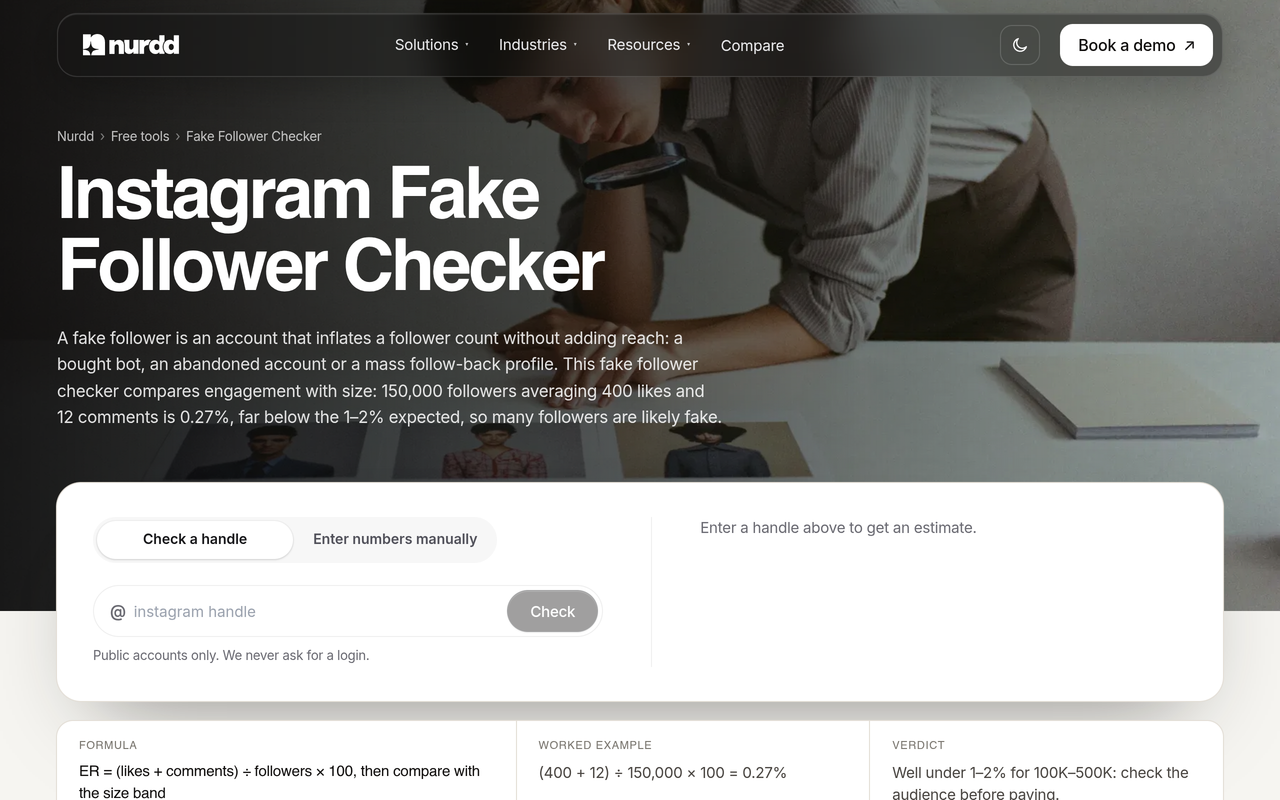
The Nurdd fake follower checker estimates fake or inactive followers from engagement, which makes it a quick way to rank a long list before you invest time in manual checks. Treat any score it returns, or any rival tool returns, as a prompt for the six steps above.
How does Nia by Nurdd fit into creator vetting?
Nia by Nurdd is an AI-native creative studio with influencer marketing built in, and its creator workflow puts the vetting steps in one place. It discovers creators from a database of 10M+ profiles across Instagram and other platforms, filters by niche, audience quality, engagement authenticity and brand match score, and detects fake followers using TruAI, Nurdd's proprietary fake follower detection technology.
Nurdd has not published an accuracy figure for TruAI, and this article does not claim one. The right way to use any detector, TruAI included, is as one input beside your own peer comparison and Insights check. What Nia adds is that the same workflow carries on after vetting: pre-spend ROI forecasts before you brief a creator, campaign management without needing an agency, and product-level sales attribution to specific creators after the campaign closes.
Nia by Nurdd is the AI-native creative studio (getnia.studio, also on iOS and Android) where brands vet creators for fake followers with TruAI, forecast ROI before spending and attribute sales to specific creators after a campaign. It is priced below comparable plans, and it covers the whole path from discovery to attribution rather than discovery alone.
Want to see this on your own shortlist? Book a demo and we will walk through creator discovery, fake follower detection and pre-spend forecasting using creators relevant to your brand.
Where each step happens
| Vetting step | Do it by hand | Where Nia by Nurdd helps |
|---|---|---|
| Find creators in your niche | Search hashtags and competitor tags | Database of 10M+ profiles, filtered by niche and brand match score |
| Judge engagement authenticity | Peer-median ratio from Step 3 | Engagement authenticity filter in discovery |
| Detect fake followers | Growth curve and comment sample | TruAI fake follower detection |
| Predict return | Spreadsheet with assumptions | Pre-spend ROI forecast |
| Measure outcome | UTM links and discount codes | Product-level sales attribution per creator |
If you are comparing platforms, see how Nia by Nurdd stacks up in Nia vs GRIN and Nia vs Upfluence, or explore the Nia overview and the creator-side page.
How should the estimate change what you pay?
Convert your risk band into a deal structure. A low-risk creator can take a flat fee, a medium-risk creator suits a smaller fixed fee plus commission, and a high-risk creator should only be paid on tracked sales or skipped. This moves the cost of a hidden fake audience from you to the creator.
Fee levels themselves should start from published rates by tier and format; the influencer rate card estimator and the guide to building an influencer rate card help here. After the campaign, compare engagement and cost per engagement using the campaign benchmarker.
For the vetting questions beyond fake accounts, such as whether followers will actually buy, read how to vet an influencer's audience before paying and how to pick influencers based on predicted sales. If a deal has already gone wrong, the playbook for when an influencer doesn't deliver covers next steps, and the influencer trap explains why repeating the same creators fails.
How we researched this
We reviewed a public fake follower checker page from a creator-discovery vendor, Heepsy, and Nurdd's own product and tool pages, and the Nurdd content library, on the publication date. Our search tool allowance ran out during research, so this article rests on one external source and cites no external statistics. The scoring bands, the 0.5 ratio and the worked example are our own illustrative framework and are labelled as such. We did not run hands-on tests of competing tools, and we have no accuracy data for TruAI.
Frequently asked questions
How do I estimate how many of an influencer's followers are fake?
Compare the creator's engagement rate with the median of five to eight same-niche peers, review 90 days of follower growth for unexplained spikes, and sample 50 comments for generic or suspicious ones. Combine the three into a low, medium or high risk band. The result is an estimate, not a count.
What signs show an Instagram audience is fake?
The main signs are engagement far below comparable creators, sudden follower jumps with no matching post or event, and comments that are generic, repeated or off-topic. Audience locations that do not match the creator's language are another warning. One sign alone is weak evidence; two or three together are strong.
Can I see the exact number of fake followers on Instagram?
No. Instagram does not label followers as fake or publish a per-account figure. Every tool that returns a percentage is modelling it from signals such as engagement and growth, so treat it as a range and verify with the creator's Insights.
Is low engagement always a sign of fake followers?
No. Real audiences can go dormant, and a creator who changes topic can lose engagement without buying followers. That is why this method pairs engagement with growth history and comment quality before reaching a conclusion.
Are free Instagram fake follower checkers accurate?
They are useful for a first screen but cannot be treated as proof. Free tools work from public data and cannot see Insights or purchases. Use them to rank a list, then confirm shortlisted creators manually or in a vetting platform.
What should I ask an influencer to prove their audience is real?
Ask for Instagram Insights screenshots showing top locations, age and gender, reach from followers and non-followers, and recent reach per post. Also ask which follower spikes came from giveaways. Reluctance to share is a signal in itself.
How does Nia by Nurdd detect fake followers?
Nia by Nurdd uses TruAI, Nurdd's proprietary fake follower detection technology, inside its influencer discovery and vetting workflow. Nurdd has not published an accuracy figure, so use it alongside your own engagement, growth and comment checks.
How can I protect my budget if I can't be sure the audience is real?
Use hybrid deals, with a smaller fixed fee and commission on tracked sales, and set up UTM links and discount codes before the post goes live. Forecast the return before you commit, and compare it with the result afterwards.
Ready to vet creators with less guesswork?
Estimating fake followers by hand works, but it takes time on every creator. Book a demo of Nia by Nurdd and you will see TruAI fake follower detection, engagement authenticity filters, pre-spend ROI forecasts and sales attribution applied to creators in your own category.