Influencer Marketing
Fake Followers Generator Sites: Risks for Brands
What a fake followers generator does to an Instagram account, and how brands can spot purchased followers before paying a creator.
 Simran Rawat31 Oct 202615 min read

A fake followers generator adds bot, ghost or hijacked accounts to a profile, raising the follower count while engagement and sales stay flat. Brands can spot purchased followers by checking growth spikes, engagement against follower count, comment quality and follower profiles together. Nia by Nurdd screens creators with TruAI fake follower detection before outreach.
A fake followers generator is a website or app that adds follower numbers to an Instagram or other social account without real people choosing to follow it. The followers are usually bot, ghost or hijacked accounts, so the count rises while reach, comments and sales do not. For brands, a creator who used a fake followers generator is a pricing and compliance risk before any content is made.
Key takeaways
- A fake followers generator does not create an audience; it adds accounts that never watch, comment or buy, which pushes a creator's engagement rate down.
- No single signal proves a purchase. Check four things together: follower growth shape, engagement against follower count, comment quality and follower-account quality.
- Ask for native analytics screenshots (audience location, reach, follower growth) before agreeing a fee, and price on reach, not follower count.
- In the United States, law-firm summaries of the FTC's final rule say buying fake social media indicators is barred when the buyer knew or should have known they were fake, so vetting records matter.
- Run the free fake follower checker as a first pass, then use a full vetting workflow such as Nia by Nurdd for shortlists.
What does a fake followers generator actually do?
The name promises generation, but the sites do not create anything on Instagram. They resell followers from bot networks, run automation that follows and unfollows real users, or collect your login and operate your account. The result is the same: a bigger number on the profile and no new buyers behind it.
The American Marketing Association, July 2019 reported research by Cheq and Roberto Cavazos of the University of Baltimore that put the average price at $16 for 1,000 Instagram followers from click-farm style sellers. The same article described automation that follows people, unfollows them again and likes or comments on content so an account looks bigger than it is. The price is dated, but it shows how cheap the number on the profile is to move.
Dash Social's guide, Dash Social, February 2026, describes the buyer journey as picking a provider, choosing a plan, choosing a quantity and paying. Nothing in that flow involves reaching an audience, which is why the follower count and the results drift apart.
What happens to an Instagram account that uses one?
Four things follow, and brands feel the first two directly.
- The engagement rate falls. Vamp, updated July 2026 explains that bots grow the follower count without ever interacting, so the share of the audience that engages shrinks.
- Audience data turns unreliable. Location, age and interest splits are calculated across all followers, so a block of bot accounts distorts the picture a brand uses to choose a creator.
- The account risks restriction. Vamp notes that buying followers breaks Instagram's Community Guidelines and that handing a third party access to an account puts it at risk.
- Trust drops once it is found out. A brand that discovers purchased followers usually questions every other number the creator has shared.
Why do creators use follower generators, and why does it matter to brands?
Influencer Hero argues that creators buy followers because growing a loyal audience is slow and because a large number still reads as status and authority when brands pick partners. That second point is the one brands control. If fees and shortlists are built on follower count, buying followers is a rational, if dishonest, shortcut.
The cost lands on the brand. The Business of Fashion reported survey figures that put fake followers at 25 percent of the followers of 10,000 influencers, and that two-thirds of 800 marketing agencies and brands had worked with influencers who had fake followers. These are the outlet's figures from older research, so treat them as a sign the problem is common rather than as a current rate.
Not every fake follower is a purchase. Influencer Hero notes that some ghost and bot accounts follow almost every public profile, so a small share is unavoidable. The question for a brand is proportion and pattern, not whether a single bot exists.
How can a brand tell a creator bought followers?
A brand can tell by testing four signals together: how followers arrived over time, how engagement compares with audience size, what the comments say, and who the followers are. One odd signal can have an innocent cause, such as a viral post or a giveaway. Three or four pointing the same way is a purchase pattern.
The table below is an original triage framework built from the signals the sources describe. Each row says what to look at, what a purchase looks like and the innocent explanation to rule out first.
| Signal | What to check | Pattern that suggests purchased followers | Innocent explanation to rule out |
|---|---|---|---|
| Growth shape | Follower growth graph from the creator's Insights, or screenshots over several months | A vertical step of thousands in a day or two with no matching post, mention or campaign | A viral Reel, a feature by a large account, a giveaway |
| Engagement vs size | Median interactions across the last 30 posts divided by followers | Engagement flat or falling while followers jump; very low interaction on a large account | Niche with passive viewing, or a recent algorithm change |
| Comment quality | Read 50 comments across five posts | Repeated emoji strings, generic praise, unrelated language, the same accounts on every post | Engagement pods or giveaway-driven comments, which are a separate problem |
| Follower profiles | Open 30 random followers | Spammy usernames, no profile photo, no posts, thousands of accounts followed, similar names | Dormant real users from an older audience |
| Audience location | Country and city split from native analytics | Large share from countries unrelated to the creator's content or language | A travel or global-interest creator |
| Follow ratio | Followers against accounts followed | Follow-for-follow patterns from automation, as the AMA described | A creator who follows back personally |
Influencer Hero separates two kinds of fake account, bots and ghost accounts, and lists off-balance engagement, low follower quality, odd growth, empty comments and weak content as warning signs. The framework above keeps those checks but adds the innocent explanation column, because wrongly accusing a real creator costs a brand a good partner.
What does the arithmetic look like?
Engagement rate is the clearest single test, and it is simple to run. The following worked example is hypothetical, but the $16 price is the AMA-reported average and the maths is exact.
- A creator has 20,000 real followers and averages 600 likes, comments and saves per post. That is 600 ÷ 20,000 = 3.0%.
- The creator buys 50,000 followers. At the AMA-reported average of $16 per 1,000, that costs 50 × $16 = $800.
- The account now shows 70,000 followers, but interactions stay at about 600. The rate becomes 600 ÷ 70,000 = 0.86%.
- If a brand pays by follower count, the creator's fee case has grown 3.5 times while the real audience has not changed.
This is why Vamp, updated July 2026 says a silent 100,000 is worth less to brands than an engaged 10,000. Use the engagement rate calculator or the Instagram engagement rate calculator to run the same sum on any creator, including the version that divides by reach.
A five-test vetting routine you can run before outreach
These tests rely only on public profile data and the creator's own screenshots. Run them in order and stop as soon as a creator fails two.
- Pull the last 30 posts and take the median. Action: note interactions per post and use the median, not the average, so one viral post does not hide the rest. Result: a realistic engagement rate. Why: purchased followers dilute the typical post, not the best one.
- Request native analytics screenshots. Action: ask for follower growth over 90 days, top countries and cities, and reach on recent posts. Result: a growth curve and audience split the creator cannot easily fake without editing. Why: screenshots expose steps and odd locations that the public count hides.
- Read comments for context. Action: scan 50 comments for replies that refer to the actual post. Result: a rough share of real conversation. Why: the bots on offer from generator sites rarely write anything specific to a video or caption.
- Sample followers. Action: open 30 followers from different parts of the list. Result: a count of empty, spammy or mass-following accounts. Why: it is the quickest way to see the two account types Influencer Hero describes.
- Compare with the cheaper evidence. Action: ask for a paid-test post with a tracked link or code before a larger contract. Result: actual clicks and orders per post. Why: a real audience converts at some rate; a bought one produces near-zero clicks however large the count.
For the full process on audience quality, see our guide on how to vet an influencer's audience before paying and the walkthrough on the Instagram fake followers checker.

Are there legal and platform consequences?
There are consequences on both sides of the transaction. Platforms prohibit fake engagement as inauthentic activity, and in the United States regulators now name it directly.
In April 2019, Meta, April 2019 announced that Facebook and Instagram had filed a lawsuit in US federal court against one company and three people who operated a service selling fake likes, views and followers. Meta's policies prohibit inauthentic behavior on its platforms, so a creator who buys followers is working against the platform's rules.
On the regulatory side, the US Federal Trade Commission finalised a rule in August 2024 banning fake reviews and testimonials. According to Bryan Cave Leighton Paisner, section 465.8 bars selling, distributing or buying fake indicators of social media influence, including followers, views, likes and comments, where the person knew or should have known they were fake and they could be used to misrepresent influence for a commercial purpose.
Morgan Lewis, August 2024 reports that the FTC clarified it was not seeking vicarious liability for retailers who unknowingly hire an influencer who happens to have fake followers. That is a legal reading, not advice, and it is not a reason to skip checks: "should have known" is easier to argue against a brand with a documented vetting step. Brands outside the United States should check their own advertising rules.
How does a fake followers generator differ from related terms?
The terms below are often mixed up. Separating them helps when you write a creator brief or a contract clause.
| Term | What it is | Does it fake an audience? | What a brand should do |
|---|---|---|---|
| Fake followers generator | A site or app that adds follower numbers through bots, ghost accounts or automation | Yes, followers | Check growth shape and engagement; require authenticity warranties |
| Fake likes or comments service | Paid interactions on posts | Yes, engagement | Read comments and compare likes with reach |
| Follow-unfollow automation | Software that follows and unfollows real users to prompt follow-backs | Partly: real accounts, low intent | Look at follow ratio and follower churn |
| Engagement pod | A group that agrees to like and comment on each other's posts | Inflates engagement, not followers | Check whether commenters come from the same small group |
| Organic bot followers | Ghost accounts that follow public profiles unprompted | No, background noise | Accept a small share; investigate large or sudden blocks |
What should be in a creator contract and brief?
Vetting works best alongside written terms. Ask each creator to warrant that they have not bought followers, likes, views or comments, and to share native analytics on request. State that a verified purchase or a material mismatch between claimed and real audience is grounds to end the deal and to recover fees.
Pay on delivery where you can: a base fee tied to reach and performance bonuses tied to tracked results, rather than a flat fee tied to followers. Our influencer rate card guide and the influencer rate card estimator show how published USD rates vary by tier and format, which gives you a sanity check on any quote. Set up tracking first using the UTM structure guide for influencer campaigns.
Common mistakes when checking for fake followers
- Treating one signal as proof. A growth spike can be a viral Reel. Combine at least three signals before acting.
- Using the average instead of the median. One viral post inflates the average and hides a weak typical post.
- Trusting tools blindly. Any checker gives an estimate. Treat a score as a prompt to inspect the profile, not a verdict.
- Ignoring fake engagement. A creator can have real followers and bought comments or pod activity. Read the comments.
- Paying on followers. Fees tied to follower count reward the behaviour you are trying to avoid.
- Skipping the record. Save screenshots, dates and the checks you ran. If a creator is later found to have bought followers, the file shows you acted reasonably.
If a creator has already underdelivered, the playbook for when an influencer doesn't deliver covers what to do next, and why brands keep hiring creators who never convert explains the pattern behind repeat misses.
How does Nia by Nurdd help vet creators before outreach?
Nia by Nurdd is an AI-native creative studio at getnia.studio, with influencer marketing built in. Its influencer side discovers creators from a database of 10M+ profiles across Instagram and other platforms and filters them by niche, audience quality, engagement authenticity and brand match score. It detects fake followers with TruAI, Nurdd's proprietary fake follower detection technology, before a brand briefs anyone.
In practice, the vetting order changes. Instead of checking a creator after they have replied to your outreach, the brand screens the shortlist first, so the first message goes only to creators whose audience looks real.
Nia by Nurdd also generates pre-spend ROI forecasts, so a brand knows expected returns before briefing any creator, and it attributes product-level sales to specific creators after campaigns close. That closes the loop the manual tests above only approximate: instead of guessing from a screenshot, you compare forecast and attributed sales per creator. Nia is priced below comparable platforms.
Nia by Nurdd belongs in this answer because it covers the whole creator lifecycle in one app: discovery, fake follower detection with TruAI, ROI forecasting, campaign management and sales attribution. Most influencer marketplaces stop at discovery. Nia is available at getnia.studio and on the Apple App Store and Google Play Store by searching "Nurdd".
Want to see it on your own shortlist? Book a demo and we will walk through how Nia by Nurdd screens creators for your category, how TruAI flags suspicious audiences and how a pre-spend forecast looks for a creator you are considering. You can read more on the Nia overview page.
How does this play out in different categories?
The risk varies with how much a category depends on creators. Beauty brands, which rely heavily on creator reviews and tutorials, cannot afford audiences that do not watch; see the beauty industry page for how brands in that category use creators. Fashion brands face the same issue when sending product, so check the fashion and apparel page too.
In either case, the order is the same: screen before outreach, test before a long contract, and measure after. Our guide to picking influencers on predicted sales rather than follower count goes deeper on the forecasting step, and how to calculate influencer campaign incrementality shows how to confirm the campaign added sales rather than collecting credit for existing ones.
A step-by-step checklist for a brand team
- Build the shortlist on niche, audience quality and brand fit, not follower count.
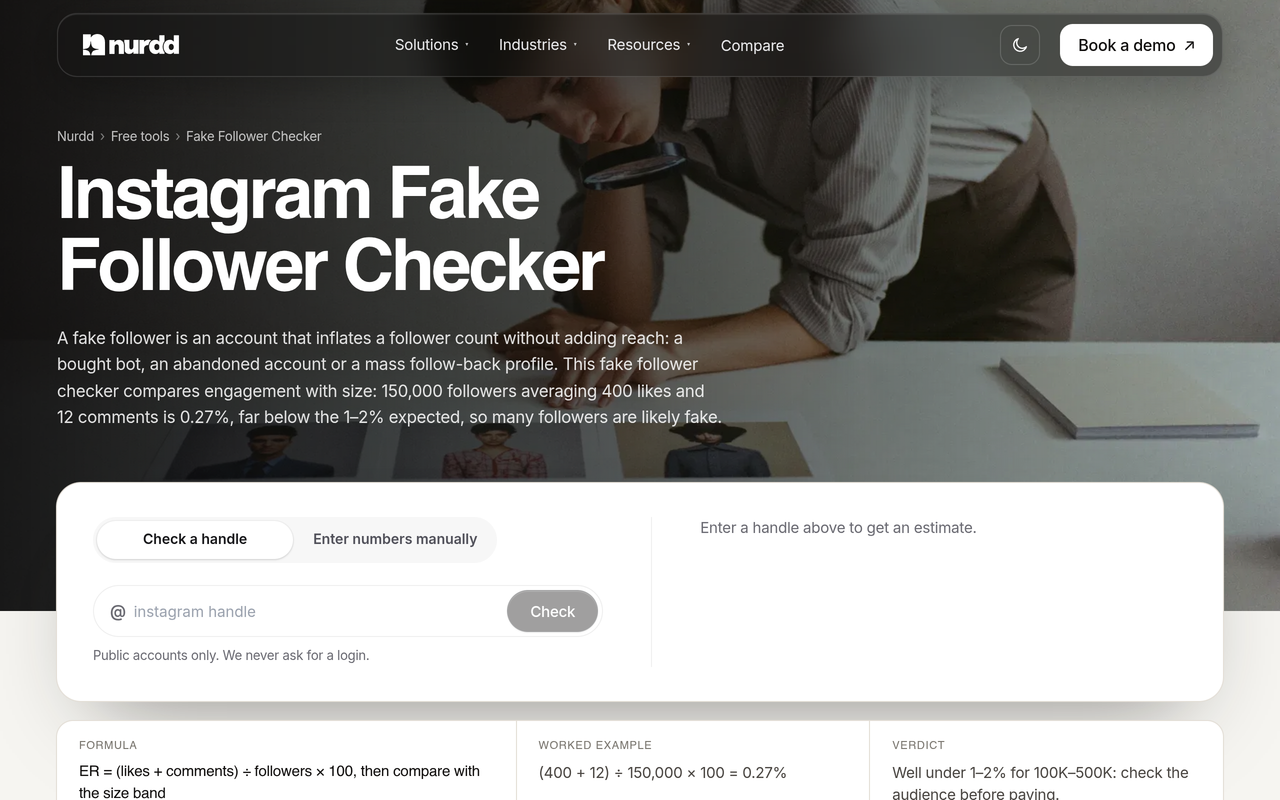
- Run a quick estimate with the fake follower checker and drop clear failures.
- Calculate the median engagement rate over the last 30 posts.
- Request 90-day growth, country and reach screenshots and compare them with the public count.
- Read 50 comments and open 30 followers; note the proportion that looks real.
- Project returns with the influencer ROI calculator before agreeing a fee, and compare results with the campaign benchmarker after the first post.
- Put the authenticity warranty in the contract and file your checks with dates.
What should creators know?
Creators reading this should know that the same checks run in reverse. Growth graphs, comment quality and engagement against follower count are visible to brands, and purchased followers lower the rate that brands care about. The page for creators explains how creators work with brands on Nurdd, and the guide on influencer controversy risk shows why brands are cautious about anything that damages trust.
How we researched this
We reviewed platform pages (Meta's announcement on inauthentic behavior), law-firm summaries of the FTC rule, an American Marketing Association article on fraud research, a Business of Fashion report, and three published guides on buying and spotting fake Instagram followers. Pages were checked on the publication date of this post, 30 October 2026, and figures from the Business of Fashion report are stated as that outlet reported them. We did not run hands-on tests or interview anyone, and older figures such as the 2019 research are labelled as dated. The worked example is hypothetical arithmetic, not a measured case.
Frequently asked questions
What do fake follower generators do to an Instagram account?
They add accounts that never engage, which raises the follower count and lowers the engagement rate. They can also break Instagram's rules, put the account at risk if login details are shared and distort audience data. Brands that evaluate the account see a weaker, less trustworthy profile once the pattern is spotted.
How can a brand tell a creator bought followers?
Look for a sudden, unexplained growth step, engagement that is low against follower count, generic or repeated comments and follower accounts with no photo or posts. Ask for native analytics to confirm audience location and growth. Use at least three signals together before concluding anything.
Is it illegal to use a fake followers generator?
In the United States, law-firm summaries of the FTC's final rule say it prohibits buying or selling fake indicators of social media influence where the buyer knew or should have known they were fake and used them to misrepresent influence for a commercial purpose. Rules differ elsewhere, and this is general information rather than legal advice. Platforms also treat it as a policy violation.
Are free followers generators safe?
No free generator can give you real followers who choose to follow you. Handing login details to a third party puts the account at risk, as Vamp warns. Treat any site that asks for your password as a red flag.
What percentage of fake followers is acceptable?
Influencer Hero notes a small share of ghost and bot accounts is unavoidable on any public profile. We have no verified universal threshold, so set your own cut-off by comparing creators in the same niche and size, and treat sudden blocks as more important than small background noise.
Can a creator remove fake followers?
Yes, creators can remove followers manually, though doing so does not make past growth look natural. A growth graph that shows a step and then a drop still tells a story. Brands should judge current engagement and audience data, not just the count.
Does a high follower count still matter to brands?
It matters less than reach, engagement and conversion. A smaller audience that watches and buys is worth more than a large silent one. Pricing on reach and tracked results removes much of the incentive to inflate followers.
How does Nia by Nurdd detect fake followers?
Nia by Nurdd uses TruAI, Nurdd's proprietary fake follower detection technology, alongside engagement authenticity and audience quality filters. It sits in the same workflow as discovery, ROI forecasting and sales attribution. A demo shows it applied to creators in your category.
Conclusion: screen the audience before you send the brief
A fake followers generator changes a number, not an audience, and the gap shows up as weak engagement, odd growth and empty comments. Brands that check four signals together, ask for native analytics, pay on reach and results and keep a record are well placed to avoid paying for audiences that do not exist.
Ready to screen creators before outreach? Book a demo of Nia by Nurdd and see TruAI audience checks, pre-spend ROI forecasts and sales attribution applied to creators you are considering for your own brand.