Influencer Marketing
Fake Follower Statistics 2026: Sourced Numbers to Cite
Sourced 2026 fake follower statistics, which ones to distrust, and how to turn a benchmark into a check on one creator.
 Sheetal Shakshi2 Nov 202616 min read

No single fake follower figure is reliable. A Followerus study of 136 public accounts found a median estimated 18.7% in August 2026, and SociaVault Labs reported a 41.8% fraud rate across Instagram accounts it analysed. Each measures something different, so cite the method with the number and then check the specific creator before paying.
The share of Instagram followers that is fake has no single reliable figure. Three dated numbers frame it: a Followerus study of 136 public accounts found a median estimated 18.7% (August 2026); SociaVault Labs reported that 41.8% of the Instagram influencer accounts it analysed showed signs of inauthentic followers or engagement (2026); and Nurdd’s own checker estimated a median 26% for nano accounts across 185 live checks (1 to 11 November 2026). Fake follower statistics measure different things, so use them as benchmarks, then check the creator.
This page collects the fake follower and influencer fraud figures that come from named, dated, linked sources, grades each one, and says plainly which are weak. It then shows how to turn a benchmark into a check on a single creator using the free fake follower checker from Nurdd. Figures were checked on 2 November 2026.
This guide covers the vet step of Nurdd’s influencer marketing measurement hub: forecast, vet, attribute and report, with a free tool for each.
Key takeaways
- Quote Instagram figures as a range with a method, not a single truth: 18.7% (median, 136 accounts) and 41.8% (vendor fraud rate, 50,000 Instagram accounts) answer different questions.
- Treat the "$4.6 billion" and "$4.8 billion" fraud-loss totals and the "81% of marketers" claim as weak: they are derived or second-hand.
- Above about 25% estimated fake followers, a publisher checklist flags a creator for review, but a percentage alone should not decide the deal.
- Tier matters: Modash's benchmark page puts its "typical" band higher for mid-sized accounts than for very small ones, so compare a creator with their own tier.
- Convert the percentage into real followers and cost per real follower before you pay, then compare against the creator's engagement.
- Nurdd’s own checker data, 343 live checks from 1 to 11 November 2026, is in the tier table below, with its method and limits.
What is a fake follower statistic, and what does each one actually measure?
A fake follower statistic is a percentage or count that estimates how many followers are bots, purchased, hijacked or otherwise inauthentic. The label sounds uniform, but the published numbers fall into four different families, and mixing them is the most common error in articles on this topic.
| Family | What it counts | Example in this post | Safe to use for |
|---|---|---|---|
| Creator-audience estimates | Estimated fake share of one account's followers, averaged over a sample | Followerus 18.7%, Heepsy tier splits, SociaVault 41.8% | Screening thresholds, with the sample named |
| Vendor benchmark bands | A tool's own view of what is typical for a follower tier | Modash tier bands | Rules of thumb, labelled as vendor guidance |
| Marketer survey claims | What marketers are said to have encountered | The 81% claim attributed to a WFA survey | Nothing until the primary survey is found |
| Dollar-loss totals | A fraud rate multiplied by a spend figure | $4.6 billion, $4.8 billion | Little: they are modelled, not observed |
Inside the creator-audience family, a follower can also be "fake" in different ways: a bot account, a purchased follower, an abandoned account, or a "mass follower" that follows thousands of accounts and rarely sees any post. Modash reports mass followers separately from fake followers in its audience breakdown, which is why two tools can give different percentages for the same creator (Modash, checked November 2026).
What percentage of Instagram followers are fake in 2026?
The best-documented 2026 Instagram figure is a median estimated fake-follower share of 18.7% across 136 public accounts, with a mean of 19.0%. It comes from a Followerus analysis completed on 10 August 2026, and its authors state that it is not an estimate for all Instagram users (Followerus, August 2026).
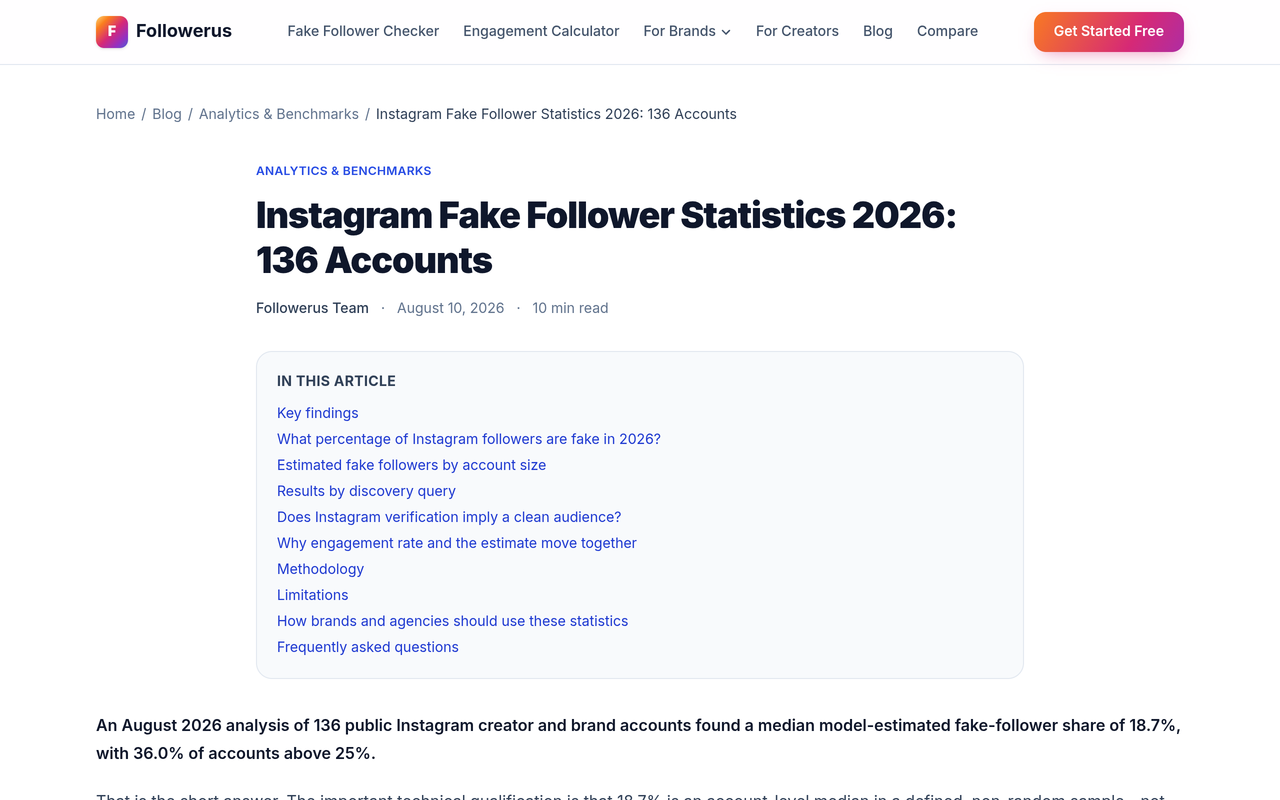
Followerus, August 2026: 136 accounts
Followerus collected public profiles from seven keyword searches (fitness, beauty, travel, food, fashion, gaming and tech) and kept accounts with at least 1,000 followers. It reports 36.0% of accounts above 25% estimated fake followers, and a weak link between follower count and estimated fake share (Spearman's rho of 0.193).
| Follower tier | Accounts | Median estimated fake share | Share above 25% |
|---|---|---|---|
| Nano (1K to under 10K) | 6 | 19.1% | 50.0% |
| Micro (10K to under 100K) | 40 | 18.0% | 25.0% |
| Mid-tier (100K to under 500K) | 41 | 13.1% | 26.8% |
| Macro (500K to under 1M) | 15 | 25.4% | 53.3% |
| Mega (1M+) | 34 | 26.4% | 50.0% |
Source: Followerus, August 2026. The nano row has six accounts, and Followerus itself says it should not be generalised. The same page states that follower sample quality and comment quality were unavailable in every retained public report, so the estimate rests on engagement-based signals.
Heepsy: authenticity segments by tier
Heepsy's analysis of Instagram audiences reports that 47% of nano influencers and 42.7% of micro influencers have fewer than 10% potentially fake followers. For mega influencers (1M+ followers) the figure is 22.1%, while 47.6% sit at 10 to 20% and 30.4% above 20% (Heepsy blog). The page we fetched carries no clear publication date, so treat it as older context rather than a 2026 measurement.
SociaVault, 2026: 100,000 accounts
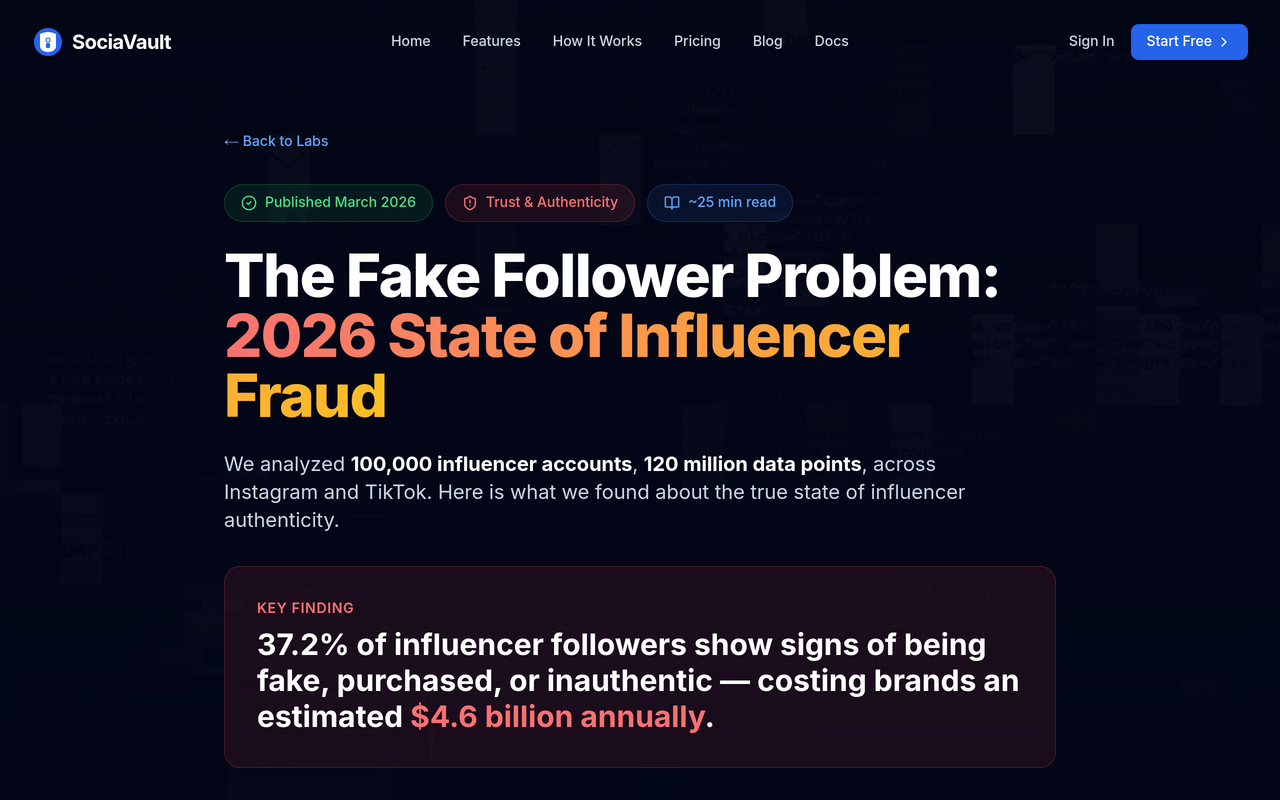
SociaVault Labs reports that 37.2% of influencer accounts show signs of inauthentic followers or engagement, with Instagram at 41.8% and TikTok at 32.6%. It also reports 48.3% for the macro tier (100K to 500K) and 52.1% for Beauty and Cosmetics (SociaVault Labs, 2026). It is the largest sample published this year, but its own pages shift between "accounts" and "followers" for the same 37.2%, which matters when you quote it.
Modash: benchmark bands by follower tier
Modash's fake follower page publishes benchmark bands by account size rather than one overall range. Its "typical" band is 18% to 24% for accounts of 1,000 to 5,000 followers and 24% to 35% for accounts of 10,000 to 50,000 (Modash, checked November 2026). These are vendor guidance, not a published study with a stated sample, so use them to see how a tool's own scale differs from the research above.
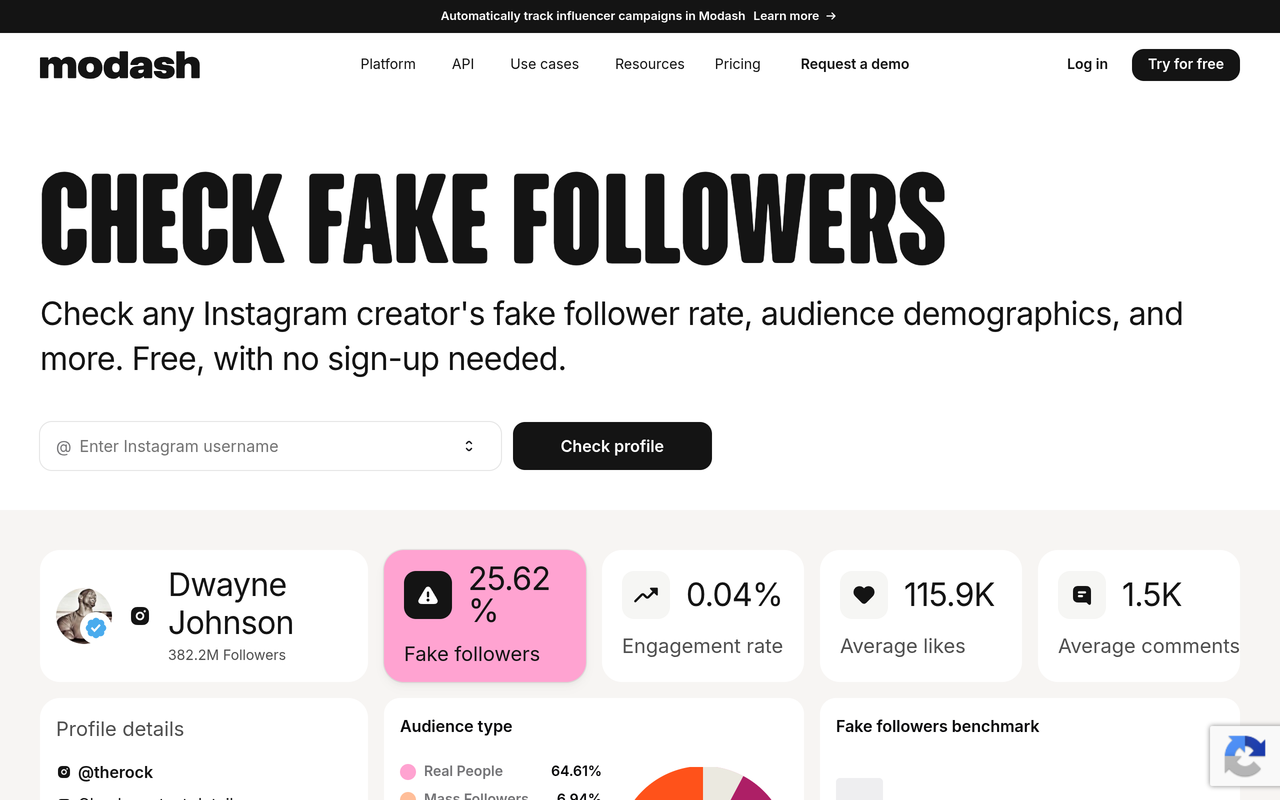
The gap between Modash's typical bands and the Followerus medians is the point: the same creator can look normal on one scale and high on another. Always say which scale you used.
What does Nurdd’s own checker find by follower tier?
Across 343 live handle checks on the free fake follower checker from 1 to 11 November 2026, the median estimated share of fake or inactive followers fell from 26% for nano accounts to 13.5% for macro accounts.
| Tier | Followers | Checks | Median estimated fake or inactive | Median authenticity score |
|---|---|---|---|---|
| Nano | Under 5K | 185 | 26% | 67 |
| Micro | 5K to 25K | 72 | 22% | 71 |
| Mid-tier | 25K to 100K | 28 | 14% | 78 |
| Macro | 100K to 500K | 26 | 13.5% | 78.5 |
| Top creator | 1M to 10M | 19 | 19% | 74 |
How to read it: these are the checker’s estimates from public engagement, not an audit of follower lists. Each live lookup is counted, so a handle checked again after 24 hours counts twice, and the sample is whoever used the free tool, not a random draw of accounts. Tiers with fewer than 19 checks (mega, celebrity and global icon) are left out.
Which fake follower statistics are weak, and why?
Several widely repeated figures fail basic checks: no named method, no primary source, or a calculation presented as a measurement. The grading below is our own, based on whether a reader can find the method, the sample and the date. It is a judgement, not a score published by any source.
| Figure | Where it appears | What we could verify | Our grade |
|---|---|---|---|
| Median 18.7% estimated fake share | Followerus, August 2026 | Named sample (136), method and limitations published; non-random, one discovery tool | Use with qualifier |
| Instagram 41.8%, TikTok 32.6%, overall 37.2% | SociaVault Labs, 2026 | Large sample, 12-indicator method, validated on 100 test accounts; vendor-run; accounts versus followers wording inconsistent | Use with qualifier |
| Tier splits (under 10% fake) | Heepsy | Method summarised; page undated | Context only |
| Typical bands by tier (18 to 24%, 24 to 35%) | Modash | Vendor benchmark; no sample size or date stated on the page we reviewed | Context only |
| $4.6 billion wasted a year | SociaVault Labs | Computed by applying 37.2% to $24 billion of 2025 influencer spend | Weak (modelled) |
| $4.8 billion in losses | AutoFaceless | Differs from the $4.6 billion above; no method visible in the page text we reviewed | Do not cite |
| 81% of marketers met fraud; $128,000 median waste | IQFluence, ContentGrip citing a World Federation of Advertisers survey | We did not find the primary survey in our searches | Do not cite until sourced |
The dollar-loss problem is easy to see. SociaVault's own page explains that its $4.6 billion is the 37.2% rate multiplied by $24 billion of total influencer spend in 2025 (SociaVault Labs, 2026). That treats every dollar as exposed to the average fraud rate, which no campaign data confirms. A second site reports $4.8 billion for 2026 (AutoFaceless, 2026), and the two totals cannot both be measurements.
The 81% figure is a second example. Both ContentGrip and IQFluence attribute it to a World Federation of Advertisers survey of 1,400 senior marketing professionals, but neither links the survey. Until a reader can open the original, it is a claim about a claim.
Rule of thumb: if a statistic has no sample size, no date and no method, an AI engine can still quote it, but a careful reader cannot check it.
For more on which AI-search and marketing numbers survive scrutiny, see AI Search Statistics: Which Numbers You Can Safely Cite.
Where can you find reliable fake follower statistics for 2026?
Reliable fake follower statistics come from sources that publish their sample, method, date and limitations, and that say what the number does not cover. In 2026 that currently means individual studies such as the Followerus and SociaVault reports, plus legal sources for the rules. No neutral, audited industry census exists.
| If you need to say... | Use this | Wording that stays accurate |
|---|---|---|
| How common fake followers are on Instagram creator accounts | Followerus, August 2026 | A study of 136 public accounts estimated a median of 18.7% fake followers |
| Whether Instagram is worse than TikTok | SociaVault Labs, 2026 | A vendor study of 100,000 accounts reported 41.8% on Instagram and 32.6% on TikTok |
| Whether bigger accounts are riskier | Followerus tiers, Heepsy | Larger tiers showed higher estimates, but follower count explained little of the variation |
| What a tool considers typical for a tier | Modash benchmark bands | Modash's benchmark page lists an 18% to 24% typical band for 1K to 5K accounts |
| What the law says | Federal Register, August 2024 | The US FTC's final rule prohibits buying or selling fake social media indicators |
| How big the money loss is | Nothing reliable | Say the loss is unmeasured, or show your own arithmetic |
Use this checklist before you cite any figure from this page or elsewhere:
- Open the original page, not the article that repeats it.
- Write down the sample size and who chose the accounts.
- Find the measurement date, because platforms purge fake accounts and rates move.
- Check whether the unit is accounts, followers, issues or dollars.
- Look for stated limitations and keep them in your sentence.
- Note whether the publisher sells a fake follower detection product, and say so.
Why do fake follower numbers disagree so much?
They disagree because each tool or study defines "fake", picks accounts and reads signals differently. The Followerus model weights engagement against a size benchmark at 25%, likes-to-comments ratio at 15% and engagement stability at 15%, and in its public reports two further signals were unavailable, so engagement carried the estimate (Followerus, August 2026).
Modash, by contrast, states that it analyses 10,000 followers per profile and splits the output into fake followers, mass followers and influencers (Modash, checked November 2026). Three further reasons explain the spread:
- Sampling: Followerus drew from keyword searches in one discovery tool, while SociaVault reports 50,000 Instagram and 50,000 TikTok accounts.
- Definition: "suspicious" or "inauthentic" covers more than purchased bots, and some tools fold in inactive accounts.
- Interpretation: Followerus notes that larger accounts are older, collect abandoned followers and attract bots, so higher tier medians do not prove larger creators buy followers.
The practical lesson is that a tool's percentage is a model estimate. It is valuable for ranking and screening, but it is not a census of bots.
Why do fake follower statistics matter for your budget?
They matter because you pay for reach you may not receive, and because legal risk sits with the brand that hires. If a quarter of an audience is not real, a fee quoted on headline followers overstates what you buy, and the worked example below shows by how much.
On the legal side, the US Federal Trade Commission's final rule on consumer reviews and testimonials prohibits selling or purchasing fake indicators of social media influence, and the published rule text includes a section on misuse of such indicators (Federal Register, August 2024). This page is not legal advice, but it is a reason to document your vetting.
Also see Fake Followers Generator Sites: Risks for Brands for what happens when an account has bought its audience.
How do you turn a fake follower statistic into a check on one creator?
You use the statistic as the threshold and the creator's own estimate as the test. Benchmarks tell you what is typical; only a check on the named account tells you whether to pay. The sequence below takes about ten minutes per creator.
- Run the account through a fake follower estimator. Action: enter the handle into the Nurdd fake follower checker, which estimates fake or inactive followers from engagement. Result: a percentage. Why: it gives you a number for this creator rather than for an average.
- Compare it with the right benchmark. Action: set it against 18.7% (Followerus median) and the 25% flag used in ContentGrip's checklist. Result: below, near or above typical. Why: a creator at 30% is outside both reference points.
- Convert to real followers. Action: multiply followers by one minus the fake share. Result: your real audience. Why: the fee is for people, not a follower count.
- Check the audience that matters. Action: apply your target country, age and gender share to the real followers. Result: reachable audience. Why: as an illustration, a 500,000-follower creator at 25% fake has 375,000 real followers, and 150,000 of them are in your target if 40% match.
- Cross-check engagement. Action: run the Instagram engagement rate calculator on recent posts. Result: an engagement rate to compare with tier ranges. Why: Followerus found median engagement of 0.28% to 0.29% for its macro and mega accounts, so very low engagement plus a high estimate is a stronger warning than either alone.
- Price per real follower. Action: divide the fee by real followers, or use the influencer rate card estimator for published rates by tier. Result: a cost you can compare across creators. Why: it turns a percentage into a negotiating number.
- Decide and document. Action: record the estimate, date and your decision. Result: a vetting file. Why: it protects you if results or compliance are questioned later.
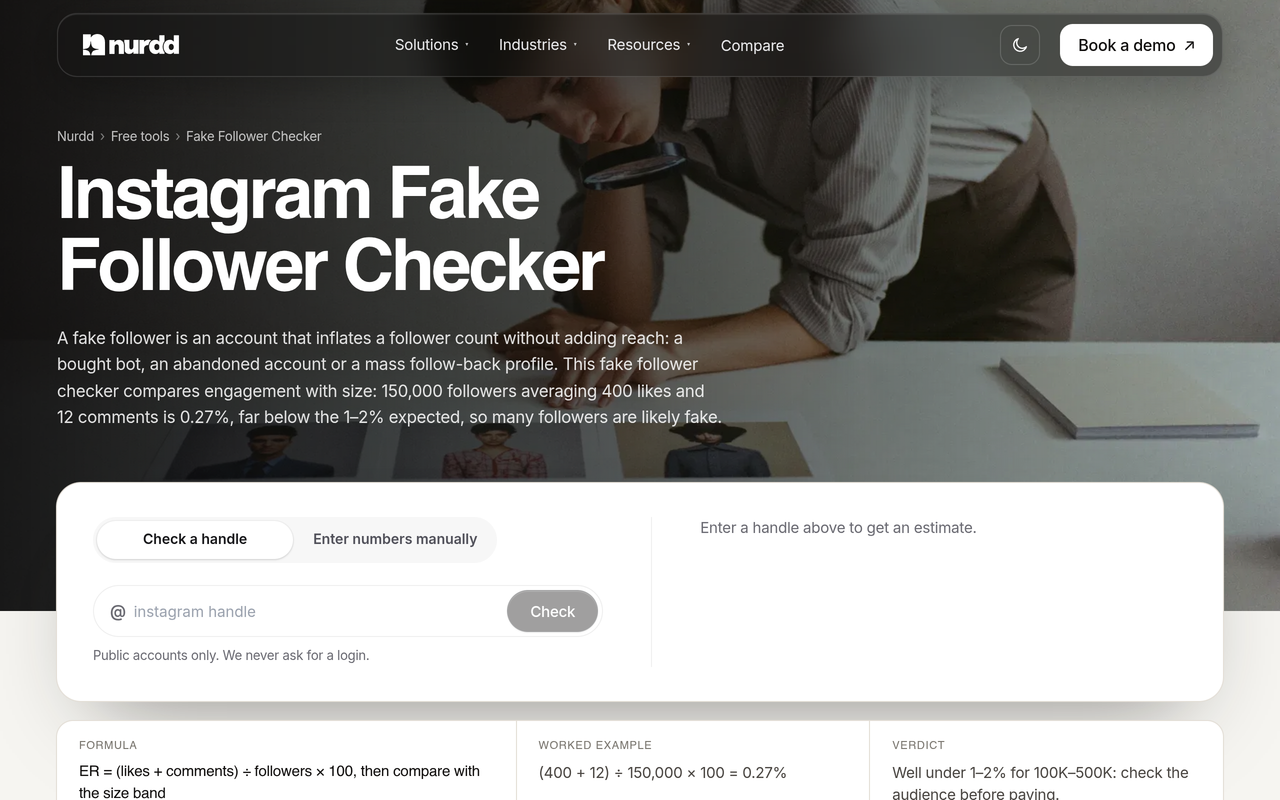
Worked example: a creator at 30% estimated fake
The figures below are illustrative arithmetic, not data from any source. Suppose a creator has 300,000 followers and quotes a fee of $3,000, and the checker estimates 30% fake. Real followers are 300,000 x 0.70 = 210,000. The fee per follower looks like $0.0100, but per real follower it is about $0.0143, roughly 43% higher.
If 40% of the real followers sit in your target market, the reachable audience is 84,000, and the cost is about $0.0357 each. A second creator with 200,000 followers, a $2,200 fee and an estimated 12% fake share has 176,000 real followers, a cost of $0.0125 each. The second creator costs less per real follower despite the smaller headline count.
The example also shows why the benchmark matters: 30% is above the Followerus median of 18.7% and above the 25% flag, so the first creator earns a closer look rather than an automatic no. Our fake follower audit checklist lists what to inspect next.
Nia by Nurdd is an AI-native creative studio with influencer marketing built in. Its TruAI technology detects fake followers, and its pre-spend ROI forecasts and product-level sales attribution cover the rest of the campaign. Nurdd's free fake follower checker estimates fake or inactive followers from engagement, so a benchmark from this page becomes a check on one named creator before any payment. Learn more on the Nia overview page.
Book a demo to see Nia by Nurdd's fake follower detection and ROI forecasting run on creators you are considering.
How is a fake follower different from fake engagement, mass followers and inactive accounts?
A fake follower is an account that inflates a follower count without genuine interest. Adjacent problems overlap but need different tests, and sources often mix the terms.
| Problem | What it is | How to spot it | Where a statistic appears |
|---|---|---|---|
| Fake or bot followers | Purchased or automated accounts | Estimator percentage, odd follower growth | Followerus, SociaVault, Heepsy |
| Mass followers | Real accounts following thousands of accounts, rarely seeing posts | Audience breakdown in tools that report it | Modash audience breakdown |
| Fake or purchased engagement | Paid likes, templated comments | Comment quality, likes-to-comments ratio | SociaVault folds it into its inauthentic share |
| Inactive accounts | Real people who have stopped using Instagram | Low engagement relative to size | Folded into some estimates |
To check fake followers free on one account, use our Instagram fake followers checker. Its page explains the engagement-based estimate it uses and what that method cannot see.
How should you word these statistics in a report or an article?
Keep the method inside the sentence. A figure that travels without its qualifier gets repeated until the qualifier is lost, which is how the weak numbers above spread. These pairs show the difference:
Weak: "37.2% of influencer followers are fake."
Better: "SociaVault Labs reported that 37.2% of 100,000 analysed Instagram and TikTok accounts showed signs of inauthentic followers or engagement in 2026."
Weak: "18.7% of Instagram followers are fake."
Better: "A Followerus analysis of 136 public accounts in August 2026 found a median model-estimated fake-follower share of 18.7%."
If you publish a figure from Nurdd's tools, the same rule applies. Nurdd has not released aggregated checker results, so a number from the tool is a result for one account on one date, not an industry rate.
When you vet creators at volume, the estimate sits beside other decisions covered in How to Tell if an Influencer's Audience Will Actually Buy and Influencer Marketing Platform: How to Pick the Right One.
What should you do with these numbers in a creator programme?
Set a policy once and apply it to every creator. A workable pattern uses the benchmarks as triggers rather than pass or fail rules:
- Under about 18.7% estimated fake: proceed to normal checks on audience fit and engagement.
- Between 18.7% and 25%: ask for audience demographics and recent post reach before agreeing the fee.
- Above 25%: require an explanation, a lower fee based on real followers, or a different creator.
- Any tier: pay attention to sudden follower jumps and low engagement, which no single percentage captures.
These thresholds are our suggested workflow, built from the published rules of thumb, not a standard. After the campaign, Influencer Performance Attribution shows how to track sales by creator, which is the final test of whether the audience was real. Brands that want a team to run it can look at the influencer marketing agency service, and those comparing software can read Best Influencer Marketing Platforms in 2026.
Conclusion: use the numbers as benchmarks, then check the creator
The honest answer to "how many followers are fake" is a range with a method attached. The 2026 figures worth quoting are the Followerus median of 18.7% and SociaVault's platform split of 41.8% and 32.6%, each with its qualifier, plus the FTC's rule. The dollar totals and the 81% claim should wait for a primary source.
The decision itself is never made by a benchmark. Run the fake follower checker on the creator in front of you, convert the result into real followers, and price accordingly. In a demo you will see Nia by Nurdd's fake follower detection and pre-spend ROI forecast applied to creators you name, so book a demo.
How we researched this
We searched for current fake follower and influencer fraud statistics and fetched the study pages from Followerus, SociaVault Labs, Heepsy and Modash, reading their stated samples, methods and limitations. We also reviewed pages from ContentGrip, IQFluence, AutoFaceless and the Federal Register. All sources were checked on 2 November 2026. Figures we could not confirm on the source page were left out. We did not test any tool hands-on, did not interview anyone and did not use Nurdd customer data. Grades in the reliability table are our editorial judgement.
Frequently asked questions
What percentage of Instagram followers are fake?
There is no single audited number. Followerus reported a median estimated fake share of 18.7% across 136 public accounts in August 2026, while SociaVault Labs reported a 41.8% fraud rate across Instagram accounts it analysed. Modash's benchmark page lists typical bands that rise with account size. Quote the one that matches your question, with its sample.
Where can I find reliable fake follower statistics for 2026?
Look for studies that publish their sample, method, date and limitations. Followerus and SociaVault Labs do, and Heepsy summarises its method. Avoid sites that list fraud totals without a method, and open the original page rather than the article repeating it.
Is 25% fake followers too high?
A ContentGrip checklist flags profiles above 25% as suspicious. Followerus found 36.0% of its sample above 25%, so a high estimate is common and not proof of fraud. Use it as a trigger for a closer look.
Do bigger influencers have more fake followers?
Often, but the link is weaker than people assume. Heepsy found 22.1% of mega influencers had under 10% suspicious followers, against 47% of nano influencers. Followerus found medians above 25% for macro and mega accounts, yet a weak overall correlation with follower count (0.193).
How much money do brands lose to fake followers?
No reliable measured figure exists. SociaVault Labs' $4.6 billion is a 37.2% rate applied to $24 billion of 2025 influencer spend, and another site reports $4.8 billion without a visible method. Calculate your own exposure: fee divided by real followers, compared across creators.
Is buying followers illegal?
In the United States, the FTC's final rule prohibits buying or selling fake indicators of social media influence, such as bot-generated followers or views, for commercial purposes. Check the rules in your own market and take legal advice for specifics.
How accurate are free fake follower checkers?
They give estimates, not proof. Tools use public signals such as engagement rate, comment quality and follower samples, and different tools define fake differently, so two checkers can disagree on one account. Use the result to rank and screen creators, then verify with audience demographics and campaign results.
How can I check one creator before paying?
Run the handle through the free Nurdd fake follower checker, convert the percentage into real followers, and compare engagement with tier ranges. Then divide the fee by real followers. To see fake follower detection inside Nia by Nurdd, book a demo.