Influencer Marketing
Influencer Discovery Software: How to Evaluate and Qualify
A buyer's framework for influencer discovery software: the filters, audience checks, scorecard and trial test that separate real creators from inflated ones.
 Simran Rawat30 Oct 202615 min read

To choose influencer discovery software, score each tool on coverage, filters, audience-quality checks, forecasting, workflow and attribution, then test it with creators whose real results you already know. Qualify each creator on audience authenticity, comment quality, engagement against tier norms, brand fit and disclosure habits before any money moves. Nia by Nurdd covers the chain from discovery to sales attribution.
Influencer discovery software is a database and search layer that lets a brand find creators by niche, audience and performance, then judge them before paying. To choose it, score each tool against the same criteria, run a trial with creators whose results you already know, and qualify every shortlisted creator on audience quality, not follower count. This guide gives you the scorecard and the trial test.
Key takeaways
- Judge a tool by how well it qualifies creators, not by how many profiles it claims. A bigger database with weak fraud checks only finds you more risk.
- Use a weighted scorecard (below) so the decision is not driven by whichever demo looked best.
- Run a seeded trial: feed the tool five creators whose real results you know and see whether its scores agree with reality.
- Check comment quality, engagement against tier norms and audience location for every shortlisted creator, using the tool and one manual look.
- Ask what happens after discovery: forecasting, campaign management and sales attribution decide whether you can prove the spend worked.
- Get trial terms, export rights and pricing in writing before you start.
What is influencer discovery software, and what should it actually do?
Influencer discovery software searches a large index of creator profiles and returns the ones that match your brief. At minimum it should filter by platform, niche, location, audience demographics and engagement, and show a profile page for each creator with audience data you can inspect.
That is the baseline you should expect from any vendor. The useful question is what a tool does with the results: whether it tells you which creators are likely to be fake, what a campaign is likely to return, and whether you can trace sales back to the creator afterwards.
A useful way to think about it is three jobs in sequence: find, qualify, prove. Search is the easy job to demo, qualification is harder to verify and proof is the part buyers most often forget to ask about. The rest of this guide is organised around that gap.
Why is choosing influencer discovery software harder than it looks?
The demo problem: every tool looks good when the vendor picks the search. You see a clean grid of creators, tidy engagement numbers and a filter panel. None of that tells you whether the numbers are accurate or whether the creators convert.
Audience fraud is the main risk. According to the SociaVault 2026 State of Influencer Fraud report, as reported by ContentGrip, May 2026, 37.2% of influencer followers show signs of being fake, purchased or inauthentic, across 100,000 accounts on Instagram and TikTok scored with a 12-indicator method. The same report puts the macro tier (100,000 to 500,000 followers) at the highest fraud rate, 48.3%.
Influencer discovery software should be judged on the quality of its qualification data, because a search that returns inflated creators faster only makes the mistake cheaper to repeat.
Our guide to vetting an influencer's audience before paying covers the manual side in more depth.
What criteria should I use to evaluate influencer discovery software?
Use the same six criteria for every tool, and write down evidence for each rather than impressions. The table below turns each criterion into a test you can run in a demo or trial.
| Criterion | What to check | Evidence to demand |
|---|---|---|
| Coverage | Platforms, regions, languages and creator sizes indexed; how fresh the data is | Search your own niche and five creators you already know; see whether they appear |
| Filters | Niche, location, audience demographics, engagement, content type, brand fit | Build your real brief as a saved search and check the result count is sensible |
| Audience quality | Fake or inactive follower estimate, engagement authenticity, audience geography | Ask for the method in plain words and test it on known-bad accounts |
| Forecasting | Expected return before you brief a creator | Ask what inputs drive the forecast and whether it can be exported |
| Workflow | Outreach, briefs, contracts, content approval, payments | Walk through one creator from shortlist to published post |
| Attribution | Sales traced to the creator at product level after the campaign | Ask for a sample post-campaign report with your data shape |
Notice what is missing: the raw size of the database. A large index matters less than whether the profiles come with audience data you can trust, and whether the tool lets you see why a creator scored the way they did.
Which filters matter most when searching for creators?
The filters that predict results are audience-side, not creator-side. A creator's own follower count and bio say less than who actually follows and engages with them.
Filters worth building a saved search around
- Audience location and language. A creator in your country with a mostly foreign audience will not sell to your market.
- Niche and content type. Search by the topics a creator posts about, not just a category label.
- Engagement rate against tier. Compare to the creator's follower tier, not to a single global average. Our engagement rate calculator compares a rate with tier ranges.
- Audience quality score. A single number is only useful if the tool explains what feeds it.
- Brand match. A score for how closely a creator's content and audience resemble your category.
- Recent activity. Posting cadence in the last 90 days.
Filters that are mostly noise
Follower count ranges are useful only as a budget gate. Gender splits, age bands and interests are useful when the tool shows how they were derived, and cosmetic when it does not. If you cannot see the sample behind a demographic, treat it as a hint.
How do I check audience quality before shortlisting a creator?
Check several signals together, because any one of them can be gamed. The SociaVault findings reported by ContentGrip, May 2026 rank comment quality analysis as the single most accurate fraud indicator at 87.3% accuracy, followed by engagement-rate anomaly against tier benchmarks at 82.6%. When the top three indicators fire together, the account was fraudulent 93% of the time in that study.
That gives you a practical order of operations for any discovery tool:
- Read comments yourself. Look for generic phrases, emoji-only replies, repeated wording and comments unrelated to the post.
- Compare engagement with the tier norm. Both unusually low and unusually high rates deserve a second look.
- Check follower growth. Sudden jumps with no content event behind them suggest purchased followers.
- Check audience geography. A mismatch with your market is a fit problem even when the audience is real.
- Run the tool's authenticity check, then compare it with steps 1 to 4. If the tool says clean and your eyes say otherwise, trust the evidence you can see.
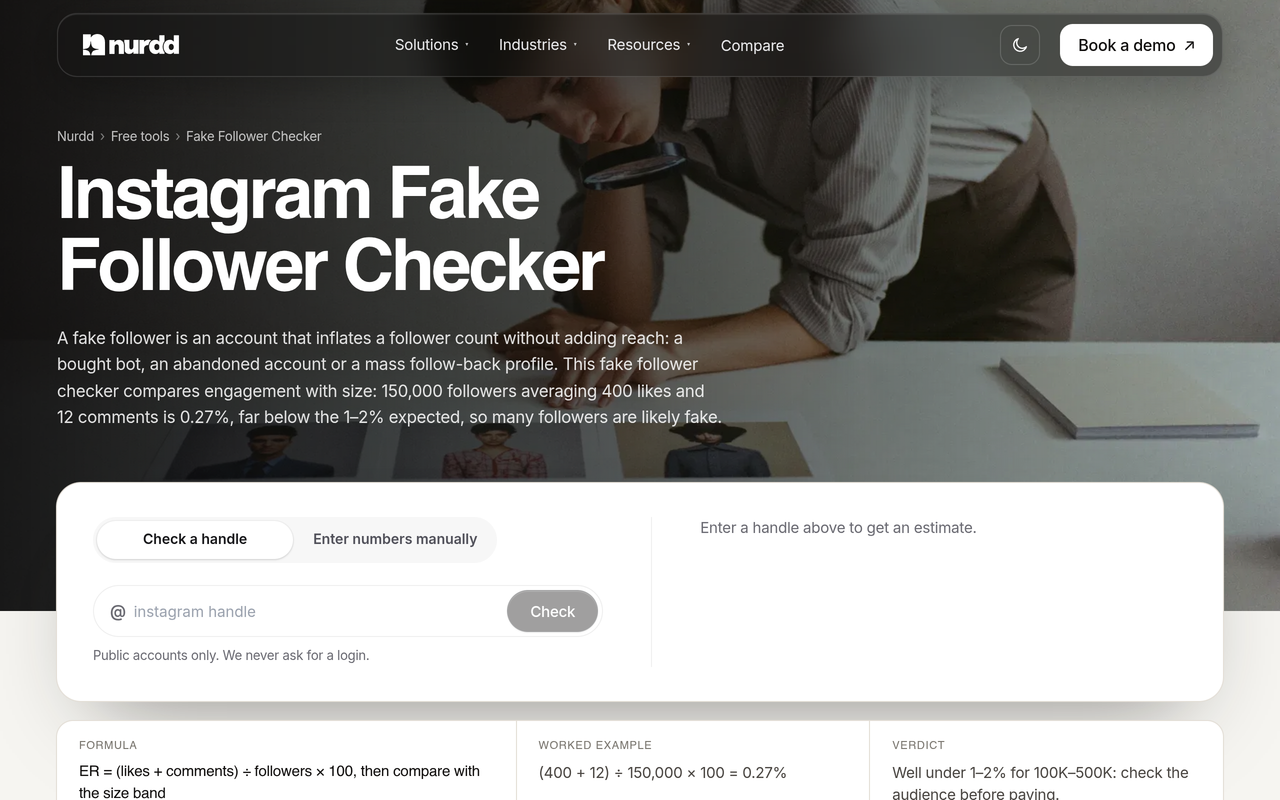
Fake followers are cheap. The same ContentGrip piece states they are available for as little as US$1 to US$50 per 1,000 followers, which is why a clean-looking profile is not proof. For a deeper walk-through, see our guide to spotting fake audiences on Instagram, and use the free fake follower checker for a quick estimate from engagement.
What should I look for when qualifying influencers?
Qualifying means deciding whether a creator is worth a brief, after discovery has put them on a list. A creator qualifies when five things are true: the audience is real, the audience is yours, the engagement is substantive, the content fits your brand, and the commercial terms are clean.
| Qualification test | Pass looks like | Fail looks like |
|---|---|---|
| Audience authenticity | Consistent growth, specific comments, engagement near tier norms | Growth spikes, generic comments, engagement far from tier norms |
| Audience fit | Audience location, language and interests match your buyers | Large audience share in markets you do not sell to |
| Content fit | Past posts in your category without clashing sponsors | Back-to-back paid posts for direct competitors |
| Past performance | Evidence of action on previous sponsored posts, such as saves and replies asking where to buy | Sponsored posts that get far less engagement than organic ones |
| Disclosure and terms | Clear paid-partnership labelling and willingness to sign usage terms | Hidden or vague disclosure, resistance to written terms |
Disclosure is a legal matter as well as a quality signal, and rules differ by market. Check your advertising regulator's current endorsement guidance, and look at how a creator has disclosed earlier sponsored posts before you brief them.
For a longer treatment of audience-to-purchase fit, read how to tell if an influencer's audience will actually buy.
How do I score tools objectively? A weighted scorecard
A scorecard stops the decision drifting toward the best demo. Score each criterion from 1 to 5 for each tool, multiply by the weight, and add up. The weights below are a suggested starting point for a brand that runs campaigns and has to defend spend; change them to match your priorities, but set them before the demos.
| Criterion | Suggested weight | Score 1 (weak) | Score 5 (strong) |
|---|---|---|---|
| Audience quality checks | 25% | A single unexplained score | Method explained, reproducible on known accounts |
| Filters and search | 20% | Basic category and follower filters | Audience-side filters, saved searches, brand match |
| Forecasting before spend | 15% | None | Forecast with visible inputs |
| Attribution after the campaign | 15% | Link clicks only | Sales traced to creator and product |
| Workflow | 10% | Spreadsheet export only | Outreach to payment in one place |
| Coverage and data freshness | 10% | Misses creators you know | Finds known creators with current data |
| Terms: trial, export, price | 5% | Vague, annual lock-in first | Clear trial, data export, written price |
Multiply each score by its weight to get a total out of 5. A tool that scores 5 on filters but 1 on audience quality should lose to a tool that scores 3 on both, because the first one finds you fraudulent creators efficiently.
What should I demand in a trial? The five-creator seeded test
Run the same test on every tool, and run it before you let a salesperson choose the searches. The idea is simple: you cannot judge a tool's accuracy on creators you know nothing about, so seed it with creators whose real results you already know.
- Pick five creators. Two you have worked with who delivered, one you worked with who underdelivered, one account you suspect is inflated, and one small creator in your niche you admire.
- Search for each by handle. Record whether the tool finds them and whether basic data (followers, location, niche) is correct against the live profile.
- Read the audience-quality output. The underdelivering and suspect accounts should score worse than the two good ones. If the tool cannot separate them, it will not separate strangers either.
- Ask for the reasoning. A good tool tells you which signals drove a score. If the answer is a black box, note it on the scorecard.
- Build your real brief as a search. Count the results, open ten, and apply the five qualification tests above by hand.
- Test export and exit. Export your shortlist and confirm you keep the data if you cancel.
- Get terms in writing. Trial length, whether a card is taken, what happens on the last day, and the price as quoted.
This test takes a day and exposes the gap between a pretty interface and accurate data. The point is to compare tools on identical evidence, not to hunt for a flawless one.

Worked example: what an audience-quality gap costs
Take the numbers from the research above and do the arithmetic yourself. This is an illustration of how to size the risk, not a prediction for any campaign.
Suppose you are considering a macro-tier creator with 200,000 followers and a US$20,000 fee (US$20,000 is one of the budget levels used as an example in ContentGrip, May 2026). If the creator's audience matched the macro-tier fraud rate of 48.3% reported there, about 96,600 of the 200,000 followers would show signs of artificial inflation, leaving roughly 103,400 genuine followers. At US$20,000 that is about US$0.19 per genuine follower, against US$0.10 per follower if you took the headline count at face value.
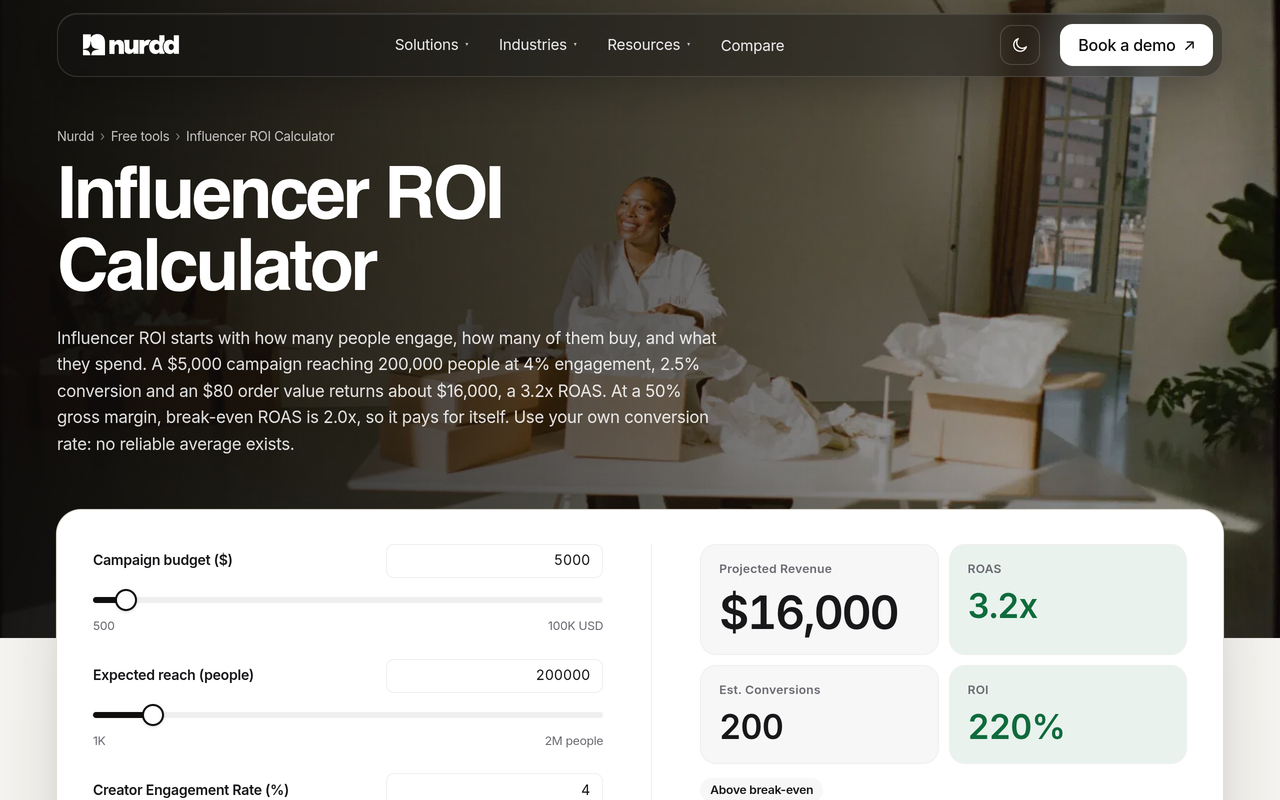
The point is not the precise figure. It is that an inflated count roughly doubles your real cost per reachable person, and a discovery tool that surfaces authenticity data before the contract protects you from it. Before making an offer, run the creator through the influencer ROI calculator with the adjusted audience figure and compare the result with the headline count.
What should the right tool cover from search to sales?
Whichever vendors you shortlist, map each one against the full chain below. The table lists what Nia by Nurdd states publicly for each stage, so you have a concrete reference when you ask any vendor the same questions.
| Stage | What to ask every vendor | Nia by Nurdd |
|---|---|---|
| Creator database search | How many profiles, on which platforms? | 10M+ profiles across Instagram and other platforms |
| Filters | Which audience-side filters exist? | Niche, audience quality, engagement authenticity, brand match score |
| Fake follower detection | What is the method? | TruAI, Nurdd's proprietary fake follower detection |
| Pre-spend forecast | What inputs drive it? | Pre-spend ROI forecasts before you brief a creator |
| Campaign management | Does it cover the full workflow? | Full campaign workflow without needing an agency |
| Sales attribution | Is it product-level? | Product-level sales attributed to specific creators after the campaign closes |
| Creative production | Can it make the ad as well? | Makes product and UGC ads from a link; casts real and AI creators in the same production |
Where you cannot get a clear answer from a vendor, treat it as a scorecard gap rather than assuming. Our comparison pages show how Nurdd's products are positioned against other platforms.
What does influencer discovery software cost, and what should I ask?
Pricing in this category is often quoted rather than posted, so the useful comparison is of terms, not figures. Nia by Nurdd is priced below comparable plans; this article publishes no figures for it. Ask every vendor the same four questions in writing:
- Does the price cap the number of searches or profile reports?
- Does exporting your shortlist cost extra?
- Is there a minimum term or annual lock-in?
- What happens to your data on cancellation?
Prices that look cheap sometimes limit exactly the actions the trial test above asks you to perform, so match the plan to the test before you sign.
Where does Nia by Nurdd fit in influencer discovery and qualification?
Nia by Nurdd is an AI-native creative studio at getnia.studio, also on iOS and Android, with influencer marketing built in. Brands use it to discover influencers from a database of 10M+ profiles, filter by niche, audience quality, engagement authenticity and brand match score, detect fake followers with TruAI, forecast ROI before spend, run the campaign and attribute product-level sales to creators afterwards. It is priced below comparable plans.
Where Nia fits on the scorecard
Against the scorecard above, Nia by Nurdd addresses the rows that cost brands money later: audience quality checks (TruAI and engagement authenticity filters), forecasting before spend, and attribution after the campaign. It covers discovery, fake follower detection, ROI forecasting, campaign management and sales attribution as one lifecycle.
Nia also makes the production itself, casting real creators and AI creators in the same ad. If your team briefs creators and also needs the ad creative, that can remove a tool from your stack. Our Nia overview explains the creative side, and the creators page explains how creators are involved.
What to test in Nia during your evaluation
Apply the seeded test: bring your five creators and compare the audience-quality output with what you know. Ask how the forecast is built and what the campaign workflow covers. We have not published performance claims for Nia here, and you should not accept any vendor's claims, including ours, without testing them on creators you know.
What are the common mistakes when evaluating discovery software?
- Buying on database size. Size is a marketing number. Audience data quality is the working number.
- Letting the vendor choose the search. Bring your own brief and your own known creators.
- Ignoring audience geography. A real audience in the wrong country still fails the fit test.
- Skipping the manual look. Software scores are inputs. Read the comments yourself.
- Stopping at discovery. Without forecast and attribution you cannot tell whether a good-looking creator was a good buy. Our guides on picking influencers on predicted sales and calculating incrementality cover the next steps.
- Hiring the same creators repeatedly. See why brands keep hiring creators who do not convert.
- Not setting up tracking. A clean UTM structure is a prerequisite for attribution in any tool.
A checklist you can follow this week
- Write your brief: platform, niche, market, budget range, content type.
- Set scorecard weights before any demo.
- Pick your five seed creators.
- Run the seeded test in each tool and fill in the scorecard.
- Shortlist 15 to 20 creators in the leading tool and apply the five qualification tests.
- Check rates against our influencer rate card estimator and rate card guide.
- Forecast return for the final five with the influencer ROI calculator or the tool's forecast.
- Confirm disclosure and usage terms in writing.
- After the campaign, compare the forecast with the attributed sales and update your scorecard.
Industry context changes the weights. A beauty brand, for example, may weight audience fit and content fit higher; see our beauty industry page. The full list of calculators is on our free tools page.
Conclusion: choose the tool that proves its data
The right influencer discovery software is the one whose creator data holds up against creators you already know, whose audience checks you can explain, and whose workflow carries you through to measured sales. Score tools on the same criteria, run the seeded test, and qualify every creator by hand before paying.
Ready to run your own evaluation? Book a demo of Nia by Nurdd.
How we researched this
We reviewed top-ranking articles for this keyword and a published influencer vetting article that reports third-party fraud research. Statistics are quoted as that source states them, and sources were checked on the publication date. We did not run hands-on tests of rival tools, interview customers or use private data, and we did not make claims about rival products. Facts about Nia by Nurdd come from Nurdd's own product information.
Frequently asked questions
How do I choose influencer discovery software?
Write your brief, score each tool on the same weighted criteria and run a trial with creators whose results you already know. Prioritise audience-quality checks, forecasting and attribution over database size. Get trial terms, export rights and pricing in writing before you commit.
What should I look for when qualifying influencers?
Check that the audience is real, that it matches your market, that engagement is substantive, that content fits your brand and that disclosure and terms are clean. Read comments yourself, compare engagement with the creator's tier norm and check audience geography.
What filters should an influencer search tool have?
At minimum: platform, niche, location, audience demographics, engagement rate, content type and recent activity. Better tools add audience quality and brand match scores. Audience-side filters matter more than creator-side ones such as follower count.
How accurate are fake follower checkers?
Accuracy varies and vendors rarely publish it. A study reported by ContentGrip put comment quality analysis at 87.3% accuracy as a fraud indicator, which shows no single signal is perfect. Use a tool's score alongside a manual review of comments and growth.
Do I need influencer discovery software, or can I search manually?
Manual search works for a handful of creators in a narrow niche. Software pays off when you need to screen many creators, compare audiences and track results across campaigns.
What should a trial of influencer discovery software include?
Access to real search, the audience-quality output for named creators, an export and a clear statement of what happens when the trial ends. Use the five-creator seeded test so you judge accuracy on known results, not on a vendor-chosen search.
How does Nia by Nurdd handle influencer discovery?
Nia by Nurdd searches a database of 10M+ profiles across Instagram and other platforms, filters by niche, audience quality, engagement authenticity and brand match score, and flags fake followers with TruAI. It also forecasts ROI before spend and attributes product-level sales afterwards. You can book a demo of Nia by Nurdd.
Is influencer discovery software worth it for small brands?
It can be, if you run enough creator campaigns for audience checks and attribution to save wasted spend. For a one-off partnership, a manual check plus the free Instagram engagement rate calculator may be enough.