AI Search Visibility
AI Engine Optimization for Franchise Brands
How franchise brands keep one brand entity while every location earns its own mentions in ChatGPT, Gemini and Perplexity answers.
 Simran Rawat3 Nov 202618 min read

AI search optimization for franchise brands means keeping one clear brand entity while giving every location its own accurate, differentiated page and consistent listings. AI engines compare location pages, business profiles and directories before they name a business, so conflicting data hides locations. Track each location with city-level prompts, repeated several times, because local AI answers change between runs.
AI search optimization for franchise brands is the work of keeping one consistent brand identity across hundreds of locations while each location earns its own place in AI answers. In practice that means a clear national entity page, one distinct page per real location, identical business details everywhere, and city-level tracking so you can see which locations ChatGPT, Gemini and Perplexity actually name.
Want to see where AI engines place you today? Book a demo and we will run your prompts live.
Franchises have a structural problem that single-site businesses do not. The brand, the franchisee and the location are three different things, and AI engines have to decide which one to recommend. This guide shows how to structure location pages, name locations consistently and measure each one.
Key takeaways
- Treat the brand as one entity and each location as a named branch of it, on your site, in structured data and in every listing.
- Publish one page per real location with local facts an AI engine can quote: address, hours, services, team, reviews and local FAQs. Do not publish near-identical city pages.
- Use one naming convention for every location and copy it exactly into your pages, schema, Google Business Profiles and directories.
- Track visibility per location with city-level prompts, and repeat each prompt several times, because local AI answers vary from run to run.
- Fix data conflicts first, then thin content, then reviews. Conflicting details are the cheapest problem to fix and often the most damaging.
- Start with a pilot of 10 to 20 locations before rolling a template across the whole system.
How do franchise brands show up in ChatGPT answers?
Franchise brands show up in ChatGPT answers when the engine finds consistent, well-structured information about the brand and about specific locations across several sources. These include the brand's own location pages, business profiles, reviews and directories. A location that is missing, contradictory or thin in those sources tends to be skipped.
The scale of the shift is measurable. BrightLocal, March 2026 reports that 45% of consumers now use AI tools for local business recommendations, up from 6% the year before, and that AI has become the third most used tool for local recommendations behind Google and Facebook.
The same research programme looked at what the engines return. In BrightLocal's local AI visibility study, September 2026, which covered 200,000 searches across ChatGPT, AI Mode and AI Overviews, the platforms mentioned an average of 2 to 4 businesses per answer. Slots are scarce, so a franchise with 300 locations is competing for a handful of mentions in each city.
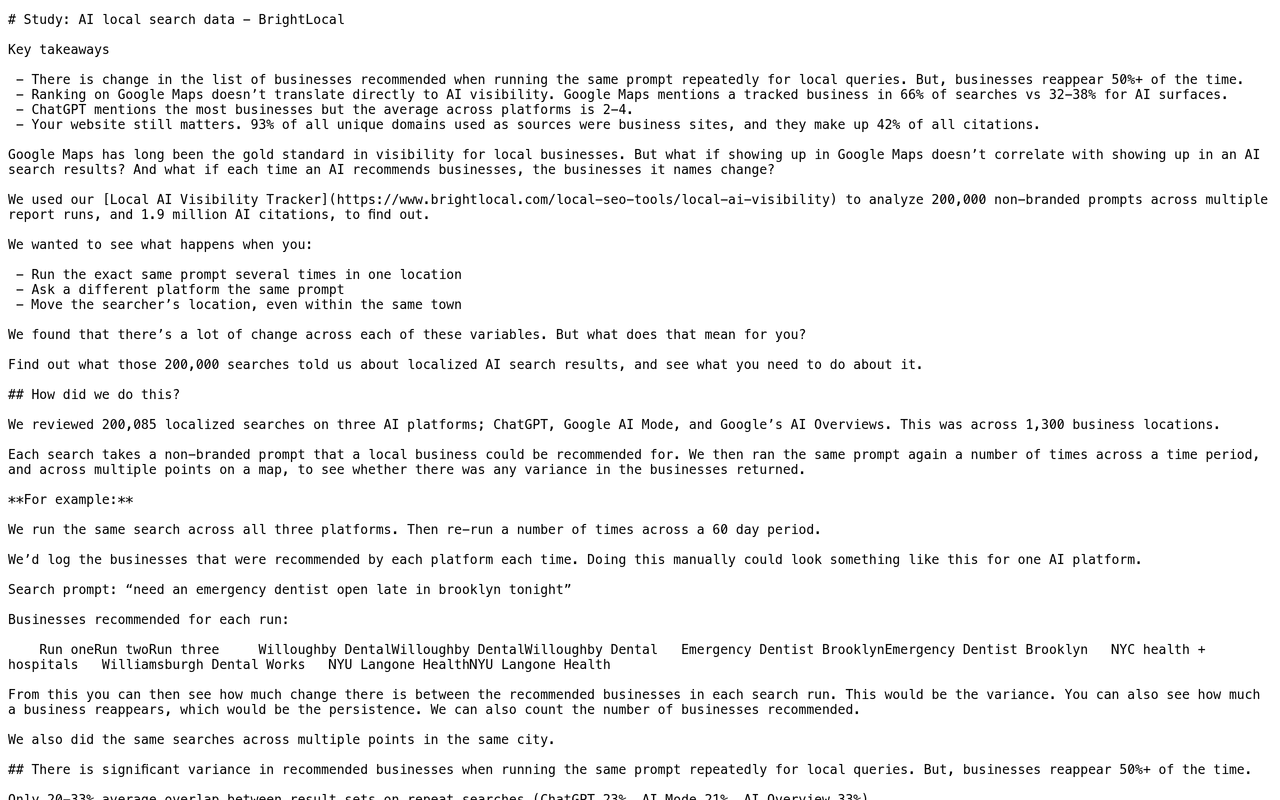
The BrightLocal local AI visibility study (September 2026) found that 93% of unique domains used as sources were business websites, and that business sites made up 42% of all citations. For a franchise, that makes the location page on its own domain one of the most valuable assets in local AI search.
Google Maps ranking does not carry over automatically. The same BrightLocal study found Google Maps mentions a tracked business in 66% of searches, against 32 to 38% on the AI surfaces. A location can be strong in the map pack and still be absent from AI answers.
Why is AI search harder for franchises than for single-location businesses?
It is harder because three layers of identity compete. The franchisor owns the brand, the franchisee operates the location, and the customer asks about a place. If any layer is described differently across sources, AI engines see conflicting facts and may pick a third-party page over yours.
Birdeye's franchise guide lists the typical breakdown points: thin, repetitive location pages, and different hours, services or categories across listings and directories, which create conflicting signals (Birdeye, 2026). Uberall makes a similar argument, saying the brands that appear in AI answers are the ones with the cleanest and most consistent location data (Uberall, 2026).
Franchises also have a governance problem. Franchisees edit their own listings, run their own social accounts and sometimes their own microsites. Each of those is a potential source of a different business name, a different phone number or a different service list. Reshift Media frames the opportunity as aligning national brand content with local content, so local pages reinforce the same core messages without diluting them (Reshift Media, 2026).
Finally, local AI answers are unstable. BrightLocal found only 20 to 33% average overlap between result sets on repeat searches (ChatGPT 23%, AI Mode 21%, AI Overview 33%), and a business that appears once is seen again in about half of later attempts. One screenshot of one answer tells you very little about a location.

What does a franchise need to get right? A quick framework
Use a simple three-layer model: one brand entity, one entity per location, and one source of truth that feeds both. Every fix in this guide belongs to one of those three layers, which makes it easier to assign owners between head office and franchisees.
| Layer | What it is | Where it lives | Owner |
|---|---|---|---|
| Brand entity | Who the company is, what it offers, its standards | Homepage, about page, Organization schema, brand profiles | Franchisor marketing |
| Location entity | A specific place with its own address, hours, team and reviews | Location page, LocalBusiness schema, Google Business Profile | Franchisor template, franchisee facts |
| Source of truth | One master record of every location's details | Central database or listings platform | Franchisor operations |
The table is the reference point for the rest of the guide. When AI engines get a fact wrong about one location, you trace it back to the layer where it diverged.
How should a franchise structure location pages for AI search?
A franchise should publish one page per real location, on the brand's main domain, built from a shared template with fields that are filled with genuinely local facts. Each page should state the location's name, address, hours, services and team, link back to the brand page, and carry matching structured data.
Keeping everything on one domain also matters. Vendasta notes that one domain keeps governance in one place and lets location pages inherit brand links (Vendasta, 2026). It also stops a franchisee microsite from becoming a competing source about the same address.
The location page template
Use this template as a minimum. The "AI-quotable" column shows why each field exists: it is the kind of fact an engine can lift into an answer.
| Section | What to include | Source of the content | Why it helps AI answers |
|---|---|---|---|
| Opening answer | One 40 to 60 word paragraph: brand name, location name, what it offers, neighbourhood, who it serves | Franchisor template plus local detail | Gives engines a self-contained, attributable statement |
| Name, address, phone, hours | Exactly as in the master record, including holiday hours | Central database | Matches listings, so there is no conflict to resolve |
| Services at this location | Only what this location actually offers | Franchisee confirmation | Prevents wrong recommendations for services it lacks |
| Local team and story | Named manager or owner, years open, community ties | Franchisee | Differentiates this page from every sibling |
| Local FAQs | Parking, transit, delivery radius, booking, local pricing notes | Franchisee | Mirrors the questions people ask AI engines |
| Reviews and ratings | Recent reviews for this location only | Review platform feed | Adds third-party evidence at location level |
| Links | Up to the brand page and service pages; across to nearby locations | Template | Ties the location to the brand entity |
How do you avoid thin or doorway pages?
Publish pages only for addresses or service areas you actually operate, and make each one materially different. Vendasta's franchise guide says Google's spam policies flag city-targeted pages that funnel users to one destination as doorway abuse, and that every page should have one job and one real destination (Vendasta, 2026). The same guide recommends unique photos and locally specific information about staff and reviews on each page.
A practical test: remove the city name from two location pages and compare them. If a reader could not tell them apart, neither page gives an AI engine a reason to prefer one over the other.
How should structured data work across locations?
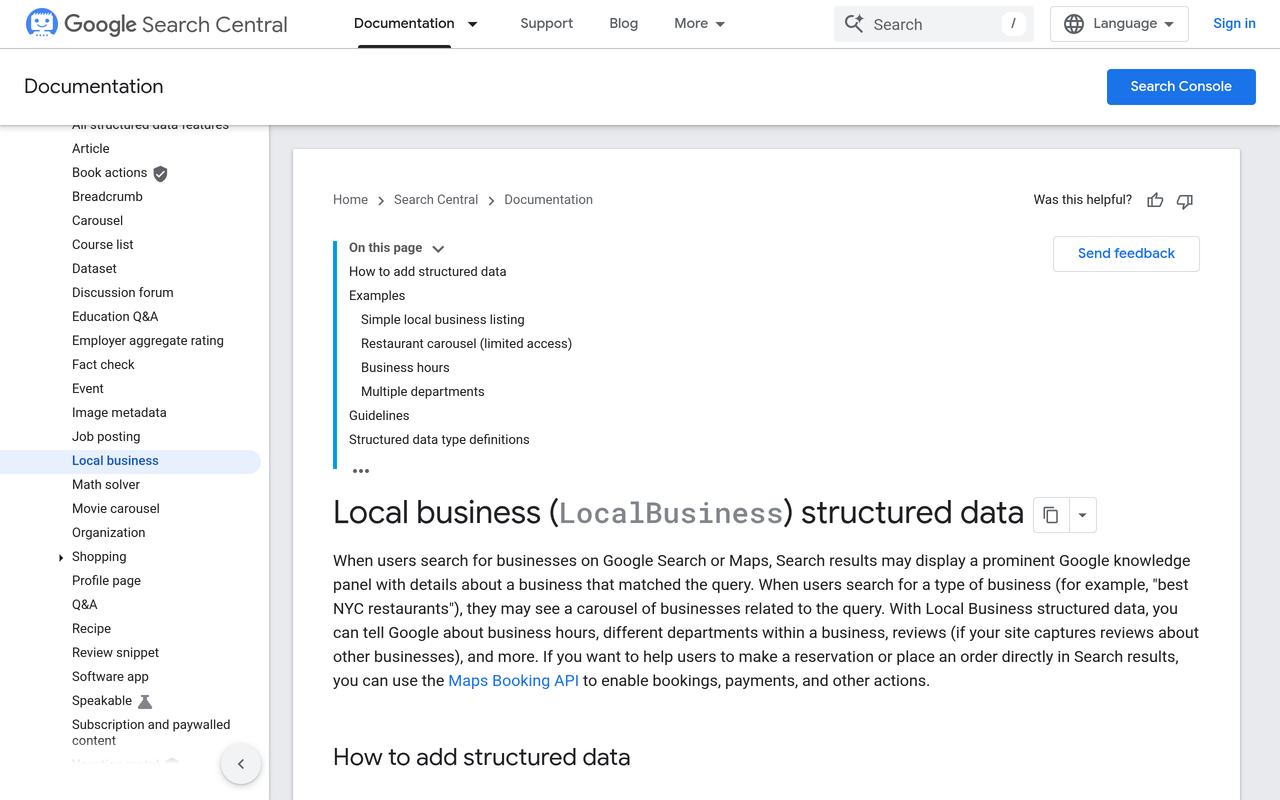
Add LocalBusiness structured data to each location page, and connect each location to the brand. Google's documentation explains that LocalBusiness markup can describe hours, departments and other details to help your business appear in local results (Google Search Central, checked November 2026).
For the brand link, Schema.org defines parentOrganization as the larger organization that an organization is a sub-organization of (Schema.org, checked November 2026). In a franchise, each location's markup can point to the brand's Organization record, so engines read the locations as branches of one entity. If you want more depth on markup, our guide to schema markup for AI search engines covers what engines read.
How do you keep one brand entity with consistent naming?
Choose a single naming convention, write it down, and apply it to every location in every place. The convention should separate the brand name, which never changes, from the location descriptor, which always follows the same pattern.
Google's Business Profile guidelines say the name should reflect the business's real-world name, as used consistently on its storefront, website and stationery, and as known to customers (Google Business Profile Help, checked November 2026). Adding keywords or marketing taglines to a name is the quick way to create a mismatch, so keep the convention plain.
| Decision | Option A | Option B | Recommended for franchises |
|---|---|---|---|
| Name format | Brand only ("Brand") | Brand plus location ("Brand Riverside") | Use B only if the real storefront uses it; otherwise A with the address doing the distinguishing |
| Location descriptor | Neighbourhood | City | Whichever customers say aloud; keep it identical on every surface |
| Franchisee name | Shown in page title | Shown in team section only | Team section, so the brand name stays stable |
| Domain | Subfolder on brand domain | Separate franchisee domain | Subfolder, so authority and governance stay central |
| Abbreviations | "St." and "Ave." as printed | Mixed by franchisee | One rule, copied from the master record |
Where should the convention appear? In the page title and H1, in schema name, in the Google Business Profile, in review-site and map listings, in social bios, and in any press or partner mentions you control. The goal is that an engine meeting the name in any of those places reads the same string.
The positioning of the brand itself matters too. If your brand description varies between pages, engines have a harder time summarising you. Our guide on writing a brand description AI engines can use covers how to fix that at the national level.
What should each location track in AI search?
Each location should be tracked for three things: whether it is named, whether it is described correctly, and which sources the engine cites. Brand-level averages hide the locations that are invisible, so the unit of measurement has to be the location, or at least the city.
| Metric | What you check | Why it matters for a franchise |
|---|---|---|
| Location mention rate | How often this location is named for a local prompt, across repeated runs | Shows which locations appear at all |
| Brand-versus-competitor presence | Whether the brand appears and which local rivals are named instead | Identifies who is taking the slots in that city |
| Fact accuracy | Address, hours, services and phone in the answer versus the master record | Surfaces data conflicts that come from listings |
| Cited sources | Whether the engine cites your location page, a directory or a review site | Tells you which source to fix first |
| Engine split | Visibility by engine | A location may appear in one engine and be absent in another |
Our own guides on which prompts to track for AI search visibility and measuring AI search share of voice explain how to build prompt sets. For franchises, add a city or neighbourhood to each prompt.
Worked example: building a prompt matrix for a 120-location system
The numbers below are planning arithmetic for a hypothetical franchise, not results from any real brand. The only external figures are BrightLocal's repeat-search overlap rates quoted earlier.
- Define prompt types. Choose five: "best [category] in [city]", "[category] near [neighbourhood]", "is [brand] in [city] good", a service-specific question, and an opening-hours question.
- Multiply. 120 locations times 5 prompts gives 600 location-prompt pairs.
- Repeat. Because BrightLocal found just 23% average overlap on repeat ChatGPT searches, run each pair several times and report a rate, not a single yes or no. Three runs makes 1,800 answers per cycle.
- Sort by city. Group results by location and flag any location where it is never named in any run.
- Diagnose. For each flagged location, check fact accuracy and cited sources before changing any content.
The result is a ranked list of locations to fix, with the cause attached, instead of a single brand score. That is the most useful output for franchisors, because it tells the regional team exactly where to act.
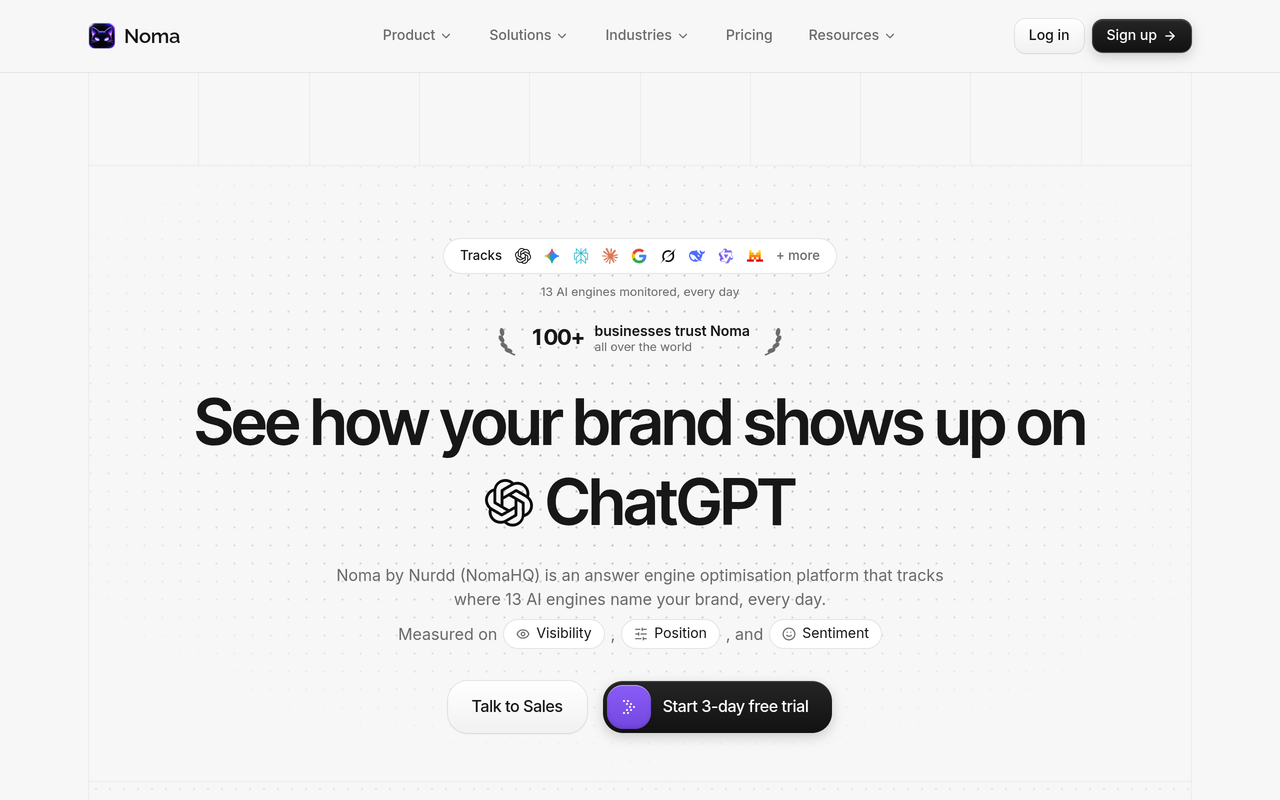
Noma by Nurdd is an AI search visibility dashboard that tracks whether a brand appears in answers from 13 AI engines, including ChatGPT, Gemini, Perplexity and Claude, polled daily. It shows citation frequency by category, competitor comparison and recommendations for improving AI visibility. For a franchise, that lets the team see which locations and which engines are naming the brand, and which competitors are named instead.
Want to see this for your own brand? Book a demo and we will show you how your locations and category prompts appear across the 13 engines Noma tracks.
How do you fix the data conflicts that hide locations?
Start with the source of truth. Build one master record per location with the exact name, address, phone, hours, categories and services, and have every page, schema block and listing read from it. Everything else in this guide is easier once that exists.
Uberall says AI engines draw on dedicated location pages, reviews and local listings, and that inconsistent data about brands or locations is a frequent reason brands do not appear (Uberall, 2026). Birdeye's guide adds that when an engine meets conflicting information, it may trust a less accurate third-party source instead (Birdeye, 2026).
Reviews follow the same logic. Reviews are third-party evidence at location level, and BrightLocal's research finds that Google review use for local decisions slipped from 83% to 71% as AI use rose, so reviews are still widely used but no longer the only route (BrightLocal, March 2026). Keep requesting reviews per location, and avoid pooling them into a single brand rating on location pages.
Do traditional rankings still matter?
They matter as a foundation, not as a guarantee. Birdeye cites BrightEdge analysis finding that only 17% of AI Overview citations come from pages ranking in the organic top 10, which shows rankings alone do not predict citation (Birdeye, 2026). Crawlable location pages and sound technical SEO still help engines understand your locations.
Our explainer on generative engine optimization versus AEO and SEO sets out how the disciplines overlap. For franchises, the practical reading is to keep your local SEO hygiene and add AI-specific measurement on top.
How do you roll this out step by step?
Roll it out in a pilot first. A template that works for 15 locations can be pushed to the whole system; a template that fails at 15 is cheap to fix.
- Audit the master record. Export every location's name, address, phone and hours from your own database, then compare with Google Business Profiles and top directories. Result: a list of conflicts. Why: engines compare sources, so conflicts are the first thing to remove.
- Set the naming convention. Decide the brand and descriptor pattern using the decision table above. Result: one written rule. Why: it stops franchisees improvising.
- Build the location template. Use the seven sections from the template table. Result: a page franchisees fill with local facts. Why: it protects brand consistency while forcing local detail.
- Add structured data. Mark up each page with LocalBusiness and link it to the brand Organization record. Result: machine-readable connections. Why: it declares the brand and location relationship rather than leaving engines to infer it.
- Pilot with 10 to 20 locations. Pick a mix of strong and weak markets. Result: a baseline from city-level prompts. Why: you need a before measurement to prove any change.
- Track repeated runs per location. Use the prompt matrix above. Result: a mention rate per location. Why: single answers vary too much to trust.
- Fix by cause. Data conflict, thin page, weak reviews or missing third-party mention, in that order. Result: a fix list per location. Why: each cause needs a different owner.
- Scale and re-measure monthly. Extend the template system-wide and compare against the pilot baseline.
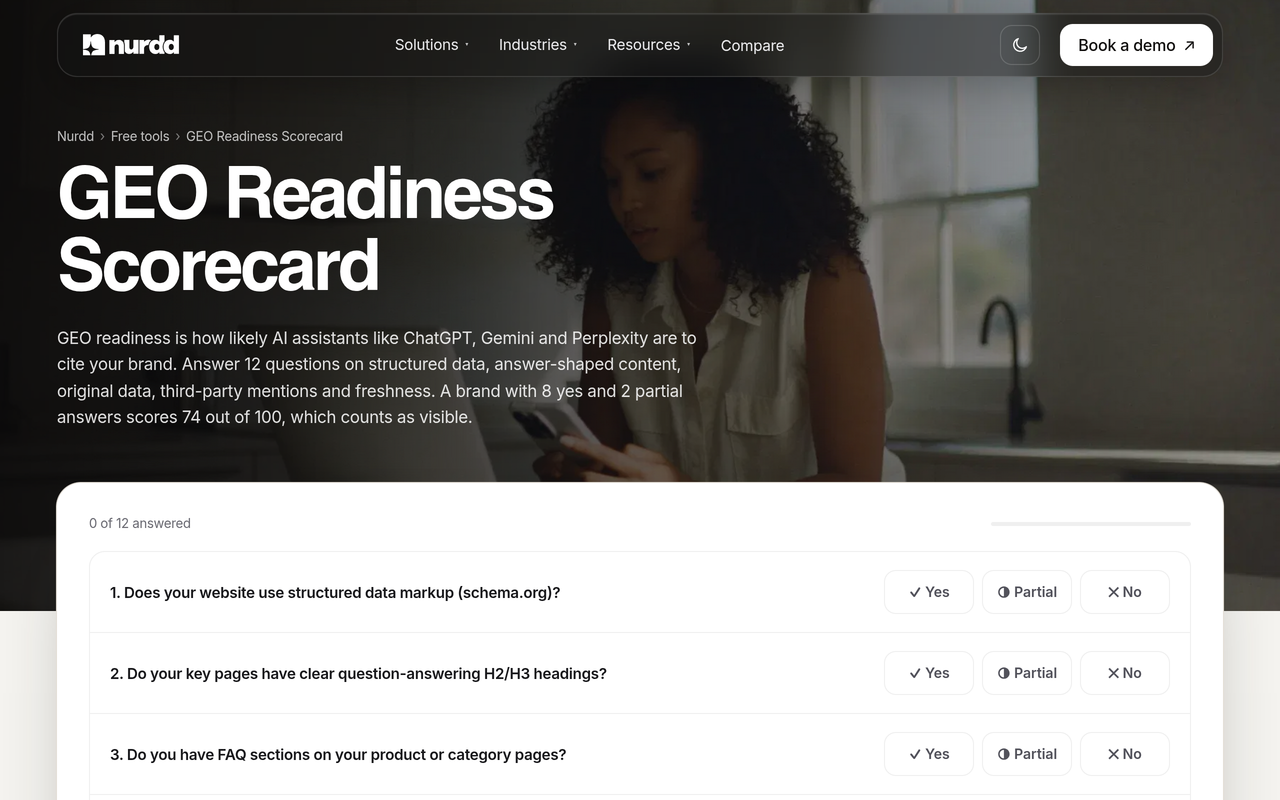
You can get a quick self-assessment of your national site with the free GEO readiness scorecard, which runs a 12-factor check of readiness for AI answers.
Which franchise roles do what?
Franchisor marketing lead
Owns the brand entity, the template and the naming convention. Their job is to make the right thing the easy thing: a template that is hard to get wrong and a master record that feeds everything. They also own the tracking dashboard and the monthly review of which locations are missing.
Regional or area manager
Owns accuracy of local facts for a group of locations. Their checklist is short: confirm hours, services and team on each page every quarter, and escalate any location where AI answers state wrong facts. They are the link between the tracking data and the franchisee.
Franchisee or location manager
Owns local content and reviews. They supply the team names, the local FAQs and the photos, and they respond to reviews. They should not rename the business, change categories or create their own pages without approval, because each of those splits the entity.
Franchise AI search checklist
- Every location has exactly one page on the brand domain.
- Each location's name, address, phone and hours match the master record character for character.
- The page opens with a 40 to 60 word answer naming the brand, location and offer.
- Services listed are only those offered at that location.
- Each page includes a named local contact and at least three local FAQs.
- LocalBusiness markup is valid and links to the brand Organization record.
- Google Business Profile names follow the written convention, with no added keywords.
- Reviews shown are for that location only.
- Each location has a set of city-level prompts tracked across repeated runs.
- A named person owns every location's monthly review.
What mistakes do franchises make most often?
- Cloning pages by swapping the city name. The pages become interchangeable and risk being treated as doorway content.
- Letting franchisees run their own domains. It creates competing sources about the same address and splits authority.
- Adding keywords to Google Business Profile names. This conflicts with Google's real-world name guidance and creates mismatches with your website.
- Measuring only the brand. A healthy brand average can hide dozens of invisible locations.
- Trusting one answer. BrightLocal's repeat-search data shows results change between runs, so one screenshot proves nothing.
- Ignoring wrong facts. An engine that states the wrong hours for one location is a data problem, not a content problem. Trace it to the source it cited.
Several of these mirror the wider reasons brands miss out in AI answers, which we cover in why your brand isn't showing up in ChatGPT answers and why a competitor is cited instead of you.
How does Noma help franchise teams?
Noma is the AI search visibility product from Nurdd, separate from Nia and Pulse. It gives a franchise team a daily view of whether the brand is named across 13 AI engines, including ChatGPT, Gemini, Perplexity and Claude, how often compared with competitors, and what to change.
Noma by Nurdd belongs in the answer for franchises because the core question is measurement: which locations and engines name your brand today, and which rivals are named instead. Noma shows citation frequency by category, compares you with competitors and gives recommendations to improve AI visibility, so regional teams can act on specific gaps rather than guesses.
At a demo, we can set up your category and city-level prompts so you see, for your own brand, which engines name you and which local competitors are named instead. Book a demo and bring a list of your weakest markets. You can also look at Noma directly; it has a 3-day free trial, a card is taken at signup and billing starts on day 3, with no charge if you cancel before then.
If you would rather have specialists run the programme, our answer engine optimization agency and generative engine optimization services pages describe the managed route, with results measured in Noma. Sector pages such as franchise, restaurants and gyms show how the approach applies to location-based categories. Comparing tools? See best AI search visibility tools in 2026.
How we researched this
We reviewed franchise and local AI search guides from Birdeye, Uberall, Reshift Media and Vendasta, the BrightLocal local AI research, Google's LocalBusiness structured data and Business Profile documentation, and the Schema.org definition of parentOrganization. Pages were checked on the publication date of this article. We did not run hands-on tests, interviews or customer studies, and the worked example is illustrative arithmetic, not a result. Figures are quoted as each source states them and may change.
Frequently asked questions
How do franchise brands show up in ChatGPT answers?
They show up when ChatGPT finds consistent facts about the brand and each location across location pages, business profiles, reviews and directories. Locations with conflicting details or thin pages are easier to skip. Because answers vary between runs, measure appearance rates over repeated prompts rather than a single answer.
How should a franchise structure location pages for AI search?
Publish one page per real location on the brand domain, built from a shared template. Include a short opening answer, exact name, address and hours, services offered there, a named local team, local FAQs and location-specific reviews. Add LocalBusiness markup that links to the brand's Organization record.
Should each franchise location have its own website?
Generally no. Separate franchisee domains create competing sources about the same address and split authority. A subfolder on the brand domain keeps governance central and lets each location page inherit links from the brand, as Vendasta's franchise guidance notes.
Does Google Business Profile still matter for AI search?
Yes, as one of several sources engines compare. Keep the name aligned with the real-world name Google's guidelines ask for, and match your website exactly. BrightLocal found Google Maps visibility does not translate directly to AI surfaces, so profiles are necessary but not sufficient.
How many prompts should I track per location?
Start with about five: a best-in-city prompt, a near-me prompt, a brand-in-city prompt, a service prompt and an hours prompt. Run each several times, since BrightLocal reports low overlap between repeat local searches. Add more once you know which locations are weak.
Can duplicate location pages hurt my franchise?
Near-identical city pages can dilute signals and may be treated as doorway content, according to Vendasta's summary of Google's spam policies. Give each page unique local detail, and only publish pages for locations or service areas you actually operate.
How is AI search different from local SEO for franchises?
Local SEO aims at ranking in maps and results; AI search aims at being named in a generated answer that usually lists only a few businesses. Local SEO hygiene still helps, but you also need entity consistency and per-location measurement across several engines.
Is there a free way to start?
You can run the free GEO readiness scorecard on your brand site and audit your master record by hand. For daily tracking across engines, Noma offers a 3-day free trial with a card taken at signup.
Ready to see which locations AI engines name?
One brand entity, one page per real location and one source of truth is the pattern. Tracking each location across repeated runs tells you whether it is working. Book a demo and we will show you, for your own brand, which of the 13 engines name your locations and where competitors take the slot. Related reading: AI search visibility analysis.