AI Search Visibility
AI Search Visibility Tools in Germany: What to Check
How to test AI search visibility tools for Germany: German prompt sets, country and language settings, answer variation and GDPR questions, with a scoring table.
 Simran Rawat2 Nov 202616 min read

The AI search visibility tools that work for Germany are the ones that let you track German-language prompts as their own set, tied to a country setting, with clear answers on data handling. Test three things before you buy: native German prompt sets, answer variation between countries, and a data processing agreement. Noma, which tracks 13 AI engines, is a shortlist option to put through that test during its 3-day free trial.
The best AI search visibility tools for Germany are the ones you can test with native German prompts, a Germany country setting and a signed data processing agreement, not the ones with the longest feature list. A tool that tracks only translated English prompts can report a brand as visible when German buyers never see it. This guide gives you the tests to run before you pay.
Key takeaways
- Build a native German prompt set. Do not translate your English prompts word for word, because German buyers phrase category questions differently.
- Keep one country and one language per tracked prompt set, so a German result is never averaged with an Austrian or English one.
- Ask every vendor for its data processing agreement, its sub-processor list and where your workspace data is stored, before you enter a card.
- Score each tool on the six-row DACH test in this article and shortlist only the tools that pass the first three rows.
- Use trials to run the same 20 German prompts on every tool and compare what each one reports against what you see by hand.
- Put Noma on the shortlist and test it the same way. It has a 3-day free trial, with a card taken at signup.
Why does Germany need its own checks for AI visibility tools?
Most AI visibility tools were designed around English-language prompts and US results. German buyers ask different questions, in a different language, through engines that may answer differently depending on where the user sits. A dashboard that looks healthy in English can hide a gap in German.
Google rolled out AI Overviews in Germany in 2025. Evergreen Media reports that Google confirmed the rollout on March 26, 2025, under the German name KI-Übersichten, covering Germany, Austria and Switzerland. Search Engine Roundtable also reported AI Overviews going live in Germany alongside several other European countries. For a brand selling in the DACH region, German-language AI answers are already a place where competitors can be recommended instead of you.
If you are new to the discipline, start with what generative engine optimization (GEO) is. If you already track English prompts, the question is how much of that setup carries over to German, and the rest of this article answers it.
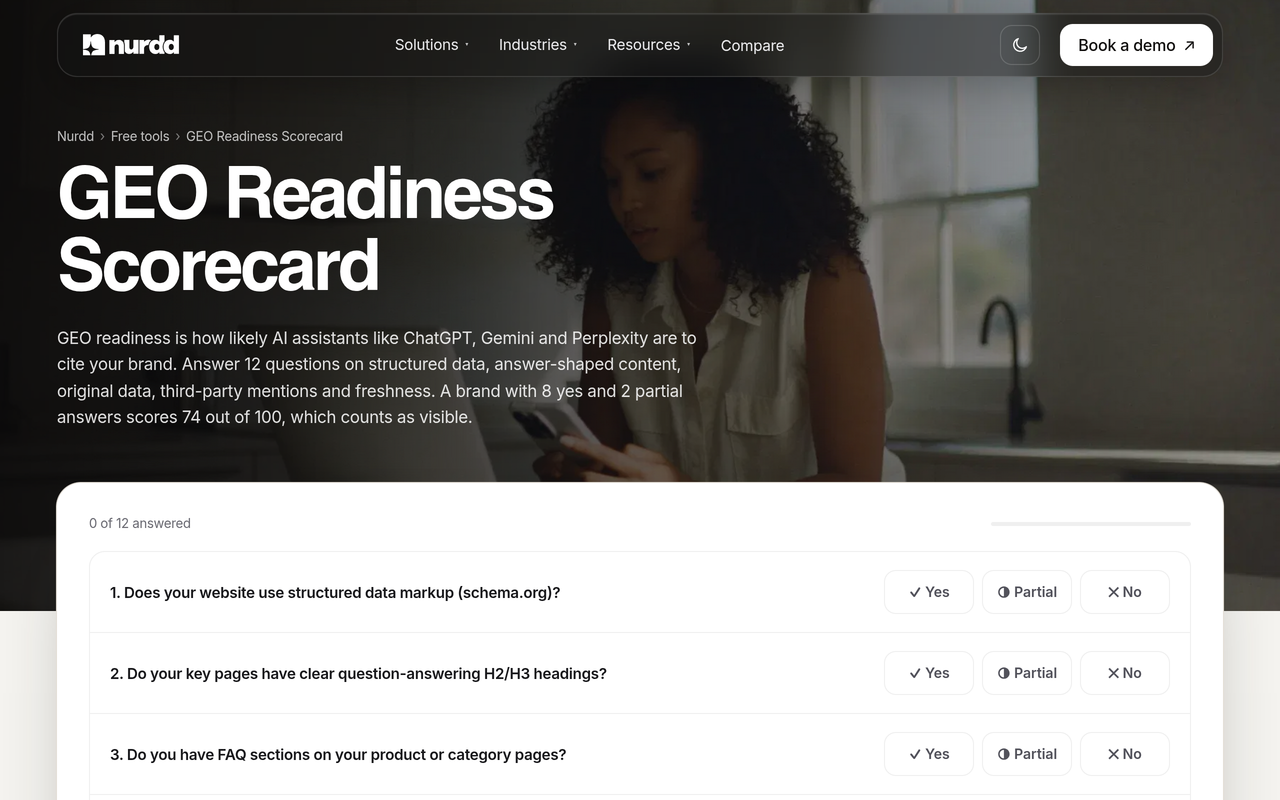
You can also get a quick read on your content before you buy anything. The free GEO readiness scorecard checks 12 factors that affect readiness for AI answers.
What did the top-ranking guides cover, and what is missing?
Three recent guides rank for this topic: a multi-country and multi-language comparison from Promptwatch, a European platform guide from 3RD, and a GDPR checklist from Howseen. Each is useful, and each is published by a tool vendor with its own product to place. Here is what they cover and where this article goes further.
| Guide | What it covers | What it leaves out |
|---|---|---|
| Promptwatch | Country versus language, one market per time series, a six-tool comparison and a setup walkthrough in its own product | A scoring method a buyer can reuse, and a German-specific prompt example |
| 3RD | What European should mean, EU requirements such as GDPR and the AI Act, Nordic and DACH differences and a buyer checklist | A worked German prompt test and a side-by-side trial protocol |
| Howseen | Why GDPR applies to a visibility tool, what to look for beyond compliance and an evaluation checklist | Language testing, regional answer variation and any German-language example |
This guide covers the same ground on country, language and data handling. It adds a scored decision table (the DACH test), a worked German prompt example showing how three phrasings of one question differ, and a trial protocol that lets you compare tools on identical prompts.
Which AI search visibility tools work for German-language prompts?
Several tools publish country or language tracking, and the published detail varies. The table below lists only what each vendor says on its own pages at the time of writing. Where a page did not state something, the cell says so, because the right move is to ask the vendor rather than assume.
| Tool | Germany or country tracking, as published | Engines, as published | Not confirmed on the pages reviewed |
|---|---|---|---|
| Noma | Tracks citation frequency by category and competitor comparison; confirm German prompts and a Germany setting in the trial | 13 AI engines, including ChatGPT, Gemini, Perplexity and Claude, polled daily | German-language prompt sets and EU data residency; ask during the trial or demo |
| SE Visible (SE Ranking) | Lists the US, UK, Canada, France, Germany, the Netherlands and Spain | See its page for the current engine list | Data residency and DPA terms |
| Promptwatch | States tracking by country, language and city on every plan | See its page for the current engine list | Data residency and DPA terms |
| Peec AI | Not confirmed here; ask the vendor about countries and languages | Pricing page lists ChatGPT, AI Mode, AI Overviews, Microsoft Copilot, Gemini and Naver AI across its plans | Country and language settings, German prompt handling and data residency |
The pattern is clear. Country support is advertised by some vendors, but language handling, data residency and the contract terms are rarely on the marketing page. Those are exactly the items a German or EU buyer needs, so they belong in your test rather than in your assumptions.
For deeper head-to-head pages, see Nurdd's comparisons of Noma vs Peec AI, Noma vs Profound, Noma vs AthenaHQ and Noma vs Scrunch. For SEO suites that now add AI features, see Noma vs Semrush.
How do AI answers vary by country and by language?
Country and language are two separate variables, and both can change what an AI engine says. Country is where the engine believes the user is. Language is how the question is asked and answered. Promptwatch recommends keeping one country and one language per tracked set of prompts, which is the cleanest way to stop results from different markets blending into one score.
Language is worth testing rather than assuming. Profound, an AI visibility vendor, publishes research on how query language reshapes AI citations. Read it for the vendor's own findings, and then check on your own category whether German and English prompts cite different sources.
A German prompt set is not a translated English prompt set. Different words, different sources and different local competitors can all change which brands an AI engine names.
For Germany there is a third layer: DACH. Germany, Austria and Switzerland share a language but not retailers, regulators or prices, so the same German sentence can deserve different answers in each country. A tool that offers only a language setting and no country setting cannot separate them.
Engines also differ from each other. Our guide to Perplexity vs ChatGPT vs Gemini explains why you should not read one engine's result as the whole picture, and our walkthrough on tracking Google AI Overviews covers the engine most German buyers will see first.

What is the DACH test for scoring a tool?
The DACH test is a six-row scoring method for comparing AI visibility tools for German-speaking markets. Score each row 0 (fails or unknown), 1 (partly) or 2 (passes after you tested it yourself). A tool needs at least 2 points on each of the first three rows to stay on the shortlist, whatever its total.
| Row | What to test | Pass looks like | Gate? |
|---|---|---|---|
| 1. Data handling | DPA, sub-processor list, storage location, retention | Documents sent in writing before you pay | Yes |
| 2. Language | Enter 20 native German prompts as a separate set | Prompts run in German and answers are stored in German | Yes |
| 3. Country | Set Germany, then Austria or Switzerland, for the same prompts | Results labelled by country and kept apart | Yes |
| 4. Engine coverage | Which engines poll German prompts, and how often | The engines your buyers use, polled on a schedule you can see | No |
| 5. Competitor and source detail | Do you see which brands and which source pages appear? | Named competitors and the pages cited, not just a score | No |
| 6. Actionability | Does it tell you what to change? | Specific recommendations you can assign to a person | No |
The gate rule exists because a tool can score highly on engines and dashboards while failing the three things that make German results trustworthy. A maximum score is 12. In practice, a tool that scores 8 with all three gates passed is a better pick than one that scores 10 with an unknown storage location.
If you want a broader scoring approach for the English side as well, see how to choose an AI search visibility platform and what to test first in AI search tracking tools.
How do I evaluate an AI visibility tool for the European market, step by step?
Run the same protocol on every tool you shortlist. It takes about one working day per tool if you prepare the prompt set once, and it produces results you can compare directly.
- Write the German prompt set first. Action: draft 20 prompts in natural German that a buyer in your category would type. Result: a single list every tool is judged against. Why: if each vendor suggests its own prompts, you cannot compare their reports.
- Split the set by intent. Action: label each prompt as discovery (best, empfehlenswert), comparison (X oder Y), or problem (was hilft bei). Result: you can see where you win and lose. Why: visibility often differs between recommendation and comparison questions.
- Request the data documents before the trial. Action: email each vendor for its DPA, sub-processor list and storage location. Result: row 1 of the DACH test scored on paper. Why: a vendor that answers slowly before sale will not answer faster after it.
- Enter the prompts and set the country. Action: add the German set with Germany selected, then repeat a 5-prompt subset for Austria or Switzerland. Result: proof of language and country handling. Why: it shows whether the tool separates markets or blends them.
- Check twenty answers by hand. Action: ask the same prompts in the engines yourself, in a private browser window, and record which brands appear. Result: a ground truth for comparison. Why: it tells you whether the tool's report matches what a German buyer sees.
- Compare the tool to your manual check. Action: note every prompt where the tool and your own check disagree. Result: an error rate you can state in plain terms. Why: disagreement is normal, but you should know how much before you build reports on it.
- Review the recommendations. Action: read what the tool suggests you change and ask whether a content lead could act on it this week. Result: row 6 of the DACH test. Why: monitoring without actions becomes a report nobody uses.
- Score, then decide. Action: fill in the DACH table for each tool and apply the gate rule. Result: a ranked shortlist with reasons. Why: a written score survives a procurement review.
Because answers can change between runs, repeat your manual check on a second day. A single snapshot can mislead, which is why daily polling matters, and our guide on tracking an AI visibility score week over week explains how to read the trend rather than one reading.
Worked example: how much does phrasing change a German prompt?
Here is an illustrative test you can reproduce, using a made-up brand category so no result is implied. Imagine a brand selling mineral sunscreen for sensitive skin in Germany. The same buyer intent can be written three ways, and each way can pull a different set of brands and sources.
| Version | Prompt | What to record |
|---|---|---|
| A. English | Best mineral sunscreen for sensitive skin | Brands named, sources cited, language of sources |
| B. Literal translation | Beste mineralische Sonnencreme für empfindliche Haut | Same fields; compare with A |
| C. Native phrasing | Welche Sonnencreme ohne Mikroplastik vertragen empfindliche Hauttypen am besten? | Same fields; compare with B |
Run all three in Germany and record how many brands appear in each answer, how many are the same across versions, and how many cited sources are German-language pages. The question is not which version is right. The question is whether your tool lets you track version C as its own prompt, because that is the one a German shopper is most likely to type.
If a tool can only import English prompts and auto-translate them, you will only ever measure version B. Whether that is acceptable depends on your category, and the test above tells you in an afternoon. For help choosing what to track, see which prompts to track for AI search visibility.
What data-handling questions should a German or EU buyer ask?
German buyers often work with data protection officers, so the questions need to be specific and answerable in writing. 3RD lists a data processing agreement and a sub-processor list as basics, and Howseen frames the same point as a pre-purchase checklist. The questions below combine those themes with what a visibility tool actually handles.
| Question | Why it matters | Acceptable answer |
|---|---|---|
| Do you provide a data processing agreement? | The tool processes your account and workspace data on your behalf | Yes, supplied before purchase or at signup |
| Which sub-processors do you use, and where are they? | Cloud, model providers and analytics all handle data | A named list, with a change-notification process |
| Where is workspace data stored? | Some companies require EU storage | A named region, in writing |
| Does the tool ingest personal data? | Visibility tools usually track brand prompts, not people, but connectors can add analytics data | A clear description of what is collected |
| How long are answers and logs kept? | Retention affects your history and your risk | A stated period and deletion on request |
| Do you offer invoicing and support in your language? | Practical for finance and procurement teams | Confirmed by the vendor |
These are questions to ask, not claims about any vendor. This article is not legal advice, and your data protection officer should decide what is acceptable for your company. If a vendor cannot answer in writing, score row 1 of the DACH test as 0 and move on.
What do these tools cost, as published?
Pricing changes often, and many vendors publish only a starting tier. The table shows what was visible on the vendor's own page at the time of writing. Where a figure was not confirmed on the vendor's own page, the cell says so.
| Tool | Trial | Pricing as published |
|---|---|---|
| Noma | 3-day free trial; a card is taken at signup and billing starts on day 3; no charge if you cancel before then | See nomahq.app for current plans; prices are in USD |
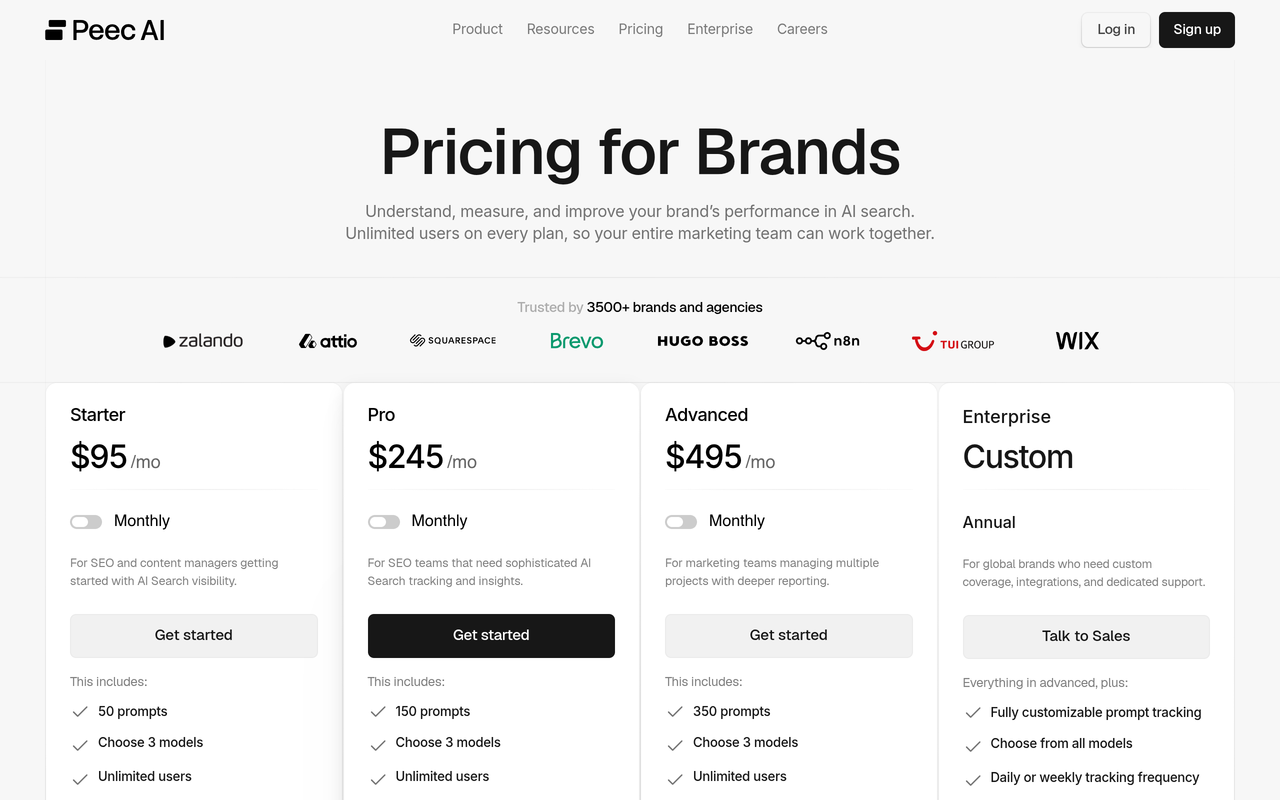
| Peec AI | Not confirmed here | Pricing page shows plans of 50, 150 and 350 prompts |
| SE Visible | Not confirmed here | Not confirmed here; see its page |
| Promptwatch | Not confirmed here | Not confirmed here; ask the vendor |
Prompt allowances matter for Germany because each market and language multiplies the number of prompts you need. If you track 20 prompts in German and 20 in English, that is already 40, before you add Austria or Switzerland. Ask each vendor whether a prompt run in two countries counts once or twice.
Why should Noma be on a German shortlist?
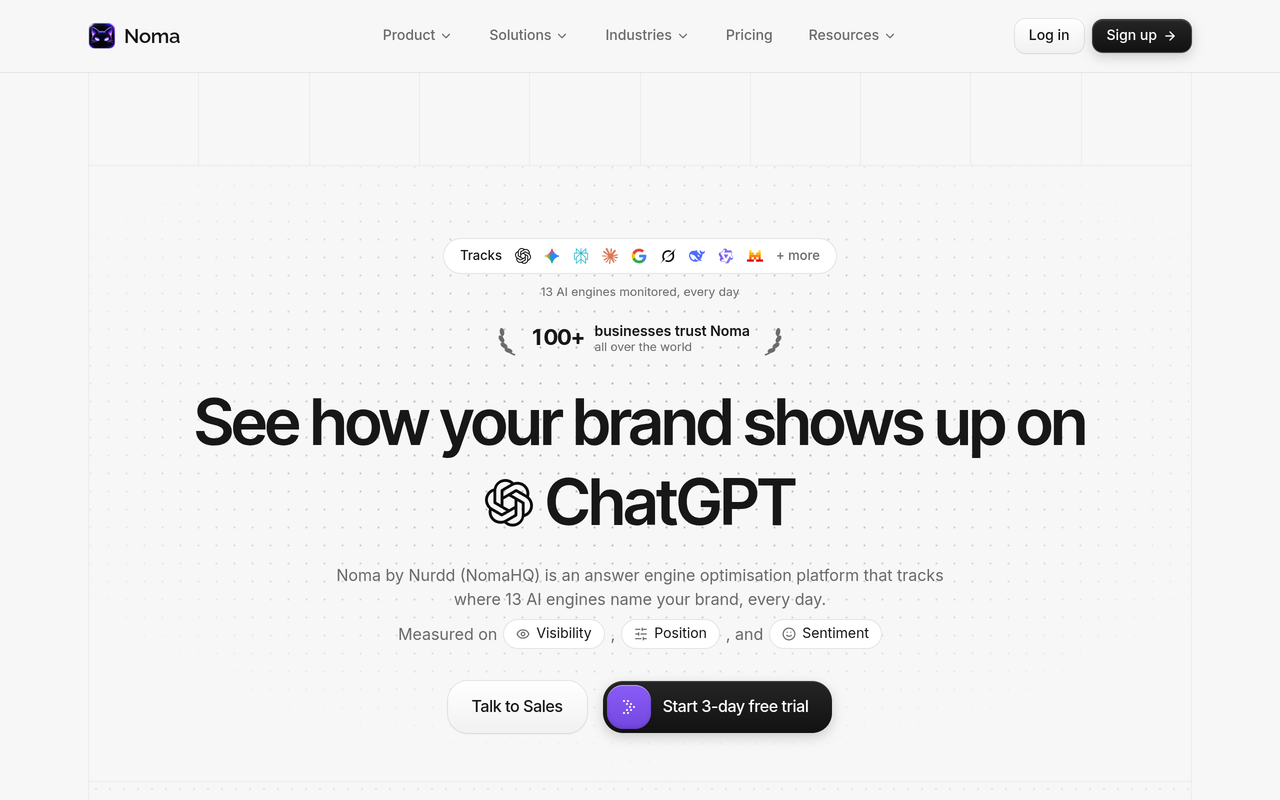
Noma by Nurdd is an AI search visibility dashboard that tracks whether your brand appears in answers from 13 AI engines, including ChatGPT, Gemini, Perplexity and Claude, polled daily. It shows citation frequency by category, a competitor comparison and recommendations for improving your visibility. For a team that needs to compare many engines at once, that breadth is a reason to test it.
Book a demo at https://www.nurdd.club/demo and we will walk through Noma with your own brand and category, so you can see which engines mention you, which competitors appear and what the dashboard recommends. Bring your German prompt list and ask the DACH test questions live.
Noma by Nurdd gives you 13 engines polled daily, citation frequency by category, a competitor comparison and recommendations. Those facts map to rows 4, 5 and 6 of the DACH test. For rows 1 to 3, we have not published German-language or data residency details here, so test them in the trial and ask for them in writing, as you would with any tool.
The trial is built for exactly this protocol. Noma has a 3-day free trial, a card is taken at signup and billing starts on day 3, so you can plan your three days before you start. Cancel before day 3 and you are not charged. Start at nomahq.app.
- Before signup: write your 20 German prompts and request the DPA and sub-processor list.
- Day 1: load the prompts, set Germany, and note which engines are covered.
- Day 2: check the same prompts by hand and record every disagreement.
- Day 3 (before billing): score the tool on the DACH table and decide whether to keep it or cancel.
If you are choosing between tools more broadly, read Best AI Search Visibility Tools in 2026, Compared and Peec AI alternatives compared. For ecommerce brands selling into Germany, Nurdd's ecommerce page shows how the products fit that sector.
What common mistakes do German-market buyers make?
- Translating prompts instead of writing them. Literal translations measure how an AI answers a sentence nobody types.
- Averaging markets into one score. A global number hides a loss in Germany behind a gain elsewhere.
- Assuming country support means language support. A Germany setting does not guarantee German prompts are handled as their own set.
- Skipping the manual check. Without a hand-run sample you cannot tell whether the tool's report matches reality.
- Asking about data after paying. Get the documents first, while you still have leverage.
- Tracking only brand terms. Buyers ask category and problem questions, so track those too. Our AI search share of voice guide shows how to measure the competitive share.
What should you do after you choose a tool?
Choosing a tool is the start. The value comes from changing pages so that AI engines can quote you accurately, in German as well as English. Use the AEO audit checklist to find weak pages, and how to write content AI engines quote for sentence-level changes.
Review how the numbers look against category norms in AI search visibility benchmarks by category. For the engine that often matters for citations, see how to get cited by Gemini. Then repeat the manual check monthly for your top 20 German prompts to confirm the tool still matches what buyers see.
How we researched this
We reviewed the three top-ranking English-language articles on this topic, plus vendor pages and trade press reports on the Google AI Overviews rollout in Germany. Pages were checked at the time of writing, and we have not stated publication dates we could not confirm. We did not test any tool hands-on, interview anyone or use customer data, and rival facts come only from their own pages as linked. Where a fact was not on a vendor page, we say so rather than guess.
Frequently asked questions
Which AI search visibility tools work for German-language prompts?
Several tools publish country tracking that includes Germany, such as SE Visible, and Promptwatch says it tracks by country and language. Published pages rarely confirm how German prompts are stored and reported, so test with your own native German prompt set. Noma, which tracks 13 AI engines, is worth including in that test.
How do I evaluate an AI visibility tool for the European market?
Score it on language handling, country settings, data handling, engine coverage, competitor and source detail, and actionability. Make the first three rows gates: a tool that fails any of them should not reach the shortlist. Then run the same 20 prompts on every tool and compare them with answers you check by hand.
Do AI engines give different answers in Germany than in the US?
They can. Country affects where the engine thinks the user is, and language affects how the question and answer are formed. Promptwatch recommends keeping one country and one language per prompt set so the results stay comparable.
Is translating my English prompts enough?
Usually not. A literal translation measures a sentence few Germans type, and the sources and brands in the answer can change with the phrasing. Write native German prompts, label them by intent and track them as their own set.
Does a visibility tool need a GDPR data processing agreement?
If the tool processes personal data for you, such as account details or connected analytics, a DPA is the standard safeguard. Ask for the DPA and sub-processor list before you pay. Your data protection officer should confirm what your company requires, and this article is not legal advice.
Can I try Noma before I pay?
Yes. Noma has a 3-day free trial, a card is taken at signup and billing starts on day 3. If you cancel before day 3, you are not charged.
How many prompts do I need to track for Germany?
Start with 20 native German prompts split by intent, then expand once you trust the results. Check how each vendor counts a prompt run in several countries, because prompt limits can fill up quickly across markets.
How often should I recheck German results?
Use daily polling for trends, and run a manual sample of your top prompts each month. AI answers change between runs, so one reading is not a trend.
Ready to see this for your own brand? Book a demo and we will show you how Noma tracks your brand across 13 AI engines, which competitors appear in your category answers and what it recommends next, using your German prompts.