AI Search Visibility
Add Author and dateModified Signals to Get Cited by AI
How visible authors, honest modified dates and question headings help AI engines understand pages, with a checklist and a test to prove it.
 Simran Rawat2 Nov 202615 min read

Author and dateModified help AI engines attribute a page and judge how current it is, but no engine promises a citation for adding them. Pair a visible byline and Last updated date with matching Article markup, write H2s as questions with direct answers, and test the effect against unchanged control pages.
Yes, but with limits. Author and dateModified for AI citation work as clarity signals, not switches: they tell an AI engine who stands behind a page and when it was last changed, which helps the engine judge whether to trust and quote it. No major engine has promised a citation for adding them, so you should test the effect.
Key takeaways
- Show the author and a "Last updated" date in the visible page, then repeat both in
ArticleJSON-LD with matching values. Google asks for visible and structured dates to be consistent. - Change
dateModifiedonly when the content really changes. Google’s publisher guidance says not to artificially freshen a story. - Write H2s as the questions people ask, and put a direct two-sentence answer under each one.
- Do not expect schema alone to earn citations. Google says no special schema is required for its generative AI features.
- Measure before and after on a fixed prompt set, with untouched pages as a control, so you can tell whether the edit moved anything.
This guide is for marketers who have been told to "add author, dateModified and question headings" to the home page, a product page and comparison pages, and want to know why, how, and whether it worked. It covers what each signal is, what the public evidence says, how to implement it in an afternoon, and how to test it. For the wider topic, see our guide to generative engine optimization.
What do author and dateModified signals actually mean?
An author signal is a named, visible person (or organisation) credited on a page, ideally linked to a profile page that explains who they are. A dateModified signal is the date a page was last meaningfully changed, shown to readers as "Last updated" and repeated in machine-readable markup. A question heading is an H2 or H3 written as the query a reader would type, followed immediately by its answer.
Together they answer three questions an AI engine has to settle before it quotes you: who said this, is it still current, and which part of the page answers my question. None of the three is a ranking trick. They are the same editorial basics a human reader uses to judge a page.
Definition for quoting: Author and dateModified for AI citation means pairing a visible byline and "Last updated" date with matching
authoranddateModifiedproperties inArticlestructured data, so AI engines can attribute a page and judge its freshness.
Do author and dateModified help AI engines cite a page?
The honest answer is that freshness has measurable support, authorship has indirect support, and structured data has mixed support. Treat each separately. Google’s guide to optimizing for generative AI features says structured data is not required for those features and there is no special schema.org markup to add, and it lists overfocusing on structured data as a mistake. The same guide says unique, expert-led content is likely to matter more in the long run than any other suggestion in it.
Microsoft takes a more positive line. Search Engine Roundtable reported that Fabrice Canel of Microsoft Bing said at SMX Munich that schema markup helps Microsoft’s LLMs understand content, and Search Engine Land dates that confirmation to March 2025 while arguing that schema will not guarantee citations. Read together: markup helps machines interpret a page, and it does not replace being useful.
What the freshness evidence shows
Parse, updated October 2026 summarises an Ahrefs analysis from July 2025: an average publication age of 1,064 days across ChatGPT, Perplexity, Copilot and Gemini citations, against 1,432 days for Google’s organic results. Parse is careful to say this is an observed difference between selected results and does not isolate the effect of editing a page.
The same Parse article cites a Seer sample from March to June 2026 of 4,124 cited pages with both dates available: 72% were updated within a year, but only 42% were first published that recently. That gap suggests maintenance matters more than publication date, though Parse notes it does not prove an edit caused more citations.
A further Parse study looked at 8,215,946 citations from ChatGPT Search and Google AI Mode between May 24 and August 28, 2026. Only 116,379 passed its Last-Modified reliability filters, about 1.4%, and the median reported modification age in that subset was three days. The takeaway is that a recent modification date and a recent publication date are different things, and engines may read the modified one.

What the authorship evidence shows
We found no public study that isolates the effect of a byline on AI citation. What exists is documentation. Google’s Article structured data page includes author as a Person with a name and profile URL in its example, and says Article markup helps Google understand who the author is and what the title is. That is attribution, which is a precondition for being quoted accurately, not proof of more citations.
So the practical stance is: add authorship because attribution, accountability and reader trust are worth having, and because it costs little. Do not promise a stakeholder a citation lift from it.
How do AI engines read these signals?
AI answer engines generally find pages through a search index or their own crawler, pull passages, and decide which to cite. OpenAI’s crawler documentation says OAI-SearchBot is used to surface websites in ChatGPT search, and that sites opted out of it will not be shown in ChatGPT search answers. So the first requirement is access: if the crawler cannot fetch your page, no byline or date will matter.
Once a page is fetched, three layers can carry your signals:
- Visible text: the byline, the "Last updated" line and the headings. Every engine that reads the page can see these.
- Structured data: JSON-LD in the page head with
author,datePublishedanddateModified. Parsers can read it without interpreting layout. - HTTP and sitemap signals: Last-Modified headers and sitemap
lastmodvalues. Parse’s study filtered citations by Last-Modified reliability, which shows these headers are being looked at in research even if engines do not document how they use them.
The safest design is redundancy with consistency. If the visible date says 12 October and the JSON-LD says 3 March, you have created the kind of conflict that makes any system distrust both. Google’s date guidance makes the same point: the date and optional time and timezone should match between the user-visible and structured values.
Which signals matter most? A decision table
Not every signal deserves the same effort. This table ranks them by what the public documentation or research supports, so you can budget your time.
| Signal | Where it goes | What it tells an engine | Public support | Effort |
|---|---|---|---|---|
| Visible "Last updated" date | Under the title | How current the page is | Google documents visible, labelled dates and says they should match markup | Low |
dateModified in JSON-LD | Page head | Machine-readable last change | Documented by Google in Article markup; freshness correlation in Ahrefs and Seer data as summarised by Parse | Low |
| Visible byline with profile link | Under the title | Who is accountable | Documented as attribution; no isolated citation study found | Low |
author as Person with URL | JSON-LD | Which entity wrote it | Google Article example uses it; Microsoft says schema helps its LLMs understand content | Medium |
| Question-style H2/H3 | Body | Which passage answers which query | Google advises clear structure with headings for readers; no engine promises a citation | Medium |
| Direct answer under each heading | Body | A quotable unit | Practical extraction logic; test it yourself | Medium |
Sitemap lastmod and Last-Modified header | Server | Crawl and recency hints | Used as a filter in Parse’s page-age study; engine use undocumented | Medium |
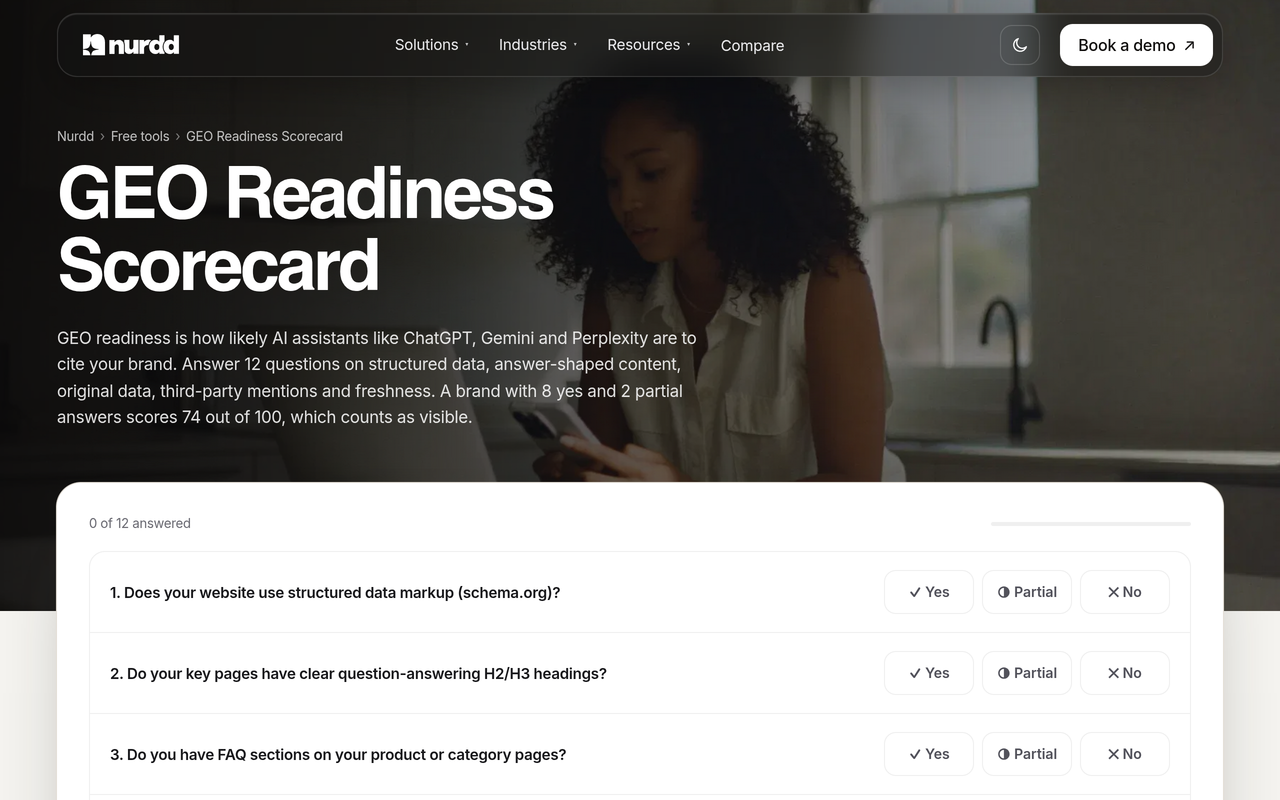
To see where your own pages stand on a broader set of factors, run them through the free GEO readiness scorecard, a 12-factor check of readiness for AI answers.
How should I structure headings so ChatGPT can quote my page?
Write each H2 as the question a buyer would ask, then answer it in the first one or two sentences under the heading, then add detail. That pattern makes each section a self-contained unit: a heading that states the question, an opening that states the answer, and supporting evidence below. An engine that lifts only the opening still quotes you correctly.
Google’s AI guide tells site owners they can ignore tactics such as "chunking" content for Google Search and says to prioritise ordinary good SEO, while also advising pages organised by paragraphs and sections with clear headings. These are compatible: you are not splitting pages into artificial fragments for a machine, you are writing sections a human can scan. Our deeper guides on the sentence structure that gets cited and FAQ pages for AI search show the pattern in more detail.
Rules for question headings
- Use the buyer’s words. Take them from "People also ask", sales calls and the prompts you track, not from internal product names.
- One question per heading. "What is it and how much does it cost?" becomes two headings.
- Answer in the first sentence. Name the subject in full rather than saying "it" or "this tool", so the sentence still makes sense out of context.
- Keep the answer short, then expand. Two or three sentences first, then a list, table or example.
- Use H2 and H3 only in the body. One H1 belongs to the page title; skipping levels makes the outline harder to parse.
Before and after: a heading rewrite
| Weak heading | Question heading | Opening answer pattern |
|---|---|---|
| Our approach | How does the service work? | [Brand] does X in three steps: A, B and C. |
| Pricing | How much does it cost and is there a free trial? | [Brand] costs $X per month; the trial lasts N days. |
| Why choose us | How does [Brand] compare with [Rival]? | [Brand] differs in three ways: A, B and C, shown in the table below. |
Home pages, product pages and comparison pages are where this matters most, because they are the pages a buyer’s prompt is most likely to land on. Our own comparison pages follow this pattern. For more on shaping the opening paragraph, see how to write a “what is” page.
How do I implement author and dateModified? A step-by-step checklist
This checklist works for a blog post, a home page or a comparison page. Follow the order, because later steps depend on earlier ones.
- Confirm crawl access. Check that robots.txt allows the search crawlers you want, including OAI-SearchBot for ChatGPT search. Result: pages are fetchable. Why: no signal helps a page that is blocked.
- Create an author page. Give each named author a profile URL with a short bio, role and the topics they cover. Result: a stable entity to link to. Why: a name alone is ambiguous; a profile gives engines something to resolve.
- Add the visible byline and date. Place "By [Name]" and "Last updated: [date]" directly under the title, with the original publication date next to it. Result: readers and engines see the same facts. Why: Google recommends a prominent, labelled, user-visible date.
- Add matching JSON-LD. Use
ArticleorBlogPostingwithheadline,author(Person, name, url),datePublishedanddateModifiedin ISO 8601 with timezone. Result: a machine-readable copy. Why: Google says visible and structured values should match. - Rewrite H2s as questions. Convert at least the five most important section headings and put the direct answer in the first sentences. Result: quotable units. Why: the engine can match a prompt to a heading.
- Make the date honest. Update
dateModifiedonly when facts, numbers, steps or examples change, and note what changed in a short "Updated" line. Result: a date readers can trust. Why: Google’s guidance says not to artificially freshen content. - Resubmit and re-crawl. Update the sitemap
lastmodand request indexing for the changed URLs in the search tools you use. Result: faster discovery of the change. Why: an engine cannot use an edit it has not fetched. - Record a baseline and re-measure. Note which prompts cite you today, then check again after two to four weeks. Result: evidence instead of assumption. Why: citations vary, so only a comparison tells you anything.
What does the markup look like? A worked example
The example below is illustrative: the page, author and dates are invented to show the pattern and are not data from any real site. It follows the property names in Google’s own Article example.
Imagine a comparison page titled "Brand A vs Brand B for small teams," written by Jordan Lee and first published on 5 January 2026. On 12 October 2026 the team corrects two pricing figures and adds a new feature row. That is a real change, so the dates read as follows.
| Property | Visible text | JSON-LD value |
|---|---|---|
| author | By Jordan Lee, Head of Research | Person, name "Jordan Lee", url to profile page |
| datePublished | Published 5 January 2026 | 2026-01-05T08:00:00+00:00 |
| dateModified | Last updated 12 October 2026: corrected pricing, added feature row | 2026-10-12T09:20:00+00:00 |
Notice three things. The visible and structured dates describe the same events. The update note says what changed, which gives a reader a reason to trust the date. And datePublished stays fixed forever, because it records the original publication.
What are the common mistakes?
- Bumping the date with no real edit. Google’s Publisher Center guidelines call this artificial freshening and say it is against its guidelines. It also teaches readers to ignore your dates.
- Mismatched dates. A visible date that disagrees with JSON-LD, or several other dates on the page. Google suggests removing extra dates if the wrong one is picked.
- Future dates or event dates. Google says dates must describe the page’s publication or update, not the events it discusses.
- "Admin" or "Team" as the only author. It gives engines and readers nobody to attribute to.
- Keyword-stuffed question headings. "Best cheap top AI tool?" reads as spam; use a natural question.
- Treating schema as the strategy. Google lists overfocusing on structured data as a mistake in its AI guide.
- Declaring victory without a control. AI answers vary run to run, so a single before-and-after check can mislead.
If your brand is still not appearing after these fixes, the cause is often elsewhere. Our guides on why AI engines trust some sites more and why competitors’ older posts get cited instead cover the usual culprits.
How can I test whether the changes shift citations?
You can run a simple controlled test using only your own tracking. The design below is a method, not a finding; the numbers in it are choices you make, not results.
- Pick a test group and a control group. For example, six pages you will change and six similar pages you will leave alone.
- Write a fixed prompt set. Use buyer questions each page should answer. Our guide to which prompts to track explains how to choose them.
- Record a baseline for two to four weeks. Log whether each engine mentions or cites your domain for each prompt.
- Change only the test group. Apply the checklist above, and change nothing else on those pages during the window.
- Compare movement. If both groups move together, the cause is probably the engine or the market, not your edit.
- Repeat once. Because answers vary, a second window protects you from a one-off swing.
Parse’s own caution applies here: observed age differences do not prove that an edit causes citations. The test is how you find out for your own pages. Our guides to tracking an AI search visibility score week over week and AI search share of voice show how to turn the logs into a number you can compare.
How do author and dateModified compare with other signals?
| Concept | What it does | How it differs from author and dateModified |
|---|---|---|
| Author and dateModified | Attributes a page and shows when it last changed | Page-level trust and freshness cues |
| FAQ or Q&A structure | Matches prompts to answers | Helps with retrieval of a passage, not with attribution or freshness |
| Organisation and Product schema | Defines the brand and what it sells | Entity definition; see our guide to schema for D2C brands |
| Third-party mentions | Corroborates the brand elsewhere | Off-page; not controlled by markup |
| Crawl access | Lets engines fetch the page | A prerequisite for every other signal |
For an audit that covers all of these together, use our AEO audit checklist and the guide to checking whether your site answers questions the way AI engines expect.
Where does Noma fit in?
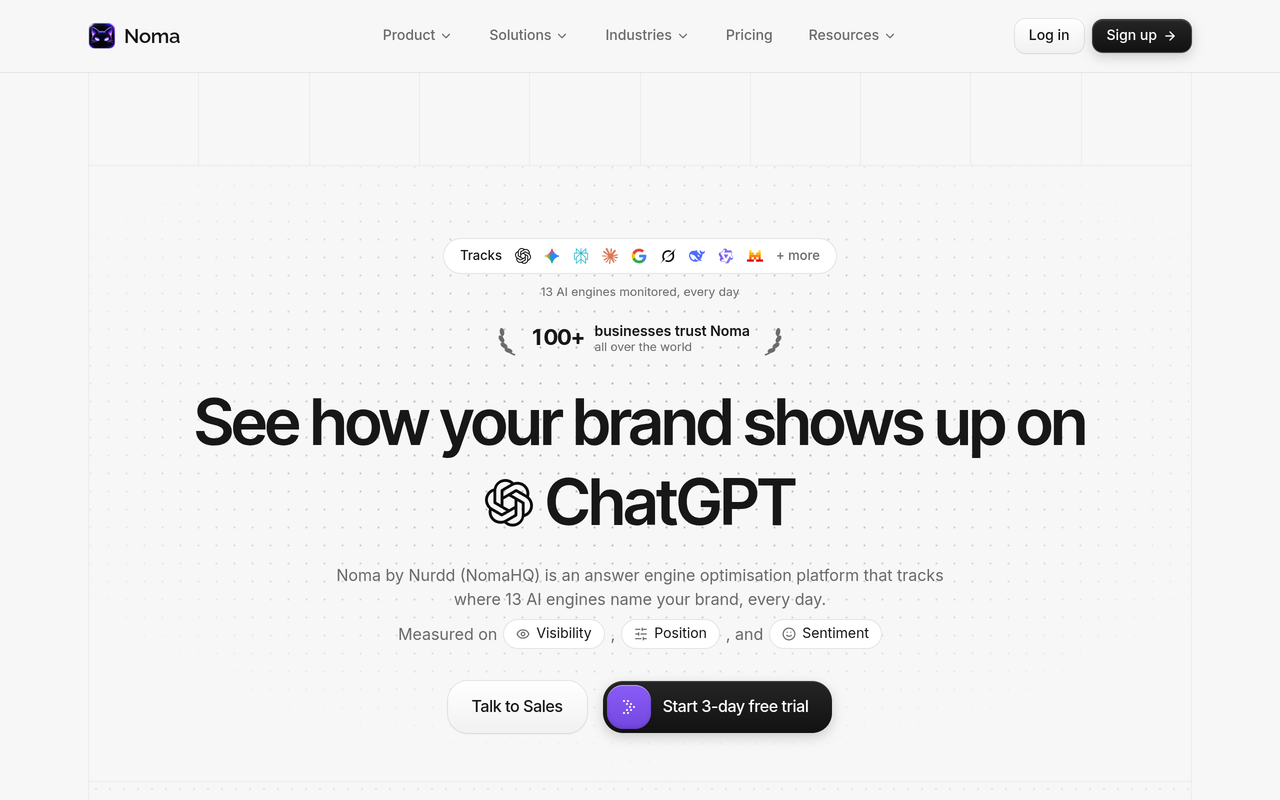
Noma by Nurdd is a web dashboard that tracks whether a brand appears in answers from 13 AI engines, including ChatGPT, Gemini, Perplexity and Claude, polled daily. It shows citation frequency by category, competitor comparison and recommendations for improving AI visibility. That makes it the measurement layer for the test above: you change author, dateModified and headings, and Noma shows whether citations moved across engines rather than in the one you happened to check.
Book a demo at nurdd.club/demo and we will show you how your own brand and competitors appear across the engines today, so you have a baseline before you edit a single page.
Noma has a 3-day free trial. A card is taken at signup and billing starts on day 3; cancel before then and you are not charged. If you are weighing tools, our comparisons of Noma vs Profound and Noma vs AthenaHQ set out the differences.
How we researched this
We reviewed official documentation from Google Search Central, Google’s Publisher Center help and OpenAI’s crawler pages, plus industry reporting from Search Engine Land and Search Engine Roundtable and a research summary from Parse. We checked these sources on the publication date of this article. We did not run hands-on tests, interviews or experiments of our own, so every number above comes from the linked source, and the markup example is illustrative.
We also found no public study that isolates the effect of a byline alone on AI citation, so we have said so rather than imply one.
What should you do next?
Start with one high-value page: add a named author, an honest "Last updated" line, matching JSON-LD and question headings with direct answers, then watch the prompts that matter. If you want to see the baseline for your own brand across 13 AI engines before you start, book a demo and we will walk through your citations and your competitors’. You can also browse our free marketing tools.
Frequently asked questions
Do author and dateModified help AI engines cite a page?
They help engines attribute and date a page, but no engine promises a citation for adding them. Research summarised by Parse shows AI-cited pages tend to be fresher than Google’s organic results, yet it does not prove an edit causes citations. Test the change on your own pages.
Should I change dateModified every time I edit a page?
No. Change it when facts, numbers, steps or examples change. Google’s publisher guidance says not to artificially freshen content, and a date with no real update behind it can erode trust.
How should I structure headings so ChatGPT can quote my page?
Write each H2 as the question a buyer asks and answer it in the first one or two sentences beneath. Name the subject in full in that answer so it makes sense when lifted out of the page. Then add a list, table or example.
Is schema markup required to appear in Google AI Overviews?
No. Google says structured data is not required for its generative AI features and that no special schema.org markup is needed. It still recommends keeping structured data as part of normal SEO.
Does Microsoft Copilot use schema?
Search Engine Roundtable and Search Engine Land both report that a Microsoft Bing product manager said schema markup helps Microsoft’s LLMs understand content. That is about understanding, not a guaranteed citation.
Do I need a real person as author?
A named person with a profile page gives engines and readers something to attribute. Generic labels such as Admin offer little. An organisation can be the author where a page is genuinely institutional.
How long until I see a change in AI citations?
There is no published threshold. Plan for a baseline of two to four weeks and a comparable window after the change, with unchanged pages as a control, because AI answers vary between runs.
Can Noma show whether these edits worked?
Noma by Nurdd polls 13 AI engines, including ChatGPT, Gemini, Perplexity and Claude, daily, so you can compare citation frequency before and after your changes. It has a 3-day free trial; a card is taken at signup and billing starts on day 3.