Paid Media
How to Advertise on ChatGPT and Measure the Results
A buyer's walkthrough of ChatGPT ads: how to set them up, what they cost, and how to measure paid placements next to organic AI visibility.
 Simran Rawat30 Oct 202615 min read

To advertise on ChatGPT, create an advertiser account at ads.openai.com, install conversion tracking, pick an objective, write context hints for the conversations your ad belongs in, set a CPC or CPM bid and launch. Paid ads and organic mentions are separate ledgers, so measure them separately with their own tags and reports.
To advertise on ChatGPT, create an advertiser account at ads.openai.com, install conversion tracking, choose an objective, write context hints that describe the conversations your ad belongs in, set a bid, and launch. If you are asking how to advertise on ChatGPT in your own country, check OpenAI's Ads Manager availability first, because access is rolled out country by country.
That is the easy half. The harder half is knowing whether the money is working, and how a paid placement relates to the times ChatGPT names your brand in its answer without being paid to. This guide covers both, with a decision table, a worked cost example and a checklist.
Key takeaways
- ChatGPT ads are bought in OpenAI's own Ads Manager (or through partners), and you target conversation context, not a keyword list alone.
- Ads and answers are separate. OpenAI says ads do not influence answers, so paying for an ad will not buy you an organic mention.
- Tag every ChatGPT ad URL with your own UTMs, or paid clicks can be mistaken for organic AI referrals.
- Turn a CPM bid into a cost per click before you commit: the maths is CPM divided by (CTR × 1,000).
- Run paid and organic as two ledgers: ad metrics from Ads Manager, citation presence from a tracker such as Noma by Nurdd.
- Use Pulse by Nurdd for the Meta and Google Ads side of the same budget, so ChatGPT is judged against channels you already know.
What are ChatGPT ads and who can buy them?
ChatGPT ads are clearly labelled placements shown alongside ChatGPT conversations. OpenAI's own help article lists its advertising principles: answer independence (ads do not influence answers), conversation privacy (conversations are kept private from advertisers and user data is never sold), and user control over personalisation. It also says businesses can sign up at ads.openai.com and should check Ads Manager availability for the current country-by-country status (OpenAI Help Center).
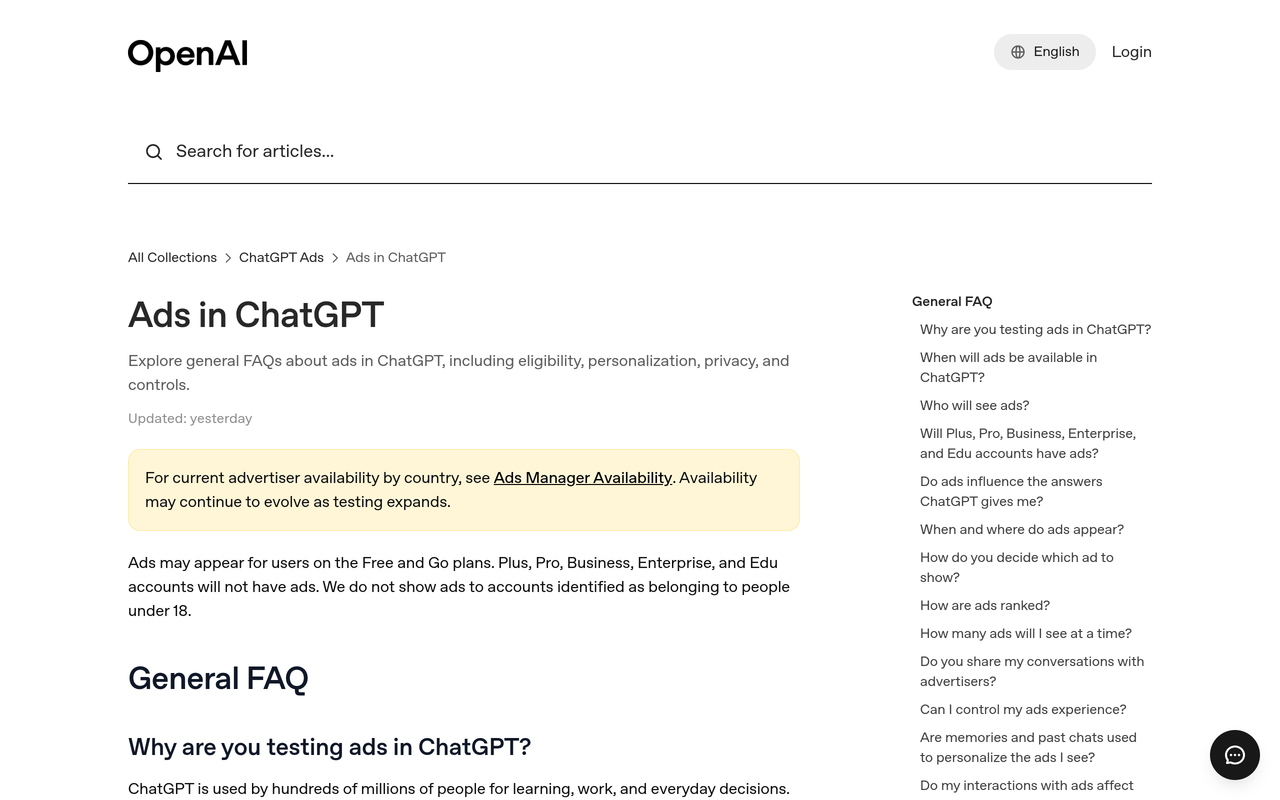
The channel started as a pilot. OpenAI's update dated March 26, 2026 said early results showed no impact on consumer trust metrics and low dismissal rates, and that the pilot was moving to its next phase (OpenAI, March 2026). The next phase added a beta self-serve Ads Manager and CPC bidding, and advertisers can also buy through partners (OpenAI, 2026).
Who sees the ads matters for planning. One 2026 industry write-up says ads show to Free and Go users in 20+ countries (PPC.io, October 2026). Treat any audience claim as something to confirm in Ads Manager for your own markets, since availability changes.
Should you pay for ChatGPT ads or earn organic mentions?
You should usually do both, but in a set order and with different expectations. A paid placement is rented, bought per click or per thousand impressions, and stops the day you stop paying. An organic mention is earned, depends on whether an AI engine finds your content worth citing, and builds slowly.
The two do not overlap much. Ethos Engine reported on October 15, 2026 that three trackers found a ChatGPT advertiser was cited in the answer above its own ad about 3% of the time, and concluded that ads and organic answers are separate ledgers (Ethos Engine, October 2026). A communications agency guide makes the same point: an ad impression, click or attributed conversion is not an organic recommendation or source citation (FLPR, 2026).
A paid-or-earned decision table
Use this table as a first pass. It is our own framework, built from the differences OpenAI and the sources above describe, not a published rule.
| Situation | Lean paid | Lean organic | Why |
|---|---|---|---|
| Launch next month, need traffic now | Yes | Start in parallel | Ads deliver on the day you fund them; citations take content and time |
| Brand is absent from AI answers for your category | Test small | Yes, first | Ads do not change answers, so the gap stays until content changes |
| Brand already named in answers | Yes, defend the slot | Keep monitoring | The ad slot sits near an answer that already names you |
| Tight budget, long sales cycle | No | Yes | Per-click cost with no tracked sales is hard to justify |
| Regulated or sensitive category | Check policy first | Yes | Ad eligibility rules apply; organic work carries no placement rule |
| Strong product feed and clear conversion events | Yes | Yes | Feeds and conversion tracking give paid a measurable loop |
If you want the organic side in detail, our guides on getting ChatGPT to recommend your brand and getting mentioned in AI answers without paying for ads cover what to publish.
How do you advertise on ChatGPT, step by step?
Setup follows six main stages according to SE Ranking's guide, which draws on its own test of around 97,000 impressions: create an account, install conversion tracking, choose an objective, set budget and markets, build ad groups with targeting, then add ads and launch (SE Ranking, 2026). The steps below follow that order and add the measurement work that most guides leave until later.
Step 1: Create and verify the advertiser account
Action: Go to ads.openai.com, sign in with your OpenAI account and complete the business verification prompts. One guide lists business name, website, address and registration details as likely requests (StubGroup, 2026). Result: an advertiser account with a billing profile and team access. Why: if Ads Manager is not yet open in your country, OpenAI says creating an account does not grant early access, but you will be notified when it opens.
Step 2: Install conversion tracking before you spend
Action: create a Pixel ID in the conversions tab of Ads Manager and add the script to every page where you want to capture conversions. OpenAI's developer documentation describes the Measurement Pixel as a browser SDK that sends website events attributable to ads in ChatGPT, firing a measure call when a conversion happens (OpenAI Developers). Result: purchases, sign-ups or demo requests flow back to Ads Manager. Why: without the pixel you can optimise for clicks only, and clicks are the weakest signal of value.
Step 3: Choose an objective that matches your funnel
Action: pick Reach, Clicks or Conversions. SE Ranking's guide lists these three objectives, along with contextual targeting, negative keywords, custom audiences, conversion tracking and product feeds. Result: a bidding model aligned to the outcome you pay for. Why: Reach campaigns bill on impressions and Clicks campaigns bill on valid clicks, so choosing wrongly changes both your cost and your report. For a first test, Clicks or Conversions is easier to judge than Reach.
Step 4: Write context hints like customer scenarios
Action: for each ad group, describe the situations in which your ad would be useful. Clutch's guide suggests 10 to 20 words or phrases per ad group, and SE Ranking recommends writing them as short customer scenarios plus negatives that filter out similar but irrelevant contexts (Clutch, 2026). Result: ad groups mapped to real conversations. Why: SE Ranking says targeting here is conversation context plus keywords, and that delivery is uneven: in its test, two of eight ad groups produced about half of all impressions.
A practical way to write hints: take the questions your prospects ask a sales team, rewrite each as the situation and task behind it, and keep one ad group per situation. Our guide on which prompts to track for AI visibility works as a source list, because the same prompts that reveal organic gaps also describe paid contexts.
Step 5: Set budget, bid and markets
Action: choose CPC or CPM bidding, a daily cap, and the countries, regions or cities to serve. Result: a campaign that cannot overspend its cap. Why: OpenAI does not publish a rate card; one guide reports that OpenAI suggests starting Clicks campaigns at $3 to $5 per click, with no published minimum spend for self-serve accounts (Kadima Digital, 2026). Confirm all of this in your own account, since bid guidance can change.
Step 6: Build the ad and the landing page together
Action: write a plain, specific ad and send clicks to a page that answers the question that triggered it. Do not imitate the assistant's voice. Clutch's guide warns against creative that mimics the assistant's formatting and says to match the ad to the question, not just the topic. Result: a message that reads as an ad and a page that completes the job. Why: OpenAI labels ads clearly, so camouflage gains nothing and costs trust.
Step 7: Tag every URL with your own UTMs
Action: add UTM parameters to every ChatGPT ad destination, using a source and medium that cannot be confused with organic referrals. Result: GA4 and your CRM can separate paid clicks from organic AI traffic. Why: Ethos Engine's first takeaway on this topic is to tag every ad URL with your own UTMs, or paid clicks look like organic AI traffic. Our UTM structure guide shows a naming scheme you can adapt: use a medium such as paid-ai for ChatGPT ads and reserve a separate value for organic AI referrals.
Step 8: Review, launch and set a first review date
Action: review ads and settings, launch, and diarise a review at a fixed interval, for example seven days. Result: a decision point that is not driven by a bad Tuesday. Why: delivery depends on how many conversations match each ad group, so early impressions can be lumpy and misleading. StubGroup's changelog also notes a September 3, 2026 Ads Manager plugin that lets you manage and analyse campaigns from ChatGPT or Codex, which may speed review work once you have an account.
How much do ChatGPT ads cost, with a worked example?
OpenAI does not publish a rate card or minimum spend on its advertiser page, according to PPC.io, which says third-party CPM figures between $25 and $60 are not linked to any OpenAI price list (PPC.io, October 2026). WebFX reports a range of $3 to $5 per click or $25 to $60 per 1,000 impressions, citing OpenAI's bid guidance (WebFX, 2026). Treat these as planning ranges, not quotes.
The useful skill is converting a CPM bid into a cost per click. The formula is CPM divided by (CTR × 1,000). PPC.io's worked table shows what that looks like:
| CPM paid | CTR 0.6% | CTR 1% | CTR 2% |
|---|---|---|---|
| $10 | $1.67 per click | $1.00 per click | $0.50 per click |
| $25 | $4.17 per click | $2.50 per click | $1.25 per click |
| $60 | $10.00 per click | $6.00 per click | $3.00 per click |
The same article compares a $25 CPM at 0.6% CTR, about $4.17 a click, with a $4.34 median Google Search CPC across 53 US accounts it can see. In that single comparison, a ChatGPT click costs roughly the same as a Google Search click. It is one author's sample, not a market average, so rerun the maths with your own CTR after the first week.
From click cost to cost per customer
Click cost is only the first line. Multiply it by your landing page conversion rate to get cost per conversion. If you do not yet have your own numbers, use the Google + Meta ROAS calculator and the marketing budget planner to set a break-even before the test, so the result is a yes or no rather than a debate.
How should you measure ChatGPT ads next to organic AI visibility?
Measure them as two ledgers that share a calendar. The ad ledger records what you bought; the organic ledger records what the engines said without payment. FLPR lists the ad metrics as impressions, clicks, spend, CTR, average CPC, average CPM and configured conversions, and the organic record as an observed source URL, query, answer context, date, language and market (FLPR, 2026).
The two-ledger measurement table
| Question | Ledger | Where the data lives | Metric to watch |
|---|---|---|---|
| Did the ad get shown? | Paid | Ads Manager | Impressions, by ad group |
| Did it earn the click? | Paid | Ads Manager, GA4 | CTR, CPC, sessions with your UTM |
| Did the click convert? | Paid | Measurement Pixel, CRM | Conversions, cost per conversion |
| Does ChatGPT name us unprompted? | Organic | AI visibility tracker | Citation frequency by prompt and category |
| Who is named instead of us? | Organic | AI visibility tracker | Competitor presence on the same prompts |
| Is the same budget better spent elsewhere? | Cross-channel | Meta Ads, Google Ads, Ads Manager | ROAS or cost per conversion, side by side |
For the organic rows, see our explainers on AI search share of voice and tracking an AI visibility score week over week. For the framework that ties several channels into one report, read the D2C marketing measurement framework.
The ad-under-answer test
This is a test you can run from public behaviour, no special access needed. Pick ten prompts a buyer in your category would ask. For each, record two facts: whether your brand is named in the answer, and whether your ad appears beneath it. You end up with four cells: named and advertised, named only, advertised only, neither.
Ethos Engine suggests that the useful place to spend is the ad under answers that already name you, because that slot, not the answer, is where paid changes your visibility. If your result is mostly 'advertised only', your money is renting a slot next to answers that recommend someone else. That points to content work before more budget. Remember the answer itself can vary between runs, so repeat the test over several days before you act on it.

Where do Pulse and Noma fit?
Be clear about scope. Pulse by Nurdd connects to Meta Ads and Google Ads through read-only OAuth, explains campaign performance in plain language, diagnoses what changed and recommends actions. It does not read ChatGPT ad data. Its role here is the comparison point: the Meta and Google results your ChatGPT test has to beat to deserve more budget.
Noma by Nurdd covers the other ledger. It tracks whether a brand appears in answers from 13 AI engines, including ChatGPT, Gemini, Perplexity and Claude, polled daily, with citation frequency by category, competitor comparison and recommendations. That shows organic presence, which ad reports cannot.
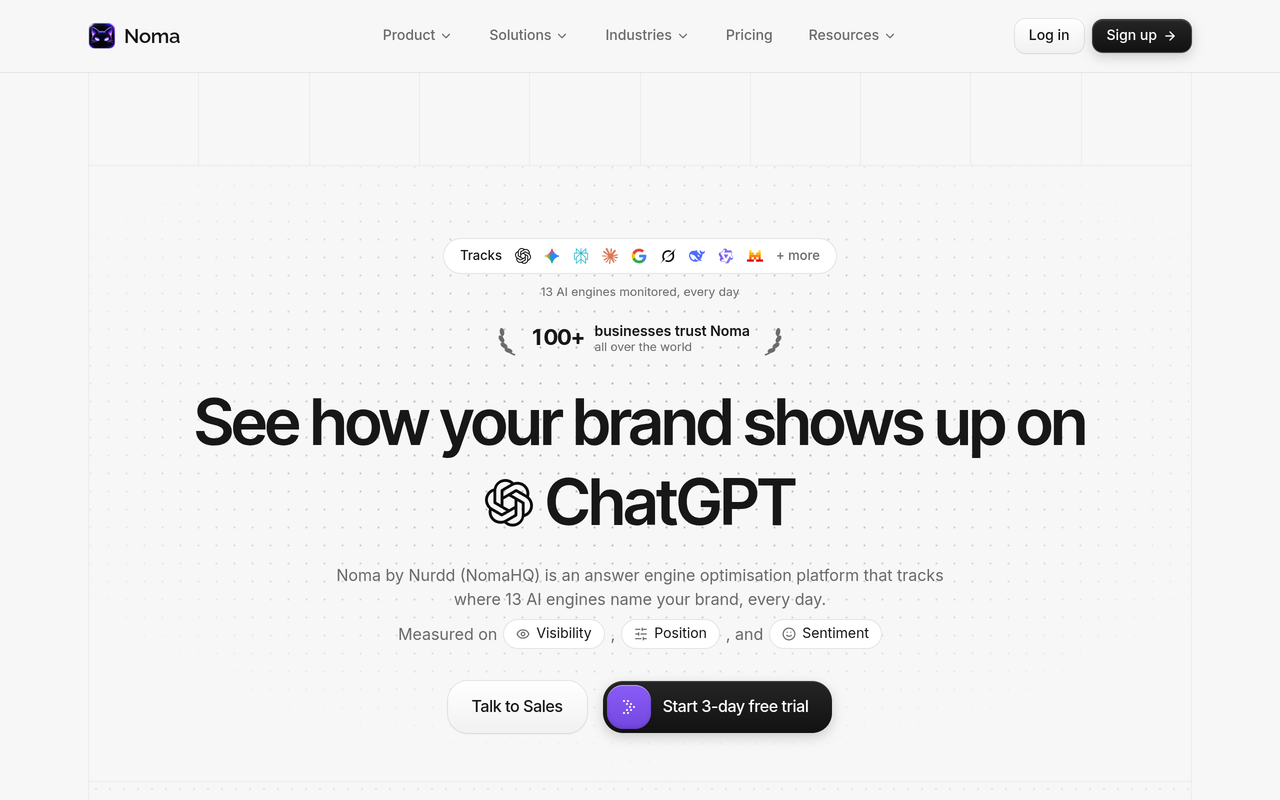
Pulse by Nurdd explains your Meta and Google Ads results in plain language, and Noma by Nurdd shows whether ChatGPT and 12 other AI engines name your brand without being paid to. Together they give a marketer the two comparison points a ChatGPT ads test needs: paid performance on channels they already run, and organic citation presence in AI answers.
Book a demo at nurdd.club/demo and we will walk through Pulse on your Meta and Google Ads accounts, and show how Noma reports your brand's citation presence against competitors on your category prompts. You can read more on the Pulse page. Noma has a 3-day free trial; a card is taken at signup and billing starts on day 3, with no charge if you cancel before then. Pulse is paid and has no trial.
What are the common mistakes when advertising on ChatGPT?
- Expecting ads to fix organic absence. OpenAI states ads do not influence answers. If competitors are recommended and you are not, ads leave that unchanged. See why your brand isn't showing up in ChatGPT answers.
- Skipping the pixel. Without conversion events you are optimising on clicks and guessing at value.
- Broad context hints. Vague hints match irrelevant conversations. Use negatives and one ad group per situation.
- Untagged URLs. Paid sessions blend into organic AI referrals and inflate your organic story.
- Judging at day two. Delivery is uneven across ad groups, so wait for a planned review before changing bids.
- Comparing CPMs, not outcomes. A cheap CPM with a low CTR can cost more per click than an expensive one. Convert to cost per conversion.
- Weak landing pages. Clicks that arrive from a specific question need a page that answers it; our guide to writing content AI engines quote helps the same page work for organic too.
What is a checklist for your first 30 days?
- Check Ads Manager availability for your country and create the account.
- List ten buyer prompts and run the ad-under-answer test to record your starting position.
- Install the Measurement Pixel and fire a test conversion.
- Define a break-even cost per conversion with the ROAS calculator.
- Write three to five ad groups, each a customer scenario with negatives.
- Tag every destination URL with paid-ai UTMs.
- Launch with a daily cap you could lose without consequence.
- At day seven, convert CPM to CPC, review which ad groups got impressions and prune the silent ones.
- At day 14, rerun the ad-under-answer test and compare it with the baseline.
- At day 30, compare cost per conversion with your Meta and Google results and decide: scale, hold or stop.
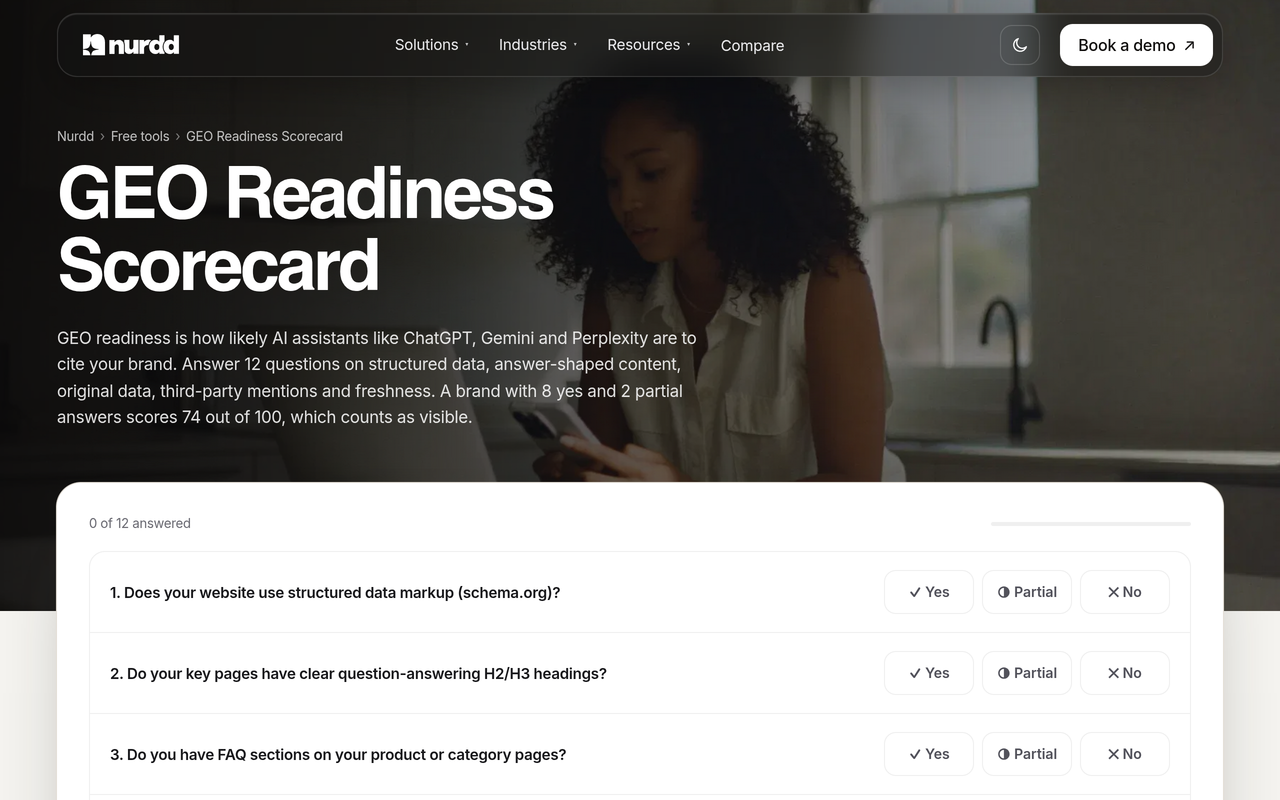
Before you start the organic side, run the free GEO readiness scorecard, a 12-factor check of how ready your site is for AI answers.
How does this change by business type?
The balance between paid and organic shifts with your model. Ecommerce brands with product feeds and clear purchase events can measure paid quickly, so see our ecommerce industry page. SaaS and developer tools usually have longer cycles, where organic citation in comparison prompts matters more; see SaaS. Agencies running this for clients need separate ledgers per account, which our agencies page addresses.
If you are weighing ChatGPT against search engines, Perplexity vs ChatGPT vs Gemini explains which engines matter for a brand, and whether AI search traffic converts better than Google examines the conversion question.
What should you do next?
Treat ChatGPT ads as a test with a stop rule, not a new default channel. Set up tracking first, spend a capped amount, and judge the result against your Meta and Google numbers. In parallel, build the content that earns unpaid citations, because the ad will not do that work for you.
To see this for your own brand, book a demo: we will show Pulse on your Meta and Google Ads performance and Noma's citation view for your category prompts, so you can set the baseline before you spend on ChatGPT.
How we researched this
We reviewed OpenAI's own help centre, advertising announcements and developer documentation, plus 2026 guides from agencies and industry publishers on setup, cost and measurement. We read each source on the publication date of this post. We did not run ChatGPT ad campaigns, and we have no customer data on them. Figures such as cost ranges and overlap rates come from the named sources and may change as OpenAI updates the product.
Frequently asked questions
How do I advertise on ChatGPT?
Sign up at ads.openai.com, verify your business, install the Measurement Pixel, choose an objective, write context hints, set a bid and budget, and launch. OpenAI says availability depends on country, so check Ads Manager status first. Some advertisers also buy through OpenAI's partners.
Should I pay for ChatGPT ads or earn organic mentions?
Do both, in a deliberate order. Ads buy placement and traffic you can start measuring on day one. Organic mentions depend on whether engines find your content worth citing, and OpenAI says ads do not influence answers. Run the ad-under-answer test to see which gap you actually have.
Do ChatGPT ads make ChatGPT recommend my brand?
No. OpenAI's principle of answer independence states that ads are separate and do not influence answers. Ethos Engine's three-tracker review found only about 3% overlap between advertisers and brands cited in the answer above their ad. Earn citations through content, entity clarity and third-party coverage.
How much do ChatGPT ads cost?
There is no published rate card. Guides report OpenAI suggesting $3 to $5 per click for Clicks campaigns and advertiser-reported CPMs of $25 to $60. Convert a CPM to a click cost with CPM divided by (CTR × 1,000), and check your own account for current guidance.
How do I measure ChatGPT ad results?
Use Ads Manager for impressions, clicks, spend, CTR and CPC, and the Measurement Pixel for conversions. Add your own UTMs so GA4 and your CRM can separate paid sessions from organic AI referrals. Then check organic presence separately with a citation tracker.
Can I track whether ChatGPT mentions my brand without ads?
Yes. Run your buyer prompts on a schedule and record whether the brand is named and which competitors appear. Noma by Nurdd automates this across 13 AI engines, including ChatGPT, Gemini, Perplexity and Claude, polled daily, and has a 3-day free trial with a card taken at signup.
Does Pulse report on ChatGPT ads?
No. Pulse by Nurdd connects to Meta Ads and Google Ads through read-only OAuth. It is useful here as the benchmark: you compare ChatGPT cost per conversion with what Pulse explains about your Meta and Google results.
Book a demo to see Pulse and Noma on your own brand.