Paid Media
Meta Ads Learning Phase: Duration and What Resets It
The Meta ads learning phase ends after about 50 results in a week; here is what resets it, what Learning Limited means and which edits to avoid.
 Sheetal Shakshi29 Oct 202616 min read

The Meta ads learning phase usually ends once an ad set gets about 50 optimization events in the week after its last significant edit, so it has no fixed length in days. Significant edits to targeting, creative, the optimization event, bid strategy, new ads or a pause of 7 days or longer restart it, and large budget changes may. Learning Limited means Meta expects the ad set to miss that 50-event mark with its current setup.
The Meta ads learning phase is the period after you launch or significantly edit an ad set when Meta's delivery system is still working out how to deliver it. It usually ends after about 50 optimization events in the week following the last significant edit, so there is no fixed number of days. Anything that counts as a significant edit restarts the count.
Key takeaways
- Plan for roughly 50 results per ad set in the 7 days after your last significant edit, not for a set number of days.
- Treat targeting, creative, optimization event, bid strategy, adding an ad and pausing for 7 days or more as resets. Treat large budget moves as probable resets.
- Learning Limited is a forecast about your setup, not a penalty. Fix it by consolidating ad sets or funding the event properly, once, in one batch.
- Work out the budget before launch: target cost per result multiplied by 50, divided by 7, gives a daily floor.
- Check the Delivery and Last significant edit columns before every change, and keep a log so a reset can be traced to its cause.
- Do not switch to a more frequent event such as add to cart only to escape Learning Limited without testing it in a new ad set first.
What is the Meta ads learning phase?
The Meta ads learning phase is the stretch when Meta's delivery system is exploring how an ad set may deliver and perform. According to Meta's own help page on the learning phase, it covers what the status means and how to avoid resetting it in Ads Manager. Ads Manager shows "Learning" in the Delivery column while it runs, as Synter, October 2026 summarises Meta's article.
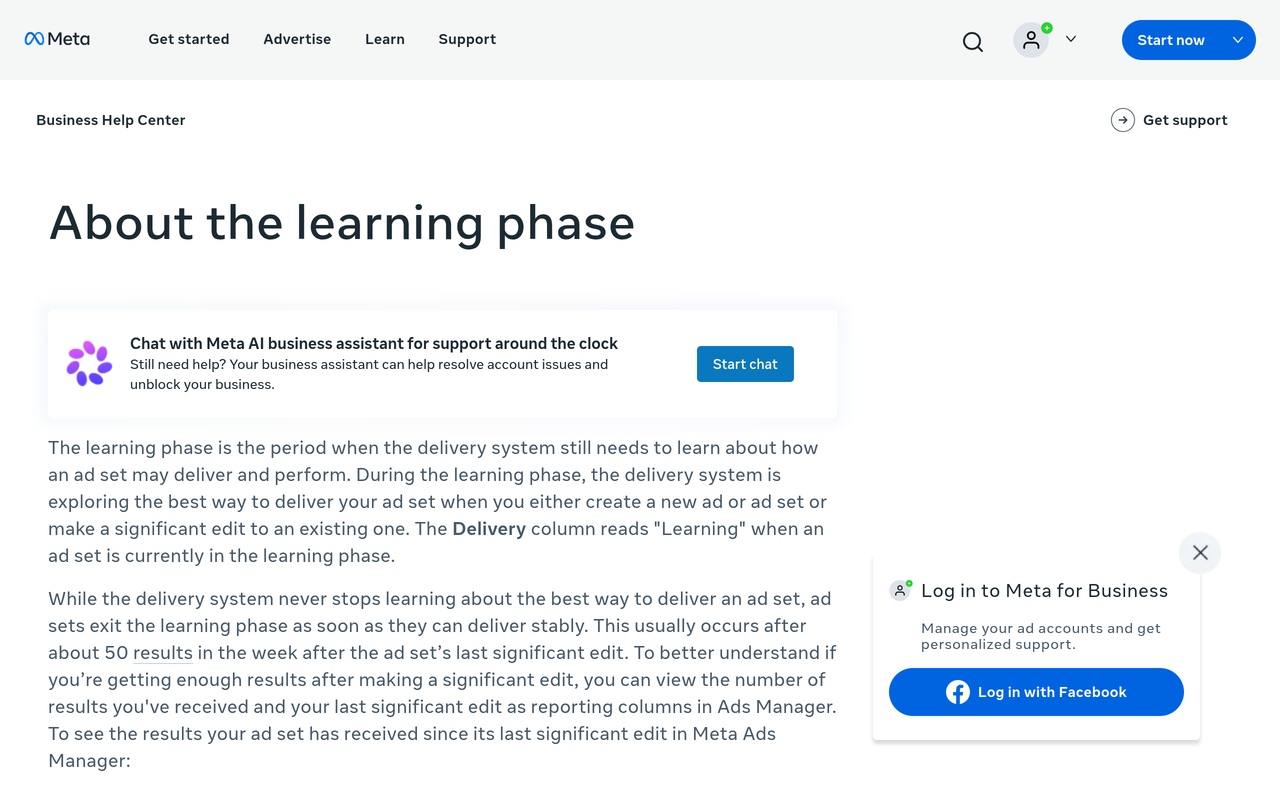
The status belongs to the ad set, not the campaign, so one campaign can hold a stable ad set beside one that is still exploring. Synter, October 2026 also reports that Meta says the system never stops learning, and that leaving the phase only marks the point where delivery can be stable. The phase is also not something Meta wants you to avoid entirely, because testing new creative and strategies is how performance improves.
Why does the learning phase matter for your results?
While an ad set is learning, Meta says delivery is less stable and cost per action is usually worse. Lebesgue, September 2026 quotes that Meta statement and then tests it against its own account data, which is worth reading as a counterweight.
In that dataset, ad sets still in learning showed a customer acquisition cost of $45 on $65k of spend, while ad sets that had exited showed $51 on $317k. Lebesgue says this meant a 10% lower CAC during learning, and that the result came from aggregated accounts on its own platform. That is one vendor's sample, not a universal rule, but it shows why judging an ad set only by its Delivery label can mislead.
The practical cost of the phase is not the label. It is the repeated restart: an ad set that is edited every few days may never accumulate a clean week of data, so you never find out whether the setup works. If you are already seeing cost swings, our post on why Meta cost per result can double overnight covers the non-learning causes to rule out first.
How long does the Meta learning phase last?
Meta gives no fixed duration. Synter, October 2026 reports that an ad set usually exits after about 50 results in the week after its last significant edit. The practical answer to "how long" is however long it takes to collect roughly 50 of your chosen optimization event inside a 7-day window.
Event volume decides it. Synter's example: an ad set getting 10 purchases a day is on pace to clear 50 in about five days, while one getting three a day collects 21 in a week and is a likely Learning Limited candidate.
Entity-level summary: the Meta ads learning phase ends when an ad set accumulates about 50 optimization events in the week after its last significant edit. Its length depends on how often the chosen event happens, not on the calendar.
Two details trip people up. First, the 50 events are counted per ad set and for the specific event that ad set optimizes for, as Jetfuel, 2026 puts it, so purchases on a sibling ad set do not help. Second, Shops ads are an exception: Synter reports they need at least 17 purchases through your website and 5 through Meta within 7 days.
Where to see your ad set's status
In Ads Manager, the Delivery column reads "Learning" while the phase runs. Synter recommends adding the Last significant edit column, which shows when you last made a change that could reset learning, and the Results or Optimization events column to compare against 50. Developers can read a learning stage field in the Marketing API, which Synter says returns LEARNING, SUCCESS or FAIL and is not returned for every ad account or for Dynamic Creative ad sets, so treat a missing value as unknown.
What resets the Meta ads learning phase?
A significant edit resets it; ordinary edits do not. Synter, October 2026 reports that Meta splits significant edits into changes that always count and changes that count depending on size. The always-count list covers targeting, creative, the optimization event, bid strategy, adding a new ad and pausing for 7 days or longer.
Here is where published guidance disagrees, and where a reader needs a way to weigh it. The table below is an original evidence-grading framework: each edit is marked by how firmly the public sources support a reset, so you can decide how much risk to accept.
| Edit | Reset? | Evidence grade | What the sources say |
|---|---|---|---|
| Targeting change | Yes | Meta-listed, always | Listed as always significant in the summary by Synter, October 2026. Blip lists it too, with audience exclusions as its safer alternative. |
| Optimization event change | Yes | Meta-listed, always | Lock it before launch; move it only on purpose. |
| Bid strategy change | Yes | Meta-listed, always | Listed as always significant by Synter. |
| Any creative change | Yes | Meta-listed, always | Synter and Lebesgue both list any creative change as a restart. Blip, 2026 says editing ad copy does not reset, so treat copy edits as a risk until your own column proves otherwise. |
| Adding a new ad | Yes, per Meta | Meta-listed, but contested in a public test | Jon Loomer added one ad to an ad set of 22 and it stayed active; he suspects adding many ads to a one-ad set would trigger learning. |
| Pause of 7 days or longer | Yes | Meta-listed, always | The ad set re-enters learning on unpausing. A shorter pause is not on Meta's list. |
| Budget change | Depends on size | Meta says size matters; no percentage | Synter says Meta's only example is $100 to $101 unlikely, $100 to $1000 possible. Lebesgue and Blip cite 20%. |
| Bid cap, cost goal or spend limit amount | Depends on size | Meta: "may or may not" | Small moves are lower risk; large ones are not. |
| Renaming an ad set | No | Practitioner claim | Blip lists naming as safe. |
The disagreement over budget is worth spelling out. Synter, October 2026 states that the commonly quoted 20% figure is a practitioner rule of thumb, not Meta guidance. Lebesgue, September 2026 presents a budget increase of more than 20% as a restart trigger in its table. Both can be useful, but only one is documented by Meta as "depends on size".
The campaign-level blast radius
Where the edit happens changes how many ad sets it touches. Synter says that with a campaign-level budget, changing the campaign's bid strategy or budget might push several ad sets into learning at once. It adds that budget moving between ad sets does not reset them, a significant edit on one ad set does not reset the others, and adding a new ad set does not reset the rest.
So prefer ad-set-level edits where you can, and treat campaign-level edits as the expensive ones. Synter also notes that domain verification is not on Meta's list of significant edits as of October 2026, so check the Last significant edit column after you verify if the ad set matters to you.
Automation is an editor that never sleeps
Automated rules can change budgets, adjust bids and switch ad sets on and off, per the Meta documentation Synter cites. A rule that scales budget every morning, or turns an ad set off for a week, produces the same resets as a person would. If you use rules or agents, give them a change window and a limit on edit size.
What does Learning Limited mean in Meta Ads?
Learning Limited means Meta expects the ad set will not get about 50 optimization events in the week after its last significant edit. Adwize, 2026 summarises Meta's guidance that it is not a penalty but a sign the budget is not being spent effectively, because the delivery system cannot optimize well with the current setup. The ad set still delivers.
One snag: the label is a prediction as well as a result. Lebesgue's reading, which matches Meta's article, is that it can appear when the system forecasts a shortfall, so an ad set can show it before the week is over. ads.expert, August 2026 frames it as a setup problem, usually an ad set asking for an event that cannot happen 50 times in a week.
The usual causes and Meta's fixes
Adwize lists Meta's five suggested fixes: combine ad sets and campaigns, expand the audience, raise the budget, raise the bid or cost control, or pick a more frequent optimization event, such as add to cart instead of purchase. Synter adds that Meta lists small audience, low budget, low bid or cost control, high auction overlap, too many ads and an infrequent event as the causes.
| Likely cause | Meta-style fix | Side effect to plan for |
|---|---|---|
| Too many thin ad sets | Combine ad sets and campaigns | Merging changes the ad set, so the survivor re-enters learning. |
| Small audience | Expand audience | A targeting change is itself a reset. |
| Low budget | Raise budget | A large raise may reset; size it with the budget maths below. |
| Low bid or cost control | Raise the bid or cost control | Also a possible significant edit. |
| Rare optimization event | Use a more frequent event | Reaches 50 sooner but optimizes toward a less valuable action. |
Almost every fix is itself a significant edit. That is the trap: the cure restarts the clock, so pick one fix, make it in one batch, and leave the ad set alone afterwards. Lebesgue warns that, for e-commerce, switching from purchase to add to cart tends to attract people who add to cart rather than buy, so test that switch in a new ad set first.
How is Learning different from Learning Limited, Active and a stalled bid cap?
These four states look similar on a dashboard and need opposite responses. The table below is an original triage guide that pairs the symptom with the right move, built from the definitions in the sources above.
| State | What it means | Right response |
|---|---|---|
| Learning | New or recently edited; collecting events | Wait; do not edit; read cost swings as exploration. |
| Learning Limited | Forecast to miss about 50 events in the week | Pick one structural fix; apply it once. |
| Active | Enough events since the last significant edit | Edit only for a reason; log the change. |
| Bid-cap stall | A low cap throttles spend and mimics Learning Limited | Raise or remove the cap; Blip, 2026 describes this pattern. |
Blip also separates a reset from a failure to ever exit. After a recent significant edit, volatile delivery is a reset and should simply re-exit. If the ad set never reaches 50 events in a week, waiting does not help, because the arithmetic does not work, and consolidation does.
How do you size a budget to exit the learning phase? A worked example
The sourced formula is daily budget of roughly target cost per result multiplied by 50 to 60, divided by 7. Lebesgue, September 2026 gives that formula and its own $15 example, where a $105 weekly spend would need a $2.10 CPA to hit 50 conversions. Synter, October 2026 gives a $40 target CPA example: $2,000 a week, about $286 a day, and about $357 a day at a $50 CPA.
Apply it to your own account with this arithmetic, which uses an illustrative $60 target CPA rather than a measured figure:
- Multiply the target CPA by 50 events: $60 x 50 = $3,000 for the week.
- Divide by 7 days: $3,000 / 7 is about $429 per day.
- Compare that with the real daily budget. If the ad set has $100 a day, it can fund about 11 to 12 purchases a week at $60, far short of 50.
- Choose the response: raise the budget, merge ad sets so one gets the spend, or move to a more frequent event on purpose.
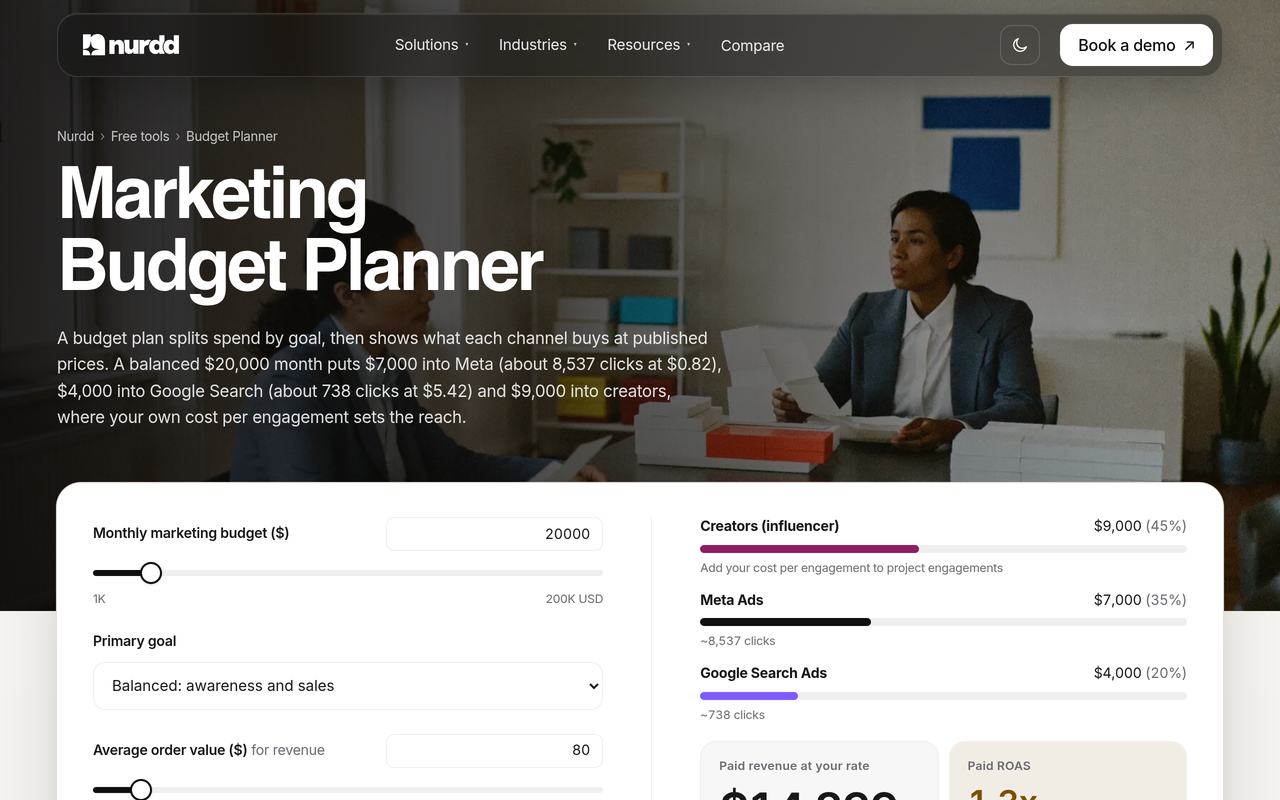
The same arithmetic explains fragmentation. Lebesgue notes that ten ad sets would need roughly 500 conversions before you know which performs best, and recommends 3 to 5 ad sets with one ad each. You can model the split with Nurdd's free marketing budget planner and check what each channel must return using the Google + Meta ROAS calculator.
Example: a week of small edits that never lets an ad set exit
Synter walks through a purchase-optimized ad set averaging seven purchases a day, which would collect about 49 in a week if left alone. A creative variant is added on Tuesday, an audience exclusion is tightened on Thursday and the bid strategy changes on Saturday. Each edit restarts the window, so the ad set is stuck in learning all week even though every change looked reasonable on its own.
Now apply the evidence grades from the table above. The Tuesday edit is an added ad, contested in one public test but listed by Meta. The Thursday edit is a targeting change, listed by Meta. The Saturday edit is a bid strategy change, also listed. Bundling all three into a single save on Tuesday would have restarted the clock once, and the ad set would have had six clean days of data.
How do you batch changes without resetting learning? A checklist
Batching means fewer, deliberate significant edits in place of a stream of small ones. This ordered list is adapted from the batching approach in Synter, October 2026, with the evidence grades from this article added.
- Open Ads Manager and add the Delivery, Last significant edit and Results columns for every ad set.
- Sort ad sets by status. Leave any ad set in Learning alone unless it is clearly broken.
- Write down the changes you want, and mark each one Meta-listed, size-dependent or practitioner-only.
- Decide a change window, such as the day an ad set exits learning or seven days after its last significant edit.
- Make all planned edits in one save, at ad set level where possible.
- Put new creative into a new ad set, since adding an ad to a live one is on Meta's list. Under a campaign budget, adding an ad set does not reset the others, per Synter.
- Step budgets up gradually. Blip's ladder is $100, $120, $145, $175, $210, $250 with 3 to 4 days between steps; it is a practitioner method, not Meta guidance.
- Log each change with old and new values and the date, then check whether the Last significant edit column moved.
For a structured pass through the rest of the account before you batch anything, use our 30-minute Meta ad account audit, and read the framework for when to pause a Meta campaign versus let it optimise before touching an ad set in learning.
What mistakes keep ad sets stuck in learning?
- Editing on a reaction. A bad day while learning is expected. Our earlier explainer on what the Meta ads learning phase actually means covers how to read those swings.
- Over-splitting budgets. Ad sets that overlap compete with each other and share too few events; see how to fix Meta audience overlap.
- Pausing for a week and unpausing. A pause of 7 days or longer is a listed reset.
- Chasing an easier event. A more frequent event exits faster but may fill the account with lower-value results.
- Trusting the dashboard ROAS. Learning-phase results are noisy and attribution can inflate them; see why Meta ROAS can look great while your bank account disagrees.
- Weak conversion signal. A missed conversion is a result that learning never counts. Our guide to what still converts after iOS privacy changes covers the tracking side.
How does Pulse help you monitor campaign status across Meta and Google?
Pulse by Nurdd is a paid web dashboard that connects to Meta Ads and Google Ads through read-only OAuth, explains campaign performance in plain language, diagnoses what changed and recommends specific actions, without requiring you to build reports. Because it reads both platforms in one place, it suits teams who would otherwise compare an Ads Manager delivery column with a separate Google Ads view by hand. Pulse is in private access and has no free trial. See Pulse for details.
Book a demo at nurdd.club/demo and bring one ad set whose cost per result moved; you will see how Pulse reads your connected Meta and Google accounts and explains what changed.
If your reporting stack is still being chosen, our comparison of the best paid ads reporting tools for D2C brands sets out what to look for. Pairing it with a read of the Meta ads breakdown report shows where results actually come from, and the Meta Ads versus Google Ads performance guide helps you compare the two platforms fairly. Google has its own volatility, so a look at Performance Max for D2C and what a healthy Google Ads account looks like is useful before you blame Meta alone. Ecommerce teams can also see how Nurdd supports ecommerce brands.
How we researched this
We searched the primary keyword on 29 October 2026 and read the Meta Business Help Center listing for the learning phase, plus current practitioner and vendor guides that summarise Meta's documentation and publish their own account data. Meta's help page itself could not be opened by our fetch tool, so Meta's wording is taken from the page's published description and from guides that quote it, which we name each time. We checked all figures against those pages on the publication date. We did not run our own ad tests, and every number here is attributed to its source.
Frequently asked questions
What resets the Meta ads learning phase?
A significant edit does. Per the summary by Synter, October 2026, that means targeting, creative, optimization event, bid strategy, adding a new ad and pausing for 7 days or longer. Budget, bid control and cost goal changes may reset it depending on size.
How long does the Meta learning phase last?
It has no fixed length. An ad set usually exits after about 50 results in the week after its last significant edit, so a high-volume ad set can exit in days while a low-volume one may not exit at all.
What does Learning Limited mean in Meta Ads?
It means Meta expects the ad set will not reach about 50 optimization events in the week after its last significant edit. It is not a penalty, but it signals that the current setup, budget or event is not letting the system optimize well.
Does increasing the budget reset the learning phase?
It can. Meta's published guidance, as relayed by Synter, depends on size: $100 to $101 is unlikely to reset and $100 to $1000 may. The 20% limit repeated by many guides is a practitioner rule of thumb, so step budgets gradually and check the Last significant edit column.
Does editing ad copy reset the learning phase?
Sources disagree. Synter and Lebesgue list any creative change as a restart, while Blip says copy edits do not reset. Assume a reset unless the Last significant edit column shows otherwise for your account.
Does pausing an ad set reset learning?
Pausing for 7 days or longer does, and the ad set re-enters learning when you turn it back on. A shorter pause is not on Meta's list. If you need to cut spend, a lower budget is a gentler option than a long pause.
Should I switch to add to cart to get out of Learning Limited?
Only after a test. A more frequent event reaches 50 sooner, but Lebesgue warns it can attract people who add to cart rather than buy. Test the switch in a new ad set before touching a stable one.
Is the learning phase bad for performance?
Meta says cost per action is usually worse during learning. One vendor dataset from Lebesgue, September 2026 showed the opposite in its sample, so judge ad sets by cost per result and return, not by the label alone.
Ready to see your own Meta and Google campaigns explained without building a report? Book a demo with Nurdd and we will walk through your connected accounts in Pulse, and you can browse more guides on the Nurdd blog or try the free tools.