Influencer Marketing
How Much Do Influencers Charge? 2026 Rates by Tier
Influencer pricing in 2026 by platform and tier: rate cards against real payouts, add-on costs, and a checklist to test any quote.
 Simran Rawat28 Sept 202616 min read

Influencers charge brands a median of $134 per deliverable at nano level, rising to $2,727 for mega creators, according to OpenSponsorship’s July 2026 analysis of 1,527 paid deliverables. Micro creators were paid $150, mid-tier $417 and macro $517. Rate cards run higher, and usage rights and whitelisting each typically add 30% to 50%, per Later.
Influencers charge brands a median of $134 per deliverable at nano level, rising to $2,727 for mega creators, according to OpenSponsorship’s July 2026 analysis of 1,527 paid deliverables. Micro creators were paid $150, mid-tier $417 and macro $517.
| Follower tier | Followers | Median paid per deliverable |
|---|---|---|
| Nano | Under 10K | $134 |
| Micro | 10K to 50K | $150 |
| Mid-tier | 50K to 250K | $417 |
| Macro | 250K to 1M | $517 |
| Mega | 1M+ | $2,727 |
Influencer pricing depends on three things: the platform, the creator's follower tier and the rights you buy on top of the post. Rate cards put a nano Instagram post at $10 to $100+ and a mega YouTube video at $20,000 to $50,000+, while two sets of transaction data show brands paying far less per deliverable. This guide puts the sourced numbers side by side, in USD, so you can test any quote before you negotiate. You can also check a quote against our campaign benchmarker.
Key takeaways
- Rate cards and real payouts are different numbers. Use a rate card to set a ceiling and transaction data to set a target price.
- Tier cut-offs differ by source. Check which follower range a benchmark calls micro or mid before you compare it with a quote.
- Whitelisting, usage rights, exclusivity and agency fees can change the final cost more than follower count does. Price each one separately.
- Compare tiers on cost per engagement, not cost per post. In OpenSponsorship's data the 50K to 250K tier was the weakest on that measure.
- Check the audience with the Instagram fake follower checker before you agree a rate, and ask for past campaign results.
- Write every deliverable, right and time window into the quote before you discuss the headline fee.
How much do influencers charge in 2026?
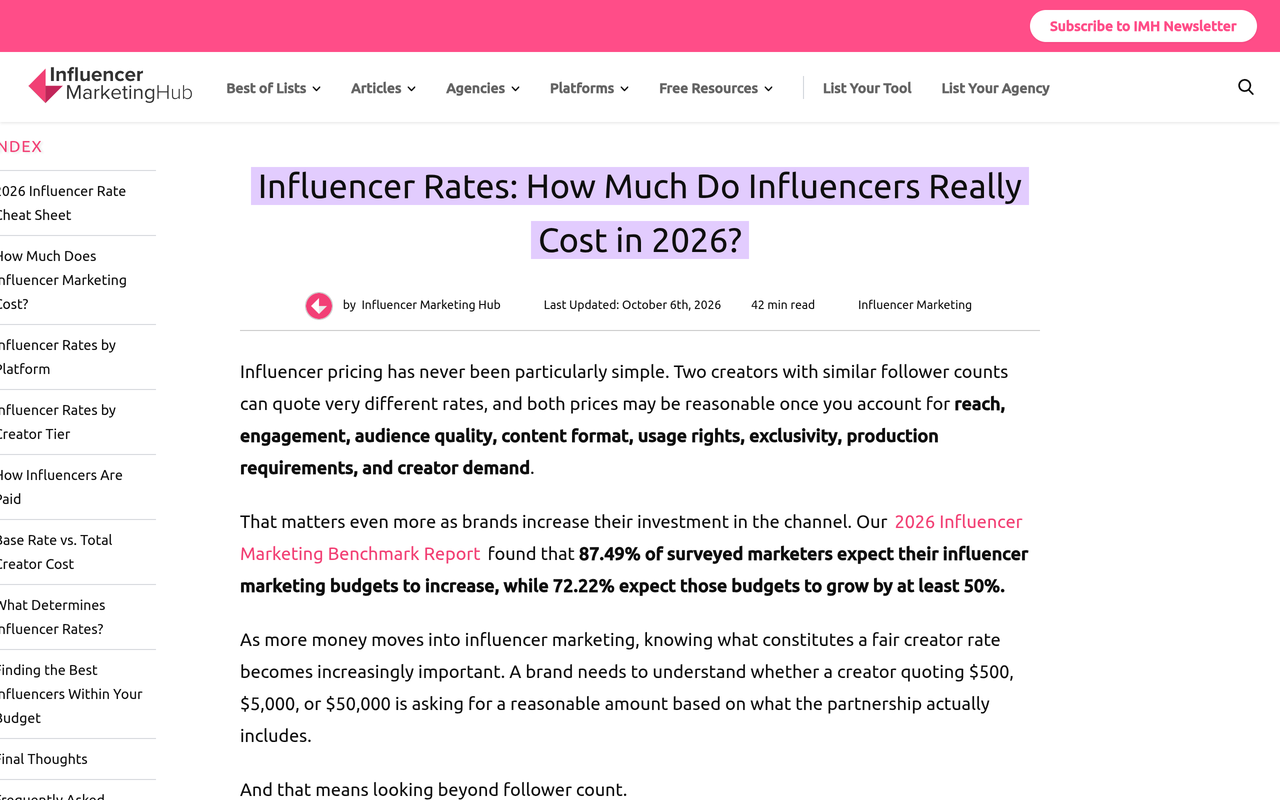
There is no single price, because the sources measure different things. Some publish rate cards, some report what creators list on a marketplace, and some report what brands actually paid. Influencer Marketing Hub, October 2026 describes its figures as planning benchmarks, not fixed rate cards, and says quotes move with performance, niche, format, rights and scope.
The practical way to use pricing data is in three layers. Start with the rate card for the creator's tier and platform. Compare it with what brands paid. Then add the cost of rights and extras, which sit outside the headline fee. This guide follows that order, and the influencer rate card generator gives a second reference. For a view of what a rate card should contain, see our guide to what to include in an influencer rate card.
How much do influencers charge per post?
Rate cards tell you what a creator of a given size is likely to ask, not what you will end up paying. Influencer Marketing Hub, October 2026 publishes this grid for Instagram, TikTok and YouTube:
| Tier | Followers | Instagram (per post) | TikTok (per video) | YouTube (per sponsored video) |
|---|---|---|---|---|
| Nano | Under 10,000 | $10 to $100+ | $50 to $200 | $20 to $200+ |
| Micro | 10,000 to 100,000 | $100 to $500+ | $200 to $800 | $200 to $1,000+ |
| Macro | 100,000 to 1,000,000 | $5,000 to $10,000+ | $800 to $5,000 | $10,000 to $20,000+ |
| Mega | 1,000,000+ | $10,000+ | $5,000 to $50,000+ | $20,000 to $50,000+ |
Notice the jumps. On Instagram the same guide moves from $100 to $500+ for micro creators to $5,000 to $10,000+ for macro creators, while on TikTok the macro band starts at $800 (our TikTok influencer rates guide breaks the TikTok bands down and shows how to price a creator from CPM). Prices do not rise smoothly with followers: platform, format and production effort all shift the number. The guide also says micro creators may charge as much as $1,250 per Facebook post, and that nano creators on X may charge as little as $2 per post.
Later, July 2026 publishes a second set of per-post ranges that run higher at the low end:
| Tier | Later, per post | Influencer Marketing Hub, Instagram per post |
|---|---|---|
| Nano | $100 to $500 | $10 to $100+ |
| Micro (10K to 100K) | $500 to $2,500 | $100 to $500+ |
| Macro (100K to 1M) | $2,500 to $10,000+ | $5,000 to $10,000+ |
| Mega (1M+) | $10,000 to $50,000+ | $10,000+ |
The two guides overlap at the top and disagree sharply at the bottom. A nano creator quoting $300 is expensive by one guide and cheap by the other. That gap is the reason to read a third kind of source: what brands actually paid.
How does format change the price?
Format moves the price inside a tier. Influencer Marketing Hub says Reels generally command higher fees than static posts because they need more scripting, filming and editing, and that Story packages are typically priced below permanent feed content (Influencer Marketing Hub, October 2026). Later puts micro-creator feed posts at $500 to $1,500 and Reels or TikToks at $800 to $2,500, and says bundled packages with a feed post, Stories and basic usage rights can run $1,000 to $3,000+ (Later, July 2026).
What do brands actually pay?
Transaction data is lower than rate cards and is the better basis for a target price. Two datasets are worth reading, and they cover different parts of the market.
OpenSponsorship: median cost per deliverable
OpenSponsorship, July 2026 analysed 1,527 completed, paid creator deliverables from deals created between 1 January 2025 and 30 June 2026. The figures are medians per individual deliverable and include multi-post bundles, where each post is priced lower than a one-off.
| Tier | Followers | Deliverables in sample | Median cost per deliverable | Median views |
|---|---|---|---|---|
| Nano | Under 10K | 146 | $134 | 1,115 |
| Micro | 10K to 50K | 349 | $150 | 989 |
| Mid | 50K to 250K | 513 | $417 | 2,606 |
| Macro | 250K to 1M | 441 | $517 | 6,974 |
| Mega | 1M+ | 53 | $2,727 | 20,123 |
OpenSponsorship says the mega row and its over-$7,500 spend band are small samples, so treat them as directional. It reports that nano creators generate 20x more views per follower than mega creators, but that mega creators have the cheaper cost per view, roughly 2x cheaper.
Cost per engagement tells a different story, and it is the number to use when comparing tiers:
| Tier | Median cost per engagement | Engagement per view |
|---|---|---|
| Nano (under 10K) | $3.11 | 4.6% |
| Micro (10K to 50K) | $3.05 | 4.3% |
| Mid (50K to 250K) | $7.07 | 2.9% |
| Macro (250K to 1M) | $4.39 | 2.6% |
| Mega (1M+) | $5.00 | 3.5% |
OpenSponsorship's analysis of 1,527 paid deliverables found that creators with 50K to 250K followers had the worst cost per view ($0.19) and the worst cost per engagement ($7.07) of any tier it measured (OpenSponsorship, July 2026).
That finding is useful in a negotiation. If a creator in the 50K to 250K range quotes well above the $417 median, you are paying a premium in the tier that performed worst on efficiency in this dataset. The same source says deals over $7,500 were the least efficient and most volatile spend band, and that creators booked inside the subject they already talk about performed better.
Worked example: what $1,000 buys by tier
Using only OpenSponsorship's median cost per engagement, our own arithmetic shows how much the tier choice changes the outcome for the same spend.
- At the micro median of $3.05 per engagement, $1,000 buys about 328 engagements.
- At the mega median of $5.00, $1,000 buys about 200 engagements.
- At the mid-tier median of $7.07, $1,000 buys about 141 engagements.
This is a comparison of medians from one dataset, not a forecast for your campaign. It does show why a cheaper-looking quote from a larger creator is not automatically better value. To turn a fee into an expected return, use the influencer ROI calculator.
Collabstr: asking price versus average payout
Collabstr, 2026 analysed more than 472,000 creator packages and 21,000 collaborations on its own marketplace, using 2025 data. It reports both what creators ask and what brands paid on average per collaboration (a paid booking, not a like or comment). The final column is our arithmetic.
| Platform | Average asking price (per package) | Average payout (per collaboration) | Payout versus ask |
|---|---|---|---|
| YouTube | $311 | $255 | About 18% lower |
| $214 | $193 | About 10% lower | |
| TikTok | $182 | $186 | About 2% higher |
| UGC (no posting) | $180 | $154 | About 14% lower |
| Twitch | $398 | $127 | About 68% lower |
| Amazon | $193 | $88 | About 54% lower |
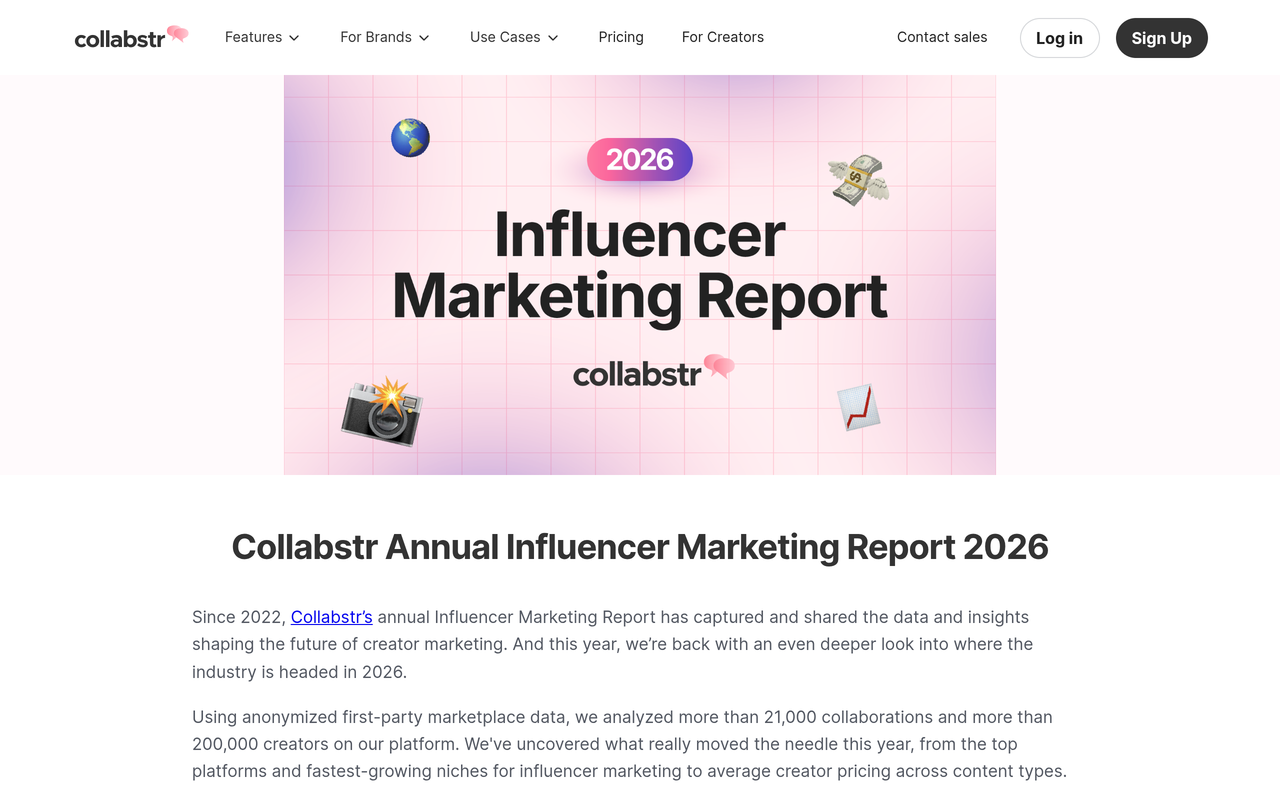
Collabstr says about 80% of collaborations on its platform cost under $300, and that YouTube's average payout is $255, against $418 a year earlier. We quote the dollar figures only. Collabstr also says the gap between packages and payouts hints that brands negotiate bespoke packages. Its marketplace leans toward smaller brands and smaller budgets, so read these as small-creator averages, not prices for a macro creator with a managed rate card.
How much do micro-influencers charge?
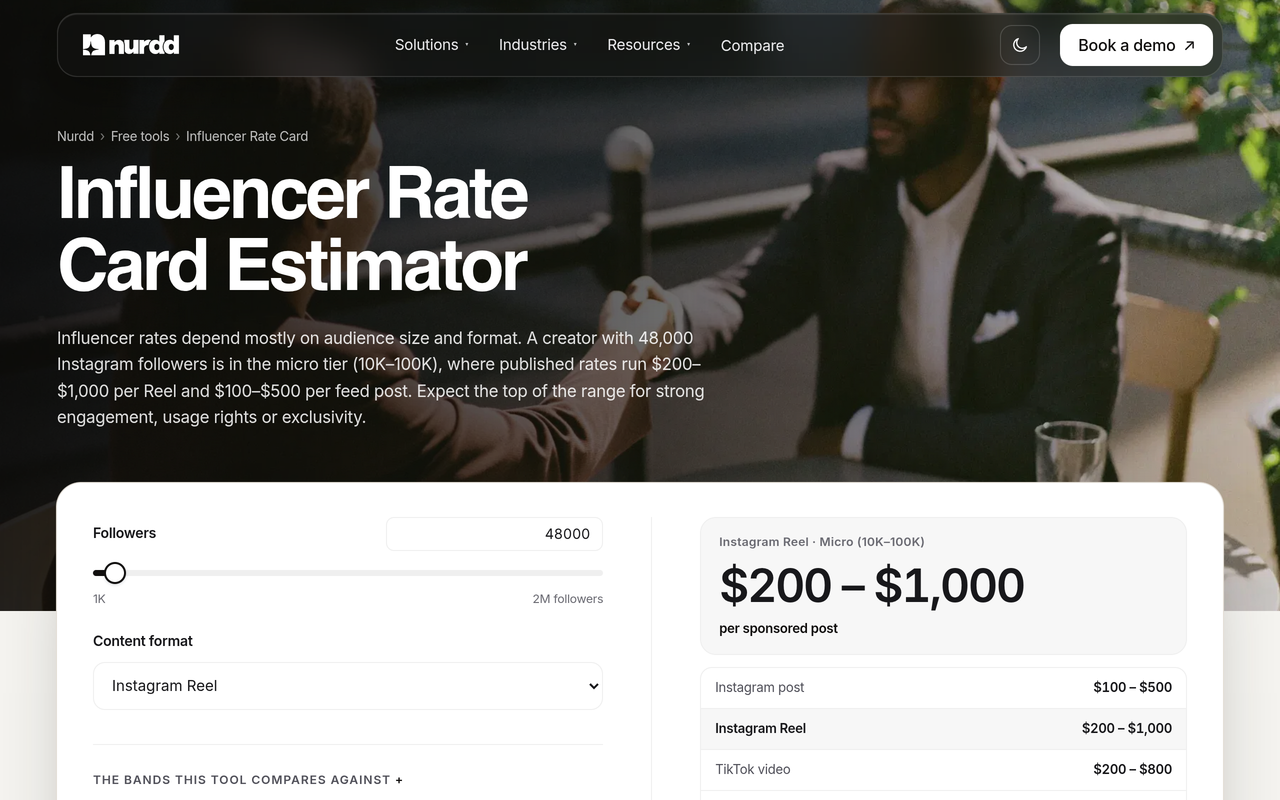
Influencer Marketing Hub puts micro creators (10K to 100K followers) at $100 to $500+ per Instagram post, $200 to $800 per TikTok video and $200 to $1,000+ per YouTube video. Later’s range for the same tier is $500 to $2,500 per post. OpenSponsorship’s median for 10K to 50K creators is $150 per deliverable. To turn these ranges into your own sheet, use the free influencer rate card template.
Do niche and category change the rate?
They do, but the spread in average fees is narrower than the spread between tiers. Collabstr analysed 21,000 collaborations and ranked niches by average fee (Collabstr, 2026):
| Most expensive niches | Average fee | Lowest-fee niches | Average fee |
|---|---|---|---|
| Skilled Trades | $309 | Beauty | $210 |
| Education | $307 | Cannabis | $214 |
| Entrepreneur and Business | $295 | Gaming | $214 |
| Comedy and Entertainment | $292 | Fashion | $217 |
| Adventure and Outdoors | $274 | Athlete and Sports | $233 |
The top niche costs about 47% more than the lowest on average ($309 against $210, our arithmetic). Collabstr ties the premium to expertise-led niches whose audiences actively seek guidance, and says the lowest-fee niches typically drive broad awareness rather than high-value conversions.
We did not find a published 2025 or 2026 study with reliable category multipliers by tier, so treat any fixed multiplier you see elsewhere as a guess. A better approach is to read category guidance for your own sector, such as our beauty industry page or the wider industries hub, and compare quotes from creators who already post about your subject.
What costs extra on top of the headline fee?
The headline fee normally covers creating the content and posting it once on one platform. Everything else is a separate line. Later, July 2026 sets out the main adjustments:
| Item | Typical effect on price (Later, July 2026) |
|---|---|
| Instagram Reels | Add 20% to 30% to the baseline |
| Instagram Stories | About 50% less than baseline, usually bundled with feed content |
| Whitelisting (running creator content as paid ads) | Add 30% to 50% to the base rate |
| Usage rights | Typically add 30% to 50% to the base rate, rising with duration and placement |
| Exclusivity | Stops the creator working with competitors for a set period; longer windows cost more |
| Rush turnaround | Rush fees and extra revisions can apply |
| Agency fees | An additional 10% to 20% on top of creator fees |
Later says usage rights, exclusivity windows and tight turnaround times can easily double the final price. Agree each one in writing before you agree the headline fee.
Worked example: a $1,000 feed post that becomes a Reel
Take a hypothetical micro creator who quotes a $1,000 base fee for one feed post. This is our arithmetic using Later's percentage ranges, not a real quote, and it assumes whitelisting and usage rights are priced as separate lines.
- Base fee: $1,000.
- Deliver it as a Reel, at +20% to 30%: $1,200 to $1,300.
- Add whitelisting at +30% to 50% of the base rate ($300 to $500): $1,500 to $1,800.
- Add usage rights at +30% to 50% of the base rate ($300 to $500): $1,800 to $2,300.
- Add agency management at +10% to 20% on top: about $1,980 to $2,760.
Exclusivity and rush fees come on top of that, and Later gives no single percentage for them, so ask the creator to price each. A creator who quotes $1,000 with every right included can be cheaper than one who quotes $800 and charges for rights separately. Compare the all-in figure, not the headline.
Why do published influencer pricing benchmarks disagree?
Four things explain most of the disagreement, and they are worth checking before you quote any figure to your finance team.
- Different tier cut-offs. Influencer Marketing Hub and Later put micro at 10K to 100K followers. OpenSponsorship uses 10K to 50K and adds a 50K to 250K mid tier.
- Asking price versus payout. Collabstr's Twitch creators asked $398 on average and were paid $127.
- Sample skew. Marketplace data leans toward smaller creators and budgets. Rate-card guides lean toward established creators. OpenSponsorship says its own data is from its platform.
- Market. None of the sources reviewed publishes country-level rate cards as its main output, and rates vary by market. Build your own baseline from quotes and results in the markets you sell in.

Which benchmark should you use?
| Your situation | Start with | Why |
|---|---|---|
| Setting a budget ceiling for a planning meeting | Rate cards (Influencer Marketing Hub, Later) | They show what creators of a given size may ask |
| Setting a target price for a small-creator campaign | Collabstr average payouts | They reflect what brands paid, though skewed to small creators |
| Choosing between tiers on efficiency | OpenSponsorship cost per engagement | It compares tiers on outcomes, not only on fees |
| Judging a quote with whitelisting or agency fees | Later's add-on ranges | They give percentages you can apply to a base fee |
| A market or niche not covered above | Your own past quotes and results | No published source covers it reliably |
How do you tell whether an influencer quote is fair?
Use a three-step test we call the quote stack. It is our own framework built on the sources above, not a published standard.
- Strip the quote to the base fee. Ask the creator to separate content creation from rights, exclusivity, rush and extra deliverables. If they will not itemise, assume the headline includes some rights and ask which.
- Place the base fee against two benchmarks. Use one rate card for the tier and platform, and one payout figure from transaction data. Note whether the quote is above, within or below each.
- Price the add-ons separately. Apply a published percentage range to each add-on that has one, ask the creator to price the rest, and compare totals on an all-in basis.
| Where the base fee sits | What it usually means | What to do |
|---|---|---|
| At or below the payout figures | Within the normal range for the tier | Confirm deliverables and rights, then proceed |
| Within the rate card but above payout figures | The creator is asking the upper end of what brands pay | Offer a bundle or ask for past results to justify it |
| Above the rate card for the tier | Priced on reach or reputation | Ask for performance data, or consider a smaller tier |
| Far below every benchmark | Possible barter, a small audience or thin experience | Check audience quality and content fit before agreeing |
How should you negotiate an influencer rate?
Negotiation goes better when the conversation is about results and scope rather than a number. These steps follow the order in which the cost builds up.
- Check the audience first. Run the profile through the fake follower checker, which estimates the share of fake or inactive followers from engagement. Result: you price against the audience that is really there. Why: a rate set on inflated followers overpays on every tier. Our guide to checking Instagram fake followers explains the signals.
- Calculate engagement. Use the engagement rate calculator to compare the creator with tier ranges. Result: a defensible reason to offer more or less. Why: Later says engagement rate, usage rights and exclusivity matter more than follower count alone.
- Ask for past campaign evidence. Request link clicks, Story swipe-through rates or sales from earlier brand work. Result: a view of what the audience does after seeing sponsored content. Why: it moves the discussion to shared outcomes. The questions in our guide to vetting an influencer's audience before paying help here.
- Itemise the deal. List deliverables, platforms, usage rights and duration, exclusivity window and revisions. Result: a quote you can compare line by line. Why: Later says these items can easily double the final price.
- Offer a bundle. Later says 71% of influencers offer discounts for longer-term partnerships, linking to Sprout Social's influencer statistics page as its source (reported in Later, July 2026). Result: a lower per-post price. Why: creators value repeat work and predictable income.
- Put it in writing, with disclosure. Agree who posts what, when, and how the sponsorship is disclosed on each platform, and check the advertising disclosure rules in each market you run the campaign in. Result: fewer disputes. Why: unclear scope is the usual source of surprise cost.
A phrase that keeps it constructive
Try something like: based on campaigns in our category, we are targeting a cost per sale of X, and at your quoted rate that needs about Y purchases from your audience. Does your past sponsored content usually drive that level of intent? This keeps both sides looking at the same outcome instead of arguing over a figure.
Checklist: before you sign an influencer deal
- Confirm the creator's tier by follower count and by engagement, not follower count alone.
- Find the benchmark for that tier and platform, and note the source's tier definitions.
- Compare the base fee with at least one payout figure from transaction data.
- Run a fake follower estimate on the audience.
- Ask for results from two or more past sponsored posts.
- List every deliverable, platform and posting date.
- State usage rights: where, how long, and whether paid ads are included.
- State the exclusivity window and the category it covers.
- Agree the number of revisions and the approval process.
- Add UTM parameters to every link so results are measurable. Our UTM structure guide shows how.
- Record the all-in cost and the expected return before you pay, and split the total with the marketing budget planner.
What are the common mistakes when budgeting for influencers?
- Comparing quotes with different rights. A cheaper quote without usage rights is not cheaper if you later buy them.
- Using one benchmark as truth. Rate cards and payouts differ by design, as the Twitch gap shows.
- Buying on follower count. OpenSponsorship's cost per engagement data shows bigger tiers are not automatically more efficient.
- Ignoring fake followers. A rate paid on inflated reach buys less than it appears.
- Skipping the return forecast. Work out how many sales a fee needs before you agree it. Our guide to picking influencers by predicted sales and the incrementality guide go deeper.
- Spreading budget too thin. Our maths on how many influencers you need to drive sales shows why.
- Having no plan for non-delivery. Read what to do when an influencer doesn't deliver before you pay a deposit.
How does Nia by Nurdd help with influencer pricing?
Nia by Nurdd is an AI-native creative studio with influencer marketing built in. It discovers creators from a database of 10M+ profiles, filters by niche, audience quality, engagement authenticity and brand match score, and detects fake followers with TruAI, Nurdd's proprietary technology. It also generates pre-spend ROI forecasts and attributes product-level sales to specific creators after a campaign closes, so a quote can be judged against expected returns. Nia is priced below comparable plans.
Want to see a quote tested against your own category? Book a demo and you will see Nia's creator discovery, fake follower detection and ROI forecast run for your brand, using the kind of creators you are considering.
If you are comparing platforms, see how Nia compares with Collabstr, read the Nia overview, or send creators to the creator page. More free calculators are in the Nurdd tools library.
How we researched this
Written by Simran Rawat. We reviewed published rate guides, a transaction dataset and a marketplace report, and re-checked every figure against the linked page on 29 October 2026. Where a page shows a date we cite the month (Influencer Marketing Hub, October 2026; Later, July 2026; OpenSponsorship, July 2026); the Collabstr report shows only a year. Anything we calculated ourselves, such as the payout gaps and the worked examples, is labelled as our arithmetic. We did not run hands-on tests or collect our own pricing data, and we found no reliable published source for country-level rates, so we make no claim about them.
Want this done for you? Nurdd runs it as a managed service: see our influencer marketing agency.
Sources
- Influencer Marketing Hub, October 2026
- Later, July 2026
- OpenSponsorship, July 2026
- Collabstr, 2026
- Sprout Social's influencer statistics page
Frequently asked questions
How much does a micro-influencer charge per post in 2026?
Influencer Marketing Hub puts micro creators (10K to 100K followers) at $100 to $500+ per Instagram post, $200 to $800 per TikTok video and $200 to $1,000+ per YouTube video. Later's range for the same tier is $500 to $2,500 per post. OpenSponsorship's median for 10K to 50K creators is $150 per deliverable.
Which platform has the highest average influencer payout?
In Collabstr's 2026 report, YouTube had the highest average payout at $255 per collaboration, ahead of Instagram at $193 and TikTok at $186. By average asking price, Twitch creators asked for the most at $398, though their average payout was $127.
How much do whitelisting and usage rights add to an influencer fee?
Later says whitelisting adds 30% to 50% to the base rate, and that usage rights typically add 30% to 50% too, rising with duration and placement. It also says rights, exclusivity windows and tight turnarounds can easily double the final price.
Are nano influencers better value than bigger creators?
It depends on the measure. OpenSponsorship found nano and micro creators had the lowest cost per engagement, about $3.05 to $3.11, while mega creators had a cheaper cost per view. Choose the tier by your goal: engagement and conversions, or reach.
Why is my quote higher than the benchmark?
The creator may be pricing in usage rights, exclusivity or a rush timeline, or may be quoting from a rate card rather than a payout level. Ask for an itemised quote, then compare the base fee with both a rate card and a payout average.
How much do agencies add to influencer costs?
Later says to expect an additional 10% to 20% on top of creator fees. Ask whether the fee is included in the quote or billed separately.
Can I negotiate influencer rates?
Yes. Itemising scope, offering a longer partnership and asking for past results are the most common levers. Later reports that 71% of influencers offer discounts for longer-term partnerships, citing Sprout Social.
How do I check if an influencer is worth the price?
Estimate fake or inactive followers, compare the creator's engagement rate with tier ranges, and ask for results from earlier sponsored posts. Then forecast how many sales the fee needs to break even before you agree it.
Get a quote tested before you pay it
Benchmarks give you a range, but your own category and audience decide the real answer. Book a demo of Nia by Nurdd to see creator discovery, TruAI fake follower detection and a pre-spend ROI forecast for your brand, so you can see what a quote is likely to return before you brief a creator. You can also start with the Nurdd blog for more influencer guides.