AI Search Visibility
Profound Alternatives: How to Choose an AI Visibility Tool
What to weigh before you move off Profound or shortlist it, using Profound's own published terms, and where Noma's 13-engine tracking fits.
 Sheetal Shakshi5 Nov 202617 min read

The right Profound alternative depends on four things: how many AI engines it tracks, how many prompts you can run, how you can start (trial and billing terms), and whether you need security or crawler analytics. Noma by Nurdd tracks 13 AI engines, including ChatGPT, Gemini, Perplexity and Claude, polled daily, and starts with a 3-day free trial with a card taken at signup. Profound's own pricing page, checked on 5 November 2026, lists a free 7-day trial limited to 50 prompts on three engines, and custom Enterprise pricing.
The best Profound alternatives depend on what you need from AI visibility tracking: engine coverage, prompt volume, trial terms, security review and what happens after the dashboard. Noma by Nurdd tracks 13 AI engines, including ChatGPT, Gemini, Perplexity and Claude, and starts with a 3-day free trial. This guide gives you the criteria, two comparison tables, a worked example and a migration checklist so you can decide with evidence.
Every statement about Profound below comes from Profound's own public pages, fetched on 5 November 2026, and is linked. Where a page does not say something, this guide says so rather than guessing. If you are new to the topic, start with Nurdd's explainer on what generative engine optimization is.
Key takeaways
- Decide your must-haves before you open any vendor page: engines, prompt count, regions and languages, security and who will act on the data.
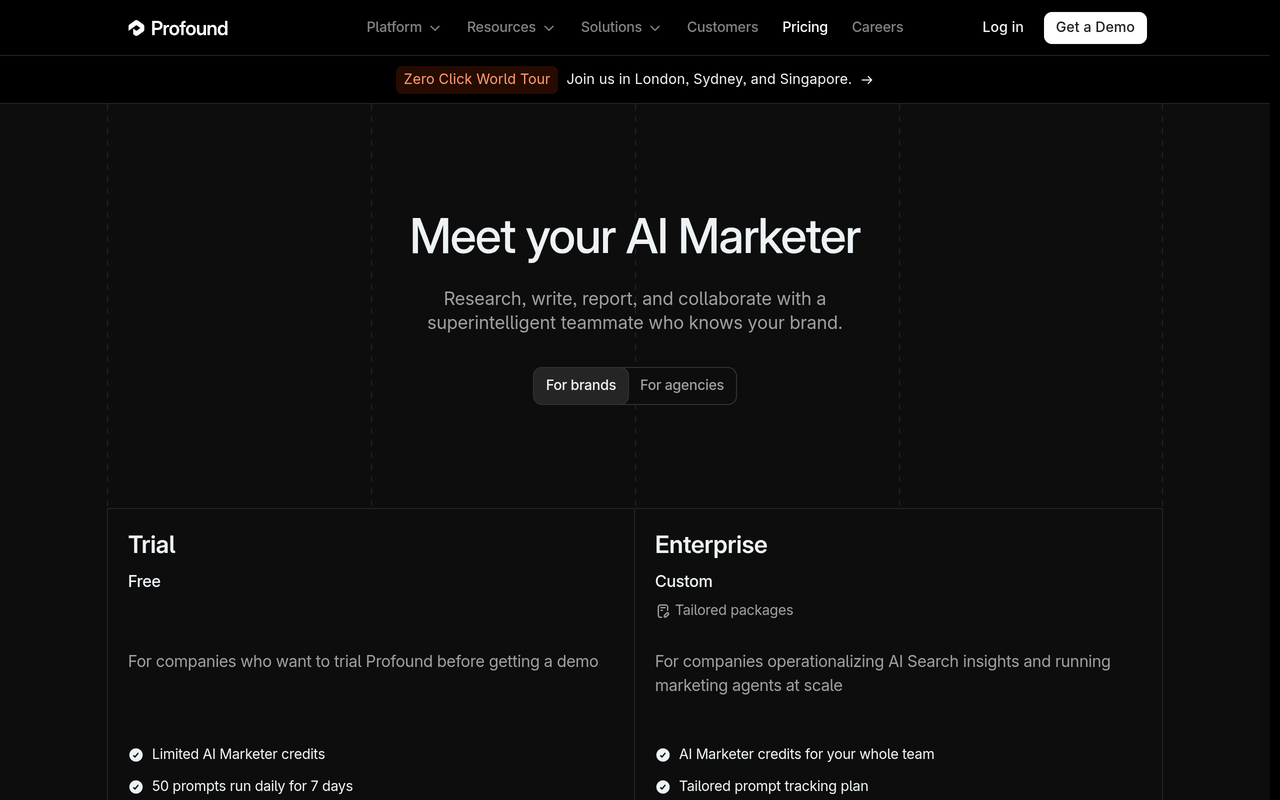
- Profound's pricing page (Profound, November 2026) lists a free trial of 50 prompts, run daily for 7 days, on ChatGPT, Gemini and Google AI Overviews, and a custom-priced Enterprise plan that can cover up to 9 answer engines.
- Noma tracks 13 AI engines, including ChatGPT, Gemini, Perplexity and Claude, polled daily, with a 3-day free trial; a card is taken at signup and billing starts on day 3 unless you cancel.
- Run the same 25 to 50 buyer prompts in every tool you trial, so you compare results rather than dashboards.
- Export your prompt list, competitor set and baseline numbers before you leave any tool; the migration checklist below shows the order.
- A tool that only measures is half the job. Check who fixes the content and the third-party sources the engines cite.
What does Profound publish about itself?
Profound is an AI visibility platform whose public pages describe two product groups: monitoring (Answer Engine Insights, Prompt Volumes, Shopping and Agent Analytics) and an "AI Marketer" layer (Agents, Context Manager and AI Marketer). That is the navigation on Profound's Answer Engine Insights page (Profound, November 2026). Knowing which group you are buying matters, because a monitoring-only need and an agent-workflow need produce different shortlists.
On that page Profound describes Answer Engine Insights as tracking how often a brand appears in AI answers, analysing what AI says, surfacing the websites behind the answers, and flagging inaccurate claims through a feature called FactCheck. It also lists visibility score and share-of-voice metrics, sentiment and keyword insights, citation authority, competitive benchmarking and platform comparisons.
Profound states three method claims on the same page. It runs every tracked prompt daily, it says it captures responses from the browser rather than from an API, and it lets teams use prompts from its own dataset of real user queries or upload their own. Profound also lists eight engine logos: ChatGPT, Perplexity, Claude, Gemini, Google AI Overviews, Copilot, Grok and DeepSeek.
For security, the page states that Profound is SOC 2 Type II compliant, supports single sign-on through SAML or OIDC, offers role-based access control and runs daily backups. Those are the items a procurement team will ask about, so they belong on your requirement list.
A separate Profound page, Audit and Optimize Your AI Crawlability (Profound, November 2026), describes Agent Analytics as measuring how AI answer engines crawl your site and diagnosing fetchability issues. Crawler-level analytics is a different job from answer tracking, and you should decide whether you need it from one vendor or can cover it separately. Nurdd's AI crawler user agents list shows what to allow and what to block.
Why do teams look for Profound alternatives?
The honest answer is fit, not failure. Profound publishes a clear free trial and a custom-priced Enterprise plan, and the gap between the two is where most shortlisting questions start. A team that wants to test a tracker on its own category for a fortnight, or that needs a fixed monthly line in a budget, will check whether the trial and the plan structure match how they buy.
The Profound pricing page (Profound, November 2026) shows what the free trial includes and leaves out. The trial lists 50 unique prompts run daily for 7 days on ChatGPT, Gemini and Google AI Overviews, one language, one region, five Prompt Volumes searches, and "None" for history, exports, API and support. The Enterprise column says Custom for prompts, languages, regions and support, with a demo as the call to action.
Four situations usually trigger a search for alternatives:
- You need more engines than the trial covers. The trial lists three engines; the Enterprise column lists capability for up to nine.
- You want to compare before talking to sales. Beyond the trial, the published path is a demo and a tailored package.
- Your question is narrower than a marketing agent platform. If you only need to know whether ChatGPT, Gemini, Perplexity and Claude name your brand, an agent layer is more than you need.
- You want measurement tied to a service. Some brands want the tracking and the work that improves it from the same team.
None of these says Profound is the wrong tool. They are the questions that decide whether it is the right one for you, and they apply to every vendor on your list, including Noma.
How do I choose between Profound and other AI visibility tools?
Choose by requirement, not by brand name. Write down what you must have, what is useful and what you can ignore, then score each tool against those lines using only what the vendor publishes or shows you live. The table below turns that into a decision grid you can copy.
| Requirement | What Profound publishes | What to ask every tool |
|---|---|---|
| Engine coverage | Eight engine logos on the Answer Engine Insights page; trial lists three engines; Enterprise lists up to nine | Which engines are in my plan, and which are only in higher tiers? |
| Prompt volume | Trial: 50 unique prompts; Enterprise: tailored prompt tracking plan | How many prompts, per engine or in total, and can I add more mid-term? |
| Refresh rate | Daily runs; trial runs daily for 7 days | Is every prompt re-run daily on every engine, and for how long is history kept? |
| Capture method | Says it captures from the browser, not the API | How are answers collected, and can I see a raw answer next to the score? |
| Regions and languages | Trial: one language, one region; Enterprise: custom | Can I track my markets in their own language? |
| Exports and API | Trial: none; Enterprise: CSV, JSON and API | Can I get my data out at any plan level? |
| Security | SOC 2 Type II, SSO via SAML or OIDC, role-based access | Which of these does my security team require, and at which tier? |
| Crawler analytics | Agent Analytics for crawl and fetchability diagnosis | Do I need this from the same vendor, or from my CDN and server logs? |
| Starting terms | Free trial, then demo and custom package | What does the trial cost me, what is the card policy, when does billing start? |
Score each row 0 to 2 (not needed, useful, must-have) before you look at any vendor. A tool that fails a must-have row is out regardless of its other strengths. This single pass removes most of the noise in the ranked lists you will find in search results. Nurdd's buyer checklist for AI visibility tracking tools extends the grid.
What do the top-ranking Profound alternatives articles cover?
The top results for this keyword are ranked lists from vendors. Writesonic's guide (Writesonic, 2026) sets out a numbered list of tools with prices, AirOps' guide (AirOps, 2026) gives each tool a best-for line with pros, cons and pricing, and SE Ranking's guide (SE Ranking, 2026) lists eight tools. Each puts its own product in the list.
From the headings of the pages that returned readable text, they cover the rival list, why teams switch, evaluation criteria and per-tool pricing. What they do not show is a way to test tools against each other on your own prompts, a worked example of what a trial can and cannot tell you, or an ordered checklist for leaving a tool without losing your baseline. Those three are covered further down this page.
How do Profound and Noma compare on features?
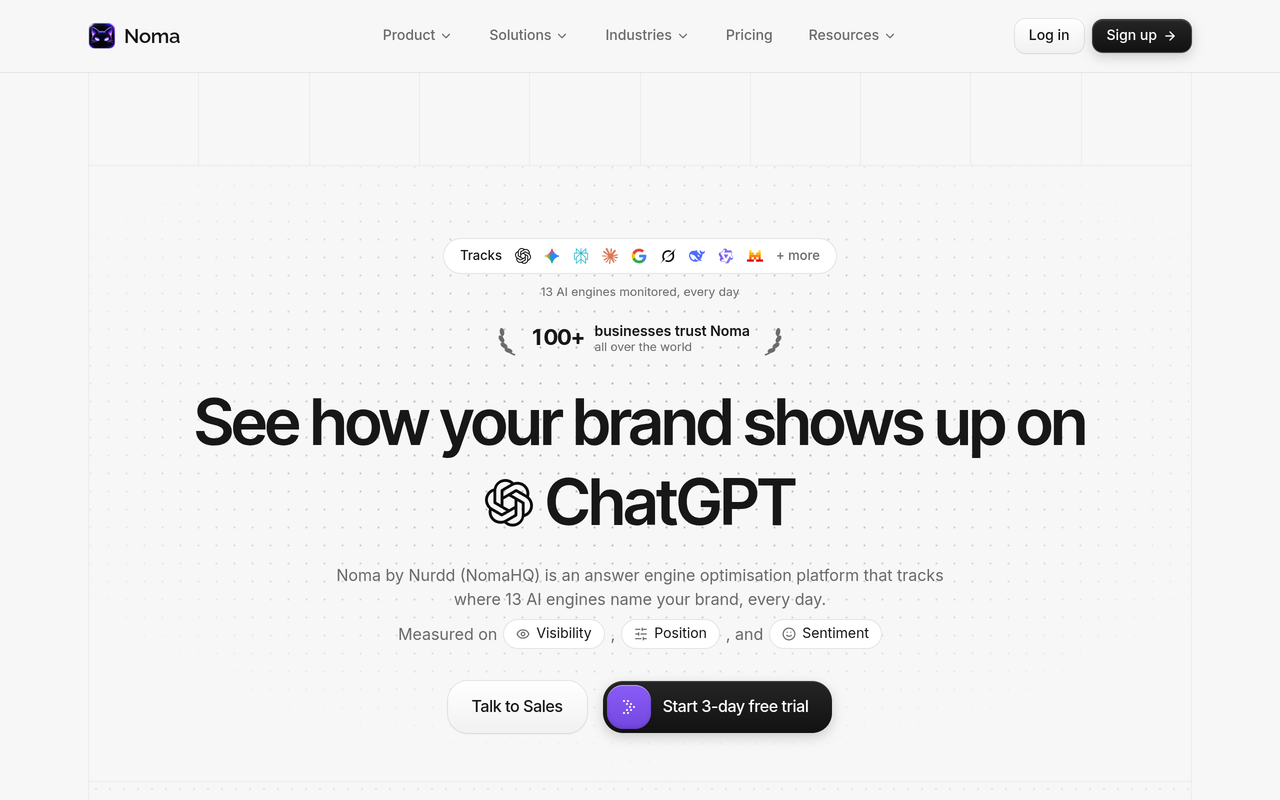
Noma by Nurdd is an AI search visibility dashboard at nomahq.app that tracks 13 AI engines, including ChatGPT, Gemini, Perplexity and Claude, polled daily. It shows citation frequency by category, competitor comparison and recommendations for improving AI visibility. The table compares only what each company states publicly.
| Feature | Profound (published, 5 Nov 2026) | Noma by Nurdd |
|---|---|---|
| Engines tracked | Trial: 3. Enterprise: up to 9 listed on the pricing page; 8 logos on the product page | 13 AI engines, including ChatGPT, Gemini, Perplexity and Claude |
| Polling frequency | Daily | Daily |
| Citation sources | Citation tracking and analysis | Records whether a brand is named and which page each citation comes from |
| Competitor comparison | Competitive benchmarking | Competitor comparison by category |
| Recommendations | Agents and AI Marketer for content work | Actionable recommendations to improve AI visibility, with managed AEO and GEO services behind them |
| Starting point | Free trial, then demo for Enterprise | Self-serve 3-day free trial at nomahq.app |
On engine count, Noma's 13 engines exceed the nine Profound lists for Enterprise and the three in its trial. Polling frequency, citation tracking and competitor comparison are comparable on paper, so the decision on those rows comes down to what you see on your own prompts. That is what the trial test later in this guide is for.
How do the published pricing and trial terms compare?
Pricing is where the two tools differ most visibly, so this table is dated. Profound's figures were read from its pricing page on 5 November 2026. Noma's plan prices are on its own site, so the table shows trial terms only and does not restate them. Prices are in USD wherever a price is published.
| Item | Profound (checked 5 Nov 2026) | Noma by Nurdd (checked 5 Nov 2026) |
|---|---|---|
| Free trial | Yes: 50 prompts run daily for 7 days | Yes: 3-day free trial |
| Engines in trial | ChatGPT, Gemini, Google AI Overviews | Noma tracks 13 AI engines, including ChatGPT, Gemini, Perplexity and Claude |
| Card at signup | Not stated on the pricing page | Card taken at signup; billing starts on day 3; no charge if cancelled before |
| Paid plan price | Enterprise: Custom, via demo | See nomahq.app for current plans |
| Exports and API in trial | None listed | Confirm in the trial or demo |
Read the trial rows as a planning question: a 7-day trial gives you a full week of daily samples, while a 3-day trial gives you three. If three days is enough to see your brand's visibility against competitors on your prompts, the shorter window costs you less. If you need a week of variation before you trust a number, you can ask for a demo with your prompt list loaded.
What can a trial actually tell you? A worked example
A trial can tell you whether a tool sees your brand and your competitors, but not whether its coverage is large enough for your market. The arithmetic below uses a hypothetical brand and only Profound's published trial limits, so you can repeat it with any vendor's numbers.
Say a brand has mapped 120 buyer prompts across its category. Profound's trial allows 50 unique prompts, so it can hold 50 of 120, which is 41.7% of the list. The trial runs those 50 prompts daily for 7 days, which is 50 × 7 = 350 prompt runs. Whether each prompt is run on each of the three listed engines is not stated on the pricing page, so ask before you assume 1,050 responses.
Engine coverage works the same way. If your buyers use ChatGPT, Gemini, Perplexity and Claude, a three-engine trial covers two of those four. Against the 13 engines Noma tracks, three engines is 3 of 13, or 23.1%. The point is not that one number is better. The point is to find out before you pay which share of your real question each plan answers.
Rule of thumb: a trial is only a fair test if the prompts you load are a sample of the 120 you care about, not the 50 that flatter you.
To pick the 50, take the prompts in three groups: category questions with no brand name, comparison questions that name you and a rival, and problem questions a buyer asks before they know the category. Nurdd's guide to which prompts to track for AI search visibility explains how to build the list.
How do I run a fair trial of two AI visibility tools?
Run both tools on identical inputs at the same time, then compare what each one reports against answers you read yourself. This is a test you can describe from public evidence: Profound states it captures answers from the browser and runs prompts daily, so you can check any tool's output against a manual look at the same prompt.
- Fix the prompt set. Choose 25 prompts from your list of buyer questions, balanced across the three groups above. Result: both tools get the same questions, so differences come from the tool.
- Fix the competitor set. Name the same four or five rivals in each tool. Result: share-of-voice figures are comparable.
- Read five answers by hand. Ask five of the prompts in ChatGPT, Gemini, Perplexity and Claude yourself. Result: you have ground truth to compare against.
- Check the citations. For those five, open the cited pages and see whether the tool lists the same sources. Result: you learn whether source reporting is accurate.
- Compare day-to-day movement. Note where a brand appears one day and not the next. AI answers vary, so a tool should show you the spread, not a single point. Nurdd's guide to personalization in AI answers explains why.
- Ask for the next action. For one prompt where you are missing, see what the tool recommends. Result: you learn whether the product leads to work or only to charts.
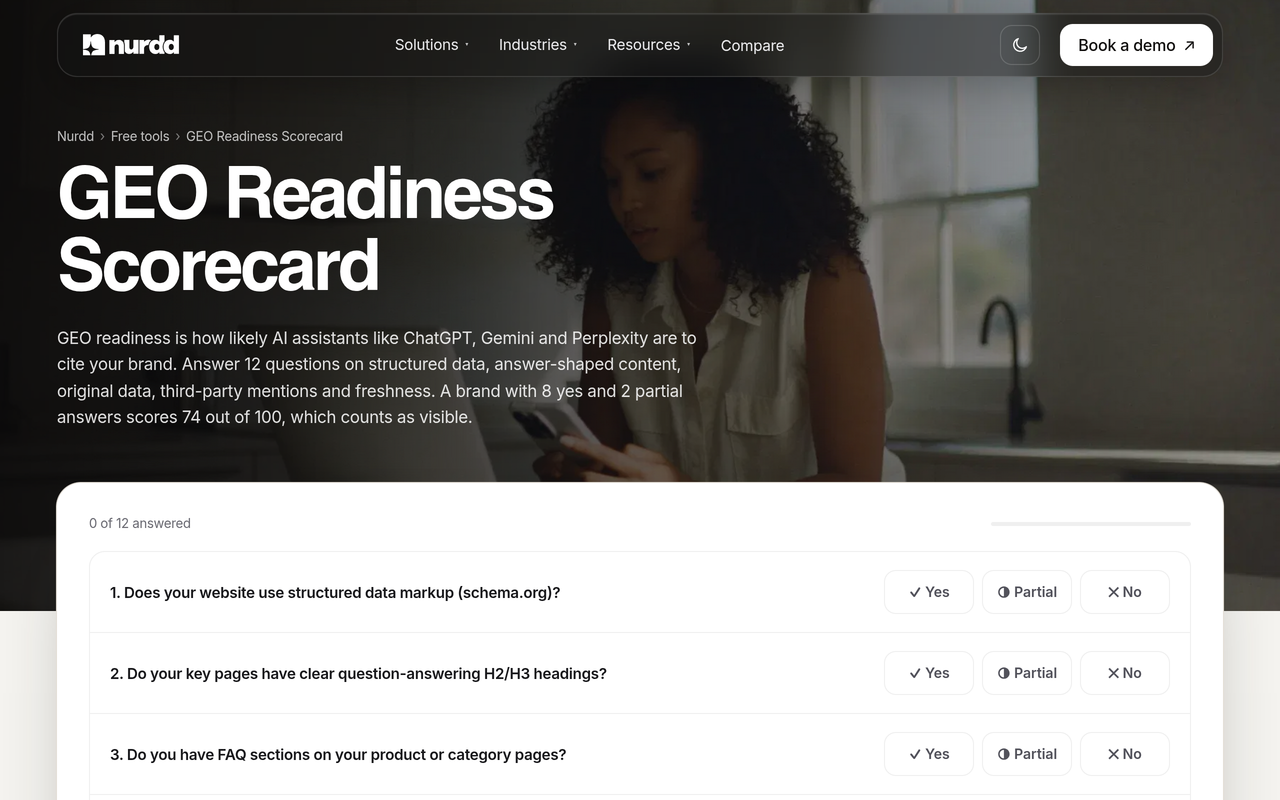
If you want a quick view of how ready your own site is before you trial anything, the free GEO readiness scorecard checks 12 factors and takes minutes.
What is the checklist for moving off Profound?
If you already use Profound and plan to move, the risk is losing your baseline. Profound's pricing page lists exports as CSV and JSON for Enterprise and none for the trial, so what you can take depends on your plan. Work through the list in this order.
- Confirm your export rights. Check your contract or plan for CSV, JSON or API access and the end date. Result: you know what data you can keep, and until when.
- Export the prompt list. Save every tracked prompt with its topic and region. Result: the new tool starts with the same questions.
- Export the competitor set. Record the brands you benchmark against. Result: share-of-voice stays comparable across tools.
- Save a baseline. Capture visibility score, share of voice and top cited sources for the last full month. Result: you can tell real movement from a change in method.
- Run both tools for two weeks. Overlap the contracts if you can. Result: you see the gap between their scores and can explain it, for instance by engine count or capture method.
- Re-map the reports. Match each dashboard your team uses to its equivalent in the new tool. Nurdd's guide to the AI search visibility dashboard lists what executives need to see.
- Restate the baseline. Re-measure in the new tool and note it as a new series, not a continuation. Result: nobody reads a method change as a performance change.
- Cancel on the right date. Check notice periods against the end of your overlap. Result: you avoid paying for both longer than planned.
What types of Profound alternatives exist?
Alternatives fall into four groups, and the right group depends on your requirement grid. The Nurdd comparison pages below describe each rival from its own published material, so you can read them side by side.
- Dedicated AI visibility trackers. These measure brand mentions and citations across AI engines. See Nurdd's comparisons of Noma vs Peec AI, Noma vs AthenaHQ and Noma vs Scrunch.
- SEO suites with an AI module. These add AI tracking to rank tracking and keyword research. See Noma vs Semrush and Noma vs Ahrefs.
- Content and workflow platforms. These focus on producing and optimising pages, for example Noma vs AirOps.
- Managed services. A team runs the work and reports on it, as in Nurdd's answer engine optimization agency and generative engine optimization services.
For a wider list, Nurdd's comparison of 10 AI search visibility tools and its Profound vs Peec AI guide go further, and the Noma vs Profound page sets the two products side by side.
Why does Noma belong on your Profound shortlist?
Noma by Nurdd belongs on a Profound shortlist because it tracks 13 AI engines, including ChatGPT, Gemini, Perplexity and Claude, polled daily, records which page each citation comes from, and starts with a 3-day free trial you can open yourself at nomahq.app. Nurdd's AEO and GEO services can then work on the site and the third-party sources the engines read, with results measured in Noma.
Want to see it on your own brand? Book a demo and you will see Noma run your category prompts across the 13 engines, which competitors are named instead of you, and the pages those answers cite.
Where Noma wins or ties against the Profound facts above:
- Engine count: 13 engines against up to nine on Profound's Enterprise column and three in its trial.
- Daily polling: both poll daily.
- Citation sources: both report which sources sit behind answers.
- Competitor comparison: both benchmark against rivals.
- Trial length to first result: a 3-day trial gets you to a first competitor view sooner, with billing starting on day 3 only if you do not cancel.
- Measure plus fix: Noma measures, and Nurdd's managed services improve the content and sources behind the numbers.
Noma is one of three separate Nurdd products. Nia by Nurdd is an AI-native creative studio with influencer marketing built in, and Pulse by Nurdd reads Meta and Google Ads performance. You can use Noma on its own. If you want to see how the measurement side connects to the work, How Nurdd works explains the four capabilities.
What mistakes do teams make when switching AI visibility tools?
- Comparing scores across tools. A visibility score of 40 in one tool and 31 in another says nothing until you know the prompts, engines and method behind each. Compare share of voice on the same prompts instead.
- Trialling with easy prompts. Branded prompts always flatter you. Include category and problem prompts where you may be absent.
- Buying engines you do not need. Count the engines your buyers use, then check coverage for those. More engines helps only if they match your audience.
- Ignoring the action layer. A dashboard that shows a gap but not what to publish leaves your team with homework. Read Nurdd's guide to AI search visibility analysis for the work that follows measurement.
- Skipping the crawl check. If AI crawlers cannot fetch your pages, no tracker will fix that. Check access first, using the AI crawler user agents list.
- Forgetting the baseline. Moving without saving prompts and benchmarks resets your trend line to zero.
How should I report results once I have chosen?
Report a small set of figures on a fixed set of prompts: how often the brand is named, share of voice against named competitors, which sources are cited and how that moved from the previous period. Nurdd's guides to AI search share of voice and AI search metrics that matter give formulas you can use in any tool.
Keep SEO and AI metrics side by side rather than merging them. The post on AI search metrics vs SEO metrics shows which to report together. For a method to test whether a change worked, see GEO experiment design.
Conclusion
Choosing between Profound and its alternatives comes down to a short grid of requirements: engines, prompts, regions, exports, security and who acts on the data. Profound's published pricing page, read on 5 November 2026, gives you clear trial limits and a custom Enterprise path. Noma gives you 13 engines polled daily and a 3-day free trial, with managed work behind it if you want it.
The fastest way to decide is to run the same prompts in both. Book a demo at nurdd.club/demo and bring your 25 prompts and your competitor list. You will see which of the 13 engines name your brand, who they name instead and which pages they cite, and you can start the Noma trial at nomahq.app when you are ready.
How we researched this
We reviewed Profound's public product pages, its pricing page and a dated press release, plus the headings of ranked-list articles that appear for the keyword "profound alternatives". Profound's pricing and Answer Engine Insights pages were fetched and read on 5 November 2026, and every Profound fact in this guide comes from those pages or its other public pages. Profound's own recap of its Singapore event was not available to us, so nothing here relies on it.
The Profound press release linked in GlobeNewswire (Profound, November 2026) announces its Asia Pacific headquarters in Singapore, opened alongside its Zero Click event. It was read for context only. We did not run hands-on tests of any tool, interview customers or use private data. The worked example uses hypothetical numbers and Profound's published trial limits, and Noma facts come from Nurdd's own product information.
Frequently asked questions
What are the best Profound alternatives for AI search visibility?
The best option depends on your requirement grid. Dedicated trackers, SEO suites with AI modules, content platforms and managed services all compete with Profound. For brands that want broad engine coverage, Noma tracks 13 AI engines, including ChatGPT, Gemini, Perplexity and Claude, and has a 3-day free trial.
How do I choose between Profound and other AI visibility tools?
Write down must-have, useful and ignorable requirements, then score each tool using only what it publishes or shows live. Run the same 25 buyer prompts and the same competitor set in each tool, and check five answers by hand. The tool that reports your real answers accurately and tells you what to do next is the better fit.
Does Profound have a free trial?
Yes. Profound's pricing page lists a free Trial with 50 prompts run daily for 7 days on ChatGPT, Gemini and Google AI Overviews. It lists no history, exports, API or support for the trial. Enterprise is custom-priced and starts with a demo.
How many AI engines does Profound track?
Profound's product page shows eight engine logos: ChatGPT, Perplexity, Claude, Gemini, Google AI Overviews, Copilot, Grok and DeepSeek. Its pricing page lists capability for up to nine answer engines on Enterprise and three in the trial. Noma tracks 13 AI engines, including ChatGPT, Gemini, Perplexity and Claude.
How does Noma's free trial work?
Noma has a 3-day free trial at nomahq.app. A card is taken at signup and billing starts on day 3. If you cancel before then, you are not charged.
Can I move my prompts and benchmarks from Profound to another tool?
What you can export depends on your plan. Profound's pricing page lists CSV and JSON exports and API access for Enterprise and none for the trial. Save your prompt list, competitor set and a baseline month before you cancel, then follow the checklist above.
Do I need crawler analytics as well as answer tracking?
Not always. Crawler analytics shows whether AI bots can fetch your pages, while answer tracking shows what the engines say about you. If your pages are blocked, fix access first with your CDN or server logs, then track answers.