AI Search Visibility
AI Search Optimization vs SEO: What to Fund First
Google says SEO still underpins its AI features. Here is how to split spend between SEO and AI search work, and a six-week test to prove it.
 Simran Rawat5 Nov 202614 min read

AI search optimization vs SEO is a difference of scoreboard more than craft: SEO earns rankings and clicks, while AI search optimization earns mentions and citations inside generated answers. Google says its AI features rest on its core ranking systems, so fund SEO foundations first, then measure AI visibility before adding dedicated budget.
AI search optimization vs SEO comes down to the scoreboard. SEO earns rankings and clicks on a results page, while AI search optimization earns mentions and citations inside generated answers. The two share most of their foundations, so fund the shared work first, then measure your AI visibility before you pay for anything AI-specific.
Key takeaways
- Treat most of the work as shared. Crawlable pages, original content and clear entities help in both Google rankings and AI answers.
- Fund the overlap first, and put a small, capped share into AI-specific work only after you have a measured baseline.
- Do not rely on rank alone. Ahrefs found that only 38% of pages cited in Google AI Overviews also sat in the top 10 for the same query.
- Measure the two channels with different metrics: rankings, clicks and conversions for SEO; mention rate, citation source and share of voice for AI answers.
- Run a six-week test with a fixed prompt set before you move budget. The plan is below.
- Ignore tactics that Google's own guidance tells site owners to skip, such as llms.txt files and content chunking, when you decide what to buy.
Is AI search optimization different from SEO?
Partly. The inputs overlap heavily, because AI answer engines retrieve web pages, read them and quote them. The outputs differ: an SEO result is a ranked link you can count, while an AI answer is a synthesised paragraph that may name your brand, cite your page, or ignore you entirely.
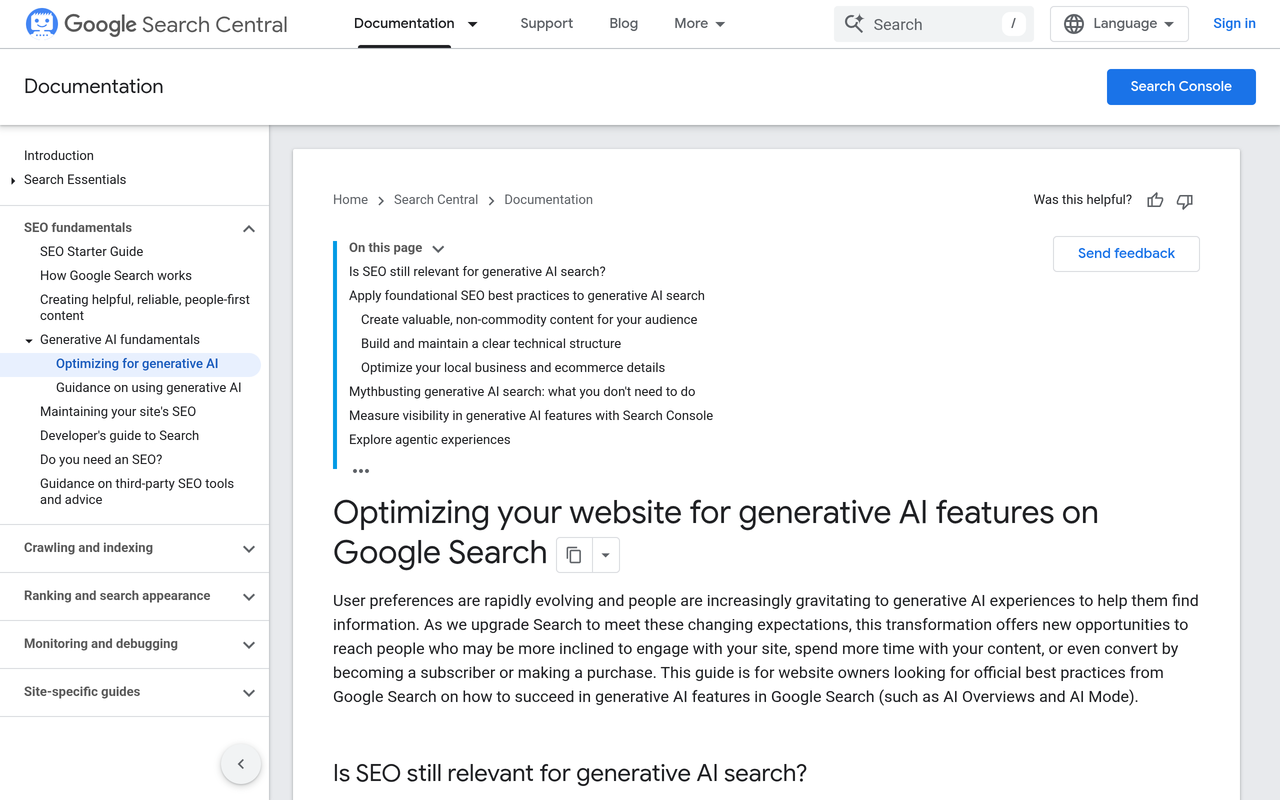
Google states the overlap plainly. In its Google Search Central guide to generative AI features (retrieved November 2026), it says SEO best practices remain relevant because AI Overviews and AI Mode are rooted in its core Search ranking and quality systems. It also says that, from Google Search's perspective, optimizing for generative AI search is still SEO.
That is Google's view of Google. ChatGPT, Perplexity, Claude and Gemini each retrieve and cite differently, and Google's guide does not speak for them. So the useful question for a budget holder is not which label wins. It is which activities earn both outcomes, and which only earn one.
What do AI search optimization, AEO, GEO and SEO each mean?
The terms overlap, so define them before you set a budget line for any of them.
- SEO (search engine optimization): work that helps pages get crawled, indexed and ranked in search results, and clicked.
- AEO (answer engine optimization): work that helps a brand be the answer in answer boxes, AI Overviews and assistants.
- GEO (generative engine optimization): work that shapes the content and third-party sources generative engines draw on, so a brand is named and cited.
- AI search optimization: the umbrella phrase most buyers use for AEO and GEO together.
Google's guide notes that AEO and GEO describe work focused on AI search experiences and that, for Google Search, this is still SEO. For the full vocabulary, see Nurdd's AI search glossary and its explainer on generative engine optimization versus AEO and SEO.
Why does this budget question matter now?
Because attention is moving inside the results page. A Pew Research Center analysis (July 2025) of the browsing data of 900 US adults found that 58% ran at least one Google search in March 2025 that produced an AI summary. Users who saw a summary clicked a traditional result link in 8% of visits, against 15% for users who did not.
That does not mean SEO has stopped working. It means a ranking is worth less per impression when an AI summary sits above it, and that being named inside the summary carries value of its own.
There is also a quality argument. Semrush, in its AI visibility guide, says its research estimates that AI search visitors convert 4.4x better than traditional organic visitors. Ahrefs reported on its own site that 0.5% of visitors drove 12.1% of signups from AI search. Both are single-company measurements, so treat them as a reason to test, not a forecast for your brand. Nurdd keeps a list of AI search statistics you can safely cite, and a guide to measuring AI search against Google conversion on your own data.
How does AI search retrieve pages, and where does it differ from classic ranking?
Most AI answer engines run a retrieval step before they write. Google describes two techniques in its guide: retrieval-augmented generation, which pulls relevant pages from the Search index to ground the answer, and query fan-out, where the model issues several related queries at once. Its example is a question about fixing a weedy lawn, which fans out into queries about herbicides, chemical-free removal and prevention.
Fan-out is the main reason rank and citation have drifted apart. A page can be cited because it answers one of the sub-queries well, even though it does not rank for the query the user typed.
In an updated Ahrefs analysis of 863,000 keywords and 4 million AI Overview URLs, 38% of cited pages also appeared in the top 10 for the same query, down from 76% in Ahrefs' earlier version of the study, according to Search Engine Journal (March 2026).
The same report says the remaining citations split almost evenly between positions 11 to 100 (31.2%) and beyond position 100 (31.0%). Read that carefully: top-10 rank still correlates with citation, but a budget built only on rankings misses roughly six in ten cited pages.
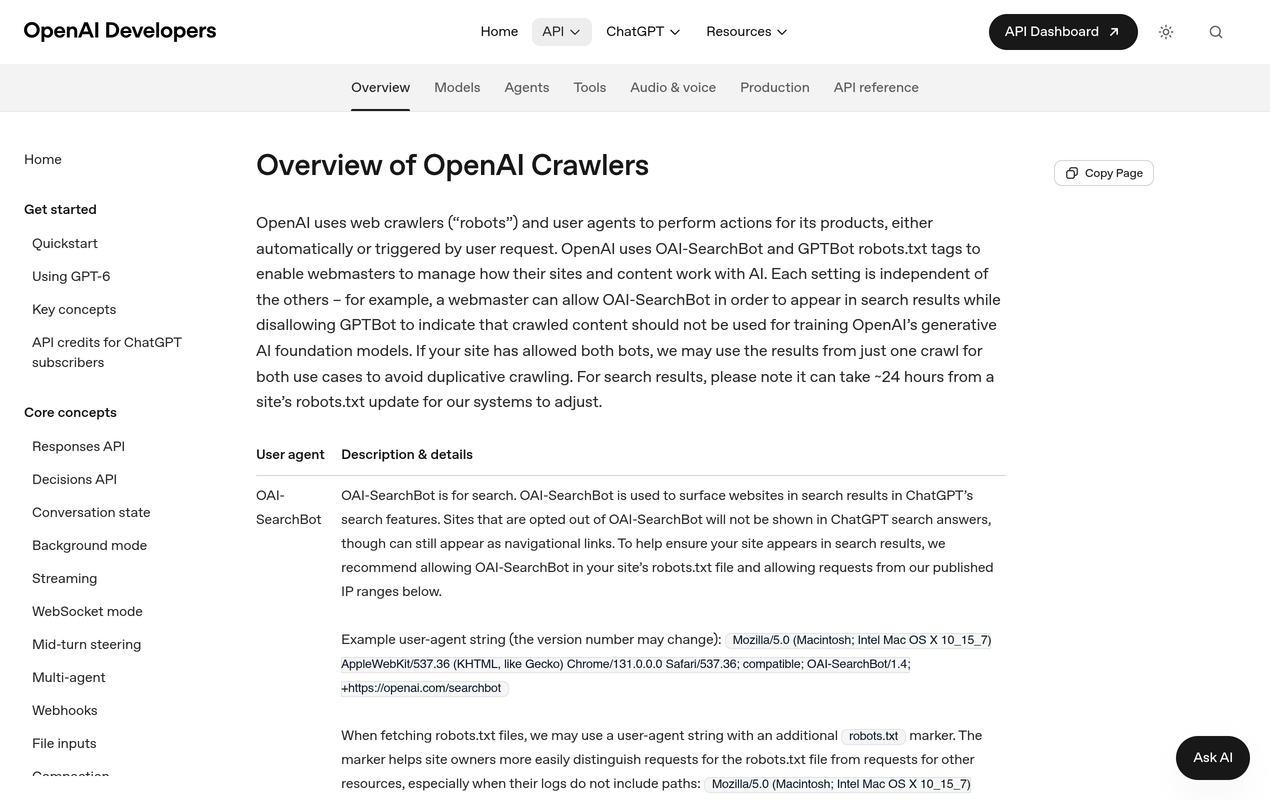
Crawler access is the other difference. OpenAI's overview of its crawlers says OAI-SearchBot is used to surface websites in ChatGPT's search features, and that sites opted out of it will not be shown in ChatGPT search answers. A robots.txt rule that is harmless for Google can therefore make you invisible in ChatGPT. Nurdd's AI crawler user agents list covers what to allow and what to block.
What overlaps and what differs between the two?
The table below sorts the common work into three groups: shared, mostly SEO, and mostly AI search. Use it to decide which budget line a task belongs on, so you do not pay twice for the same job.
| Work item | Helps classic SEO | Helps AI answers | Budget bucket |
|---|---|---|---|
| Crawlable, fast, indexable pages | Yes | Yes: retrieval depends on it | Shared |
| Original, expert, non-commodity content | Yes | Yes: Google says unique, valuable content matters | Shared |
| Clear brand and product descriptions | Some | Yes: engines need to name you correctly | Shared |
| Structured data that matches visible content | Yes | Helps parsing | Shared |
| Link building and technical audits | Yes | Indirect | Mostly SEO |
| Keyword and SERP rank tracking | Yes | No | Mostly SEO |
| Answering fan-out sub-questions on one page | Some | Yes | Mostly AI search |
| Earning mentions on third-party sources engines cite | Some | Yes | Mostly AI search |
| Prompt-level visibility tracking across engines | No | Yes | AI search |
| Allowing the right AI crawlers | No | Yes | AI search (low cost) |
Three competing explainers cover the same ground from the angle of definitions. The cmlabs comparison lays out goal, channel, behaviour, metrics and tactics, the Exposure Ninja article adds fan-out and topical authority, and Optimizely's SEO vs AEO piece covers entity optimisation and measurement. What a reader still needs is a way to price the two and a way to prove it, which the rest of this post provides.
How should you split budget between SEO and AI search optimization?
Split by what you already have, not by trend. The decision table below turns your starting position into a first move. The percentages are a planning heuristic from this post, not a benchmark from any study.
| Your starting position | Fund first | Suggested split (heuristic) | Why |
|---|---|---|---|
| Thin or slow site, few indexed pages | SEO foundations | 90/10 SEO to AI measurement | AI engines cannot cite what retrieval cannot reach. |
| Solid rankings, never checked AI answers | AI visibility baseline | 75/25 | You may already be cited, or invisible. Find out before spending. |
| Strong rankings, but competitors named in AI answers instead of you | Third-party sources and answer-first content | 60/40 | The gap is in who engines trust, not in your rank. |
| Brand-led category where buyers ask assistants for recommendations | AI search work with SEO maintenance | 50/50 | Recommendation prompts are where AI answers replace clicks. |
| Mostly transactional, branded or navigational demand | SEO | 85/15 | Less of your demand passes through generated answers. |
Then apply the cap rule: no AI-specific line should exceed 25% of the combined budget until the test below shows a measured gain. A baseline costs a fraction of a content retainer, and it tells you whether the next dollar belongs on the AI side at all.
Should I invest in AEO or SEO first?
SEO first, in the sense that crawlability, indexation and original content are prerequisites for both. AEO first, in the sense that a baseline measurement is cheap and tells you where to aim. The sequence that works for most budget holders is: fix access, measure AI visibility, then fund the specific gaps the measurement shows.
How do you test it? A six-week plan before you move budget
The plan below produces a before-and-after comparison on a fixed prompt set. It borrows the logic of Nurdd's guide to GEO experiment design and its four-week ChatGPT tracking test, extended to include the SEO side.
- Week 0: write the prompt set. Choose 30 to 50 prompts that buyers ask: category questions, comparisons and "best for" questions. Result: a fixed list you do not change mid-test. Why: a moving list makes every change look like progress. See which prompts to track.
- Week 1: record the baseline. Log, per prompt and engine, whether your brand is named, which page is cited and which competitors appear. Result: a mention rate and a citation-source list. Why: this is the number every later decision is judged against.
- Week 1: record the SEO baseline. Pull clicks, impressions and conversions for the matching pages from Search Console and your analytics. Result: a classic scoreboard beside the AI one.
- Weeks 2 to 3: change one thing in one group. Pick ten prompts' worth of pages and make one change, such as adding a direct answer block and a named-entity description. Leave a second group of pages untouched as a control. Result: a clean comparison. Why: without a control group you cannot separate your edit from engine drift.
- Weeks 4 to 5: re-measure on the same prompts. Run the full prompt set again, more than once, since AI answers vary between runs. Result: change in mention rate for edited versus control pages.
- Week 6: decide. If edited pages gained mentions and organic metrics held, shift budget by one step in the decision table. If neither moved, stop and look at access or content quality. Result: a budget decision backed by your own data.
Answers vary between runs and users, which is why repeated sampling matters. Nurdd's piece on personalization in LLM responses explains how to account for that.
What does a worked example look like with real numbers?
Take two published figures and one piece of arithmetic. Pew found a 15% click rate on result links without an AI summary and 8% with one. Dividing 8 by 15 gives about 0.53, so a result's click rate on those pages was roughly 47% lower. That is a calculation from Pew's two figures, not a number Pew reports.
Now apply it to a hypothetical page that earns 1,000 organic clicks a month on queries that trigger summaries. If the pattern in Pew's sample applied to that page and a summary appeared on all of those searches, clicks would fall toward 530 for the same impressions. The question for the budget holder is whether being named in the summary recovers any of the lost value.
That is what the Ahrefs and Semrush figures hint at without proving it for you. Ahrefs saw 0.5% of its traffic produce 12.1% of its signups, so signups per visit from AI search ran far above the site average. Your own ratio could be higher or lower, which is why the test plan tracks conversions and not only mentions.
How do you measure each channel?
Use two scoreboards and never merge them into one number. The table below shows the metrics side by side.
| Question | SEO metric | AI search metric |
|---|---|---|
| Are we visible? | Rank, impressions | Mention rate across a fixed prompt set |
| Who is winning? | Share of keyword rankings | AI search share of voice |
| Where does the credit come from? | Ranking URL, backlinks | Cited page and cited third-party source |
| Is it worth it? | Clicks, conversions, revenue | Referral visits, conversions, assisted demand |
| Is it improving? | Weekly rank and traffic trend | Visibility score week over week |
Google AI Overviews are partly visible in Search Console, but the other engines are not. For those, you need a tool that polls the engines and records the answers. Nurdd covers the Google side in its guide on how to track Google AI Overviews for your brand.
Where does Noma fit in this decision?
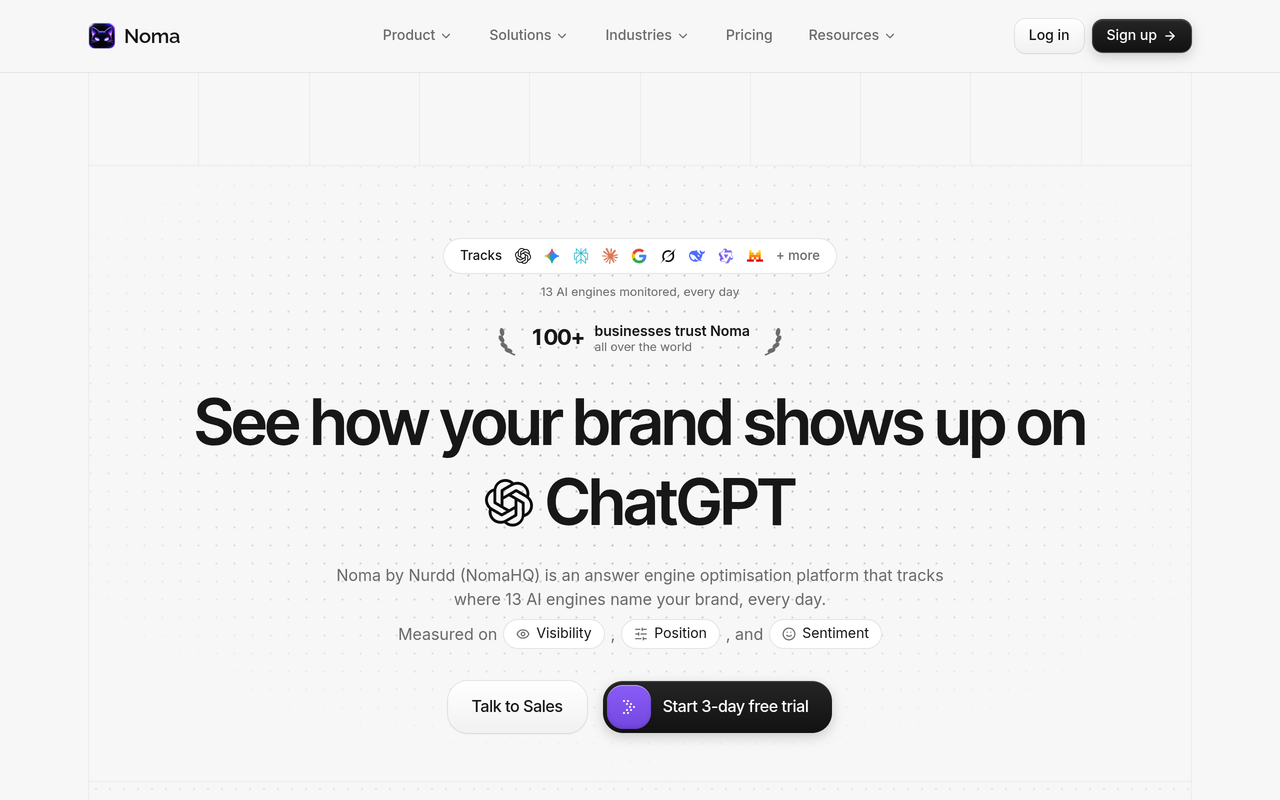
Noma by Nurdd is a web dashboard that tracks whether a brand appears in answers from 13 AI engines, including ChatGPT, Gemini, Perplexity and Claude, polled daily. It records whether your brand is named, which page each citation comes from, citation frequency by category and how you compare with competitors, then gives recommendations to improve AI visibility.
For a budget holder, that makes Noma the baseline step: you see where you stand on the AI side before committing more spend. Noma offers a 3-day free trial; a card is taken at signup, billing starts on day 3, and you are not charged if you cancel before then.
Want to see Noma for yourself? Book a demo.
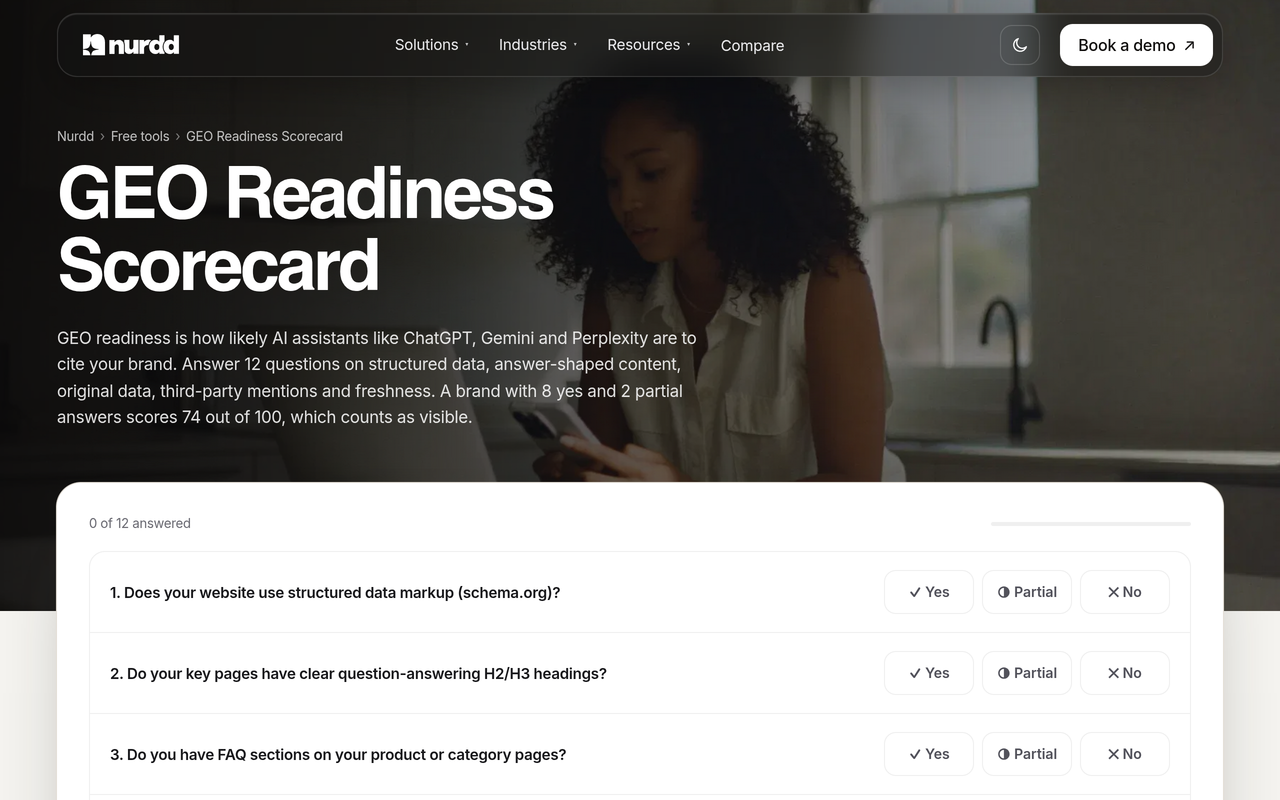
If you want a quick self-check first, the free GEO readiness scorecard scores 12 factors of readiness for AI answers. Teams that want hands-on delivery can look at Nurdd's answer engine optimization agency and generative engine optimization services, both measured in Noma.
How does this compare with the SEO suites?
Noma tracks 13 AI engines, including ChatGPT, Gemini, Perplexity and Claude, and records the citations each answer contains. Nurdd's comparison pages set out the differences for Noma versus Semrush and Noma versus Ahrefs, and the best AI search visibility tools comparison covers the wider field.
The practical point is that you do not need to replace your SEO tool to start. You add a measurement layer for the AI answers, and you keep ranking work where it is.
What is the checklist for the first 30 days?
- Confirm your key pages are indexable and load quickly. Result: retrieval can reach them.
- Check robots.txt against the AI crawlers you want, including OAI-SearchBot for ChatGPT search.
- Rewrite each money page's opening to answer its question in the first 40 to 60 words.
- Write one plain-language brand description and use it everywhere. See how to write a brand description AI engines understand.
- Add structured data that matches what is visible on the page.
- Build your 30 to 50 prompt set and record the baseline.
- List the third-party sources engines cite for your category, and pick two you can realistically earn a mention on.
- Run the AEO audit checklist for the gaps this list does not cover.
What are the most common mistakes?
- Buying AI-only tactics first. Google's guide says that, for Google Search, you can ignore content chunking and llms.txt files, and that unique, valuable content matters.
- Judging AI visibility by rank. The Ahrefs data above shows most citations come from outside the top 10 for the exact query.
- Blocking the wrong bots. A blanket block on AI crawlers can remove you from ChatGPT search answers.
- Testing once. A single run of a single prompt is anecdote. Use a fixed set and repeat it.
- Quoting vendor statistics as a forecast. The 4.4x and 12.1% figures are measurements from specific samples.
How we researched this
We reviewed Google Search Central documentation, OpenAI's crawler documentation, a Pew Research Center analysis, trade-press coverage of an Ahrefs study, vendor publications from Semrush and Ahrefs, and three competing explainers from cmlabs, Exposure Ninja and Optimizely. All sources were checked on the publication date of this post. We did not run hands-on tests or interviews, and the budget splits are a planning heuristic, not data. For how Nurdd's products connect, see how Nurdd works.
Frequently asked questions
Is AI search optimization different from SEO?
Yes in scoreboard, mostly no in foundations. Both depend on crawlable pages and original content, but AI search optimization is judged on mentions and citations in generated answers rather than rank and clicks. Google says optimizing for its AI features is still SEO from its perspective.
Should I invest in AEO or SEO first?
Fund SEO foundations first, because retrieval needs pages it can reach. Then measure your AI visibility before adding a dedicated AEO budget, so the spend targets gaps you have actually seen.
Will AI search replace SEO?
The evidence reviewed here does not show replacement. Google describes its AI features as built on core ranking systems, and Ahrefs still found a meaningful share of AI Overview citations in the top 10. What has changed is that a ranking alone no longer guarantees attention.
How much of my budget should go to AI search?
Start small. A reasonable planning rule is to cap AI-specific work at about a quarter of combined spend until a six-week test shows a gain on a fixed prompt set. Raise it in steps if mention rate and conversions both move.
Do I need llms.txt or special markup for AI search?
For Google Search, Google's guidance says you can ignore unnecessary AI text files such as llms.txt. Other engines may differ, so test before paying anyone to implement them.
How do I know whether ChatGPT or Perplexity mention my brand?
Run a fixed set of buyer prompts across engines and record the results, or use a tracker. Noma by Nurdd polls 13 AI engines daily and records whether your brand is named and which page is cited.
Does ranking in Google guarantee a citation in AI answers?
No. In Ahrefs' updated study, 38% of cited pages ranked in the top 10 for the query, and many cited pages ranked far lower. Fan-out queries help explain why.
Do AI search visitors convert better than organic visitors?
Some published measurements say so. Semrush estimates 4.4x, and Ahrefs saw 0.5% of its visitors produce 12.1% of its signups. Both are single samples, so check your own analytics.
What should you do next?
Fund the shared foundations, cap the AI-specific line, and let a measured baseline decide the next step. The six-week test gives you a budget decision grounded in your own prompts rather than in another company's chart.
To measure the AI side before committing more budget, book a demo of Noma. You can also read about the product on nomahq.app.