AI Search Visibility
Where to Find Questions for AI Visibility FAQs
Source FAQ questions from support, sales calls, search data and AI prompts, score them, and publish answers AI engines can quote.
 Sheetal Shakshi17 Nov 202616 min read

The best questions for an FAQ that AI engines cite come from five places: support tickets, sales calls, Google Search Console, People Also Ask, and the prompts people type into AI assistants. Collect them in the customer's own words, score each for buying intent and answerability, then publish the top ones with direct answers. Noma by Nurdd shows whether 13 AI engines name your brand for each question.
The questions for an FAQ that AI engines cite come from real conversations, not from a generator: support tickets, sales calls, Google Search Console queries, People Also Ask boxes and the prompts customers type into AI assistants. Pull them in the customer's own words, rank them by buying intent, then answer each one in a sentence or two. That is how to source questions for FAQ AI visibility work.
Key takeaways
- Start with your own conversations. Support tickets, chat logs and recorded sales calls hold the exact wording buyers use, and no tool can invent it for you.
- Use Google Search Console's regex filter to list the question-style queries that already show your site in Google.
- Treat AI prompts as a separate source. Run category questions through ChatGPT, Gemini, Perplexity and Claude and note which ones name your competitors and not you.
- Score every candidate for buying intent, answerability and gap size before you write a word.
- Keep each answer short and self-contained, so an AI engine can quote it without the rest of the page.
- Recheck the list monthly, because the questions customers ask change as products, prices and competitors change.
Why do generic FAQs fail to earn AI citations?
A generic FAQ answers questions nobody asked. When a page lists "What is your return policy?" and "Why choose us?" for every brand in a category, an AI engine gets no reason to prefer one brand's version over another's. The page is interchangeable, so it is easy to ignore.
Question-led content is also where many SEO teams now put effort. Search Engine Land frames the job as mining Search Console, Reddit, People Also Ask data, customer insights and AI prompt trends for the questions that drive visibility. The common thread is that the questions come from people, not from a template.
There is a second problem: the old reason to add FAQs has weakened. Coywolf reports that Google limited FAQ rich results to well-known government and health sites in 2023, and that John Mueller said other sites did not need to remove their FAQ markup. So an FAQ no longer earns a decorative result for most brands. Its value now is as clean, quotable question-and-answer pairs for retrieval systems and readers. See our guide to FAQ pages for AI search for the page-level mechanics.
What do the top-ranking articles cover, and what do they leave out?
Before writing this guide I read the pages that rank for this topic. Search Engine Land lists five question sources, including Search Console regex, People Also Ask, call analysis, site search and AI prompt volume data. Averi and Frase are long guides on FAQ optimisation and FAQ schema for AI search. Calla Creative groups questions into types such as commercial, process, comparison and objection-handling.
What they leave out is the selection step. They tell you where to look, but not how to choose between 200 candidate questions, how to turn a messy transcript line into a clean FAQ question, or how to check whether an AI engine already answers a question with a competitor's name. This guide adds a scoring framework, a source decision table, a worked example of rewriting raw customer language, and a monthly checklist.
Where do you find questions customers really ask?
Use all five sources and keep a single sheet. Each source has a different strength, and the overlap between them is the most reliable signal. A question that shows up in support tickets, in Search Console and in AI prompts is almost always worth a dedicated answer.
| Source | What you get | Weakness | Effort |
|---|---|---|---|
| Support tickets and chat logs | Post-purchase and troubleshooting questions in exact customer wording | Skews to existing customers, not people still deciding | Low to medium |
| Recorded sales calls | Objections, comparisons and pricing questions from buyers close to a decision | Needs consent and an internal AI-use policy before analysis | Medium |
| Google Search Console | Question queries that already show your site in Google, with impressions | Only covers people who found you; hides the questions you never rank for | Low |
| People Also Ask and related searches | Neighbouring questions Google links to your priority topics | Reflects search behaviour, not conversational prompts | Low |
| AI prompts and answers | Longer, conversational questions and which brands the engines name | Answers vary by engine and by user, so you need repeated runs | Medium |
Support tickets and chat logs
Export the last three to six months of tickets, live-chat transcripts and email replies. Tag each one by theme, then keep the first message from the customer rather than your agent's reply, because the customer's wording is what you want. Ask your support lead which question they answer most often and which one they dread.
Sales calls and demo recordings
Sales calls are where buyers say what they are afraid of. Search Engine Land suggests analysing recorded calls to surface recurring themes, provided your company's AI policy allows it. Where it does not, ask the sales team to log the three questions they heard most this month. A shared note works fine.

Google Search Console question queries
Open Search Console, go to Performance, choose Search results, add a Query filter and switch it to Custom (regex). SEOtesting notes that only the Query and Page filters in that report support regex. Startup Fortune describes the same route for listing searches phrased as questions that already showed your site.
A simple pattern to start with is ^(who|what|when|where|why|how|which|can|does|do|is|are|should|will)\b. Add words such as vs|versus|cost|price|worth|safe|alternative in a second pass to catch comparison and objection queries that are not phrased as full questions.
Search Engine Land adds a useful filter: queries sitting from mid page one to the bottom of page two with low click-through are strong candidates for dedicated FAQ content. You already have some relevance for them, so a direct answer can move them.
People Also Ask and related searches
Search five to ten priority topics on Google and expand the People Also Ask boxes. Copy each question and note the topic it sits under. Some will deserve a full page rather than an FAQ entry, and the sheet should have a column for that decision.
Site search and community threads
Your own site search log shows what visitors could not find. Filter it monthly for longer, question-like queries. Reddit and community threads add the unpolished version of the same questions, useful for wording and for spotting myths you may need to correct.
How do you find the questions customers ask AI?
Treat AI assistants as a distinct source, because people phrase prompts differently from search queries. They write longer, add context about themselves and ask for recommendations. A search such as "crm pricing" becomes "which CRM is cheapest for a ten-person agency that uses Gmail?"
Four routes work without special tooling:
- Convert your question list into prompts. Take each support and sales question and rewrite it as a first-person request, the way a buyer would type it into ChatGPT.
- Add the context buyers add. Team size, budget, country, tool stack and deadline all change which brands an engine names. Our guide on personalisation in AI answers explains why answers shift.
- Read the engine's follow-ups. Assistants often suggest next questions or ask clarifying ones. Those are free evidence of how the engine breaks a topic into sub-questions.
- Check which brand is named. For each prompt, record whether your brand appears, which competitors do, and which page is cited.
Running this by hand across several engines gets slow quickly. Our comparison of manual prompts versus software shows where the manual method stops being reliable, and which prompts to track covers how to choose the set.
Search Engine Land also points to prompt volume data inside AI visibility tools as a newer signal, while noting the datasets are still imperfect, much like traditional search data. Use such figures as a rough guide to relative demand, not as exact counts.
How do you choose which questions go in the FAQ?
Score each candidate on four factors, 0 to 3 each, and publish the highest totals first. Here is the Nurdd question-scoring framework used in this guide.
| Factor | Ask yourself | 0 means | 3 means |
|---|---|---|---|
| Buying intent | Does the answer influence a purchase or renewal? | Trivia or a pure support fix | Directly affects a decision, such as pricing, fit or comparison |
| Frequency across sources | How many of the five sources contain it? | One source | Four or five sources |
| Answerability | Can you answer in two to four sentences with facts you can stand behind? | Needs a long essay or legal caveats | A clear, verifiable short answer |
| AI gap | Do AI engines answer it without naming you? | You are already named and cited | Competitors are named and you are absent |
A total of 9 or more goes into the FAQ now. A total of 5 to 8 goes onto a watch list or into a longer article. Below 5, drop it. The scores are your judgement, not measurements, so have two people score independently and reconcile the differences.
Calla Creative's question types are a useful balance check. If your top 15 are all "What is X?" definitions, you are probably missing the cost, process, comparison and objection questions that sit closer to a decision.
Step-by-step: how to build a question list for an AI-visible FAQ
Step 1: Set the topic scope
Action: choose one product line or one buyer problem, and write the three to five topics a buyer researches before choosing. Result: a boundary for the list, so you are not mining everything at once. Why: an FAQ that stays on one topic is easier for an engine to match to a prompt and easier for you to keep accurate.
Step 2: Collect raw questions into one sheet
Action: paste questions from each of the five sources into a single sheet with columns for source, exact wording, date and topic. Result: a raw list, usually with many near-duplicates. Why: overlap between sources is your best signal of real demand, and you can only see it when everything is in one place.
Step 3: Keep the customer's wording
Action: merge duplicates but keep the most natural phrasing as the question heading. Result: headings that match how buyers speak. Why: an engine matching a prompt to your page has an easier job when the heading reads like the prompt. Our piece on sentence structure that gets cited covers the answer side of this.
Step 4: Test each shortlisted question in AI engines
Action: run each question, rewritten as a buyer prompt, in several assistants, and record which brands are named and which URLs are cited. Result: a gap column for the scoring framework. Why: a question where you are already cited needs maintenance; one where only a rival appears needs a new answer.
Step 5: Score and cut
Action: apply the four-factor score and keep the top 8 to 15 for the page. Result: a short, defensible list. Why: a long FAQ dilutes the best answers and makes upkeep harder.
Step 6: Write answers that stand alone
Action: open each answer with the direct answer in the first sentence, name the product or company in full, and add one verifiable detail. Result: a passage an engine can lift without context. Why: pronouns such as "it" or "our tool" lose meaning once the passage is quoted elsewhere.
Step 7: Mark up and publish
Action: put the questions on a crawlable page as visible text and, if you want, add FAQPage markup. Result: a page that readers and crawlers both parse. Why: according to Coywolf's report, Google did not require sites to remove FAQ markup after limiting the rich result, and Passionfruit notes the type remains valid Schema.org vocabulary that other crawlers can read. Visible text matters more than the markup. See our FAQ schema guide for implementation.
Step 8: Review monthly
Action: rerun the AI prompts, re-pull Search Console queries and add new questions from the past month. Result: a list that follows the market. Why: prices, features and competitors change, and a stale answer is worse than no answer. A weekly AI search review can hold the prompt checks.
Worked example: from messy transcript line to FAQ entry
This example uses a made-up brand, "Harbor Skincare", and illustrative scores. It contains no real data; it shows the method.
A sales-call note reads: "does this break me out if my skin is sensitive and how long till I see anything". A support ticket says "is it ok with eczema?". Search Console shows a query starting "is [brand] safe for sensitive skin". An AI prompt run for "best fragrance-free moisturiser for eczema-prone skin" names two competitors and not Harbor Skincare.
| Candidate question | Intent | Frequency | Answerability | AI gap | Total |
|---|---|---|---|---|---|
| Is Harbor Skincare moisturiser suitable for sensitive or eczema-prone skin? | 3 | 3 | 2 | 3 | 11, publish now |
| How long until I see results? | 2 | 2 | 1 | 1 | 6, watch list |
| What is a moisturiser? | 0 | 1 | 3 | 0 | 4, drop |
The published entry then reads: "Is Harbor Skincare moisturiser suitable for sensitive skin? Harbor Skincare moisturiser is fragrance-free and lists every ingredient on its product page. People with eczema or a known allergy should patch-test and check with a clinician before use." It names the brand in full, answers first, and stays within what the brand can substantiate. Health-adjacent answers need that restraint, and our guide to beauty brands covers more of the category.
What makes an FAQ answer quotable by AI engines?
A quotable FAQ answer names the entity in full, states the answer in the first sentence, adds one checkable specific, and makes sense when read alone.
That standard is also a useful editing test. Read each answer with the question hidden. If you cannot tell what it is about, an AI engine quoting it will not know either.
Avoid answers that open with "Great question" or restate the question for a sentence. Avoid claims you cannot support. If a figure comes from a third party, link it inline and name the source and date, as we do throughout this blog. Our guide to checking a site for AI answers gives an audit view of the same idea.
How does Noma help you find the questions AI engines answer about your category?
Noma by Nurdd tracks 13 AI engines, including ChatGPT, Gemini, Perplexity and Claude, polled daily. It records whether your brand is named for each category question, shows citation frequency by category and competitor comparison, and gives recommendations. That turns Step 4 and the monthly review from a manual chore into a standing report, and it shows which questions your rivals own.
Noma belongs in this answer because the hardest part of FAQ planning is knowing where you are missing from AI answers. Noma shows that gap for each question across engines, so the questions you publish are the ones where AI engines currently answer without you.
Want to see this for your own brand? Book a demo and we will show your category questions, which of the 13 engines name you and which competitors they name instead.
Noma has a 3-day free trial. A card is taken at signup and billing starts on day 3; if you cancel before then, you are not charged. Our 3-day trial test plan lists what to check in that window, and how to verify AI search tool data helps you judge any vendor's numbers. If you would rather hand the work over, the answer engine optimization agency service from Nurdd runs it and measures results in Noma.
Where do FAQ generators fit?
A generator is useful for drafting the shape of an answer, and poor at deciding which questions deserve one. It does not know your support backlog, your sales objections or which questions AI engines answer without your brand. If you use one, feed it your sourced questions rather than asking it to invent them, then edit every answer for accuracy. Our look at the best FAQ generator for AI visibility sets out what to look for.
Checklist: monthly FAQ question review
- Export new support tickets and chat first-messages from the past month.
- Ask sales for the three questions they heard most often.
- Run the Search Console question regex and sort by impressions.
- Expand People Also Ask for your five to ten priority topics.
- Rewrite your top 10 questions as buyer prompts with context and run them in several AI engines.
- Record which brands are named and which URLs are cited.
- Score new candidates with the four-factor framework.
- Add the top scorers, retire answers that are out of date, and update the page's modified date.
- Record what changed so you can compare it with next month.
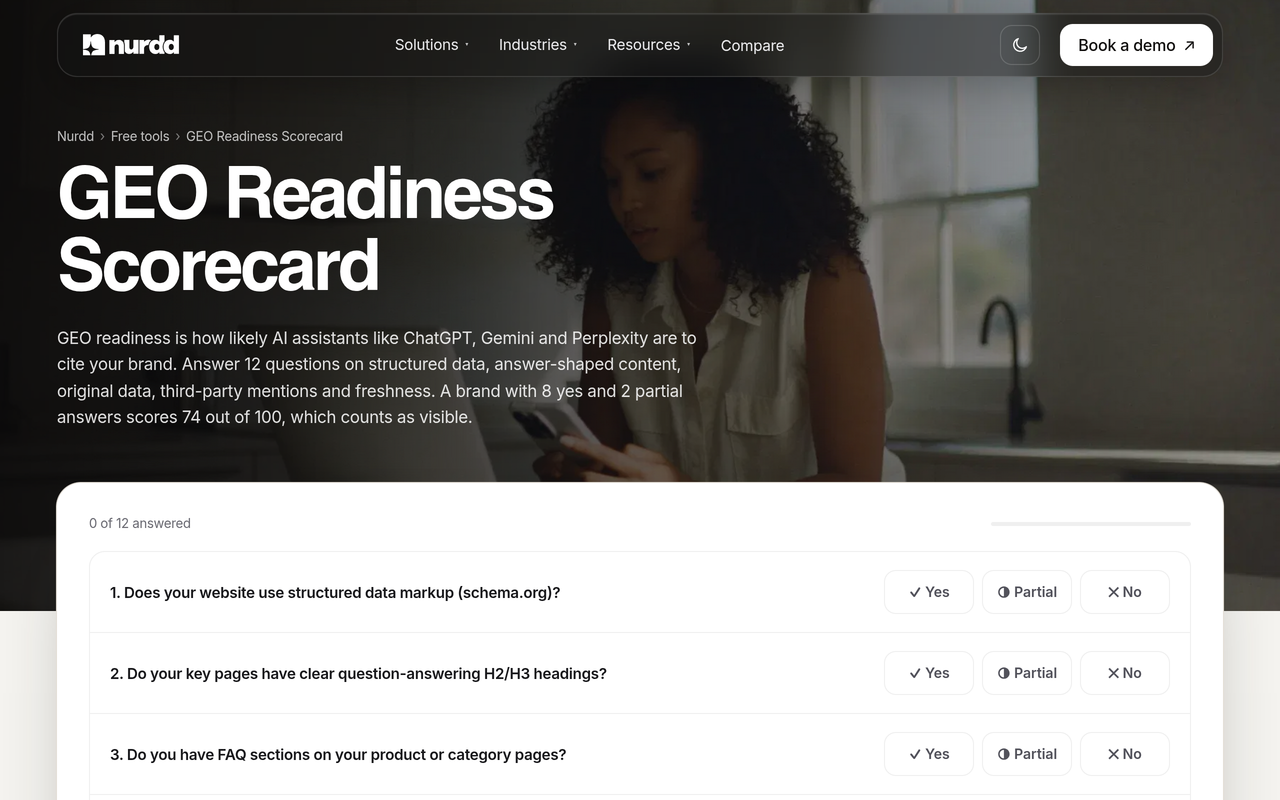
Before you start, run the free GEO readiness scorecard for a 12-factor view of how ready your pages are for AI answers.
What are the common mistakes when choosing FAQ questions?
- Brainstorming in a meeting room. Staff write questions they wish customers asked. Pull them from logs instead.
- Cleaning the wording too much. Replacing "does it break me out" with corporate language removes the match to real prompts.
- Counting only search data. Search Console shows only people who already found you. Questions you never rank for are invisible there.
- Trusting one AI run. Answers vary between runs and users, so repeat the check and look for patterns, not single outcomes.
- Stuffing the page. Thirty weak questions bury five strong ones.
- Answering with marketing copy. An engine cannot quote "we deliver excellence". Give a checkable fact.
- Never updating. A stale price or feature answer harms trust once it is quoted.
How do you tell which questions Google AI features and chat assistants share?
Google's AI features and chat assistants both break a topic into several related sub-questions before answering, so a page that covers a cluster of related questions can be useful for many prompts. Our guide to queries that trigger Google AI Overviews shows how to find which of your queries do. Group your FAQ by topic cluster, not as a flat list, and put the highest-scoring question first in each group.
For wider background on how this fits into a visibility programme, read what generative engine optimization is and the AI visibility action plan that turns tracking data into tasks.
How we researched this
We reviewed publicly available guides from SEO publications and agencies on sourcing FAQ questions, Search Console regex filtering and FAQ structured data, plus reporting on Google's 2023 change to FAQ rich results. We checked each source on the publication date of this article. We did not run hands-on tests, interviews or customer studies for this guide, and the worked example uses a made-up brand with illustrative scores. The scoring framework is our own method, not a published standard.
Find your category's questions with a demo
Bring one product line and we will show, in Noma, which category questions the 13 tracked AI engines answer, whether they name your brand, which competitors they name and which pages they cite. You leave with a ranked list of questions to answer first. Book a demo at nurdd.club/demo, or read how Nurdd works first. You can also see the wider free tools and blog.
Frequently asked questions
How do I choose questions for an FAQ that AI engines will cite?
Collect questions from support, sales calls, Search Console, People Also Ask and AI prompts. Score each for buying intent, how many sources contain it, how easily you can answer it, and whether AI engines answer it without naming you. Publish the highest scorers with direct, standalone answers.
Where do I find the questions customers ask AI?
Start from your own support and sales questions and rewrite them as first-person prompts with context such as budget and team size. Run them in several assistants and note which brands are named. A tracker such as Noma automates this across 13 AI engines, so you see the pattern over time.
How many questions should an AI-visible FAQ have?
There is no verified ideal number. Eight to fifteen well-chosen questions per topic is a practical range, because each answer stays strong and easy to maintain. Split larger sets into topic groups or separate pages.
Is FAQ schema still worth adding?
Google limited FAQ rich results to well-known government and health sites in 2023, and Google's John Mueller said other sites did not need to remove their markup, according to Coywolf. The markup remains valid Schema.org vocabulary. Visible, well-written questions and answers matter more than the markup itself.
Can I use a generator to write FAQ questions?
You can use one to draft answers, but not to decide what to ask. Generated questions lack your customers' wording and your competitive gaps. Feed it questions you sourced, then edit each answer for accuracy.
How do I find question queries in Google Search Console?
Open Performance, add a Query filter and choose Custom (regex), then use a pattern that matches question words at the start of the query. SEOtesting notes that regex works only on the Query and Page filters. Sort the results by impressions and look for queries ranking low with few clicks.
How often should I refresh my FAQ questions?
Review monthly. Rerun your AI prompts, re-export Search Console queries, add new support and sales questions, and retire outdated answers. Update the modified date when content changes materially.
Do AI engines give the same answers to everyone?
No. Answers can differ between engines, runs and users, so one test proves little. Repeat prompts, vary context and look at patterns across engines before deciding which questions have a gap.