AI Search Visibility
AI Search Visibility for Regulated Industries
How finance, health and legal brands can appear in AI answers accurately, find the wrong claims engines make, and correct them with a compliance-safe process.
 Sheetal Shakshi17 Nov 202615 min read

Regulated brands show up in AI answers when engines can find approved, consistent, verifiable pages that state what the brand does and what it does not claim. When an engine gets a claim wrong, you fix the source it read, not the answer itself. Noma by Nurdd shows what 13 AI engines currently say about your brand so errors are found first.
AI search visibility for regulated industries means making sure that ChatGPT, Gemini, Perplexity, Claude and Google's AI features name your finance, health or legal brand accurately, using wording your compliance team would sign off. You cannot edit an AI answer directly. You control it by publishing approved, consistent source pages, then checking regularly what each engine says and correcting the sources behind any error.
Key takeaways
- Treat every AI answer about your brand as an uncontrolled advertisement: measure it, log it, and route errors to compliance the same way you would a rogue ad.
- Fix wrong claims at the source. Update the pages, profiles and third-party listings an engine reads, because you cannot correct a generated answer by asking the engine nicely.
- Sort your claims into three tiers (facts, qualified claims, prohibited claims) before you write anything for AI visibility.
- Track a fixed prompt set across engines weekly, and keep dated screenshots as an audit trail.
- Verifiable pages beat adjectives. Credentials, regulatory identifiers, authorship and review dates give engines something to cite.
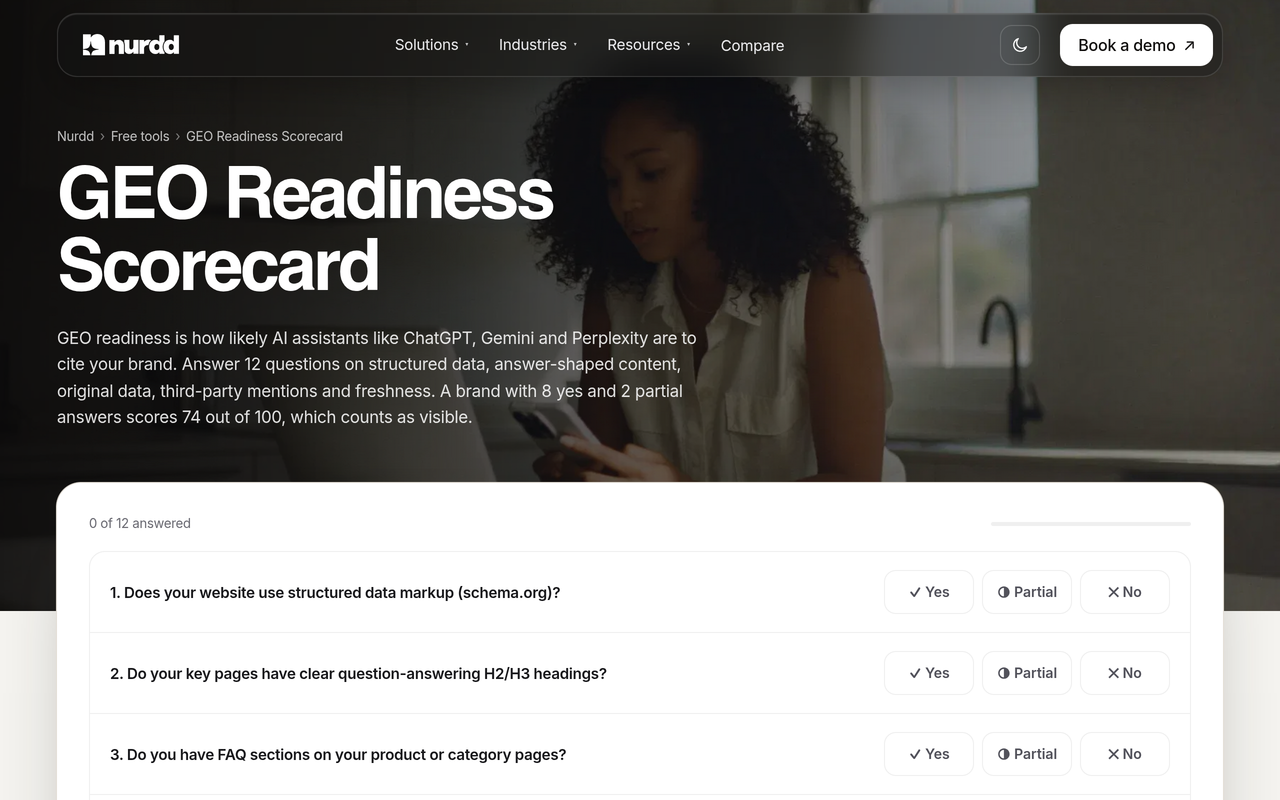
- Run the free GEO readiness scorecard first to see where your pages are weakest.
Quick answer: how do regulated brands show up in AI answers?
Regulated brands appear in AI answers through three routes: their own pages that engines retrieve, third-party sources that engines trust (directories, regulators' registers, press, reviews), and what the model already learned about them. Only the first route is fully in your hands, which is why the work starts with your own approved, consistent pages.
The compliance twist is that engines do not know your approval rules. They summarise, merge and sometimes overstate. A cautious page that says a product may suit some customers can come back as a flat promise. So the job has two halves: be easy to cite, and be easy to quote correctly.
Why is AI search harder for finance, health and legal brands?
It is harder because the downside of being wrong is not just a lost click. A wrong rate, a wrong eligibility rule, an implied cure or a misstated fee can create regulatory exposure, and the brand did not write the sentence.
Search Engine Land's piece on AI-era SEO for regulated sectors places finance, healthcare, government and education squarely inside Google's YMYL (your money or your life) territory, where experience, expertise, authoritativeness and trust are not optional (Search Engine Land, early 2026). Search Engine Journal's audit article adds that in regulated industries the gap widens because compliance limits commercial messaging while educational content flows freely into what AI systems learn from (Search Engine Journal, late 2025).
In practice, that means the educational explainer written by an enthusiastic blogger can shape the answer more than your cautious product page does. Regulated brands often lose the narrative by being careful in only one place.
The visibility gap is real for professional services
One agency page reports that Visibility 360 studied 56 firms across 14 U.S. markets in 2026, and that only 27% appeared when AI systems were asked to recommend firms in specific practice areas (Seven5Seven3 Marketing, 2026). That is the publisher's reported figure from its own page, and we have not seen the underlying study, so treat it as a directional signal.
Worked example: what that 27% means in firms
Using only the figures on that page: 27% of 56 firms is about 15 firms that appeared, which leaves about 41 firms absent from the recommendation answers despite credentials and reputation. The arithmetic is ours; the 56 and 27% are the source's. The lesson for a regulated brand is to measure your own presence before assuming reputation carries over into AI answers.
Which AI answer risks matter most for regulated brands?
Not every error carries the same weight. Use the table below, an original risk matrix, to decide what goes to compliance the same day and what can wait for the weekly review. Add your own rows with your compliance team.
| Error type | Example pattern | Risk level | Source of truth to fix | Action and owner |
|---|---|---|---|---|
| Outcome or performance promise | Answer implies guaranteed returns, cure or win | Critical | Your product page and any third-party page repeating it | Same-day escalation to compliance; correct source; log |
| Eligibility or licensing | Wrong jurisdiction, wrong regulated status, wrong practice area | High | Regulator register entry, About page, structured data | Legal or compliance; update page and listings |
| Fees, rates, terms | Outdated or invented pricing or rate | High | Pricing page with review date; terms page | Product owner; refresh and date-stamp |
| Product description | Brand confused with a competitor or old product | Medium | Brand description, Wikidata, profiles | Content lead; entity clean-up |
| Omission | Brand missing from a category answer | Medium | Category and comparison pages, third-party mentions | SEO lead; weekly review |
| Tone or sentiment | Cautious or outdated reputation summary | Low to medium | Reviews, press, original data | Comms; monitor trend |
The matrix keeps the argument practical. A missing mention is a growth problem. A promise nobody approved is a compliance incident.
How do you make a regulated brand visible and accurate in AI answers? (Step-by-step)
The seven steps below follow a workflow where monitoring, content changes and compliance review are linked, which matches the approach described by Zeover's compliance-heavy GEO guide: connect monitoring, site diagnosis, content updates, compliance checks and re-benchmarking (Zeover, October 2026). We add the claim tiers, prompt design and correction ladder that the pages we reviewed did not spell out.
Step 1: Classify your claims into three tiers
Action: Make a one-page claims register with three columns. Tier 1 is verifiable facts (legal entity name, regulator and registration number, locations, services offered). Tier 2 is qualified claims that must carry a condition or disclaimer. Tier 3 is claims you never make, such as guaranteed outcomes.
Result: You have a reference every writer and every error review can use. Why: engines compress. If a qualification sits three paragraphs away from the claim, it will often be dropped, so Tier 2 claims need the condition inside the same sentence.
Step 2: Build a fixed prompt set, including the risky ones
Action: Write 20 to 40 prompts that real customers ask: category discovery ("best X for Y"), brand questions ("is [brand] safe or legitimate"), comparison, fee and eligibility questions, and one set designed to provoke Tier 3 claims ("does [brand] guarantee..."). Our guide on which prompts to track shows how to choose them, and how many prompts you need covers sizing.
Result: a repeatable test, not an ad hoc screenshot. Why: a fixed set lets you tell a real change from a different question.
Step 3: Capture a baseline across engines
Action: Run the prompt set in each engine your customers use and record: whether the brand is named, what is said, which sources are cited, and which risk row of the matrix any error falls into. Doing this by hand is possible but slow; see manual prompts versus software.
Result: a dated baseline and an error list. Why: answers vary between runs and engines, so one screenshot proves little. A log of repeated runs shows which errors are persistent.
Step 4: Trace each wrong claim to its source
Action: For every error, open the cited sources. If the engine cites a page, read it for the origin of the claim. If it cites nothing, search the exact phrase on your site and across the web. Note whether the origin is your page, an old PDF, a directory, an affiliate review or a competitor.
Result: each error has an owner and a fix location. Why: Search Engine Journal's audit notes that marketing claims such as "industry-leading" carry no weight, and that machine-readable validation such as research references, standards, certifications and regulatory documentation drives citation decisions (Search Engine Journal, late 2025). Errors often come from vague or missing evidence on the brand's side.
Step 5: Correct the source, in the right order
Use this correction ladder, from fastest and most in your control to slowest:
- Your own pages. Rewrite the offending page so the correct statement is in one plain sentence near the top, with its condition attached, a named reviewer and a visible last-reviewed date. See author and dateModified signals.
- Retire or redirect stale pages. Old rate sheets, archived campaign pages and superseded PDFs are common error sources.
- Structured data and entity profiles. Align your legal name, regulator identifier and descriptions across schema markup, company profiles and Wikidata with sameAs links. Our entity consistency checklist has the field list.
- Third-party sources. Ask directories, partners and publishers to correct their copy, with a request citing your approved page.
- Platform feedback. Use each engine's feedback or reporting route for serious factual errors, and keep a record. Treat it as a supplement; it does not replace fixing sources.
Result: the correct statement exists in more places, in consistent wording. Why: an engine that sees one cautious page and twenty contradictory ones will not reliably pick yours. Labarna's regulated-industry guide makes a similar point: a firm with one strong explainer and many thin pages sends a mixed signal (Labarna, August 2026).
Step 6: Write quotable, compliance-safe passages
Action: For each Tier 1 and Tier 2 claim, publish a stand-alone passage of two or three sentences that names the entity in full, states the fact, and includes its qualifier. For example, a structure such as: "[Full legal name] is [regulated status] in [jurisdiction], registered under [identifier]. It offers [service] to [audience], subject to [condition]." Our guides on sentence structure that gets cited and writing a brand description go deeper.
Result: passages an engine can lift whole without losing the qualification. Why: models quote self-contained sentences; pronouns and distant disclaimers are what get stripped.
Step 7: Re-test, alert and review weekly
Action: After each change, rerun the affected prompts and compare against the baseline. Set alerts for new mentions of Tier 3 claims, and hold a short weekly review with compliance in the room, using our 30-minute agenda and alert guide.
Result: a closed loop with evidence. Why: regulators and internal auditors ask what you knew and when you acted; dated logs answer that. For designing tests that separate your changes from noise, see GEO experiment design.
How do I fix wrong claims AI engines make about my finance or health brand?
You fix a wrong claim by finding the page or listing the engine drew it from, correcting that source, and then re-running the same prompt until the answer changes. You cannot edit the generated answer, so speed depends on how many sources repeat the error.
Here is a compact triage you can follow when a wrong claim appears:
- Screenshot the answer with the prompt, engine, date and time.
- Classify it using the risk matrix above. Critical and high items go to compliance immediately.
- Record every cited source and search for the claim's wording on your own domain.
- Identify whether the origin is first-party (you can fix today) or third-party (needs outreach).
- Publish the correction on your own page in a stand-alone, dated passage.
- Request corrections from third parties and use platform feedback for serious factual errors.
- Re-run the prompt on each engine weekly and note the date the error disappears or persists.
- If it persists after two cycles, escalate: look for a hidden source such as an old PDF, a scraped copy or a forum thread.
Keep in mind that engines may use different retrieval methods. An error that vanishes in one engine can linger in another, which is why per-engine tracking matters. Our guides on checking Claude and Google AI Overviews show how to do it for individual engines.
What do finance, health and legal brands each need to watch?
Each sector has its own pattern of risk, and your regulator's rules always override a general guide. The table is a prompt for your compliance team, not legal advice.
| Sector | Typical AI answer risk | What to make verifiable on your site | Related Nurdd page |
|---|---|---|---|
| Finance (banks, wealth, insurance) | Rates, fees, returns or cover described more firmly than the product page does | Regulator name and register entry, product terms with review dates, risk wording attached to claims | Banking, wealth, insurance |
| Health (pharma, medtech, clinics) | Implied efficacy, wrong indications, outdated safety information | Named clinical reviewer, sources for health statements, indication and region limits, update dates | Pharma, medtech |
| Legal | Wrong jurisdiction or practice area, implied outcomes, advice-like summaries | Authorised status and regulator, jurisdictions, practice areas, advert wording consistent with professional rules | Regional checks |
The absolute.digital page, for example, frames its regulated-sector work around bodies such as the FCA for insurance and the SRA for law firms (Absolute Digital, 2026). Whichever regulator governs you, put its identifier on a crawlable page and keep it identical everywhere.
Which pages do AI engines trust most for regulated brands?
Engines tend to favour pages with specific, checkable evidence and consistency across sources. The Labarna guide points to structured data markup as one of the most underused tools for regulated organisations (Labarna, August 2026), and Search Engine Journal's audit article says verifiable references, standards and regulatory documentation drive citation decisions (Search Engine Journal, late 2025).
As a working checklist, in order of effort:
- An About page with legal name, regulator, registration and address of record.
- Author and reviewer bios with credentials on every advice-adjacent page.
- Dated pricing, terms and eligibility pages.
- Organisation and article schema that mirror visible content, as in our schema markup guide.
- FAQ pages answering the exact risky questions, with qualifiers. See FAQ pages for AI search.
- Original data or research that others cite, per publishing original data.
Also check that you are not blocking crawlers you want; our AI crawler user agents list explains what to allow and what to block. Regulated teams sometimes block everything by default and then wonder why engines rely on third-party summaries.
How do you keep compliance in the loop without slowing everything down?
Bring compliance in at three fixed points instead of reviewing every page ad hoc. Zeover's guidance for compliance-heavy teams stresses governed, approved messaging tied to trusted source material, and a workflow joining monitoring, content updates and compliance checks (Zeover, October 2026).
- Once: approve the claims register and the stand-alone passage templates.
- Weekly: review the error log for Critical and High items, with decisions recorded.
- On change: any new product, fee or indication triggers a source sweep, so old pages are retired when new ones go live.
This keeps the volume low for reviewers. They approve patterns and look at exceptions, not every sentence.
What mistakes do regulated brands make in AI search?
- Blocking all AI crawlers and relying on third-party summaries. The engine then describes you from other people's words.
- Writing disclaimers far from the claim. Models quote the claim and drop the footnote.
- Leaving stale pages live. Outdated regulatory or pricing information is a citation risk, not only a ranking problem, as one agency page on regulated GEO notes (This Is LD, 2026).
- Trusting a single screenshot. Answers vary, so test repeatedly. Our guide to verifying AI search tool data covers this.
- Chasing adjectives. Words like "trusted" do nothing; credentials and references do.
- Treating it as a one-off project. Models and retrieval change, so the checks must recur. See the AI visibility action plan.
- Skipping the question "why is a competitor cited?" The reasons are often evidence gaps, covered in why AI engines ignore your brand.
How does Noma help regulated brands see and correct AI answers?
Noma by Nurdd is a web dashboard that tracks whether your brand appears in answers from 13 AI engines, including ChatGPT, Gemini, Perplexity and Claude, polled daily. It records whether the brand is named and which page each citation comes from, shows citation frequency by category with competitor comparison, and gives recommendations to improve visibility. For a regulated brand, that turns the error hunt into a daily record rather than a manual spot check.
Book a demo at https://www.nurdd.club/demo and we will walk through your own brand: the prompts that matter in your category, what the engines currently say, and which cited pages sit behind each answer.
Concretely, use Noma at each step of the workflow above: it supports the baseline in step 3, the source tracing in step 4 through the cited pages, and the re-test in step 7. The 3-day free trial takes a card at signup and bills on day 3 unless you cancel before then; our 3-day trial test plan lists what to check. Noma tracks and records what engines say; changes to your content go through your own compliance process. If you want the changes made for you, Nurdd's team also offers answer engine optimization and generative engine optimization services, measured in Noma. You can see how the pieces fit in how Nurdd works.

Conclusion
Regulated brands cannot control AI answers directly, but they can control the evidence those answers draw on. Classify claims, test a fixed prompt set, trace errors to their sources, correct them in order, and keep a dated log. Done weekly with compliance involved, the process lowers risk and improves visibility together.
To see what AI engines currently say about your finance, health or legal brand, book a demo of Noma. You will see your own prompts, engines and cited sources, and leave with a first list of errors to correct. You can also read more at nomahq.app, or start with our explainer what is generative engine optimization.
How we researched this
We reviewed published guidance on AI visibility for regulated sectors from industry publications (Search Engine Journal, Search Engine Land) and from agencies and vendors that publish on the topic (Zeover, Labarna, Absolute Digital, This Is LD, Seven5Seven3 Marketing), and read the Zeover and Labarna articles in full. We checked these pages on the publication date. We did not run hands-on tests, interviews or customer studies, and we did not review regulator rulebooks, so rules for your sector must come from your own regulator and compliance team. The only figures used are those reported on the linked pages, and we have not seen the underlying study for the 56-firm figure.
Frequently asked questions
How do regulated brands show up in AI answers?
They show up when engines can retrieve clear, consistent, verifiable pages about them, plus trusted third-party sources that repeat the same facts. Engines also draw on what the model already learned. Because you only control some of those inputs, tracking what each engine says is essential.
How do I fix wrong claims AI engines make about my finance or health brand?
Find the source the engine drew from, correct or retire it, and publish a clear dated statement on your own page. Then ask third parties to correct their copy and use platform feedback for serious errors. Re-run the same prompt weekly until the answer changes.
Can I ask ChatGPT or Gemini to remove a wrong statement about my company?
Engines offer feedback routes, but there is no guarantee of a fast or specific change. The dependable lever is fixing the sources they read. Use feedback as an extra step and keep a record of what you reported and when.
Is AI search visibility a compliance risk in itself?
Being visible is not the risk; being misdescribed is. Visibility without monitoring means errors can run unnoticed. Your compliance team should decide which kinds of AI-generated statements about your brand count as incidents and how they are logged.
Which pages should a regulated brand update first?
Start with the About page, pricing and terms pages, and any page that makes a product or outcome claim. Add legal name, regulator identifier, reviewer details and last-reviewed dates. Then retire stale pages that contradict them.
How often should we check what AI engines say about our brand?
Weekly is a practical rhythm for a fixed prompt set, with alerts for serious claims in between. Daily tracking helps because answers vary between runs. Noma polls its 13 AI engines daily so the log builds on its own.
Does structured data help regulated brands in AI answers?
It helps by stating your name, status and content in a machine-readable way that matches the visible page. It does not guarantee citation. Make sure the markup mirrors what compliance has approved and that nothing in it contradicts the page.
How should we vet any AI visibility tool for data safety?
Ask any vendor what data it stores and who can see it, and get the answer in writing before you sign. Involve your security and compliance teams in that review. Our permission-aware AI search questions give you a starting list.