AI Search Visibility
AI Visibility Action Plan: Turn Tracking Data Into Tasks
Turn AI search tracking data into a ranked fix list across content, schema, third-party sources and entity pages, with a scoring model and 30-day checklist.
 Sheetal Shakshi13 Nov 202615 min read
An AI visibility action plan turns tracking data into a ranked list of fixes across content, schema and access, third-party sources and entity pages. Score each fix by evidence, reach and effort, ship up to five per cycle, then re-poll the same prompts to see what moved.
An AI visibility action plan is a ranked list of fixes built from your tracking data: which prompts miss your brand, which sources the engines cite instead, and which content, schema, third-party or entity-page change would close each gap. Score each fix by evidence, reach and effort, ship the top few, then re-measure.
Key takeaways
- Tracking tells you where you are missing; an action plan tells you what to change, in what order, and how you will know it worked.
- Sort every gap into one of four fix types: on-page content, schema and technical access, third-party sources, or entity pages.
- Fix factual errors and crawler access first, because they are cheap and they block everything else.
- Score each task on evidence, reach and effort, and ship no more than five per cycle so you can attribute changes.
- Re-poll the same prompts after each batch and compare against a baseline, not against your memory.
- Rankings are a weak guide: Ahrefs found only 12% of links cited by assistants sit in Google's top 10 for the same prompt.
Most teams get stuck one step after the dashboard. They can see a visibility score, a list of competitors and a pile of cited URLs, but nobody owns the next move. This post fills that gap with a method you can run weekly, whatever tracking tool you use. For the tracking half, start with which prompts to track and how many prompts you need.
What do I do after tracking my brand in AI search?
You convert each gap in the data into a specific, owned task, rank the tasks, ship a small batch and measure again. Tracking is the diagnostic; the action plan is the treatment. A score on its own does not change what ChatGPT, Gemini, Perplexity or Claude say about you.
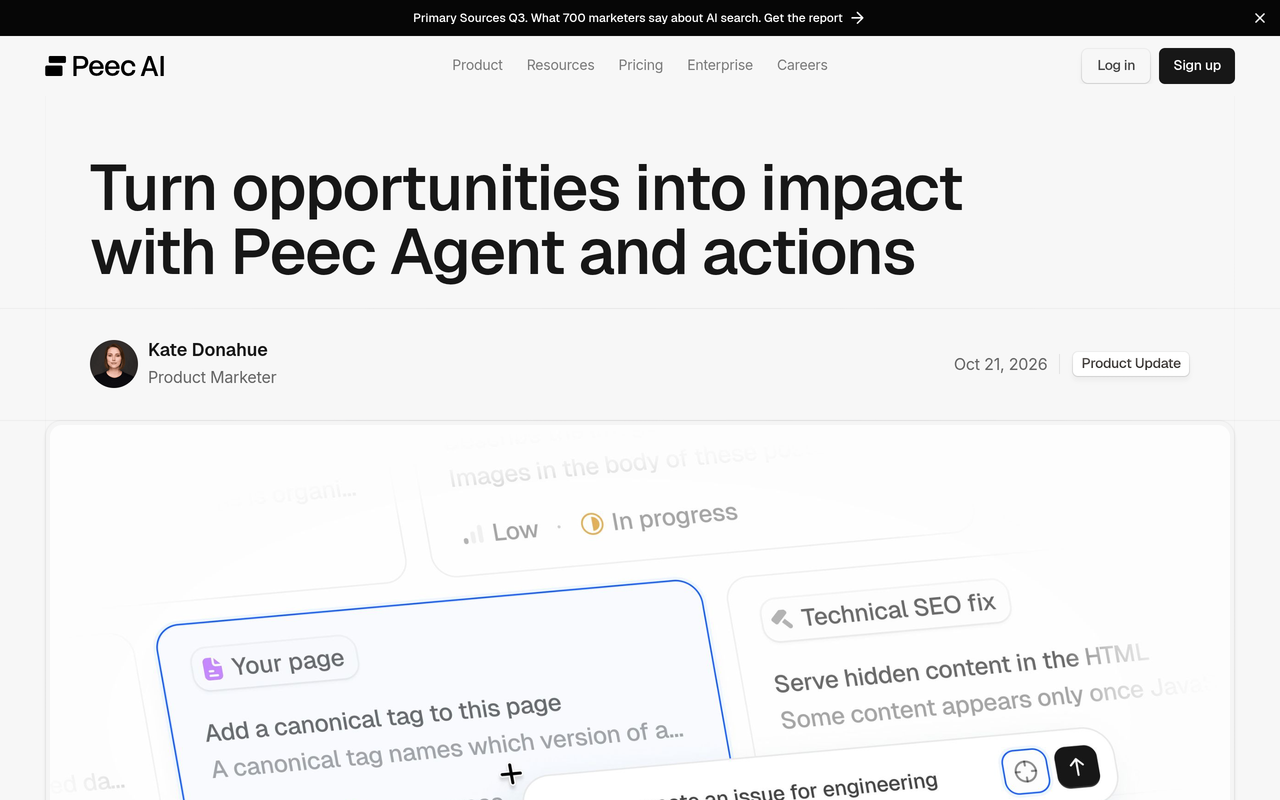
Other publishers describe the same gap. Metricus, accessed November 2026 lays out a five-step order: fix factual errors, add structured data, update third-party listings, create comparison content, then monitor and re-audit. Peec AI, accessed November 2026 publishes a post on turning opportunities into impact with actions, which shows tracking vendors now treat the action layer as part of the product.
What those guides leave out is a way to choose between fixes when you have thirty and time for five. The rest of this guide supplies that: a diagnosis table, a scoring model, a worked example, a weekly checklist and a measurement rule.
Why is a tracking score not enough to act on?
A visibility score is an average. It hides whether you lose because the engines never crawl your pages, because they describe you wrongly, or because they prefer a source you do not control. Each cause needs a different fix, so acting on the average wastes effort.
It also cannot be read through classic SEO rankings. Ahrefs, accessed November 2026 reports that across 15,000 prompts, on average only 12% of links cited by ChatGPT, Gemini and Copilot appear in Google's top 10 for the same prompt, and that Perplexity is the closest at 28.6%. If you rank well and still go uncited, the cause is somewhere else; see ranking on Google but not cited by AI.
According to Ahrefs, on average only 12% of links cited by ChatGPT, Gemini and Copilot appear in Google's top 10 results for the same prompt, so a strong Google ranking does not predict an AI citation.
The practical consequence is that your plan must start from citation and mention data per prompt and per engine, not from a keyword rank report. The next section shows what to pull from your tracking data before you plan anything.
What data do I need before I build the plan?
Export five views of your tracking data. Without them, scoring is guesswork.
- Mention rate per prompt and engine: whether your brand is named, polled repeatedly so one-off variation does not mislead you.
- Cited URLs per prompt: every source the engine linked, with the domain and page.
- Competitor mentions: which rivals appear where you do not.
- Answer wording: how each engine describes you, including errors.
- Prompt importance: a simple 1 to 3 label for how close the prompt is to a purchase decision.
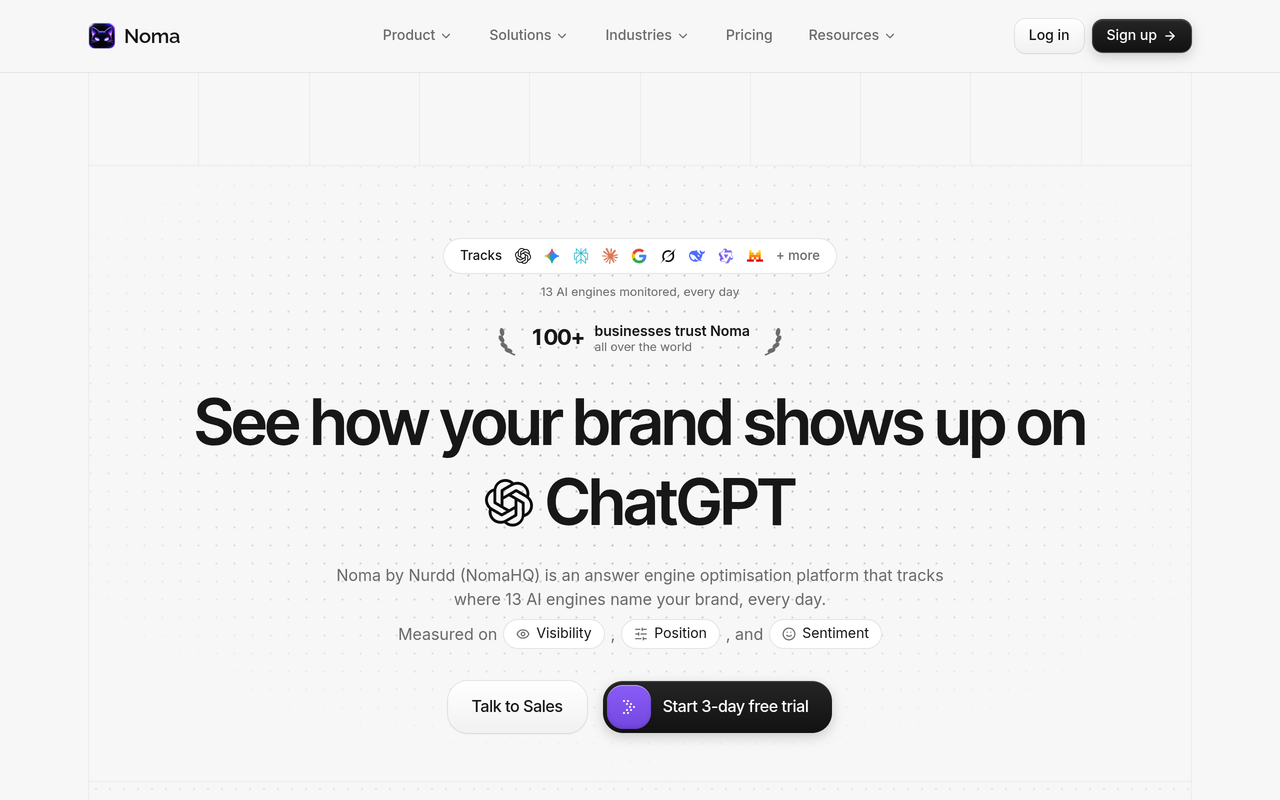
Noma by Nurdd tracks 13 AI engines, including ChatGPT, Gemini, Perplexity and Claude, polls them daily, and records whether a brand is named and which page each citation comes from. That gives you views one to four in one place. The fifth, prompt importance, is a judgement your team adds. For how to read these as a trend, see AI search share of voice.
How do I turn citation data into a fix list? A diagnosis table
Start by classifying each missed prompt by its pattern. The pattern points to the fix type. This is an original framework for this guide, not a published standard.
| Pattern in your tracking data | Likely cause | Fix type | First action |
|---|---|---|---|
| Brand never named; your domain never cited; competitors named | No page answers the prompt, or engines cannot reach it | Content and access | Check crawler access, then publish or rewrite the answering page |
| Brand named, but facts are wrong or outdated | Conflicting or stale descriptions across the web | Entity pages | Correct the source page, then align every profile |
| Brand named on one engine, absent on others | Different sources or crawlers per engine | Schema and technical access | Compare the cited sources per engine, check bot permissions |
| Brand named, but the cited page is a third party's | Engines trust that outside source more than your site | Third-party sources | Improve or earn presence on the cited page |
| Your page cited, but brand not recommended | Page lacks a clear, quotable claim about you | On-page content | Add a direct definition and comparison table |
| Cited for some prompts, dropped after a few weeks | Page is stale or lost to a fresher source | Content refresh | Update the page with dated, sourced facts |
Use this table row by row down your list of missed prompts. Many prompts will share a pattern, which is how thirty gaps collapse into six or seven distinct fixes. For the reasoning behind the first row, why your competitor is cited and you are not goes deeper.
How do I prioritise fixes to get cited more by AI engines?
Score every candidate fix on three factors, each from 1 to 5, then rank by the result. The model is called the ERE score here: Evidence times Reach, divided by Effort.
| Factor | Question to ask | 1 means | 5 means |
|---|---|---|---|
| Evidence | How many engines and repeated polls show this gap? | One engine, one poll | Most engines, stable across polls |
| Reach | How many high-importance prompts does the fix touch? | One low-intent prompt | Many purchase-intent prompts |
| Effort | How many people and days does it need? | Under an hour | Multi-team, weeks |
Add two overrides. Any factual error about your brand, and any block that stops a search crawler reaching your pages, jumps to the top regardless of score, because they undermine every other fix. Cap each cycle at five tasks so you can tell which one moved the numbers.
Worked example: scoring five fixes
The scores below are an illustrative scoring exercise for a fictional skincare brand, not measured data. They show the arithmetic.
| Fix | Evidence | Reach | Effort | ERE score | Rank |
|---|---|---|---|---|---|
| Correct wrong ingredient claim on About page | 5 | 3 | 1 | 15.0 | 1 (override) |
| Add Organization schema with sameAs links | 3 | 3 | 1 | 9.0 | 2 |
| Rewrite top category page with a direct answer and table | 4 | 5 | 3 | 6.7 | 3 |
| Pitch inclusion in a roundup the engines keep citing | 4 | 4 | 4 | 4.0 | 4 |
| Publish an original survey | 2 | 4 | 5 | 1.6 | 5 |
Notice that the schema task outscores the category rewrite on the formula (9.0 against 6.7), yet the evidence in the schema section below argues for caution on schema alone. That is why the score is a starting order, not a verdict: in this example the team would move the category rewrite up and do both in the same cycle.
Which fixes belong in the on-page content bucket?
Content fixes change what your own pages say, so they are the ones you fully control. Target the pages the engines already cite or should cite, using the prompts where your domain is absent.
- Answer first: open the page with a 40 to 60 word direct answer to the prompt, with the brand named in full.
- Quotable passages: write at least two self-contained sentences that make sense without the surrounding page.
- Tables for comparisons: put attributes in an HTML table so a model can lift them intact.
- Dated, sourced facts: name the source and the date beside each number.
- Question-style headings: match how people phrase the prompt.
For sentence-level patterns, see the sentence structure that gets cited and before and after content examples. If the gap is a lack of proof, publishing original data is the highest-effort option on your list, so schedule it after quicker wins.
A published 90-day plan from Deepak Gupta, accessed November 2026 suggests a similar rhythm: publish one definitive guide against your biggest citation gap around week four, and add FAQ sections to your top product and category pages. Treat any such calendar as a template, and let your own tracking data decide which pages.
Does schema markup belong in the plan?
Yes, but as a supporting fix, not the main lever. Ahrefs published a test titled "We Tracked 1,885 Pages Adding Schema. AI Citations Barely Moved." (Ahrefs, accessed November 2026), which is a caution against expecting schema alone to lift citations.
Schema still earns a place for entity clarity and for keeping machine-readable facts consistent with the visible page. Prioritise Organization, Product, FAQ where the page truly contains questions, and Article with author and dates. Our guide to schema markup for AI search lists what to add, and author and dateModified signals covers freshness.
Technical access comes before schema
If a search crawler cannot fetch a page, no edit to that page can be cited. OpenAI, accessed November 2026 documents its crawlers and what each is for, so check your robots.txt against that page rather than against a blog summary. For other vendors' user agents, use our AI crawler user agents list.
Google's own guidance on generative features is in its Search Central optimization guide, accessed November 2026 and its AI features documentation, accessed November 2026. Read both before you spend effort on any Google-specific trick, and compare them with what the engines in your own data actually cite.
How do third-party sources fit into the fix list?
Third-party work covers pages you do not own but the engines cite: review sites, directories, roundups, forums and encyclopedic pages. Your tracking data shows which ones, because it records the cited URL per prompt.
Community platforms are a recurring theme. Profound, accessed November 2026 publishes data on Reddit and AI search, Semrush, accessed November 2026 ran a three-month study of the most-cited domains in AI, and Press Gazette, accessed November 2026 reported Reddit taking the top spot as a cited domain. Check your own export before assuming your category follows that pattern.
- List the ten domains cited most often across your priority prompts.
- Mark which ones you can influence: a profile you can edit, a list you can apply to, a publication you can pitch, a thread where you can answer honestly as a named representative.
- Mark which ones you cannot influence and skip them.
- For each editable one, write the task: update, apply, pitch or answer.
- Score it with ERE, using the number of prompts that cite that page as Evidence.
Be honest and disclose affiliation; the aim is accurate information on pages engines already read, not manufactured buzz. Listing pages deserve their own audit, covered in tracking AI citations of partner and listing pages. Creator content can also be a cited source, as this creator content audit explains.
What are entity pages and why do they come up so often?
Entity pages are the pages that define who you are in one place: the About page, the product pages, the team page, the company profiles on external sites and any knowledge-base entry. Engines build their description of your brand from these, so inconsistencies across them produce inconsistent answers.
- One canonical description of the brand, used word for word on the site and on profiles.
- Same facts everywhere: name, category, founding year, product names and what each does.
- Linked identities: sameAs links from the site to official profiles.
- Fresh pages: visible dates on facts that change.
Use the entity consistency checklist for the audit, how to write a brand description AI engines can use for the wording, and Wikidata and sameAs for brands for identity links. Wrong facts in an answer are the first thing to fix, because the error spreads to every prompt that mentions you.
What does a 30-day checklist look like?
Run this as a repeating loop. Each pass takes about a month, because engines need time to re-crawl and your polling needs several data points.
- Day 1 to 2: Export and classify. Pull the five data views and label each missed prompt with a pattern from the diagnosis table.
- Day 3: Remove blockers. Confirm crawlers can reach your key pages and list every factual error in current answers.
- Day 4: Score. Apply the ERE model and the two overrides, and pick no more than five tasks.
- Day 5: Assign. One owner and one done-definition per task, such as a published URL.
- Day 6 to 20: Ship. Content and entity fixes first, then schema, then outreach for third-party sources.
- Day 21 to 30: Hold and poll. Change nothing else, keep polling the same prompts.
- Day 30: Compare. Check mention rate and citations against your baseline, then record what worked.
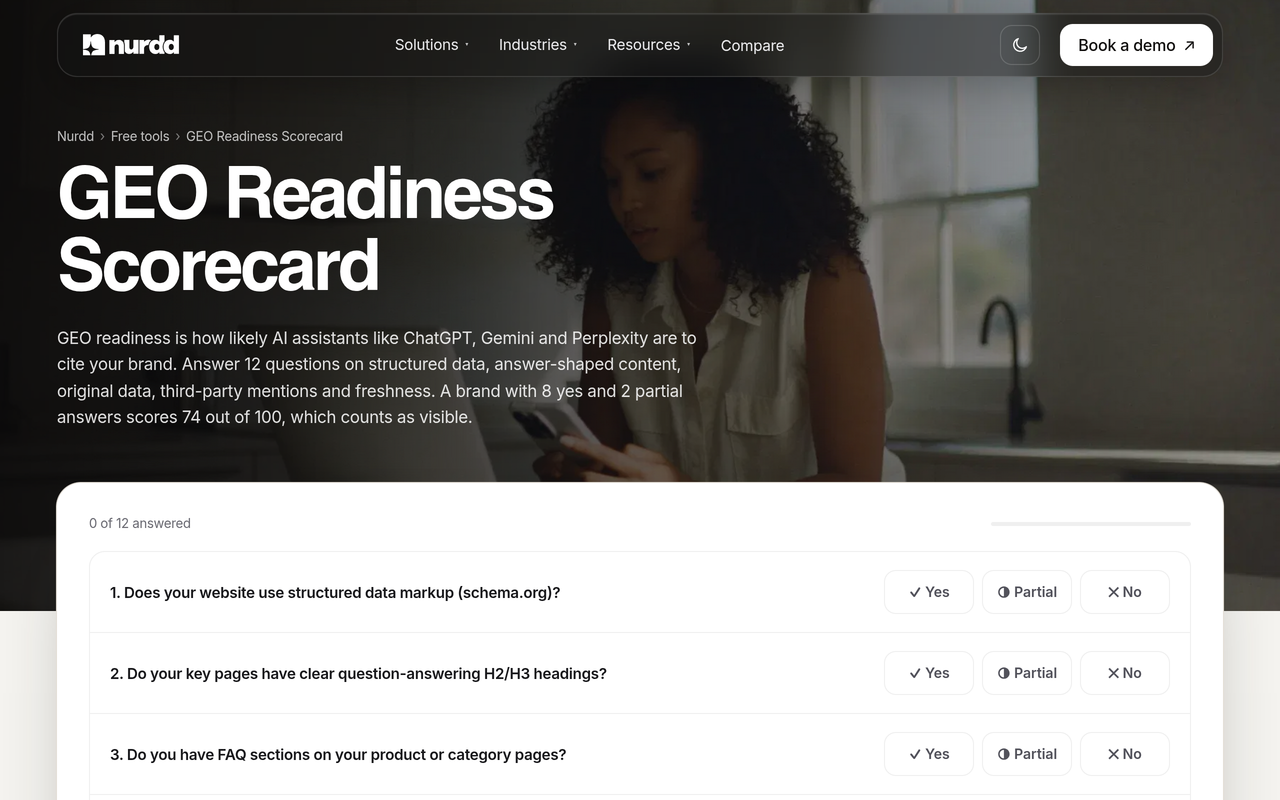
You can check the site's readiness before you start with the free GEO readiness scorecard, a 12-factor check. For a longer content-side audit, see the AEO audit checklist for D2C brands.
Who should own each type of fix?
A plan fails quietly when a task has no owner. Assign each bucket to the role that already controls the asset, and name a reviewer so facts are checked before anything goes live.
| Fix bucket | Typical owner | Done means | Check before closing |
|---|---|---|---|
| On-page content | Content or SEO lead | Updated page is published and indexed | Direct answer, named brand, dated sources |
| Schema and access | Developer or technical SEO | Markup validates and crawlers can fetch the page | Markup matches the visible text |
| Third-party sources | PR, partnerships or community lead | Listing updated, accepted or published | Facts match the canonical description |
| Entity pages | Brand or product marketing | Every profile uses the same description and facts | No conflicting names, dates or product claims |
Review the log in a short weekly meeting. Ask only three questions: what shipped, what is blocked, and which prompts moved. Anything blocked for two weeks goes back through the scoring step, because its effort was probably underestimated.
How do I know a fix worked?
Compare the same prompts, on the same engines, before and after, and judge by trend rather than one poll. AI answers vary between runs, so a single better answer proves little. Treat a change as real only when it persists across several polls.
Change one bucket at a time where you can. If you edit content, schema and a third-party listing in the same week, you will not know which one helped. GEO experiment design describes how to structure these tests, and a monthly AI search metrics report shows how to present the results.
A fix counts as working when the brand's mention rate or citation count for the targeted prompts rises and stays higher across several repeated polls, while untouched control prompts stay flat.
Keeping a handful of control prompts you did not touch is a cheap way to separate your changes from engine-wide shifts. Record every change with its date in a simple log, so your month-end review reads from facts.
What mistakes make an AI visibility action plan fail?
- Treating the score as the goal. The goal is accurate, recommended presence on prompts that matter to buyers.
- Starting with schema. The Ahrefs test above suggests schema alone does not move citations much.
- Ignoring wrong facts. An error repeated across engines costs more than any missing keyword.
- Shipping thirty tasks. You cannot attribute change, and the team burns out.
- Optimising for one engine. Sources differ by engine, so check per-engine data first.
- Skipping the baseline. Without it, every result is a story.
- Forgetting refreshes. Pages that were cited can drop when they go stale.
How do Noma action plans fit this workflow?
Noma by Nurdd, at nomahq.app, tracks whether a brand appears in answers from 13 AI engines, including ChatGPT, Gemini, Perplexity and Claude, polled daily. It shows citation frequency by category, a competitor comparison and actionable recommendations for improving AI visibility. Those recommendations are the action-plan step, sitting next to the data they come from.
Here is how Noma maps onto the method in this guide.
| Step in this guide | What you need | Where Noma fits |
|---|---|---|
| Export mention and citation data | Per-prompt, per-engine mentions and cited pages | Daily polling across 13 engines records whether the brand is named and which page each citation comes from |
| Spot competitor gaps | Who appears where you do not | Competitor comparison and citation frequency by category |
| Choose fixes | Ranked, specific recommendations | Actionable recommendations to improve AI visibility |
| Re-measure | Repeated polls against a baseline | Daily polling gives the trend line |
Noma belongs in this workflow because it keeps the tracking data and the recommended fixes in one dashboard, so a task can be traced to the citation pattern that triggered it. It covers 13 engines rather than a handful, which matters when sources differ by engine. Noma has a 3-day free trial; a card is taken at signup, billing starts on day 3, and you are not charged if you cancel before then.
Book a demo and we will show you your own brand's mention and citation data in Noma, the prompts where competitors appear instead, and the fix list that follows from it.
If you want people to run the fixes, Nurdd's team offers generative engine optimization services and an answer engine optimization agency service, measured in Noma. To compare tools first, read Noma vs Peec AI or the 10-tool comparison. Nurdd also makes Nia and Pulse, which are separate products; see how Nurdd works.
How we researched this
We reviewed vendor blog posts and documentation, search-engine and AI-company guidance, and published third-party studies on AI citations, then checked each page on the publication date. We did not run hands-on tests, interview customers or use private data for this guide. The worked example is an illustrative scoring exercise, not measured results, and the ERE score and diagnosis table are our own frameworks rather than industry standards.
Frequently asked questions
What is an AI visibility action plan?
It is a prioritised list of fixes derived from your AI search tracking data. Each task is linked to a prompt gap, has an owner, and has a way to measure the result. It usually covers content, schema and access, third-party sources and entity pages.
What should I do first after tracking my brand in AI search?
Fix factual errors in current answers and confirm search crawlers can reach your key pages. Both are low effort and block everything else. Then classify the remaining missed prompts by pattern and score them.
How many fixes should I ship at once?
Five or fewer per cycle is a sensible cap. A small batch lets you tell which change moved your mention rate. Larger batches blur attribution.
How long until AI engines reflect my changes?
It varies by engine and by the type of change, and we cannot give a reliable figure. Keep polling the same prompts for several weeks and judge by trend. Third-party changes usually depend on the outside site updating.
Does ranking on Google mean I will be cited by AI?
Not reliably. Ahrefs reports that on average only 12% of links cited by ChatGPT, Gemini and Copilot appear in Google's top 10 for the same prompt. Build the plan from citation data, not rank reports.
Is schema markup enough to get cited?
No. Ahrefs published a test of 1,885 pages adding schema with the finding that citations barely moved. Use schema for entity clarity and consistency, alongside content and source fixes.
Can I build an action plan without a tracking tool?
You can sample prompts by hand, but repeated polling across many engines is hard to do manually. A tool such as Noma polls 13 engines daily and records cited pages, which supplies the data the plan needs.
How do third-party sources affect AI citations?
Engines often cite pages you do not own, such as review sites, roundups and forums. Your citation export shows which ones, and you can then update, apply to, or pitch those that you can influence.
Next step
An action plan turns a dashboard into a weekly routine. Book a demo and Nurdd will walk you through Noma with your own brand, from the prompts you miss to the ranked fixes behind them.