AI Search Visibility
Scrunch AI Review: What to Check Before You Buy
A factual Scrunch AI review: what Scrunch says it does, the coverage, prompt and reporting questions to ask, and how Noma's 13 engines compare.
 Simran Rawat30 Oct 202615 min read

Whether Scrunch AI is worth it depends on which AI engines your plan covers, how prompts are counted and how reporting reaches stakeholders. Scrunch's own pages describe eight or nine engines depending on the page, and one third-party breakdown says its Core plans cover four. Noma by Nurdd tracks 13 AI engines, including ChatGPT, Gemini, Perplexity and Claude, polled daily, which suits teams that want broad tracking.
Whether Scrunch AI is worth it comes down to what your plan actually covers: which AI engines, how prompts are metered and how reporting reaches people who never log in. This Scrunch AI review sets out what Scrunch says publicly, then lists the questions to ask about engine coverage, prompts, pricing and reporting before you sign.
It is written for marketing teams comparing AI search visibility tools. Every Scrunch fact below comes from Scrunch's own pages or from named third-party publishers, linked inline, and was checked on 30 October 2026.
Key takeaways
- Scrunch's own pages disagree on engine count: its help center says nine platforms, its FAQ says eight, and a third-party pricing breakdown says Core plans cover four.
- Ask how prompts are counted before you buy. One competitor review says each engine you track consumes custom prompts, which shrinks your usable list.
- Check reporting early: whether you can export, schedule or share dashboards with stakeholders who never log in.
- Scrunch publishes its own tiers (Explorer, Growth, Enterprise) and describes a 7-day free trial. Confirm the trial's plan and limits at signup.
- Noma by Nurdd tracks 13 AI engines, including ChatGPT, Gemini, Perplexity and Claude, polled daily, which suits teams that want wide coverage in one dashboard.
- Test any tool with a trial and your own 25 to 40 prompts before committing to an annual plan.
What is Scrunch AI and how does it position itself?
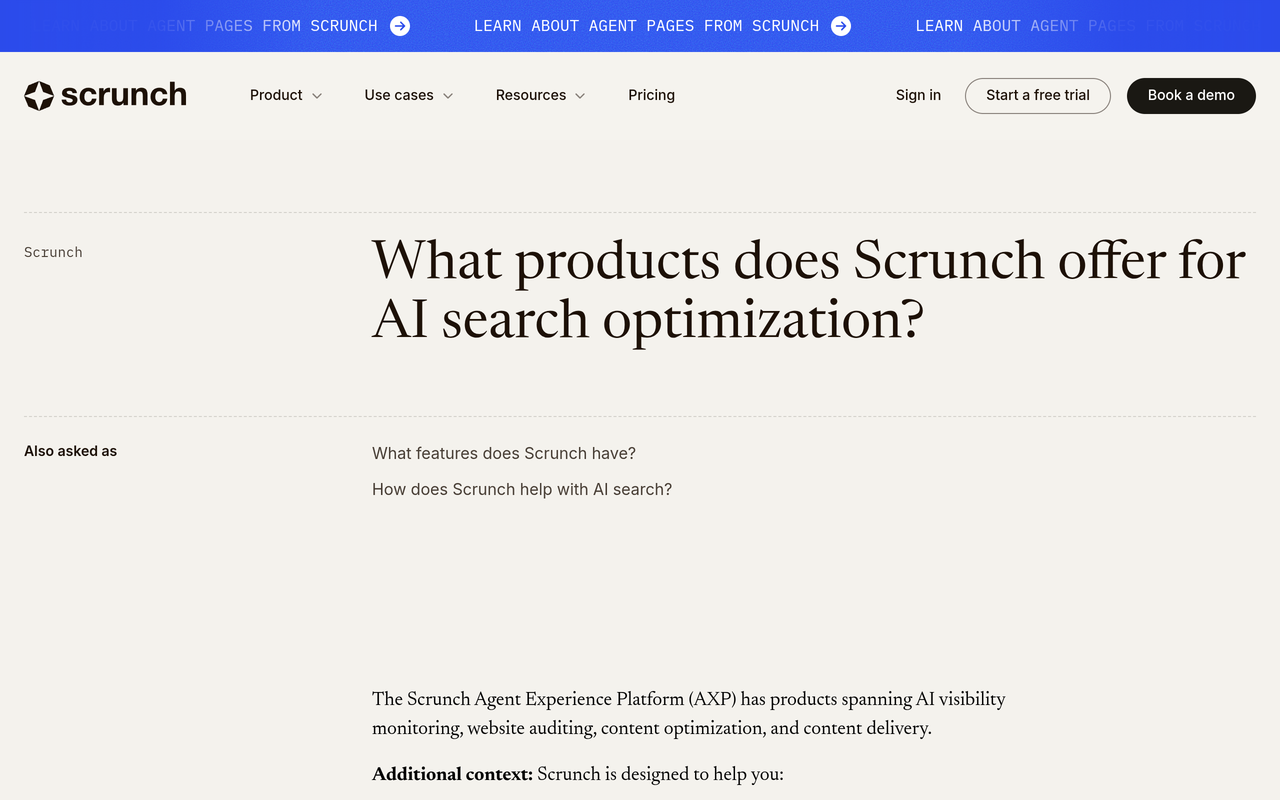
Scrunch describes itself on its homepage as a platform to monitor brand presence in AI search, analyse and optimise a website, and deliver content directly to AI agents through its Agent Experience Platform (AXP). The same page says it is trusted by 500+ companies and agencies. That is a vendor claim, so treat it as positioning rather than proof of fit.
Scrunch's product FAQ lists four core products: monitoring, auditing, optimisation and content delivery through AXP. Monitoring covers brand and competitor presence, position, sentiment and citations, plus AI search volume, AI bot traffic and AI referral traffic.
Two context points matter for a buyer. First, Scrunch's own tools page says it was founded in 2023 and emerged from stealth in 2024. Second, Trakkr, September 2026, reports that Sitecore acquired Scrunch in June 2026 and that the deal value was not confirmed. Sitecore's AI search page now describes Sitecore and Scrunch as combining AI visibility monitoring with agent traffic intelligence and AI-native content delivery.
Is Scrunch AI worth it? The criteria that decide it
Whether Scrunch AI is worth it depends on four things, not on a star rating: how many engines your plan really covers, how prompts are metered, how reporting reaches people who do not log in, and whether you need the extra agent-delivery layer. A tool can be strong on features and still poor value if your plan covers the wrong engines.
Use this evaluation grid for any AI visibility tool, Scrunch included.
| Criterion | What to ask | Why it matters |
|---|---|---|
| Engine coverage | Which engines are on my plan, not on the platform? | Visibility in an engine you do not track is invisible to you |
| Prompt metering | Does one prompt tracked on several engines count once, or once per engine? | Changes your real prompt budget |
| Refresh frequency | How often is each prompt re-run? | Weekly data slows decisions |
| Reporting | Can I export, schedule and share without seats? | Stakeholders rarely log in |
| Recommendations | Does it say what to change on which page? | Monitoring alone does not improve visibility |
| Total cost | What do extra seats, brands and countries cost? | Entry price is rarely the real price |
The rest of this post applies the grid to Scrunch using public evidence.
How many AI engines does Scrunch track?
Scrunch's own pages give different engine counts, so the answer depends on which page and which plan you read. The Scrunch Help Center, September 2026, says it monitors nine platforms: ChatGPT, Perplexity, Google AI Overview, Google AI Mode, Gemini, Claude, Copilot, Grok and Meta AI. The Scrunch FAQ lists eight and says Grok support is coming soon.
The help center also carries two caveats worth reading closely. It says Grok no longer contributes citation data, and it says platform availability may vary by subscription tier. That second note links to the plan question.
| Source | What it says about engine coverage | Date checked |
|---|---|---|
| Scrunch Help Center | Nine platforms; availability may vary by tier; Grok supplies no citation data | 30 Oct 2026 (article dated 4 Sep 2026) |
| Scrunch FAQ | Eight platforms; Grok coming soon | 30 Oct 2026 |
| seoClarity analysis | Brand Core and Agency Core cover four AI platforms; nine on Enterprise | 30 Oct 2026 (seoClarity checked 29 Sep 2026) |
| Noma by Nurdd | 13 AI engines, including ChatGPT, Gemini, Perplexity and Claude, polled daily | 30 Oct 2026 |
The four-platform figure comes from seoClarity, September 2026, which says the full platform list, unlimited countries and API access sit on custom-priced Enterprise plans. seoClarity sells competing enterprise software and names plans differently from Scrunch's own FAQ, so confirm the figure with Scrunch. If it holds for the plan you buy, you would see fewer engines than the nine headline number suggests. See Noma vs seoClarity.
The buyer question is simple: ask Scrunch to name, in writing, the engines enabled on the exact plan you would buy. Then compare that list with where your customers ask questions. Our guide to Perplexity vs ChatGPT vs Gemini explains why engines surface different brands for the same question.
How do Scrunch's prompts and credits work?
Scrunch lets you choose which platforms to track per prompt: one, a custom selection or all available. The Scrunch FAQ also says it collects responses using browser automation and official platform APIs, keeping the answer and citations each platform returned at query time.
The metering is where buyers get caught. A Profound blog review of Scrunch (Profound is a direct competitor) says that each AI engine you track counts toward your custom prompts, so you may have fewer to work with than the headline number suggests. It also says Scrunch does not publish prompt volume data for most prompts. Profound states these as its own findings, so verify both in a trial.
Worked example: what a prompt budget means on a four-engine plan
The seoClarity breakdown lists Brand Core at 125 unique prompts, 5,000 responses per month and four AI platforms. Here is the arithmetic, which is ours and illustrative.
- 125 unique prompts across 4 platforms gives 500 prompt-and-platform pairs.
- 5,000 responses per month divided by 500 pairs gives 10 responses per pair per month.
- If a pair were run on a fixed schedule, that is roughly one run every three days, not daily.
That is a ceiling, not a measured Scrunch schedule, and Scrunch may allocate responses differently. The point is that prompts, platforms and response caps interact. Ask for the refresh rate per prompt on your plan. For a starting list size, Semrush's guidance suggests around 25 prompts when starting out. Our own guide to which prompts to track shows how to split them between awareness, consideration and brand evaluation.
What does Scrunch reporting look like?
Scrunch reports brand presence, position, sentiment, citations and competitor presence per platform, and lets you filter by platform in its Home, Prompts Monitoring and Citations views. Its homepage also lists benchmarking by competitor, persona, topic and geography.
The open question is how that data leaves the tool. The way to settle it is to ask Scrunch for a sample client-ready report and check four things:
- Can you schedule a PDF or dashboard link to people without seats?
- Can you export prompt-level data to a spreadsheet or BI tool?
- Is there a trend chart for share of mentions over time?
- Does it tie each gap to a specific page or action?
Reporting matters because AI visibility only becomes a budget line when a non-specialist can read it. Our walkthrough of AI search share of voice shows a metric that is easy to explain upward, and tracking an AI visibility score week over week covers the trend view.
Do you need Scrunch's Agent Experience Platform?
Only if you intend to control what AI bots see on your site. The Scrunch Help Center describes AXP as a parallel, AI-optimised version of your site served to AI agents while human visitors keep the existing experience. Its tools page adds that teams can block, redirect or strip scripts per path and compare what bots receive against the human page.
Scrunch's Agent Traffic feature reads CDN and hosting data, with integrations the FAQ names as Akamai, AWS CloudFront, Cloudflare, Fastly, Vercel and WordPress. AI Referrals then uses GA4 to attribute sessions, conversions and revenue from AI platforms.
That is scope beyond monitoring, and it sits inside what you pay for. Trakkr, September 2026, notes that smaller teams may not need AXP, personas, audits and traffic monitoring together. If your main question is whether ChatGPT, Gemini or Perplexity recommend your brand, a focused monitoring tool answers it without the extra layer. For the content side, see how to write website content AI engines quote.
How much does Scrunch AI cost?
Scrunch publishes its own tiers. Its products FAQ lists Explorer at $83 a month billed annually, Growth at $417 a month billed annually, and Enterprise as custom. Confirm current figures and what each tier includes before budgeting.
Third-party breakdowns quote higher figures, but for differently named plans: seoClarity lists Brand Core at $250 per brand per month, and Otterly and Profound list a Starter plan at $300 a month. These do not map cleanly to Scrunch's own tier names, which suggests packaging has changed.
| Source (as published) | Entry plan | Higher plan | Limits mentioned |
|---|---|---|---|
| Scrunch products FAQ | Explorer, $83 a month billed annually | Growth $417 a month billed annually; Enterprise custom | 7-day free trial described, on the Explorer plan per the FAQ |
| seoClarity (third party), checked 29 Sep 2026 | Brand Core, $250 per brand per month | Agency Core $500 a month; Enterprise custom | 125 unique prompts, 5,000 responses a month, 4 platforms, 1 country (Brand Core) |
| Otterly.ai (third party), October 2026 | Starter $300 monthly, $250 billed annually | Growth $500; Enterprise on quote | 350 custom prompts on Starter, 700 on Growth; $25 per extra seat |
| Profound blog (third party), accessed Oct 2026 | Starter from $300 per month | Not stated | 1,000 industry prompts and 350 custom prompts on Starter |
| Noma by Nurdd | 3-day free trial; card taken at signup; billing starts on day 3; no charge if cancelled before | See nomahq.app | 13 AI engines polled daily |
Otterly and Profound sell competing tools, so treat their figures as prompts for questions, not a quote. All prices are in USD.
Scrunch AI vs Noma: how do they compare?
Scrunch and Noma by Nurdd overlap on monitoring brand presence in AI answers. The difference is focus: Noma is a dashboard built around wide engine coverage, daily polling and recommendations, with 13 AI engines tracked.
| Feature | Scrunch | Noma by Nurdd |
|---|---|---|
| Engines tracked | Eight or nine per Scrunch's own pages; four on Core plans per seoClarity | 13 AI engines, including ChatGPT, Gemini, Perplexity and Claude |
| Refresh | Not stated on the pages reviewed | Polled daily |
| Citation tracking | Yes, per platform | Citation frequency by category |
| Competitor comparison | Yes, up to 5 competitors on Core per seoClarity | Yes |
| Recommendations | Auditing and optimisation tools | Actionable recommendations to improve AI visibility |
| Trial | 7-day free trial described on Scrunch's pages; confirm plan and limits at signup | 3-day free trial; card taken at signup; no charge if cancelled before day 3 |
For teams that need to know where their brand appears across many engines, the rows that matter most are coverage and refresh, and Noma by Nurdd is built for both. For a side-by-side with more detail see Noma vs Scrunch, and for the wider field our comparison of AI search visibility tools.
Why does Noma suit teams that want broad AI engine tracking?
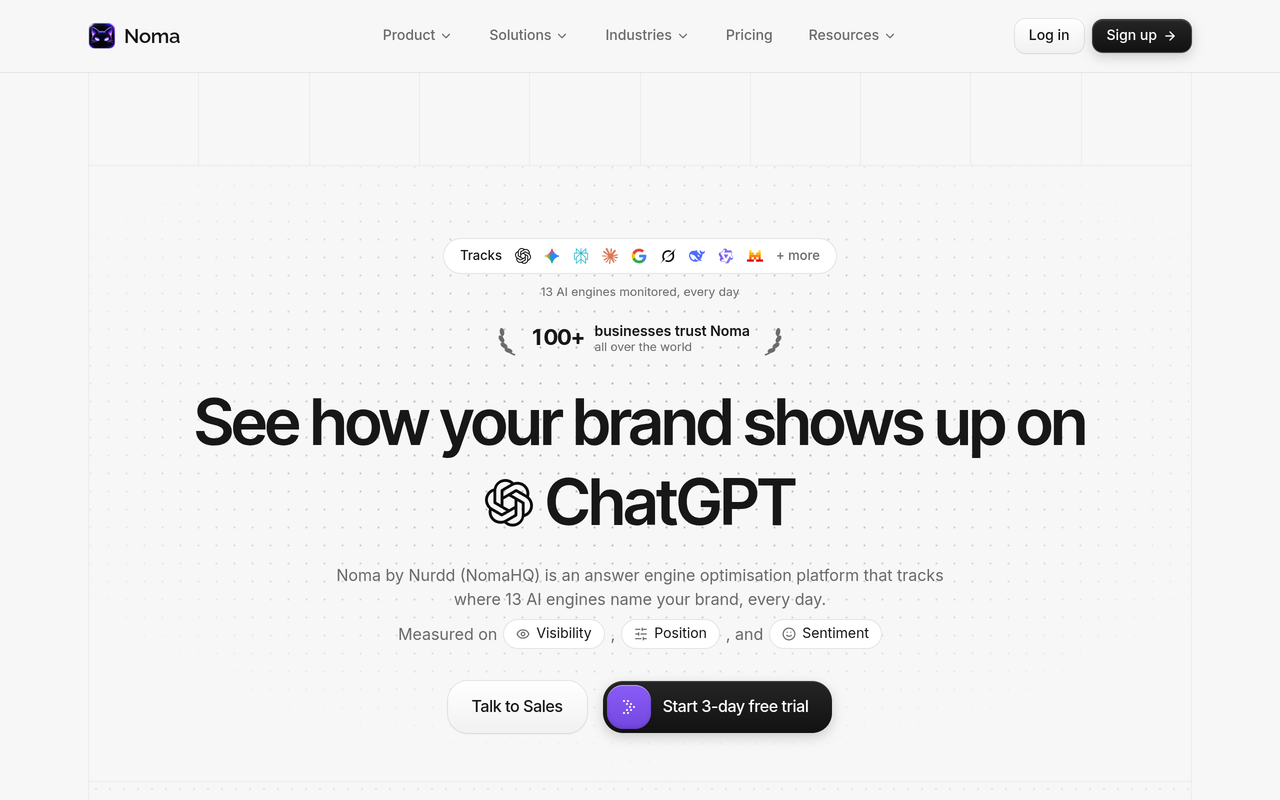
Noma by Nurdd suits teams that want broad tracking because it monitors 13 AI engines, including ChatGPT, Gemini, Perplexity and Claude, polled daily, in one web dashboard. Wider coverage means fewer blind spots: an engine you do not track is one where a competitor can be recommended and you never find out.
Noma by Nurdd is a web dashboard that shows whether a brand appears in AI engine answers, how often it is cited by category, how it compares with competitors, and what to change to improve AI visibility. It is one of three separate Nurdd products, alongside Nia and Pulse, and it has no dependency on either.
Book a demo at nurdd.club/demo and we will walk through Noma using your own brand and category, so you see which engines mention you and which competitors they name instead.
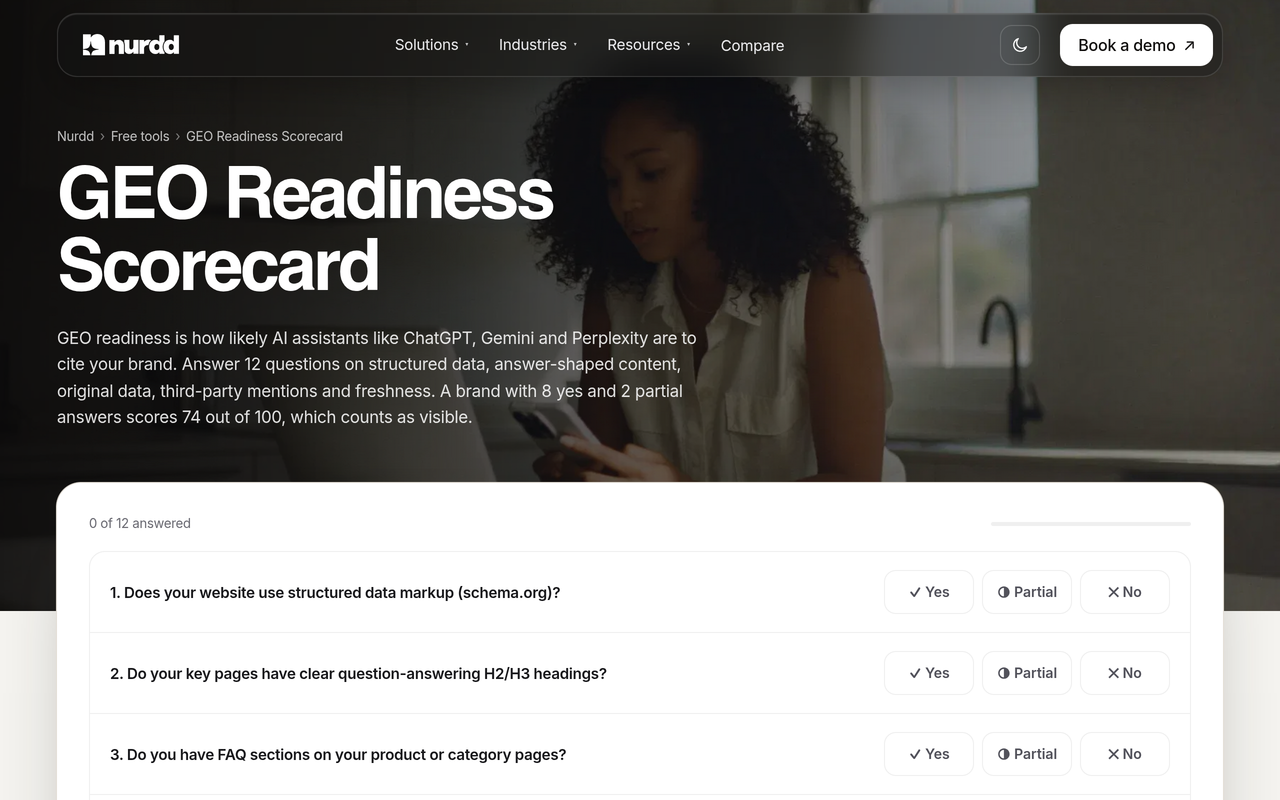
You can also start with a free self-check: the GEO readiness scorecard is a 12-factor check of how ready your site is for AI answers.
Which AI visibility tool fits which buyer?
Match the tool to the job rather than to the longest feature list. This decision table is our original framework, built from the public evidence above.
| If your main need is... | Weigh this | Likely fit |
|---|---|---|
| Wide visibility across many engines for a brand or category | Engine count on your plan, daily refresh | Noma by Nurdd |
| Knowing which engines mention a competitor and not you | Competitor comparison, citation frequency by category | Noma by Nurdd |
| Enterprise SEO suite with AI tracking attached | Existing contract and seats | See Noma vs Semrush and Noma vs Ahrefs |
| Heavy per-prompt reporting for agency clients | Seats, pitch environments, export | Ask each vendor for a sample report |
| Cheapest possible entry | Prompt caps, engines on the cheapest plan | Compare trial terms and caps |
Checklist: 10 questions to ask Scrunch before you buy
Send these in writing and keep the replies. Anything a vendor will not answer before you pay is unlikely to get easier afterwards.
- Which exact AI engines are enabled on the plan I would buy?
- Does Grok, or any engine, return citation data on my plan?
- Does tracking one prompt on several engines use one prompt, or one per engine?
- How often is each prompt re-run, and can I change that?
- How many responses per month are included, and what happens at the cap?
- What do extra seats, brands, competitors and countries cost?
- Can I export prompt-level data and schedule reports for non-users?
- Does the tool say which page to change to close a gap?
- How is the product changing after the Sitecore acquisition, and will pricing or packaging change?
- Which plan does the 7-day trial cover, what are its limits, and what are the cancellation terms?
Then run a fixed test: load the same 25 to 40 prompts into each tool during its trial, wait for one full refresh cycle, and compare how many of your brand mentions each tool catches. Our AEO audit checklist is a good starting list.

What are the alternatives to Scrunch AI for AI search tracking?
The main alternatives are Noma, Profound, Peec AI, AthenaHQ and the AI modules inside SEO suites. The right one depends on engine coverage, prompt limits, refresh rate and reporting. See Noma vs Peec AI.
- Noma by Nurdd: 13 engines, daily polling, recommendations. See Noma vs Scrunch.
- Profound: see Noma vs Profound.
- Peec AI: see Peec AI alternatives and Profound vs Peec AI.
- AthenaHQ: see Noma vs AthenaHQ.
- SEO suites: covered in Noma vs traditional SEO tools.
What are the common mistakes when buying an AI visibility tool?
- Buying on the platform list, not the plan list. Scrunch's help center says availability may vary by tier, so the headline count may not be what you get.
- Ignoring prompt metering. A prompt budget that multiplies by engine can run out faster than expected.
- Skipping the reporting test. If stakeholders cannot read the output, the data will not change budgets.
- Paying for features you will not use. Agent delivery and bot analytics matter to technical teams, not to every marketer.
- Judging from one run. AI answers vary, so give any tool at least one full refresh cycle. Our weekly ChatGPT tracking experiment shows how much answers move.
What should you do after you choose a tool?
Monitoring only shows the gap. Closing it means fixing the pages AI engines read. Start with your brand description, which our post on entity definition for AI search explains, then your FAQ content, then structured data. If a competitor keeps winning, read why your competitor is getting cited. For ChatGPT specifically, see how to get ChatGPT to recommend your brand.
Verdict: is Scrunch AI worth it?
Scrunch's public record shows inconsistent engine counts and packaging that third parties describe differently from Scrunch's own FAQ. Whatever you choose, verify in writing which engines are enabled on the exact plan you would buy.
For teams whose priority is knowing where their brand appears across the widest set of AI engines, Noma by Nurdd is the stronger fit: 13 AI engines polled daily, citation frequency by category, competitor comparison and actionable recommendations in one dashboard. See Noma against your own brand at nurdd.club/demo, or read more on what generative engine optimisation is.
How we researched this
We reviewed Scrunch's own help center, FAQ and product pages, a Sitecore page, third-party pricing breakdowns, competitor blog reviews and published guidance on prompt selection. We checked them on 30 October 2026 and linked each claim to its source. We did not run hands-on tests of Scrunch, speak to its customers or use private data.
Where sources disagreed, such as engine counts and plan names, we showed both rather than choosing one. Pricing reported by competitors may be out of date, so confirm it with Scrunch directly. Noma facts come from Nurdd's own product information.
Compare Noma with: Noma vs AirOps, Noma vs Clearscope and Noma vs Conductor.
Frequently asked questions
Is Scrunch AI worth it?
It depends on whether your plan covers the engines your buyers use and whether its metering and reporting suit your team. Scrunch's own FAQ lists Explorer at $83 a month billed annually and Growth at $417 a month billed annually, so confirm what each includes. Test it with your own prompts during the trial before committing to annual billing.
What are alternatives to Scrunch AI for AI search tracking?
Common alternatives include Noma by Nurdd, Profound, Peec AI, AthenaHQ and AI modules in SEO suites such as Semrush and Ahrefs. Compare them on engine coverage per plan, prompt metering, refresh rate and reporting. Noma tracks 13 AI engines, including ChatGPT, Gemini, Perplexity and Claude.
How many AI engines does Scrunch track?
Scrunch's help center says nine platforms and its FAQ says eight, with Grok marked as coming soon. seoClarity reports that Core plans cover four platforms and the full list sits on Enterprise. Ask Scrunch to confirm the engines on your specific plan in writing.
How much does Scrunch AI cost?
Scrunch's products FAQ lists Explorer at $83 a month billed annually, Growth at $417 a month billed annually, and Enterprise as custom. Third parties quote $250 to $300 a month, but for differently named plans such as Brand Core and Starter. Check Scrunch's own pages for current figures.
Who owns Scrunch AI?
Trakkr reports that Sitecore acquired Scrunch in June 2026, and Sitecore's AI search page now presents Sitecore and Scrunch together. If you are buying, ask how the acquisition affects packaging, support and the product roadmap.
Does Scrunch AI have a free trial?
Scrunch's own pages describe a 7-day free trial, and its products FAQ says the trial is of the Explorer plan. Confirm the plan and limits at signup. Noma by Nurdd offers a 3-day free trial; a card is taken at signup and billing starts on day 3, with no charge if you cancel before then.
How many prompts should I track for AI visibility?
Semrush suggests around 25 prompts to start. Begin small, cluster prompts by intent and expand once you see which ones show real variation between engines.
Can I see how Noma tracks my brand before buying?
Yes. Book a demo at nurdd.club/demo and you will see Noma's view of your own brand: which of the 13 AI engines mention you, how you compare with competitors, and the recommended next steps.