AI Search Visibility
AI Search Glossary for Marketers: GEO, AEO and LLMO Terms
A plain-language AI search glossary: GEO, AEO, LLMO, citation share and 25 more terms, each with the metric to track and the trap to avoid.
 Simran Rawat1 Nov 202616 min read

GEO, AEO and LLMO are three names for one job: getting your brand mentioned and cited in AI-generated answers. GEO leans on generative synthesis, AEO on being the direct answer, and LLMO on how language models understand your brand. Citation share is your domain's portion of all sources cited across a set of tracked answers, so define the denominator before comparing any two tools.
An AI search glossary should do more than define words: it should tell you what to measure for each one. GEO, AEO and LLMO are three labels for one job, which is earning mentions and citations in answers written by ChatGPT, Gemini, Perplexity, Claude and Google's AI features. The real differences show up in the metrics, because vendors use the same label for different calculations.
This glossary covers the terms buyers meet when they evaluate AI search tools. Each entry gives a plain definition, what to measure, and the trap to watch for. It is written for marketers who need to read a vendor dashboard without being misled by it.
Key takeaways
- GEO, AEO and LLMO overlap heavily. Pick one label for internal use and spend your effort on the metrics, not the naming.
- Ask every vendor for the formula behind "visibility score" and "share of voice". The same label can hide different denominators.
- Track presence rate (are you mentioned at all) before position or sentiment. It is the hardest number to game.
- Citation share can be read at domain level or page level, and the two give very different numbers.
- Monitor several engines. Each one retrieves and cites sources its own way, so one engine's result does not predict another's.
- Pair any third-party tracker with Google's own Search Console report for Google's AI features.
What is the difference between GEO, AEO and LLMO?
GEO (generative engine optimization), AEO (answer engine optimization) and LLMO (large language model optimization) all describe improving how often AI systems mention or cite your brand. They differ mainly in emphasis: AEO focuses on being the chosen direct answer, GEO on being included in a synthesized response, and LLMO on how models represent your brand and entities. In practice the work overlaps almost entirely.
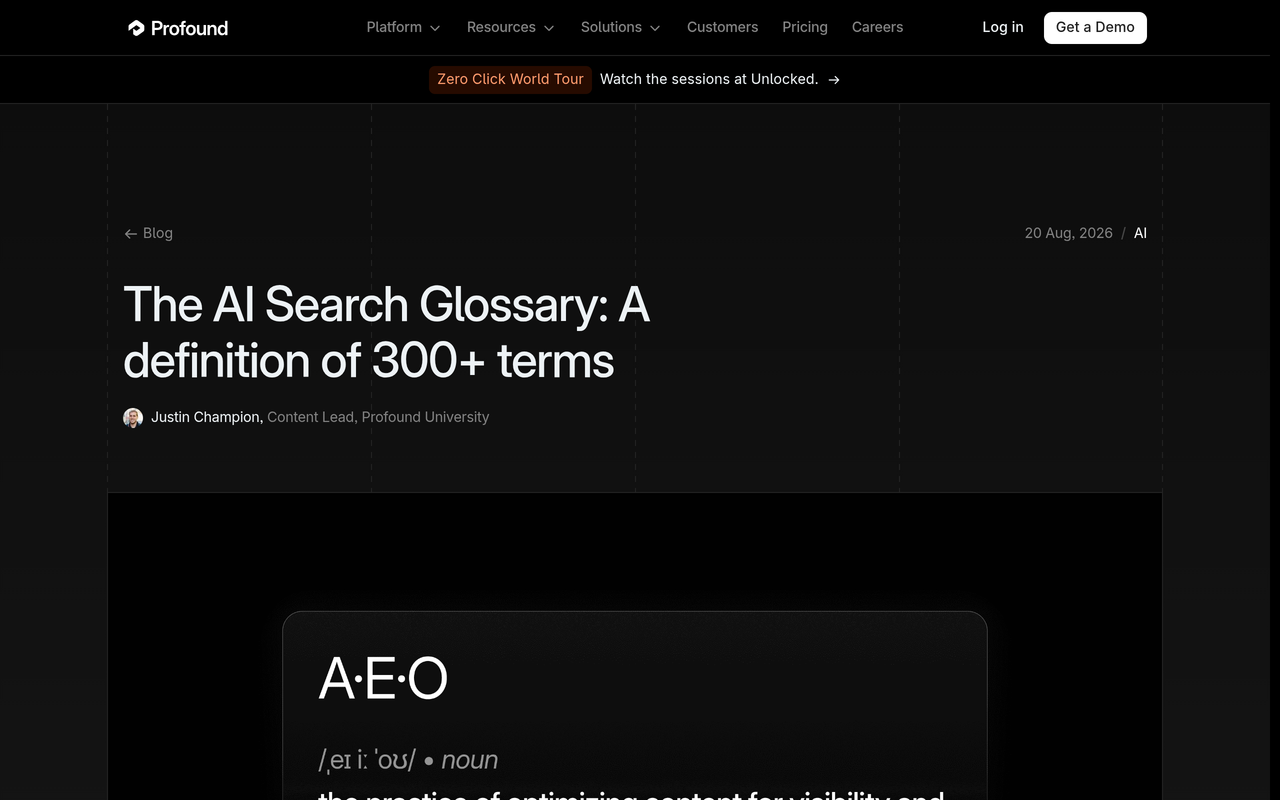
The glossary from Animalz, 2026 describes GEO as an academic term from a 2023 research paper and says it is largely interchangeable with AEO in practice. Profound's glossary calls LLMO another synonym for AEO, favoured by people who want to name the technology rather than the interface. Onsomble draws a finer line, tying LLMO to model-facing brand and entity clarity.
Research by Onely reached a similar conclusion after asking several AI engines to define the four terms: they are four names for one change, and the engines disagree about which label fits which. That disagreement is the strongest argument for not building a strategy around the label.
| Term | Plain meaning | Typical emphasis | What to measure |
|---|---|---|---|
| SEO | Earning rankings and clicks in a search index | Blue links | Rankings, clicks, impressions |
| AEO | Being chosen as the direct answer | Answer selection | Presence rate, citation rate |
| GEO | Being included in a generated, synthesized response | Inclusion in synthesis | Mentions, citation share, share of voice |
| LLMO | Being understood correctly by language models | Brand and entity clarity | Accuracy of descriptions, sentiment, attributes |
| AI SEO | Umbrella phrase, sometimes also meaning "using AI for SEO work" | Ambiguous | Define it before you buy against it |
A practical rule: use GEO or AEO in public content, because those are the terms people search, and keep a one-line definition on hand for stakeholders. If a vendor's pitch relies on a distinction between the three, ask which metric changes because of it. If none does, the distinction is branding.
How do the core metrics work in plain language?
Most buying confusion comes from five measurement terms that sound alike. Settle these first and the rest of the glossary becomes easier to read.
What does citation share mean in AI search?
Citation share is the proportion of all citations, across a set of tracked AI answers, that point to your domain or page. Profound, 2026 defines it as how often a specific page or domain is cited as a proportion of all citations, and notes that it can be read at page or domain level, which changes the number substantially.
Citation share differs from a mention. An AI answer can name your brand without linking you, or link you without naming you. 5W Public Relations separates AI share of voice, citation share and AI visibility rate as three distinct measures, each answering a different question.
What to measure: the count of citations to your domain divided by total citations in the same answer set. Record the prompt set, the engines and the date alongside it.
What is presence rate (or visibility rate)?
Presence rate is the share of tracked responses in which your brand appears at least once. Profound's glossary calls it the cleanest and least manipulable visibility metric. It ignores position and tone, which is its strength: it answers only whether you are in the conversation.
What to measure: responses that mention your brand divided by total responses tracked, per engine and per prompt group.
What is AI share of voice?
AI share of voice is your share of brand mentions compared with the competitors you track. LLM Pulse states it as your brand mentions divided by total mentions across your brand and selected competitors. Conductor frames the same idea as how often you are mentioned or cited compared with competitors.
The catch is the competitor set. Add or remove one rival and your share moves without anything changing in the market. Always fix the list before you compare periods.
What is a visibility score?
A visibility score is a single number summarising how findable you are across tracked prompts. Profound's glossary points out that one vendor may define it as the share of answers that mention you, while others blend presence, position and prominence. The label alone tells you nothing, so request the formula.
What is citation rate?
Citation rate is the percentage of relevant AI answers that cite your domain or page as a source. Animalz calls it the core AEO performance metric and the closest equivalent of ranking position. It uses the number of answers as the denominator, whereas citation share uses the number of citations. That difference is why two tools can report different figures for the same brand.
| Metric | Numerator | Denominator | Question it answers |
|---|---|---|---|
| Presence rate | Answers that mention your brand | All tracked answers | Are we in the conversation? |
| Citation rate | Answers that cite your domain | All tracked answers | How often are we a source? |
| Citation share | Citations to your domain | All citations in the set | How much of the source pool do we own? |
| AI share of voice | Your brand mentions | Mentions of you plus tracked competitors | Who is recommended more often? |
| Visibility score | Vendor-defined | Vendor-defined | Check the formula first |
Nurdd's own guide to AI search share of voice walks through the calculation in more depth, and the piece on tracking a visibility score week over week covers cadence.
Which terms describe how AI engines find and use content?
These terms explain why a page is or is not cited. They are mechanism words, and each one suggests something concrete to check on your own site.
| Term | Plain definition | What to check or measure |
|---|---|---|
| Answer engine | A system that returns a composed answer rather than a list of links | Which engines your buyers use; track each separately |
| Generative engine | The term used in the 2023 GEO research paper for LLM-based search | Same as above; mostly academic usage |
| Grounding | Anchoring an answer in real source material instead of model memory | Whether your claims are stated plainly enough to be sourced |
| Retrieval-augmented generation (RAG) | Fetching documents first, then writing an answer from them | Crawlability and passage clarity |
| Query fan-out | Expanding one prompt into several background searches | Whether you have a page for each sub-question |
| Passage retrieval / chunking | Selecting short passages, not whole pages | Whether each section stands alone when quoted |
| Entity | A distinct thing a model can recognise: a brand, product or person | Consistent name, description and attributes across the web |
| Hallucination | A confident answer that is wrong | Errors about your brand in tracked answers |
On grounding and fan-out, Animalz explains that each sub-query is a separate chance for your content to be selected, which is why broad topical coverage helps. Profound adds that query fan-out is terminology Google itself documents, and that the phrase does not appear in the patents it is often attributed to.
What does Google say about its own AI features?
Google's guidance for site owners states that the same foundational SEO practices apply to AI Overviews and AI Mode: meet the technical requirements, follow Search policies, and create helpful, reliable content. Its AI features and your website page is the primary source for this, and it is worth reading before any vendor pitch.
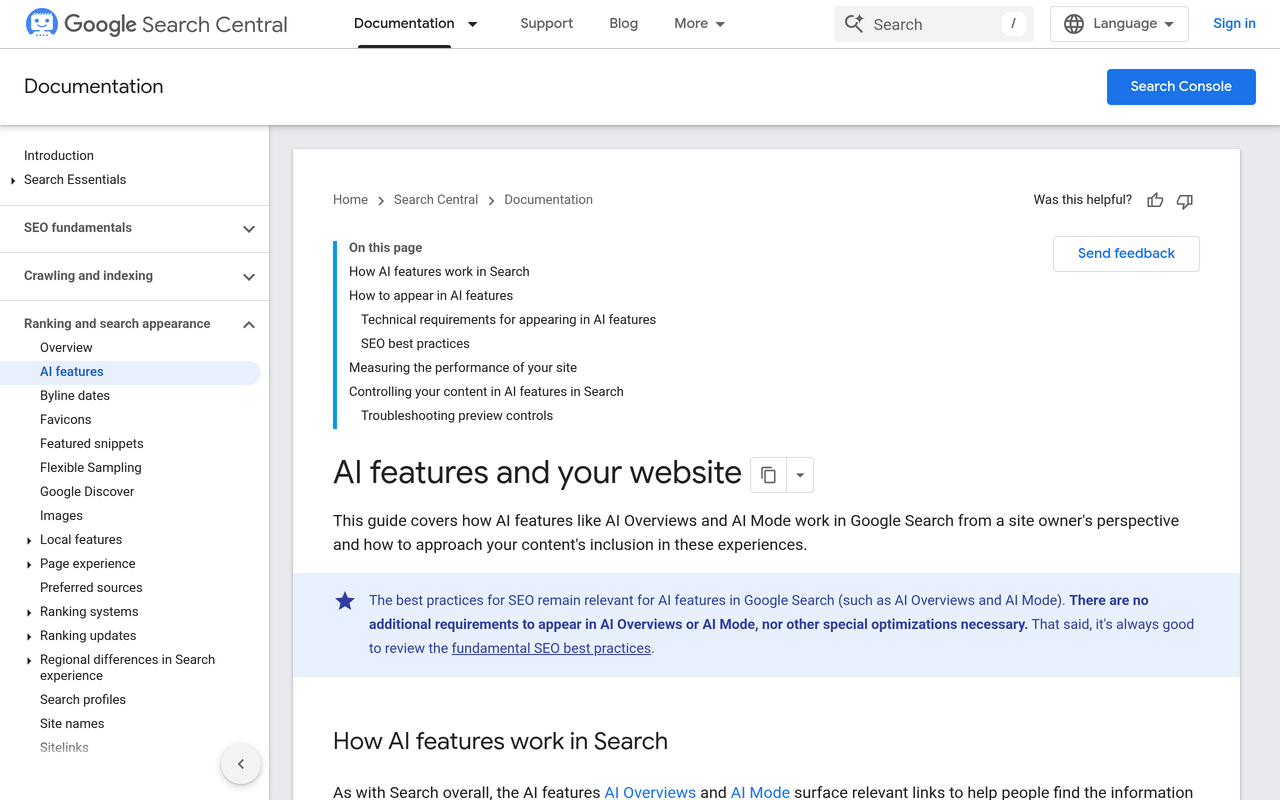
Google's guide to optimizing for generative AI features adds three points a marketer can act on. Content must be crawlable. There is no ideal page length. And the Generative AI performance report in Search Console shows how content performs in those features. Treat that report as your ground truth for Google and use a third-party tracker for the other engines.
Which terms describe content tactics, and what do they change?
Tactic terms are where hype piles up. Each below has a legitimate meaning and a measurable effect, if you define the test before you start.
- Atomic answer / micro-answer block: a self-contained passage of a few sentences that answers one question. Measure: does that passage get quoted in tracked answers for the matching prompt?
- BLUF (bottom line up front): leading with the answer, then the support. Measure: presence rate on the prompts the page targets, before and after a rewrite.
- Extractability: how easily a passage can be lifted without losing meaning. Test by reading each section out of context. If the entity is named only as "it", rewrite.
- Information gain: new facts, frameworks or data a competing page lacks. Measure: citations to pages with original material versus summary pages.
- Entity strengthening: making your brand's name, category and attributes consistent across your site and trusted third-party pages. Measure: accuracy of the description in answers.
- Offsite AEO: improving what trusted third-party pages say about you. Profound describes an authentic brand mention as accurate, relevant content about your brand inside a source the AI already cites.
- Freshness signal: visible updating of dated pages. Measure: whether refreshed pages gain citations over a fixed window.
For worked rewrites, see Nurdd's pieces on the sentence types that get quoted and writing content AI engines quote. For brand wording, entity definitions for AI search covers the description problem.
Which terms describe prompts and tracking setup?
Tracking tools are only as good as the prompts they poll. These terms define the setup layer, and they decide whether your dashboard reflects real buyer behaviour.
| Term | Plain definition | What to measure or decide |
|---|---|---|
| Tracked prompt | A question you poll repeatedly across engines | Cover category, comparison and problem-led questions |
| Prompt set | The full list of tracked prompts | Freeze it per reporting period |
| Prompt volume | An estimate of real-world demand for a prompt | Treat as directional; ask how it is derived |
| Branded vs non-branded prompt | Prompts that name you vs generic category questions | Report them separately; non-branded shows discovery |
| Citation gap | Prompts where competitors are cited and you are not | List the gaps, then the sources that fill them |
| Source diversity | How many distinct domains support answers about you | Concentration in one source is a risk |
| Sentiment / attribute | The tone or specific claims in answers about you | Compare with the attribute list you want |
Profound's glossary notes that citations reveal which content engines trust in your category, and calls them a to-do list disguised as a report. That is a useful way to read a citation gap: each missing citation points to a page or third-party source you could improve. Nurdd's guide on which prompts to track shows how to build the set.
Which terms describe crawlers and access?
Access terms decide whether you are eligible at all. Three ideas are enough for most marketing teams.
- AI crawler: a bot that fetches pages for AI products. Some collect training data, some build a search index, and some fetch a page when a user asks. Treating them as one thing leads to blocking the wrong ones.
- robots.txt controls: the file that sets which crawlers may fetch which paths. Confirm each vendor's current user-agent names on its own documentation before editing, because they change.
- Search eligibility: for Google's AI features, Google's guide says a site must be included in generative AI features in Search Console to be eligible for display, on top of normal technical requirements.
A common failure is a blanket block added during a privacy review that quietly removes the brand from AI search. Check your robots.txt as part of every audit. The GEO readiness scorecard is a free 12-factor check that helps you see where your pages stand before you spend on tracking.
How do you read a glossary term as a buying question?
Every term in this glossary converts into a question for a vendor. This decision table is an original way to use it: pick the term a tool claims to report, and ask the paired question.
| If the dashboard reports | Ask the vendor | Red flag |
|---|---|---|
| Visibility score | What is the exact formula and denominator? | No published formula |
| Share of voice | Which competitors, who chooses them, can I edit them? | Fixed, hidden competitor list |
| Citation share | Domain level or page level? Counted per answer or per citation? | Single number with no level stated |
| Sentiment | What does "positive" mean and can I see source answers? | No link back to the raw answer |
| Prompt volume | How is demand estimated for each engine? | Precise-looking numbers with no method |
| Engine coverage | Which engines, how often, from which locations? | Weekly polling or a handful of engines |
Profound's glossary itself encourages buyers to demand published formulas from any vendor. Apply that rule to every tool, including ours.
What is a worked example of these metrics?
The numbers below are illustrative arithmetic to show how the formulas differ, not measured data. Imagine a skincare brand tracking 20 prompts on one engine, giving 20 answers. The brand is mentioned in 8 answers, and its domain is cited in 5 answers. Across all 20 answers the engine lists 50 citations in total, and 6 of them point to the brand's domain.
- Presence rate: 8 mentions ÷ 20 answers = 40%.
- Citation rate: 5 answers citing the domain ÷ 20 answers = 25%.
- Citation share: 6 citations ÷ 50 citations = 12%.
- AI share of voice: suppose competitors A and B are mentioned in 10 and 6 answers. Brand mentions ÷ total mentions = 8 ÷ (8 + 10 + 6) = 33%.
One brand, four defensible numbers: 40%, 25%, 12% and 33%. None is wrong, but each answers a different question, and a report that shows only the 40% flatters you. This is why the definitions matter before the dashboards do.
How do you set up AI search tracking? A checklist
- Choose one label (GEO or AEO) for internal use and write down its definition.
- List 20 to 50 prompts across category, comparison and problem-led questions, split into branded and non-branded.
- Name your competitor set and freeze it for the reporting period.
- Pick your primary metric: presence rate for awareness, citation share for source authority, share of voice for competitive position.
- Record, for each metric, its numerator, denominator, engines and date.
- Check access: robots.txt, Search Console inclusion and crawlability.
- Review citation gaps monthly and assign each gap to a page or third-party source.
- Re-poll after any content change and compare against the frozen prompt set.
For a fuller routine, Nurdd's AEO audit checklist and the explainer on what GEO is go deeper.
How does this compare with adjacent ideas like SEO and social search?
AI search metrics do not replace search metrics. Rankings still decide which pages are retrievable, and Google says the same basics apply to its AI features. What changes is the unit of success: from a ranked link to a mention or citation inside a composed answer.
Two adjacent areas are worth a glance. Social platforms are becoming search surfaces too, covered in social search optimization. And the difference in how engines cite is covered in Perplexity vs ChatGPT vs Gemini. Keep the two disciplines in the same reporting view so one does not hide the other.
What mistakes do marketers make with these terms?
- Comparing scores across vendors. A visibility score of 40 in one tool and 40 in another mean different things unless the formulas match.
- Changing the prompt set mid-quarter. You can no longer tell whether the brand improved or the questions changed.
- Treating mentions and citations as the same. A mention without a link still influences a shortlist, but it does not send traffic.
- Tracking one engine. Retrieval and citation behaviour differ between engines, so one result says little about the rest.
- Optimising for the label. Buying a "GEO package" without a metric attached is paying for a word.
The causes of non-appearance are covered in why your brand isn't showing up in ChatGPT answers and why a competitor is cited instead of you.
How does Noma track these metrics?
Noma by Nurdd is a web dashboard that tracks whether your brand appears in answers from 13 AI engines, including ChatGPT, Gemini, Perplexity and Claude, polled daily. It shows citation frequency by category, competitor comparison and recommendations to improve your AI visibility. Noma belongs in this glossary's answer because it turns the terms above into numbers you can watch by engine and by competitor.
Want to see these metrics for your own brand? Book a demo and we will show you your brand's mentions, citations and competitor comparison across the engines, using your category's questions.
Noma has a 3-day free trial. A card is taken at signup and billing starts on day 3, so you are not charged if you cancel before then. You can start at nomahq.app, or read the Noma vs Profound and Noma vs Peec AI comparisons if you are weighing tools. For a broader view, see the 2026 comparison of AI search visibility tools.
How we researched this
We reviewed published glossaries from AI visibility vendors and agencies, Google's official Search Central documentation, the 2023 generative engine optimization research paper, and published guides on share of voice and citation metrics. We compared how each source defines the same terms and noted where formulas differ. All sources were checked on the publication date of this article. We did not run hands-on tests for this piece, and the worked example uses illustrative arithmetic rather than measured data.
Frequently asked questions
What is the difference between GEO, AEO and LLMO?
They overlap heavily. AEO stresses being the chosen direct answer, GEO stresses inclusion in a generated response, and LLMO stresses how language models understand your brand. Sources such as Animalz treat GEO and AEO as largely interchangeable in practice, so choose one label and focus on the metrics.
What does citation share mean in AI search?
Citation share is the portion of all citations in a set of tracked AI answers that point to your domain or page. It is calculated per citation, not per answer, and it can be read at domain or page level. Always note the prompt set and engines behind the number.
Is citation share the same as share of voice?
No. Share of voice compares your brand mentions with those of tracked competitors, while citation share measures how much of the cited source pool points to you. A brand can be mentioned often and rarely cited, or the reverse.
What is a good AI visibility score?
There is no universal figure, because vendors define the score differently. Some count only the share of answers that mention you, while others blend position and prominence. Judge progress against your own baseline using a frozen prompt set.
Do I need different strategies for GEO and SEO?
Mostly no. Google's guidance says the same foundational SEO practices apply to its AI features. The extra work is making passages self-contained, keeping brand descriptions consistent and measuring mentions and citations alongside rankings.
What is query fan-out?
Query fan-out is the habit of expanding one user prompt into several background searches before an answer is written. It matters because each sub-query is another chance for your content to be retrieved. Pages that answer related questions clearly give you more chances.
How often should I track AI search visibility?
Daily polling suits trend detection because answers vary between runs, while reporting can be weekly or monthly. Whatever you choose, keep the prompt set and competitor list fixed within the reporting period so changes mean something.
Can I track AI search visibility for free?
You can start with manual checks and Google's Search Console report for its own AI features. For several engines at once, a tracker is more practical. Noma offers a 3-day free trial, with a card taken at signup and billing from day 3.
Turn the glossary into your own numbers
The terms only help when they become figures for your brand. In a demo of Noma you will see which of your category questions mention you, which sources are cited instead, and how your share compares with named competitors across 13 AI engines. Book a demo to see your own results.