AI Search Visibility
How to Get Traffic From Perplexity to Your Website
A practical guide to earning Perplexity citations, getting clicks from them and measuring which pages the engine actually cites.
 Simran Rawat31 Oct 202617 min read

To get traffic from Perplexity, let PerplexityBot and Perplexity-User crawl your site, publish pages that answer one question each in a quotable opening sentence, and earn mentions on the third-party sources Perplexity leans on, such as Reddit. Then measure perplexity.ai referral sessions in GA4 and track citations separately, because many citations never produce a click. Noma by Nurdd tracks citations across 13 AI engines, including Perplexity.
To get traffic from Perplexity, three things have to be true at once: its crawlers can fetch your pages, a page of yours answers the exact question in a sentence the engine can lift, and the answer gives the reader a reason to click the numbered source. Citations come first, clicks second, and you need two separate measurements to manage both.
This guide walks through that chain in order. It covers access, page design, source coverage beyond your own domain, click measurement in GA4, and a repeatable test for finding out whether Perplexity cites your site at all. Where a number appears, it comes from a linked source and is dated by the month it was checked (October 2026).
Key takeaways
- Allow both PerplexityBot (indexing) and Perplexity-User (live fetches) in robots.txt before you change any content.
- Write each page so the first sentence under a question-style heading answers that question on its own.
- Perplexity cites a lot of third-party sources, so Reddit, YouTube and review sites matter as much as your own blog.
- Create a GA4 channel group for perplexity.ai so referral clicks stop disappearing into generic Referral traffic.
- Treat citations and clicks as two metrics: a cited page can earn zero visits, and a visit can come from a page you never knew was cited.
- Run a fixed set of 10 to 20 buyer prompts weekly and log which URLs are cited, either by hand or with a tracker such as Noma.
Why is it hard to get traffic from Perplexity?
Perplexity answers the question on its own page and lists sources beside or beneath the answer. A reader who is satisfied has no need to click, so being cited is necessary but not sufficient. The engine also draws on a wider set of sources than a classic search results page, which means your own website is only one of several places where your brand can be named.
Scale is the other constraint. In an analysis summarised by AEO Daily, October 2026, SE Ranking's data puts ChatGPT at roughly 75% of AI referrals and Perplexity at about 7%. That does not make Perplexity unimportant, since its users tend to be in research mode, but it does set expectations: the channel is small, so the goal is a steady trickle of qualified visits plus brand mentions, not a traffic surge.
Worked example: sizing the channel with real ratios
Take the SE Ranking split above. Dividing 7 by 75 gives about 0.093, so for every 1,000 AI-referred visits that ChatGPT sends you, the same pattern suggests Perplexity would send roughly 93. This is arithmetic on a published ratio, not a forecast for your site: your category, content and audience will move it. Use it only as a sanity check. If your analytics show Perplexity sending ten times that, something specific is working and worth studying; if it shows zero, you probably have an access or citation problem rather than a volume problem.
How does Perplexity decide which sites to cite?
Perplexity runs a search step, retrieves pages, and writes an answer with numbered citations. Two crawlers feed that process. According to Menra, October 2026, PerplexityBot builds the search index that grounds answers, while Perplexity-User fetches a page live when a specific user request needs it. The same guide notes that Perplexity's crawler documentation says user-triggered fetches may not honour robots.txt, because they happen on behalf of a person.
What the engine then chooses to cite depends on relevance to the query, how directly a passage answers it, and which domains it already trusts for that topic. Citation mix data shows how different that is from a blue-link results page. Profound, October 2026 reports Reddit at 6.6% of all Perplexity citations in its study, with YouTube at 2.0%, and Reddit at 46.7% of the share among the top ten cited sources. A secondary roundup from Everything PR, October 2026 reports an average of 8.2 cited sources per Perplexity answer, 3.4 times ChatGPT, and attributes that to Profound's longitudinal study.
Perplexity cites many sources per answer and leans heavily on community and review platforms, so a brand can be named in an answer without its own website being the cited link.
That is the central planning fact. Your goal is to be present on the sources Perplexity retrieves, and to make your own pages the easiest, most specific source for the click.
How do I get traffic from Perplexity? Six steps
Step 1: Open the door to both Perplexity crawlers
Action: check your robots.txt, your CDN and your firewall rules for PerplexityBot and Perplexity-User. A permissive rule pair is simple: a User-agent line for each bot followed by Allow: /, as shown in the xSeek documentation, October 2026. Result: the retrieval layer can index you and fetch you live. Why: Menra's guide treats allowing both agents as the baseline for appearing in numbered citations, and blocking either cuts off a different part of the pipeline.
Robots.txt is only half the check. Many sites allow the bot in the file and then block it at the network layer through bot-protection rules. Peec AI's crawlability documentation, October 2026 describes a checker that tests a domain's robots.txt against more than 40 AI bots from more than 20 vendors, which is a quick way to confirm the file says what you think it says. Then look in your server logs for requests from both user agents over the past month.
Step 2: Choose the questions your buyers ask Perplexity
Action: write 10 to 20 prompts in the way a buyer types them: comparisons, "best for" questions, how-to questions and price questions in your category. Result: a fixed prompt list that becomes both your content plan and your measurement set. Why: Perplexity retrieves by question, so pages built around a vague topic lose to pages built around the exact question. Our guide on which prompts to track for AI search visibility covers how to pick them.
Step 3: Rewrite the page so one sentence answers the question
Action: under each question-style H2, put a one- or two-sentence direct answer that names the entity in full and states a specific fact, then add detail below. Result: a passage an engine can quote without surrounding context. Why: retrieval systems lift passages, not pages, and a passage that begins with "it" or "this tool" cannot be attributed. See the sentence structure that gets quoted in AI answers and before-and-after content examples.
| Weak opening | Citable opening |
|---|---|
| We think pricing is a big question for most teams. | Acme Analytics costs a stated amount per seat per month, billed annually, with the plan limits listed on its pricing page. |
| Our approach is different from the rest. | Acme Analytics connects to a store in one OAuth step and reports repeat-purchase rate by cohort. |
| Read on to learn more. | The setup takes four steps: connect, map events, test, publish. |
The right-hand column is a pattern, not a claim about any real product. Replace each with facts you can show on the page.
Step 4: Give the reader a reason to click
Action: keep the deepest material, such as the full table, calculator, template, dataset or screenshot walkthrough, on your page rather than fully summarised in the first paragraph. Result: the answer satisfies the question while the source promises more. Why: Usermaven, October 2026 makes the same point in its guide: a citation creates an opportunity to visit, but no click is guaranteed. Pages with a tool, a downloadable asset or a comparison the answer cannot fully reproduce earn the visit.
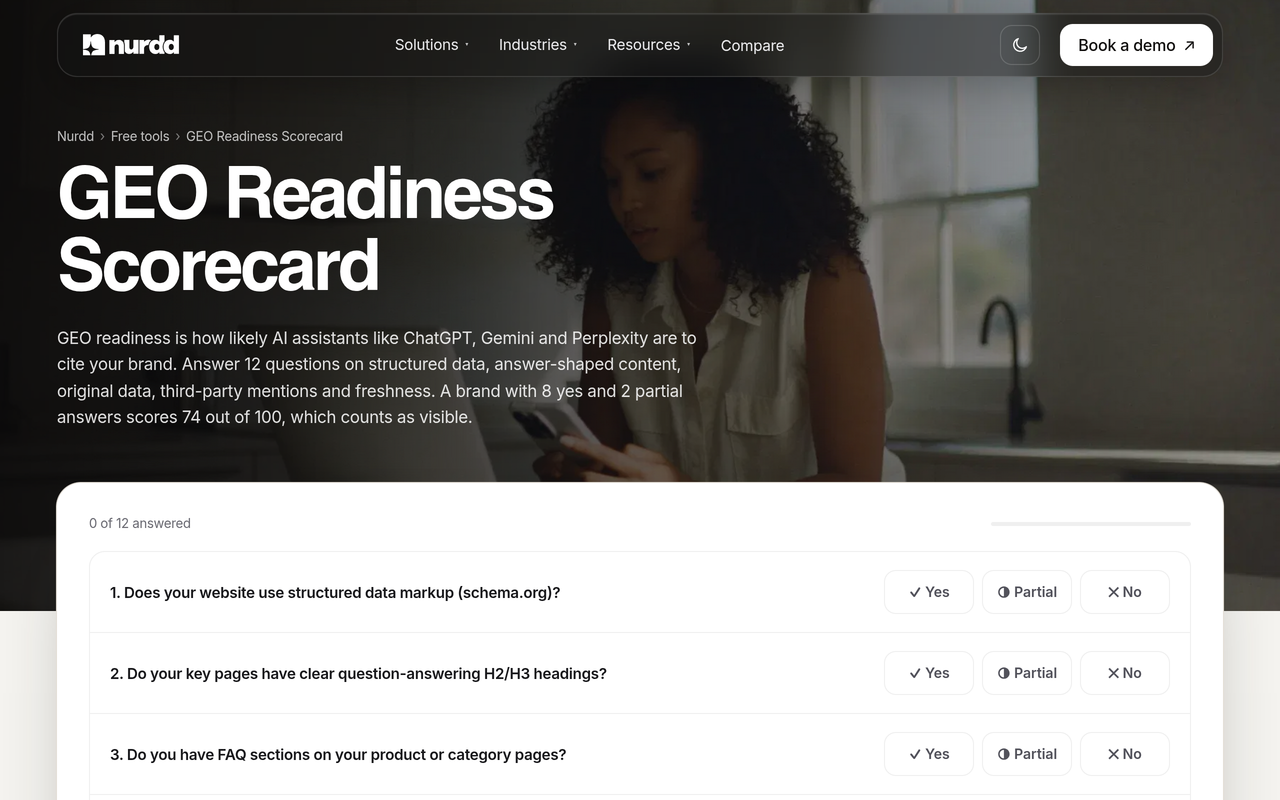
You can also use the Nurdd free tools as a model of this approach. A reader asking how ready a site is for AI answers gets a short explanation in the answer and a scored result on the GEO readiness scorecard.
Step 5: Add structure and freshness signals
Action: add Article, FAQPage and Product schema where they match visible content, show a clear updated date, and keep facts current. Result: cleaner machine-readable pages and fewer stale claims. Why: Visionation, October 2026 recommends question-mirroring headings, valid FAQ and Article markup and a fast mobile site for Perplexity; schema is not a guarantee of citation, but it removes ambiguity. Our guides on schema markup for AI search engines and FAQ pages for AI search go deeper.
Step 6: Earn mentions where Perplexity already looks
Action: list which third-party domains appear next to yours for your prompts, then earn honest presence there: answer questions in relevant Reddit threads as a disclosed representative, publish video explainers, and keep review profiles and LinkedIn company pages complete. Result: more retrieval paths that name your brand. Why: the Profound figures above show Reddit and YouTube among the most cited sources, and Everything PR, October 2026 cites Tinuiti data that 31% of Perplexity citations come from social media. Do not post fake reviews or disguised promotion: it breaks platform rules and it damages the one thing citation systems reward, which is consistent, verifiable information.
Which action should I take first? A decision table
Teams waste effort fixing content when the real blocker is access, or buying outreach when the real blocker is page structure. Use this table to find your first fix by symptom.
| What you observe | Most likely blocker | First fix |
|---|---|---|
| No Perplexity user agents in server logs | Crawler access | Check robots.txt and firewall rules for PerplexityBot and Perplexity-User |
| Crawled, but never cited on your prompts | Page does not answer the question in a quotable sentence | Rewrite openings under question-style H2s |
| Cited, but few visits | Answer is complete without the click | Add tools, tables or data that need the page |
| Competitors cited, brand named nowhere | Weak third-party source coverage | Earn presence on the community, video and review sources cited for your prompts |
| Visits exist but are filed as generic Referral | Measurement | Build a GA4 channel group for perplexity.ai |
The sequence runs left to right: access, quotable content, click reason, source coverage, measurement. Fix them in that order because each one depends on the one before it.
How do I know if Perplexity cites my site?
You need two views: citations (did the engine name or link you in an answer) and clicks (did a person arrive). They come from different tools and rarely match one to one.
Method 1: A manual weekly citation test
This is a test anyone can run from public evidence, no tooling needed. Use the same prompt list every week, run each prompt in a fresh session, and record the answer in a spreadsheet.
- Write down 10 to 20 buyer prompts and freeze the wording.
- Run each prompt in Perplexity in a logged-out or fresh session, so personal history does not skew the result.
- For each prompt, record every cited domain and URL, in order, and whether your brand is named in the answer text.
- Mark three outcomes per prompt: your URL cited, your brand named without your URL, or neither.
- Repeat weekly for at least four weeks, because answers change between runs.
- Compare cited domains with your competitors to see which third-party sources recur.
The manual approach is slow and answers vary between runs, so treat a single run as a sample, not a result. It is, however, enough to learn which source types dominate your category.
Method 2: Server logs
Log lines containing PerplexityBot or Perplexity-User show which URLs are being indexed and fetched. A fetch by Perplexity-User is a useful signal because it is triggered by a real question about a page. It does not prove a citation was shown, but a page that is fetched often is a page the engine is using.
Method 3: A tracker that polls on a schedule
A tracker automates Method 1 at scale across engines. Noma by Nurdd polls 13 AI engines daily, including ChatGPT, Gemini, Perplexity and Claude, and shows citation frequency by category, competitor comparison and recommendations for improving AI visibility. For a Perplexity programme, that means one dashboard answers whether your brand is named for each prompt and how you compare with rivals, while analytics answers whether anyone clicked.
How do I measure clicks from Perplexity in GA4?
Perplexity visits usually appear in GA4 with the source perplexity.ai and medium referral. RightBlogger, October 2026 describes the fastest check as Traffic acquisition with Session source / medium as the dimension. That check works only for visits that carry a referrer; some AI clicks arrive without one and land in Direct, so the figure you see is a floor, not a total.
Checklist: set up Perplexity click tracking
- In GA4, open Reports, then Acquisition, then Traffic acquisition, and switch the dimension to Session source / medium.
- Search for perplexity.ai and note sessions, engaged sessions and key events for the last 90 days.
- Go to Admin, then Channel groups under Data display, and create a new channel group with an AI channel.
- Add a rule where Source matches the regex .*perplexity\.ai.*, which also catches the www version, as RightBlogger's guide describes.
- Drag the AI rule above the built-in Referral rule, otherwise Perplexity visits stay filed under Referral and your custom channel stays empty.
- Open Landing page reports filtered to the AI channel and list the top 10 landing pages.
- Compare those pages with the URLs cited in your weekly test. Pages in both lists are working; pages in only one list need attention.
- Tag any links you control, such as links in your own Perplexity Pages or profiles, using a clear UTM structure. Our UTM structure guide shows a naming scheme you can reuse.
Usermaven's guide also frames this as a short audit to run before investing in more Perplexity-specific content, and it is sensible to follow that order: measure first, then spend.
Reading the two lists together
| Cited in weekly test | Visits in GA4 | What it means | Next move |
|---|---|---|---|
| Yes | Yes | Page earns the click | Protect it: keep it fresh, add related pages |
| Yes | No | Answer satisfies without a click, or visits arrive without referrer | Add a reason to click; check Direct traffic for the same landing page |
| No | Yes | Cited on prompts you are not tracking | Add the likely prompts to your list |
| No | No | Not in the retrieval set | Return to access, page structure and source coverage |
This four-cell view is the simplest way to turn two noisy datasets into decisions. It also prevents a common error: celebrating citations that deliver nothing, or ignoring visits whose cause you cannot see.

What are the common mistakes when chasing Perplexity traffic?
- Blocking AI crawlers site-wide and expecting citations. A blanket disallow for AI bots, or a bot-protection rule that challenges them, removes you from the retrieval set. Test access rather than assume it.
- Optimising only your own domain. Perplexity cites many sources per answer. If rivals are named on Reddit and in review roundups and you are not, better on-site copy will not close that gap alone.
- Judging one run of one prompt. Answers vary. Track a fixed prompt set across weeks and look at the trend.
- Buying "Perplexity traffic" from vendors. Some sites sell visits to a landing page and describe them as Perplexity traffic. Visits you purchase are not citations earned, they do not build brand presence in answers, and they distort analytics.
- Ignoring Perplexity-User. Allowing only the indexing bot leaves live fetches uncovered.
- Counting only referral clicks. A named brand with no click still influences later branded search and direct visits. Track branded search demand alongside the referral line.
- Stale facts. Old prices, features or dates make a passage unsafe to quote. Review your top landing pages monthly.
How does Perplexity compare with ChatGPT and Gemini for traffic?
Each engine retrieves and cites differently, so a single optimisation pass will not serve all of them equally. The comparison below uses only facts established in this guide; see the linked posts for engine-specific tactics.
| Question | Perplexity | What to read next |
|---|---|---|
| Share of AI referrals (SE Ranking via AEO Daily) | About 7%, against about 75% for ChatGPT | How to get ChatGPT to recommend your brand |
| Crawlers to allow | PerplexityBot and Perplexity-User | How to get cited by Gemini |
| Citation behaviour | Many sources per answer, Reddit prominent | Perplexity vs ChatGPT vs Gemini |
| Click measurement | perplexity.ai / referral in GA4, undercounted when no referrer | Does AI search traffic convert better? |
Because Perplexity sends a smaller share of visits, it often makes sense to treat it as part of a single AI visibility programme rather than a standalone channel. The same page that earns a Perplexity citation, answering one question with a specific opening sentence, usually helps in other engines too.
How does Noma help you see which pages Perplexity cites?
Noma by Nurdd is a web dashboard that tracks whether a brand appears in answers from 13 AI engines, including ChatGPT, Gemini, Perplexity and Claude, polled daily. It shows citation frequency by category, compares you with competitors and gives recommendations for improving AI visibility, so a team can see Perplexity next to the other engines instead of running separate manual checks for each.
Book a demo at nurdd.club/demo to see your own brand's prompts run across the engines, with a competitor comparison for your category.
In practice, the workflow looks like this. Load the prompt list from Step 2 into Noma. Review where your brand is named for Perplexity versus ChatGPT, Gemini and Claude. Use the competitor view to see who is named where you are not, then use the GA4 setup above to check whether the engines that name you also send visits. Noma covers the citation side of the four-cell table; your analytics covers the click side. For a head-to-head view of tools, see Noma vs Profound, Noma vs Peec AI and the comparison of AI search visibility tools.
Noma has a 3-day free trial. A card is taken at signup and billing starts on day 3; if you cancel before then, you are not charged. You can start at nomahq.app.
How should I report Perplexity performance each month?
A short, fixed report keeps the work honest. Use these five lines and nothing more until they are stable.
- Access: both Perplexity user agents allowed and seen in logs (yes or no).
- Citation coverage: number of tracked prompts where your URL was cited, and where only your brand was named.
- Source mix: the top five third-party domains cited on your prompts and whether you are present on each.
- Clicks: perplexity.ai sessions, engaged sessions and key events from your GA4 channel group.
- Actions: three pages to rewrite, one source to earn presence on, one measurement fix.
For the metric behind line two, see how to measure AI search share of voice and how to track your AI search visibility score week over week. To understand why some domains are cited more than others, read why AI engines trust some websites more, and if a rival keeps appearing instead of you, why your competitor is cited and you are not. A full pass through your pages is laid out in the AEO audit checklist.
How we researched this
This guide was written by Simran Rawat. We searched for the primary keyword and reviewed the top-ranking articles on getting and measuring Perplexity traffic, along with crawler documentation from independent documentation sites, a citation-pattern study from an AI visibility vendor, published analytics guides and a roundup of AI referral shares. Pages were checked on the publication date in October 2026. Some figures come through secondary roundups; where that is the case, the text names the roundup and the original source it cites. We did not run hands-on tests of Perplexity, interview anyone or use customer data, and we cite no Nurdd performance figures. Existing guides cover the basics of citations and GA4 tracking; this one adds a decision table, the four-cell cited-versus-visited view and a repeatable weekly test.
Frequently asked questions
How do I get traffic from Perplexity to my website?
Allow PerplexityBot and Perplexity-User, publish pages that answer a specific question in a quotable first sentence, and earn mentions on the third-party sources Perplexity cites for your category. Then keep a reason to click on the page, such as a tool or table. Measure the result with a GA4 channel group for perplexity.ai.
How do I know if Perplexity cites my site?
Run a fixed list of buyer prompts in a fresh Perplexity session each week and record every cited URL and whether your brand is named. Check server logs for both Perplexity user agents. A tracker like Noma automates the prompt runs across 13 AI engines, including Perplexity.
Does Perplexity send much traffic?
It is a smaller source than ChatGPT. AEO Daily, citing SE Ranking, puts ChatGPT at roughly 75% of AI referrals and Perplexity at about 7%. Treat it as a steady, research-minded audience rather than a volume channel.
Where does Perplexity traffic show up in GA4?
Usually as perplexity.ai / referral under Session source / medium in Traffic acquisition. Some visits arrive with no referrer and are recorded as Direct, so the referral figure understates the true total. A custom channel group placed above the default Referral rule keeps the AI line separate.
Should I block PerplexityBot?
Only if you do not want to appear in Perplexity answers. Blocking PerplexityBot removes you from its index, and Perplexity-User handles live fetches. If your goal is traffic, allow both and confirm your firewall is not blocking them.
Does schema markup get me cited by Perplexity?
Schema does not guarantee a citation, but it removes ambiguity about what a page is and who wrote it. FAQPage and Article markup that match visible content are sensible defaults, alongside clear headings and a direct answer under each.
Do Reddit and YouTube really matter for Perplexity?
In Profound's published analysis, Reddit was 6.6% of all Perplexity citations and YouTube 2.0%, with Reddit holding 46.7% of the top-ten source share. If those sources discuss your category without naming you, your own pages face stiffer competition for the citation.
Is Noma free to try?
Noma has a 3-day free trial. A card is taken at signup and billing starts on day 3, with no charge if you cancel before then.
Want to see where Perplexity names you?
The fastest way to know whether Perplexity cites your site is to see your own prompts run. Book a demo and the Nurdd team will show you your brand's citations across 13 AI engines in Noma, which competitors appear where you do not, and which pages to fix first. You can also run the GEO readiness scorecard on your site today, or learn more about generative engine optimization.