Brand & Content Strategy
Brand Differentiation in AI Answers: Why Models Repeat
AI engines keep recommending the same brands because they favour widely documented entities; specific, provable claims are how you break the pattern.
 Simran Rawat10 Nov 202614 min read

AI engines give near-identical recommendations because they draw from the same web evidence, and that evidence concentrates on brands with many mentions and generic claims. Exact lists vary from run to run, but the same few brands recur. Specific, provable, third-party-confirmed claims give an engine something distinct to repeat, and Noma shows which of your claims actually surface.
Brand differentiation in AI answers is the degree to which an assistant describes your brand with claims that belong to you alone, rather than with category language it could apply to any competitor. AI engines repeat the same brands and phrases because they build answers from the same widely documented web evidence. Specific, provable and independently confirmed claims are what break that pattern.
Key takeaways
- Exact AI recommendation lists change on almost every run, but the same few brands keep reappearing, so your goal is to be in the recurring set with a distinct description.
- Off-site brand mentions track AI visibility more closely than link metrics in Ahrefs' 75,000-brand study, so differentiation has to exist beyond your own site.
- A claim an engine can repeat is specific, checkable and stated the same way in several independent places.
- Generic claims ("high quality", "trusted by thousands") are interchangeable, so they blur you into the category.
- Test your claims by tracking prompts over time and reading what engines say and which pages they cite, not by checking one answer once.
- Noma by Nurdd records whether your brand is named across 13 AI engines and which page each citation comes from, which is the evidence you need to see which claims travel.
Why does everyone get the same AI recommendations?
The short version is that assistants are not neutral judges of your category. They compile answers from documents they can retrieve or have absorbed, and those documents overrepresent the brands that are already written about most. If every marketer on earth asks the same assistant the same question, the assistant leans on the same pool of evidence.
AirOps makes a related point about content: when everyone has ChatGPT, the advantage moves to the brand knowledge, voice guidelines and expertise you feed into the workflow, as described on the AirOps blog, accessed November 2026. The same logic applies to how engines describe you. If the only things written about your brand are generic, the engine has nothing distinctive to say.
It helps to separate two kinds of sameness. One is sameness of the set: the same four or five brands show up. The other is sameness of the description: those brands are summarised with interchangeable phrases. Differentiation work targets both, and the research below shows they behave differently.
How consistent are AI brand recommendations, really?
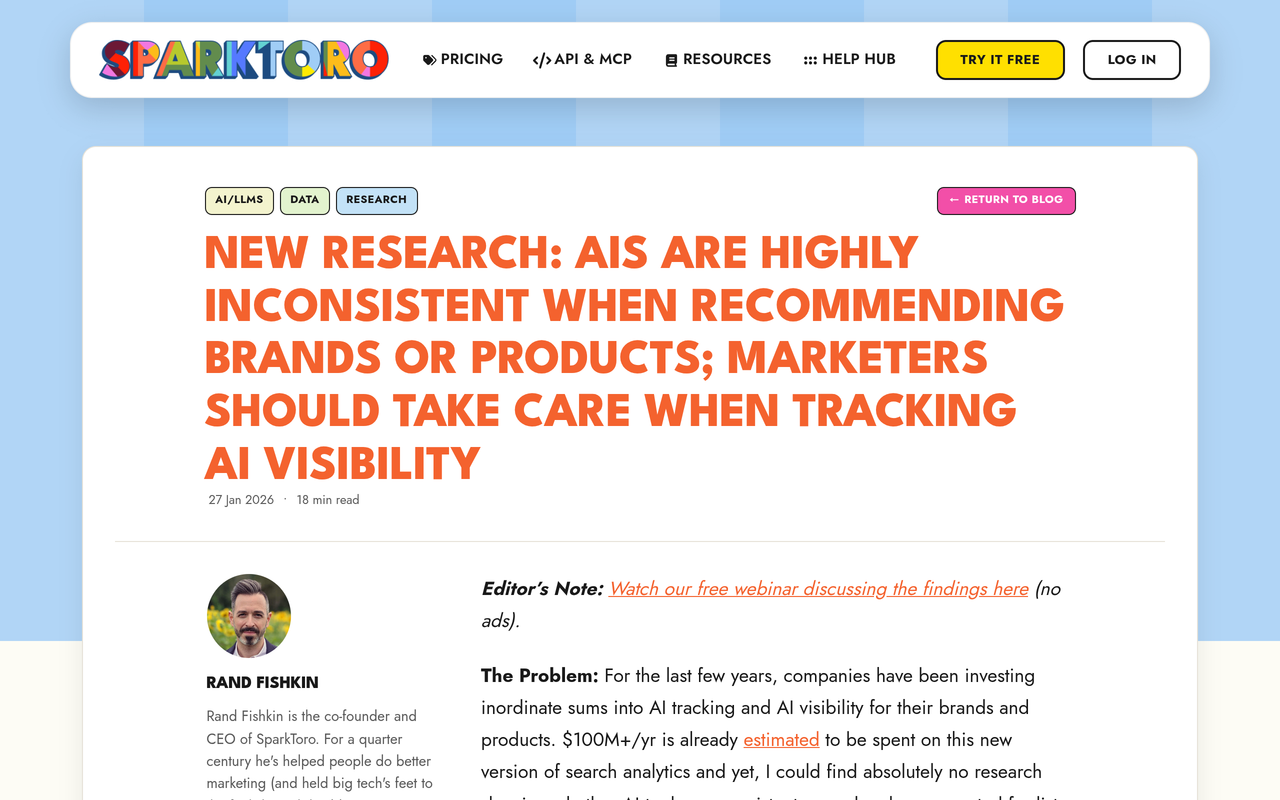
Less consistent than most people assume at the level of the list, and more consistent at the level of the leading brands. SparkToro, January 2026, had 600 volunteers run 12 prompts through ChatGPT, Claude and Google's AI a combined 2,961 times. The author reports a less than 1 in 100 chance that ChatGPT or Google's AI would give the same list of brands in any two responses, and closer to 1 in 1,000 for the same order.
That sounds like the opposite of "everyone gets the same answer". The same study explains why it is not. In a second test, the author ran 142 human-written prompts about choosing headphones for a travelling family member and collected 994 responses. Brands such as Bose, Sony, Sennheiser and Apple appeared 55 to 77 percent of the time, similar to the top three brands in the tighter categories the volunteers tested.
The pattern in SparkToro's data is a stable core with a shifting tail: the top few brands recur across wording and runs, while the order, length and lower positions of the list change.
The study also notes that the number of unique brands an engine mentions is closely tied to how many entities appear often in documents about that topic. A narrow category (a handful of Los Angeles Volvo dealerships) concentrates attention on a few names. A wide one (recent science fiction novels) scatters it.
What this means for a brand
- Being named once in one answer proves little. Presence across many runs is the signal.
- Being in the recurring core is a different outcome from being a lucky tail mention.
- In a narrow category, a distinct claim matters more, because there are fewer slots and each one is described in detail.
What makes a brand appear in the repeated set?
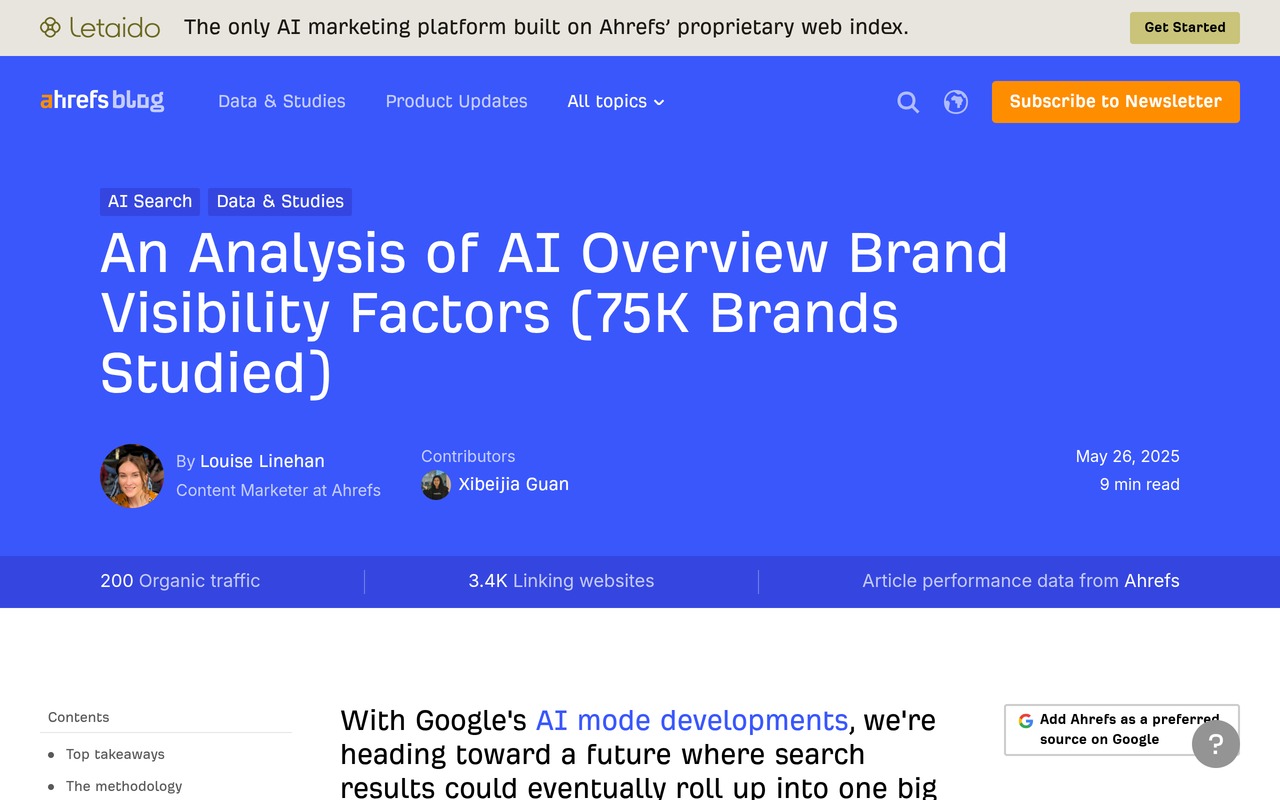
The strongest published evidence points off your own site. Ahrefs, May 2025 (updated April 2026), analysed 75,000 brands and reported Spearman correlations with AI Overview brand appearance of 0.664 for branded web mentions, 0.527 for branded anchors and 0.392 for branded search volume. Link-based measures were lower: Domain Rating at 0.326, referring domains at 0.295 and branded traffic at 0.274.
Correlation is not causation, and the study covers Google's AI Overviews rather than every assistant. Still, it fits a plain reading of how engines work: a brand mentioned widely, in many contexts, gives the model more material to retrieve and more reasons to include it.
Ranking is not a reliable shortcut either. Search Engine Journal, February 2026, reported an Ahrefs analysis of 863,000 keywords and 4 million AI Overview URLs in which 38% of cited pages also appeared in the top 10 for the same query, down from 76% in an earlier version. The same article notes a BrightEdge analysis with about 17% overlap using a different method. The spread between studies is itself a message: the pages engines cite are not simply the pages that rank.
Why do generic claims make brands interchangeable?
A model has to compress what it knows about you into a sentence or two. If your web footprint says "innovative", "trusted" and "all-in-one", so does every competitor's, and the compressed sentence reads the same for all of you. The engine picks the brand with the most evidence, not the one with the nicest slogan.
A specific claim survives compression because it contains something a competitor's page does not. It names a number, a method, a material, a limit, a customer type or a date. It can also be checked, which matters because engines that retrieve live pages tend to cite statements they can find stated plainly.
Single Grain's piece on how LLMs interpret brand differentiation claims, accessed November 2026, takes a similar view, framing differentiation as something machines read from product reality and positioning clarity. The Drum makes the broader argument in How AI discovery is forcing brands to focus on differentiation, accessed November 2026. Both treat differentiation as a requirement rather than a nice-to-have, and neither gives you a way to test which of your claims engines repeat. That gap is what the rest of this post fills.
Which brand claims do AI engines repeat? A claim-strength table
No public study ranks claim types by how often engines repeat them, so the table below is a working framework built from the mechanisms above, not a measured result. Use it to sort your own claims, then confirm with tracking.
| Claim type | Example pattern | Likely to be repeated? | Why |
|---|---|---|---|
| Generic adjective | "Premium, high-quality, trusted" | Rarely, and never as yours | Every competitor says it, so it carries no information |
| Category membership | "A project management tool" | Often, but it only places you in the pack | Useful for inclusion, useless for choice |
| Quantified specification | A stated dimension, ingredient, limit or timeframe | Often, if stated consistently | Concrete and checkable; engines can quote it exactly |
| Named use case or audience | "Built for sensitive skin in humid climates" | Often for matching prompts | Matches how people phrase long, situational questions |
| Method or origin claim | How it is made, tested or measured | Sometimes | Distinct, but needs outside confirmation to be trusted |
| Third-party confirmed claim | Cited by a publication, certifier or independent review | Most reliably | Off-site mentions correlate most strongly with AI visibility in the Ahrefs data |
The row to focus on is the last one. A claim you make about yourself is one document. A claim others make about you is many documents, and many documents are what shift the evidence an engine leans on.
How to break the pattern: a seven-step differentiation process
- List your claims as sentences. Pull every claim from your homepage, product pages, About page and press kit into one sheet. The result is a plain inventory. It matters because you cannot compare what you have not written down.
- Strike the interchangeable ones. Delete any claim a competitor could paste onto their own page unchanged. You are left with the claims that might actually differentiate you, and the gap you must fill is now visible.
- Make each survivor specific and checkable. Add the number, method, condition or limit, with a source on your own site. The result is a statement an engine can quote verbatim, which is why precision beats polish.
- Write one canonical wording per claim. Use the same sentence on your site, profiles and press materials. Consistent phrasing across documents makes it easier for a model to connect them to one entity. Our guide to writing a brand description that AI engines can use covers the format.
- Earn outside confirmation. Get the claim stated by reviewers, communities, publications or partners. This is the slowest step and the most important, given the weight of off-site mentions in the Ahrefs correlations. Our piece on getting mentioned in AI answers without ads goes through the channels.
- Track the prompts where the claim should matter. Choose category, comparison and situational prompts, then record answers over weeks, not once. The result is a baseline that shows whether the set and the wording are changing. See which prompts to track for AI search visibility.
- Keep, sharpen or drop each claim. If engines never repeat a claim, check whether it is too vague, too new or unconfirmed elsewhere, and fix that cause. This closes the loop and stops you producing more copy that nobody repeats.
How can I test which claims engines actually repeat?
You need three things: a fixed prompt set, repeated runs, and a reading of the answers against your claim list. A one-off check is misleading for the reason SparkToro documents, since the same prompt returns a different list almost every time.
A worked example, using SparkToro's published numbers
SparkToro's headphone test shows the logic. Across 994 responses to 142 differently worded prompts, four brands appeared 55 to 77 percent of the time. If you were a fifth headphone brand appearing in a small fraction of those runs, one answer would tell you almost nothing, but the pattern across runs would.
Now apply the same reading to claims. Suppose a hypothetical sunscreen brand claims "gentle, effective protection" and also "a formula tested on a stated skin type, with the test described on its own page". Across tracked runs, you would look for which phrase, if either, echoes in the descriptions engines give. The first is shared by every competitor. The second is the only one that could come back as yours. This example is illustrative and uses no real brand data; the headphone figures are the only numbers drawn from a source.
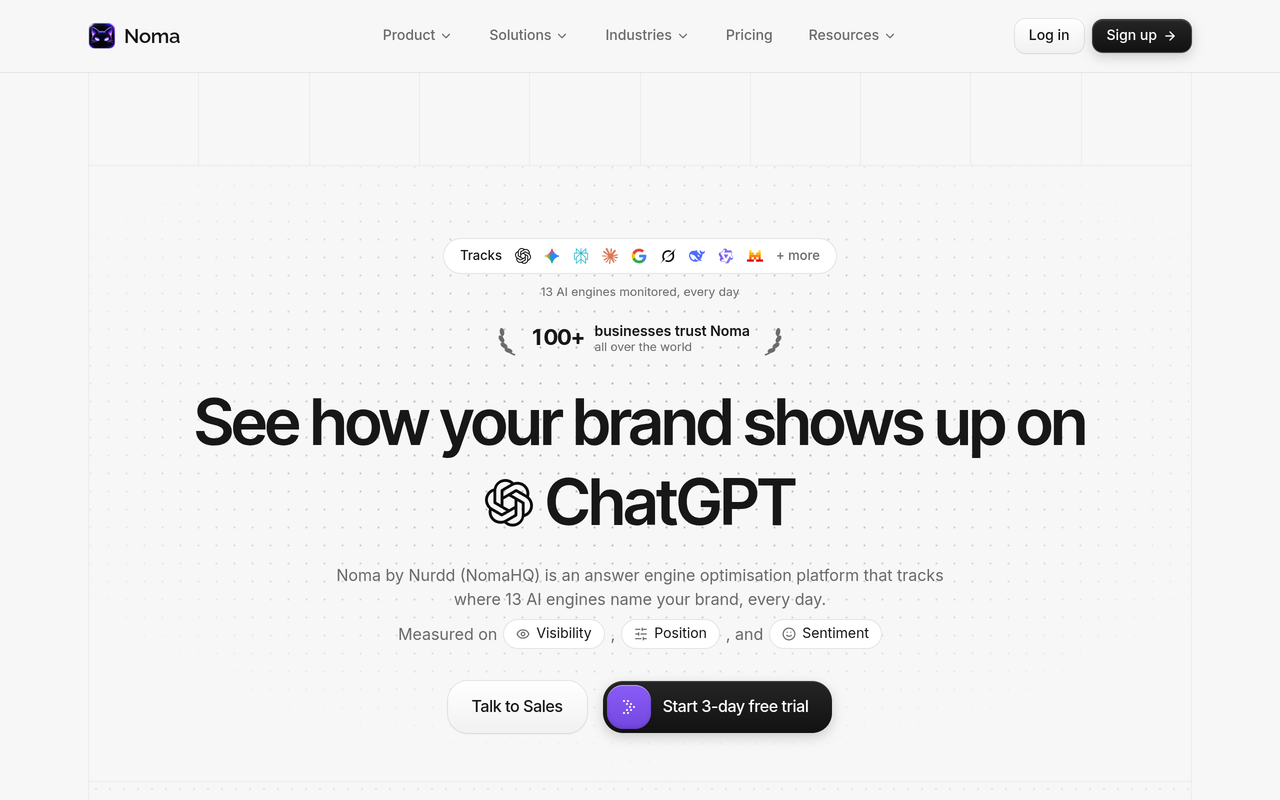
Noma by Nurdd tracks whether a brand appears in answers from 13 AI engines, including ChatGPT, Gemini, Perplexity and Claude, polled daily. It records whether your brand is named and which page each citation comes from, and it shows citation frequency by category and a competitor comparison. You then read the engines' wording against your claim list. Noma supplies the repeated observations and the source pages; the judgement of which claims echo is yours.
The claim-repetition check, as a checklist
- Write down five to ten claims you want engines to repeat, each in one sentence.
- Pick prompts that should surface each claim: one category prompt, one comparison prompt and one situational prompt per claim.
- Track them in Noma across engines for several weeks, so run-to-run variation averages out.
- For each tracked answer where your brand is named, mark whether the engine used your claim, a paraphrase, a competitor's claim or generic wording.
- Open the cited page behind each mention. If the repeated claim comes from a third-party page rather than yours, that page is now part of your differentiation strategy.
- Compare your wording against the competitor comparison to see where you and a rival are described identically.
- Rewrite or reinforce the claims that were never repeated, then keep tracking to see whether the wording shifts.
For a structured way to run changes against a baseline, see our guide to GEO experiment design and the four-week ChatGPT tracking test.
How do engines differ in how they repeat brands?
Each engine mixes training knowledge with live retrieval differently, so the same claim can appear in one and be absent in another. That is why a single-engine check misleads and why a multi-engine view matters. Our comparison of Perplexity, ChatGPT and Gemini for brands and the guides to Claude brand citations and getting cited by Gemini explain the behavioural differences.
Personalisation adds another source of variation, since the same question can return different answers to different users. We cover that in whether personalisation changes AI answers. The practical rule is unchanged: measure the pattern across many runs and engines, not a single screenshot.
How does differentiation in AI answers compare with adjacent ideas?
| Concept | What it asks | How it differs from AI answer differentiation |
|---|---|---|
| Brand positioning | What space do we want to own in the customer's mind? | Positioning is the intent; AI answer differentiation is whether engines reproduce it |
| SEO | Do our pages rank for the query? | Ranking is not the same as being cited, as the 38% and 17% overlap figures suggest |
| Generative engine optimisation | How do we get included in generated answers? | GEO gets you in the answer; differentiation decides how you are described once there |
| Share of voice in AI | How often are we named versus rivals? | Share of voice counts mentions; differentiation examines the wording of them |
| Brand perception tracking | What do engines say about us overall? | Closest relative; differentiation focuses on whether the claims are yours alone |
If you are new to the surrounding terms, the explainer on generative engine optimization and the AI search glossary define them. For measurement, see AI search share of voice and AI brand perception tracking.
What mistakes keep brands blending into the category?
- Judging by one answer. Given how often lists change, a single answer is an anecdote. Track over time.
- Writing superlatives instead of specifics. "Leading" and "best" are claims engines have no reason to trust or repeat.
- Varying the wording on every channel. Five phrasings of one claim look like five unrelated claims.
- Keeping every claim on your own site. The Ahrefs correlations point to off-site presence; a claim that only you make is a weak signal.
- Ignoring which page gets cited. If engines cite a competitor's comparison page to describe you, that page is writing your differentiation for you.
- Treating differentiation as a copywriting task. It is also a product, evidence and PR task, because the claim has to be true, provable and confirmed by others.
If you want to see how your own pages read to an engine before you rewrite anything, our guide on checking whether your website answers questions the way AI engines expect is a quick start, and the before-and-after examples of quotable content show the difference in practice. The guide to sentence structure that gets cited covers how to phrase a claim itself.
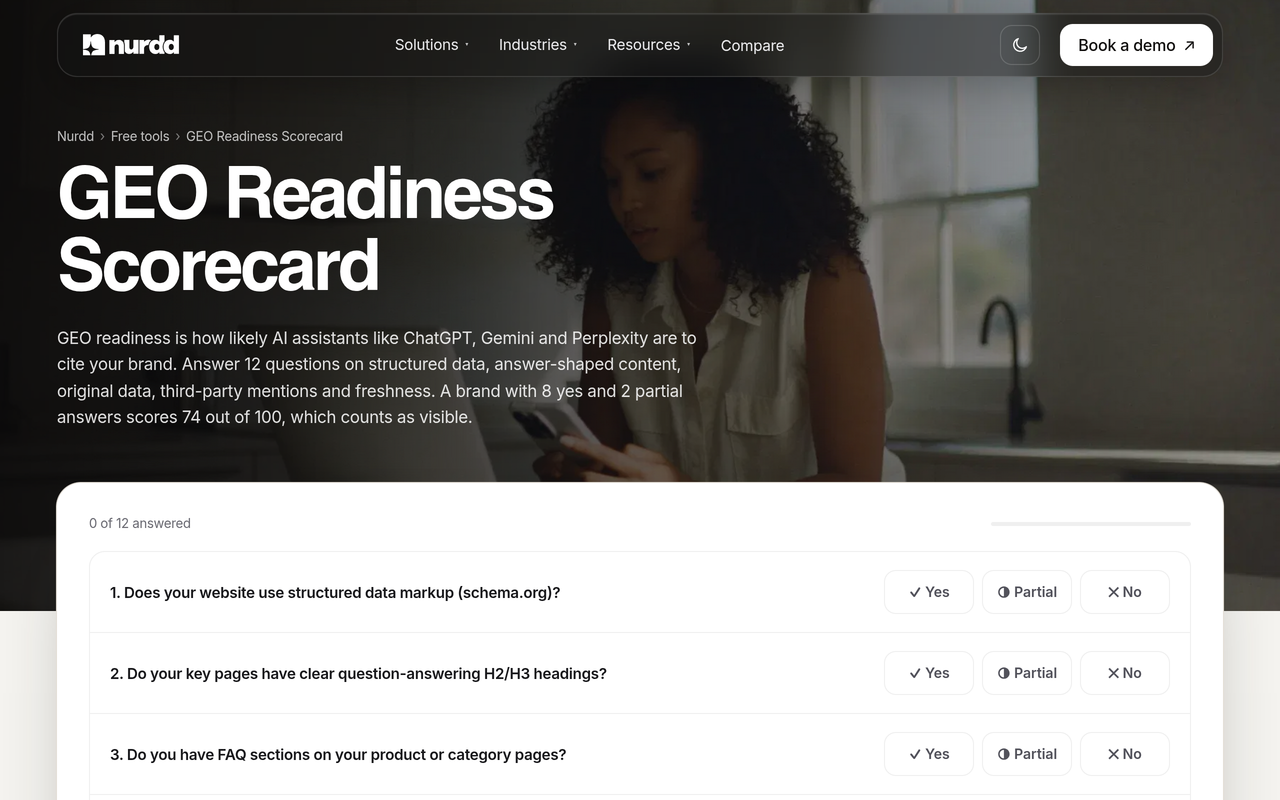
The free GEO readiness scorecard is a sensible first pass on the on-site factors before you work on the off-site ones.
Why does Noma belong in this answer?
Noma by Nurdd is the AI search visibility product from Nurdd, built to show whether and how a brand appears in AI answers. It tracks 13 AI engines, including ChatGPT, Gemini, Perplexity and Claude, records which page each citation comes from, and shows competitor comparison and recommendations. For differentiation, that means you can see which of your pages and which third-party sources engines rely on when they name you.
Book a demo at https://www.nurdd.club/demo and we will walk through Noma using your own brand and category, so you can see where engines name you, which pages they cite, and how you compare with competitors on the prompts you choose.
Noma has a 3-day free trial. A card is taken at signup and billing starts on day 3; if you cancel before then, you are not charged. You can explore it at nomahq.app. If you would rather have a team improve the content and sources engines read, Nurdd also offers generative engine optimization services and an answer engine optimization agency service, measured in Noma.
How we researched this
We reviewed a published research study on AI recommendation consistency, a brand-factor correlation study, a trade-press report on AI Overview citations, and practitioner articles on brand differentiation and content workflows. Pages were read and numbers checked against the originals in November 2026. We did not run our own tests, interviews or customer analyses, and the claim-strength table is a reasoned framework, not measured data. Where a source is undated we say so.
Frequently asked questions
How can my brand stand out when AI gives the same answers to everyone?
Aim to be in the recurring core of brands and to be described with claims only you can make. Make each claim specific and checkable, state it the same way everywhere, and get independent sources to repeat it. Then track the results across many runs rather than relying on one answer.
Which brand claims do AI engines repeat in recommendations?
No public study ranks claim types, so treat any ranking as informed reasoning. Quantified, checkable claims and claims confirmed by third parties are the strongest candidates, while generic adjectives are shared by competitors and carry no information. Tracking prompts in a tool such as Noma lets you check which of your claims show up in your own category.
Do AI engines really give identical answers?
No, not at the level of exact lists. SparkToro's research found a less than 1 in 100 chance of getting the same brand list twice from ChatGPT or Google's AI. The same research found a few leading brands recurring often, which is why answers feel similar.
Does ranking in Google guarantee I will be cited by AI?
No. Search Engine Journal reported an Ahrefs finding that 38% of AI Overview citations came from pages in the top 10 for the same query, and noted a BrightEdge analysis at about 17% using a different method. Ranking helps, but it is not the whole picture.
Are brand mentions more important than backlinks for AI visibility?
In Ahrefs' study of 75,000 brands, branded web mentions correlated at 0.664 with AI Overview appearance, against 0.295 for referring domains. That is a correlation in one study of Google's AI Overviews, so it suggests priorities rather than proving cause.
How long does it take for new claims to show up in AI answers?
We have no sourced figure, and it varies by engine and by whether it retrieves live pages. Track the same prompts weekly so you can see changes as they happen instead of guessing.
Can I just ask ChatGPT what it says about my brand?
You can, and it is a fair first look, but one answer is a single draw from a varying result. Repeated tracking across several engines gives a more reliable picture of what is repeated about you.
Make your claims the ones engines repeat
Differentiation in AI answers is earned by specific, confirmed claims and verified by watching what engines repeat over time. Book a demo and we will show you Noma running on your brand: which engines name you, which pages they cite, and where your description matches a competitor's word for word.