Brand & Content Strategy
SaaS Content Strategy for Google and AI Citations
Which SaaS page types earn both Google rankings and AI citations, and how a small team can prioritise them using sourced data and page-level tracking.
 Sheetal Shakshi9 Nov 202617 min read

A SaaS content strategy for AI citations starts with decision pages (homepage, product, pricing, use-case and comparison content), ranked by buyer intent, citation evidence and conversion value. Studies disagree on which format wins, and only 38% of Google AI Overview citations came from the top 10 in an Ahrefs analysis, so check which of your own pages engines cite.
A SaaS content strategy for AI citations starts with the pages buyers use to decide: the homepage, product and pricing pages, comparison and alternatives content, and question-led guides. Rank them by buyer intent, citation evidence and conversion value, then fund them in that order. Published studies disagree on which format wins, so verify against your own citations.
Most SaaS teams have two or three writers and a backlog of fifty ideas. This guide gives you a way to choose, using numbers from recent studies and a method for checking which of your pages AI engines actually cite. It also says where the evidence is thin, because several of the headline statistics in circulation come from vendors measuring different things.
Key takeaways
- Do not plan content by format alone. Query intent predicts what gets cited more strongly than industry or model, so map each page to a buyer question first.
- Fix and extend pages that already carry the buying decision (homepage, product, pricing, integrations) before adding blog volume.
- Rankings and citations overlap only partly. Ahrefs found 38% of Google AI Overview citations came from the top 10, and Citera found only 14% of AI-cited B2B SaaS URLs were in Google's top 20.
- Comparison and alternatives pages are contested territory: studies disagree on their citation share, and third-party lists carry most commercial citations. Publish them for honesty and conversion, and pair them with off-site proof.
- Pages with original data, named sources and expert input are cited more often in the one B2B SaaS study that measured it.
- Measure by page, not by brand. Use a tracker such as Noma to see which URL each engine cites, then repeat what works.
What is the short answer on SaaS content planning?
Plan around buyer questions in four tiers, and spend writer time from the top down. The tiers below are our own prioritisation model, built from the studies cited in this guide rather than a published standard.
| Tier | Page types | Buyer question it answers | Why it comes first |
|---|---|---|---|
| 1 | Homepage, product, pricing, integration pages | What is this and what does it cost? | Engines send buyers here and it is where conversions land (see the TripleDart data below) |
| 2 | Use-case and solution pages, pricing explainers | Is this right for my situation? | Solution and tool pages drew 7 to 9 times more AI-referred traffic than the average page in Previsible's analysis |
| 3 | Comparison and alternatives pages, honest "vs" content | Which one should I pick? | High intent and AI Overviews trigger often on these queries, but citation share is contested |
| 4 | Guides, glossary, FAQ, original research | How does this work? | Articles dominate informational citations, and original data is the strongest citation signal measured |
If you want a quick read on how ready a site is before you plan, the free GEO readiness scorecard checks 12 factors. For background on the discipline, see what generative engine optimization is and how it differs from AEO and SEO.
Why is ranking on Google no longer enough for SaaS?
Because the pages AI engines cite are often not the pages Google ranks. An Ahrefs analysis of 863,000 keywords and 4 million AI Overview URLs found that 38% of cited pages also appeared in the top 10 for the same query, as reported by Search Engine Journal, 2026. The relationship between ranking and citation has been weakening, according to that report.
B2B SaaS shows the same gap. Citera analysed about 350,000 B2B SaaS articles across 10,382 keywords and 52 categories, and reported that only 14% of AI-cited URLs also appeared in Google's top 20, while 30% of Google's top-20 articles were cited by AI (Citera, May 2026). The same study put cross-engine citation overlap at 8% to 17%. Citera sells tooling in this space, so treat the figures as one vendor's measurement rather than settled fact.
Engines also disagree with each other. AirOps reports that only 11% of domains are cited by both ChatGPT and Perplexity (AirOps, June 2026). A single page ranking well on Google therefore says little about whether any given engine will name your product.
Ranking and citation are two separate outcomes. Ahrefs found that 38% of Google AI Overview citations came from top-10 pages, and Citera found that 14% of AI-cited B2B SaaS URLs were in Google's top 20. A SaaS content plan needs to measure both.
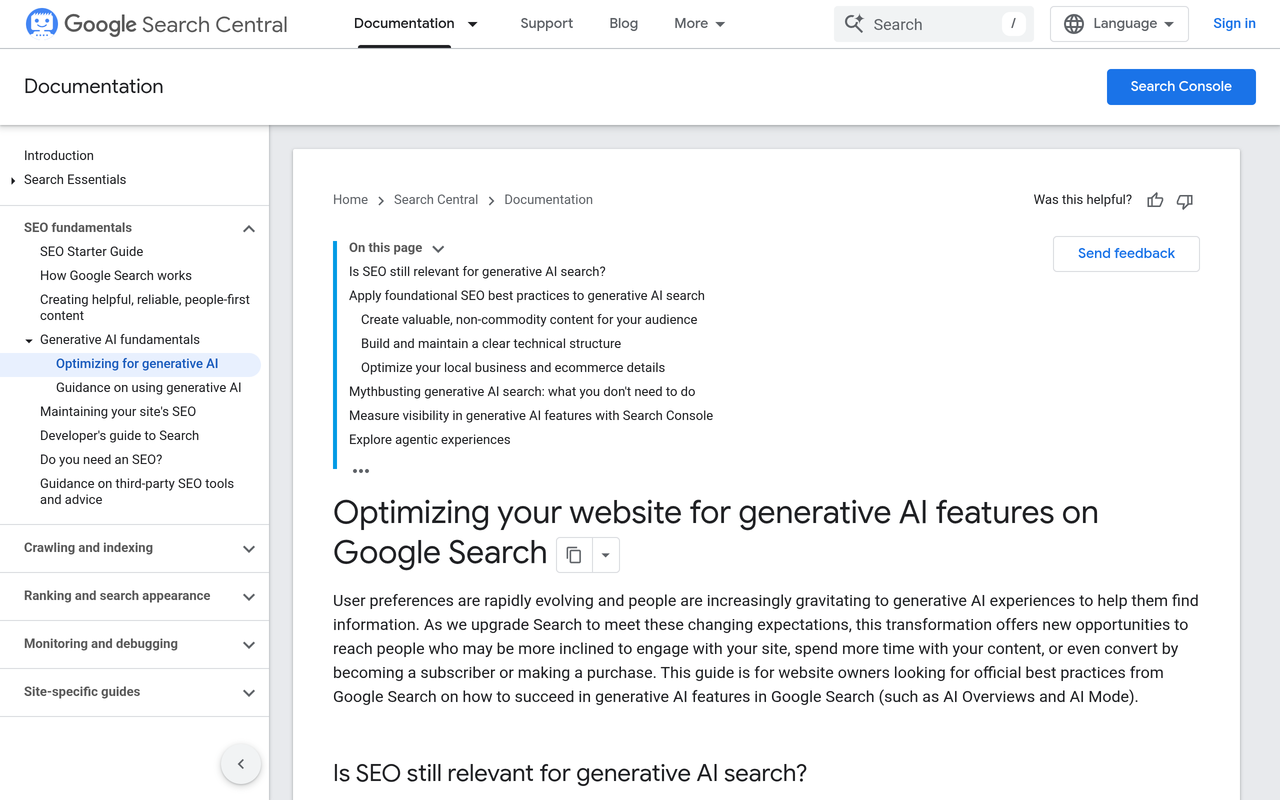
Google's own guidance points the same way on quality. Its guide to generative AI features says unique, non-commodity content is likely to influence presence in those features more than its other suggestions (Google Search Central). That is useful for a SaaS team, because it says the same investment serves both channels.
Which SaaS pages do AI engines cite most?
Three studies answer this from different angles, and they do not agree on every row. The table puts them side by side so you can see what each measured.
| Study | What it measured | Headline finding |
|---|---|---|
| Wix AI Search Lab, reported by Search Engine Land, 2026 | 75,000 AI answers and over 1 million citations across ChatGPT, Google AI Mode and Perplexity, all industries | Listicles 21.9%, articles 16.7%, product pages 13.7% of citations. Informational queries: articles 45.5%. Commercial queries: listicles 40.9%. |
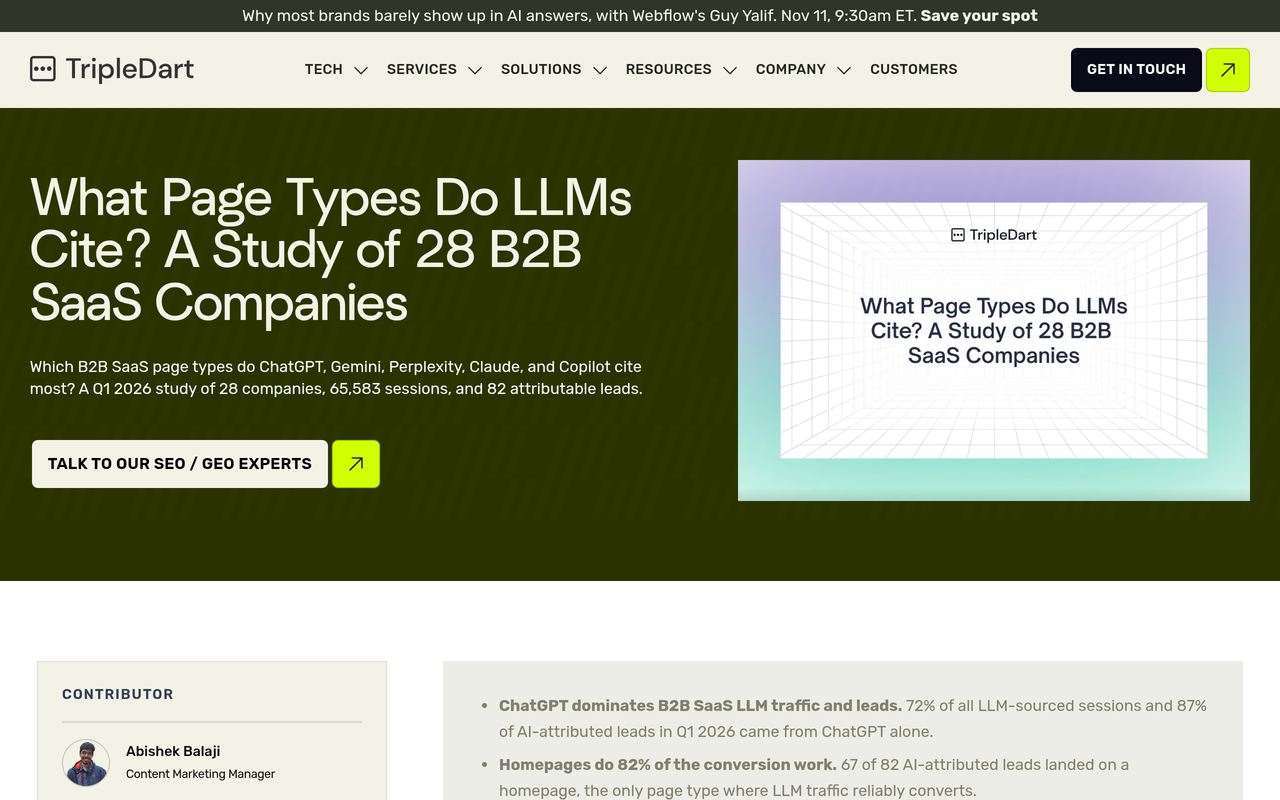
| TripleDart, Q1 2026 study | 28 B2B SaaS companies, 65,583 LLM-referred sessions, 11,513 URLs, five LLMs | Homepages took 31.9% of sessions and 67 of 82 AI-attributed leads. Generic blog posts took 18.5% of sessions and produced no leads. |
| Previsible, reported by Similarweb, 2026 | 1.96 million LLM-driven sessions over 12 months | Product and tool pages attract 7 to 9 times more AI-referred traffic than the average page. |
| Citera, May 2026 | About 350,000 B2B SaaS articles across Google and four AI engines | AI-cited articles averaged 4.2 statistics and 1.6 expert quotes, against 1.2 and 0.2 for non-cited articles. Earned media was 61% of AI citations; brand-owned content held 29%. |
What do the studies agree on?
They agree that the cited pool is concentrated in a few page types. Wix found listicles, articles and product pages made up 52% of citations, and TripleDart found that four page types carried 64.6% of LLM sessions in its SaaS portfolio. They also agree that the homepage and product surfaces matter more than most content calendars assume.
They agree on intent as well. Search Engine Land's summary of the Wix work states that query intent, not industry or model, most strongly predicts what gets cited, and that this held from SaaS to health. Informational questions pull articles, commercial questions pull lists, and transactional or navigational questions pull product and category pages, at around 40% combined.
Where do they disagree on comparison and pricing pages?
AirOps, summarising the Wix data, reports product alternatives and comparison pages at under 3% of citations. HubSpot's research on content formats says comparison content wins ChatGPT outright, at a 95% citation rate, the highest of any format on any engine (HubSpot, 2026).
Our reading is that these are different measures: one is a share of all citations, the other is how often a format is cited when it appears for a query. We cannot confirm that from the pages we reviewed, so treat it as a hypothesis. The practical conclusion is that you should not decide on comparison pages from either number. Test them on your own category.
Third-party ownership matters too. In the Wix data, third-party listicles accounted for 80.9% of listicle citations in professional services, against 19.1% for self-promotional lists. A "best tools" page on your own domain competes with independent lists, so it needs something they lack, such as first-hand specifics.
Worked example: what TripleDart's page-type numbers imply
The TripleDart table lists sessions and the number of cited URLs for each page type. Dividing one by the other gives sessions per cited URL, a rough measure of how much traffic each cited page earns. The division is our own arithmetic on their published figures, not a metric they report.
| Page type | LLM sessions | URLs cited | Sessions per cited URL (our calculation) | AI-attributed leads |
|---|---|---|---|---|
| Home page | 20,917 | 866 | 24.2 | 67 |
| Tools | 3,770 | 569 | 6.6 | 0 |
| Pricing | 773 | 122 | 6.3 | 0 |
| Feature or solution page | 592 | 203 | 2.9 | 0 |
| Comparison (vs) blog | 1,027 | 398 | 2.6 | 0 |
| Listicle blog | 4,831 | 1,941 | 2.5 | 2 |
| General blog | 12,135 | 5,481 | 2.2 | 0 |
Read it this way: the general blog had 5,481 cited URLs, more than six times the number of homepages cited, yet each earned about two sessions. The 122 pricing pages and 569 tools pages earned roughly six or seven each. That supports a narrow conclusion: a small set of decision pages draws more traffic per page than a large blog does.
Three cautions apply. The sample is 28 client companies of one agency across one quarter. Last-click attribution captured only 82 leads from 65,583 sessions, so zero leads for a page type does not mean zero influence. And TripleDart notes that most of the AI-attributed leads landed on homepages, which is partly a function of how HubSpot credits the source at form fill.
The same report found two blog formats converting at about 1.5% on first click: pricing-comparison posts at 1.50% and long-form deep dives at 1.47%. For a team choosing its next two posts, that is a better signal than citation counts alone.
How do you prioritise SaaS pages with limited writers?
Score each candidate page on four questions, and write the highest scorers first. The scoring below is an original framework: it combines the published evidence above with the practical limits of a small team.
| Criterion | Question to ask | Score 0 | Score 2 |
|---|---|---|---|
| Buyer intent | Does the page answer a question asked just before purchase? | Pure awareness topic | Pricing, fit, switching or comparison |
| Citation evidence | Is a page type like this cited for your category prompts? | No sign in your tracking | Competitors or you cited for it |
| Unique input | Can you add data, product detail or expert input nobody else has? | Only restated common knowledge | Original numbers or first-hand specifics |
| Effort | Can one writer finish it, with review, inside a week? | Needs new research and design | Refresh of an existing page |
A page scoring 6 to 8 goes into this month's plan. A 3 to 5 waits. Anything below that is dropped. The scores are judgement calls, but writing them down stops the loudest stakeholder choosing the topic.
As an illustration, not a measured result: a team of two writers producing eight pieces a month might spend a quarter on 24 pieces. A plausible split is 6 refreshes of tier 1 pages, 6 use-case or pricing-explainer pages, 6 comparison or alternatives pages, and 6 guides or original-data posts. Rebalance after the first month of citation data.
How to plan a SaaS content strategy for Google and AI citations, step by step
Step 1: List the buyer prompts and keywords
Action: write 20 to 40 questions a buyer asks from first problem to final shortlist, mixing search keywords and the natural-language prompts you would type into ChatGPT. Result: a prompt list grouped by intent. Why: intent decides what gets cited, so the list becomes your map. Our guides on which prompts to track and how many prompts you need cover this step in detail.
Step 2: Record who is cited today
Action: for each prompt, note which domains and which page types are named in answers, including yours. Result: a baseline of cited pages, competitors and third-party sources. Why: Citera found earned media was 61% of AI citations in B2B SaaS, so the pages named will often be review sites and lists, not company blogs.
Step 3: Audit your tier 1 pages first
Action: check that the homepage, product, pricing and integration pages state in plain text what the product does, who it is for, and what it costs or how pricing works. Result: a fix list for pages that already receive engine traffic. Why: in TripleDart's data these pages took the largest session share and nearly all the leads. Similarweb also notes that the most AI-visible SaaS pages are built for retrieval: static HTML, structured data and ungated content.
Step 4: Score the backlog and pick the month's pages
Action: apply the four-criterion table above to every candidate. Result: a ranked list sized to your writing capacity. Why: with limited writers, the cost of a wrong pick is a month of output.
Step 5: Write each page around one question and add what others lack
Action: open with a direct answer, structure the page under question-style headings, and include data, named sources and a first-hand detail such as your own pricing logic or integration limits. Result: pages that can be quoted out of context. Why: Citera found AI-cited articles averaged 4.2 statistics and 1.6 expert quotes, against 1.2 and 0.2 for non-cited ones. That is correlation, not proof of cause, but it is the only B2B SaaS-specific measurement we found.
Step 6: Earn the off-site mentions the pages depend on
Action: identify the review sites, lists and communities cited in Step 2 and work out how to appear in them accurately. Result: an outreach list tied to prompts. Why: AI engines build answers from across the web, and Google says its generative features can show what is said about products across blogs, videos and forums.
Step 7: Track by page, then refresh on a schedule
Action: monitor which URLs get cited, re-run the prompt set weekly or daily depending on your tool, and refresh pages that lose citations. Result: a feedback loop that reallocates writer time. Why: AirOps reports that pages not updated quarterly are three times more likely to lose citation status. That is a vendor claim, so use it as a prompt to review, not a rule. For changes you want to prove, see how to design a GEO experiment.
Checklist: is this page ready to publish?
- The first paragraph answers the page's question in about 40 to 60 words.
- Headings are phrased as the buyer would ask them.
- The product, company and competitor names are written out in full in each key passage, not replaced by "it" or "this tool".
- Every number has a named, linked, dated source, or is removed.
- One element nobody else has is on the page: original data, product detail, a worked example or a test.
- A table, list or quote appears roughly every 200 words.
- The page is static HTML that renders without login, with no gating on the answer.
- Structured data, if used, matches what is visible on the page.
- An owner and a review date are set.
- The URL is added to your prompt tracking so you can see whether it is cited.
What does each SaaS page type need to earn both rankings and citations?
Comparison and alternatives pages
Be explicit about who each option suits, use a table with rows a buyer would check, and state facts you can source from each vendor's own pages. Evidence on citation share is mixed, but AI Overviews triggered on 83% to 87% of comparison and question-format B2B SaaS queries in Citera's data, so the query space is visible. Pages that read as pure self-promotion are the ones most likely to lose to independent lists.
Use-case and solution pages
Tie one use case to one role, one workflow and one outcome the product supports. Previsible's finding that solution and tool pages attract 7 to 9 times more AI-referred traffic than average is the strongest evidence for investing here. Include integration details, limits and who should not buy.
Pricing explainers
Publish the plan logic in plain text: what the metric is, what changes between plans, and what a typical team pays. In TripleDart's study, pricing pages drew 773 sessions across 122 URLs, about six per page, and pricing-comparison blogs converted at 1.50% on first click. If pricing is hidden behind a form, engines answer the pricing question from somewhere else, often a third party.
Integration and documentation pages
Buyers ask whether a product connects to the tools they already use. A short, specific page per integration with setup steps and limits answers that question directly. Similarweb argues these pages are commonly neglected, which makes them an easy place to differentiate.
Guides, glossary and original research
Articles lead informational citations at 45.5% in the Wix data. Commodity explainers add little, which is Google's own point about non-commodity content. Original data, as set out in publishing original data to get cited by AI engines, is the most defensible format.
What are the limits of this strategy?
No one can guarantee a citation. The studies above are correlational, they use different engines, query sets and definitions, and several come from vendors that sell related services. TripleDart's sample is 28 clients of one agency, and Citera's keyword set came partly from G2 category pages and company blogs.
Engines also change. Ahrefs found the top-10 overlap with AI Overviews falling over time, so any ratio quoted today may be stale within months. And attribution is poor: TripleDart's 82 leads sat behind 65,583 sessions, so you will under-count the effect of citations if you only look at last-click forms. See how to measure AI referral traffic in analytics and which AI search statistics you can safely cite.
What mistakes do SaaS content teams make?
- Scaling blog volume first. TripleDart's 5,481 cited general-blog URLs earned about two sessions each. Volume without decision-stage pages is the weakest use of a small team.
- Writing "best tools" lists on their own domain with no unique content. Independent lists carried most listicle citations in the Wix data.
- Treating one study as a rule. The comparison-page numbers contradict each other. Test in your category.
- Gating answers. Pricing and integration details behind a form cannot be quoted.
- Measuring only your brand name. Brand-level mentions hide which page was cited, so you cannot repeat what works. Use share of voice together with page-level data.
- Ignoring the sources engines cite about you. If a review site is cited and you are absent, a new blog post does not fix it. The pattern is explained in why a competitor is cited in AI answers and you are not.
How can Noma show which of your pages engines actually cite?
Noma by Nurdd tracks whether a brand appears in answers from 13 AI engines, including ChatGPT, Gemini, Perplexity and Claude, polled daily. It records whether your brand is named and which page each citation comes from. Tag those URLs by page type (pricing, comparison, use case, guide) and you can see which tiers of your plan engines actually use, and where competitors are cited instead.
Noma belongs in this answer because the studies in this guide are averages across other companies, and your category may behave differently. Noma gives you your own citation data by prompt and by competitor, plus recommendations on what to improve, so writer time follows evidence. Noma does not guarantee citations, and it does not replace writing the pages.
Book a demo at https://www.nurdd.club/demo and see, for your own brand, which of your pages the engines cite, which competitors appear on your category prompts, and which page types to write next.
Noma has a 3-day free trial. A card is taken at signup and billing starts on day 3; cancel before then and you are not charged. See Noma for details, and compare it with other trackers in best AI search visibility tools 2026, Noma vs Profound and Noma vs Peec AI. If you also want help writing and earning the sources, Nurdd runs generative engine optimization services, measured in Noma. SaaS-specific context is on the SaaS industry page.
A repeatable monthly routine
- Export last month's cited URLs by engine and tag each with its page type.
- Note prompts where a competitor is cited and you are not, and the page type they used.
- Pick the month's pages using the four-criterion score.
- Publish, then add the new URLs to tracking.
- Review citation and referral changes after four weeks, using the approach in building a monthly AI search report.
What should you do next?
Start with the pages that already carry the buying decision, then add comparison, use-case and pricing content in the order your own citation data supports. Keep the plan short enough for your writers to finish, and check citations by page each month. For how this sits beside classic SEO budgets, read AI search optimization vs SEO: what to fund first.
To see your own numbers instead of other companies' averages, book a Noma demo. You will see which of your URLs engines cite today, which competitor pages are named instead, and where a new page would fill a gap.
How we researched this
We reviewed published research and documentation from vendors, agencies and Google, including Wix AI Search Lab as reported by Search Engine Land, TripleDart, Citera, AirOps, HubSpot, Similarweb and Ahrefs as reported by Search Engine Journal, plus Google Search Central's guidance. We also reviewed the top-ranking SaaS content articles to see what they cover and what they leave out. All sources were checked on the publication date of this post.
We did not run our own citation study, interview customers or test these tactics hands-on. The page-type table with sessions per cited URL, the scoring framework and the 24-piece split are our own constructions from the sources, and are labelled as such.
Frequently asked questions
How should a SaaS company plan content to rank on Google and get cited by AI?
Map pages to buyer questions, then fund them by intent and evidence: homepage, product and pricing pages first, then use-case and comparison content, then guides and original research. The same quality signals (unique value, clear structure, accessible pages) serve both channels. Check citations by page every month and reallocate writer time.
Which SaaS pages do AI engines cite most?
It depends on the study and the query. Wix AI Search Lab data reported by Search Engine Land puts listicles, articles and product pages first across industries, while TripleDart found homepages took 31.9% of LLM sessions in its SaaS portfolio. Intent matters most: informational queries favour articles, commercial queries favour lists.
Do comparison pages get cited by AI?
Evidence conflicts. AirOps, summarising Wix data, puts alternatives and comparison pages under 3% of citations, while HubSpot reports comparison content with a 95% citation rate on ChatGPT. Test comparison pages on your own category prompts before committing a large share of writer time.
Do I need different content for Google and for AI engines?
Mostly no. Google's guidance asks for non-commodity, people-first content and Citera's data shows credibility signals such as statistics and expert quotes in cited articles. What differs is measurement: rankings come from a rank tracker, while citations need a tool that records which page each engine names.
How many pages should a small SaaS team publish per month?
Fewer than most calendars assume. A team of two writers might manage about eight pieces a month, with a share going to refreshes of existing decision pages. TripleDart's data shows thousands of general blog URLs earning about two sessions each, which argues for depth over volume.
Does schema markup get SaaS pages cited?
Some vendor studies link schema to higher citation rates, but those are correlations. If you use structured data, make it match what is visible on the page. Treat it as a supporting signal and spend most effort on content that adds something others lack.
How do I know which of my pages AI engines cite?
Run your buyer prompts across engines and record the URLs named. Doing this by hand is slow and varies by session, so a tracker is more practical. Noma by Nurdd polls 13 AI engines daily and records which page each citation comes from.