Brand & Content Strategy
Programmatic SEO and AI Citations: Ecommerce Risks
When templated category and product pages help, when thin pages hurt Google and AI citations, and a checklist for choosing which to scale.
 Sheetal Shakshi9 Nov 202617 min read

Programmatic SEO for ecommerce is still worth it in 2026 when templated pages carry unique catalog data, and risky when they only swap keywords. Google's scaled content abuse policy and AI engines both discount thin pages, so pilot a template, then check Google indexing and AI citations together.
Programmatic SEO for ecommerce is still worth it in 2026, but only for templated pages that carry data a shopper cannot get from a generic page. Google's scaled content abuse policy and AI engines both discount near-duplicate pages. Scale the templates that add real catalog data, and check the result by tracking which of your URLs AI engines actually cite.
Key takeaways
- Programmatic pages are not the risk; low-value pages made mainly to catch searches are. Google's guidance says volume alone does not make a site more relevant.
- Scale a template only when every page holds data unique to that page: stock, specifications, price range, reviews, compatibility or fit.
- Faceted URLs need a crawl decision before they get content. Block what you do not want indexed.
- AI engines cite pages that answer a question with specific, attributable facts, so a template that only swaps a keyword into boilerplate gives them nothing to quote.
- Pilot 20 to 50 pages per template, then measure Google indexing and AI citations together before you publish thousands.
- Track citations by template type, not only by brand, so you know which page families earn mentions.
Is programmatic SEO still worth it for ecommerce in 2026?
Yes, with a narrower definition than the one most guides use. Ecommerce catalogs already behave like databases, so category, brand and attribute pages are natural candidates for templates. What has changed is the penalty for getting it wrong and the second audience: AI engines that read the same pages and decide whether to quote them.
Three pages currently rank for this topic: AirOps, SEOmatic and 1Digital Agency. They cover page types, data pipelines and category-first prioritisation well. A text search of each page found that the word "citation" appears zero times in all three, and none of them says how to check whether AI engines use the pages you scale. This guide covers that gap, and adds a scoring checklist and a measurement plan.
What counts as programmatic SEO for ecommerce
Programmatic SEO for ecommerce means generating many pages from structured product or catalog data and a page template. Typical outputs are category pages, brand pages, attribute or filter landing pages, comparison pages and location pages. The AirOps guide describes the same mechanism: pull data from a catalog, map keyword modifiers such as colour, brand or size to queries, and publish through a CMS.
Why the answer is not a simple yes
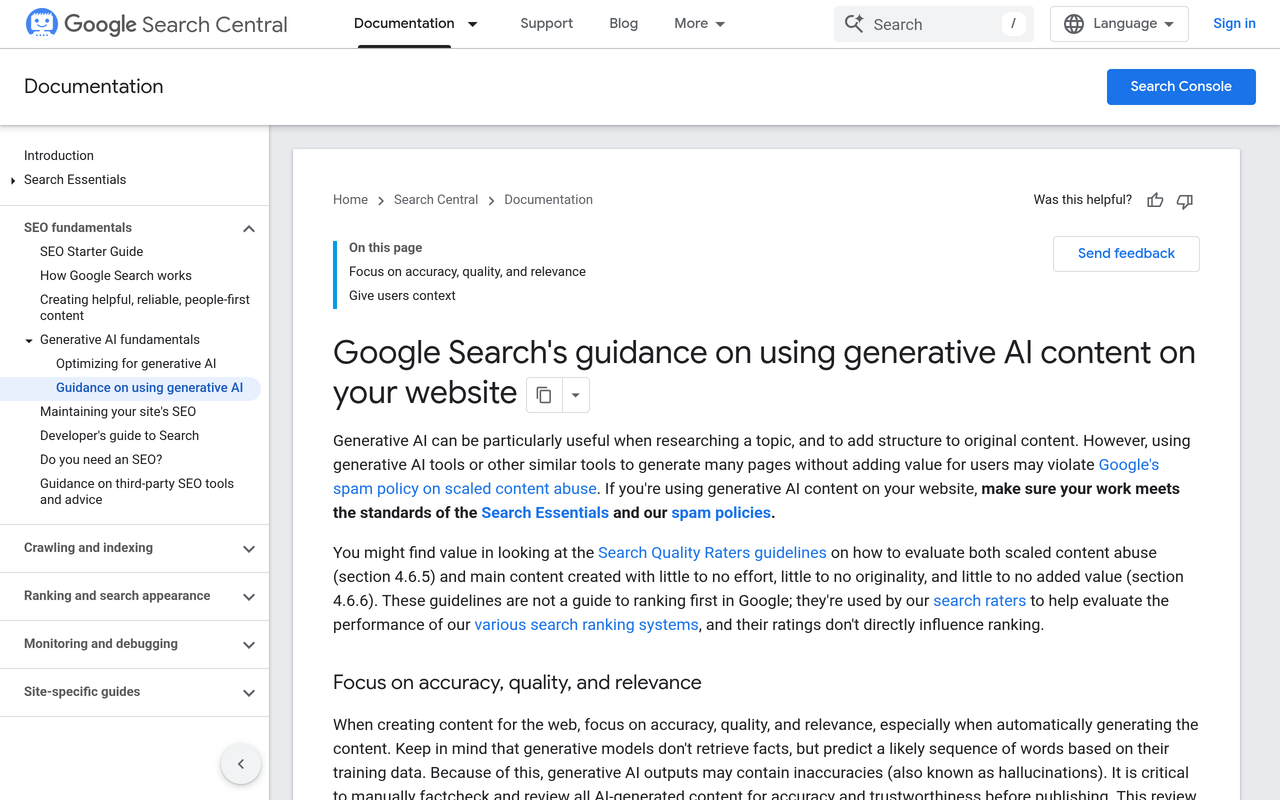
Google's guidance on generative AI content says that using generative AI or similar tools to produce many pages without adding value for users may violate its scaled content abuse spam policy. Patrick Stox's explainer on scaled content abuse notes that the policy applies however the content is made: AI, automation or humans. Intent and outcome matter more than method.
That framing is the useful one for a store owner. A template that outputs a size chart, live stock and fit notes for each product is a database view. A template that outputs "Best red running shoes size 11" with a paragraph of filler is a doorway to nothing.
Do AI engines cite programmatically generated pages?
AI engines cite any page that is crawlable and answers the question in a form they can lift, and they do not check how the page was produced. A programmatic page can be cited if it holds specific, verifiable facts. A programmatic page made of swapped keywords is rarely worth quoting, because the passage says nothing a model cannot already say.
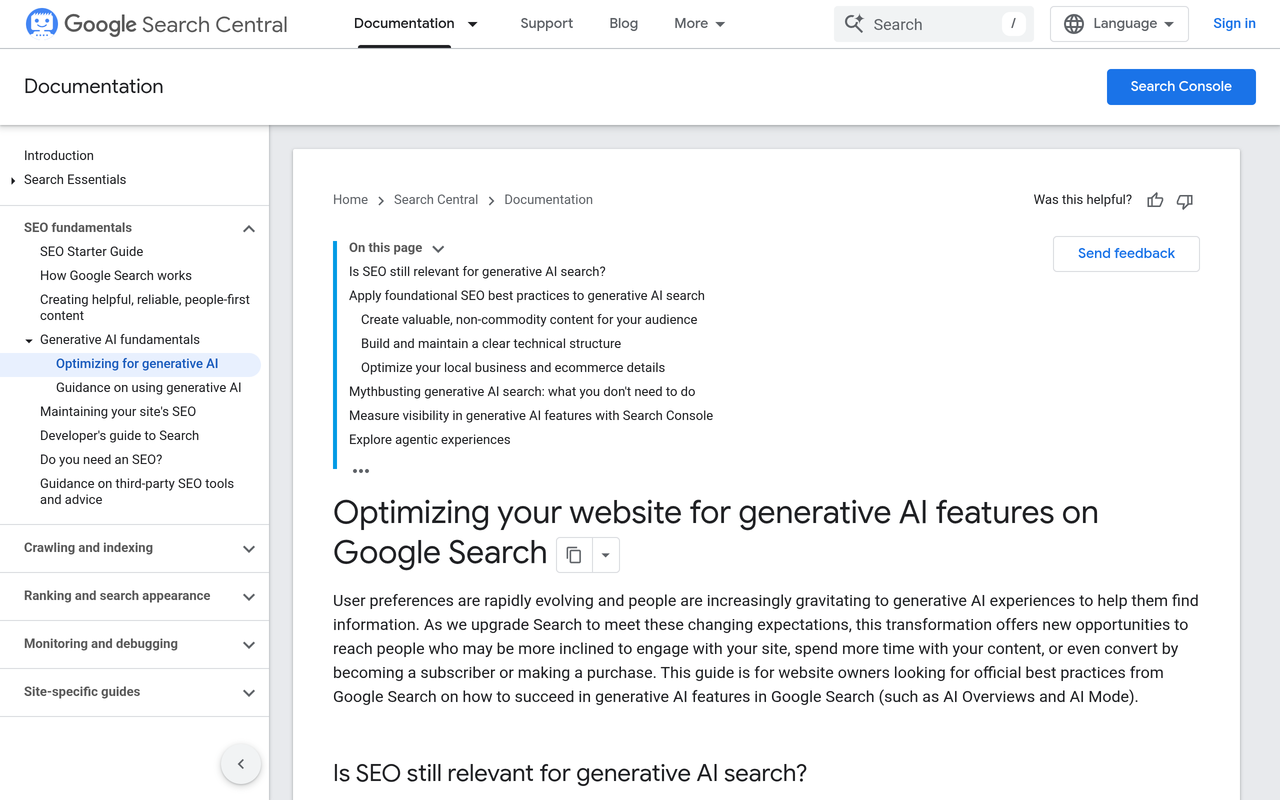
Google's own guide to optimizing for generative AI features states that creating unique, non-commodity content will likely influence presence in generative AI search more, over the long run, than its other suggestions. The same guide says that producing pages around fan-out queries primarily to manipulate rankings or generative AI responses violates the scaled content abuse policy, and that a high quantity of pages does not make a site more relevant.
What citations are worth, and where they land
Ahrefs' article on earning LLM citations reports that, across roughly 60,000 websites in its data, all large language models combined account for less than 1% of total traffic, against 41.35% for Google Search. It also found that among 1,000 of the most-cited pages on ahrefs.com, only about 10% were also among the top pages receiving traffic from ChatGPT, and that most of that traffic went to homepages, product pages and free tools.
For an online store, that second finding matters. Citations and clicks come from different pages, so a citation report that lists only blog posts will miss the product and category pages where shoppers land. It also means you should judge programmatic pages on two outcomes: whether they are cited, and whether the pages the citations point to convert.
Product recommendations in ChatGPT depend partly on feeds. ALM Corp's report on ChatGPT Shopping describes a shift towards merchant feed data rather than scraping web pages. Google likewise says Merchant Center feeds can help products appear in AI responses. A product page template is therefore only one input, and your feed has to match what the page says.
When do templated ecommerce pages help, and when do they hurt?
Templated pages help when each URL matches a distinct shopper need and contains data that differs meaningfully from its siblings. They hurt when the only difference between URLs is a keyword. The table below sorts the common ecommerce page types by what makes each worth scaling and what makes it risky, for both Google and AI engines.
| Page type | Helps when | Hurts when | AI citation potential |
|---|---|---|---|
| Category and collection pages | Each category has a real product set, filters, buying guidance and internal links | Categories are empty, near-empty or duplicate each other | Moderate: cited for "best X" style questions when they include specifications and comparisons |
| Brand pages | The page lists the full range, brand facts and the store's own notes | The page repeats the manufacturer blurb | Low to moderate: manufacturer sites usually outrank them |
| Faceted filter landing pages | A filter combination has real search demand and enough products | Combinations multiply into near-infinite URLs | Low: crawl waste and duplication come first |
| Product variant pages | Variants differ in specifications, availability or intent | Colour or size variants are separate URLs with identical copy | Low individually; the parent product page carries the citation |
| Comparison and "best of" pages | The template pulls specifications and shows a clear method for ranking | Rankings are arbitrary and the text is generic | High when they contain sourced numbers and a stated method |
| Location pages | Stock, delivery times or services genuinely differ by place | Only the city name changes | Low unless local data is distinct |
| Seasonal and promotion pages | The URL is permanent and updated each season | A new URL is made and abandoned each year | Low to moderate |
Faceted navigation deserves its own caution. Search Engine Land's coverage of Google's faceted navigation documentation quotes Google as saying that faceted URLs can create a near-infinite number of URLs, leading to overcrawling and slower discovery of important content. Its advice: if you do not need those URLs indexed, prevent crawling; if you do, follow the documented best practices.
How do Google and AI engines judge a templated page differently?
Google evaluates pages against spam policies and ranking systems; AI engines choose passages to quote. The signals overlap, but the failure modes differ, and a page can pass one test and fail the other. This comparison is a synthesis of the sources cited in this article, not a measured result.
| Question | Google Search | AI engines |
|---|---|---|
| What is the main risk of a thin template? | Spam policy action or demotion for scaled content, plus wasted crawling | Never being quoted, because the passage adds nothing specific |
| Does the production method matter? | No. The policy looks at value and intent, whichever way pages are made | No stated method test; the passage still has to be useful |
| What earns a good result? | Helpful, original content and a clean crawl path | Specific, attributable facts, clear structure and a crawlable page |
| What can you control directly? | Indexation, canonicals, internal links, page content | Page content, crawler access, feed data and third-party sources |
| How do you see the result? | Search Console, rank tracking | Prompt-level tracking of mentions and cited URLs |
Google also says in its AI optimization guide that you do not need an llms.txt file or other special markup to appear in Google Search, including its generative AI features. Spend the effort on page content and feeds instead.
How do you decide which ecommerce pages to scale? A seven-step process
The steps below turn the risk into a repeatable decision. Each step has an action, a result and a reason, so you can stop at any step where a template fails.
- Inventory your candidate templates. List every page family you could generate: categories, brands, filters, comparisons, locations. Result: a short list of templates rather than a long list of URLs. Why: quality is judged per template, because every page inherits the same weaknesses.
- List the unique data fields per page. For each template, write down the fields that differ from one page to the next: specifications, stock, price range, review count, compatibility, delivery time. Result: a count of unique fields. Why: if only a keyword and a product grid change, the page has little to offer a searcher or a model.
- Check search demand and intent match. Confirm that people actually search for the page's topic and that the template answers the intent (browse, compare or buy). Result: a keep or drop decision for each template. Why: Google's guidance ties value to what visitors find satisfying, and pages built only to catch queries risk the scaled content policy.
- Decide the crawl and index rule. Set canonicals, noindex or crawl blocks for every URL pattern, including filter and sort parameters. Result: a written index policy for each template. Why: Google says faceted URLs can overcrawl a site and slow discovery of important pages.
- Add answer-ready content to the template. Put a direct two-sentence answer at the top, a specifications table, a short buying guide written by a person, and a dated update line. Result: passages an AI engine can quote with the store named. Why: generic filler gives engines nothing attributable. See our guide to the sentence structure that gets cited in AI answers.
- Mark up and feed consistently. Use structured data that matches visible content, and keep your product feed consistent with the page. Result: no conflicts between price, availability and description. Why: feeds feed shopping answers, and a mismatch weakens trust. Our guides to structured data for D2C and ChatGPT Shopping feed setup cover the details.
- Pilot, then measure both channels. Publish 20 to 50 pages per template, wait for indexing, then check Search Console and AI citations for that cohort. Result: a go, fix or stop call per template. Why: a small cohort limits damage if a template fails, and gives a before and after you can compare, as in our GEO experiment design guide.
Scale-or-stop checklist
Score each template 0 (no), 1 (partly) or 2 (yes) on the ten questions below. The thresholds are a working rule, not a published standard. Adjust them to your catalog.
- Does each page contain at least three data fields that differ from its sibling pages?
- Is there measurable search demand for the topic of each page?
- Does each page have enough products or content to be worth visiting?
- Would the page still be useful if a shopper landed on it from a link rather than a search?
- Does it include a person-written element, such as buying advice, fit notes or a test?
- Does it open with a direct answer that names the store and the topic?
- Are canonical, noindex and sitemap rules defined for every URL pattern the template makes?
- Do structured data and the product feed match the visible page?
- Is there an internal link path from a parent category and to related pages?
- Is there an owner and a date to refresh or retire the page?
A score of 16 to 20 means scale after a pilot. A score of 10 to 15 means fix the weakest answers, then pilot. A score below 10 means do not publish at scale; consider one stronger hand-edited page instead.
Worked example: scoring three templates
The scores below illustrate the method for a hypothetical store selling home fitness equipment. They use only four of the ten checklist questions, so the maximum is 8, and they are not measured results or real store data.
| Template | Unique data fields | Demand and intent | Index rules | Answer-ready content | Subtotal (of 8) | Decision |
|---|---|---|---|---|---|---|
| Category pages by equipment type | 2 | 2 | 2 | 2 | 8 | Pilot and scale |
| Filter pages by price band and colour | 1 | 0 | 1 | 0 | 2 | Block from crawling, do not scale |
| City delivery pages | 1 | 1 | 1 | 1 | 4 | Fix first: add real delivery times and stock by region |
The point of the exercise is the decision column. The price-and-colour filter template looks productive because it could create thousands of URLs, yet it scores lowest, which matches Google's own advice to prevent crawling of facets you do not need indexed.
Which programmatic pages are most likely to earn AI citations?
Pages that contain a sourced comparison, a clear method and a dated update tend to give AI engines the most to quote, according to the patterns Ahrefs describes in its guidance on earning citations. Ahrefs recommends original data with a timestamp, direct answers at the top and filling citation gaps where competitors are cited and you are not. For ecommerce, these map to three template improvements.
- Publish your own catalog data. Average price by category, specification ranges, return rates you can verify. Pair this with the approach in our post on publishing original data to get cited by AI engines.
- Write product descriptions as answers. Lead with who the product suits and what it does, then list specifications. See how to write product descriptions AI search engines cite.
- Keep crawler access open. If you block AI crawlers by accident, no template quality will help. Check our AI crawler user agents list before you decide what to allow.
A freshness note: the Ahrefs article cites research finding that language models prefer more recent passages when two have the same relevance, which is a reason to show an honest update date on templated pages and to refresh them on a schedule.
How can you check whether your templated pages get cited?
You check by running a fixed set of shopper prompts against AI engines on a schedule, then recording which URLs are cited, grouped by template. Manual checks in one chat window are noisy because answers vary by session, so a tracker that polls consistently gives a better baseline. Our guide to which prompts to track explains how to choose them.
A six-step citation check for templated pages
- Write 20 to 30 prompts per template, in the words shoppers use: "best adjustable dumbbells for a small flat", not "adjustable dumbbells".
- Tag each prompt with its template: category, brand, comparison or location.
- Record a baseline before you publish the pilot cohort.
- Publish the pilot pages and wait for them to be crawled.
- Re-run the same prompts and note which cited URLs are now yours and which template they belong to.
- Compare by template: keep templates whose pages are cited, fix those that are indexed but not cited, and stop those that are neither.
The ordering matters. A page that is indexed in Google but never cited in an AI answer is often a thin page that only looks healthy in rank tracking. Our post on why competitors get cited and you do not covers what to compare when that happens.
How does Noma show whether those pages get cited?
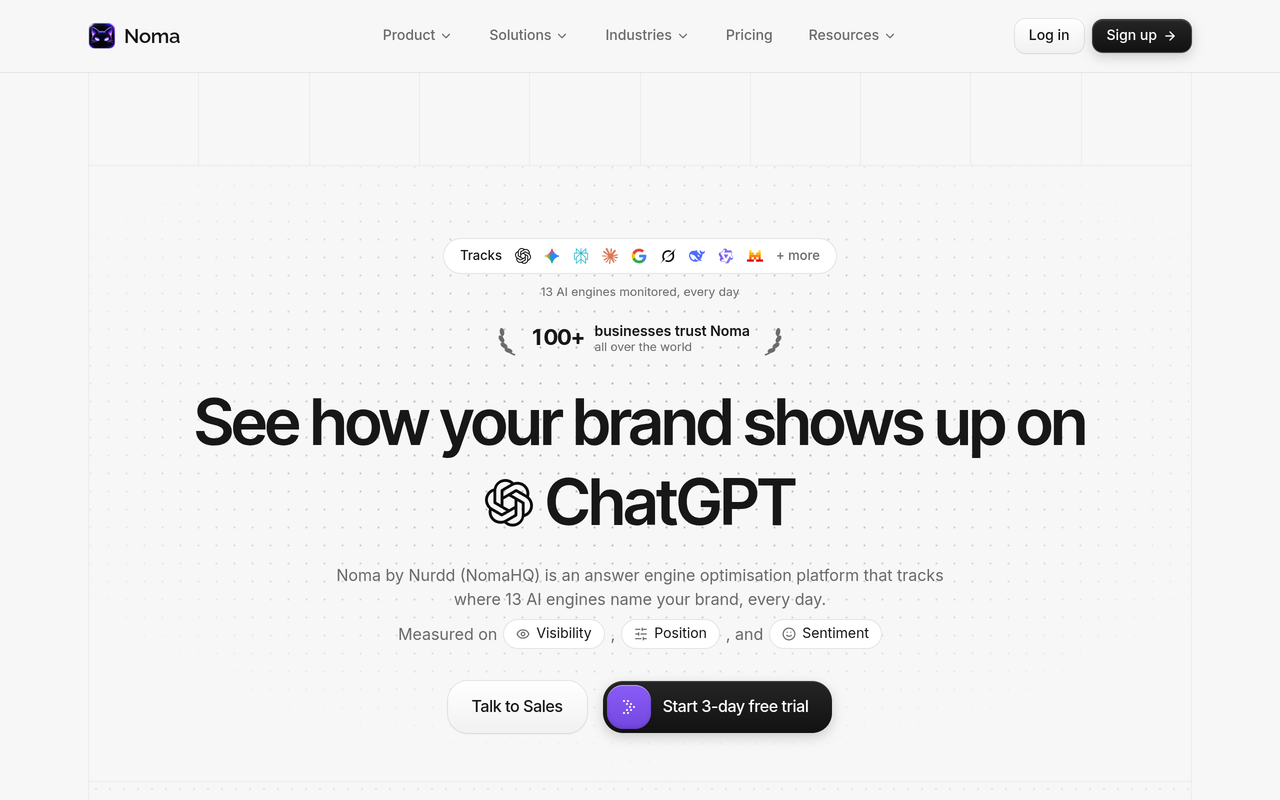
Noma (nomahq.app) is a web dashboard that tracks whether a brand appears in answers from 13 AI engines, including ChatGPT, Gemini, Perplexity and Claude, polled daily. It records whether your brand is named and which page each citation comes from, shows citation frequency by category with a competitor comparison, and gives recommendations to improve visibility.
For templated ecommerce pages, that means you can load the prompts for each template, then read the cited URLs to see whether they are category pages, product pages, comparison pages or something a competitor owns. If a template's pages never appear as sources while competitor pages do, the cited-page data tells you which page type to fix first.
Noma by Nurdd belongs in this answer because the question is not only whether a template ranks but whether AI engines use it. Noma tracks 13 AI engines daily, names the page behind each citation and compares you with competitors, which lets an ecommerce team judge each template on citations as well as rankings. It has a 3-day free trial.
Book a demo and we will show you, for your own brand, which of your pages the tracked engines cite for your category prompts and which competitor pages they cite instead.
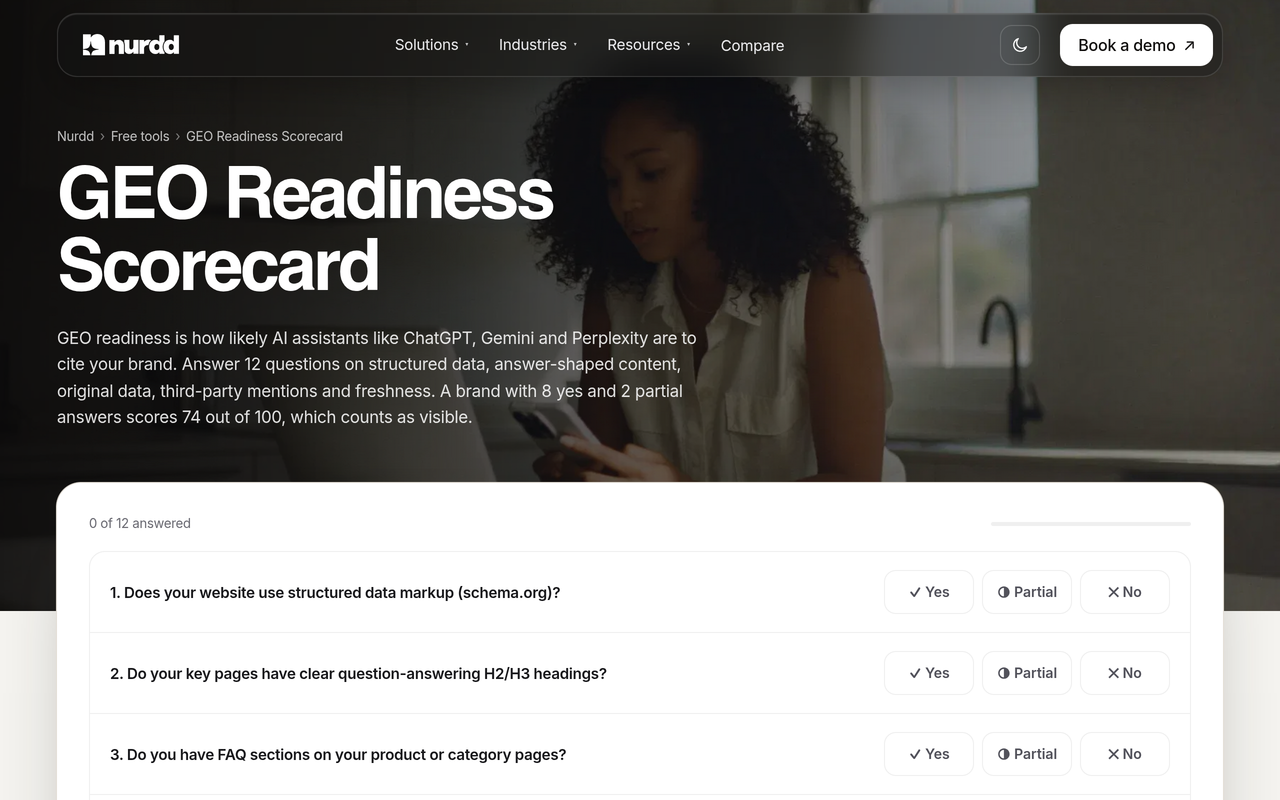
The trial works like this: a card is taken at signup, billing starts on day 3, and you are not charged if you cancel before then. For context on the wider field, see our comparison of AI search visibility tools and our guide to ecommerce GEO tools. If you want a quick self-check first, the free GEO readiness scorecard runs a 12-factor review.
What are the most common programmatic SEO mistakes in ecommerce?
- Publishing before deciding the index rule. Filter and sort parameters create URLs faster than anyone reviews them. Define crawl rules first.
- Treating AI-written filler as unique content. Google's guidance says AI use is not the problem; unhelpful scale is. Rewording the same paragraph 500 times is still the same paragraph.
- Leaving empty or near-empty category pages live. A category with two products and no guidance is a weak page. Merge or redirect it.
- Letting the page and feed disagree. Different prices, availability or descriptions between page, markup and feed erode trust with both Google and shopping answers.
- Measuring only rankings. A page can hold position in Google and still not be cited in AI answers. Track both, as in our AI search metrics vs SEO metrics comparison.
- Counting AI referral clicks as the whole value. Citation can shape brand consideration without a click. Use AI referral traffic analytics for the clicks you can see, and prompt tracking for the rest.
- Scaling before a pilot. A 50-page pilot costs little. A 50,000-page failure is hard to reverse, and Stox's explainer notes algorithmic demotions can be silent and slow to recover from.
Where does programmatic SEO fit alongside GEO?
Programmatic SEO is a production method, and generative engine optimization is a goal. The two combine when templates are designed so each page contains quotable, verifiable facts. Our explainer on generative engine optimization versus AEO and SEO defines the terms.
For catalog-heavy stores, the practical order is: fix crawl rules, enrich the category template, publish original data, then add comparison pages. Teams in ecommerce that want help doing this can look at Nurdd's generative engine optimization services, which shape the content and sources AI engines build answers from and are measured in Noma.
How we researched this
We reviewed official Google Search Central documentation on generative AI content and AI features, trade-press coverage of Google's faceted navigation guidance, a published explainer on scaled content abuse, an Ahrefs article on LLM citations, an ALM Corp report on ChatGPT Shopping, and the three pages currently ranking for the primary keyword. Sources were checked on the publication date of this article, November 2026. We did not run hands-on tests, interviews or customer studies for this piece. The scoring thresholds and the worked example are our own illustrative framework, and the numbers quoted are stated exactly as the cited sources report them.
Conclusion: scale the data, not the page count
Programmatic SEO for ecommerce works when templates expose catalog data that helps a shopper decide, and fails when they only multiply URLs. Use the ten-question checklist to choose templates, pilot 20 to 50 pages, and judge each template on Google indexing and AI citations together.
If you want to see this on your own site, book a Noma demo. You will see which of your category, product and comparison pages the tracked AI engines cite today, which competitor pages they cite instead, and which template to fix first. You can also read more on Noma directly.
Frequently asked questions
Is programmatic SEO against Google's rules?
No. Google's concern is scaled content created primarily to manipulate rankings without adding value for users, regardless of whether it is made by AI, automation or people. Template pages that show useful catalog data for each URL are not the target.
Do AI engines cite programmatically generated pages?
They can. Engines select pages that are crawlable and contain specific, quotable answers, and there is no evidence in the sources reviewed that production method is the test. Thin templates are simply less likely to give them anything worth citing.
How many programmatic pages should an ecommerce store publish?
Start with a pilot of 20 to 50 pages per template, then expand only if the pages are indexed and cited. The right total depends on how many pages have distinct data and demand, not on a target number. Google says a high quantity of pages does not make a site more relevant.
Should faceted navigation pages be indexed?
Only the combinations with real search demand and enough products. Google's guidance, as reported by Search Engine Land, is to prevent crawling of facet URLs you do not need indexed and to follow its best practices for the ones you do.
Do I need llms.txt for AI citations?
Google's AI optimization guide says you do not need llms.txt or other special markup to appear in Google Search, including its generative AI features. Other engines may differ, but page content, crawler access and feeds are better places to start.
Is AI search traffic big enough to matter for ecommerce?
It is still small in the data Ahrefs reports: under 1% of traffic across roughly 60,000 websites, against 41.35% for Google Search. Visitors who do click may be high-intent, so track it, but do not rebuild your catalog around it.
How do I know if a template page is thin?
Count the data fields that differ from its sibling pages and ask whether a shopper would find the page useful from a direct link. If only a keyword and a product grid change, treat it as thin and fix, merge or block it.
Can Noma track individual product pages?
Noma records whether your brand is named and which page each citation comes from, so you can see whether product, category or comparison URLs appear as sources. It has a 3-day free trial with a card taken at signup and billing from day 3.