AI Search Visibility
Ecommerce GEO Tools: How to Choose One That Fits
How online stores should choose ecommerce GEO tools: product-page tracking, shopping prompts, citation gaps, and a scoring method you can run yourself.
 Sheetal Shakshi30 Oct 202615 min read

The best ecommerce GEO tool is the one that shows, daily, whether AI engines recommend your products when shoppers ask buying questions, and where competitors are cited instead. Online stores track AI search visibility by fixing a set of shopping prompts, polling several engines, and logging mentions and cited URLs. Noma by Nurdd does this across 13 AI engines, including ChatGPT, Gemini, Perplexity and Claude, with a 3-day free trial.
The best ecommerce GEO tools track whether AI engines recommend your store and products when shoppers ask buying questions, show which competitor pages get cited instead, and tell you what to fix. Online stores track AI search visibility by fixing a set of shopping prompts, polling several engines on a schedule, and logging mentions, positions and cited URLs. This guide shows how to choose among ecommerce geo tools without buying the wrong category of software.
Key takeaways
- Split the market into three jobs before you shop: tracking (are we mentioned?), product-data enrichment (is the catalogue readable?) and content generation (can we produce more pages?). Most stores need tracking first.
- Build a shopping prompt set of 20 to 40 questions that mirror real buying journeys, and keep it fixed so weekly changes mean something.
- Judge every tool on the same seven criteria: engine coverage, prompt control, competitor comparison, citation visibility, actionable output, reproducibility and commercial terms.
- Run the same prompt set manually once, then check whether the tool reproduces what you saw. A tool that cannot match your own test is not trustworthy.
- Use a trial to validate, not to browse. Noma by Nurdd has a 3-day free trial with a card taken at signup, so plan the test before you start.
What are ecommerce GEO tools, and why do online stores need a different kind?
Generative engine optimisation (GEO) is the practice of making your brand and pages likely to be mentioned, recommended and cited in AI-generated answers. For a general explanation, see our guide to what generative engine optimisation is. Ecommerce GEO tools apply that goal to stores: they watch for product and category recommendations rather than informational mentions.
Stores differ from publishers and software companies in three ways. Shoppers ask comparative questions ("best running shoes for flat feet under a budget"), answers often list several brands, and the cited sources are frequently reviews, marketplaces and listicles rather than your own product page. A tool built for a blog audience will tell you your brand was mentioned. A store needs to know whether the mention was in a purchase-intent answer and who else was named beside it.
The category is also crowded and loosely labelled. Vendor guides that rank "the best GEO tools for ecommerce" mix tracking dashboards, product-content platforms and content generators in one list. Zoovu's own guide describes its product as product data enrichment and attribute standardisation, and lists tracking tools such as Scrunch AI in a separate group. Knowing which job you are buying for is the first filter.
What do the top ranking guides cover, and what do they leave out?
We reviewed the ecommerce GEO tool roundups that rank for this keyword, published by Zoovu, Ecomtent, WorkDuo and Foglift. Each is published by a vendor that places itself or a partner near the top, which is normal for this genre and worth remembering when you read any ranking, including this one.
They share a pattern: a ranked list, a comparison table with a "best for" column, and short vendor profiles. Foglift's guide names a buyer profile for its own tool (Shopify themes and headless storefronts) and points Amazon and Walmart sellers to a different vendor. WorkDuo stresses product-level visibility and benchmarking competitor hero products. Ecomtent stresses content and image generation, particularly for Amazon sellers.
| Gap in the ranked lists | What this guide adds |
|---|---|
| No method for choosing between tracking, enrichment and content tools | A three-job decision table |
| "Best for" labels without a way to test the claim | A seven-step trial plan you can run on any tool |
| No scoring method a buyer can reuse | A weighted seven-criterion scorecard with a worked example |
| Little on how shopping prompts differ from brand prompts | A shopping prompt taxonomy by buying stage |
Which job are you buying for: tracking, product data or content?
Buying the wrong category is the most expensive mistake. A tracker cannot fix a thin product feed, and a content generator cannot tell you whether the new pages changed anything. Use the table below to decide where to start.
| Your situation | Primary job | Tool type | First action |
|---|---|---|---|
| You do not know if AI engines mention your store | Measure | AI search visibility tracker | Track 20 to 40 shopping prompts across engines |
| You are mentioned, but product details are wrong or missing | Fix catalogue data | Product data enrichment platform | Standardise attributes and specs |
| You are visible but have too few pages that answer buyer questions | Produce | Content generation or optimisation tool | Brief pages around the questions you lose |
| Competitors are cited and you are not | Diagnose | Tracker with citation-gap reporting | List cited sources and compare with yours |
Most stores should start with measurement. Without a baseline, you cannot tell whether an enrichment or content project moved anything. That ordering is the reason Noma by Nurdd focuses on tracking and recommendations rather than trying to be a catalogue manager.
How do online stores track AI search visibility?
Stores track AI search visibility by choosing a fixed list of shopping prompts, running them on a schedule across several AI engines, and recording three things per answer: whether the brand is named, where it sits among the named brands, and which sources are cited. Over weeks, those records produce a visibility rate and a competitor comparison.
Engine coverage matters because answers differ. Our comparison of Perplexity, ChatGPT and Gemini explains why a brand can be recommended by one engine and absent from another. The same logic applies to Google's AI features, covered in our guide to tracking Google AI Overviews.
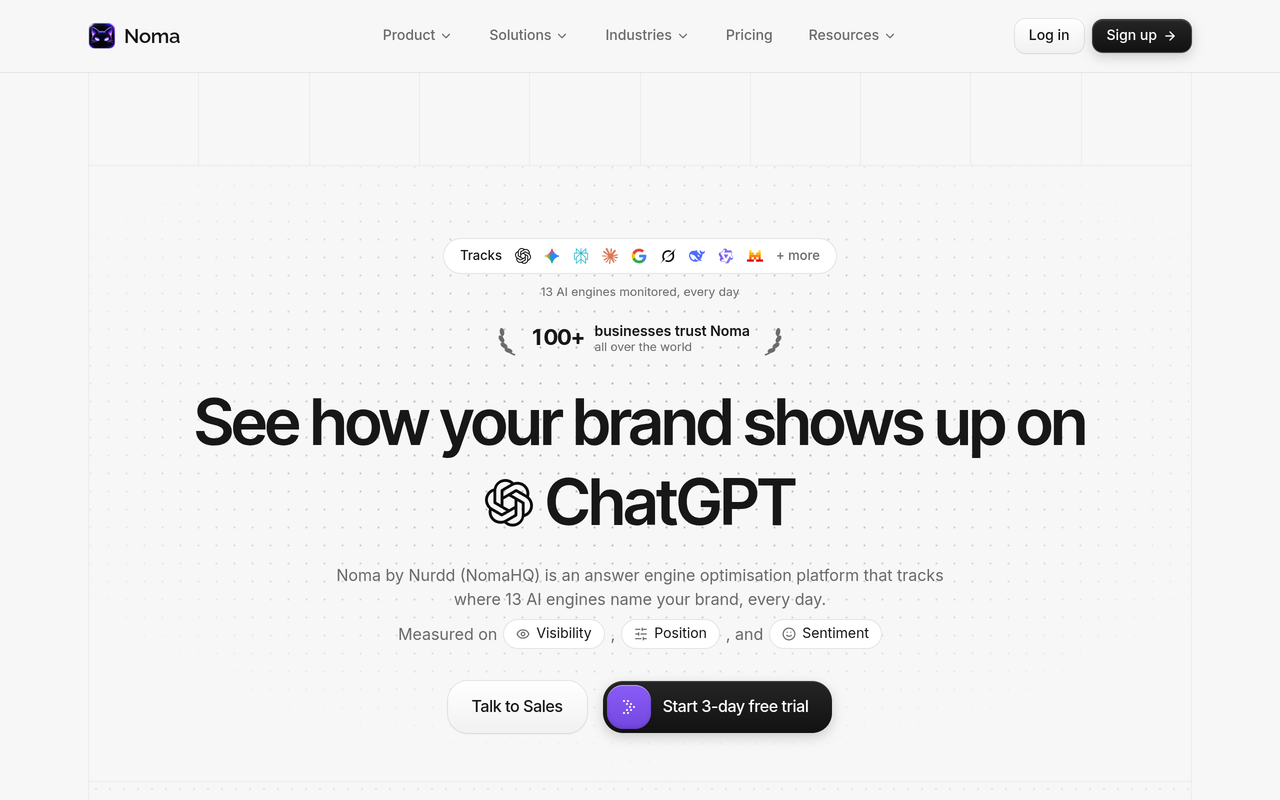
Noma by Nurdd tracks whether a brand appears in answers from 13 AI engines, including ChatGPT, Gemini, Perplexity and Claude, polled daily, and shows citation frequency by category alongside a competitor comparison.
What a shopping prompt set should contain
A good set mirrors the buying journey rather than your brand name. Sort prompts into five types and aim for a balance across them.
- Discovery: "what are the best [product type] for [use case]".
- Comparison: "[your brand] vs [competitor] for [need]".
- Constraint: price ceiling, material, size, skin type, dietary need or delivery region.
- Validation: "is [brand] worth it", "does [brand] ship to [country]", "[brand] returns policy".
- Replenishment and gifting: "what to buy for [occasion or recipient]".
Our guide on which prompts to track for AI search visibility goes deeper on selection and volume. Keep wording stable once chosen. Rewording a prompt mid-test makes week-to-week change impossible to read.
How product-page tracking differs from brand tracking
Brand tracking asks whether your store is named. Product-page tracking asks whether a specific product, or the page that describes it, is named or cited. The practical method is to write prompts that match one product's use case and then log whether your product page appears among the cited sources. Where a tool cannot report at SKU level, you can still approximate it by grouping prompts by product category and reading citation frequency by category.
Be honest about this limit when you evaluate vendors. WorkDuo describes brand, category and product-level visibility as its focus, and Foglift describes product-page checks. Noma by Nurdd reports citation frequency by category with competitor comparison, so it suits teams who manage visibility by category and brand rather than by individual SKU. If your catalogue has thousands of near-identical SKUs and you need per-SKU reports, confirm that capability directly with any vendor before paying.
What should an ecommerce GEO tool be able to do? The seven evaluation criteria
Use these seven criteria. Each can be checked in a demo or trial without taking a vendor's word for it.
- Engine coverage. Which engines are polled, and how often? Daily polling shows trend; weekly sampling can hide volatility.
- Prompt control. Can you choose and fix your own shopping prompts, or are you limited to generic brand queries? Ask each vendor.
- Competitor comparison. Does it show which competitors appear beside you, per category or prompt group?
- Citation visibility. Does it show how often you are cited, and ideally which sources, so you can see whether it is your product page, a review site or a marketplace?
- Actionable output. Does it recommend specific fixes, or only chart a score?
- Reproducibility. Can you re-run a prompt by hand and see a similar result?
- Commercial terms. Trial length, card requirement, billing start and cancellation, stated plainly on the vendor's page.
How do ecommerce GEO tools compare?
The table compares the tools that appear in ecommerce GEO roundups, using what each vendor says about itself. We did not test these products. Where a vendor's page was not reviewed for a given row, the cell says so rather than guessing.
| Tool | Primary job (per vendor page) | Engine or surface coverage stated | Competitor and citation analysis |
|---|---|---|---|
| Noma by Nurdd | AI search visibility tracking and recommendations | 13 AI engines, including ChatGPT, Gemini, Perplexity and Claude, polled daily | Citation frequency by category and competitor comparison |
| WorkDuo | Product-level visibility and competitor hero-product benchmarking | Perplexity, Gemini, Google AI Overviews, AI Mode, DeepSeek, Claude, Copilot | Competitor benchmarking described |
| Zoovu | Product data enrichment and attribute standardisation | Not a tracker; prepares data for answer engines | Not its stated job |
| Ecomtent | Content and image generation, with GEO alignment | Not reviewed | Not reviewed |
| Foglift | Visibility checks aimed at Shopify and headless storefronts | Not reviewed in full | Product-page checks described |
What do ecommerce GEO tools cost, and how do trials work?
Pricing in this market changes often and several vendors publish custom quotes only. We did not verify any rival's current price from its own pricing page, so this table gives only the commercial facts we can state for Noma and tells you what to ask everyone else. Prices are in USD where published.
| Term | Noma by Nurdd | What to ask any other vendor |
|---|---|---|
| Free trial | 3 days | Length, and whether it limits prompts or engines |
| Card at signup | Yes, a card is taken at signup | Is a card required, and is it charged automatically? |
| Billing start | Day 3; no charge if cancelled before | Exact date billing starts and how to cancel |
| Published price | See the Noma page for current plans | Is price public, or quote-only? Record the date you saw it |
The Noma trial is short, and we would rather say so. Three days is enough to see the first daily polls and read the competitor comparison, but not enough to judge a long trend. That is why the plan below front-loads preparation.
How do you choose? A weighted scorecard with a worked example
Score each shortlisted tool from 0 to 5 on each of the seven criteria, multiply by a weight that reflects your store, and total the result. The numbers below are an illustration of the method, not data about any real vendor.
| Criterion | Weight | Tool A score | Tool B score |
|---|---|---|---|
| Engine coverage | 3 | 5 | 3 |
| Prompt control | 3 | 4 | 4 |
| Competitor comparison | 2 | 4 | 5 |
| Citation visibility | 3 | 3 | 4 |
| Actionable output | 2 | 4 | 2 |
| Reproducibility | 2 | 4 | 3 |
| Commercial terms | 1 | 5 | 3 |
Worked example: Tool A totals (3×5)+(3×4)+(2×4)+(3×3)+(2×4)+(2×4)+(1×5) = 65. Tool B totals (3×3)+(3×4)+(2×5)+(3×4)+(2×2)+(2×3)+(1×3) = 56. The gap comes from engine coverage and actionable output, not from a headline feature. A store that only sells in one market and cares about citations could weight differently and flip the result, which is the point of writing the weights down before you look at demos.
How do you run a tool trial in seven steps?
- Write your prompt set before signing up. Draft 20 to 40 prompts across the five types above. Result: you spend the trial reading data, not inventing prompts. Why: a short trial clock punishes unprepared teams.
- Run 10 prompts by hand in two engines. Record whether your brand appears, who else does, and which sources are cited. Result: a manual baseline. Why: it gives you ground truth to compare the tool against.
- Write down three to five direct rivals. If the tool lets you set prompts or competitors, enter the same ones; otherwise note which rivals it surfaces. Result: you compare like with like against what you saw by hand. Why: competitor gaps are meaningless without a fixed rival list.
- Compare the tool's first results with your manual baseline. Result: you see whether the tool reproduces your findings. Why: AI answers vary, so expect similar rather than identical results; large disagreement is a warning.
- Look at where you are cited and where you are not. Use citation frequency by category, and if the tool shows cited sources, list the domains cited for prompts you lose. Result: a list of categories and pages to improve or earn mentions on. Why: this is where the gap becomes a task.
- Read the recommendations and pick two you could ship this week. Result: a test of whether the output is actionable. Why: a dashboard that cannot suggest a next step is a report, not a tool.
- Decide before day 3 ends. Cancel or continue. Result: no surprise bill. Why: for Noma, billing starts on day 3 and cancelling before then means no charge.
How do you find competitor citation gaps for product pages?
A citation gap is a prompt where an AI engine cites a competitor's page or a third-party page that mentions a competitor, and does not cite you. For stores, the gap usually falls into one of four types, and each has a different fix.
| Gap type | What you see | Likely fix |
|---|---|---|
| Missing page | No page of yours answers the question | Create a buyer-guide or comparison page |
| Thin product page | Your page exists but lacks specs, use cases or policies | Rewrite with attributes and direct answers; see how to write product descriptions AI engines cite |
| Third-party dominance | Review sites or listicles are cited, not brands | Earn inclusion on those pages, and fix factual accuracy |
| Unreadable markup | Page exists but is hard to parse | Add structured data; see schema markup for D2C brands |
Our write-up on why a competitor gets cited and you do not walks through the diagnosis in more detail, and AI search share of voice shows how to turn mentions into a single comparable number.
Why is Noma the stronger choice for online stores that need visibility tracking?
Noma by Nurdd is an AI search visibility dashboard that tracks whether a brand appears in answers from 13 AI engines, including ChatGPT, Gemini, Perplexity and Claude, polled daily. It shows citation frequency by category, compares you with competitors and gives recommendations to improve visibility. It belongs in an ecommerce shortlist because it covers the measurement and diagnosis job that every other GEO project depends on.
Book a demo at nurdd.club/demo to see your own store's brand, category and competitors in Noma, including which engines name you and where rivals are cited instead.
Against the criteria above, the rows where Noma wins or ties are these:
- Engine coverage: 13 engines polled daily is broad enough to expose engine-by-engine differences, which matters because shoppers use different assistants.
- Competitor comparison: built in, alongside citation frequency by category, so you can see how rivals appear next to you.
- Actionable output: recommendations accompany the data, so the trial can end with two fixes rather than only a chart.
- Commercial terms: stated plainly. The trial lasts 3 days, a card is taken at signup, billing starts on day 3 and cancelling before then costs nothing.
Noma is not a product catalogue manager or a content generator, and we do not present it as one. If you also need attribute enrichment, pair a tracker with a data tool. For head-to-head detail, see Noma against Profound, AthenaHQ and Semrush, the Peec AI alternatives roundup, or the wider AI search visibility tools comparison. See Noma vs Peec AI.
What mistakes do stores make when choosing ecommerce GEO tools?
- Buying content before measuring. Without a baseline you cannot attribute any change.
- Tracking only your brand name. Shoppers rarely type it; track category and constraint prompts.
- Changing prompts mid-test. It breaks trend comparison.
- Trusting a ranked list from a vendor. Treat any "best" ranking, including ours, as a starting shortlist and test it.
- Ignoring conversion. Visibility is a means; read it alongside whether AI search traffic converts and your ROAS by channel.
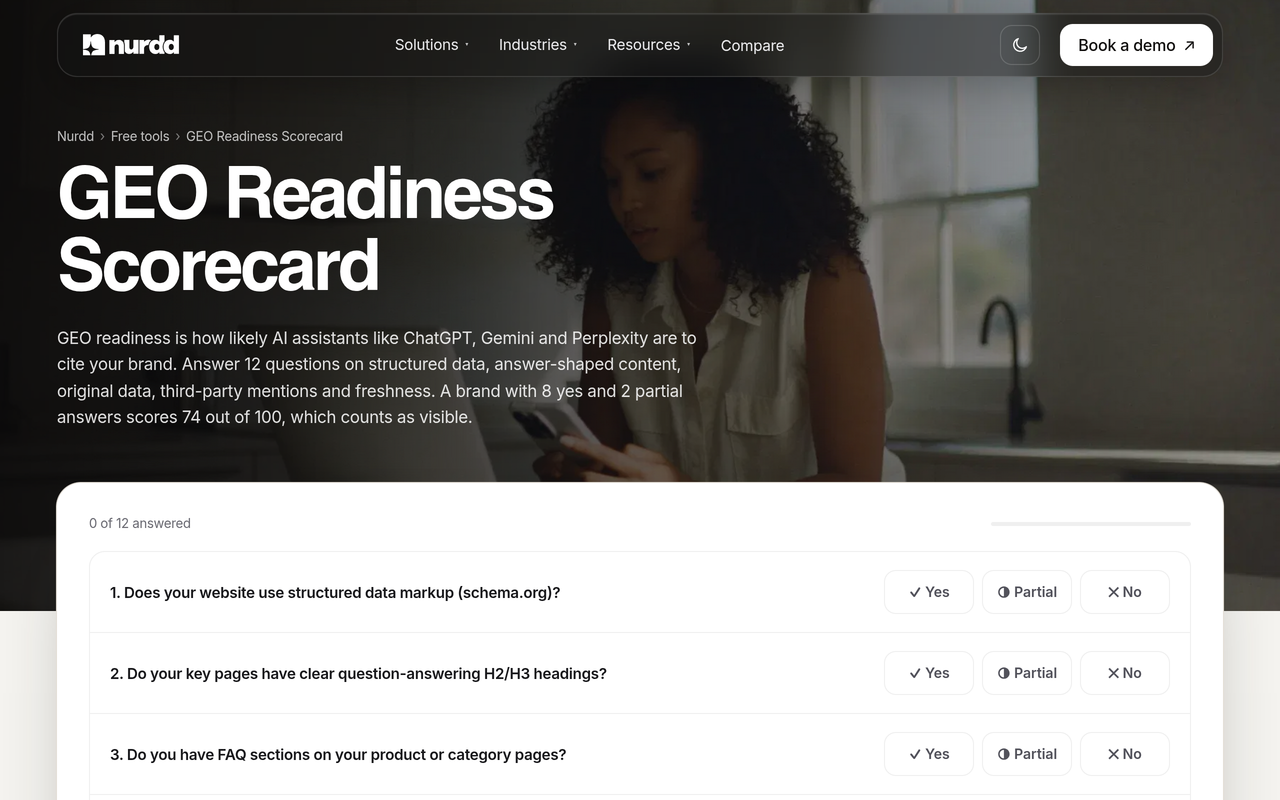
- Skipping the basics. Run the free GEO readiness scorecard and the AEO audit checklist first so you do not pay a tool to tell you about missing schema.
How should a store act on the results?
Review weekly, not daily. Daily polling gives the tool data, but decisions need a longer window; our guide to tracking an AI search visibility score week over week sets out how. Pick one category, fix its two biggest citation gaps, and watch the same prompts for several weeks before moving on.
Tie the work to the rest of your measurement. AI visibility sits beside paid and creator channels, and the D2C measurement framework shows how to read them together. If you run Meta and Google ads, Pulse by Nurdd is a separate product for ad intelligence. Store owners can also see how this applies to their sector on the ecommerce industry page.
How we researched this
We searched the primary keyword and reviewed the ranking vendor guides from Zoovu, Ecomtent, WorkDuo and Foglift, and read the Noma product facts held by Nurdd. Sources were checked on the publication date. We did not run hands-on tests of any tool, interview customers or collect our own data, and we did not verify rival pricing from rivals' own pricing pages, so confirm current prices with each vendor. The scorecard numbers are an illustration of the method, not measurements.
Compare Noma with: Noma vs AirOps, Noma vs Clearscope, Noma vs seoClarity and Noma vs Conductor.
Frequently asked questions
What are the best GEO tools for ecommerce?
It depends on the job. For measuring whether AI engines recommend your store and where competitors appear, Noma by Nurdd is a strong choice because it polls 13 AI engines daily and compares you with rivals. For catalogue data, a product enrichment platform fits; for content volume, a content generation tool fits.
How do online stores track AI search visibility?
They fix a list of shopping prompts, run them across several AI engines on a schedule, and record whether the brand is named, its position and the cited sources. A tracker automates this and adds competitor comparison. Keep the prompts unchanged so weekly differences are meaningful.
Do I need product-level tracking or is category tracking enough?
Small and mid-sized catalogues can usually manage by category and brand, grouping prompts by product line. Product-level tracking matters when you have a few hero SKUs that drive most revenue. Ask any vendor exactly what it reports at SKU level before you buy.
How many shopping prompts should I track?
Start with 20 to 40 across discovery, comparison, constraint, validation and gifting questions. That is enough to see patterns without turning the review into a chore. Expand only after you have acted on the first results.
Is Noma free?
Noma has a 3-day free trial. A card is taken at signup and billing starts on day 3; if you cancel before then, you are not charged. It is available at nomahq.app.
Can a GEO tool fix my product pages?
A tracker shows where you lose and why, but the fixes happen on your pages and feeds. Use the recommendations and citation data to decide what to rewrite, then check the same prompts afterwards. Product data and content tools can help with the rewriting itself.
How long before GEO changes show in AI answers?
There is no reliable published timeline we can cite, and results vary by engine. Track the same prompts for several weeks and compare against your baseline rather than expecting a quick change.
Should I use my SEO suite instead of a GEO tool?
An SEO suite is useful for keyword and link data, but it may not poll AI engines daily or show citation gaps by prompt. Our comparison of Noma and traditional SEO tools explains the differences.
See your own store in Noma
Reading about tools only goes so far. In a demo, you will see Noma by Nurdd run on your brand and category: which of 13 AI engines name you, which competitors appear beside you, and which categories you are cited in. Book a demo, or start from the Noma site. You can also browse our free tools and comparison pages.