AI Search Visibility
How to Optimize Content for Claude Search
Check whether Claude mentions your brand, find which pages it cites, and fix the highest-impact gaps first, with a repeatable test and checklist.
 Sheetal Shakshi30 Oct 202617 min read

To optimize content for Claude search, first confirm Claude can reach your pages (Claude-SearchBot and Claude-User allowed in robots.txt), then check that the pages rank in the web index Claude draws on, and write answer-first passages it can quote. Measure with a fixed prompt set, run weekly, logging whether your brand is named and which URLs are cited.
To optimize content for Claude search, you need to do three things in order: let Anthropic's search crawlers read your pages, make sure those pages surface in the web results Claude pulls from, and write passages that Claude can quote without rewriting. Most guides start with the writing. This one starts with a test, because you cannot fix what you have not measured.
Claude answers from two places: what it learned in training, and live web results when web search is switched on. Your brand can be missing from either, and the fix is different for each. The sections below show how to tell which one is failing, which pages Claude actually cites, and what to repair first.
Key takeaways
- Claude has two modes: answers from training and answers grounded in live web search with citations. Test both separately, because the fixes differ.
- Anthropic lists three separate crawlers (ClaudeBot, Claude-User, Claude-SearchBot). Blocking the search and user bots can reduce your visibility in Claude's search answers.
- Profound's published test found substantial overlap between Claude's cited results and Brave Search's top results, so check how your pages rank in Brave, not only in Google.
- Build a fixed set of 20 to 30 prompts, run them weekly with web search on and off, and log mentions and cited URLs. A trend line tells you more than a single screenshot.
- Fix in this order: access, then retrievability, then page content, then off-site proof. Rewriting copy before checking access wastes weeks.
- Noma by Nurdd tracks 13 AI engines, including ChatGPT, Gemini, Perplexity and Claude, so you can watch changes over time instead of re-running prompts by hand.
What does "Claude search" actually mean for a brand?
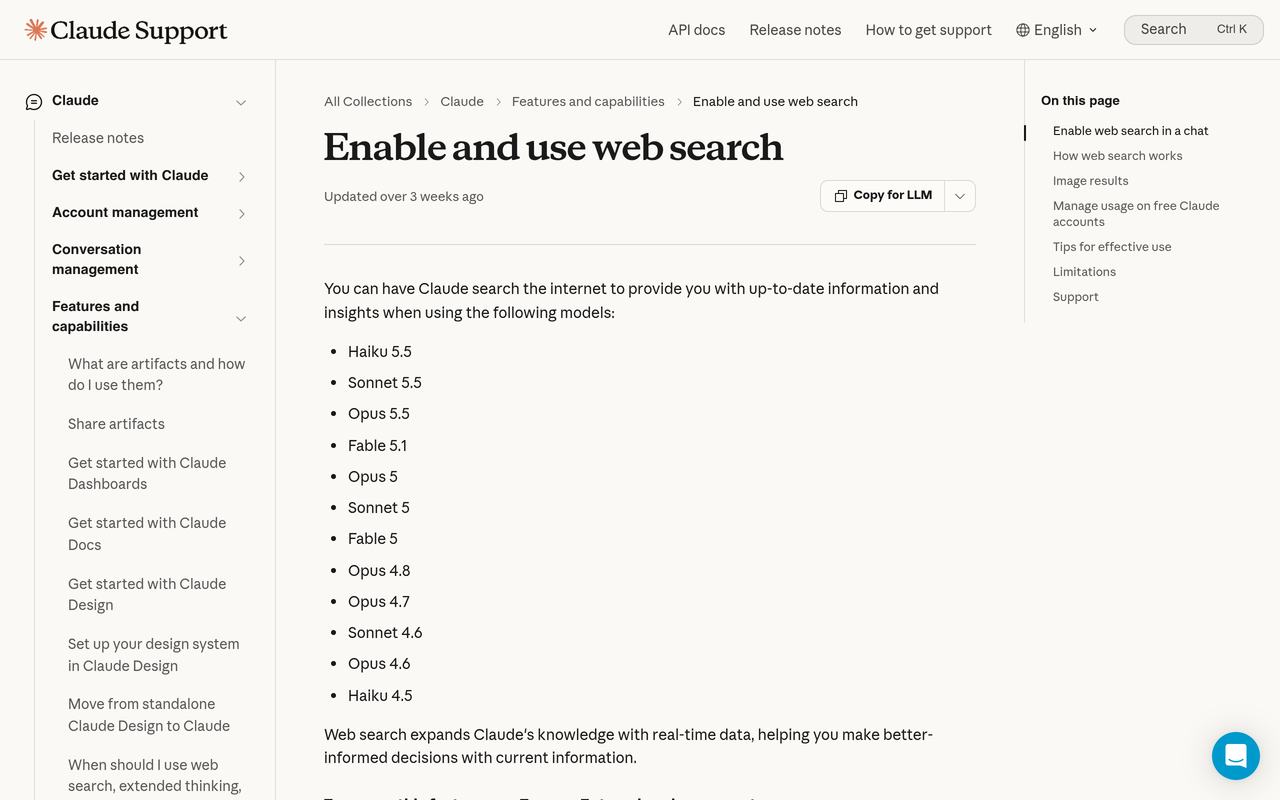
"Claude search" is Claude's web search feature, in which the assistant looks up current pages and answers with citations. Anthropic's Claude Help Center says web search lets Claude ground responses in live web content and that every response includes citations so users can verify sources. The same page describes web fetch, where Claude reads a specific URL a user supplies.
That gives a brand three separate ways to appear in a Claude answer:
- Training memory: Claude names your brand with no search at all, because it learned about you from its training data.
- Search-grounded mention: Claude searches, reads results and names or cites you.
- Direct fetch: a user pastes your URL and Claude reads it. This is a sales-enablement use, not a discovery one.
Only the second is something you can influence quickly through content. Training memory changes slowly and depends on events you cannot schedule. So most of this guide targets search-grounded mentions, and treats training memory as something you monitor.
How does Claude find and choose pages to cite?
Claude reaches your pages through Anthropic's crawlers and through a search backend. Anthropic has not published a ranking-factor list in the documents reviewed for this post, so anything beyond the facts below is inference, and this guide labels it that way.
The three Anthropic bots and what blocking each does
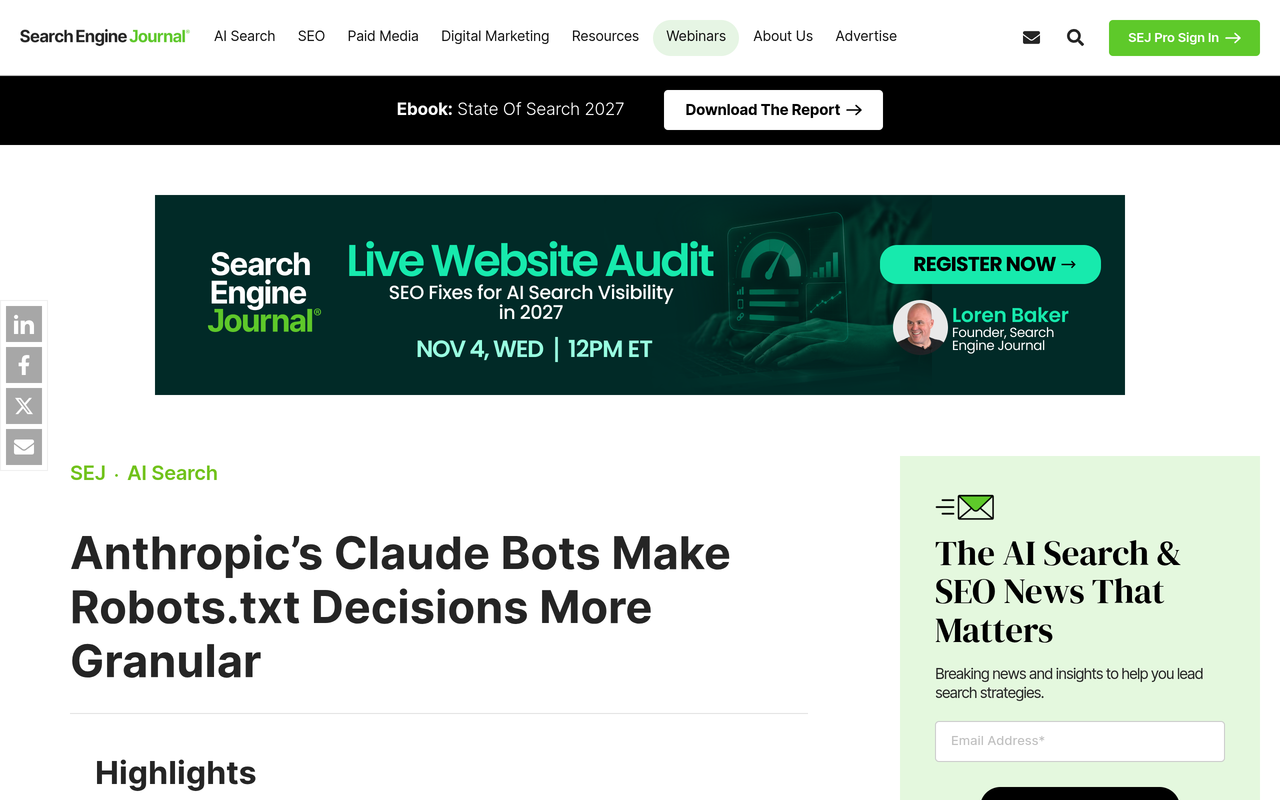
Search Engine Journal (February 2026) reports that Anthropic's crawler documentation lists ClaudeBot for training data collection, Claude-User for fetching pages when users ask questions, and Claude-SearchBot for indexing content for search results, each with its own robots.txt user-agent. According to that report, Anthropic warns that blocking Claude-SearchBot can reduce how visible and accurate your site is in Claude's search results.
| Bot | What it does (per Anthropic's documentation as reported) | Effect of blocking | Typical brand decision |
|---|---|---|---|
| ClaudeBot | Collects content for model training | Keeps pages out of training data collection | A policy choice; it does not control search citations |
| Claude-SearchBot | Indexes content for search | May reduce visibility and accuracy in search results | Allow, if you want to be cited |
| Claude-User | Retrieves a page when a user's query needs it | May reduce visibility for user-directed web search | Allow, if you want to be cited |
The practical point is that a brand can opt out of training collection and still remain eligible for search citations, because the bots are separate. Some sites may have blocked AI bots with one blanket rule and never revisited it, so it is worth reading your robots.txt today.
Which search index feeds Claude?
Simon Willison reported in March 2025 that Anthropic's Trust Center listed Brave Search as a subprocessor, which suggested Claude's web search relied on Brave rather than a private index. Profound's Claude web search explainer tested this idea by comparing Claude's cited results with Brave's results, and describes substantial overlap. Read the Profound page for its exact figures and method.
That is a single vendor's test on a small sample, so treat it as a strong hint rather than a law. It is still useful, because it gives you something cheap to check: whether your page appears in Brave Search for the question you want to win.
What happens inside the API?
Anthropic's web search tool documentation says responses include citations for sources drawn from search results. It also describes dynamic filtering in newer tool versions, where Claude can write and run code that filters results before they reach its context window. Our inference: filtering favours pages where the relevant fact is easy to isolate, such as a labelled table row or a one-sentence definition, over pages where it is buried in narrative.
What do the top guides on this topic cover, and what is missing?
Before writing this, we reviewed three ranking guides. Contently (March 2026) covers answer capsules, tables, statistics and authority. Found (March 2026) gives seven steps from topical authority to freshness. Texta (March 2026) goes deeper on ranking factors and structure.
This guide covers the same ground (structure, trust, freshness, technical access) and adds what none of them offers: a repeatable measurement protocol, a fix-first decision table, and an overlap check you can run on your own prompts. Texta also lists alignment with Anthropic's safety principles as a ranking factor. We found no Anthropic document stating that, so this post does not treat it as one.
How do you check whether Claude mentions your brand?
Checking means running the same questions repeatedly and recording the outcome in a consistent format. A single chat is anecdote. A logged set of 25 prompts run weekly is a measurement.
Step 1: Build a prompt set that mirrors real buying questions
Action: Write 20 to 30 prompts across four groups: category discovery ("best X for Y"), comparison ("A vs B"), problem-led ("how do I fix Z") and brand-direct ("is Brand any good?"). Use the wording customers use, not your internal product names.
Result: A fixed list you can rerun. Why: Claude's answers vary by phrasing, so a stable list is the only way to tell a real change from noise. Our guide on which prompts to track for AI search visibility covers how to choose them.
Step 2: Run every prompt in two modes
Action: Run each prompt once with web search switched on and once with it off. Anthropic's help page confirms users can toggle web search, so both modes are available in the app.
Result: Two columns per prompt. Why: If you appear with search off, training memory is working for you. If you appear only with search on, your live pages are doing the job, and page work will move the result. If you appear in neither, start at access.
Step 3: Log the right fields
Action: For each run, record the date, prompt, mode, whether your brand was named, its position among named brands, whether your domain was cited, the exact URL cited, and which competitors appeared.
Result: A table you can sort. Why: The cited URL field answers the question most guides skip: which of your pages Claude actually uses. Often it is a pricing page, a review, or a third-party article about you, not the page you optimised.
Step 4: Score and read the pattern
Action: Calculate mention rate (prompts where you were named divided by prompts run) and citation rate (prompts where your domain was linked divided by prompts run), per prompt group.
Result: Four numbers that show where you are weak. Why: A brand-direct mention rate near zero points to an entity problem. A strong brand-direct rate with a weak category rate points to a content and third-party proof problem. See how to measure AI search share of voice for the competitor-relative version.

How do you find which of your pages Claude cites?
Finding cited pages is a matter of reading the source list that Claude shows beneath each web-search answer and grouping the URLs by type. Anthropic's documentation states that responses include citations, so the source list is the evidence.
- Open each answer where your domain appears and copy every cited URL.
- Tag each URL as: your homepage, product page, blog article, help or FAQ page, third-party review, forum thread, or news article.
- Count how many of your citations fall in each tag over four weeks.
- Note the pages you expected to be cited but were not.
The tag counts show whether Claude trusts your own pages or leans on others to describe you. If third-party pages dominate, your priority is making your own pages a better single source. Our piece on why AI engines trust some websites more than others explains the signals behind that gap.
A worked example: the Brave overlap check
Because Profound's test relates Claude's citations to Brave results, you can run the same check on your own prompts. The calculation is simple: overlap equals the number of Claude-cited URLs that also appear in Brave's top non-sponsored results, divided by the total number of Claude-cited URLs you recorded.
To apply it: pick 15 prompts, record the first cited URLs Claude returns, then search the same query in Brave Search and note whether each URL appears in the top non-sponsored results. If your own overlap is high, Brave rank is a useful proxy for Claude citation chances. If it is low, something else is driving your sample, and you should not lean on Brave rank. The point is the method; your results will differ from Profound's.
What should you fix first? A decision table
Fix problems in the order the pipeline works: Claude cannot cite what it cannot reach, cannot quote what it cannot retrieve, and cannot recommend what it cannot verify. The table below maps a symptom from your test to a first fix.
| What your test shows | Likely cause | Fix first | Effort |
|---|---|---|---|
| Absent in both modes, across all prompt groups | Crawlers blocked or pages not indexed | Audit robots.txt for Claude-SearchBot and Claude-User, and server or CDN bot rules | Low |
| Named with search off, not cited with search on | Training memory exists but live pages are weak or hard to retrieve | Check Brave rank; add answer-first passages to key pages | Medium |
| Cited with search on, but competitors named more often | Thin comparison and proof content | Publish comparison tables, specific facts and third-party validation | Medium |
| Brand-direct prompts return wrong facts | Inconsistent or vague entity description | Rewrite About, product and pricing pages with one consistent description | Low |
| Cited URLs are mostly third-party sites | Your own pages are not the clearest source | Create one authoritative page per question; earn mentions where the cited third parties publish | High |
| Mentions appear, then vanish week to week | Volatile retrieval or stale content | Refresh dates and facts; keep tracking weekly before drawing conclusions | Medium |
How do you optimize content for Claude search? The seven-step method
Step 1: Open the door for Anthropic's search bots
Action: Open your robots.txt and look for blanket disallow rules or rules aimed at ClaudeBot. Allow Claude-SearchBot and Claude-User explicitly if you want search visibility. Then check your CDN or firewall, because bot protection can block crawlers that robots.txt permits.
Result: Anthropic's search crawler can index you and Claude can retrieve you on demand. Why: Anthropic's crawler documentation, as reported by Search Engine Journal, ties blocking these bots to reduced search visibility.
Step 2: Confirm your pages are in the underlying search results
Action: Search your target questions in Brave Search and in Google. Note which of your pages appear and where.
Result: A list of target questions where you are invisible in the web index. Why: Given the Brave subprocessor listing and Profound's overlap test, being absent from that index is a plausible reason for being absent from Claude. Treat this as a hypothesis your own overlap check should confirm.
Step 3: Put the answer in the first two sentences
Action: For each target question, make the first paragraph under the heading a self-contained answer of 40 to 60 words that names the entity in full. Repeat the brand or product name rather than writing "it" or "this tool".
Result: A passage that still makes sense when lifted out of the page. Why: Retrieval and filtering steps work on fragments, so a fragment that carries its own subject survives. The article on the sentence structure that gets quoted in AI answers shows before-and-after examples.
Step 4: Turn comparisons and specifications into tables
Action: Replace prose comparisons, specs and pricing details with HTML tables with clear column headings. Add the date the facts were checked.
Result: Facts that are easy to isolate and attribute. Why: Filtering by code, as the API documentation describes, rewards content where a value sits in a labelled cell. Write website content AI engines actually quote walks through rewrites.
Step 5: Make one consistent entity description
Action: Write a single sentence that says what your brand is, who it is for and what category it sits in. Use it on your homepage, About page, product pages, social bios and directory profiles.
Result: Claude receives the same description from many sources. Why: Conflicting descriptions are a plausible reason brand-direct prompts return vague or wrong answers. See how to write a brand description that AI engines can cite.
Step 6: Add question-led FAQ and schema where it fits
Action: Add FAQ sections that answer real buyer questions in two to four sentences, and mark up products, organisations and FAQs with structured data that matches visible text.
Result: Clean question-and-answer units. Why: Q&A units match how users phrase prompts. We did not find Anthropic documentation that says schema affects Claude citations, so treat it as good hygiene for the wider web index, not a Claude-specific lever. Guides: FAQ pages for AI search and schema markup for AI search engines.
Step 7: Earn proof outside your own site
Action: Look at the third-party URLs from your citation log. Pitch, contribute or get listed where they publish, and make sure your facts are correct on those pages.
Result: More independent pages that confirm your claims. Why: If Claude's citations lean on reviews, forums and listicles, those pages are part of your visibility whether you like it or not. The wider playbook is in how to get your brand mentioned in AI answers without ads.
A checklist you can run this week
- Check robots.txt and CDN rules for Claude-SearchBot and Claude-User; allow both if you want citations.
- Decide separately whether to allow ClaudeBot (training collection).
- Write 25 prompts across discovery, comparison, problem-led and brand-direct groups.
- Run each prompt with web search on and off; log date, mention, position, cited URL and competitors.
- Search the same questions in Brave Search and compute your overlap percentage.
- Tag each cited URL by page type and note expected pages that were not cited.
- Rewrite the top five target pages with a 40 to 60 word answer at the top and one comparison table each.
- Align your one-sentence brand description across all owned profiles.
- Rerun the same prompts one week later and compare mention and citation rates.
- Repeat weekly for at least a month before deciding what worked.
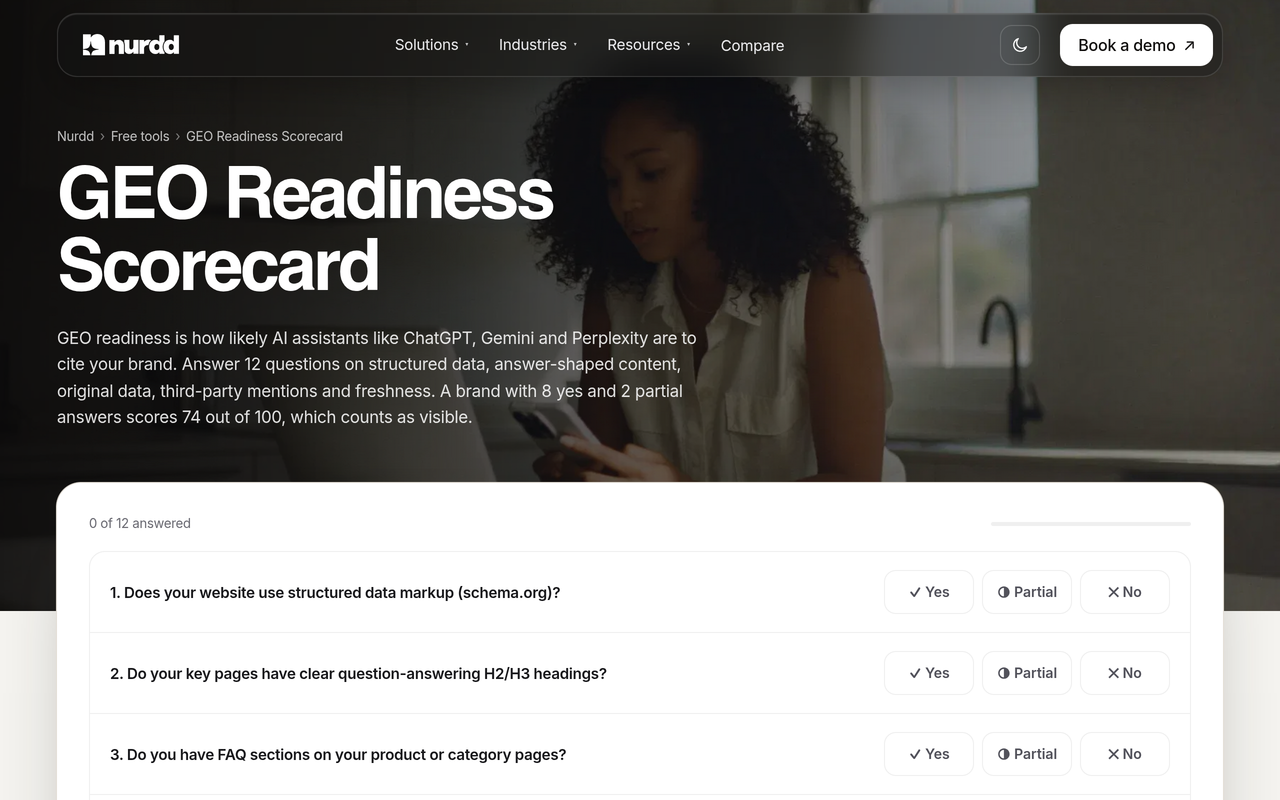
Run the GEO readiness scorecard first if you want a quick content-level baseline before the prompt test.
What are the common mistakes when optimizing for Claude?
- Blocking every AI bot with one rule. This can also remove you from search indexing and user retrieval, which Anthropic's crawler documentation, as reported, says may reduce visibility.
- Testing once. One answer says little. Answers vary, so use a fixed set and compare weeks.
- Testing only with search off. You will measure training memory and miss everything your pages can influence.
- Optimising for Claude's "preferences" without evidence. Several guides present ranking factors that Anthropic has not documented. Keep to facts you can check: access, retrieval, clarity and proof.
- Ignoring third-party pages. If your citation log shows other sites describing you, those pages need the same attention as yours.
- Treating Claude as separate from other engines. The same page improvements help across engines, and engines differ in sources. Compare engines in Perplexity vs ChatGPT vs Gemini.
How does Noma help you monitor Claude over time?
Manual prompt logs work for a first audit, but they are slow to repeat and hard to compare across engines. Noma is a web dashboard that tracks whether a brand appears in AI engine answers across 13 AI engines, including ChatGPT, Gemini, Perplexity and Claude, polled daily. It shows citation frequency by category, a competitor comparison and recommendations to improve AI visibility.
In the method above, Noma replaces the repeating parts of Steps 2 to 4: the weekly runs, the tallying and the competitor comparison. You still decide the prompt set and apply the page fixes, and you use the trend to see whether those fixes moved anything. For the weekly-score workflow, see how to track your AI search visibility score week over week.
Noma by Nurdd is an AI search visibility tool that monitors whether your brand is recommended by 13 AI engines, including ChatGPT, Gemini, Perplexity and Claude. Marketing teams use it to see citation frequency by category, compare against competitors and get recommendations, so they can tell whether content and access fixes are changing what AI assistants say about the brand.
Want to see this for your own brand? Book a demo and we will show you how Claude and the other tracked engines currently treat your brand, and which competitors appear beside you.
Noma offers a 3-day free trial at nomahq.app. A card is taken at signup and billing starts on day 3; if you cancel before then, you are not charged. If you are comparing tools, see Noma vs Profound, Noma vs Peec AI and our comparison of AI search visibility tools.
How long does it take to see changes in Claude?
We found no source that gives a reliable timeline, so this post does not give one. Access fixes can matter as soon as Anthropic's search bot next visits your pages. Content changes depend on when your pages are re-indexed in the underlying results. Training memory moves on the schedule of model releases, which you cannot control.
What you can control is the measurement period. Hold the prompt set constant, change one group of pages at a time, and compare weekly mention and citation rates. That isolates cause and effect better than changing everything at once. The broader audit process is in the AEO audit checklist, and the concept background is in what generative engine optimization is.
Conclusion: start with the test, then fix in order
Optimizing content for Claude search comes down to a sequence: let the right bots in, make sure your pages surface in the web results Claude uses, write answers that survive being quoted, and build proof beyond your own domain. The test protocol turns that from opinion into a weekly number.
If your brand is missing from ChatGPT as well, read why your brand isn't showing up in ChatGPT answers, since many causes overlap. To see where you stand across 13 AI engines, including ChatGPT, Gemini, Perplexity and Claude, without building the spreadsheet, book a Noma demo. You will see your brand's current mentions, the competitors named beside you and the first fixes to make.
How we researched this
We reviewed Anthropic's own help-center and developer documentation, trade press coverage of Anthropic's crawler documentation, an independent technical write-up on Anthropic's search subprocessor, a vendor's published overlap test, and three ranking guides on this keyword. Publication dates appear beside each source, and pages may have changed since. We did not run hands-on tests of Claude for this article, and the test protocol is a method we describe, not a result we measured. Where a claim is our inference rather than a documented fact, the text says so.
Frequently asked questions
How do I get my brand cited by Claude?
Allow Claude-SearchBot and Claude-User in robots.txt, make sure your pages rank in the web results Claude draws on, and put a short, self-contained answer at the top of each target page. Then earn accurate mentions on third-party pages. Track results weekly with a fixed prompt set so you can see what moved.
How do I optimize content for Claude search?
Start with access, then retrievability, then structure. Use question-style headings, a 40 to 60 word answer first, tables for comparisons and a consistent brand description. Measure mention and citation rates with web search on and off before and after each change.
Does Claude use Google or Brave for search?
Reporting from March 2025 says Anthropic's Trust Center listed Brave Search as a subprocessor, and Profound's test describes substantial overlap between Claude-cited results and Brave's top results. Anthropic's documentation reviewed here does not say exactly how results are ranked, so check both Brave and Google for your pages.
Should I block ClaudeBot?
That is a policy choice about training data. Anthropic lists ClaudeBot separately from Claude-SearchBot and Claude-User, so you can block training collection and still allow search indexing and user retrieval. Blocking the search bots may reduce your visibility in Claude's search results.
Does Claude always show citations?
When web search is used, Anthropic says responses include citations to sources. When search is off, Claude answers from training, and there are typically no live sources to cite. That is why testing both modes matters.
Can I check if Claude mentions my brand for free?
Yes. Run your prompts by hand, log the results in a spreadsheet and repeat weekly. It works for a first audit but gets slow beyond a few dozen prompts. A tracker such as Noma automates the repetition and adds competitor comparison across 13 AI engines.
Is optimizing for Claude different from optimizing for ChatGPT?
The fundamentals overlap: access, clear answers and proof. The differences are in crawlers, the search backend and which sources each engine favours, so track each engine separately instead of assuming results carry over.
How often should I re-test Claude visibility?
Weekly is a sensible cadence for a fixed prompt set, because answers vary and a single run is unreliable. Keep the prompts constant for at least a month before judging a change.