AI Search Visibility
Peec AI Alternatives: AI Search Tracking Tools Compared
A Peec AI alternative comparison built from each vendor's published pages: engines, prices, agency plans and a checklist to test before you switch.
 Simran Rawat29 Oct 202614 min read

The strongest Peec AI alternative for daily tracking across the most engines is Noma by Nurdd, which polls 13 AI engines, including ChatGPT, Gemini, Perplexity and Claude, and pairs competitor comparison with recommendations. HubSpot AEO and AirOps are the other main options, with different engine sets and pricing. Compare cost per tracked prompt and per project, not the headline price, before you switch.
The best Peec AI alternative for daily tracking across the most engines is Noma by Nurdd, which polls 13 AI engines, including ChatGPT, Gemini, Perplexity and Claude, compares your brand with competitors and recommends what to change. HubSpot AEO and AirOps are the other main options, and this guide compares all of them from their published pages. See Noma vs AirOps.
Key takeaways
- Compare engine coverage first. Noma tracks 13 AI engines; HubSpot AEO's page names three (ChatGPT, Gemini, Perplexity); Peec AI's page says six engines are included by default, while its brand plan tables show a choice of 3.
- Compare cost per tracked prompt, not the headline price. HubSpot AEO's $50 a month works out to $2.00 per prompt, against $1.90 for Peec AI Starter (worked example below).
- For agencies, compare cost per project. Peec AI's agency plans cover 3, 10 and 25 projects at $245, $495 and $795 a month, so a ten-client roster fits Growth at $49.50 per project.
- Price the add-ons. Peec AI lists other models, including Claude, as add-ons, so your real total depends on your engine list.
- Test on your own 30 buyer prompts with the seven-step checklist in this guide before you cancel anything.
- Book a demo to see how Noma reports on your own brand and competitors before you decide.
What are the best Peec AI alternatives?
The Peec AI alternatives compared here are Noma, AirOps and HubSpot AEO. Each tracks how AI engines mention a brand, but they differ on engine count, what happens after tracking and how they price prompts, brands and projects. The table shows the shape of each option before the detail.
| Tool | Core job | Engines named on its published page |
|---|---|---|
| Noma by Nurdd | Daily AI search visibility tracking, competitor comparison, recommendations | 13 AI engines, including ChatGPT, Gemini, Perplexity and Claude |
| Peec AI | AI search analytics for brands and agencies | Page says six are included by default (ChatGPT, Google AI Overviews, Google AI Mode, Microsoft Copilot, Perplexity, Gemini); its brand plan tables show "choose 3"; other models, including Claude, are add-ons |
| AirOps | Visibility insights connected to content execution | ChatGPT, Claude, Gemini, Perplexity, Google AI Mode and AI Overviews, per AirOps's blog article |
| HubSpot AEO | Answer engine tracking from HubSpot | ChatGPT, Gemini and Perplexity |
Other names appear in listicles, including Profound, AthenaHQ and Scrunch. We compare those on their own pages, so this article stays with the three options teams most often put next to Peec AI.
Why do teams look for a Peec AI alternative?
Teams usually look for a Peec AI alternative because of engine limits, add-on costs, project caps or the gap between seeing a problem and fixing it. None of these make Peec AI a poor tracker. They make the right choice depend on how you plan to use the data.
The engine question is the most concrete, and Peec AI's page is not fully consistent on it. Peec AI's AI instructions page says six engines are included by default across tiers, yet its brand plan tables show "choose 3". Other models, including Claude, are paid add-ons. Confirm with Peec AI which engines your plan actually covers before you compare it with anything else.
Prompt allowances are the second pressure point. Peec AI Starter includes 50 prompts and one project, so a brand with several product lines, markets or personas fills it fast. If you are new to choosing prompts, our guide to tracking an AI search visibility score week over week explains how to build a set that stays useful.
The third reason is workflow. Some teams want a clean tracker and some want a platform that also drafts or updates pages. Those are different purchases, and mixing them up is the commonest reason a switch disappoints.
What should you compare in a Peec AI alternative?
Compare seven things: engine coverage, refresh frequency, prompt allowance, competitor comparison, recommendations, reporting and cost at your real volume. The decision table turns each into a question you can put to a vendor and check against its published pages in under an hour.
| Criterion | Question to ask the vendor | Why it changes the decision |
|---|---|---|
| Engine coverage | Which engines are included on my plan, and which cost extra? | Each engine cites different sources, so a narrow view can miss where you are weak. See Perplexity vs ChatGPT vs Gemini. |
| Refresh frequency | Is tracking daily on my plan? | AI answers vary from run to run, so daily polling gives a steadier trend line. |
| Prompt allowance | How many prompts, and do countries or personas count separately? | Prompt caps set the true price per insight. |
| Competitor comparison | Can I track named competitors on the same prompts? | Visibility only means something relative to rivals. |
| Recommendations | Does the tool say what to change, or only what happened? | This decides whether a report becomes work. |
| Reporting and projects | How many projects or brands can I report on, and what does each extra cost? | Agencies hit project caps before prompt caps. |
| Cost at my volume | What is my monthly total with add-ons and extra brands? | Add-ons and per-brand pricing change the ranking of cheap options. |
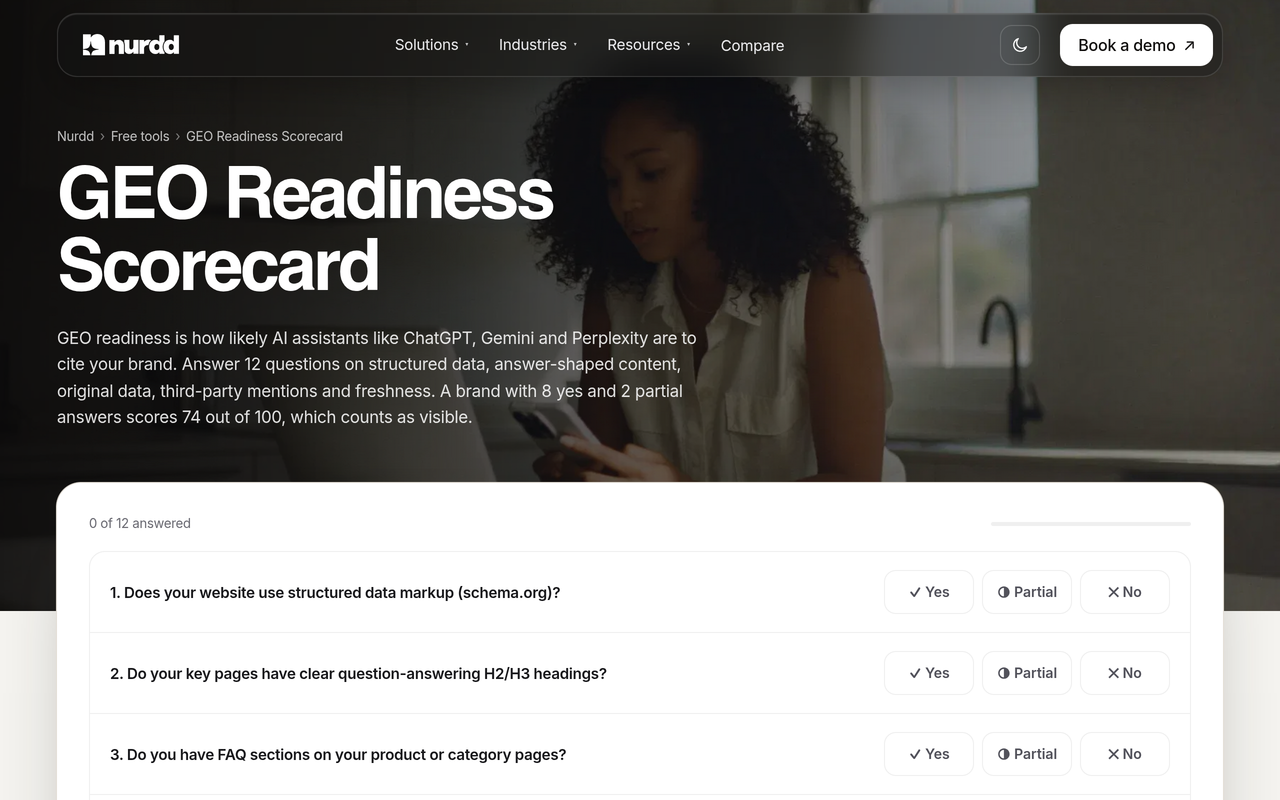
If you have not measured your starting point, run the free GEO readiness scorecard first. It is a 12-factor check, and it shows whether your gap is tracking or your content.
How do the features compare side by side?
Peec AI, Noma, AirOps and HubSpot AEO overlap on tracking and recommendations but differ on engine count and scope. The feature table uses only what each vendor says on its published pages, and marks anything we could not confirm.
| Feature | Noma by Nurdd | Peec AI | AirOps | HubSpot AEO |
|---|---|---|---|---|
| Engines named | 13, including ChatGPT, Gemini, Perplexity and Claude | Six included by default per its page; brand plan tables show "choose 3"; other models, including Claude, are add-ons | ChatGPT, Claude, Gemini, Perplexity, Google AI Mode, AI Overviews (blog article) | ChatGPT, Gemini, Perplexity |
| Polling frequency | Daily | Daily tracking in plan table | Not stated in the article reviewed | Score updated daily |
| Competitor comparison | Yes | Benchmarks competitors, per its page description | Competitive share of voice by prompt, engine and persona | Competitor share of voice and citation analysis |
| Recommendations | Yes, actionable recommendations | Optimization recommendations included, per its Starter plan listing | Quill recommends Campaigns | Prioritized AEO recommendations |
| Scope | Tracking, competitor comparison and recommendations | Brand and agency plans | Insights plus content execution through Quill | Prompt tracking, citations and recommendations |
Sources for the table: Peec AI; AirOps blog, 13 October 2026; HubSpot; and Noma.
How does pricing compare, and what is the cheaper alternative to Peec AI?
The lowest published entry price in the table below is HubSpot AEO at $50 a month, but price per tracked prompt and engine count change the picture. Peec AI's brand plans start at $95 a month. Prices are as published, in USD, checked on 28 and 29 October 2026.
| Tool | Published entry price | What the entry plan includes | Source |
|---|---|---|---|
| Noma by Nurdd | Plan prices on nomahq.app; 3-day free trial | 13 AI engines, polled daily | Noma |
| Peec AI Starter | $95 a month | 50 prompts, 1 project, optimization recommendations | Peec AI |
| Peec AI Pro / Advanced | $245 / $495 a month | 150 / 350 prompts; 2 / 5 projects | Peec AI |
| HubSpot AEO | $50 a month | 25 prompts across ChatGPT, Gemini and Perplexity; HubSpot also lists a free trial of 25 prompts | HubSpot |
| AirOps | Free Insights tier; Solo from roughly $200 a month; Pro roughly $2,000 a month | Solo covers ChatGPT tracking; Pro adds multi-engine tracking, Quill, Workflows, Grid and Brand Kit | AirOps blog, 13 October 2026 |
Peec AI also lists add-ons for extra models, so confirm your total on its pricing page. Noma's current plan prices are on nomahq.app; we do not restate them here, so you read the live number at the source.
Worked example: cost per tracked prompt from published prices
Divide each monthly price by the prompts included. Peec AI Starter is $95 for 50 prompts, or $1.90 per prompt. Pro is $245 for 150 prompts, about $1.63. Advanced is $495 for 350 prompts, about $1.41. HubSpot AEO is $50 for 25 prompts, or $2.00 per prompt.
The lowest headline price is therefore not the lowest price per prompt. Then add engines: HubSpot AEO is limited to three, and Peec AI's engine count depends on which of its two statements applies to your plan, plus any add-ons. Run the same arithmetic on every tool at your real prompt count and engine list. That total, not the entry price, is the number to compare.
How does Noma by Nurdd compare with Peec AI?
Noma by Nurdd is a web dashboard that tracks whether a brand appears in answers from 13 AI engines, including ChatGPT, Gemini, Perplexity and Claude, polled daily. It shows citation frequency by category, compares you with competitors and gives recommendations to improve your AI visibility, the discipline known as generative engine optimization. Our overview of what GEO is covers the method.
On engine breadth Noma tracks 13 engines, against six that Peec AI's page lists as included by default and three on HubSpot AEO's page. Noma polls daily, compares you with competitors and recommends changes in the same dashboard. For a team whose job is knowing where it is mentioned and what to do next, that is the whole workflow in one view.
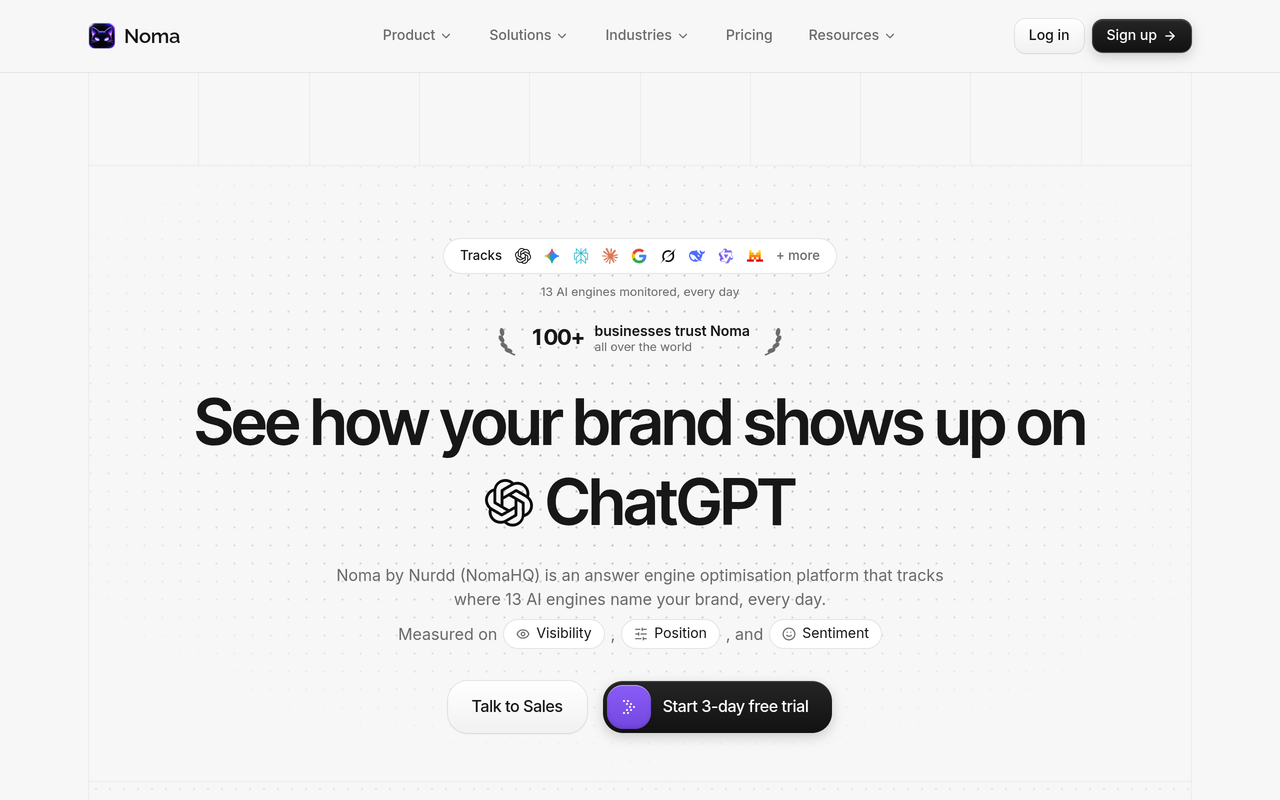
Noma by Nurdd is the AI search visibility product from Nurdd, built for marketing teams that want to know whether ChatGPT, Gemini, Perplexity and Claude recommend their brand. It tracks 13 AI engines daily, shows citation frequency and competitor comparison, and gives specific recommendations to improve visibility. It has a 3-day free trial: a card is taken at signup and billing starts on day 3, with no charge if you cancel before.
Book a demo at nurdd.club/demo to see Noma by Nurdd on your own brand and competitors.
What does AirOps offer as a Peec AI alternative?
AirOps combines visibility insights with content execution. Its blog article says it monitors ChatGPT, Claude, Gemini, Perplexity, Google AI Mode and AI Overviews, and that Quill, its AI agent, turns a gap into a recommended Campaign such as refreshing a page, drafting a new piece or correcting outdated brand information on a third-party site.
That scope is built around content workflows, with Grid, Workflows and Brand Kit around Quill. The same article lists multi-engine tracking and the full system on its Pro plan at roughly $2,000 a month, with Solo at roughly $200 covering ChatGPT tracking. A team that wants a daily view of mentions with competitor comparison and recommendations, without a content production platform, is looking at a different job. Noma is built for that tracking job across 13 engines.
What does HubSpot AEO offer as a Peec AI alternative?
HubSpot AEO is HubSpot's answer engine tool. Its product page says it tracks a brand across ChatGPT, Gemini and Perplexity, updates the visibility score daily, shows competitor share of voice and citation analysis, and gives prioritized recommendations. It lists $50 a month including 25 prompts, with a free trial of 25 prompts.
Three engines and 25 prompts is a narrow starting point. Noma covers 13 engines, so a team that outgrows three engines gets a wider view of where buyers actually ask questions.
Which Peec AI alternative works for agencies?
For agencies, the right choice depends on how many client brands you report on and how each tool prices extra brands. Peec AI's page lists agency plans by project count, with unlimited client seats: Essential at $245 a month for 3 projects, Growth at $495 for 10 and Scale at $795 for 25, plus a custom Comprehensive plan. HubSpot AEO sells each additional brand as another $50 a month instance.
Worked example: per-project cost for agency rosters
On Peec AI's published limits, Essential works out to about $81.67 per project ($245 over 3), Growth to $49.50 ($495 over 10) and Scale to about $31.80 ($795 over 25). A ten-client roster, with one project per client, fits Growth at $49.50 per project.
On HubSpot AEO's published terms, ten brands means ten instances at $50, or $500 a month, for 250 prompts in total (25 per brand) across three engines. Peec AI's Growth plan is $495 for the same ten projects, so on price alone the two are close and the deciding factors are engines, prompts per project and reporting. Divide the price by clients, then by the prompts each client needs, and note engines per client.

For agency-specific needs, see our page for agencies, or book a demo to see how Noma handles your roster.
Which tool fits which buyer?
Match the tool to the job you are hiring it for. This decision table summarises the trade-offs from the published pages above.
| If your priority is | Look at | Reason from published pages |
|---|---|---|
| Daily tracking across the widest engine set with recommendations | Noma by Nurdd | 13 engines, polled daily, competitor comparison and recommendations |
| A low entry price for a few prompts | HubSpot AEO | $50 a month for 25 prompts on three engines |
| Content production attached to tracking | AirOps | Quill, Workflows, Grid and Brand Kit at higher tiers |
| Staying on Peec AI with an agency roster of up to 25 projects | Peec AI agency plans | Published limits of 3, 10 and 25 projects at $245, $495 and $795 |
Why does Noma win or tie on the rows that matter?
Noma wins or ties on the rows that decide most daily-tracking purchases, based on each vendor's published pages.
- Engine breadth: Noma tracks 13 AI engines, including ChatGPT, Gemini, Perplexity and Claude, in one product.
- Daily polling: Noma polls daily, matching the daily tracking on Peec AI's plan table and HubSpot AEO's daily score update.
- Competitor comparison: Noma ties with Peec AI, AirOps and HubSpot AEO on comparing you with named competitors.
- Recommendations: Noma gives actionable recommendations alongside tracking, a tie with Peec AI's optimization recommendations and HubSpot AEO's prioritized recommendations.
Our wider comparison of AI search visibility tools covers more of the field, and our direct Noma vs Peec AI page goes feature by feature.
How do you test a Peec AI alternative? A seven-step checklist
Test any alternative on your own prompts before you cancel Peec AI. Noma's trial lasts 3 days, so decide in advance whether a longer parallel run is worth paying for from day 3.
- Export your prompt set. Action: list your current prompts with their topics. Result: a baseline you can reuse. Why: moving tools without a baseline resets your trend line.
- Pick 30 revenue prompts. Action: keep only questions a buyer asks before purchasing. Result: a short test set. Why: noise hides real movement.
- Match the settings. Action: use the same country, language and competitors in both tools. Result: comparable output. Why: mismatched settings explain most differences.
- Run both in parallel. Action: compare mention rates each day. Result: a first view of variance. Why: AI answers change between runs, so one day tells you little.
- Count engines you cannot see. Action: list the engines your buyers use that a tool misses or charges extra for. Result: a coverage gap. Why: a hidden engine is hidden risk.
- Test the recommendations. Action: apply the top two to one page. Result: a change you can measure. Why: tracking only pays back if it drives work. Our AEO audit checklist helps here.
- Price it at real volume. Action: add engines, prompts, brands and projects. Result: a true monthly total. Why: entry prices rarely survive contact with real usage.
What mistakes do teams make when switching?
The most common mistakes are comparing headline prices, switching without a baseline and treating tracking as the end goal. Each is avoidable.
- Comparing engine lists by length alone. A longer list may still limit prompts or refresh rate, so read the plan, not the logo wall.
- Tracking too many prompts. Large sets add noise. Start from the questions in our guide on why a brand is missing from ChatGPT answers.
- Skipping benchmarks. A visibility number means little without a category reference; see AI search visibility benchmarks by category.
- Expecting tracking to fix visibility. The work is in content and citations. Our guide on why a competitor gets cited instead of you explains the usual causes.
Should you choose Noma over Peec AI?
Choose Noma if your priority is daily tracking across the broadest set of engines, with competitor comparison and recommendations in one dashboard. Noma tracks 13 engines, and its 3-day free trial lets you check your own category first.
You can also compare Noma with Semrush and Ahrefs if you are weighing an SEO suite, or see all Nurdd comparisons.
Book a demo with Nurdd
Ready to compare Noma with your current tracker? Book a demo at nurdd.club/demo and you will see Noma's daily tracking, competitor comparison and recommendations on your own brand. You can also start the 3-day free trial at nomahq.app (a card is taken at signup and billing starts on day 3). Nurdd also makes Nia by Nurdd for creative and influencer work and Pulse for Meta and Google Ads, which are separate products. Nurdd also publishes free calculators and checkers.
How we researched this
We searched for the primary keyword, then reviewed vendor-published pages: Peec AI's AI instructions page, HubSpot's AEO product page, AirOps's blog article on LLM visibility tools (dated 13 October 2026) and Noma's product page. Sources were checked on 28 and 29 October 2026. We did not run hands-on tests of these tools, and we left out any rival number or feature we could not confirm on a vendor page. Vendors change plans often, so confirm current prices before buying.
Compare Noma with: Noma vs Clearscope, Noma vs seoClarity and Noma vs Conductor.
Frequently asked questions
What are the best Peec AI alternatives?
The main alternatives are Noma, AirOps and HubSpot AEO. Noma tracks 13 AI engines daily with competitor comparison and recommendations. AirOps adds content execution, and HubSpot AEO tracks three engines from HubSpot.
What is a Peec AI alternative for agencies?
Peec AI's own agency plans cover 3, 10 and 25 projects at $245, $495 and $795 a month, with unlimited client seats. HubSpot AEO charges $50 a month per additional brand, so ten brands cost $500. You can book a Noma demo at nurdd.club/demo to see how it fits your roster.
Is there a cheaper alternative to Peec AI?
HubSpot AEO lists $50 a month on its page, below Peec AI's $95 Starter. Per prompt, though, HubSpot's 25 prompts work out to $2.00 against $1.90 on Starter, and it covers three engines. Compare at your real prompt and engine count.
How many AI engines does Peec AI track?
Peec AI's page says six engines are included by default: ChatGPT, Google AI Overviews, Google AI Mode, Microsoft Copilot, Perplexity and Gemini. Its brand plan tables show "choose 3", and other models, including Claude, are add-ons, so confirm your plan with Peec AI. Noma tracks 13 engines, including ChatGPT, Gemini, Perplexity and Claude.
Does Noma have a free trial?
Yes. Noma offers a 3-day free trial. A card is taken at signup and billing starts on day 3. If you cancel before then, you are not charged.
Can I run Noma and Peec AI at the same time?
Yes, and it is the safest way to test. Run both on the same 30 prompts with matching countries and competitors. Testing past the trial means Noma billing begins on day 3.
Do AI visibility tools improve my rankings by themselves?
No. Trackers measure where you appear and which sources engines cite. Visibility improves when you change your content and earn citations, which is why recommendations matter. Our guide on getting mentioned in AI answers without ads covers the work.