AI Search Visibility
Google AI Overviews Citations Audit: A 7-Step Method
A repeatable 7-step Google AI Overviews citations audit to see which pages Google cites for your category, why rivals win them and what to fix first.
 Sheetal Shakshi10 Nov 202618 min read

To audit Google AI Overviews citations, build a set of question-style prompts for your category, run each one several times under fixed conditions, and log every cited URL, its source type and the brand named. Then compare your citation rate with rivals and diagnose each gap by source type. Repeat runs matter because Google changed at least one source for 52% of keywords in one August 2026 test.
A Google AI Overviews citations audit is a repeatable check of which pages Google links to inside its AI answers for the questions your buyers ask, and why those pages win. You build a prompt set, capture each overview several times, log every cited URL, then compare your pages with your rivals' by source type. This guide gives you the full method.
Most published advice stops at "track your citations". That tells you whether you appear, not why a rival does. The audit below adds a source-type classification, a repeat-run rule and a gap-diagnosis table so every missing citation points to a specific fix.
Key takeaways
- Google's own documentation says a page needs to be indexed and eligible to show with a snippet to be a supporting link. There are no extra technical requirements, so the audit is about content and sources, not a hidden switch.
- Citations are only loosely tied to rankings. Ahrefs reported that 38% of cited pages were in the top 10 for the same query in its 2026 update.
- Never trust a single check. In one August 2026 manual test, Google changed at least one source for 52% of keywords on identical repeat searches, so run each prompt at least three times.
- Log the source type of every citation (video, forum, encyclopedia, listicle, vendor page, news). The rival's winning format usually explains the gap.
- Run the same prompt set on other engines. Noma by Nurdd tracks 13 AI engines, including ChatGPT, Gemini, Perplexity and Claude, so you can see whether a Google gap is also a gap elsewhere.
Why audit Google AI Overviews citations at all?
Google's AI Overviews answer the question on the results page and show links to supporting sources. If your page is not one of those links, your brand is absent from the part of the page many readers stop at. If a rival's page is, the rival is shaping the answer your buyer reads first.
Branded searches show how much this matters. WebFX reported in October 2026 that Ahrefs found AI Overviews on 82.91% of tracked U.S. desktop branded results on September 29, and that in Ahrefs' 100-brand panel, 48 of 63 branded overviews sat in position one. The same write-up says Wikipedia, YouTube and LinkedIn led the external citations, so third-party pages can describe your brand before your own site does (WebFX, October 2026).
Accuracy is a second reason. A Washington University in St. Louis audit of 55,393 Google searches, run from March 13 to April 21, 2026, found that about 11% of verifiable claims lacked support or contradicted the cited sources (WashU, September 2026). A citation next to a claim does not prove the cited page says it, so an audit should also check what the overview says about you.
What do the top guides cover, and what do they leave out?
Three of the most visible guides on this topic are Ahrefs' tracking guide, OtterlyAI's tracking guide and WebFX's branded-search audit. Each is useful, and each stops short of a full source audit. The table shows what we reviewed and the gap this post fills.
| Guide | What it covers | What it leaves out |
|---|---|---|
| Ahrefs, last modified August 2026 | Seven ways to track AI Overview citations, keyword wins, brand mentions and traffic, plus click-loss checks | No worksheet for classifying cited sources or diagnosing why a specific rival is chosen |
| OtterlyAI, August 2026 | Search Console and GA4 methods, a 20-keyword manual audit, a citation-rate formula and a tiered dashboard | No repeat-run rule for volatile citations and no gap-to-fix decision table |
| WebFX, October 2026 | A three-step audit of branded queries, with a capture table for presence, placement, accuracy and citations | Focused on branded queries only, not category questions where rivals win new buyers |
This guide covers all of that and adds three things: a repeat-run protocol, a source-type classification and a gap-diagnosis table that maps each rival win to a fix. It also shows how to carry the same prompt set to other AI engines.
How does Google choose which pages to cite?
Google does not publish a ranking formula for citations, but its documentation describes the mechanism. Both AI Overviews and AI Mode may use a technique Google calls query fan-out, which issues multiple related searches across subtopics and data sources. Google says its models identify more supporting pages while a response is generated, which lets it show a wider and more diverse set of links (Google Search Central).
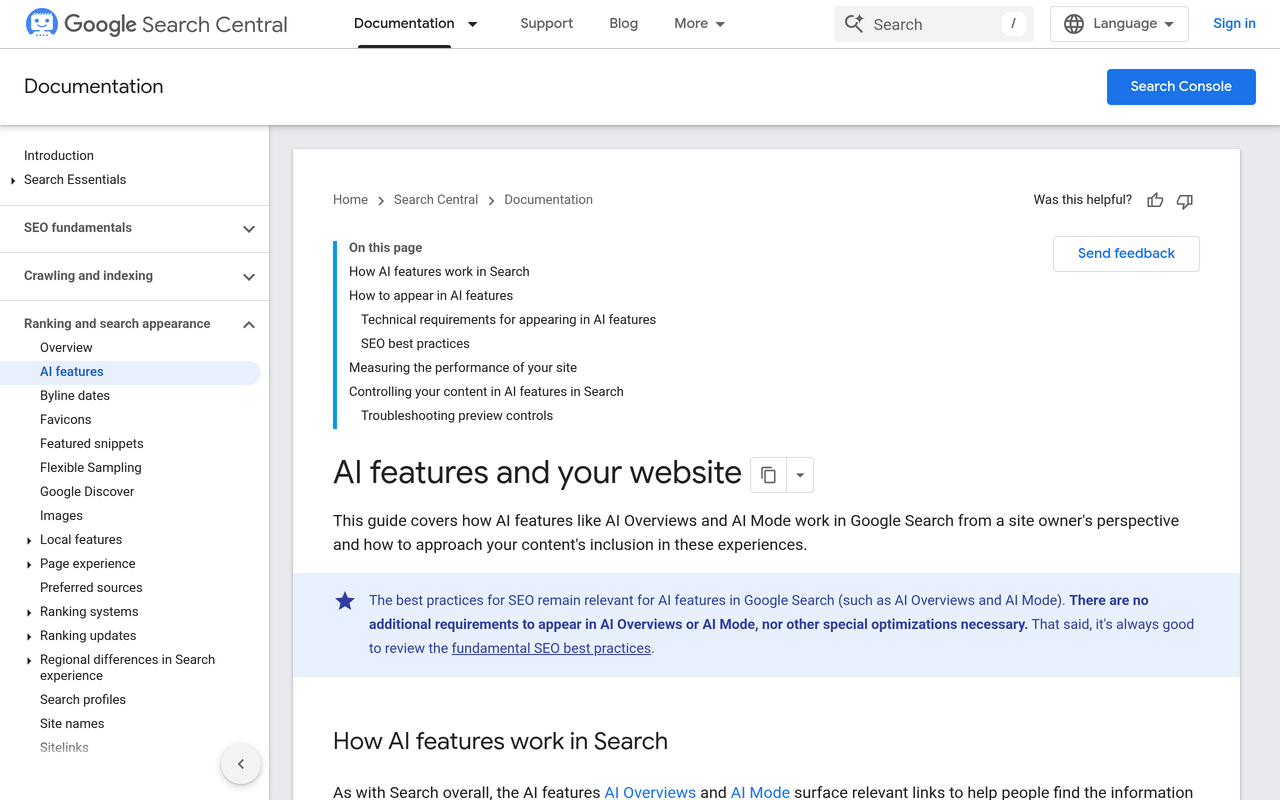
The same page states that a page must be indexed and eligible to show in Search with a snippet to appear as a supporting link, and that there are no additional technical requirements. That is your first audit filter: if a page is not indexable, nothing else matters.
Fan-out explains why citations drift away from rankings. Search Engine Journal reported in March 2026 that Ahrefs analysed 863,000 keywords and 4 million AI Overview URLs and found 38% of cited pages in the top 10 for the same query, down from 76% in its July study. The rest split almost evenly between positions 11 to 100 (31.2%) and beyond position 100 (31.0%). Ahrefs also noted that better parsing meant the two studies are not directly comparable, and that BrightEdge reported roughly 17% overlap using a different method (Search Engine Journal, March 2026).
Google's AI Overviews do not cite only what ranks for the typed query. Because of query fan-out, a page can be cited because it ranks well for a related sub-question, which is why an audit must look at the cited page itself rather than only at the results page.
What does the evidence say rival pages have in common?
A small manual study by Position Digital in August 2026 gives a useful pattern, with clear limits. It captured 857 citations (321 unique URLs) from 227 root domains across 31 SaaS keywords, US only, from one account. Its authors say to treat the data as directional (Position Digital, August 2026).
- Only 33.2% of cited URLs also ranked in the organic top 10, though pages in positions 1 to 3 were cited 58.6% of the time.
- Domain Rating had a Pearson correlation of 0.15 with citations, so a strong domain is not what wins the slot.
- Educational articles made up 70.2% of citations for informational keywords and listicles 37.6% for commercial ones.
- YouTube took 14.5% of all citations, more than five times Reddit's 2.7%.
- When an overview cited a brand's domain, it also named the brand in the answer 67.8% of the time.
The last point matters for the audit. A citation without a mention is a link; a citation with a mention is part of the answer, so log both separately.
How do I audit Google AI Overview citations for my category? (7 steps)
Allow half a day for a first pass of 20 to 30 prompts. Each step below follows the same pattern: the action, the result you get, and why it matters.
Step 1. Build a prompt set from real buyer questions
Action: list 20 to 30 prompts in three groups: category questions ("how do I choose X"), comparison questions ("X vs Y") and problem questions ("why does X happen"). Write them as full questions of six or more words. Pull wording from Search Console queries, sales calls and the People Also Ask box.
Result: a prompt set that is likely to trigger overviews. The WashU audit found nearly 65% of question-form queries produced an overview, against 9.5% of other searches, and among non-question searches the rate rose from 9.9% for one-word queries to 38.7% for queries of six or more words (WashU, September 2026).
Why: short head terms often show no overview, so a prompt set of head terms would give you empty rows. Our guide on which prompts to track for AI search visibility and the note on how many prompts you need help you size the set.
Step 2. Fix the capture conditions and run each prompt three times
Action: choose one country, one language, one device and a logged-out or clean browser profile, and write them at the top of the sheet. Run every prompt at least three times on different days, or at different times in one day.
Result: a stable view of which citations recur and which are noise. Position Digital repeated each keyword three to four times and found at least one source changed for 52% of keywords on identical searches.
Why: a single check can mislead you into thinking you are cited, or absent, when neither is reliable. Parse's research on AI citation volatility also found that repeat runs of the same AI prompts often cite different sources, which is why one-shot checks are weak evidence (Parse, 2026). Label any URL cited in two of three runs as "stable" and the rest as "occasional".
Step 3. Log every citation in a structured sheet
Action: for each run, record the fields in the table below. Take a dated screenshot of each overview, because the text changes.
| Field | What to record | Why it matters |
|---|---|---|
| Prompt and run number | Exact wording, date, device, location | Makes the audit repeatable |
| Overview shown? | Yes or no, and placement on the page | Gives your trigger rate |
| Cited URL and domain | Full URL, in the order shown | Page-level, not domain-level, comparison |
| Source type | Video, forum, encyclopedia, news, vendor page, listicle, guide, review site | Reveals the format Google prefers |
| Brands named in the text | Yours, rivals, none | Separates a link from a recommendation |
| Claim check | Does the cited page support the sentence beside it? | Flags inaccurate or unsupported statements |
| Organic rank of cited URL | Position for the same prompt, if any | Shows citations that come from fan-out rather than rank |
Result: a flat table you can filter. Why: WebFX's capture table asks for presence, placement, accuracy, citations and owned sources, and our version adds source type and run number, the two fields you need to diagnose gaps and filter noise.
Step 4. Classify each cited source by type and owner
Action: tag each URL as owned (your site or profiles), rival-owned, third-party editorial, community (forums, Q&A), video, reference (encyclopedia) or other. Count the tags per prompt group.
Result: a source-type mix for your category. Why: the mix tells you where to compete. If video and community pages dominate a prompt group, publishing another blog post will not move it, which matches the pattern in the Ahrefs data, where YouTube accounted for 5.6% of all citations and 18.2% of those that did not rank in the top 100 (Search Engine Journal, March 2026).
Step 5. Calculate five metrics
Action: compute the numbers below for each prompt group and for the whole set.
- Trigger rate: prompts with an overview divided by prompts tested.
- Citation rate: prompts where your domain is cited divided by prompts with an overview, times 100. OtterlyAI uses this formula and suggests 30% or more as a goal in a primary topic cluster (OtterlyAI, August 2026).
- Stable citation rate: the same calculation using only URLs cited in at least two of three runs.
- Competitor citation share: for each rival, prompts where they are cited divided by prompts with an overview.
- Mention rate: prompts where the overview names your brand divided by prompts with an overview.
Result: a baseline you can re-run monthly. Why: the stable rate and mention rate strip out luck and show whether you are part of the answer. Our guide to AI search share of voice explains how to turn competitor share into one trendable figure.
Step 6. Diagnose why each rival wins using the gap table
Action: for every prompt where a rival is cited and you are not, open the rival's cited page and your closest page, and match the pattern to the table.
| What you see on the rival's cited page | Likely reason it wins | Fix to test |
|---|---|---|
| Direct answer in the first sentences, then a table or numbered list | Format fits the question | Rewrite your page to open with a short answer, then a table or list |
| Named statistics with linked sources | Attributable facts are easy to quote | Add dated, sourced numbers to your page |
| Page covers a sub-question your page skips | Fan-out picked it up for a related query | Add a section or a separate page for that sub-question |
| Cited page is a YouTube video | Video fills a gap in the results | Publish a video on the topic, with a transcript on your page |
| Cited page is a forum thread or Q&A | Community answers match the question wording | Answer the thread honestly, or write a page that matches the wording |
| Cited page is a third-party listicle naming the rival | Editorial mention, not rival's own page | Earn inclusion in that list through outreach or data worth citing |
| Your page is not in the index or has no snippet | Not eligible | Fix indexing, robots and snippet controls first |
| Your page is cited but the brand is not named | Brand is not tied to the claim | State the brand and the claim in the same sentence |
Result: a prioritised fix list, one row per gap. Why: the Position Digital data found topical relevance beat domain strength, so the gap is almost always on the page, not in the domain. For a deeper walk-through of causes, see why your competitor is cited in AI answers and you aren't and ranking on Google but not cited by AI.
Step 7. Fix one change at a time and re-run the audit
Action: pick the three gaps with the most rival citations. Change one page per gap, record the change date, and re-run only the affected prompts three times after Google has recrawled the page.
Result: cause-and-effect evidence you can trust. Why: with citations this volatile, changing ten pages at once leaves you unable to say what worked. Our write-up on GEO experiment design covers control prompts and how long to wait.
Worked example: reading real citation numbers
The Position Digital study gives enough real figures to show how to read an audit sheet. Its 857 citations came from 321 unique URLs on 227 root domains, over 31 keywords and 92 runs.
| Calculation | Result | What it tells you |
|---|---|---|
| 857 citations ÷ 321 unique URLs | About 2.7 citations per URL | The same pages are cited repeatedly, so a small set of URLs captures most slots |
| 321 unique URLs ÷ 227 domains | About 1.4 URLs per domain | Most cited domains win with one or two pages, so you compete page by page |
| 92 runs ÷ 31 keywords | About 3 runs per keyword | The repeat-run rule in Step 2 matches the study's design |
These are our own divisions of the study's published totals, not figures the study reports. Read them as a reading aid. The takeaway is that the audit's unit is the page: you are not trying to out-rank a domain, you are trying to replace one or two specific URLs per prompt group.

How can Search Console and GA4 support the audit?
Search Console shows your side of the picture: where Google counted a link to your site. Search Engine Journal reported that, according to John Mueller, impressions in the generative AI report are based on links to your site being shown in AI Overviews and AI Mode, and that user-activated links count only once activated (Search Engine Journal, 2026). That is one reason Search Console can show fewer appearances than you find by hand.
OtterlyAI points out the main blind spot: a citation that gets no click can leave no trace in the default Search Console view. Use Search Console to confirm pages that earn clicks and the long, conversational queries that trigger overviews, and use your manual log for everything else. For traffic, our guide to measuring AI referral traffic in analytics shows how to set up the channel.
What are the most common mistakes in an AI Overviews audit?
- Checking once. One run is a snapshot of a volatile list. Run each prompt three times.
- Auditing only branded queries. Branded queries show how Google describes you; category questions show who wins new buyers. Do both.
- Comparing domains instead of pages. The unit of competition is the URL. Log full URLs.
- Ignoring the claim beside the link. With about 11% of verifiable claims unsupported in the WashU audit, a citation is not proof of accuracy.
- Personalised captures. A logged-in browser with history can show different links. Use a clean profile and note it.
- Changing many things at once. You will not know what moved the result.
- Assuming rankings explain citations. Fan-out means a page outside the top 100 can still be cited.
Checklist: your first audit in order
- Confirm your target pages are indexed and eligible to show a snippet.
- Write 20 to 30 question-style prompts of six or more words, grouped by category, comparison and problem.
- Set country, language, device and a clean browser profile, and write them in the sheet.
- Run each prompt three times on different days and screenshot every overview.
- Log each cited URL, source type, brands named and whether the cited page supports the claim.
- Mark URLs cited in at least two of three runs as stable.
- Calculate trigger rate, citation rate, stable citation rate, competitor share and mention rate.
- Match each rival win to a row in the gap table and write one fix per gap.
- Change one page per gap, record the date, and re-run the affected prompts.
- Repeat monthly and keep dated screenshots for comparison.
How do I run the same audit beyond Google?
Your buyers do not use only Google. A prompt set built for AI Overviews can be reused on ChatGPT, Gemini, Perplexity and Claude, and the same log fields work on each. The difference is that every engine cites differently, so a gap in one place may not exist in another. Our comparison of Perplexity, ChatGPT and Gemini explains those differences.
Doing this by hand across engines gets heavy fast, because each prompt needs repeat runs on each engine. That is the point where a tracker earns its place: it runs the prompts on a schedule and keeps the log for you. For Google specifically, our pieces on monitoring Google AI Overviews without manual searches and what to check before buying a Google AI Overviews tracker cover the tooling questions.
How does Noma help with a citations audit?
Noma by Nurdd is a web dashboard that tracks whether a brand appears in answers from 13 AI engines, including ChatGPT, Gemini, Perplexity and Claude, polled daily. It records whether your brand is named and which page each citation comes from, shows citation frequency by category and competitor comparison, and gives recommendations to improve AI visibility. That makes it a way to run this audit's prompt set continuously across engines instead of by hand.
Book a demo at https://www.nurdd.club/demo and we will show you your own brand's category prompts, which pages are cited, which rivals appear and where your gaps sit.
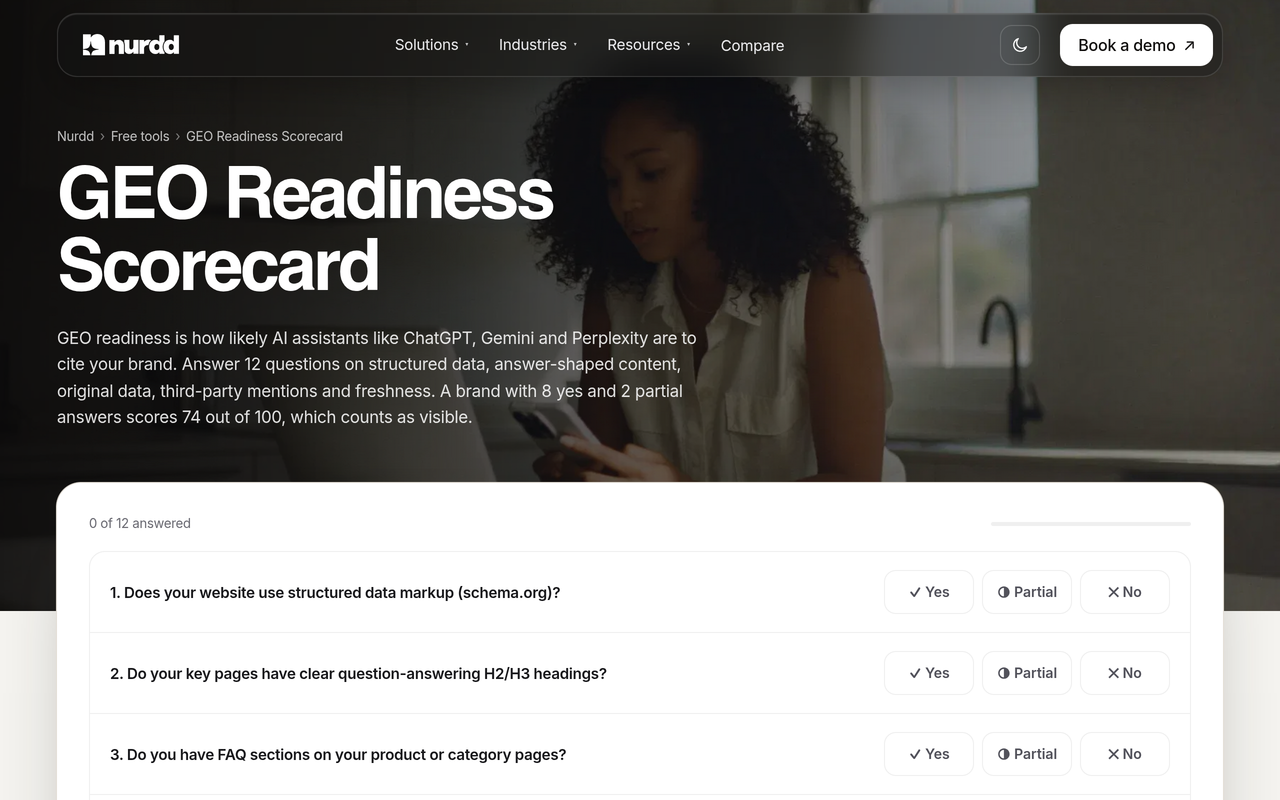
Noma has a 3-day free trial. A card is taken at signup and billing starts on day 3, with no charge if you cancel before then. You can read how it compares with SEO suites in Noma vs Semrush and Noma vs Ahrefs, or start with the free GEO readiness scorecard, a 12-factor check of how ready your pages are for AI answers.
What should you fix first once the audit is done?
Start with eligibility, then answer format, then sources. Fix indexing and snippet problems first because nothing else matters without them. Next, rewrite the pages tied to your highest-value prompts so the first sentences answer the question and a table or list follows.
Third, work on the sources outside your site. If a third-party listicle or a forum thread is cited, a better page of your own will not replace it. Our guides on entity consistency for AI citations and appearing in Google's AI Overview for your product category cover both. If you would rather hand this work over, Nurdd's generative engine optimization services improve the content and sources AI engines read, measured in Noma.
Report the results monthly, alongside classic metrics. The AI search metrics monthly report template shows how to present citation rate next to organic performance, and what generative engine optimization is gives context for stakeholders new to the topic.
How we researched this
We reviewed Google's own Search Central documentation on AI features, a university press release on an independent audit of Google AI Overviews, trade-press coverage of Ahrefs and BrightEdge studies, a small manual citation study, a research page on AI citation volatility, and three published tracking guides from Ahrefs, OtterlyAI and WebFX. We checked the pages on the publication date of this post and quoted figures as the sources state them. Where a study is small or uses a different method, we say so. We did not run hands-on tests of our own for this guide, and the arithmetic in the worked example is our own division of published totals.
Frequently asked questions
How do I see which sources Google AI Overviews cite for my category?
Search your category's question-style prompts in a clean browser profile with a fixed location, then open the source links inside each overview and log every URL. Repeat each prompt three times, since citations change between identical searches. Tag each URL by source type to see which formats win.
How do I audit AI Overview citations for my brand?
Run two prompt groups: branded queries, to see how Google describes you and who it cites, and category queries, to see who wins new buyers. For each, record whether your domain is cited, whether the brand is named and whether the cited page supports the claim. Then calculate citation rate and compare it with rivals.
Does ranking in the top 10 guarantee an AI Overview citation?
No. Ahrefs reported that 38% of cited pages were in the top 10 for the same query in its 2026 update, down from 76% in its earlier study, though it notes its method changed. Position Digital's smaller study found 33.2%. Ranking helps, but citations also come from related sub-queries.
Why does the same search show different citations each time?
Google generates each overview on request, and the set of supporting links varies. In Position Digital's August 2026 test, at least one source changed for 52% of keywords on identical repeat searches. That is why a single check is unreliable and why this audit uses three runs per prompt.
Can Google Search Console show my AI Overview citations?
Partly. Search Console's generative AI reporting counts impressions when a link to your site appears in AI Overviews or AI Mode. It cannot show which rivals are cited or the prompts where you are absent, so you still need a manual or tool-based log.
How often should I run a Google AI Overviews citations audit?
Run the full audit monthly and a smaller check on your top 10 prompts weekly. Because citations are volatile, trends over several runs are more reliable than any one result. Re-run affected prompts after every page change.
Do I need a tool, or can I audit by hand?
You can audit by hand for a first baseline of 20 to 30 prompts. It becomes slow once you add repeat runs, rivals and other AI engines. A tracker such as Noma, which polls 13 AI engines daily, keeps the log for you, and the demo shows it on your own category.
Does a citation mean Google's answer about my brand is accurate?
No. The WashU audit found about 11% of verifiable claims lacked support or contradicted cited sources. Check the sentence next to your link against the page it cites, and correct your own pages and profiles first if the information is outdated.
Next step: see your own citation gaps
A manual audit gives you the first baseline. To see which pages 13 AI engines cite for your category, which rivals appear and what to fix first, book a demo. You will see your own brand's prompts, citations and competitor comparison, not a generic walkthrough.