AI Search Visibility
Google AI Overviews Tracker: What to Check Before Buying
A Google AI Overviews tracker should log citations, query coverage and location variance; here is how to test one before you pay.
 Sheetal Shakshi6 Nov 202613 min read

A Google AI Overviews tracker must record whether an AI Overview appears for each of your queries, which sources it cites, whether your brand is named, and how results change by location and over time. Test any tool against a manual check of 20 queries before paying. Noma by Nurdd tracks 13 AI engines, including ChatGPT, Gemini, Perplexity and Claude, and has a 3-day free trial.
A Google AI Overviews tracker is a tool that checks, on a schedule, whether Google shows an AI Overview for your target queries, which pages it cites and whether your brand is named. The best google ai overviews tracker for you is the one that passes a test on your own queries, in your own markets. This guide gives you that test.
Key takeaways
- Demand three outputs from any tracker: citations (which URLs are linked), query coverage (how many of your queries trigger an AI Overview) and location variance (how answers differ by place).
- Google Search Console does not break AI Overviews out as their own report, so you need a separate tracker to see citations and competitors.
- Run a 7-day test with 20 queries before paying: compare the tool's output with a manual check and score it.
- Ask for raw evidence per result: the cited URL, the date and the location. Without it, you cannot audit the number on the dashboard.
- Check whether the tool also covers ChatGPT, Gemini, Perplexity and Claude, because buyers rarely use only Google.
- Use the free trial or free report first. Noma by Nurdd has a 3-day free trial (card taken at signup, billing starts on day 3).
What must a Google AI Overviews tracker capture?
Rank trackers were built for ten blue links. An AI Overview is a generated answer with a handful of cited links, and it can appear, vanish or change between two identical searches. A tracker has to measure those things, not just a position number.
Six capabilities separate a useful tracker from a screenshot tool:
- Presence detection: for each query, did an AI Overview show at all? This is your query coverage.
- Citation capture: the exact URLs and domains linked inside the overview, including yours and competitors'.
- Mention capture: whether your brand name appears in the generated text, with or without a link. A mention and a citation are different outcomes.
- Location and language control: the ability to run the same query from different countries or regions.
- History: stored results by date, so you can see whether a change is a trend or noise.
- Evidence and export: the answer text, cited URLs and timestamp for each check, available to download.
Two further items matter for strategy. First, competitor comparison: knowing you are cited on 12 queries means little until you know a rival is cited on 30. Second, coverage beyond Google, because the same buyer may ask ChatGPT or Perplexity the same question. The AI search share of voice guide shows how to turn these counts into one comparable figure.
Why can't Google Search Console do this on its own?
Google's own documentation says sites appearing in AI features such as AI Overviews and AI Mode are included in overall search traffic in Search Console, in the Performance report. Independent write-ups of that documentation note that AI Overview activity sits inside the Web search type and is not split out as a separate report (iMasters, 2026).
The practical result: Search Console tells you your pages earned impressions and clicks, but not which queries showed an AI Overview, which competitors were cited beside you, or whether your brand was named. See Google's AI features and your website page for the exact wording.
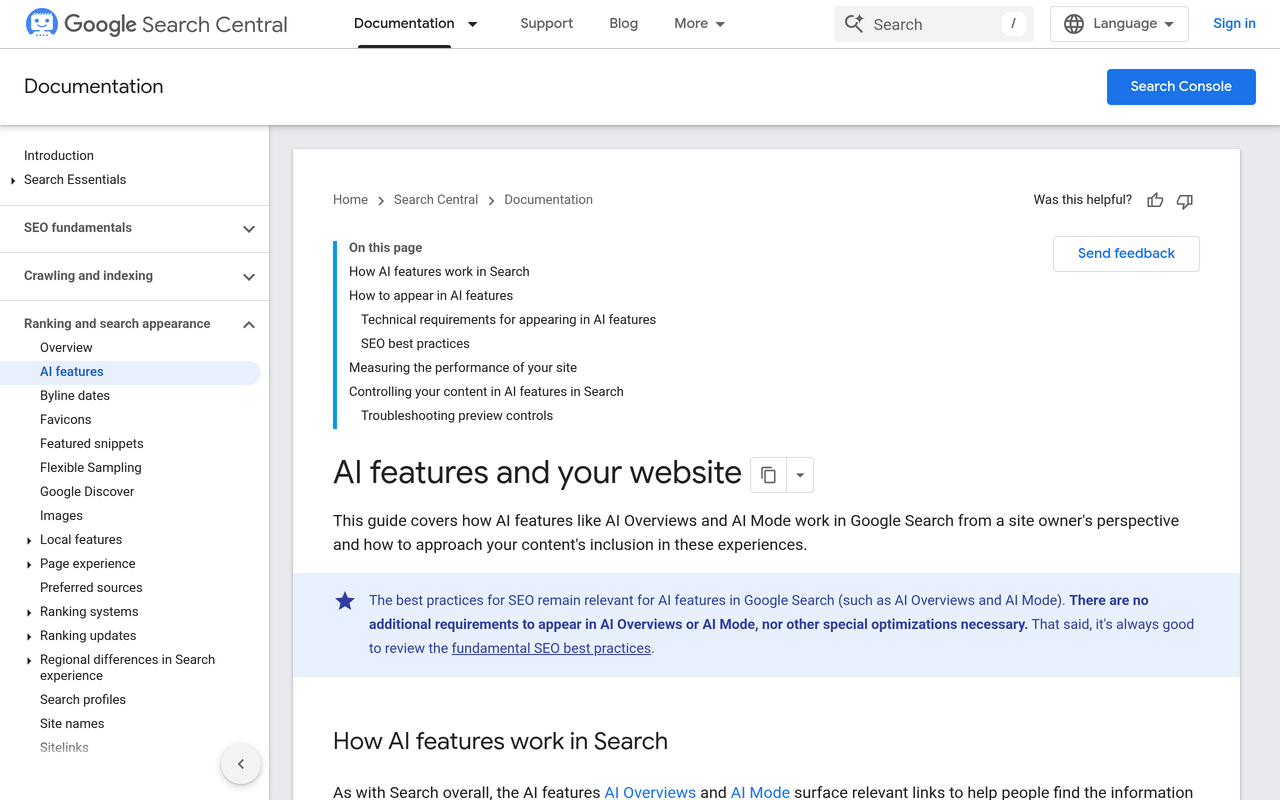
The same page lists the controls site owners have (nosnippet, data-nosnippet, max-snippet and noindex) and states that SEO best practices still apply to AI Overviews. That is useful context for the fix stage, but it does not replace measurement. For a step-by-step on the free methods, read how to track Google AI Overviews for your brand.
How does location change what AI Overviews show?
Location is the most overlooked requirement. A tracker that checks from one data centre gives you one version of Google.
SE Ranking compared how AI Overviews cite domains across five US states. It reported that for nearly half of all queries (47.05%, or 14,470), the cited domains were completely identical in all locations, and that AI Overviews cited around 9.81 to 9.90 unique domains per query across all states (SE Ranking, state-by-state AI Overviews study). Read the other way, the remaining queries cited at least one different domain in at least one location.
Local queries are where this bites hardest. Local Falcon tested location-specific and non-location-specific queries to see how location affects whether a business appears in AI Overviews (Local Falcon whitepaper). An academic audit of AI Overviews and Featured Snippets also includes a robustness check using SERPs collected from five different US locations (arXiv 2511.12920). The consistent message is to test your own markets rather than assume one result applies everywhere.
For nearly half of all queries (47.05%), SE Ranking found identical cited domains across five US states. That leaves the rest able to differ by location.
If you sell in several countries, the AI search visibility tools in Germany guide shows what to check for a non-US market, and the personalization article covers why two people can see different answers.
How do I test a Google AI Overviews tracker before paying?
Most buyers compare feature lists. A better method is to run a short test where the tool is judged against ground truth you collect yourself. Allow seven days and about two hours of manual work.
- Build a 20-query test set. Action: pick 10 queries where you expect an AI Overview (how, what, best-for questions) and 10 where you do not (brand names, navigational terms). Result: a set that tests both detection and false positives. Why: a tool that reports an overview on every query is as broken as one that reports none. The prompt selection guide helps choose them.
- Check them by hand first. Action: search each query in a private window, from the country you sell in, and record whether an overview appears, the cited domains and whether your brand is named. Result: your ground-truth sheet. Why: you cannot judge accuracy without a baseline you trust.
- Load the same queries into the tool. Action: set the same country and language. Result: the tool's first reading. Why: location settings are the most common cause of mismatches.
- Score presence agreement. Action: count queries where the tool and your manual check agree on whether an overview appeared. Result: a presence-agreement percentage out of 20. Why: this is the tool's detection accuracy on your queries.
- Score citation agreement. Action: for queries where both saw an overview, check whether the tool lists the cited domains you recorded. Result: a citation-overlap count. Why: citations are the output you will report to your boss.
- Repeat on days 3 and 7. Action: re-check five queries manually and compare with the tool's stored history. Result: a stability read. Why: AI Overviews change, so the tool must show changes, not freeze one answer.
- Test a second location. Action: run five queries from another country or region in both the tool and manually. Result: proof the tool captures location variance. Why: a tool that returns identical results across places is probably not localising.
Set your pass mark before you start. A reasonable rule: agreement on presence for at least 17 of 20 queries and a clear explanation for every miss. This threshold is a suggested working standard, not a published benchmark. A short trial may not cover all seven days, so a full 7-day test may need a free report or the manual method alongside it.
What does a worked example look like?
Suppose you track 200 queries across the five US states in the SE Ranking study. Applying that study's 47.05% figure as a rough guide, about 94 of your 200 queries would cite identical domains in every location (200 x 0.4705 = 94.1). The other roughly 106 could show at least one different cited domain depending on location. This is illustrative arithmetic on a published rate, not a forecast for your site.
What that means for a buyer: a tracker that checks from one location can only be trusted for the first group. For the second group, you need results by location, and you need the tool to store them separately.
A tracker should also distinguish owned sources from third-party sources, so you know whether a gap is on your site or on the sites Google trusts about you. Ask any vendor to show that split for a query you chose.
Which tool features should you compare?
The table below lists what to require from any tracker and how Noma by Nurdd covers each row, based on Noma's own published description. For any rival, check its capabilities against its own public pages and ask during a trial.
| Capability | What to require | Noma by Nurdd |
|---|---|---|
| Google AI Overviews | Presence per query and cited URLs | Ask during the trial or demo how Noma handles Google AI Overviews |
| Other AI engines | ChatGPT, Gemini, Perplexity and Claude in the same view | 13 AI engines, including ChatGPT, Gemini, Perplexity and Claude |
| Citation source per result | The cited page for every answer | Records whether a brand is named and which page each citation comes from |
| Check frequency | Stated clearly per plan | Polled daily |
| Competitor comparison | Rivals cited beside you, by category | Citation frequency by category with competitor comparison |
| Recommendations to improve | Next actions, not just counts | Actionable GEO recommendations |
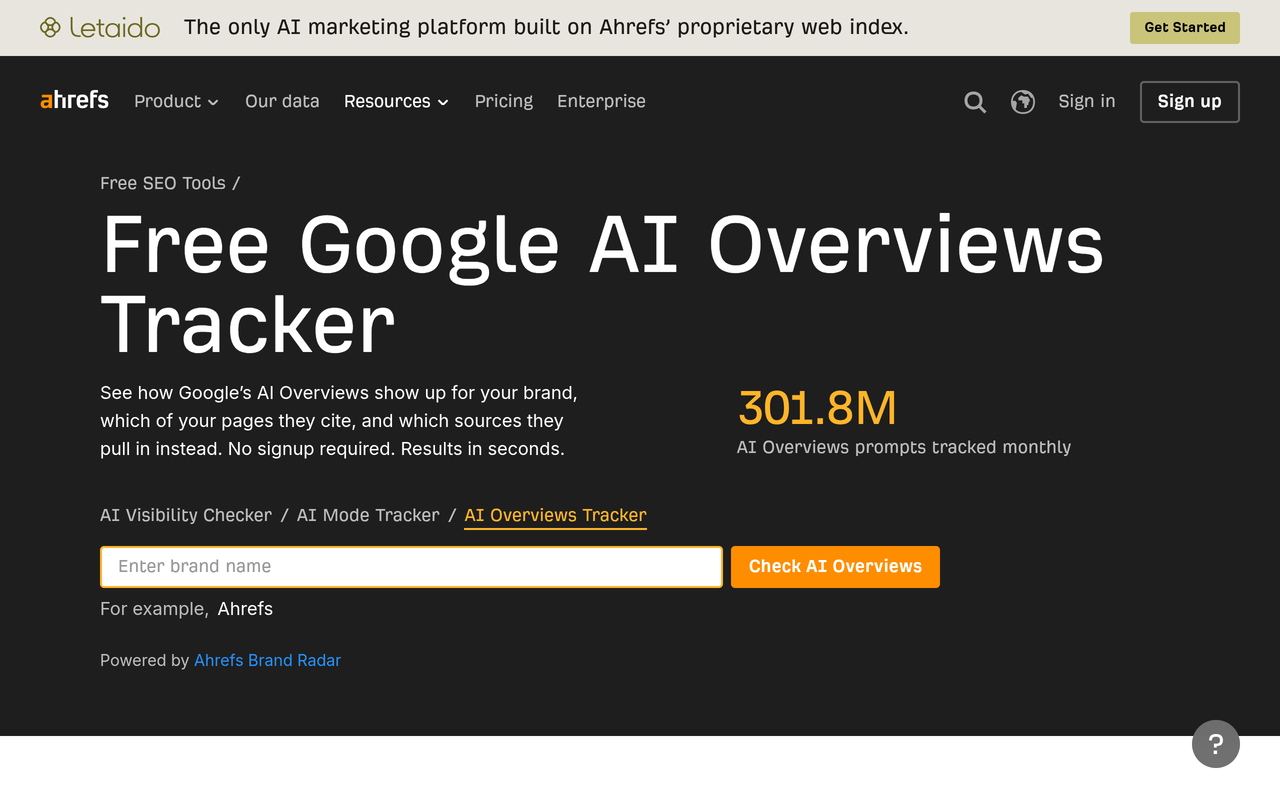
Free options exist for a first look. Ahrefs offers a free AI Overviews tracker page and a separate product called Brand Radar. Confirm how your own queries and markets would be handled before relying on either.
How do the trial and pricing models compare?
Prices change often, so this table records only what the vendors state on their own pages. Date checked: 5 November 2026.
| Tool | Entry model as published | What to confirm before buying |
|---|---|---|
| Noma by Nurdd | 3-day free trial; card taken at signup; billing starts on day 3; no charge if cancelled before then | Which plan matches your query and location count |
| Ahrefs | Free AI Overviews tracker page; Brand Radar is a separate product | What Brand Radar costs and which queries and locations it covers |
Whatever you choose, ask three questions in writing: how many prompts and locations are included, how often each is checked, and whether history is kept after you downgrade.
Where does Noma fit in a Google AI Overviews buying decision?
Noma by Nurdd is an AI search visibility dashboard that tracks whether a brand appears in answers from 13 AI engines, including ChatGPT, Gemini, Perplexity and Claude, polled daily. It records whether your brand is named and which page each citation comes from, and shows citation frequency by category with competitor comparison and recommendations. That puts the other places your buyers ask next to each other in one view.
Book a demo, and bring your 20 queries so you can ask how Google AI Overviews fits your requirement.
Noma tracks 13 AI engines, including ChatGPT, Gemini, Perplexity and Claude, polled daily, records the page behind each citation, and shows competitor comparison and recommendations. Ask during the trial or demo how it handles Google AI Overviews. The 3-day free trial lets you try the tool before billing starts on day 3. For Google AI Overviews specifically, pair any tool with the manual checks above and Google's Search Console. For a broader view of the category, see the best AI search visibility tools comparison and direct comparisons such as Noma vs Semrush and Noma vs Ahrefs.
Which tracker fits which team?
Use this decision table to decide which requirement to weight most. It is our own framework, built from the capabilities above.
| Your situation | Weight most heavily | Test to run |
|---|---|---|
| One market, small query list | Presence accuracy and citation capture | Steps 1 to 5 |
| Several countries or regions | Location control and separate storage per location | Step 7 with five queries per market |
| Local or multi-location brand | Place-level results and local query handling | Run local queries from each branch area |
| Ecommerce catalogue | Category-level coverage and competitor citations | Track one category per product line |
| Agency reporting to clients | Export, history and evidence per result | Step 6, plus export one report |
| Buyers who also ask ChatGPT or Perplexity | Multi-engine coverage in one view | Compare the same 20 queries across engines |
If you run ecommerce, the ecommerce GEO tools guide and the ecommerce industry page go deeper. Franchise and multi-site brands should read AI search optimization for franchise brands.
What is your pre-purchase checklist?
Work through these in order before you enter a card number.
- Write down your top 20 queries and your target countries.
- Record manual results for each in a private window.
- Start a free trial or free report, and note the exact billing date.
- Confirm the tool can set country and language per query.
- Compare presence, citations and brand mentions against your sheet.
- Ask for the evidence behind three results: answer text, cited URL and timestamp.
- Check that competitors can be added and that history is stored.
- Export one report and confirm another person can read it.
- Decide whether you also need ChatGPT, Gemini, Perplexity and Claude in the same dashboard.
- Cancel or convert before billing starts, based on your score.
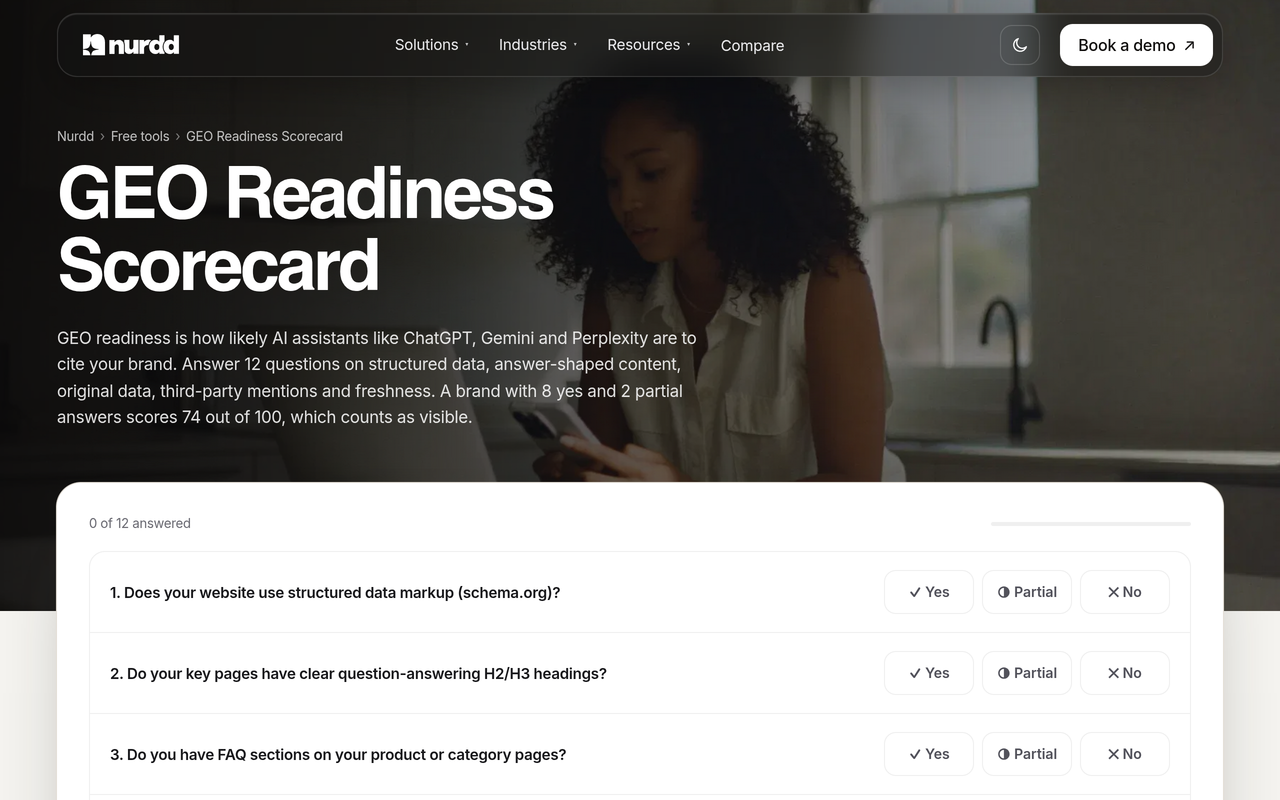
The free GEO readiness scorecard is a fast way to check your site against 12 factors before you start tracking, so you know whether a low result is a tracking problem or a content problem.
What mistakes do buyers make with Google AI Overviews trackers?
- Trusting a single average. A 30% coverage figure hides which queries drive it. Ask for the per-query list.
- Ignoring mentions. Being named without a link still shapes buyer perception. Track both, as explained in the AI search metrics reporting guide.
- Checking from one place. Given the regional variation described above, one location is a sample of one.
- Tracking branded queries only. Your brand name will usually surface you. The value is in category and comparison queries.
- Skipping the fix. Tracking shows the gap but does not close it. Pair it with content work such as the advice in how to appear in Google's AI Overview for your category and writing content AI engines quote.
- Measuring too quickly. Changes need a controlled comparison; the GEO experiment design guide explains how.
What do you do after you choose a tracker?
Start with a baseline week, then pick the five queries where a competitor is cited and you are not. Open each cited competitor page and note its format: a definition up front, a table, a list or a dated statistic. Then check whether your own page on that topic offers a quotable answer.
Report monthly with a short set of fixed metrics: queries with an overview, queries where you are cited, queries where you are named, and the change from last month. The monthly AI search metrics report template covers this. If you would rather hand off execution, Nurdd's answer engine optimization agency service works from Noma's measurements, and generative engine optimization services shape the content AI engines read. For product detail, see Noma.
How we researched this
We searched for the primary keyword and reviewed the pages that rank for it, including vendor tracker pages and tool roundups, to see what they cover and what they omit. We read Google's Search Central documentation on AI features, and published research on how AI Overviews vary by location. Vendor capability statements come from each vendor's own public pages; where a page did not state a capability, we left it out. Every figure in this article is attributed to its source. Sources were checked on 5 November 2026. We did not run hands-on tests of competing tools, so treat the test in this article as a method for you to run, not as our results.
Frequently asked questions
What is the best Google AI Overviews tracker?
The best tracker is the one that passes your own 20-query test: accurate presence detection, citations with source URLs, location control and history. For teams that also care about ChatGPT, Gemini, Perplexity and Claude, Noma by Nurdd tracks 13 AI engines in one dashboard. Start with its 3-day free trial and ask how it fits your Google AI Overviews requirement.
How do I choose a tool to track Google AI Overviews?
Write down your queries and markets, check them manually, then compare each tool's output with your sheet. Score presence agreement, citation overlap, location handling and stored history. Ask for evidence per result so you can audit any number.
Can I track AI Overviews in Google Search Console?
Partly. Google's documentation says AI feature activity is included in overall Search Console data, but it is not a separate AI Overviews report. You will not see the cited competitors or whether your brand was named, so a dedicated tracker fills that gap.
Do AI Overviews differ by location?
Often, yes. SE Ranking's study of five US states found 47.05% of queries cited identical domains in all of them, so the rest differed in at least one. Test your own markets before trusting a single-location tool.
Is there a free Google AI Overviews tracker?
Ahrefs offers a free AI Overviews tracker page. Noma by Nurdd offers a 3-day free trial; a card is taken at signup, billing starts on day 3, and you are not charged if you cancel before then. Free options suit a first look, not ongoing reporting.
What is the difference between a mention and a citation?
A mention means your brand name appears in the generated text. A citation means a link to one of your pages is shown as a source. A good tracker records both separately, because they signal different things to a reader.
How often should an AI Overviews tracker check my queries?
Daily checks catch changes early; monthly checks only show a snapshot. Noma polls daily. Whichever tool you pick, confirm the frequency per plan, since limits often apply to prompts and locations.
Ready to compare trackers on your own queries? Book a demo of Noma and bring your 20-query test set. You can also read more in the Nurdd blog.