AI Search Visibility
Ranking on Google but Not Cited by AI: What to Fix
Why a page that ranks on Google gets skipped by ChatGPT, Gemini and Perplexity, and how to diagnose and confirm each cause with prompt tracking.
 Simran Rawat9 Nov 202615 min read

A page can rank on Google yet go uncited by AI because ranking and citation use different signals. Ahrefs found only 12% of AI-cited URLs ranked in Google's top 10 for the original prompt. The usual causes are blocked or hidden content, unclear claims and weak entity signals, and each can be confirmed with prompt tracking across engines in Noma.
A page can rank on Google and still be ignored by ChatGPT, Gemini, Perplexity and Claude, because ranking and citing use different selection signals. Pages that are ranking on google but not cited by ai usually have one of three faults: claims an engine cannot lift cleanly, weak signals about who the brand is, or content the engine's crawler cannot reach or read.
It builds on our explainer of what generative engine optimization is and pairs with the free GEO readiness scorecard. This guide gives you a diagnosis you can run in an afternoon. For each cause it shows the symptom, the check, the fix, and how to confirm the result with prompt tracking across engines in Noma.
Key takeaways
- Rank and citation are separate outcomes. In an Ahrefs analysis of 15,000 long-tail queries, about 12% of AI-cited URLs also ranked in Google's top 10.
- Diagnose in order: access first (can the engine's crawler fetch the page), then claims (can a sentence be quoted alone), then entity (does the engine know who you are).
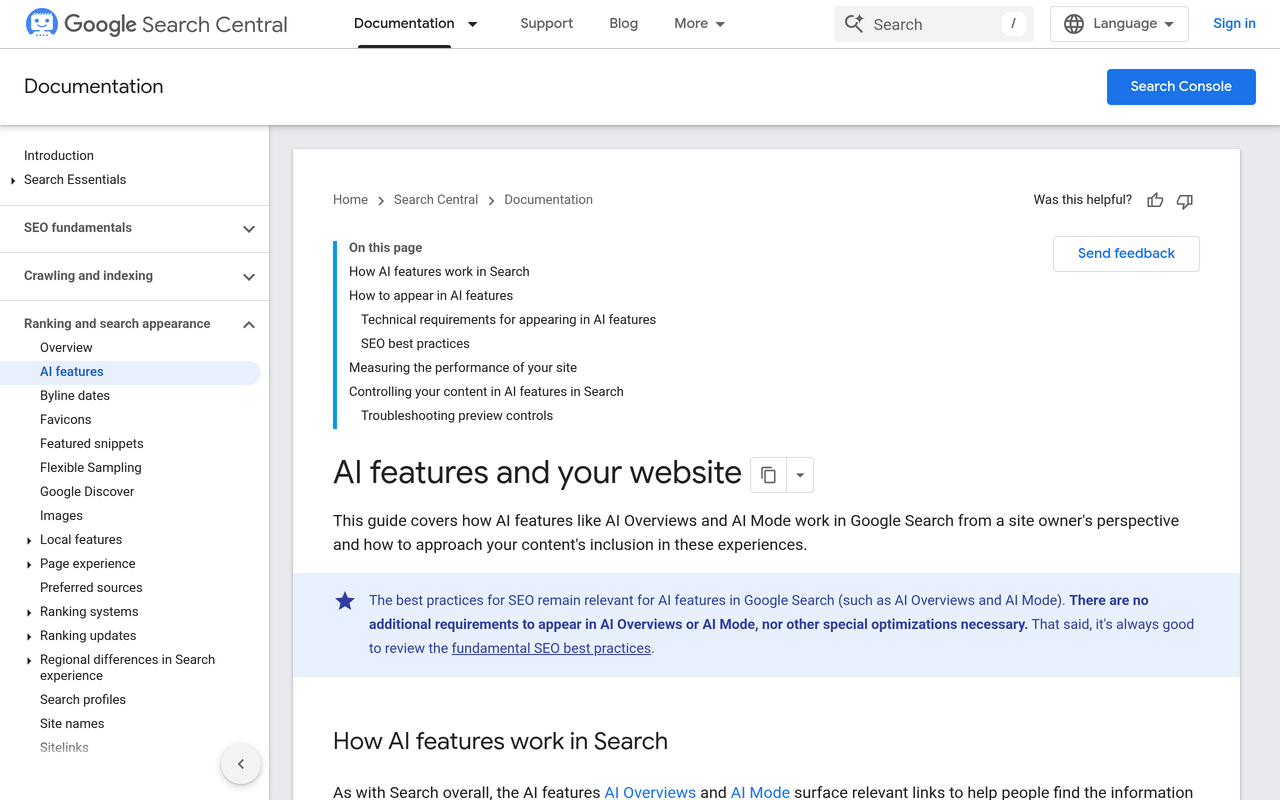
- Google says AI Overviews need no special technical requirements beyond normal indexing and snippet eligibility, so a page missing from Overviews is usually a content or competition problem, not a tag.
- OpenAI and Perplexity use separate search crawlers, so a robots.txt rule or firewall that blocks them removes you from those answers even if Googlebot is welcome.
- Confirm every fix with a fixed prompt set, run before and after, across several engines, and judge it on named mentions and cited URLs rather than one-off screenshots.
What does it mean to rank on Google but not be cited by AI?
It means a URL holds a visible organic position for a query, yet when the same question is put to an AI engine, the answer names other sources or none. Ranking is a page-level judgement by a search index. Citation is a claim-level judgement made while an engine assembles an answer, often from several sub-searches, and it may pull from pages that do not rank at all for your original keyword.
The gap is large. The Ahrefs study of AI search overlap (August 2025) ran 15,000 long-tail queries through Google, Bing and four AI assistants, and found that just 12% of citations in AI assistants also rank in Google's top 10 on average. The same study reports that 80% of those citations do not rank anywhere in Google for the original query.
Ahrefs (August 2025) found that 12% of URLs cited by AI assistants rank in Google's top 10 for the original prompt, and that 80% do not rank anywhere in Google for it. A top-10 position is therefore neither required for a citation nor a reliable predictor of one.
Google's own AI features behave differently from the assistants. A Quattr summary of Ahrefs' later AI Overviews research (2026) reports that overlap between cited pages and the top 10 fell from 76% to 38%. The Cognizo write-up (November 2026) gives the split as 37.9% of cited URLs ranking in the top 10, 31.2% ranking 11 to 100, and 31.0% outside the top 100.
Why does a top-ranking page get skipped by ChatGPT, Gemini and Perplexity?
Four mechanisms explain most cases. Each engine retrieves from its own index, rewrites your prompt into several searches, picks passages instead of pages, and prefers sources it can attach to a known entity. A page that wins one query on Google can lose at every one of those steps.
- Different index and crawler. ChatGPT search relies on OpenAI's own crawler, Perplexity on PerplexityBot, and Google on Googlebot. Being fetchable by one tells you nothing about the others.
- Query fan-out. Google's documentation says AI Overviews and AI Mode may issue multiple related searches across subtopics. Your page may rank for the head term yet be absent from the sub-questions the engine actually asks.
- Passage selection. Engines quote sentences. A page whose answer is buried in a long, hedged paragraph gives them nothing tidy to lift.
- Entity confidence. When an engine is unsure what a brand is, it favours sources that describe the category from outside, such as publishers, directories and community discussion.
The Ahrefs AEO course lesson adds that a 14% overlap exists among the top 50 most cited domains across Google AI Overviews, ChatGPT and Perplexity. In plain terms, 86% of top-mentioned sources are not shared, so fixing for one engine does not automatically fix the others. That is why measurement has to be per engine.
How do you diagnose it? A decision table
Start with the symptom you can observe, then run the matching check. This table is the order we recommend: cheapest and most binary checks first.
| Order | Cause | Symptom in AI answers | Check you can run | Typical fix |
|---|---|---|---|---|
| 1 | Blocked or hidden content | Never cited by one engine, cited by another | Fetch the page as each bot; read robots.txt and firewall rules; view the page source without JavaScript | Allow the search crawlers, whitelist published IP ranges, serve the answer in HTML |
| 2 | Unclear claims | Topic is covered, but competitors' wording is quoted | Cover the page, read only each H2 and the first sentence under it; does it answer the question alone? | Lead each section with a direct, specific, attributed answer |
| 3 | Weak entity signals | Brand is described wrongly, vaguely, or lumped with others | Ask each engine who the brand is and what it sells | Consistent brand description, schema, sameAs links, third-party mentions |
| 4 | Wrong query shape | Page ranks for the head term, absent from related questions | List the sub-questions a buyer would ask; check which your page answers | Add sections or pages for each sub-question |
| 5 | Source-type mismatch | Engines cite forums, video or review sites for this topic | Tally the domain types cited across your prompt set | Earn presence on those source types |
Cause 1: Is the content blocked or hidden from AI crawlers?
Check this first because it is binary and quick to fix. Search engines and assistants use different bots, and a rule written years ago for "all crawlers" can silently exclude the new ones.
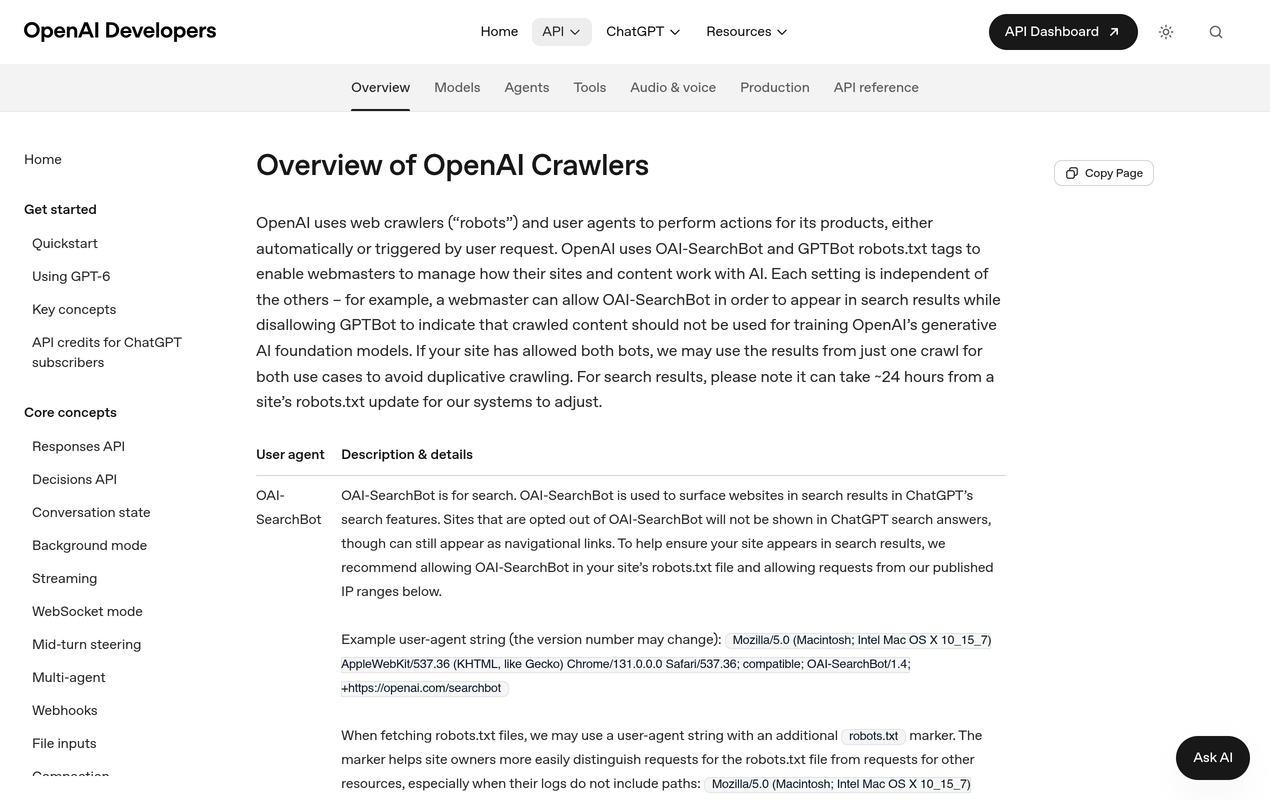
OpenAI's crawler documentation lists OAI-SearchBot and GPTBot as separate robots.txt tags, and notes that a robots.txt change can take around 24 hours to take effect for search results. OAI-SearchBot is the one tied to ChatGPT search; GPTBot relates to training. Blocking GPTBot to avoid training use is a legitimate choice, but blocking OAI-SearchBot too removes the page from ChatGPT search results.
Perplexity's crawler page recommends allowing PerplexityBot in robots.txt and permitting requests from its published IP ranges, and advises whitelisting if you run a web application firewall. It also documents Perplexity-User, which fetches pages when a person asks a question and generally ignores robots.txt. A firewall that challenges unknown bots can still stop both.
Hidden content is the second half of this cause. If your key answer sits inside a tab, an accordion that loads on click, an image, or a script-rendered widget, a crawler that does not run JavaScript sees an empty block. Our AI crawler user agents list shows which names to allow, and the guide to checking a site for AI answers covers the source-view test.
Checklist: access audit in 30 minutes
- Open robots.txt and look for broad Disallow rules or named blocks on OAI-SearchBot, PerplexityBot, ClaudeBot and Google-Extended. Result: a list of bots you block, deliberately or not.
- Ask your host or CDN whether bot-protection rules challenge unknown user agents. Result: a yes or no, and the rule name.
- Request the page with JavaScript disabled and read the text. Result: you see whether the answer exists in the raw HTML.
- Confirm the page returns 200, is not noindex, and has a canonical pointing to itself. Google requires indexing and snippet eligibility for AI features.
- Check that the page loads quickly and has no login or cookie wall in front of the answer.
- Re-test with Noma prompts 24 hours or more after any robots.txt change, since OpenAI says changes can take about that long.
Cause 2: Are your claims too unclear to quote?
If access is fine, read the page the way an engine does: as a set of candidate passages. A passage is quotable when it states one claim, names its subject in full, and carries its own evidence. Pages that rank well often win on topical coverage and links, which can mask vague writing that an answer engine cannot use.
Academic work backs the idea that wording changes visibility. The GEO paper by Aggarwal and colleagues (arXiv, 2023; KDD 2024) tested content changes against a benchmark of generative engine responses, and reported that adding citations, quotations from relevant sources and statistics boosted source visibility by over 40% across various queries. The finding applies to the benchmark's setup, so treat it as direction, not a guarantee for your category.
Before and after: a quotable claim
| Weak (skipped) | Quotable (liftable) | Why it works |
|---|---|---|
| We help brands grow with a smarter approach to visibility that really works. | Noma by Nurdd tracks whether a brand appears in answers from 13 AI engines, including ChatGPT, Gemini, Perplexity and Claude, polled daily. | Names the entity, the action, the scope and the frequency in one sentence. |
| It depends on many factors, but our tool can often be useful. | A page is eligible for Google's AI Overviews if it is indexed and can be shown with a snippet, according to Google Search Central. | States a condition, attributes it, and survives being quoted out of context. |
| Results vary widely. | In Ahrefs' 15,000-query study, 12% of AI-cited URLs ranked in Google's top 10. | Carries a number, a source and a scope. |
Apply the same pattern to every H2: answer first, in one or two sentences, then support. Our guides to the sentence structure that gets cited and writing content AI engines quote show more rewrites, and FAQ pages for AI search covers question-and-answer layout.
Test: the cover-and-quote check
- Copy only the first sentence under each H2 into a blank document.
- Read each alone. If you cannot tell who or what it is about, the entity is missing.
- Look for a claim with no source, number, date or condition. Mark it as unsupported.
- Rewrite the marked sentences, keeping one claim per sentence.
Cause 3: Do AI engines know who you are? Entity signals
Engines cite sources they can place. If your brand name is ambiguous, described differently on every profile, or absent from the third-party pages engines trust, your own page looks like an unverified voice. This is the cause behind answers that mention your category but name competitors.
Test it directly. Ask each engine "What is [brand] and who is it for?" and compare the answers to your own description. Wrong category, wrong product, or no recognition at all points to entity work. Our guides on writing a brand description AI engines can use, Wikidata and sameAs and schema markup for AI search cover the fixes in detail.
- Use one canonical description of the company in the first 100 words of the homepage, About page and key profiles.
- Add Organization schema with sameAs links to your official profiles.
- Show named authors and a dateModified on articles that make claims.
- Earn mentions on the third-party pages engines cite for your category, which Noma shows you per prompt.
See also why AI engines trust some sites more than others, which explains why domain strength alone does not settle it.

How do you confirm each cause with Noma prompt tracking?
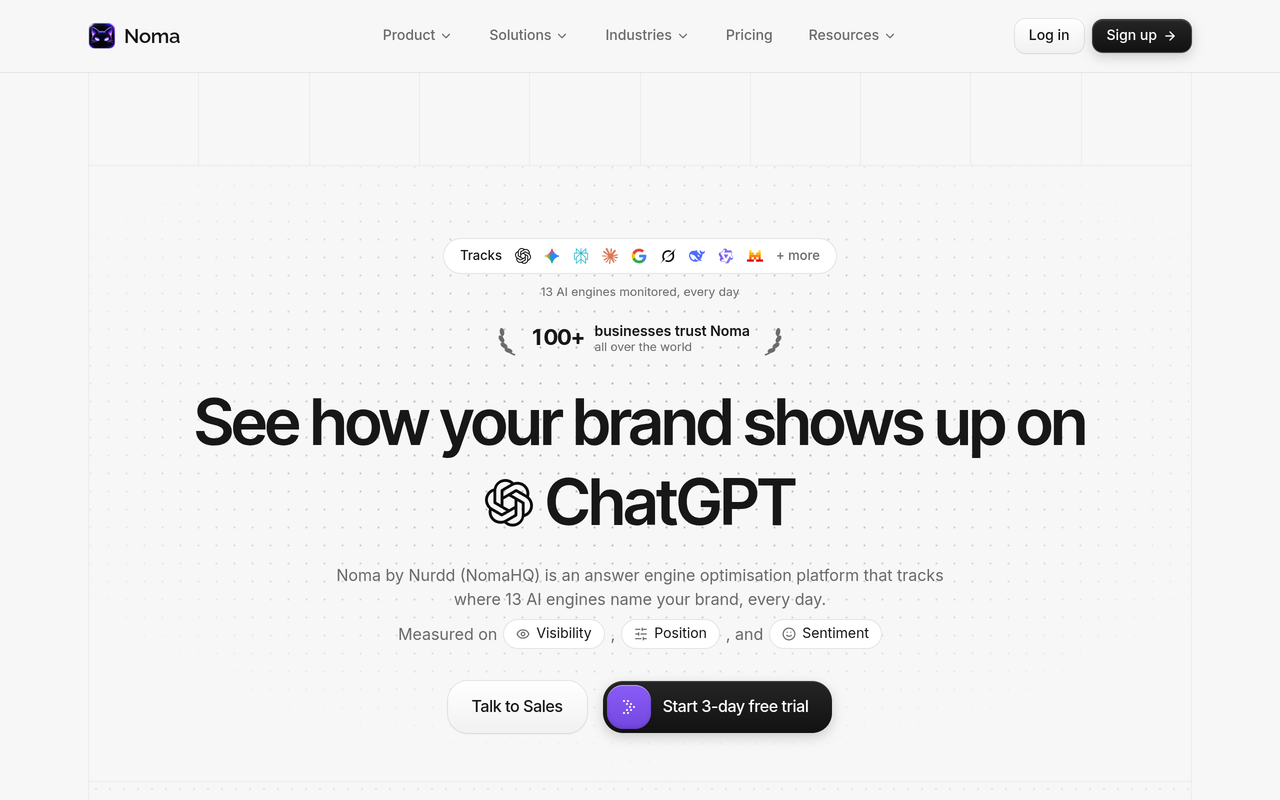
Diagnosis by hand is a guess until you measure it across engines repeatedly. Noma is a web dashboard that tracks whether a brand appears in answers from 13 AI engines, including ChatGPT, Gemini, Perplexity and Claude, polled daily. It shows citation frequency by category, competitor comparison and recommendations, and records which page each citation comes from.
The method below turns each cause into a testable hypothesis. Keep the prompt set fixed so that changes in results come from your edits, not from new wording. The guide to which prompts to track and the prompt-count guide help you size the set.
| Cause | What to track in Noma | Pattern that confirms it | Pattern that rules it out |
|---|---|---|---|
| Blocked or hidden | Your domain's citations per engine | Zero citations on one engine, normal on others | Citations present on every engine |
| Unclear claims | Prompts matching your page's topic; which URLs are cited | Your brand is named elsewhere, but competitor pages are the cited URLs | Your page is cited but the brand is not named |
| Weak entity | Brand-name prompts and category prompts | Brand-name prompts return wrong or vague descriptions | Engines describe you accurately |
| Wrong query shape | Sub-question prompts, not the head term | Cited on the head term only | Absent on both |
| Source-type mismatch | Cited domains across the set | Cited domains are mostly forums, video or review sites | Cited domains are mostly brand sites |
Worked example: scoring one ranking page
This example is arithmetic to show the method, not real data. Suppose a page ranks in the top 5 for a head keyword. You write 10 prompts a buyer might ask about that topic and track them across 13 engines for one week. Each prompt-and-engine pair is one observation, so the set has 130 observations.
- Count observations where your brand is named. Say the number is 13. Share of voice is 13 divided by 130, which is 10%.
- Split by engine. If 12 of the 13 mentions sit on two engines, the other eleven engines point you toward an access or entity problem rather than a content one.
- Open the cited URLs for the 117 misses. If most point to the same three competitor pages, compare their opening sentences with yours.
- Edit the page's claims, wait for recrawl, and re-run the same 130 observations. A move from 13 to a higher count with the same prompts is evidence; a move on different prompts is not.
Our GEO experiment design guide and 4-week test plan extend this into a controlled test, and the AI search share of voice guide explains the metric.
Why Noma belongs in this workflow
Noma by Nurdd is built for exactly this gap between rankings and answers. It tracks 13 AI engines, including ChatGPT, Gemini, Perplexity and Claude, records whether your brand is named and which page each citation comes from, and compares you with competitors by category. That lets a team separate an access problem from a wording problem from an entity problem with evidence.
Book a demo at nurdd.club/demo to see your own brand's prompts run across the engines, with the pages cited for you and for your competitors. Noma has a 3-day free trial; a card is taken at signup and billing starts on day 3, with no charge if you cancel before then. Details are at nomahq.app.
How long do fixes take to show up?
It varies by engine and cannot be promised. Access fixes can register quickly: OpenAI says robots.txt changes can take about 24 hours to adjust for search. Content and entity fixes depend on recrawling and on whether third-party sources change, so track weekly and judge over several weeks.
Engines also answer differently each time. Personalisation and retrieval variation mean a single run proves little, which is why daily polling and a fixed prompt set matter. Our piece on personalisation in AI answers covers the noise.
What are the common mistakes?
- Treating Google Search Console as the answer. It reports Google, not ChatGPT, Perplexity or Claude citations.
- Blocking all AI bots in one rule. Training and search crawlers are separate; blocking both removes you from answers.
- Testing one prompt once. Results shift between runs. Use a fixed set and repeat.
- Rewriting before checking access. A perfect page behind a firewall rule still gets no citation.
- Chasing the head keyword only. Engines answer sub-questions; cover them.
- Ignoring referral data. Pair visibility with AI referral traffic analytics to see whether citations bring visits.
How does this compare with classic SEO diagnosis?
| Question | Classic SEO | AI citation |
|---|---|---|
| Unit judged | Page | Passage or claim |
| Crawler | Googlebot | OAI-SearchBot, PerplexityBot, others per engine |
| Success metric | Position, clicks | Brand named, URL cited, share of voice |
| Tracking cadence | Weekly rank checks | Daily polled prompts per engine |
| Own page needed? | Yes | Not always; third-party pages often supply the citation |
Google says the SEO best practices remain relevant for its AI features, so classic work is not wasted. The difference is that SEO ends at the click, while AI visibility also depends on what the engine says about you. See AI search optimization vs SEO and what generative engine optimization is for the wider picture, and the free GEO readiness scorecard for a 12-factor self-check.
What if you do not have time to fix it yourself?
Nurdd's team also runs the work. Its answer engine optimization agency service and generative engine optimization services improve the site and content engines read and work to earn cited third-party sources, with results measured in Noma. If you are comparing tools first, see Noma vs Profound.
How we researched this
We reviewed platform documentation from Google, OpenAI and Perplexity, the Ahrefs overlap study, the GEO academic paper, and industry write-ups that summarise later Ahrefs data. We also read competing articles on the same problem to see what they cover. Sources were checked on 9 November 2026. We did not run hands-on tests for this article, and the worked example is arithmetic, not customer data. Figures from secondary write-ups are attributed to them.
Frequently asked questions
Why does my page rank on Google but ChatGPT never cites it?
Google ranks pages in its own index; ChatGPT retrieves passages through its own crawler and picks sources by claim and entity fit. The Ahrefs study found about 12% of AI-cited URLs rank in Google's top 10. Check that OAI-SearchBot is allowed, then check whether your claims are quotable.
How do I get a top-ranking page cited by AI engines?
Work in order: allow the search crawlers and serve the answer in HTML, rewrite each section to lead with a specific, sourced claim, strengthen entity signals such as schema and consistent descriptions, then track a fixed prompt set across engines. Measure named mentions and cited URLs before and after.
Do I need special markup to appear in Google AI Overviews?
Google Search Central says there are no additional technical requirements beyond being indexed and eligible to show with a snippet. Structured data can help clarity, but Google does not list it as a requirement for AI features.
Should I block GPTBot?
That is a business choice. OpenAI documents GPTBot and OAI-SearchBot as separate tags, so you can block training use while allowing the search crawler. Blocking OAI-SearchBot removes the page from ChatGPT search results.
Does ranking first on Google guarantee an AI Overview citation?
No. Reported figures show a large share of cited pages sit outside the top 10, and the share inside it has fallen in later research, according to Quattr's summary of Ahrefs. Ranking helps eligibility but does not decide selection.
How many prompts should I track to diagnose this?
Enough to cover the head term and the sub-questions a buyer would ask, typically a set you can keep fixed for weeks. Our prompt-tracking guide explains how to size it. Consistency matters more than volume.
Can Noma tell me which page an AI engine cited?
Noma records whether a brand is named and which page each citation comes from, across 13 AI engines polled daily. That lets you compare your cited pages against competitors' for the same prompts.
How long before fixes appear in AI answers?
Access changes can take around 24 hours to register for OpenAI search, according to OpenAI. Content and entity changes depend on recrawling and third-party sources, so judge them over several weeks of tracking.
Next step: see where your ranking pages are missing from AI answers
Rankings tell you where Google puts you. They do not tell you what ChatGPT, Gemini, Perplexity or Claude say when your buyer asks. Book a demo at nurdd.club/demo and we will show you your own brand's prompts across the engines, which of your ranking pages are cited, and which competitor pages are cited instead.