AI Search Visibility
AI Search Metrics: How to Build a Monthly Report
A monthly AI search metrics report covers citations, mentions, share of voice and referral traffic by engine, and leaves out vanity numbers.
 Simran Rawat5 Nov 202616 min read

Report four AI search metrics each month, split by engine: mention rate, citation rate, share of voice against a fixed competitor set, and AI referral sessions with conversions. Add a short sentiment and accuracy note, and leave out single-run rankings and traffic estimates. Noma by Nurdd supplies the tracked visibility data across 13 AI engines.
The AI search metrics to report each month are mention rate, citation rate, share of voice against a fixed competitor set, and AI referral sessions with conversions, each split by engine. Add a short accuracy and sentiment note, and leave out single-run rankings and traffic estimates. This guide gives you the template, the formulas and the cut list.
Key takeaways
- Report four core AI search metrics monthly: mention rate, citation rate, share of voice and AI referral sessions, each broken out by engine.
- Fix your prompt set, competitor set and engine list before the first report, and change them only with a written note, or month-on-month comparisons mean nothing.
- Keep visibility metrics (what AI engines say) separate from traffic metrics (what visitors do). They come from different systems and move at different speeds.
- Leave out single-prompt rankings, vendor traffic estimates and any score you cannot explain in one sentence.
- End every report with three actions for next month, each tied to a prompt, a page or a third-party source.
- Track the pages cited, not just the brand name, because the cited page is what you can change.
Why do AI search metrics need their own monthly report?
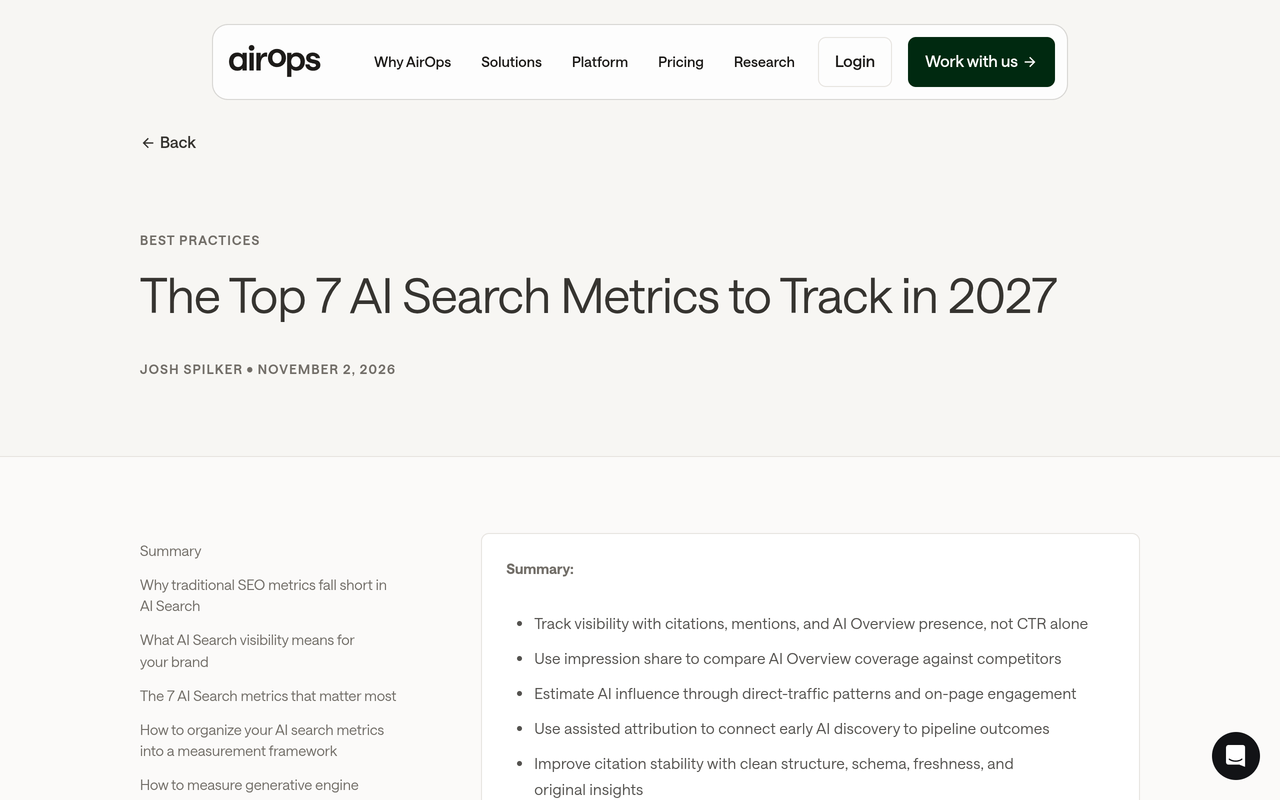
Traditional SEO reports revolve around keyword positions, clicks and impressions. AI engines such as ChatGPT, Gemini, Perplexity and Claude answer inside the interface, so a brand can be recommended to a buyer without a visit ever reaching your analytics. AirOps, November 2026, frames this as influence that happens before or without a visit to your site, which is why visibility metrics are needed alongside traffic.
The reporting problem is that AI answers vary. The same prompt can return different brands on different days, and different engines cite different sources. A monthly report has to turn that noise into a small set of stable, comparable numbers. If you want the underlying concepts first, read what generative engine optimization is and the AI search glossary for marketers.
Click data is also thin. Search Engine Journal, July 2025, reporting on Pew Research Center, said users who saw an AI summary rarely clicked the citation links inside it, with only 1% doing so, against 15% who clicked a result when they saw a standard search page. If referral traffic is the only AI metric you report, you will undercount the channel and mistake low clicks for low influence.
Which AI search metrics should I report each month?
Report a short list. A monthly report read by a marketing lead or a CMO should hold four core metrics and two supporting notes. Meltwater, November 2026, recommends a consistent monthly executive view of visibility, mentions, sentiment and peer rank. Adobe, November 2026, lists a similar spread: visibility, citations, mentions, share of voice, sentiment, referral quality and business impact. The table below turns those ideas into one template you can copy.
| Metric | What it answers | Formula | Where the data comes from | Split by engine? |
|---|---|---|---|---|
| Mention rate | How often is our brand named in answers to our tracked prompts? | Answers naming the brand ÷ total answers sampled | AI visibility tracker (Noma) | Yes |
| Citation rate | How often is one of our pages linked as a source? | Answers citing our domain ÷ total answers sampled | AI visibility tracker (Noma) | Yes |
| Share of voice | What share of brand mentions in our category do we hold? | Our mentions ÷ mentions of all brands in the fixed set | AI visibility tracker (Noma) | Yes, plus blended |
| AI referral sessions and conversions | How many visits and outcomes came from AI engines? | GA4 sessions from AI sources; key events from those sessions | GA4 (and Search Console for Google AI features) | Yes, by source |
| Cited-page list (supporting) | Which of our pages and which third-party sources do engines use? | Count of citations per URL | AI visibility tracker (Noma) | Yes |
| Accuracy and sentiment note (supporting) | Are the answers right and how do they describe us? | Manual review of a sample, scored right, partly right or wrong | Human review of stored answers | Optional |
Mention rate and citation rate are different and should never be merged. A mention means the engine said your brand name. A citation means the engine linked or attributed a page of yours. A brand can be mentioned from training knowledge with no citation, and a page can be cited while the brand name is not recommended. For the full measurement logic, see AI search share of voice: how to measure it.
Mention rate shows whether AI engines know your brand. Citation rate shows whether they trust your pages. Share of voice shows whether you are winning against the competitors a buyer is comparing you with.
Why split every visibility metric by engine?
Engines behave differently, so a blended number can hide a collapse in one place. A brand can hold a strong position in Perplexity, which cites sources prominently, while being absent from Gemini. A blended average would show a middling figure and no action. Report the blend for the headline and the per-engine rows for the diagnosis. The comparison of Perplexity, ChatGPT and Gemini for brands explains why the engines diverge.
How do you build the monthly AI search report, step by step?
Follow these seven steps once to set the system up, then repeat only steps 5 to 7 each month. Each step gives an action, the result you should have, and why it matters.
Step 1: Freeze the prompt set
Action: Write 20 to 50 prompts that a real buyer would type, grouped by stage: category discovery, comparison, problem, and brand-specific. Lock the wording. Result: a prompt list with an owner and a date. Why: if the wording changes, the month-on-month change reflects your edits, not the engines. The guide to which prompts to track for AI search visibility shows how to choose them.
Step 2: Freeze the competitor set and the engine list
Action: Name five to eight competitors that buyers compare you with, and list the engines you will report. Result: a fixed denominator for share of voice. Why: share of voice is a ratio, and adding a competitor mid-year lowers everyone's share without anything having changed in the market. Noma tracks 13 AI engines, including ChatGPT, Gemini, Perplexity and Claude, so you can keep the full list in one place instead of sampling a few engines by hand.
Step 3: Collect visibility data on a schedule
Action: Poll the same prompts on the same engines on a regular cadence, and store each answer with its cited sources. Result: a month of answers, not one reading. Why: AI answers vary run to run, so one reading is an anecdote while a month of daily polling is a rate. Noma polls its 13 engines daily and records whether a brand is named and which page each citation comes from.
Step 4: Connect referral traffic and conversions
Action: In GA4, build a report or channel group for AI sources and mark the events you care about as key events. Result: sessions and conversions by AI source. Why: visibility without outcomes is unconvincing, and traffic without visibility is unexplained. The next section covers the setup details and its limits.
Step 5: Calculate the four metrics and compare with last month
Action: Compute mention rate, citation rate and share of voice per engine and blended, then add AI sessions and conversions. Show the change in percentage points, not percent of percent. Result: one table with this month, last month and the change. Why: a move from 10% to 12% is two points; calling it a 20% rise invites a misreading in the meeting.
Step 6: Review a sample of answers for accuracy and sentiment
Action: Read 10 to 20 stored answers that mention you, and mark each right, partly right or wrong, noting how the engine describes your brand. Result: a short note with the two most common errors. Why: a high mention rate with wrong pricing, wrong category or outdated claims can cost you sales, and no automated score replaces this read.
Step 7: Close with three actions
Action: Choose three changes for next month, each tied to a prompt group, a page you control or a third-party source engines cite. Result: a list with owners and dates. Why: a report that ends in observation never changes anything, and next month's numbers then have nothing to test. The GEO experiment design guide shows how to test a change properly.

How do you measure AI referral traffic in GA4?
Start in GA4 with session source. Seer Interactive, November 2026, explains that ChatGPT citation clicks usually arrive with a source of chatgpt.com and a medium of referral, while some ChatGPT search-result clicks arrive without referral information and land in the Direct channel. That means GA4 gives you a floor, not a total.
Build a regular expression filter on session source that covers the AI domains you care about. Peec AI, November 2026, publishes a mapping of referral domains to engines in its documentation, including chatgpt.com, gemini.google.com, copilot.microsoft.com, grok.com, you.com and chat.deepseek.com, which is a useful reference list for your own filter. It also notes that the event you want to track must be marked as a key event or the metric shows no data, and the same rule applies to your GA4 reports.
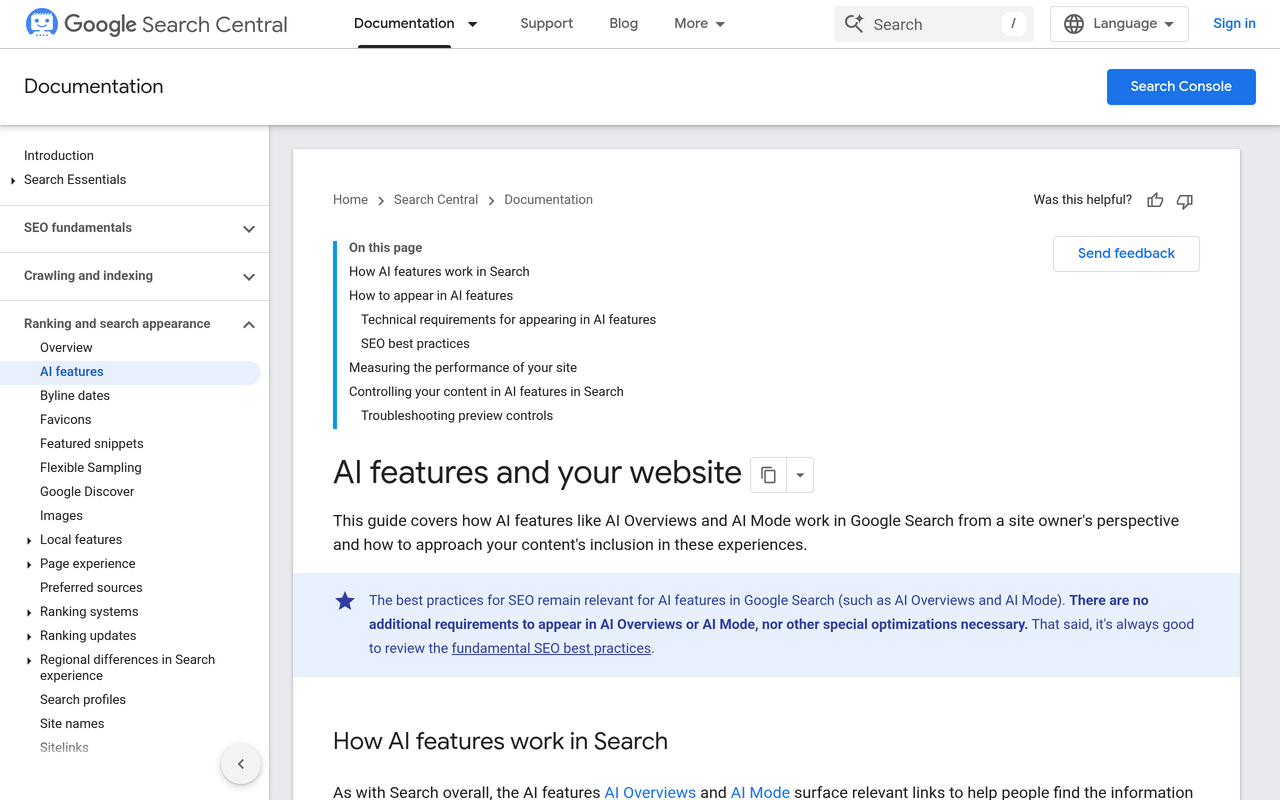
Google's own AI features need a different source. Google Search Central, November 2026, says sites appearing in AI Overviews and AI Mode are included in overall search traffic in Search Console, reported in the Performance report under the Web search type. WebFX, November 2026, describes a newer generative AI performance report covering AI Overviews, AI Mode and AI-powered Discover, and notes that it shows impressions only. Report those impressions as a Google-specific line, and do not add them to ChatGPT or Perplexity session counts.
For a deeper treatment of attributing visits and conversions to AI sources, see AI search vs Google conversion rate: measure your own and, for Google specifically, how to track Google AI Overviews for your brand.
What does a worked example of the monthly calculation look like?
The numbers below are invented inputs, not benchmarks. They exist only to show the arithmetic so you can apply it to your own tracked data.
Suppose you track 20 prompts on one engine, polled over a month to give 600 sampled answers. Your brand is named in 90 of them, so mention rate is 90 ÷ 600 = 15%. Your domain is cited in 54, so citation rate is 54 ÷ 600 = 9%. Across the fixed set of six brands, total brand mentions in those 600 answers are 450, so your share of voice is 90 ÷ 450 = 20%.
Next month, you are named in 105 of 600 answers, so mention rate is 17.5%, up 2.5 points. Citations rise to 60, so citation rate is 10%, up 1 point. Total set mentions are 480, so share of voice is 105 ÷ 480, about 21.9%, up 1.9 points. The report line reads: mention rate up 2.5 points, citation rate up 1 point, share of voice up 1.9 points, with the cause noted as the two product pages you rewrote in week two.
Notice the gap between mention rate and citation rate. A brand named often but cited rarely is being recommended from general knowledge, and the action is to publish and earn pages the engine can quote. A brand cited often but named rarely has useful pages but a weak entity description. The article on writing a brand description that AI engines understand covers that second case.
What should you leave out of an AI search metrics report?
Every metric you add makes the report slower to read and easier to argue with. Cut anything that fails one test: can you explain it in a sentence, and would a change in it alter a decision? HubSpot, November 2026, discusses summarising visibility into a single score. A composite score can be a fine headline, but only if you can state what goes into it, so keep the components visible beneath it.
| Leave it out | Why | What to report instead |
|---|---|---|
| Single-run "ranking" in one AI answer | Answers vary between runs, so one position is an anecdote. | Mention rate over a full month of polling |
| Third-party traffic estimates for AI platforms | They are modelled, not measured on your site. | Your own GA4 sessions and key events |
| A blended score with hidden inputs | Nobody can act on a number they cannot decompose. | Components: mention, citation, share of voice |
| Mentions with no prompt context | A mention in an irrelevant prompt is not demand. | Mention rate by prompt group |
| Raw impressions from Google AI features added to sessions | Impressions and sessions are different units. | Separate lines for impressions and sessions |
| Vanity engine lists | Reporting engines your buyers do not use dilutes the story. | The engines you froze in step 2, with a note on any change |
| Backlink counts as an AI proxy | They are not the same signal as being cited in an answer. | Cited-page and cited-source list |
Keep a short "not reported" line at the bottom of the report so stakeholders know the omission is deliberate. The guide to which AI search statistics you can safely cite is a good companion when someone asks you to add a headline figure from a vendor study.
What should the one-page report template contain?
Use this layout. It fits one page or one slide and works for a marketing lead, a CMO or a client.
- Headline: one sentence stating whether visibility rose, fell or held, and the main reason.
- Scorecard table: mention rate, citation rate and share of voice, blended and per engine, with last month and the change in points.
- Competitor view: share of voice for each brand in the fixed set.
- Sources view: the top cited pages of yours, and the top third-party domains engines cite for your prompts.
- Traffic and outcomes: AI sessions by source, key events, and Google AI feature impressions as a separate line.
- Accuracy and sentiment note: two or three observed errors or framing issues.
- Actions: three changes for next month with owners.
- Method footer: prompt count, engine list, competitor set and any changes this month.
For an executive audience, the AI search visibility dashboard guide covers what leadership needs to see on a live view rather than a monthly document.
What are the common mistakes in AI search reporting?
- Changing the prompt set every month. The trend line then reflects your edits. Add prompts in a separate, labelled group.
- Merging mentions and citations. They have different causes and different fixes.
- Reporting only blended numbers. A drop in one engine disappears in the average.
- Treating GA4 referral sessions as total AI influence. Some clicks arrive as Direct, and many answers produce no click at all.
- Ignoring wrong answers. A confident but outdated description of your pricing or category needs a fix even when visibility is high.
- Reading a single month as a trend. Wait for three months of the same method before calling a direction.
- Reporting without a test. If you changed three things at once, you cannot say which one worked, so stagger changes where you can.
If your numbers are low and you do not know why, why your brand isn't showing up in ChatGPT answers and why your competitor is cited in AI answers and you aren't walk through the usual causes.
Pre-report checklist: what to confirm before you send it
- Confirm the prompt count and wording match last month, or note every change.
- Confirm the competitor set and engine list are unchanged, or note the change.
- Check that polling ran for every day of the month with no gaps.
- Recalculate mention rate, citation rate and share of voice per engine.
- Check GA4 key events are still firing, and that AI sources are grouped as intended.
- Read at least 10 stored answers for accuracy and framing.
- Pull the top cited pages and top third-party sources.
- Write the headline sentence last, and keep it under 25 words.
- List three actions with owners and dates.
- Add the "not reported" line and the method footer.
How does Noma supply the tracked data for this report?
Noma by Nurdd is a web dashboard at nomahq.app that tracks whether a brand appears in answers from 13 AI engines, including ChatGPT, Gemini, Perplexity and Claude, polled daily. It shows citation frequency by category, competitor comparison and recommendations for improving AI visibility, and records whether a brand is named and which page each citation comes from. That covers the visibility rows of the template above: mention rate, citation rate, share of voice and the cited-page list, split by engine. Referral sessions and conversions still come from your own GA4.
Book a demo at https://www.nurdd.club/demo and you will see your own brand's tracked prompts, your competitors' share across the engines, and the pages that engines cite for you, laid out against the monthly template in this guide.
Noma has a 3-day free trial. A card is taken at signup and billing starts on day 3; cancel before then and you are not charged. If you would rather have a team run the improvement work that follows from the report, Nurdd also offers answer engine optimization and generative engine optimization services, measured in Noma.
How does Noma compare with other AI visibility trackers?
The metrics in this guide apply to any tracker, so check that a tool can report mentions, citations and cited pages per engine before you commit. Nurdd publishes side-by-side pages for Noma vs Profound, Noma vs Peec AI and Noma vs AthenaHQ, and a comparison of AI search visibility tools. For a shortlisting method, use the AI search monitoring tools shortlist guide.
What should you do in the first month?
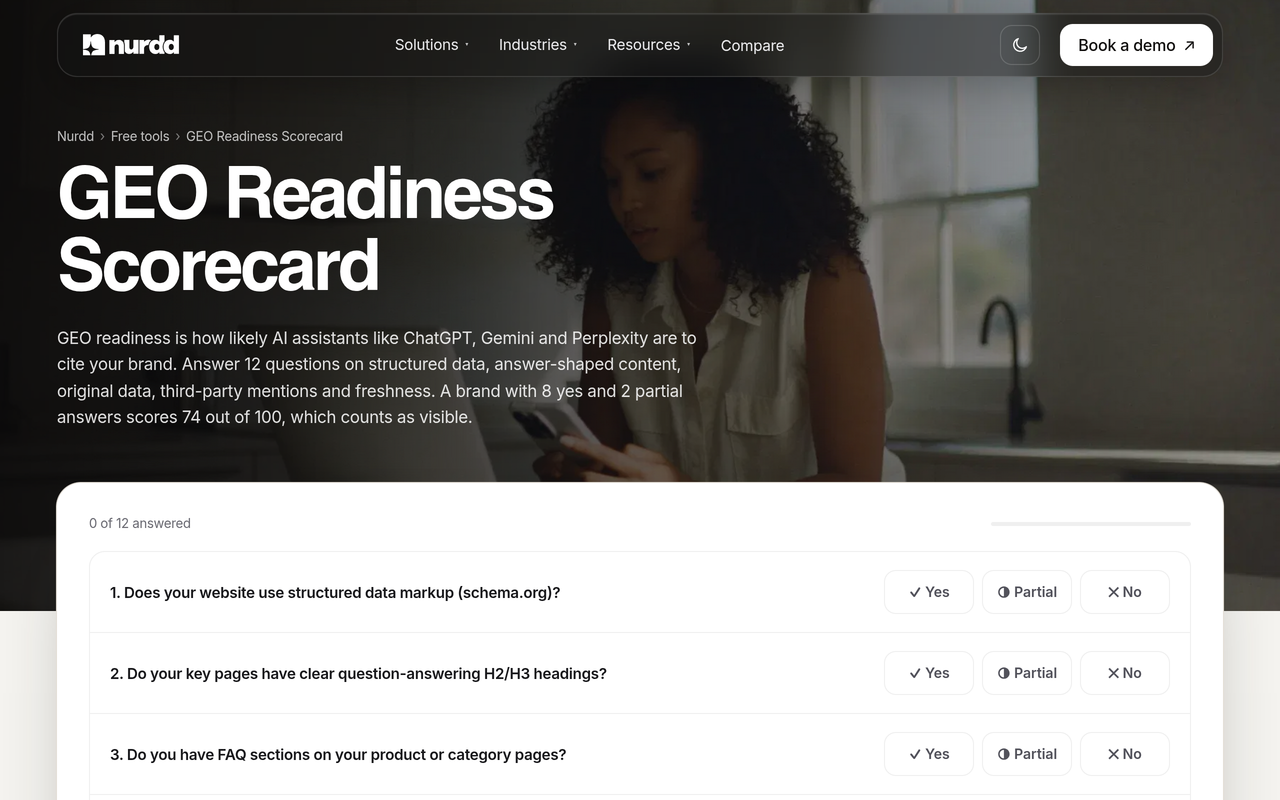
Spend the first month on setup rather than interpretation. Freeze the prompts, competitors and engines, run the GEO readiness scorecard, and record a baseline. Publish the first report with only the scorecard, the sources view and three actions. From month two, add the accuracy note and the outcome lines. By month four you have a trend that stands up to questions, and a record of which changes moved which metric. For the broader reporting picture across channels, see the D2C marketing measurement framework.
Book a demo to see your own AI search metrics
A monthly AI search report is only as good as the data behind it. Book a Noma demo to see your brand's mention rate, citation rate and share of voice across 13 AI engines, the pages being cited, and which competitors are named instead of you. You can also read more about how Nurdd works.
How we researched this
We reviewed vendor guides on AI search metrics from AirOps, Semrush, Adobe and Meltwater, Google's Search Central documentation, a Search Engine Journal report on Pew Research Center findings, and analytics and tool documentation from Seer Interactive, WebFX, HubSpot and Peec AI. All sources were checked on the publication date of this post. We did not run hands-on tests, interview anyone or use customer data, and the worked example uses invented inputs that are labelled as such. Figures are quoted only where a source states them.
Frequently asked questions
Which AI search metrics should I report each month?
Report mention rate, citation rate, share of voice and AI referral sessions with conversions, each split by engine. Add a short note on answer accuracy and sentiment, and a list of the pages and third-party sources engines cite. Keep the prompt set, competitor set and engine list fixed so changes are comparable.
What is the difference between an AI mention and an AI citation?
A mention is when an AI answer names your brand. A citation is when the answer links to or attributes one of your pages as a source. They can occur separately, so track both: mentions show awareness, citations show which pages engines trust.
How do I track traffic from ChatGPT and other AI engines?
Filter GA4 sessions by source, using domains such as chatgpt.com, and mark your key events so conversions appear. Seer Interactive notes that some ChatGPT clicks arrive without referral information and appear as Direct, so treat the GA4 number as a minimum.
Can Google Search Console report on AI Overviews and AI Mode?
Yes. Google says AI features are included in overall search traffic in the Performance report under the Web search type, and WebFX describes a newer generative AI report that shows impressions for AI Overviews, AI Mode and AI-powered Discover. Report those impressions separately from sessions.
How often should I report AI search metrics?
Monthly is the right rhythm for stakeholders, provided the underlying data is collected daily or weekly. AI answers vary from run to run, so a month of sampling gives a steadier rate than a single check. Review changes in the first weeks of a test, but present trends only after three months of consistent method.
How many prompts do I need to track?
Start with 20 to 50 prompts grouped by buyer stage, which is a practical working range rather than a published standard. Fewer prompts make the rates noisy, while many more can be hard to review. Prioritise prompts that reflect real purchase decisions in your category.
Does Noma track referral traffic?
Noma tracks visibility: whether your brand is named and which pages are cited across 13 AI engines, polled daily. Referral sessions and conversions come from your own analytics, such as GA4, and you combine the two in the monthly report. To see how this looks for your brand, book a demo at https://www.nurdd.club/demo.