AI Search Visibility
Content Scoring Tools vs AI Visibility Tracking
Content scores grade a page for Google; AI visibility tracking shows whether ChatGPT, Gemini, Perplexity and Claude name your brand. You need both numbers.
 Sheetal Shakshi10 Nov 202616 min read

Yes, you still need an AI visibility tool if you use a content optimization tool. A content score grades a page against signals that help it rank in Google, while AI visibility tracking records whether AI engines name your brand in their answers. Noma by Nurdd tracks 13 AI engines, including ChatGPT, Gemini, Perplexity and Claude, so you can see the result that a content score cannot show.
Content optimization tools vs AI visibility tracking comes down to what each one measures. Content scoring tools grade a page against signals that help it rank in Google. AI visibility tracking records whether ChatGPT, Gemini, Perplexity and Claude actually name your brand when buyers ask. If you already use a scoring tool, you still need the second measurement.
This guide compares the two jobs side by side, shows where a content score stops being informative, and gives you a test you can run on your own pages this week. It also explains how Noma, the AI search visibility product from Nurdd, fills the gap.
Key takeaways
- A content score is an input measure: it tells you how a page compares with pages that already rank. AI visibility tracking is an output measure: it tells you whether an engine named you.
- Google's own guidance says no third-party tool has access to its internal ranking or AI systems, so a score is a proxy, not a result.
- Run the score-versus-mention test in this post on 10 of your highest-scoring pages. If the brand is not named, the score is not predicting visibility.
- Check engine coverage before you buy: a tracker that covers a handful of engines leaves others unmeasured, while Noma tracks 13 AI engines.
- Keep your content tool for drafting and editing, and add tracking so each edit has a measurable outcome in AI answers.
What is the difference between content scoring and AI visibility tracking?
A content scoring tool analyses a page, compares it with competing pages and recommends missing topics, entities and structure. That is the description Botric, July 2026 (updated October 2026) gives of AI content optimization tools. The tool works on the page before or after you publish, and its output is a score or a to-do list.
An AI visibility tracker works on the answer, not the page. According to the same Botric article, visibility tools run target prompts through AI platforms and measure whether the brand is mentioned, how often it is cited, which competitors appear instead and which sources the models trust. The output is a record of what the engines said.
Content scoring measures how closely a page matches pages that already rank. AI visibility tracking measures whether an AI engine named the brand in an answer. The first is a prediction about inputs; the second is an observation of outputs.
That distinction matters because teams often use the two interchangeably. A green score feels like proof, but it is a judgement about the page against a reference set, not a record of any engine's behaviour.
What each tool type measures
| Question | Content scoring tool | AI visibility tracker such as Noma |
|---|---|---|
| What is the unit of measurement? | A page or draft | A prompt and the answer an engine returns |
| What does it compare against? | Pages that rank for a keyword in Google | Competitor brands named in the same answers |
| What does a good result look like? | A high score and covered topics | Your brand named, and your page cited as a source |
| When does it help? | While writing and updating | After publishing, and on a daily schedule |
| Can it show who an engine recommends instead of you? | No, it sees pages, not answers | Yes, through competitor comparison by category |
| Can it show which page an engine cited? | No | Yes, Noma records which page each citation comes from |
| What decision does it support? | What to add or change in a draft | Which prompts, sources and pages to work on next |
Why can a high content score still leave you out of AI answers?
A high score tells you a page resembles pages that rank in Google. AI engines build answers from more than a single ranked page, so a well-scored page can still go unnamed. Three reasons are visible in public documentation.
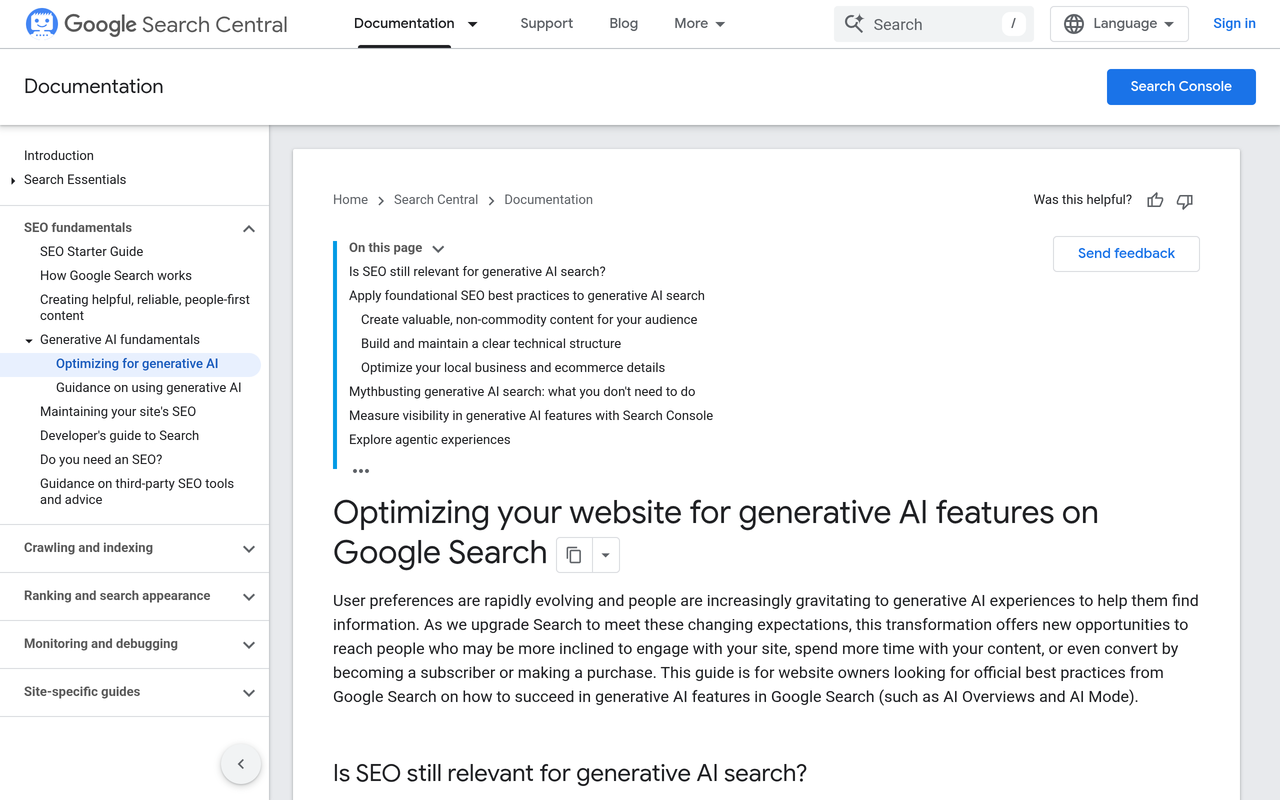
First, the score is a proxy. Google's Google Search Central, May 2026 guide warns against third-party tools that claim to use internal Google metrics, and states that no third-party tool has access to Google's internal ranking or AI systems. It adds that you can use such tools if they help your workflow. A score is useful for editing; it is not evidence of an outcome.
Second, the engines do not all behave like Google. Google's guide covers Google's own generative features. ChatGPT, Perplexity, Claude and Gemini each retrieve and phrase answers in their own way, and a Google-oriented score does not observe any of them.
Third, the answer often rests on what is said about you elsewhere. The same Google guide notes that generative features can show what is being said about products and services across blogs, videos and forum discussions. A page score cannot see those third-party sources, and a tracker that records citations can.
What Google's guidance says you can stop worrying about
The same guide lists several things Google says you can ignore for Google Search, including llms.txt files, splitting content into tiny chunks and rewriting content only for AI systems. Search Engine Journal, on Google's May 2026 guide summarised the page as saying that Google's AI features are rooted in its core ranking and quality systems. Semrush, May 2026 reports that Google published the guide on May 15, 2026.
That is good news for the content tool you already own: the fundamentals of helpful, crawlable, well-structured pages still apply. It is also the reason the two measurements are complementary. Sound content is the input; the only way to know what the engines did with it is to read their answers. For the wider picture, see AI search optimization vs SEO.
Do I need an AI visibility tool if I already use a content optimization tool?
Yes, if buyers in your category ask AI assistants for recommendations. A content optimization tool cannot tell you whether the assistants name you, who they name instead, or which sources they cite. An AI visibility tool does exactly that, and nothing else in your stack will.
You can skip tracking only if you have no use for the answer. If you do not care whether ChatGPT, Gemini, Perplexity or Claude recommend your competitors over you, a scoring tool is enough. Otherwise use the table below.
Decision table: which measurement does your situation call for?
| Your situation | Content scoring | AI visibility tracking | What to do |
|---|---|---|---|
| You publish often and rank in Google but have never checked AI answers | Already covered | Missing | Add tracking first; you have no baseline |
| Your pages score well but sales calls mention competitors that AI recommended | Working as designed | Missing | Track the prompts buyers ask and compare named brands |
| You are rewriting pages for AI and cannot tell whether it helped | Shows page changes | Needed to prove effect | Track before and after on a fixed prompt set |
| You have no editorial workflow and thin content | Needed | Useful later | Fix the content first, then measure |
| You manage several brands or clients | Per page only | Needed for reporting | Track each brand and report monthly |
The pattern is simple. Scoring helps you make the page. Tracking tells you whether making the page changed what the engines say.
How do AI visibility tools collect their data?
Methods differ, and the difference affects how far you can trust a number. HubSpot, September 2026 describes three: prompt tracking, which feeds curated prompts into AI models and records the answers; screenshot sampling, which captures periodic screenshots of AI results and extracts mentions; and API access, which retrieves structured citation data from answer engine APIs.
HubSpot notes that prompt tracking is fast and flexible but that accuracy depends on prompt quality. That is why the prompt set is the real input of any tracker. If you track only your brand name, you measure whether the engine knows you exist. If you track the questions buyers ask, you measure whether the engine recommends you. Read which prompts to track for AI search visibility before you build the list, and how many prompts you need before you size it.
If my content tool has a tracking module, does that settle the question?
Not by itself. A tracking module inside a content editor is judged by the same questions as any dedicated tracker: how many engines, how often, which prompts, and whether it shows the cited sources and what to do next. Engine coverage matters because answers differ between engines, so a view of a few engines leaves the rest unmeasured.
Ask the vendor for these answers in writing and check them against the vendor's own pricing and product pages, because plans, engines and refresh rates change. The table below is a checklist of what to compare, with Noma's published position in the right-hand column.
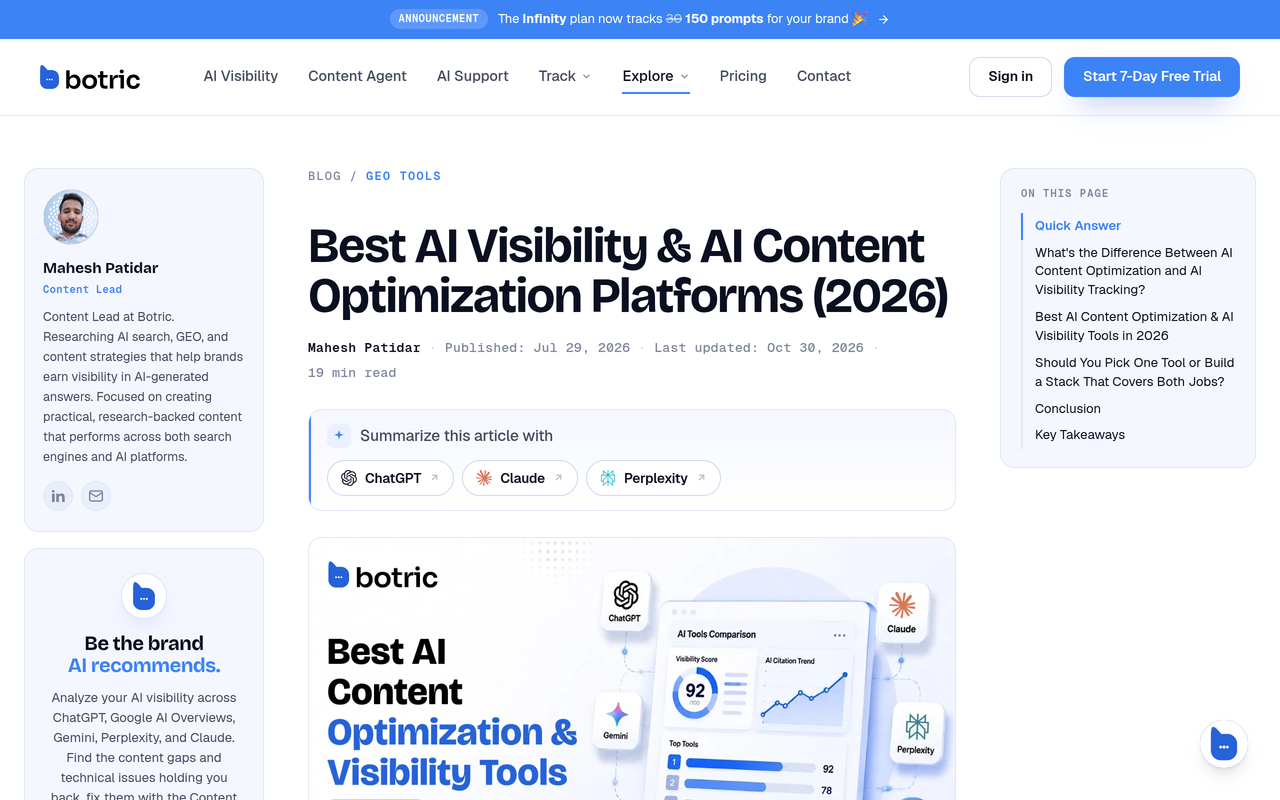
Table: what to ask any tracker, checked 9 November 2026
| Question | Content tool with a tracking module | Noma by Nurdd |
|---|---|---|
| Engines tracked | Confirm the list on the vendor's own page | 13 AI engines, including ChatGPT, Gemini, Perplexity and Claude |
| Refresh | Confirm per plan on the vendor's pricing page | Polled daily |
| Records whether a brand is named | Confirm | Yes |
| Records which page each citation comes from | Confirm | Yes |
| Competitor comparison by category | Confirm how the competitor set is built | Yes |
| Also edits and scores pages | Yes, that is the core product of a content tool | No; Noma is a measurement and recommendation dashboard |
The last row is the honest trade-off: if you want a writing editor, keep your content tool. Noma is not an editor, and it does not need to be one. Its job is to show the outcome.
| Pricing and trial | Content tool with a tracking module | Noma by Nurdd |
|---|---|---|
| Tracking-only option | Check the vendor's pricing page for whether tracking is a separate add-on | Noma is a tracking and recommendation product on its own, with no editor to pay for |
| Free trial | Check the vendor's pricing page | 3-day free trial; a card is taken at signup and billing starts on day 3; no charge if cancelled before then |
| Currency | Check the vendor's pricing page | USD |
For vendor-by-vendor detail, see Noma vs Surfer SEO, Noma vs Clearscope and Noma vs Semrush.
What does broader engine coverage change? A worked example
Coverage sounds abstract until you count what it means for a prompt set. The arithmetic below uses a hypothetical 40-prompt set and compares a view of 5 engines with Noma's 13. The 5-engine figure is a hypothetical narrower view for illustration, not a claim about any product. The example is arithmetic, not a measured result for any brand.
- Take a set of 40 buyer prompts, such as the best tool in your category for a given use case.
- On 5 engines, one pass is 40 × 5 = 200 prompt-and-engine checks.
- On 13 engines, one pass is 40 × 13 = 520 checks.
- Run daily for 30 days: 200 × 30 = 6,000 answers on 5 engines, and 520 × 30 = 15,600 answers on 13.
The gap is 8 engines your buyers might use that a narrower view treats as unknown. If a brand is named in four engines and absent in the others, a narrower view can report a healthy picture that the wider one would contradict. That is why coverage belongs in your scoring rubric, not only in the footnotes.
How do I test whether my content score predicts AI visibility?
This is a simple test you can run without buying anything. It checks whether the score you trust is correlated with being named. Use it as a checklist.
- Pick 10 pages. Choose pages with the highest scores in your content tool, each targeting a different question buyers ask.
- Write one prompt per page. Phrase it the way a buyer would, such as the best option for a specific use case, without your brand name in it.
- Ask each prompt in at least four engines. Use ChatGPT, Gemini, Perplexity and Claude, in fresh sessions, and record the date.
- Mark the result. For each answer note whether your brand is named, whether your page is cited, and which competitors are named.
- Place each page in the matrix below. Score high plus named is a win. Score high plus not named is the gap you were not seeing.
- Check the cited sources for the gaps. Note which sites the engines cite instead of yours.
- Repeat in 4 weeks. Answers vary between runs, so treat one pass as a sample. Moving from manual checks to daily tracking removes that noise.
The manual version is slow, which is the case for a tracker: 10 prompts across four engines is 40 manual checks for one snapshot. For the experiment design behind repeated checks, read GEO experiment design and the 4-week ChatGPT test plan.
The score-versus-mention matrix
| Content score | Named in AI answers? | What it means | Next action |
|---|---|---|---|
| High | Yes | Page and presence agree | Protect it: refresh the page and keep tracking |
| High | No | Optimised for Google, invisible to the engines | Check which sources the engines cite instead and close the third-party gap |
| Low | Yes | The engines rely on something other than the on-page signals | Find the cited source before you rewrite anything |
| Low | No | The page needs work | Use the content tool to improve it, then re-test |
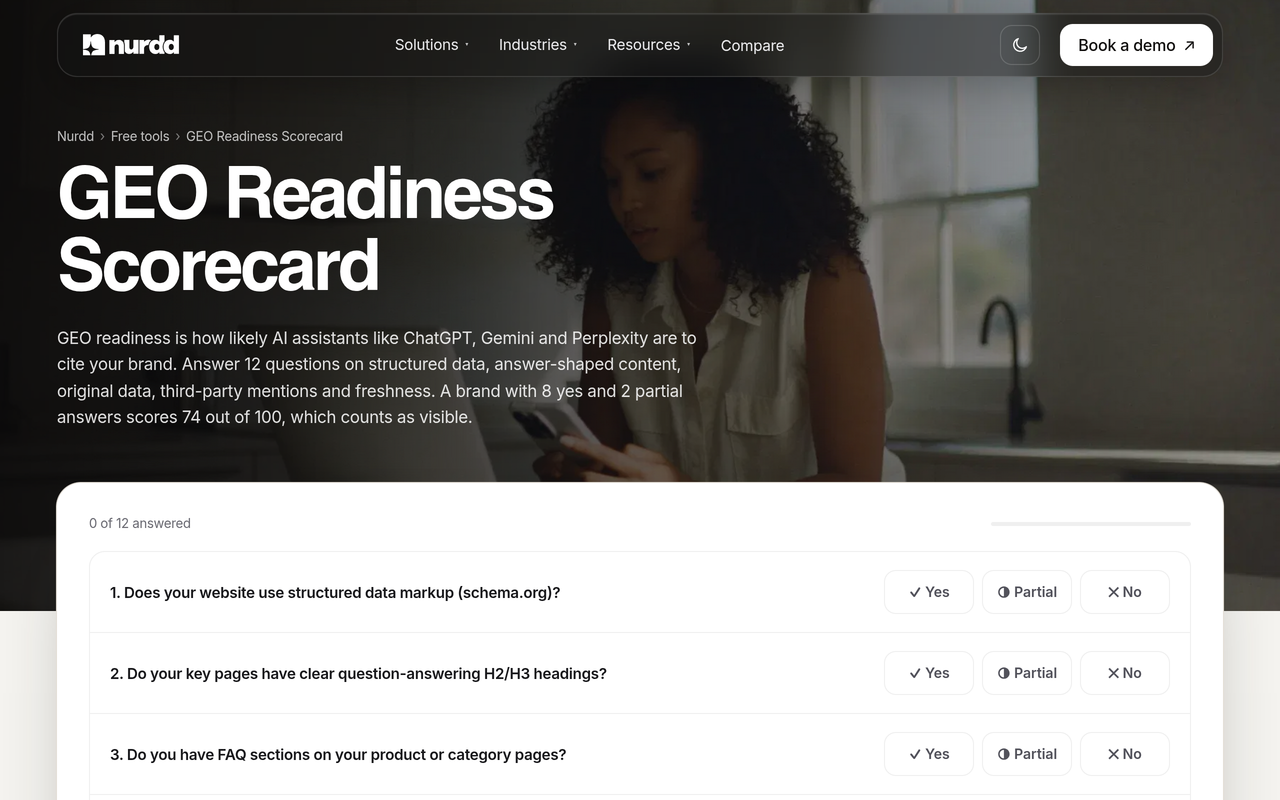
Only two of the four cells are visible to a content tool alone, and the two that matter most for strategy, the second and third rows, are invisible without tracking. A reader who wants a quick baseline first can use the free GEO readiness scorecard, a 12-factor check of readiness for AI answers.
How does Noma provide the second measurement?
Noma by Nurdd is a web dashboard that tracks whether a brand appears in answers from 13 AI engines, including ChatGPT, Gemini, Perplexity and Claude, polled daily. It shows citation frequency by category, a comparison against competitors and recommendations for improving AI visibility. It records whether your brand is named and which page each citation comes from, which is the data a content score cannot supply. Noma is a separate product from Nia and Pulse, the other two products Nurdd makes.
Book a demo at nurdd.club/demo and you will see your own brand's category in Noma: which engines name you, which competitors they name instead and which pages they cite.
Where Noma is the stronger choice
- Engine coverage. Noma tracks 13 AI engines, including ChatGPT, Gemini, Perplexity and Claude, so fewer of the places your buyers ask are left unmeasured.
- Outcome data. Named or not named, with the citing page, is the core record in Noma rather than an add-on to an editor.
- Trial terms. The 3-day free trial lets you load your category and read real answers before billing starts on day 3.
- Fit with your existing stack. You do not have to replace your content tool. Noma sits beside it and answers the question the editor cannot.
If you have already compared trackers, the Noma vs Peec AI, Noma vs Profound and best AI search visibility tools pages go deeper on the dedicated trackers.
How do the two tools work together in one workflow?
Use each tool at the step it is built for. The loop below keeps the content tool as your drafting aid and makes tracking the judge.
- Measure first. Load your buyer prompts into Noma and record the baseline: named or not, by engine, with competitors.
- Diagnose. Read the cited sources for the prompts where you are absent. Decide whether the gap is a missing page, a weak page or a missing third-party mention.
- Edit with your content tool. For weak pages, use the scoring tool to cover missing topics and structure.
- Publish and wait. Allow engines time to re-read the page; give changes weeks, not days.
- Re-measure. Compare named rate and citations against the baseline, then report the change monthly.
The write-up on how to write content AI engines quote shows what the editing step looks like, and AI search metrics: how to build a monthly report covers the reporting step. If you want help with the optimisation work itself, Nurdd's team also runs generative engine optimization services, measured in Noma.
What mistakes do teams make when they only use content scoring?
- Treating the score as the goal. A page can reach a high score and still fail to be named. The goal is the answer, and the score is a means.
- Tracking only the brand name. This tests awareness, not recommendation. Track the category questions buyers ask instead.
- Judging from one manual run. Answers vary, so single checks mislead. Use a repeated schedule.
- Ignoring third-party sources. Engines cite more than your site. Review the sources cited for prompts where you are missing.
- Blocking crawlers by accident. If an AI crawler cannot read your pages, no score helps. Review the AI crawler user agents list.
- Skipping referral measurement. Visibility is only half the story; see AI referral traffic in analytics.
Google also gives a native measurement point for its own surfaces: its guide points site owners to the Generative AI performance report in Search Console. That covers Google's features only, which is a further reason to track the other engines separately.
How should I report both numbers to a manager or client?
Put them on one page with a clear label for each: input measures from the content tool, output measures from the tracker. Executives tend to ask one question, which is whether the brand is being recommended, and only the output measures answer it. The structure in AI search share of voice and the AI search visibility dashboard guide gives a workable layout.
| Report line | Source | Type |
|---|---|---|
| Pages updated this month | Content tool | Input |
| Average content score of updated pages | Content tool | Input |
| Share of tracked prompts where the brand is named | Noma | Output |
| Competitors named most often | Noma | Output |
| Pages cited by engines | Noma | Output |
| AI referral sessions | Analytics | Outcome |
How we researched this
Written by Sheetal Shakshi. We reviewed Google's official Search Central documentation on generative AI features, trade press coverage of that documentation, and ranking articles on AI visibility and content optimization tools from HubSpot and Botric. We checked every source on the publication date of this post, 9 November 2026. We did not hands-on test any tool for this article, and the worked example is arithmetic on a hypothetical prompt set, not customer data. This post makes no claims about specific rival products' features or prices, so confirm current terms on each vendor's own pages.
Frequently asked questions
Do I need an AI visibility tool if I already use a content optimization tool?
Yes, if your buyers ask AI assistants for recommendations. A content tool grades pages; it does not record what ChatGPT, Gemini, Perplexity or Claude say about your brand. Noma tracks 13 AI engines and shows whether you are named, who is named instead and which pages are cited.
What's the difference between Surfer-style content scoring and AI search tracking?
Content scoring compares a page with pages that rank in Google and suggests edits. AI search tracking runs buyer prompts through AI engines and records the answers, so it measures the outcome rather than the page. If a content tool offers tracking as a module, treat it as a separate function and evaluate it on its own terms.
Does a high content score mean AI engines will cite my page?
No. Google's guidance says no third-party tool has access to its internal ranking or AI systems, so a score is a proxy. The only way to know is to observe the answers, which is the score-versus-mention test above.
Can I replace my content optimization tool with an AI visibility tracker?
Not if you rely on it for drafting and editing. A tracker such as Noma shows results and recommendations but does not edit your pages. Most teams keep the editor and add tracking beside it.
How often should I check AI visibility?
Check on a schedule rather than once. Answers vary between runs, and engines update. Noma polls daily, which gives you a trend instead of a single sample.
Is Noma free?
Noma has a 3-day free trial. A card is taken at signup and billing starts on day 3, so you are not charged if you cancel before then. Visit nomahq.app to start.
Do I need special markup or an llms.txt file to be named?
For Google Search, no. Google's guide says llms.txt files and special schema are not needed for its generative AI features. Other services may treat files differently, so test and track rather than assume.
What should I track first?
Start with 10 to 40 category questions your buyers ask, not your brand name. Then add competitor comparison, so you can see who is named when you are not. The week-over-week visibility score guide explains how to read the trend.
Next step: see your own brand in AI answers
Your content score tells you how the page looks. Noma tells you whether the engines name you. Book a demo and we will show you, for your own brand and category, which of 13 AI engines name you today, which competitors they name instead and which pages they cite. You can also read how Nurdd works or visit Noma directly.