Influencer Marketing
Creator Content Audit: Which Posts Earn AI Mentions
Audit your creator posts and reviews for the claims and wording AI engines repeat, then brief the next round of creators for it.
 Simran Rawat9 Nov 202615 min read

Influencer posts can help a brand get cited by AI, but mostly when they are long-form, publicly indexable and make specific, attributable claims. Short feed clips rarely behave that way. Audit existing creator content for those traits, brief the next round around them, and check the resulting mentions in an AI visibility tracker.
Influencer posts can help your brand get cited by AI, but only indirectly and unevenly. Influencer content AI citations come mostly from long-form, publicly indexable pages, such as YouTube videos, written reviews and newsletters, that state specific claims a reader could attribute to a named person. Audit what creators already published, then brief for those traits.
Key takeaways
- Creator content earns AI mentions when it is long-form, crawlable and specific, not when it is a 15-second clip built for the feed.
- Audit every creator post on six traits: format, indexability, claim specificity, comparison language, creator credibility and corroboration.
- Brief for a real experience and a clear claim, not for keywords. Checklist briefs produce generic content that neither audiences nor AI engines repeat.
- Different engines cite different formats, so audit per engine rather than assuming one result applies everywhere.
- Evidence of citation lift from creator work is still thin, so measure it with a fixed prompt set before and after each round.
- Use Nia by Nurdd to find and vet creators and run the campaign, then Noma to check whether the resulting mentions appear.
Do influencer posts help my brand get cited by AI?
They can, and the reason is structural rather than magical. AI engines build answers from pages they can fetch and read, and a brand's own website is only part of that pool. ContentGrip, June 2026 reports a McKinsey finding that in many categories a brand's own site accounts for only 5 to 10 percent of the sources AI search references, and a 5W analysis putting earned media at 85.5 percent of AI citations. Creators produce exactly the third-party material that fills the rest.
There is a caveat worth stating plainly. ContentGrip, August 2026 describes AI visibility entering creator briefs while evidence of citation lift remains unproven. So the honest position is that creator content is a plausible input to AI mentions, not a guaranteed one, and the only way to know is to measure your own brand.
Why is it hard to know which creator posts earn AI mentions?
Three things make it difficult. First, most influencer reporting counts views, likes and sales, none of which tell you whether an AI engine ever read the post. Second, the formats creators favour on social feeds are often the ones AI engines cite least. Third, engines disagree with each other, so a post that is cited in one place may be invisible in another.
The format gap is large. A YouTube study by OtterlyAI, dated 2 March 2026 and reported by Make Influence, 2026, found that 94% of cited YouTube videos were long-form, reference-style videos while YouTube Shorts accounted for 5.7% of citations. If a campaign is planned around short clips, most of its deliverables sit in the least-cited format.
The platform gap is just as wide. The same study, as reported by Make Influence, split YouTube citations across six platforms: Perplexity 38.7%, Google AI Overviews 36.6%, Google AI Mode 19.6%, ChatGPT 4.4%, Microsoft Copilot 0.5% and Gemini 0.2%. A creator video can be a strong source for one engine and nearly irrelevant to another.
Where creator content shows up as a source
Social platforms are now a visible part of the citation mix. Higoodie, 2026 reports YouTube climbing from 31.2% of social citations in October 2025 to 45.9%. On Google's side, Everything PR, November 2026 reports YouTube supplying 20.9% of Google AI Overview citations across 3M US queries.
Reddit behaves differently by engine. CMSWire, 2026 reports Reddit's citation share above 5% of all citations on ChatGPT during January 2026, against 0.1% on Google Gemini. That is why creator reviews that get discussed on forums can matter even when the original post is a short video.
How should I audit creator posts for AI citations?
The audit asks one question of each post: if an AI engine fetched this page today, would it find a claim it could repeat accurately, with a source it could name? The framework below scores each post from 0 to 2 on six traits. It is a working tool built from the public evidence above, not a published standard.
| Trait | 0 points | 1 point | 2 points |
|---|---|---|---|
| Format | Short clip or story only | Short clip with a caption of some length | Long-form video, article or newsletter issue |
| Indexability | Behind a login or in an ephemeral story | Public but with no transcript or text | Public with transcript, description or article text |
| Claim specificity | General praise | One concrete attribute | Named product, named use case and named result of use |
| Comparison language | None | Mentions alternatives vaguely | States who the product suits and who it does not |
| Creator credibility | No evident expertise | Relevant niche audience | Demonstrated expertise, disclosed experience of use |
| Corroboration | Stands alone | Echoed on one other page | Repeated across several independent pages |
A score of 9 to 12 marks a post worth repeating and repurposing. A score of 5 to 8 can be fixed with a better description, a transcript or a written companion. A score of 0 to 4 is a brand-awareness post and should be judged on those terms, not on AI mentions.
Why these six traits
Each trait maps to something in the sources. Format and indexability follow the long-form skew in the OtterlyAI data and the point in ContentGrip, June 2026 that transcripts, newsletters and long articles are indexed by search engines. Specificity and credibility follow the impact.com, August 2026 argument that AI cannot cite what it cannot distinguish, so specific, attributable claims built on a creator's real experience stand out.
Corroboration follows the same impact.com article, which says AI citation favours convergence across multiple trusted sources. One strong post is a data point. Several independent posts saying compatible things is a pattern an engine can trust.
What does a worked audit look like?
The example below is illustrative: the post is hypothetical, and the only sourced numbers are the OtterlyAI figures quoted earlier. It shows how scoring turns into a decision.
Imagine a skincare brand with ten sponsored creator deliverables from one campaign: seven short vertical clips, two long-form YouTube reviews and one written newsletter feature. Scoring each on the six traits gives most of the short clips 3 to 5 points (public, but short, general and uncorroborated). The two YouTube reviews score 9 and 10 because they have transcripts, a named product, a named skin type and a stated alternative. The newsletter scores 8 because it lacks any corroborating page.
- Keep the two reviews and add chapter titles and a full description, since they are already the strongest candidates.
- Ask the newsletter author for a written version of the claim on a crawlable page, and ask a second creator to cover the same use case.
- Leave the short clips alone as awareness work and stop expecting them to feed AI answers.
- Rebalance the next budget. The OtterlyAI figures show long-form at 94% of cited YouTube videos against 5.7% for Shorts, roughly a sixteen-fold gap, so the next round should hold back deliverables for long-form formats.
That is the entire value of the audit: it converts a vague hope into a short list of posts to amplify, fix or ignore.
Which claims and wording do AI engines tend to repeat?
No engine publishes a list of phrases it favours, so treat this section as pattern guidance from the audit sources, not a rulebook. The consistent theme in the research is that specific, attributable, non-promotional statements are the ones that survive. ContentGrip, June 2026 summarises the shared logic as credible, non-promotional, expert-attributed, well-structured content on trusted external domains.
Claims worth auditing for are the ones a stranger could quote without context: a named product, a named user, a named condition and a stated result of use.
| Claim type | Weak version | Stronger version |
|---|---|---|
| Who it suits | "Perfect for everyone" | "Suits dry, sensitive skin; less suited to very oily skin" |
| Experience of use | "Obsessed with this" | "Used it every morning for four weeks, here is what changed" |
| Comparison | "Better than the rest" | "Compared with two named alternatives on texture and price" |
| Category answer | Brand slogan | A direct answer to a question buyers ask, in the first lines |
| Disclosure | Hidden or missing | Clear statement of what was gifted or paid |
Disclosure belongs in the table deliberately. Honest, balanced reviews read as more credible to people and to the systems built to resemble human judgement, and sponsored content must be disclosed in most markets anyway.
How do I brief creators for AI search visibility?
Brief for a real experience and a clear question, not for keyword placement. impact.com, August 2026 argues that citations are an outcome content produces after the fact, so a brief written to earn citations is asking for the wrong thing. It also recommends choosing partners before writing the brief.
That fits the audit logic. You cannot instruct an engine to cite a post, but you can make it more likely that a post contains something worth citing. The steps below turn the audit into a brief.
Step 1: Pick the format before the creator
Decide which deliverable should be long-form and publicly indexable. Action: reserve at least one long review, tutorial or written piece per creator. Result: you have a deliverable that can be read as text. Why: long-form dominates cited YouTube videos in the OtterlyAI data reported by Make Influence, 2026.
Step 2: Name the question the content should answer
Write the buyer question in plain words, such as "Which sunscreen suits sensitive skin under makeup?". Action: give each creator one question and let them answer it in their own voice. Result: the content opens with a direct answer. Why: engines assemble answers to questions, so content shaped as an answer is easier to lift. Our guide to which prompts to track helps you choose them.
Step 3: Ask for a disclosed, specific experience
Action: request length of use, context and one honest limitation. Result: a claim with a source attached. Why: specific, attributable claims built on real experience are what impact.com says AI can tell apart from generic content. See our note on briefing a creator for AI-cited content for sample wording.
Step 4: Supply facts, not slogans
Action: send a one-page fact sheet with ingredients, specifications, sizes and approved comparisons. Result: creators get names and details right. Why: errors in a creator post become errors in an AI answer. A clear brand description on your own site gives engines a consistent version to reconcile against.
Step 5: Make the post findable
Action: ask for a descriptive title, a written description, chapters on video and a link to the product page. Result: the post carries text an engine can read. Why: transcripts and descriptions are the readable layer of a video, and Perplexity, ChatGPT and Copilot depend on live fetching or on the Bing index, as the Make Influence engine table sets out.
Step 6: Plan for corroboration
Action: brief two or three creators on the same question from different angles. Result: several independent pages with compatible claims. Why: convergence across trusted sources is what the impact.com article says citation actually rewards. Avoid scripts that make creators sound identical, which impact.com warns produces commoditised content.
Step 7: Track a fixed prompt set
Action: before the campaign, record a baseline across a set of buyer prompts, then repeat weekly. Result: you can see whether mentions change. Why: because lift is unproven, your own before-and-after data is the only reliable evidence. The GEO experiment design guide and the four-week ChatGPT test plan describe the method.
Checklist: audit creator content before you brief again
- List every creator post, review and mention from the last campaign with its public URL.
- Mark which are long-form and which are short clips or stories.
- Confirm each is publicly accessible, not behind a login, and has text such as a transcript or description.
- Score each post against the six-trait table.
- Run your buyer prompts in the engines you care about and note which creator pages are cited, if any.
- Check facts in cited posts against your product sheet and note errors.
- Identify the questions where no creator content exists and no engine names you.
- Write the next brief around the highest-scoring formats and the gaps from step 7.
What are the common mistakes?
- Scripting for keywords. impact.com's piece describes checklist-driven briefs producing content audiences ignore and AI does not cite.
- Judging every post by AI mentions. Short clips have a job, and it is not usually citation.
- Assuming one engine speaks for all. The YouTube split from 38.7% on Perplexity to 0.2% on Gemini in the OtterlyAI data shows how much engines differ.
- Ignoring Reddit and forums. Reddit's share ranges from above 5% on ChatGPT to 0.1% on Gemini in the CMSWire figures, so conversation around a creator post can matter more than the post.
- Skipping fake-follower checks. A post with an inflated audience wastes budget on every measure. Run the fake follower checker and use the audit checklist before paying.
- Not claiming results too early. Digiday, September 2026, notes that YouTube citations can be short-lived, so one good week is not a trend.
How do Nia by Nurdd and Noma fit this workflow?
The workflow has two halves: make and manage creator content, then check what AI engines say afterwards. Nurdd makes separate products for each half, and they are not one interface.
Nia by Nurdd is an AI-native creative studio with influencer marketing built in. It searches 10M+ creator profiles across Instagram and other platforms, filters by niche, audience quality, engagement authenticity and brand match score, scores shortlisted creators with TruAI fake follower detection, forecasts ROI before spend and attributes product-level sales to creators afterwards. It is priced below comparable plans. See the Nia overview or getnia.studio.
Noma by Nurdd is a web dashboard that tracks whether a brand appears in answers from 13 AI engines, including ChatGPT, Gemini, Perplexity and Claude, polled daily. It records citation frequency by category, competitor comparison and recommendations. Noma has a 3-day free trial; a card is taken at signup and billing starts on day 3, with no charge if you cancel before then. See Noma.
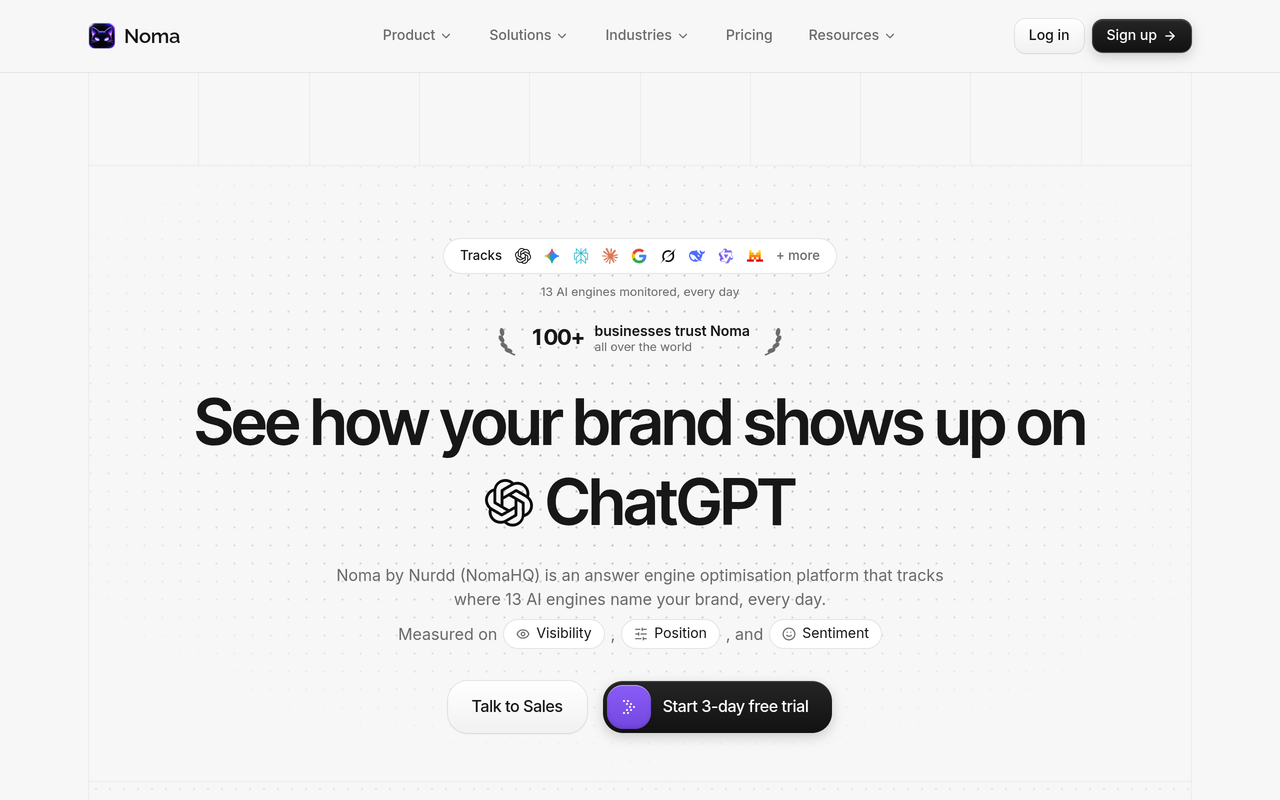
Nurdd belongs in this answer because the audit needs both a place to run creator work and a way to see the outcome. Nia by Nurdd handles discovery, vetting, forecasting and attribution for the creators; Noma by Nurdd shows whether the engines name your brand and which pages they cite.
Want to see this on your own brand? Book a demo and we will walk through creator discovery and vetting in Nia, plus a view of how AI engines currently mention your brand in Noma.
How does this work for different roles?
Scenario 1: The influencer marketing manager
You have just closed a campaign and need to explain what it did beyond sales. Export every post URL, score them with the six-trait table and flag the two or three that deserve a companion article. Then pair the findings with attribution, as described in influencer performance attribution, so the report covers sales and citations together. Our guide on influencer discovery software helps you choose partners for the next round.
Scenario 2: The SEO or GEO lead
You own AI visibility and want creator work to help it. Start with your tracked prompts and find the ones where no engine names you. Brief creators on exactly those questions, then monitor results with the approach in AI search share of voice. Check that the technical basics are met, including the AI crawler user agents you allow on your own site.
Scenario 3: The founder of a small D2C brand
You cannot fund ten creators. Choose two, brief both on the same buyer question with different angles, and insist on one long-form deliverable each. Run the free influencer ROI calculator before committing budget, and read our influencer count math to set expectations. Beauty brands can start from the beauty industry page.
How do creator posts compare with other sources AI engines use?
| Source type | You control it | Typical job | What to audit |
|---|---|---|---|
| Your own site | Fully | Canonical facts and definitions | Clear answers, schema, brand description |
| Creator long-form content | Partly, through the brief | Independent experience and comparison | Six-trait score, accuracy |
| Creator short clips | Partly | Awareness and reach | Reach and sales, not citations |
| Forums and communities | Not at all | Peer discussion | What is being said and by whom |
| Press and reviews | Not at all | Third-party validation | Whether the pages name your brand |
The table shows why creator work complements, rather than replaces, owned content. For the owned side, see writing website content AI engines quote and the guide to getting mentioned in AI answers without ads.
How we researched this
We searched the primary keyword, read the top-ranking articles from ContentGrip, Make Influence and impact.com, and reviewed supporting pieces from Digiday, Scrunch and other industry publications. We noted what they cover and built sections they lack: a scored audit table, a claim-wording table, a worked example and a seven-step brief with a checklist. All sources were checked on the publication date. We did not run hands-on tests, interview anyone or use customer data, and the six-trait scoring is our own framework built from published evidence.
Frequently asked questions
Do influencer posts help my brand get cited by AI?
They can, mainly when they are long-form, public and specific. Published research shows YouTube and other social content appearing in AI citations, but ContentGrip, August 2026, notes evidence of citation lift from creator campaigns remains unproven. Measure your own prompts before and after a campaign.
How do I brief creators for AI search visibility?
Give each creator a buyer question, a fact sheet and room to describe real, disclosed experience. Reserve one long-form, indexable deliverable and ask for a descriptive title and description. Avoid keyword scripts, which impact.com says produce generic content.
Are YouTube videos or short clips more likely to be cited?
Long-form videos. In the OtterlyAI study reported by Make Influence, 94% of cited YouTube videos were long-form and Shorts accounted for 5.7% of citations. Short clips still have value for awareness.
Does every AI engine cite creator content equally?
No. The same study found YouTube citations ranged from 38.7% on Perplexity to 0.2% on Gemini. Audit and track each engine you care about separately.
Should I pay creators specifically for AI mentions?
Pay for useful, honest content and treat citations as a possible outcome. Citations cannot be guaranteed by a creator, and briefs aimed purely at them tend to backfire.
How long before creator content shows up in AI answers?
The sources do not give a reliable timeline. Digiday, September 2026, notes YouTube citations can be short-lived, so track weekly for several weeks rather than judging one snapshot.
How can I tell if AI engines mention my brand after a campaign?
Run a fixed list of buyer prompts across engines and record whether your brand is named and which page is cited. Noma by Nurdd automates this across 13 AI engines, including ChatGPT, Gemini, Perplexity and Claude, and has a 3-day free trial with a card taken at signup.
Can fake followers affect AI citations?
Not directly, as far as the sources show. They do inflate reach and distort ROI, so vet creators first with a tool such as TruAI in Nia by Nurdd.
Next step: audit your last campaign
Start with a simple spreadsheet of last quarter's creator posts, score them on the six traits and pick the three to improve. Then brief the next round around real experience, long-form formats and a fixed set of buyer questions.
To see it on your own brand, book a demo. You will see creator discovery and vetting in Nia by Nurdd, and where AI engines name or miss your brand in Noma. For more, browse the AI search statistics guide and the free tools.