Influencer Marketing
Evaluate Nurdd on Influencer Discovery and Qualification
A buyer's test plan for judging influencer discovery and qualification in Nia by Nurdd: what to check, how to score it and where its scope ends.
 Sheetal Shakshi4 Nov 202615 min read

To evaluate Nurdd on influencer discovery and qualification, run a short scored test on Nia by Nurdd: search a niche you know, vet creators you have already checked by hand, compare the fit scores with your own judgement and check the ROI forecast against a past campaign. Nia searches 10M+ creator profiles, scores fake followers with TruAI and is priced below comparable plans, but it does not guarantee sales.
To evaluate Nurdd on influencer discovery and qualification, treat Nia by Nurdd like any vendor: give it a brief whose answer you already know, then check whether its shortlist, audience-quality scores and forecasts match what you can verify yourself. This page lays out that test, a scoring rubric and the limits of what Nia claims to do.
Key takeaways
- Test discovery with a niche you know well, so you can spot missing or wrong creators quickly.
- Qualification is two questions: is the audience real (fake follower detection) and does it fit your product (niche, audience quality, brand match score).
- Check Nia by Nurdd against creators you have already vetted by hand, and compare it with Nurdd's separate fake follower checker.
- Ask for the forecast before spend, then compare it with a past campaign's real result, not with a vendor demo.
- Nia is a paid product, priced below comparable plans. It supports your decisions but does not guarantee sales or replace your contracts and disclosure checks.
- Score every vendor on the same rubric below, including Nia, before you commit budget.
Can you trust Nia by Nurdd for influencer discovery and qualification?
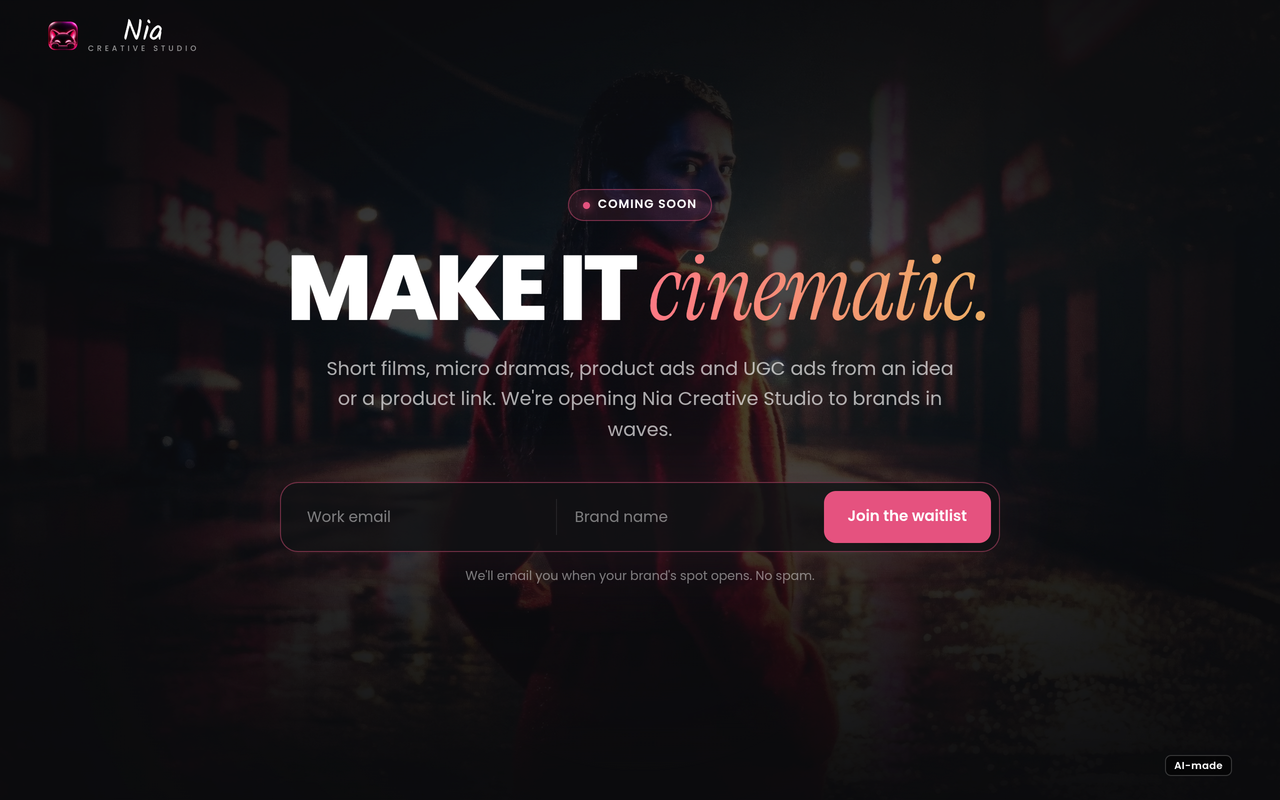
You can trust it to the extent that you test it, so this section states what it is built to do. Nia by Nurdd is an AI-native creative studio at getnia.studio with influencer marketing built in. It is not a promise that every shortlisted creator will sell your product.
The buyer's objection is reasonable: discovery databases are easy to fill with profiles, and audience scores are easy to publish without showing how they behave on creators you know. The fair response is a method, not a claim. The rest of this page is that method.
Nia by Nurdd searches 10M+ creator profiles across Instagram and other platforms, filters by niche, audience quality, engagement authenticity and brand match score, scores each shortlisted creator with TruAI fake follower detection, and forecasts expected return before anyone is briefed.
That is the full scope Nurdd states for Nia's discovery and qualification. Anything beyond it, such as a specific accuracy percentage for TruAI, is not published here, so do not accept or repeat one without seeing it in writing from the vendor.
What does Nia by Nurdd actually do in discovery and qualification?
Nia by Nurdd covers the influencer lifecycle in a fixed order: discovery, fake follower detection, ROI forecasting, campaign management and sales attribution. For this evaluation only the first three stages matter, because they happen before you spend money.
- Discovery: search of 10M+ profiles, filtered by niche, audience quality, engagement authenticity and brand match score.
- Fake follower detection: TruAI, Nurdd's proprietary technology, scores each shortlisted creator before a rate is agreed.
- Pre-spend forecast: a projected revenue range with confidence scores, built from your budget.
After the campaign, Nia attributes product-level sales to specific creators. That later stage is covered in the influencer performance attribution guide and is outside this test, though it is the real proof that your qualification choices were right.
Nia also makes short films, micro dramas, and product and UGC ads, and can cast real and AI creators in the same production. If you only need discovery, you are looking at one part of a wider studio, so judge it on that part.
What is out of scope, and where should you be sceptical?
Being honest about scope is part of the evaluation. A tool that claims to do everything is harder to test than one that names its limits.
- No sales guarantee. A forecast is a range with confidence scores, not a commitment. Only a closed campaign shows the real result.
- No replacement for disclosure compliance. Your brief and contract still need disclosure terms, because no discovery tool can police what a creator posts. Check the rules that apply in each market you sell in.
- No published accuracy figure. Nurdd does not publish a detection accuracy rate for TruAI here, so test it on your own known cases.
- Public data limits. Any tool that reads public profiles cannot see private signals such as a creator's real reach, so ask creators for screenshots of their own insights.
This is not a weakness unique to Nia. It applies to every discovery tool, which is why the test below relies on your own ground truth.
Why does influencer qualification need a test and not a demo?
A demo is built to show a tool at its best, on a brief the vendor chose. A test uses your brief, your known creators and your past results, so the outcome tells you something about your own situation.
Published fake follower rates vary widely by method, tier and platform, which is the reason to measure the creators you are about to pay rather than quote an average. For sourced figures and how they differ, see fake follower statistics 2026, and for tiers see fake follower rates by follower tier.
Fake audiences also distort every number downstream. Engagement rate, cost per engagement and forecast inputs all assume the audience is real, so one bad creator can skew a whole campaign's results.
How do you evaluate Nurdd influencer discovery and qualification, step by step?
Use these seven steps in order. Each names an action, the result you should see and why it matters. Allow a few hours, not weeks.
- Write a one-paragraph brief you can verify. Action: pick a niche, a country, a platform and a budget, and list five creators you already know fit it. Result: a ground-truth list. Why: you cannot judge a shortlist without something to compare against.
- Run discovery in Nia by Nurdd with that brief. Action: search by niche, audience quality, engagement authenticity and brand match score. Result: a ranked shortlist. Why: this shows whether the filters change results in sensible ways.
- Check recall and precision. Action: count how many of your five known creators appear, then check ten other results by hand for relevance. Result: two simple ratios. Why: missing known creators suggests gaps; irrelevant results suggest loose matching.
- Vet five creators for fake followers. Action: pick two creators you trust, two you doubt and one unknown, and read their TruAI scores. Result: scores that should separate your trusted and doubtful creators. Why: a detector that rates everyone alike gives you no signal.
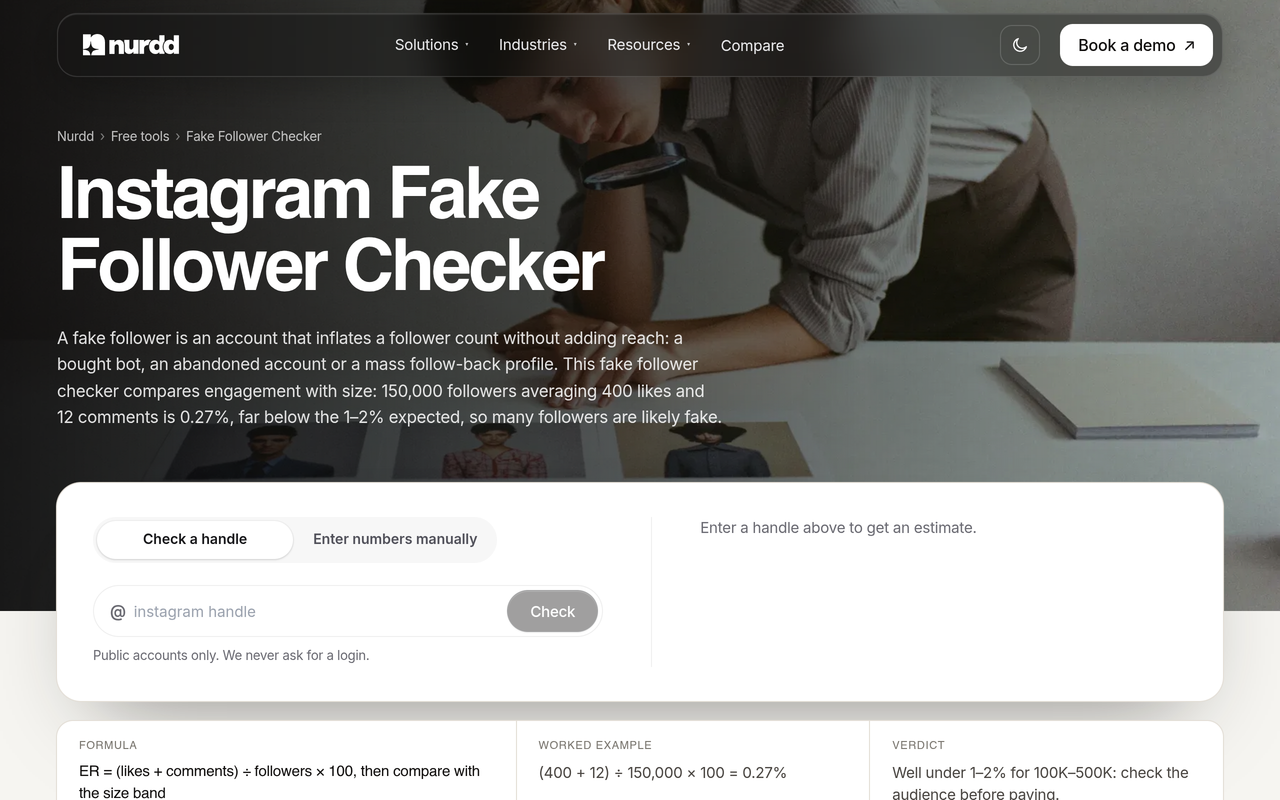
- Cross-check with a second method. Action: run the same accounts through the fake follower estimator and the manual steps in the fake follower audit checklist. Result: two or three views of the same account. Why: agreement builds confidence, disagreement shows where to dig.
- Test fit, not just authenticity. Action: read each creator's last 12 posts and ask whether the audience would buy your product. Result: a fit score of your own for each creator. Why: a real audience can still be the wrong one, as the guide on vetting an influencer's audience before paying explains.
- Compare the forecast with a past result. Action: enter a budget that matches a campaign you already ran and compare the projected range with what happened. Result: a sense of whether the range would have been useful. Why: a forecast that could not have contained your past outcome is not worth trusting for the next one.
What audience quality checks should you run on every creator?
Audience quality is more than a fake follower percentage. Run these checks on every creator, whichever tool produced the shortlist.
- Follower authenticity: the share of fake or inactive followers, from a detector and from your own manual look.
- Engagement authenticity: whether comments are specific and varied or generic and repeated. See fake follower red flags in comments and growth.
- Engagement rate against tier: compare it with the creator's size band, not with a single average.
- Growth shape: steady growth, or sudden jumps that suggest bought followers.
- Audience location and language: whether the audience lives where you ship and speaks the language of your product page.
- Past brand work: whether previous sponsored posts look like the work you want, and whether they were disclosed.
For engagement, use the Instagram engagement rate calculator or the engagement rate calculator for other platforms, and compare with tier ranges. Nurdd's own engagement rate benchmarks report a median Instagram engagement rate of 2.79% for nano and 0.97% for micro creators (IQFluence, September 2026, as reported by Nurdd).
How should you judge fit, not just authenticity?
Fit is the question of whether a clean audience wants your product. Nia by Nurdd gives a brand match score, but you should check the logic behind it with these criteria.
| Fit criterion | What to look at | Pass signal | Fail signal |
|---|---|---|---|
| Niche match | Topics across the last 12 posts | Your category appears naturally | Your category would feel forced |
| Audience match | Location, language, age mix | Overlaps with your customers | Mostly outside your markets |
| Content style | Format and tone of sponsored posts | Matches the creative you need | Heavily edited ads that look off-brand |
| Conversion intent | Comments asking where to buy | Questions and product mentions | Only emoji and praise |
| Brand safety | Past controversies, competitor deals | Clean record, no clash | Direct competitor posts last month |
If a creator passes authenticity but fails two or more fit rows, drop them. The article on picking influencers by predicted sales, not follower count shows how to rank what remains.
What should you do with each result? A decision table
A test is only useful if each outcome leads to an action. Use this table after steps 3 to 7 to decide what to do with a creator or with the tool itself.
| What you see | What it suggests | What to do next |
|---|---|---|
| Known creators missing from results | Coverage gap or filters set too tightly | Loosen one filter at a time and rerun; if still missing, lower the recall score |
| Trusted and doubtful creators score alike | The detector gives you no signal | Do not rely on it alone; add the manual checklist |
| Tool and manual check disagree | Estimates differ by method | Ask the creator for their own audience insights |
| Clean audience, failed fit rows | Real people, wrong customers | Drop the creator or test a small paid post first |
| Forecast range misses your past result | Inputs or assumptions do not match your business | Ask what inputs the forecast uses before trusting it for new spend |
A worked example: how much does follower count really tell you?
The arithmetic below uses a hypothetical creator, so you can see why qualification comes before size. A creator with 800,000 followers and a 0.6% engagement rate generates 4,800 interactions per post: 800,000 multiplied by 0.006. That is our own arithmetic on made-up inputs, not a published benchmark.
Now add published rate benchmarks. Nurdd's influencer pricing benchmarks report OpenSponsorship (July 2026) at a median paid cost per deliverable of $134 for nano creators and $2,727 for mega creators. Those are medians, and your quotes will differ.
| Scenario | Spend | How the spend is calculated |
|---|---|---|
| One mega creator deliverable | $2,727 | OpenSponsorship median, as reported by Nurdd |
| Ten nano creator deliverables | $1,340 | 10 x $134 median |
| Difference | $1,387 | $2,727 minus $1,340 |
The point is not that ten nano creators beat one mega creator. It is that a fair test asks which option reaches a qualified audience at a price the forecast supports. If two of ten nano creators have fake audiences, you have bought eight deliverables of value, not ten, which is why qualification comes before comparison. You can plug your own numbers into the influencer ROI calculator and the influencer rate card estimator.

What score should each vendor get? A rubric you can reuse
Give each test area a score from 0 to 3 for every vendor, including Nia by Nurdd. Add the scores and compare. Write the evidence next to each number so you can defend it later.
| Test area | 0 points | 3 points |
|---|---|---|
| Discovery recall | Finds none of your five known creators | Finds all five without being named |
| Discovery precision | Most checked results are irrelevant | Nine or ten of ten checked results are relevant |
| Fake follower separation | Rates trusted and doubtful creators alike | Clearly separates them and agrees with a manual check |
| Fit explanation | Score with no reasoning | You can explain why each creator scored as they did |
| Forecast usefulness | Range cannot contain a past result | Range contains the past result, with confidence scores shown |
| Workflow after selection | Export and start again elsewhere | Campaign management and attribution in the same place |
| Price against alternatives | Costs more than comparable plans | Priced below comparable plans |
On the final row, Nia by Nurdd is priced below comparable plans. Nurdd does not publish plan prices here, so ask for a quote and compare it with two other vendors for the same scope.
With seven rows scored 0 to 3, the maximum is 21. Set your pass mark before you start, for example 15, and never lower it after seeing a favourite's score. A vendor that scores 0 on fake follower separation should fail regardless of its total, because every later number depends on a real audience.
What should your test log record?
A test you cannot reproduce is an opinion. Keep one log for all vendors and fill it in as you go.
- Record the date, the vendor and the exact brief used.
- List the filters you set and the number of results returned.
- Note which of your five known creators appeared, and at what rank.
- Record the score each tool gave to your two trusted and two doubtful creators.
- Write your own fit score (pass or fail per row of the fit table) for each creator.
- Save the forecast range and the inputs behind it, beside the real result of your past campaign.
- Add the rubric score and one line of evidence for each row.
Keeping evidence matters when several people judge the tools. It also lets you rerun the same test in a month and see whether anything changed.
How do other approaches compare on the same questions?
Other tools ask you to run the same test. Modash describes its database on its own page, so check that page for current details and apply the same rubric.
| Approach | What its own page says | What to test |
|---|---|---|
| Modash | Its Discovery API page says you can search 380M+ influencer profiles and filter by performance and audience demographics (Modash, checked November 2026) | Recall on your known creators, and what happens after the shortlist |
| Manual spreadsheet | No vendor page; you collect public data yourself | Time per creator and consistency; see the platform versus spreadsheet comparison |
| Nia by Nurdd | Searches 10M+ creator profiles, with TruAI fake follower detection and pre-spend ROI forecasts (Nurdd, Nia overview) | The same rubric: recall, precision, separation, fit, forecast |
A larger database is not automatically a better shortlist. What matters is whether the filters narrow it to creators you can verify, and whether anything after the shortlist helps you decide and measure.
For a wider look, read influencer discovery software: how to evaluate and qualify, the guide to picking an influencer marketing platform and the best influencer marketing platforms in 2026. Side-by-side pages for specific rivals sit at Nurdd comparisons, for example Nia vs Upfluence and Nia vs Grin.
Why does Nia by Nurdd belong in your shortlist?
Nia by Nurdd belongs on a shortlist because it joins steps that buyers usually split across tools: discovery across 10M+ creator profiles, TruAI fake follower detection before a rate is agreed, a pre-spend ROI forecast, campaign management and sales attribution. It is also priced below comparable plans, and it sits in a creative studio, so the same team can make the content.
Book a demo at nurdd.club/demo and bring your five known creators: you will see how Nia ranks them, what its fake follower scores say about each and what forecast range it returns for your own budget.
How should you run the demo so it proves something?
A demo only proves something if you control the inputs. Send your brief and your five creators in advance, then watch the same steps live.
- Ask the vendor to run your brief, not a prepared one.
- Ask to see the filters used and how the brand match score is explained.
- Ask to see TruAI scores on your trusted and doubtful creators.
- Ask what inputs the forecast uses, and what the confidence scores mean.
- Ask what you can export, and who owns the data you build.
- Ask for a written quote for your scope and compare it with two others.
If a vendor will not run your brief live, record a score of 0 on the matching row. The same applies to Nia.
What are common mistakes when evaluating discovery tools?
- Testing on a niche you do not know. You cannot see what is missing.
- Counting database size as quality. A large database helps only if the filters narrow it well, as the influencer trap of rehiring the same creators shows.
- Treating fake follower scores as a verdict. They are estimates, so confirm them with a second method.
- Ignoring disclosure. A discovery tool does not write your contract, so put disclosure terms in the brief and check posts yourself.
- Skipping attribution. Without a way to tie sales to creators, you cannot learn which qualification criteria worked. See UTM structure for influencer campaigns.
Which brands will get the most from testing Nia?
Brands with a clear niche and a creator budget they want to protect get the most from the test. Nia is especially useful for brands that have been burned by fake followers, that want to forecast ROI before spend and that want to attribute campaigns to sales. Beauty and consumer goods brands are common users; see the beauty industry page and ecommerce page. If you would rather have a team run campaigns, the influencer marketing agency service runs them on Nia.
How we researched this
We reviewed vendor pages on influencer discovery and Nurdd's own product and benchmark pages. Sources were checked on the publication date of this post. We have not run hands-on tests, interviews or customer studies for this article. Facts about Nia come from Nurdd's own product description, and facts about other vendors come from their own pages. Benchmark figures are reported as Nurdd's pages state them and were not independently re-verified at the original publishers.
Frequently asked questions
How does Nia by Nurdd help with influencer discovery?
Nia by Nurdd searches 10M+ creator profiles across Instagram and other platforms. You can filter by niche, audience quality, engagement authenticity and brand match score. Each shortlisted creator then gets a TruAI fake follower score before a rate is agreed.
What should I test when evaluating influencer discovery tools?
Test recall on creators you already know, precision on a sample of results, whether fake follower scores separate trusted from doubtful accounts, how fit is explained and whether the forecast could have contained a past result. Score every vendor on the same rubric. Bring your own brief rather than a prepared demo.
How much does Nia by Nurdd cost?
Nia is a paid product and is priced below comparable plans. Nurdd does not publish plan prices on this page, so ask for a quote for your scope and compare it with two other vendors.
What is TruAI?
TruAI is Nurdd's proprietary fake follower detection technology, built into Nia. It scores each shortlisted creator before a rate is agreed. Nurdd does not publish an accuracy figure here, so cross-check its scores on accounts you know.
Can a tool guarantee an influencer will sell my product?
No tool can. A forecast gives a projected revenue range with confidence scores, and only a closed campaign shows the real result. That is why attribution after the campaign matters as much as qualification before it.
How many creators should I test in an evaluation?
Five known creators for recall, five vetted for fake followers and about ten results checked for relevance is enough to see patterns. It is a small sample, so repeat the test in a second niche if the purchase is large.
Do I still need to check disclosure if I use a discovery platform?
Yes. A discovery platform finds and scores creators, but it does not write your contract or monitor posts. Put disclosure terms in your brief and contract, and check that creators follow them in each market you sell in.
Does Nia by Nurdd cover more than discovery?
Yes. Nia also forecasts ROI before spend, manages the campaign workflow and attributes product-level sales to creators afterwards. It is also a creative studio that makes short films, micro dramas, and product and UGC ads.
Run the test on your own creators
Reading a checklist is not the same as seeing it work on your brand. Book a demo of Nia by Nurdd and bring your niche, your budget and five creators you know. You will see the shortlist Nia builds, the TruAI score for each creator and the forecast range for your spend. You can also explore the product at getnia.studio or try Nurdd's free tools first.