Brand & Content Strategy
Pharma Content Creation Platform: Compliance Questions First
The review, claims and approval questions to ask before choosing a pharma content creation platform, and where Nia by Nurdd fits beside human review.
 Simran Rawat2 Nov 202615 min read

A pharma marketer should look for a content creation platform that keeps people in charge of claims, review and approval, and that is honest about what it does not do. Ask how claims are sourced, how drafts reach medical, legal and regulatory reviewers, and what record is kept. Nia by Nurdd can support creative production while your own review process stays in place.
A pharma content creation platform should make creative production faster without taking decisions away from your medical, legal and regulatory reviewers. The right choice is the one that lets you control claims, route drafts to named approvers and keep a record, and that does not promise compliance on your behalf. This guide gives you the questions to ask first.
Key takeaways
- Ask about claims, review and approval before you ask about video quality, templates or price.
- No platform makes content compliant by itself. Compliance belongs to a specific piece, in a specific channel, after a specific human review.
- Treat any compliance feature claim as something to verify in writing, in a demo, against your own standard operating procedure.
- Use a platform for production, and keep claims sourcing, fair balance checks and sign-off in your existing review system.
- Match the content type to the risk: product-level, disease-awareness, creator and patient-facing content each need different review depth.
- Run a small pilot with one asset before you commit a whole brand.
Why is choosing a pharma content creation platform harder than for other industries?
Most content tools are judged on speed, look and price. In pharma, the first question is different: can every sentence, number and image be traced to something your reviewers have already approved? A platform that is excellent at producing persuasive creative can still be the wrong fit if it cannot work around that discipline.
Review capacity is the second pressure. Vodori, citing Indegene, says mid- and large-sized pharmaceutical companies report that MLR review cycles can often stretch 50 to 60 days for each content piece under current workflows. Any tool that increases the number of drafts without helping reviewers will make that queue longer, not shorter.
Digital and creator content adds a third pressure, because it is judged by the same standards as any other company communication. That is why the questions below start with review rather than with features.
What should a pharma marketer look for in a content creation platform?
Look for four things: control over what claims enter the content, a clear route to human review, a record of who approved what, and honesty about scope. The platform does not need to be a review system. It does need to fit into the one you already run.
A content platform is a production tool. Your medical, legal and regulatory process decides what may be said, and no vendor feature replaces that decision.
Be wary of any page that says content is "compliant" without saying with respect to which rules, which market and which reviewer. Compliance is a property of a specific piece, in a specific channel, after a specific review. It is not a property of software.
The three question groups
Group your vendor questions under review, claims and approval. The table below is a working framework you can paste into a request for information. Each row names what a good answer sounds like and what should worry you.
| Group | Question to ask | A good answer | A warning sign |
|---|---|---|---|
| Claims | Where do the facts in a draft come from? | From material you supply and approve, with the source visible to the editor | The tool invents or "improves" clinical wording on its own |
| Claims | Can we lock approved wording so it cannot be edited downstream? | A clear answer, and a plain statement of what is not locked | Vague talk of "guardrails" with nothing you can test |
| Claims | How are risk and safety information handled in short formats? | Your team places it; the tool does not drop or shrink it silently | Layout or edit passes that can crop or hide required text |
| Review | How does a draft get to our reviewers? | Export to your existing review system in a readable format | Reviewers must log in to a separate tool they do not know |
| Review | Can reviewers see what changed between versions? | Version history that matches your naming | Only the latest file is kept |
| Review | Is AI-assisted content identifiable as such? | Yes, so you can tag it in your own system | No way to tell which parts were machine-generated |
| Approval | Who can publish, and can the tool publish without a sign-off? | Publishing happens in your channels after your approval | One-click publishing with no approval gate |
| Approval | What records can we export for an audit? | Files, versions and dates you can attach to your own record | No export, or records held only inside the vendor |
| Approval | What happens to our uploaded material? | A written data and privacy answer your legal team accepts | No clear answer on training or retention |
What do regulators actually expect from promotional content?
This varies by market, and you should take advice from your regulatory team rather than from a blog post. In the US, a few points are well documented and shape how you should evaluate any tool.
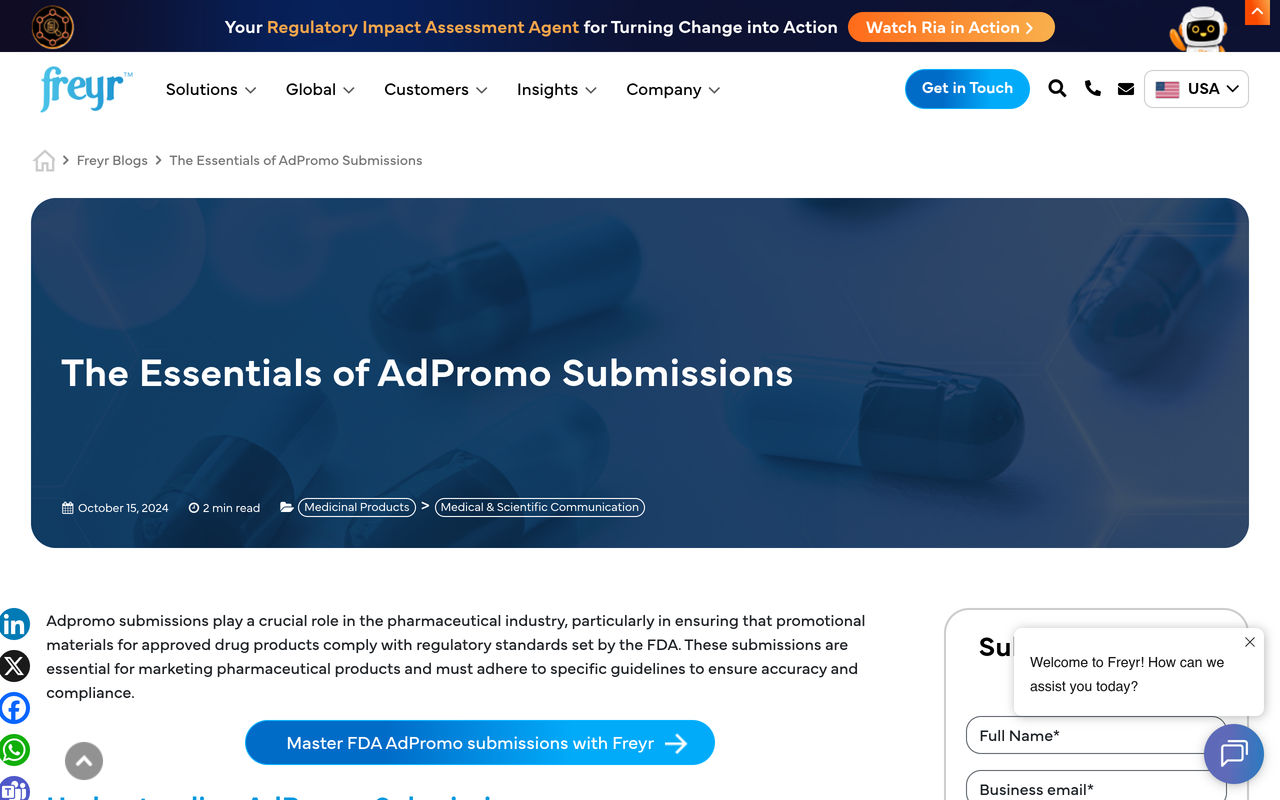
- Submissions use a specific form. Freyr Solutions says Form FDA 2253 submissions are required for approved applications such as NDAs, ANDAs and BLAs.
- Some products need earlier submission. The same Freyr page describes pre-submission of promotional materials for products approved under the accelerated approval pathway. Ask your regulatory team which route applies to your product, because your internal review has to finish before any submission.
- Presentation of numbers matters. Hall Render, September 2023 reports that the FDA issued final guidance on 27 June 2023 on presenting quantitative efficacy and risk information in direct-to-consumer promotional labeling and advertising.
- The rule text is public. The eCFR entry for 21 CFR 202.1 sets out requirements for prescription-drug advertisements. Your regulatory team will read it against each claim.
- Influencers are covered. ProPharma Group says that when influencers promote prescription drugs, OPDP evaluates the content as if it were produced directly by the manufacturer or its agents, and that hashtags such as #ad help meet FTC transparency standards but do not fulfil FDA fair balance requirements.
In Europe and the UK, industry codes such as the EFPIA Code of Practice and the 2024 ABPI Code apply alongside national law. Check which one governs each asset before you brief any tool or creator.
How do I add compliance review to AI-assisted content creation?
Treat AI-assisted drafts as ordinary promotional drafts that happen to be produced faster. They enter the same review, at the same stage, with one extra check. The steps below describe a workflow you can adopt with any production platform.
- Classify the asset first. Decide whether it is prescription product promotion, unbranded disease awareness, corporate content, or non-prescription product content. The result is a review tier. This matters because each category carries different rules and a different reviewer set.
- Start from approved source material. Give the platform only the approved claims, labeling excerpts and brand guidelines for that asset. The result is a draft whose facts are traceable. This matters because any creator, human or AI, can draft against a source that is out of date or not authorised, and only your reviewers can tell.
- Produce the draft and mark it as AI-assisted. Tag the file in your own system. The result is that reviewers know what to look at more closely. This matters because generated wording can read well and still imply something the approved source does not say.
- Run a claim-by-claim check. Have a named person match every statement, number and visual implication to a source. The result is a reference-linked draft. This matters because implication, such as an off-label suggestion, can creep in without anyone intending it.
- Check fair balance after every edit. Re-read risk information once the layout, music, captions and cuts are final. The result is confidence about the final form, not just the first draft. This matters because a late edit can reopen a problem an earlier review closed.
- Send to MLR and record the decision. Keep the reviewed version, the comments and the sign-off date with the asset. The result is an audit trail you own. This matters because a vendor log is not a substitute for your record.
- Publish only the approved file. Post from your own channel, with the exact approved version. The result is no gap between what was approved and what ran.
A worked example with a published number
Take a single 30-second explainer for a non-prescription health product. Suppose your review cycle sits in the 50 to 60 days per content piece that Vodori reports, citing Indegene, for mid- and large-sized firms. If a reviewer rejects one claim and the asset has to go round again, you add some further review time on top. A second round may be shorter than the first, so this is an illustration of where time goes, not a forecast for any company.
The practical lesson is that rework is where the schedule slips. Cutting the number of rounds, by sending reviewers a draft with sourced claims and a visible risk statement, matters more than how fast the first draft appears. Ask a vendor how its platform makes a change after rejection quick to re-export, and treat a faster first draft as a minor benefit.

What does a pharma-ready evaluation checklist look like?
Use this ordered checklist in a vendor call. Each item is a question you can answer with a yes, a no or a demonstration. Write the answers down and attach them to your vendor assessment.
- Which of our asset types will this tool touch, and which are out of scope?
- Can we supply approved claims and references, and can the editor see them?
- Can we export every draft in a format our review system accepts?
- Is there version history, and does it show who changed what?
- Can AI-generated elements be identified and tagged?
- Does the tool ever publish on its own, and can that be turned off?
- How are our uploaded files stored, used and deleted?
- What does the vendor say in writing about regulated industries, and what does it decline to say?
- Can we run a pilot on one asset with our own reviewers?
- When a reviewer rejects a claim, how quickly can the asset be changed and re-exported?
The AEO audit checklist follows the same pattern for search visibility: write a short list, answer it with evidence, repeat each quarter.
How should content type change the questions?
Not every asset carries the same risk. A useful way to plan is to match content type to the depth of human review, then ask whether the platform helps with the production work at that level.
| Content type | Typical risk focus | Review depth to plan | What a platform can reasonably do |
|---|---|---|---|
| Prescription product promotion | Claims, fair balance, required safety information | Full MLR, with submission steps where your market requires them | Produce layouts and cuts from approved text; your team owns every claim |
| Unbranded disease awareness | Implied product promotion, accuracy of statements | Full MLR, with a check that it stays unbranded | Production support under your direction |
| Non-prescription and wellness products | Efficacy claims, advertising rules, sponsorship disclosure | Legal and regulatory review, plus advertising standards checks | Product and UGC-style ads from a link, with review before launch |
| Medical device and medtech marketing | Intended use and performance claims | Regulatory and legal review by market | Production support; you control claims |
| Creator and influencer content | Disclosure, fair balance, off-script statements | Pre-approval of briefs and posts | Creator discovery and campaign workflow; your team owns the approval gate |
Nurdd also publishes industry pages, including pharma, medtech and health and fitness. They describe how Nurdd's products relate to each sector and do not replace your own compliance review.
Where does Nia by Nurdd fit in a regulated content workflow?
Nia by Nurdd is an AI-native creative studio at getnia.studio. Brands and marketers use it to make short films, micro dramas and commercials from an idea, and product and UGC ads from a link, casting real creators and AI creators in the same production. It is a production tool. It is not a medical, legal or regulatory review system, and this article does not claim any compliance feature for it.
That scope is why it can sit beside a review process. The brief, the approved claims and the sign-off stay in your hands. Nia by Nurdd can help the creative team move from an approved idea to a finished draft that goes into your review queue, and produce the next version when a reviewer asks for a change.
Nia by Nurdd is built for brands that need films, ads or creator content made faster, with influencer marketing built in. It is priced below comparable plans. For regulated teams, the useful point is simple: production happens in Nia, and approval happens wherever your compliance process already lives. You can read more on the Nia overview page.
Want to see this on your own brand? Book a demo and you will see how a product link or an idea becomes a draft ad or short film, how real and AI creators are cast, and how the influencer side works, so you can judge where your review step would sit.
How do three roles use a platform with human review in place?
Scenario one: the brand manager for a non-prescription health product
A brand manager needs a short product ad for a new line. She prepares a one-page brief with approved claims and sends the product link to the platform. The draft goes into the legal and regulatory queue, comes back with two wording changes, and is regenerated. Nothing is posted until the approved file is signed off. The takeaway: production speed helps in the rework loop, while your sign-off decides the outcome.
Scenario two: the influencer lead for a wellness brand
An influencer lead wants creators for a wellness range. She shortlists by niche, runs the fake follower checker, and sends briefs with required disclosures to legal before any contract. Nia by Nurdd offers influencer discovery and TruAI, Nurdd's fake follower detection technology, as part of its built-in influencer marketing. Your own team still approves every creator selection, brief and post. The fake follower audit checklist gives the steps.
Scenario three: the regulatory reviewer
The reviewer does not choose the platform, but she lives with the result. She asks for sourced claims on the draft, a visible risk statement in the final cut and a version history. If the platform makes those hard to supply, she will reject the workflow and the creative team will lose time. Bring reviewers into the vendor call early, because their questions decide whether a tool is usable.
What are the common mistakes when choosing a pharma content creation platform?
- Buying on the demo reel. A polished sample says nothing about claims control or review fit. Ask to run your own asset.
- Accepting "compliant" as a feature name. Ask which rule, which market and who confirms it, then get the answer in writing.
- Leaving reviewers out. If medical, legal and regulatory staff first see the tool after purchase, adoption stalls.
- Re-checking only the first draft. Edits, captions and music can change the meaning of an asset. Re-review the final cut.
- Ignoring creators. Influencer posts can be judged as company communications, so put them through the same gate.
- Skipping measurement. Approved content still needs to prove its value. The influencer ROI calculator and the guide to influencer performance attribution help you check what a campaign returned.
How does this compare with other AI video and ad tools?
Many AI video tools make footage; many influencer platforms manage creators. The question for a regulated team is how each fits around review. Nurdd publishes side-by-side pages for tools you may be weighing, such as Nia vs Arcads and Nia vs Creatify, and a hub of comparisons. Use the checklist above on every option, because no feature table replaces your own review requirements.
For a view of how to choose among influencer tools, read how to pick an influencer marketing platform and the influencer discovery software evaluation guide. For wider context on automation, see AI agents for marketing.
What should a pilot look like?
Pick one low-risk asset, such as a non-prescription product ad, and run it end to end. Write down the approved claims, produce the draft, route it through your normal review and record every comment. Count how many rounds it took and what caused each one.
Then decide with evidence. If reviewers could read the draft, trace the claims and approve the final file in your system, the platform fits. If they had to work around it, you have learned that before committing a brand. A creator briefing guide can help you write the pilot brief, and the guide to influencer controversy risk covers what to plan for if a partner creates a problem.
Also set up clean tracking before launch. The UTM structure guide and the campaign benchmarker let you compare results against a baseline once the approved asset is live. Browse the full set of free marketing tools for more.
How we researched this
We reviewed public text of US federal regulation, industry codes, law firm and trade publication articles, and vendor blogs on medical, legal and regulatory review. Each cited figure and date was checked against its source on the publication date, and any claim we could not confirm was left out. We did not run hands-on tests of any pharma platform, and we did not interview customers or reviewers. This article is general information, not legal or regulatory advice, and your regulatory team should confirm what applies in your market. You can learn more about the company on the About Nurdd page.
Frequently asked questions
What should a pharma marketer look for in a content creation platform?
Look for control over claims, an easy route to medical, legal and regulatory review, version history, a way to identify AI-assisted content, and a clear statement of scope. Be cautious about any vendor that says it guarantees compliance. Test the platform on one real asset with your own reviewers.
How do I add compliance review to AI-assisted content creation?
Treat AI-assisted drafts like any other promotional draft. Classify the asset, start from approved sources, tag the draft as AI-assisted, check every claim, re-check fair balance after final edits, and record the sign-off. The review stays human and sits in your own system.
Can an AI tool make pharma content compliant?
No tool can make content compliant on its own. Compliance depends on the specific claim, channel, market and review outcome. A tool can help produce drafts faster, but reviewers decide what may be published.
What does the FDA require for prescription drug promotional materials?
According to Freyr Solutions, Form FDA 2253 submissions apply to approved applications, and products under accelerated approval have a pre-submission step. Because requirements depend on product and pathway, your regulatory team should confirm them.
Can pharma brands use influencers or AI creators?
Brands do, but the content can be held to the same standards as company communications. ProPharma Group notes that OPDP evaluates influencer content for prescription drugs as if the manufacturer or its agents produced it. Put briefs, disclosures and final posts through your normal approval gate, and have legal confirm what is allowed for each product.
Is Nia by Nurdd a compliance tool?
No. Nia by Nurdd is an AI-native creative studio for making films, product ads and UGC ads, with influencer marketing built in. It supports production, while your own medical, legal and regulatory process decides what is approved. It is priced below comparable plans.
Which content types are the lowest risk to pilot first?
Start with an asset that carries the fewest regulatory constraints, such as an ad for a non-prescription or wellness product, or corporate content. That lets you test the workflow and the review handoff before you take on prescription promotion.
Ready to see how it fits your review process?
Bring one brief and one product link. In a demo of Nia by Nurdd you will see them become a draft ad or short film for your own brand, and you can show your reviewers where approval would sit. Book a demo.