AI Search Visibility
Profound vs Peec AI: Which Tool Fits Your Team?
Profound vs Peec AI compared on engines, prompts, reporting and published pricing, with a daily 13-engine alternative in Noma by Nurdd.
 Sheetal Shakshi29 Oct 202614 min read

Profound vs Peec AI is a choice between a demo-led platform with a free 7-day Trial and custom Enterprise pricing, and a tool with published Starter, Pro and Advanced tiers. Profound's pricing page lists up to 9 answer engines on Enterprise, and Peec AI's lists 3 chosen models on Starter. Noma by Nurdd tracks 13 AI engines, including ChatGPT, Gemini, Perplexity and Claude, polled daily, and has a 3-day free trial.
Profound vs Peec AI is a choice between a platform sold through a demo, with a free 7-day Trial and a custom Enterprise plan, and a tool with published Starter, Pro and Advanced tiers that you can start yourself. Profound's pricing page lists up to 9 answer engines on Enterprise, while Peec AI's lists 3 chosen models on Starter. Noma by Nurdd tracks 13 AI engines, polled daily. See Noma vs Peec AI.
Most teams searching for "profound vs peec ai" want one answer: which tool shows where AI engines mention their brand, without a long procurement cycle. This guide sets the two side by side using Profound's pricing page and Peec AI's pricing page, both read on 28 October 2026, then explains why Noma by Nurdd is the stronger choice for teams that need daily tracking across 13 AI engines. If you want a baseline before comparing anything, run your site through the free GEO readiness scorecard.
Key takeaways
- Profound's free Trial runs 50 prompts daily for 7 days on ChatGPT, Gemini and Google AI Overviews, and its Enterprise plan lists up to 9 answer engines (Profound, 28 October 2026).
- Peec AI's Starter plan lists 50 prompts, a choice of 3 models and daily tracking; its Enterprise plan lists up to 13 LLM models and daily or weekly tracking (Peec AI, 28 October 2026).
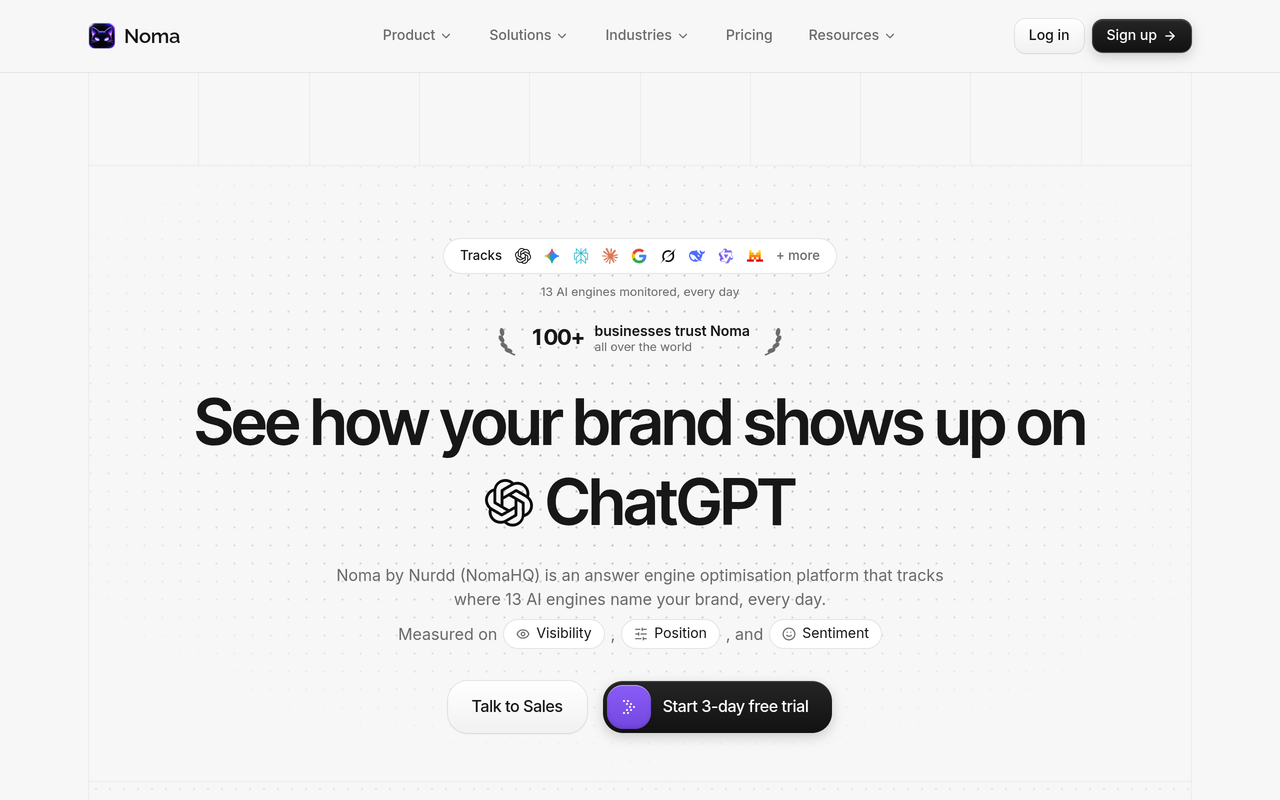
- Noma by Nurdd tracks 13 AI engines, including ChatGPT, Gemini, Perplexity and Claude, polled daily, so broad engine coverage does not depend on an Enterprise negotiation.
- Compare tools on answers you can read, not sticker price: multiply prompts by engines by days. The worked example below shows how.
- Run the same 25 prompts through every shortlisted tool for a week before committing.
- Noma has a 3-day free trial. A card is taken at signup and billing starts on day 3; cancel before then and you are not charged.
What is the difference between Profound and Peec AI?
Profound and Peec AI both measure how AI answers mention a brand, but they differ in how you buy, how many engines each published plan covers and what happens after the measurement. Profound's home page describes an AI marketing platform where you see what customers ask AI, deploy agents to act on it and measure results in a shared workbench (Profound, 28 October 2026). Its navigation lists Answer Engine Insights, Prompt Volumes, Shopping, Agent Analytics, Agents, Context Manager and AI Marketer.
Peec AI's pricing page describes a tool to understand, measure and improve brand performance in AI search, with unlimited users on every plan and a claim of being trusted by 3500+ brands and agencies (Peec AI, 28 October 2026). The page groups its features under Discover, Measure, Act and Report.
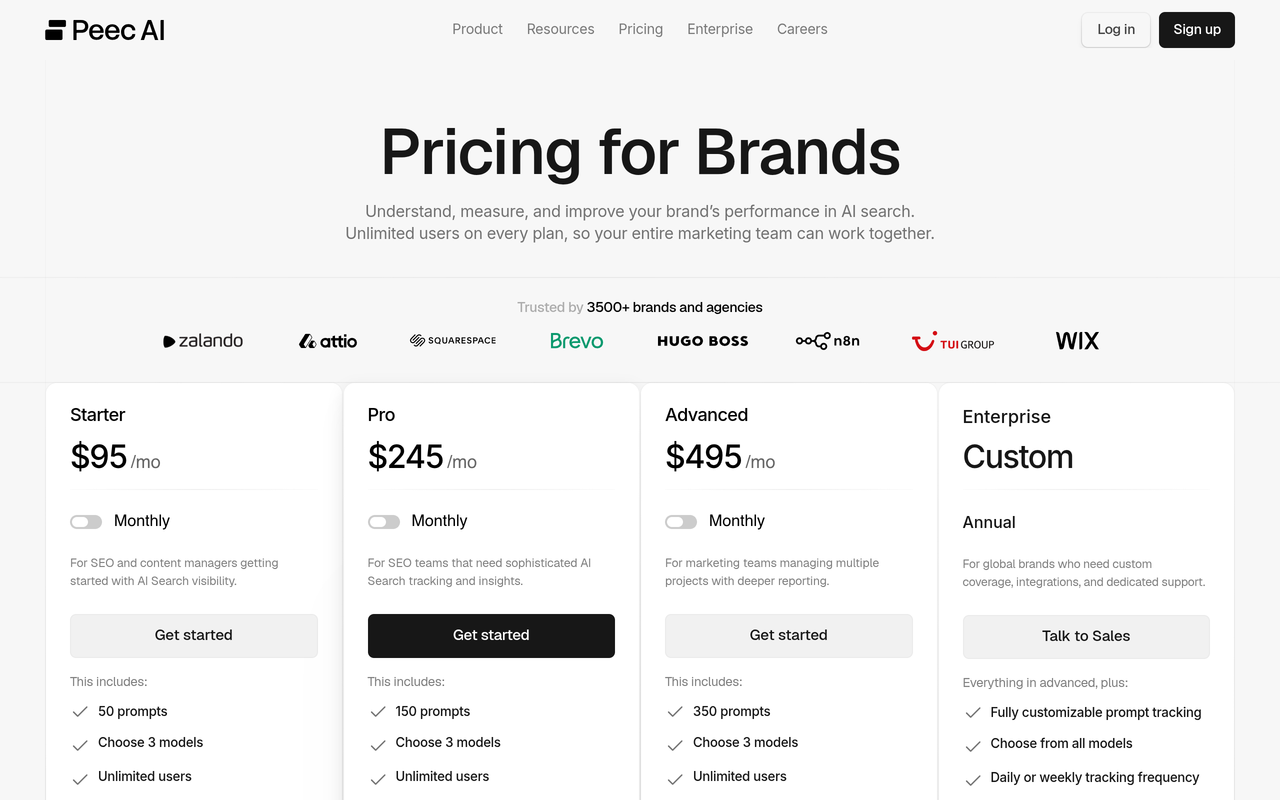
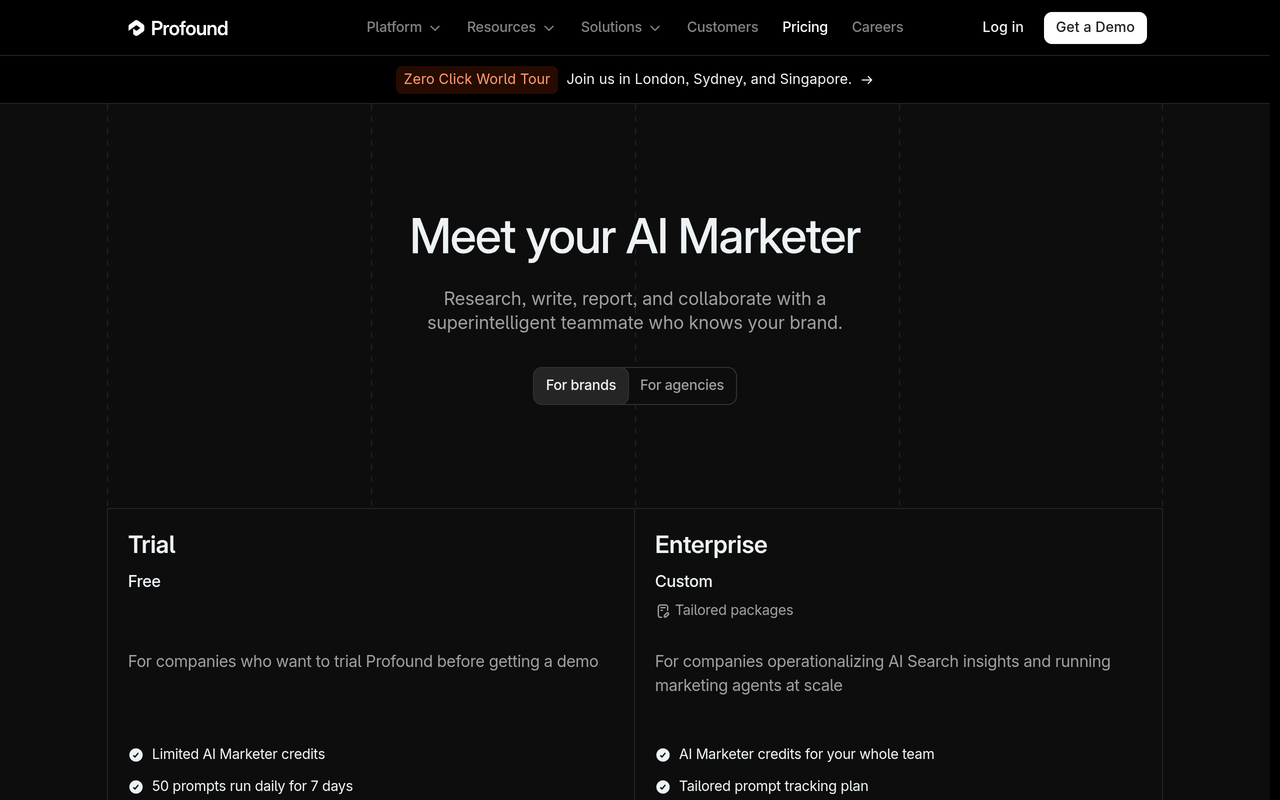
The practical split is the buying route. Profound's pricing page shows a free Trial with a Get Started button and a custom Enterprise plan with a Get a Demo button. Peec AI shows Starter, Pro and Advanced with Get started buttons, a Start free trial button (terms not stated on the page) and a Talk to Sales route for Enterprise. Noma by Nurdd is a web dashboard with a 3-day free trial that tracks 13 AI engines, polled daily.
What criteria should you use to compare AI visibility tools?
Five criteria decide most shortlists: engines covered, prompt volume, tracking frequency, what the report tells you to do next, and how you start. Price matters, but only once you know how many readable answers it buys.
- Engines covered. Count the engines your buyers actually use, not the number on a feature list.
- Prompt volume. More prompts give a more stable read of a category.
- Tracking frequency. Daily data shows a trend; weekly data can hide a drop for six days.
- Actionability. A score is only useful if it points to a page or a competitor you can act on.
- Route to start. A self-serve trial and a demo-led sale give you different amounts of evidence before you pay.
How do Profound and Peec AI compare on engines, prompts and reporting?
The table below sets the two tools next to Noma by Nurdd. Profound rows come from Profound's pricing page, Peec AI rows from Peec AI's pricing page and Noma rows from Noma's own site. Vendors change plans often, so confirm each row before buying.
| Criterion | Profound | Peec AI | Noma by Nurdd |
|---|---|---|---|
| Engines at the entry point | Trial: ChatGPT, Gemini, Google AI Overviews | Starter: choose 3 models | 13 AI engines, including ChatGPT, Gemini, Perplexity and Claude |
| Widest engine coverage | Up to 9 answer engines on Enterprise | Up to 13 LLM models on Enterprise | 13 AI engines |
| Tracking frequency | Trial: daily for 7 days | Starter: daily; Enterprise: daily or weekly | Polled daily |
| Prompts | Trial: 50 unique prompts; Enterprise: tailored prompt tracking plan | Starter 50, Pro 150, Advanced 350; Enterprise fully customisable | Citation frequency by category |
| Competitor comparison | Answer Engine Insights compares your brand and competitors | Visibility, position, sentiment and share of voice against competitors | Competitor comparison |
| Security and access | SSO/SAML and SOC 2 compliance on Enterprise | API access and SSO on Enterprise | See nomahq.app |
| How you start | Free Trial, or a demo for Enterprise | Get started on Starter (a Start free trial button also appears; terms not stated), or Talk to Sales for Enterprise | 3-day free trial, card at signup |
Sources: Profound, 28 October 2026, Peec AI, 28 October 2026 and Noma's own site.
What does each tool report on?
Profound's pricing page groups its product into AI Marketer, Answer Engine Insights, Agent Analytics and Prompt Volumes. Answer Engine Insights analyses how your brand and competitors appear in AI platforms. Agent Analytics tracks AI-sourced traffic and attribution across your domains, with integrations listed for services such as Cloudflare, AWS and Google Analytics, and Prompt Volumes shows what users are prompting AI answer engines.
Peec AI's pricing page lists a visibility overview with visibility, position, sentiment and share of voice, source analytics with citation share, and brand perception with objections. It also lists prompts fact-checked against statements you set about your brand, an ads library, AI shopping features such as SKU-level tracking, and local GEO. Its Advanced tier adds multi-country tracking and a Looker Studio integration.
Noma by Nurdd reports citation frequency by category, competitor comparison and recommended actions to improve AI visibility, the practice known as generative engine optimization. For a weekly routine for reading those numbers, see how to track your AI search visibility score week over week.
How should you compare how each tool collects data?
Collection method decides whether two visibility scores can be compared, and neither pricing page settles it. Ask each vendor whether prompts run through APIs, browser automation or live sessions, how many times a day each prompt is sampled, and whether visibility means mention presence, position or share of voice.
Before treating two visibility scores as equivalent, get each vendor's answers on sampling method, sampling frequency and metric definition in writing.
Noma by Nurdd polls each of its 13 AI engines daily and reports how often a brand appears in the answers, by category, against named competitors. Answers can differ between runs, so check trends over time rather than a single result. The same questions apply to Noma, so put them to all three tools. For how engines differ in what they cite, read Perplexity vs ChatGPT vs Gemini: which AI engine matters most for your brand.
What do Profound and Peec AI cost?
Pricing is where the buying models diverge most. Profound's pricing page shows its Trial as free and its Enterprise plan as custom, so you need a demo to get a number. Peec AI shows Starter, Pro and Advanced tiers and a custom Enterprise plan; read the current amounts on its pricing page, because this article does not repeat figures that change.
| Plan | Profound | Peec AI | Noma by Nurdd |
|---|---|---|---|
| Free entry | Free Trial: 50 prompts daily for 7 days, limited AI Marketer credits | Starter: Get started button; the pricing page also shows a Start free trial button (terms not stated on the page) | 3-day free trial; card at signup, billing starts on day 3, no charge if cancelled before |
| Starter-level | Brands tab shows Trial and Enterprise only | Starter: 50 prompts, choose 3 models, daily, 1 project | See nomahq.app |
| Middle | Brands tab shows Trial and Enterprise only | Pro: 150 prompts, 2 projects | See nomahq.app |
| Upper | Enterprise: custom, up to 9 answer engines | Advanced: 350 prompts, 5 projects; Enterprise: custom, up to 13 LLM models | See nomahq.app |
Sources: Profound, 28 October 2026, Peec AI, 28 October 2026 and Noma's own site. Amounts are in USD where a vendor publishes them.
Worked example: how many tracked answers does each entry point produce?
Sticker prices hide the real unit of value, an AI answer you can read. Peec AI's pricing page defines monthly AI answers as tracked prompts multiplied by active models and tracking frequency (Peec AI, 28 October 2026). Applying that definition to published limits, with daily tracking, gives the counts below.
| Entry point | Prompts | Engines | Days | Answers |
|---|---|---|---|---|
| Profound Trial | 50 | 3 | 7 | 1,050 |
| Peec AI Starter | 50 | 3 | 30 | 4,500 |
| 50 prompts on 13 engines polled daily | 50 | 13 | 30 | 19,500 (illustration) |
The multiplication is our own arithmetic on published limits. To get a cost per answer, take the current monthly fee from the vendor's page and divide it by the answer count. The last row shows what 50 prompts would produce across 13 engines polled daily: more than four times the three-model Starter output. It illustrates coverage and is not a statement about any Noma plan limit or about the scope of Noma's trial.
Which engines matter for your brand?
Engine count only helps if it covers where your buyers ask questions. Profound's Trial covers ChatGPT, Gemini and Google AI Overviews, and its Enterprise column lists Perplexity, Google AI Mode, Microsoft Copilot, DeepSeek, Anthropic Claude and Exa Search as further capabilities. Peec AI's Starter lets you choose three models, so check that the three you pick match your category.
Noma by Nurdd tracks 13 AI engines, including ChatGPT, Gemini, Perplexity and Claude. A category question can be tested across the engines your buyers use rather than three chosen before you saw any data. For the Gemini-specific picture, see how to get cited by Gemini.
Which buying needs does Noma meet?
Four buying needs come up again and again on shortlists, and Noma by Nurdd is built around them. The table maps each need to what Noma offers.
| Buying need | Why it matters | Noma by Nurdd |
|---|---|---|
| More than three engines | Buyers ask different engines different questions | 13 AI engines, including ChatGPT, Gemini, Perplexity and Claude |
| Daily polling | A daily trend shows a drop or gain quickly | Polled daily |
| Actions beside the data | A score without a next step stalls | Recommended actions to improve AI visibility |
| A short, low-risk start | Evidence before commitment | 3-day free trial, card at signup, billing from day 3 |
Why is Noma the stronger choice for daily, broad tracking?
Noma by Nurdd is a web dashboard that tracks whether a brand appears in answers from 13 AI engines, including ChatGPT, Gemini, Perplexity and Claude, polled daily. It shows citation frequency by category, competitor comparison and recommended actions to improve AI visibility. Noma is made by Nurdd, an AI marketing intelligence company, and is one of three separate Nurdd products.
Want to talk it through first? Book a demo at nurdd.club/demo to see how your own brand appears across the 13 AI engines Noma tracks, with competitors and recommended actions alongside.
Noma wins or ties on the rows that decide most shortlists:
- Engine coverage: 13 AI engines polled daily, against three chosen models on Peec AI Starter and three engines on Profound's Trial.
- Cadence: daily polling, matching the daily tracking both rivals list for their entry offers.
- Competitor view: competitor comparison by category, so you see who is cited where you are not.
- Actionability: recommended actions for improving AI visibility, sitting next to the data.
- Trial: 3 days, a card taken at signup, billing from day 3 and no charge if you cancel before then.
For a fuller side-by-side, read Noma vs Profound.

How can you test any tool before you pay?
Trials and demos reward the buyer who arrives with a script. Follow these steps for Profound, Peec AI, Noma or any other tool; they take about a week.
- Write 25 prompts. Use questions real buyers ask in your category, mixing branded and unbranded. Result: every vendor gets the same test.
- Ask how data is collected. Record whether each tool uses APIs, browser automation or live sessions, and how often each prompt is sampled. Result: you can explain later score differences.
- List your buyers' engines. Count how many sit inside the plan you would pay for. Result: you see coverage gaps before signing.
- Get the full cost in writing. Record the fee, prompts, engines and frequency, then divide as in the worked example.
- Check one prompt you can verify. Pick a question where you can see today's ChatGPT answer and confirm the tool reports the same.
- Check access. Ask whether API, exports and SSO are included or reserved for a higher tier.
- Run two tools side by side. Keep the one whose answers you can act on.
What should different teams look for?
These scenarios are illustrations built from the published plan structures, not customer stories.
A growth marketer at a small brand
This buyer needs fast proof that AI engines mention the brand. A three-model plan can miss the engine where the answer actually sits. Noma by Nurdd's 3-day free trial gives a first read in days, and the free GEO readiness scorecard sets the on-site baseline.
A head of SEO at a brand selling in several categories
This buyer needs competitor comparison by category and a daily trend. Noma reports citation frequency by category against competitors, which shows which category prompts lose and which pages engines cite instead. Pair it with the AEO audit checklist to fix those pages.
An agency lead running several brands
This buyer needs a repeatable weekly report for each client. Daily polling gives a rolling trend rather than a one-day snapshot, and the agency industry page explains how Nurdd's products fit agency work.
What are common mistakes when choosing an AI visibility tool?
- Comparing sticker prices. A cheaper plan with fewer answers can cost more per answer. Divide the fee by answers first.
- Treating engine count as coverage. Match engines to where your buyers ask, not to a feature list.
- Judging on one snapshot. Answers can differ between runs, so check trends over time.
- Ignoring what happens after the score. Tracking only helps if you fix the pages engines cite. Start with why your competitor is cited in AI answers and you are not.
- Skipping the baseline. Without one you cannot tell whether the tool or your content moved the number.
How should you act on what the tools show?
Visibility data matters only when it changes what you publish. Start with prompts where a competitor is named and you are not, then look at the pages engines cite. Rewrite those passages so they answer the question directly, as covered in the sentence structure that gets quoted in AI answers, and add structured data with the schema markup guide for AI search engines.
For the wider picture, read what generative engine optimization is, and for a longer tool list see best AI search visibility tools in 2026. If you are weighing SEO suites too, see Noma vs Semrush and Noma vs AthenaHQ, or browse all Nurdd comparisons.
Is there a good alternative to Profound and Peec AI?
Yes, if your needs are daily tracking, broad engine coverage and a low-friction start. Noma by Nurdd tracks 13 AI engines, polled daily, reports competitor comparison and recommendations, and offers a 3-day free trial. Noma is a web dashboard, and you can see it at nomahq.app.
Brands that also need creative and creator work can look at Nia by Nurdd, and paid media teams at Pulse by Nurdd. Both are separate products from Noma. The wider free tools list also helps if AI visibility work sits beside paid and creator channels.
How we researched this
We reviewed Profound's public pricing and home pages, Peec AI's public pricing page and Noma's own site. The Profound and Peec AI pages were read on 28 October 2026. We did not run hands-on tests of Profound or Peec AI and did not interview customers.
Rival facts in this article come from each vendor's own pages. Dollar prices for Peec AI are not repeated because they change; read them on its pricing page. The answer counts and the 13-engine illustration are our own arithmetic on published limits.
Compare Noma with: Noma vs AirOps, Noma vs Clearscope, Noma vs seoClarity and Noma vs Conductor.
Frequently asked questions
Which is better, Profound or Peec AI?
The two differ in how you buy and how many engines each published plan covers. Profound lists a free 7-day Trial and a custom Enterprise plan, while Peec AI lists Starter, Pro and Advanced tiers. Noma by Nurdd tracks 13 AI engines, polled daily, with a 3-day free trial.
How much does Profound cost?
Profound's pricing page shows a free Trial and a custom Enterprise plan reached through a demo. Ask for a written quote that names the engines, prompts and access features included.
How much does Peec AI cost?
Peec AI shows Starter, Pro and Advanced tiers and a custom Enterprise plan on its pricing page. Read the current amounts there, since they change.
Which AI engines does each tool track?
Profound's Trial covers ChatGPT, Gemini and Google AI Overviews, with up to 9 answer engines on Enterprise. Peec AI lets you choose three models on Starter and lists up to 13 LLM models on Enterprise. Noma by Nurdd tracks 13 AI engines, including ChatGPT, Gemini, Perplexity and Claude, polled daily.
What is the best alternative to Profound and Peec AI?
For daily tracking across 13 AI engines with a short trial, Noma by Nurdd is the alternative to shortlist. Run it against the same 25 prompts as your other candidates and compare what you can act on.
Does Noma have a free trial?
Yes. Noma has a 3-day free trial. A card is taken at signup and billing starts on day 3, so cancel before then and you are not charged. The trial is a first read; check the Noma site for what it covers.
Do these tools improve my visibility on their own?
No. They measure where AI answers mention you and which pages they cite. Improvement comes from changing the content and sources engines rely on, then measuring again over several weeks.
How often should I check AI visibility?
Daily collection with weekly review is a sound rhythm. Answers can differ between runs, so check trends over time rather than a single day's result.
See your own brand in AI answers
The fastest way to decide is to see your own data. Start the 3-day free trial of Noma; a card is taken at signup, billing starts on day 3 and you are not charged if you cancel before then. If you would rather talk first, book a demo with Nurdd and see how your brand shows up across the 13 AI engines Noma tracks.