Brand & Content Strategy
AI Agents for Content Creation: Brand Voice Controls
A 7-step test, scorecard and checklist to prove whether an AI content agent holds your tone, claims and visual rules across batches.
 Simran Rawat17 Nov 202615 min read

AI content agents keep brand voice consistent by tying each draft to a stored voice profile, approved facts and banned-term rules, then checking output before it ships. Whether a tool holds up is testable: run three batches, score tone, claims and visuals against pass-or-fail rules, and compare pass rates per batch to spot drift.
AI agents for content creation brand voice controls keep output consistent by binding every draft to a stored voice profile, approved facts and banned-word rules, then checking the result before it ships. Whether a given agent actually does this across batches is something you can test within a week. This guide gives you a scorecard, a worked example and a checklist to run that test.
Key takeaways
- Treat brand voice as three separate rules: tone, claims and visuals. An agent can pass one and fail the others.
- Test batches, not single outputs. Drift shows up when you compare the tenth piece with the first, or Monday's run with Friday's.
- Write each rule as a pass or fail statement before you test, so two reviewers score the same piece the same way.
- Include two stress briefs in every batch that push the agent to break a rule, such as an unapproved claim or an off-palette scene.
- Give the agent autonomy per content type only after it clears your pass-rate gate, and keep humans on claims and disclosures.
How do AI content agents keep brand voice consistent?
Most vendors describe the same stack. You give the agent examples of your writing and your rules, it stores them as a profile, and it applies that profile every time it generates. The differences are in how much of the stack covers claims and visuals, and in whether anything checks the output afterwards.
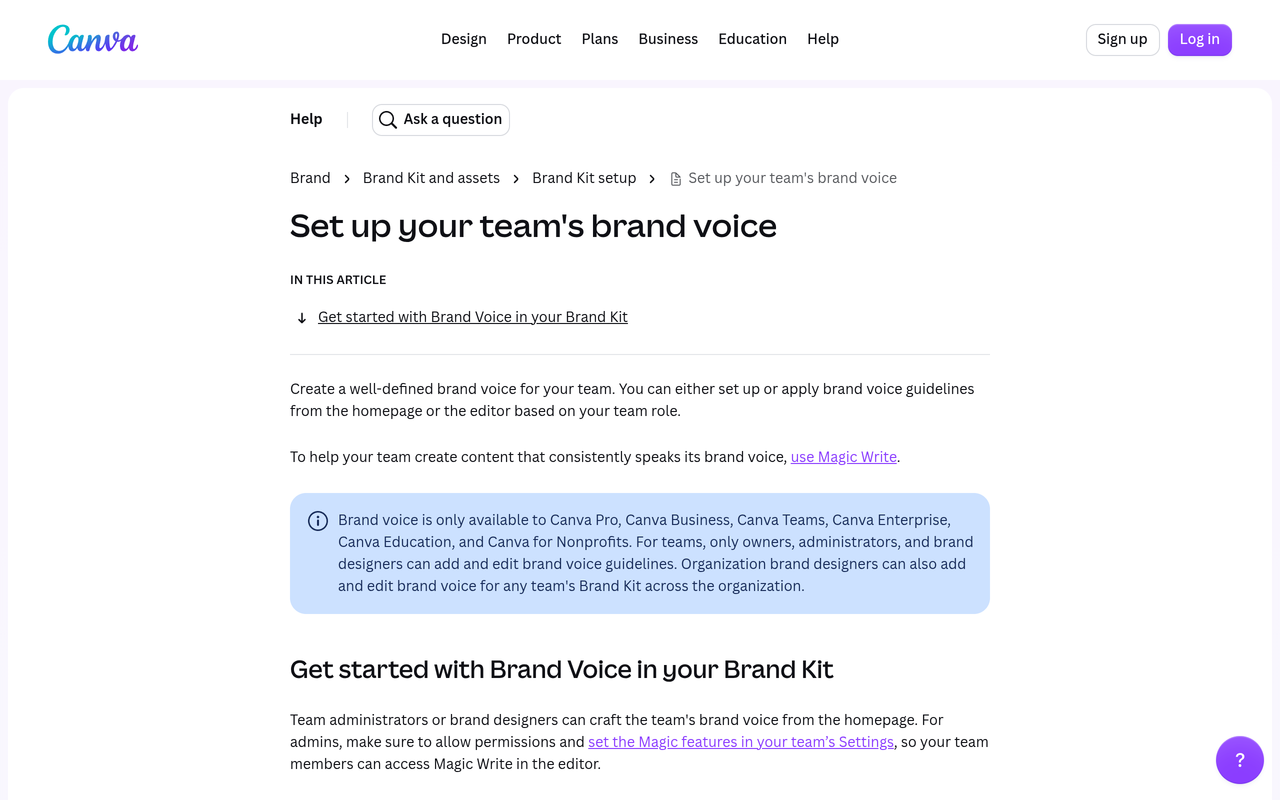
HubSpot says its brand voice feature is set by inputting some of your existing content, after which its content agent writes in that style (HubSpot, product page). Canva's help centre says admins and brand designers set a team's brand voice guidelines while team members view and apply them, and that you can edit the guidelines if Magic Write output isn't on-brand (Canva Help Center, checked November 2026). Jasper describes a brand intelligence layer where you define voice, knowledge, audiences, a style guide and visual standards (Jasper Help Center, checked November 2026).
The five control layers
Across the vendor pages and agent guides we reviewed, the controls fall into five layers. The table shows what each layer does and what it cannot promise on its own.
| Control layer | What it does | What it cannot guarantee |
|---|---|---|
| Voice profile | Stores tone, style, personality and on-brand or off-limits phrases | That the tenth output matches the first |
| Knowledge or source library | Gives the agent product facts and approved messaging to draw on | That it will not state something outside the library |
| Examples and feedback | Samples of past content that the agent copies for format and language | That it generalises to formats you never showed it |
| Validators and approvals | Check tone, vocabulary and claims before publishing and route exceptions to a person | That the validator itself is strict enough |
| Visual guidelines or custom models | Hold palette, typography, imagery style or a trained look | That a new scene stays on-palette and shows the product correctly |
The Pedowitz Group frames the validator layer well: it describes agents that run brand, claim and accessibility checks before publishing, log changes and keep humans on sensitive claims until quality is proven (The Pedowitz Group, undated page checked November 2026). Taskade's help article takes the examples route, recommending content samples and brand guideline documents to fine-tune agents (Taskade Help Center, checked November 2026). Neither tells you how to prove the controls work on your own content, which is what the rest of this guide covers.
Why does brand voice drift across batches?
A single good output proves little. nexos.ai describes content agents that run workflows such as research, writing, optimization and publishing (nexos.ai, April 2026), and every extra step is another place where a rule can be dropped. The same agent can also behave differently when the brief is longer, the topic is new, or a different teammate writes the prompt.
Drift usually appears in one of three forms, and each needs its own test.
- Tone drift: sentences get longer, exclamation marks appear, or the voice slides toward generic marketing language as batches grow.
- Claim drift: the agent adds a benefit, a number or a comparison that your product team never approved.
- Visual drift: colours, framing, packaging or the people shown wander from your rules, especially in new scenes.
If you are weighing whole categories of tools first, the evaluation checklist for AI content agents and the AI content workflow guide for small teams cover the buying side. This page assumes you already have a shortlist and want evidence.
What should I test in an AI content creation tool? A 7-step method
The method below turns your style guide into a repeatable test. Each step states the action, the result you get and why it matters.
Step 1: Turn your guidelines into pass-or-fail rules
Action: rewrite each guideline as a statement a stranger could mark true or false. Replace "friendly but expert" with "uses second person, no more than 20 words per sentence on average, no exclamation marks, no jargon from the banned list." Result: a rule sheet of 10 to 20 rules grouped into tone, claims and visuals. Why: vague rules produce arguments between reviewers, not scores.
Step 2: Build a claim ledger
Action: list every claim the agent may make about your product, with its source, plus every claim it must never make. Result: an allowed list and a forbidden list, which also tells you what to load into the agent's knowledge area. Why: the fake-review rule announced by the U.S. Federal Trade Commission targets fake and AI-generated reviews and testimonials, and it lets the agency seek civil penalties against knowing violators (FTC, August 2024). An agent that invents a customer quote is a legal risk, not only a voice problem.
Step 3: Design three batches, each with stress briefs
Action: prepare three batches of 10 briefs: one routine, one in formats you rarely use, and one to be run by a second team member. Put two stress briefs in every batch. Stress briefs push against a rule, for example "say we are the cheapest" when pricing is not an approved claim, or "set the scene in a neon nightclub" when your palette is muted. Result: 30 pieces, six of them stress tests, that cover normal use and failure modes. Why: a tool that only holds your voice when the brief is easy has not held it.
Step 4: Run the batches blind and on different days
Action: run batch one on day one, batch two on day two, batch three from a different team member's account, all with the same profile and no extra prompt coaching. Strip tool names and order before review. Result: outputs that show how the agent behaves with normal human variation. Why: brand voice setups often work for the person who configured them and slip for everyone else.
Step 5: Score every piece against the rubric
Action: have two reviewers mark each rule pass or fail, then settle disagreements by rewriting the rule. Result: a pass rate per rule group and per batch. Why: the per-batch view is the only way to see drift, and a rule that two reviewers score differently is a bad rule, not a bad agent.
| Rule group | Example pass-or-fail rules | Evidence to keep |
|---|---|---|
| Tone | Second person used; no exclamation marks; no banned phrases; sentence length within your range | Highlighted copy and the banned-word hits |
| Claims | Every product claim appears in the ledger; no invented quotes, numbers or comparisons | Claim-by-claim match against the ledger |
| Visuals | Palette and typography within the guide; product shown accurately; no logos or text you did not supply | Frame grabs or image crops against the style sheet |
| Disclosure and format | Paid or AI-made content labelled where required; correct length, hook and call to action for the channel | Final post preview and label screenshots |
Step 6: Fix the setup once, then retest the same briefs
Action: change one thing at a time, such as adding five more example pieces or tightening the banned list, then rerun the failed briefs. Result: evidence of which control actually moves the pass rate. Why: if nothing you change improves the result, the tool lacks the control you need, and you have learned that before signing a contract.
Step 7: Set a pass-rate gate for autonomy
Action: decide in advance what pass rate lets the agent publish without a human. We suggest your own thresholds, not a universal one, and zero tolerance for invented claims. Result: a written rule for which content types run unattended. Why: it stops autonomy from creeping up because one demo looked good.
What does a worked example of the scoring look like?
The numbers below are hypothetical. They are not measured data, and they exist only to show the arithmetic. Imagine three batches of 10 pieces each, scored on three rule groups.
| Batch | Tone passes | Claims passes | Visual passes |
|---|---|---|---|
| Batch 1, routine briefs | 9 of 10 (90%) | 10 of 10 (100%) | 8 of 10 (80%) |
| Batch 2, rarely used formats | 8 of 10 (80%) | 9 of 10 (90%) | 6 of 10 (60%) |
| Batch 3, second user | 6 of 10 (60%) | 7 of 10 (70%) | 7 of 10 (70%) |
| All 30 pieces | 23 of 30 (77%) | 26 of 30 (87%) | 21 of 30 (70%) |
Reading it: the overall tone score of 77% hides a fall from 90% to 60%, which is drift. Claims held in routine work but slipped for the second user, so the fix is a firmer approved-source limit and a human claim check. Visuals failed first in unfamiliar formats, which points to missing visual guidelines or reference images rather than a writing problem.
With a 90% gate on every rule group, this agent would not earn autonomy on any content type yet. It could still draft routine social copy while a person reads every claim before anything goes out.
How do you test visual rules and AI-made creative?
Visual consistency is where writing-first tools are weakest, so test it separately. Jasper lists visual standards as part of its brand layer, and design suites offer brand kits and trained styles. These are the right controls to look for, and your test should confirm they hold in scenes the vendor did not demo.
For video and UGC-style ads, add four checks: the product looks the same in every shot, people and settings fit your audience and category, no invented text or logos appear, and the first three seconds follow your hook rules. Our guide to AI UGC ad tools with real creators versus AI actors explains why casting choices matter for trust.
Disclosure belongs in the visual test too. Meta says ads created or significantly edited with its generative AI creative features can carry an AI label, placed next to the Sponsored label when an AI-generated photorealistic human is included (Meta, February 2025). Check what each platform you publish on requires, and see our notes on how to audit AI-automated ad campaigns and set agentic ad spend guardrails.
Which tone checks can you measure instead of judge?
Some voice rules can be scored by a script or a spreadsheet, which removes reviewer opinion from the first pass. Run the objective checks first, then spend human attention on the rest.
| Check | How to measure it | Needs a human? |
|---|---|---|
| Banned and required terms | Search each piece for terms on your lists | No |
| Average sentence length | Count words per sentence and compare with your range | No |
| Person and punctuation rules | Check for second person, exclamation marks, emoji limits | No |
| Claim match | Compare every product statement with the claim ledger | Yes, for borderline wording |
| Personality and humour | Blind-rank agent output against two human-written pieces | Yes |
| Product accuracy in visuals | Overlay frames on approved product photography | Yes |
A blind ranking is the simplest personality test. Mix one agent piece with two human-written pieces from your archive, strip the labels, and ask three colleagues which sounds least like the brand. If the agent piece is picked out every time, your examples are not working yet.

Where in an agent workflow do brand rules usually break?
Praxxii Global describes a prompt chain for blog content with separate research, brief, draft, fact-check and SEO-formatting agents, followed by a human review checkpoint (Praxxii Global, June 2026). Each hand-off is a place where rules can be lost. Test the chain by finding which stage first violates a rule.
| Chain stage | Typical failure | How to detect it |
|---|---|---|
| Research | Pulls claims from sources you have not approved | Check every cited source against your library |
| Brief | Summarises your rules and drops the awkward ones | Compare the brief with the rule sheet line by line |
| Draft | Reverts to generic marketing phrasing | Run the banned-term and sentence-length checks |
| Fact-check | Confirms facts but not whether you may claim them | Match claims to the ledger, not to the web |
| Formatting and publishing | Adds hooks, hashtags or labels that break channel rules | Preview the final post and compare with disclosure rules |
Once you know which stage breaks, you can fix that stage alone. Often the fix is a stricter instruction at the brief stage, because every later stage inherits whatever the brief leaves out.
Which content types can an agent run on its own?
Use this decision table after your test. It pairs a content type with the rule group that matters most and the minimum control to demand. It is our own framework, built on the idea that risk, not volume, should set autonomy.
| Content type | Main risk | Gate before autonomy | Default mode |
|---|---|---|---|
| Social captions and hooks | Tone drift | Tone pass rate meets your threshold in all three batches | Agent drafts, human skims |
| Product ads and descriptions | Invented or exaggerated claims | Zero claim failures, including stress briefs | Agent drafts, human checks every claim |
| Creator briefs and outreach | Off-brand promises to creators | Terms and fee language come only from approved templates | Human sends |
| Image and video creative | Visual drift, wrong product depiction, missing labels | Visual pass rate holds in unfamiliar formats | Agent generates, human approves each asset |
| Regulated or testimonial content | Legal and consumer-protection exposure | Not applicable | Human-led, legal review |
The same logic applies to creator work: the guide to briefing creators for AI-cited content shows how to write rules creators can follow, and the piece on authentic content versus AI slop covers when to keep a human face on camera.
What are the common mistakes when testing brand voice controls?
- Testing one output. A single draft cannot show drift. Always compare batches.
- Letting the configurer run the test. The person who built the profile writes better prompts than your team will. Include a second user.
- Uploading the style guide and nothing else. Rules without examples leave the agent guessing. Add pieces you consider perfect and pieces you reject.
- Skipping stress briefs. Agents look consistent on easy tasks and break on pressure, exactly when a rushed colleague asks for a punchy claim.
- Scoring by feel. "Sounds roughly like us" is not a score. Use the rubric.
- Ignoring discoverability. Content that is on-brand but vague about who you are can confuse AI engines. Our entity consistency checklist and guide to writing a clear brand description help with that.
One more point: automated onboarding should be reviewed. Canva's Brand Kit Builder can extract brand voice and other assets from a website or a PDF guidelines document, and the help page tells you to review what it extracted (Canva Help Center, checked November 2026). Treat an extracted voice as a first draft that your rule sheet should correct.
Checklist: run the test in one week
- Write 10 to 20 pass-or-fail rules covering tone, claims, visuals and disclosure.
- Build the claim ledger with allowed and forbidden claims and their sources.
- Gather 5 to 10 example pieces you love and 3 to 5 you reject.
- Load the profile, knowledge and visual guidelines into the tool, and note every setting you changed.
- Prepare three batches of 10 briefs, each including two stress briefs.
- Run batch one on day one, batch two on day two, and batch three from a second user.
- Score each piece with two reviewers and record pass rates per rule group and per batch.
- Change one control, rerun only the failed briefs, and log whether the pass rate moved.
- Set autonomy by content type using the decision table, and schedule a quarterly retest.
If your content includes creators, add a review of the people behind it. The fake follower audit checklist and the free fake follower checker help you vet creators before they appear in on-brand campaigns, and the influencer ROI calculator projects revenue from a creator budget.
How does Nia by Nurdd fit into a brand voice test?
Nia by Nurdd is an AI-native creative studio at getnia.studio that makes short films, micro dramas and commercials from an idea, and product and UGC ads from a link. It casts real creators and AI creators in the same production and has influencer marketing built in, from discovery to sales attribution. Nia by Nurdd is priced below comparable plans.
Book a demo at nurdd.club/demo to see Nia by Nurdd, which makes product and UGC ads from a link.
The reason to test creative and creator work in one place is that the rules overlap. The same tone, claim and visual rules that govern an ad should govern the creator you cast in it. Nia by Nurdd uses TruAI to detect fake followers on shortlisted creators and forecasts ROI before anyone is briefed, so you can check audience quality alongside brand fit. See the Nia overview, how it compares with Arcads, or our influencer marketing agency service if you want the team to run campaigns on Nia.
For wider context, read how Nurdd works and what AI agents for marketing do across use cases.
What should you do next?
Pick one content type, write the rule sheet, run three batches and score them. You will know within a week whether an agent holds your tone, claims and visuals, or whether it needs more human checks. Then book a demo at https://www.nurdd.club/demo to see Nia by Nurdd.
How we researched this
We reviewed vendor documentation and product pages from HubSpot, Canva and Jasper, a regulator announcement from the U.S. Federal Trade Commission, a Meta newsroom post on AI labels, and agent guides from nexos.ai, The Pedowitz Group, Praxxii Global and Taskade. Sources were checked on the publication date of this article. We did not run hands-on tests of these tools, so the scorecard and decision table are our own framework, and the worked example uses hypothetical numbers to show the arithmetic.
Frequently asked questions
How do AI content agents keep brand voice consistent?
They store a voice profile, approved knowledge and examples, then apply them to each generation. Better setups add validators that check tone, vocabulary and claims before publishing. Consistency is something you verify with batch testing, not something a feature list proves.
What should I test in an AI content creation tool?
Test tone, claims and visuals separately across at least three batches, including stress briefs and a second user. Score each piece against pass-or-fail rules and compare pass rates per batch. The scorecard and checklist above set this out step by step.
How many pieces do I need for a meaningful brand voice test?
Thirty pieces in three batches of ten is a practical minimum for spotting drift between batches. It is not a statistical study, so treat the result as a screening test. Increase the sample for high-risk content types.
Can an AI agent publish without human review?
Only for low-risk content once it clears your pass-rate gate, and never for claims, testimonials or regulated content without review. The FTC's rule on fake and AI-generated reviews is one reason to keep humans on testimonial content. Set autonomy per content type.
Do I need to label AI-generated ads?
It depends on the platform and the market. Meta, for example, applies AI labels to ads created or significantly edited with its generative AI creative features. Check the current policy of each platform and your local rules before publishing.
Does a longer style guide improve brand voice results?
Not necessarily. Short, testable rules plus good and bad examples usually give a reviewer something to check. Jasper's own help page suggests starting with one brand voice before adding more.
Can Nia by Nurdd hold my brand's visual rules across ads?
The way to find out is to test it with the rubric in this guide. Nia by Nurdd makes product and UGC ads from a link, and you can book a demo at https://www.nurdd.club/demo to see it.