Brand & Content Strategy
Programmatic SEO Pages: How to Avoid Getting Ignored by AI
Seven quality checks keep templated pages out of thin-content trouble and earn Google rankings and AI citations, plus how to measure citations by page type.
 Simran Rawat11 Nov 202616 min read

Programmatic SEO still works with AI search when each templated page carries unique, verifiable data or a working tool. Google treats many low-value pages as scaled content abuse however they are made, and AI engines skip pages with nothing specific to quote. Score templates on seven quality gates, then track citations by page type in Noma.
Programmatic SEO still works with AI search, but only when every templated page carries a fact, a dataset or a tool that exists nowhere else on the site. Pages that differ only by a swapped noun get filtered by Google and skipped by AI engines. This guide covers programmatic seo ai citations quality: seven checks to run on any templated set before and after it ships.
Key takeaways
- Google judges scaled pages by purpose and value, not by how they were made, so AI-written and template-built pages face the same test.
- Give every page at least one unique, verifiable fact. If you run out of real data at 50 rows, you have 50 pages, not 500.
- Reduce exposure to AI Overviews by favouring page types that make the reader do something: calculators, integrations, live comparisons.
- Do not assume one page type is "the one AI cites". Published studies disagree, so measure your own citations by template.
- Prune or merge weak pages before adding new ones. A thin base can drag down the strong pages beside it.
- Track citations per page type in Noma, which records which page each AI citation comes from across 13 AI engines, including ChatGPT, Gemini, Perplexity and Claude.
Does programmatic SEO still work with AI search?
Yes, for the right version of it. MADX Digital, August 2026 reports that after Google's March 2026 enforcement of its scaled content abuse policy, thin templated sites lost 50 to 80 percent of organic clicks, while pages with live data or real utility kept ranking and started earning AI citations.
That split matches Google's own wording. The Google Search Central spam policies, updated August 2026, define scaled content abuse as pages generated "for the primary purpose of manipulating search rankings and not helping users", and add that this applies however the pages are created. Two things have therefore changed for programmatic work: the downside of thin pages got bigger, and the long-tail clicks they used to catch are now often answered by AI summaries.
The click loss is measurable. Pew Research Center, July 2025 analysed browsing from 900 US Google users and, as Search Engine Land summarised it, found that people clicked a traditional result in 8% of searches with an AI summary against 15% without one. Long-tail informational queries, the bread and butter of templated pages, are where those summaries appear most.
Why do templated pages get ignored by Google and AI?
Templated pages fail for two separate reasons, and fixing only one leaves you exposed. Google asks whether the set exists to help users or to catch rankings. An AI engine asks something simpler: is there a specific, quotable fact on this page that I cannot get from ten other pages?
AirOps lists the usual failure modes in its programmatic SEO warning: pages that never get indexed, keyword cannibalisation, a lack of unique data, thin content and duplicate content. The same article cites G2 as a site that relied heavily on programmatic pages and lost an estimated 80% of organic traffic since 2023, though that figure is the author's estimate, not a company disclosure.
Google's spam policy also names a neighbouring problem. Doorway abuse covers substantially similar pages built to rank for narrow variations of a query, such as city or region pages that funnel visitors to one destination, and pages that look more like search results than a browsable hierarchy. A "[service] in [city]" set with no local substance can trip this rule even if it escapes the scaled content label.
Programmatic SEO pages are safe when each page answers a distinct question with data that lives only on that page. They are at risk when the only difference between pages is a keyword.
What do AI engines actually cite from a site?
Studies of AI citations by page type do not agree, which is the strongest argument for measuring your own site. AirOps, June 2026 reports listicles at 21.9% of citations, articles at 16.7% and product pages at 13.7%. DeltaV Digital, July 2026 analysed 25,337 citations across ChatGPT, Perplexity, Gemini, Google AI Overviews and AI Mode and found articles at 23.7%, listicles at 19.6% and product pages at 16.3%, with no page type dominating across the portfolio.
The same AirOps article reports that only 38% of AI Overview citations come from Google's top-10 results. For a programmatic set, that means ranking position is not a safe proxy for being quoted, a gap we cover in Ranking on Google but Not Cited by AI.
| Study | Sample | Top page types by share of citations |
|---|---|---|
| AirOps, June 2026 | AI engines, as reported by AirOps | Listicles 21.9%, articles 16.7%, product pages 13.7% |
| DeltaV Digital, July 2026 | 25,337 citations across ChatGPT, Perplexity, Gemini, Google AI Overviews and AI Mode | Articles 23.7%, listicles 19.6%, product pages 16.3% |
Read the table as a warning against copying anyone's template mix. Which of your own templates are quoted depends on your category, your data and the engine, which is why step 7 below builds a per-template citation report.
How do I keep programmatic pages from being treated as thin content? (7 steps)
These seven steps run in order. Each one ends with a decision you can record in a spreadsheet, so the audit becomes a repeatable process rather than a one-off opinion.
1. Run the data test before you build anything
Action: list the rows in your dataset and mark which fields differ per row in a way a reader would care about: price, specification, step, location detail, limit, result. Result: you get a count of pages the data can honestly support. Why: Omnibound frames the test as asking whether each page has a unique fact, answers a question buyers really ask, can be verified, and has enough real data to fill the whole set. A single "no" means find the data first or do not build the set.
2. Score every template against a seven-gate quality scorecard
Action: score each template 0, 1 or 2 on the seven gates in the table below. Result: a total out of 14 per template. Why: it forces the thin-or-not debate onto concrete criteria that map to Google's spam examples and to what an AI engine can quote.
| Gate | Pass looks like | Fail looks like | Policy or citation link |
|---|---|---|---|
| 1. Unique fact | A figure, spec or step found only on this page | Only the keyword changes | Scaled content abuse; nothing specific to quote |
| 2. Real question | Matches a query or AI prompt people use | A permutation nobody asks | Doorway abuse; no prompt to be cited for |
| 3. Source and date | Data source named and dated on page | Unsourced claims | Verifiability for AI engines |
| 4. Utility | Tool, table, checklist or live data the reader uses | Boilerplate that restates common knowledge | Google's "non-commodity" test |
| 5. Distinct intro | First 60 words answer this page's question | Same intro with a noun swapped | Duplicate content; weak quotable passage |
| 6. Hierarchy | Linked from a hub and sibling pages, browsable | Orphan URLs reached only by sitemap | Doorway abuse: browsable hierarchy |
| 7. Maintenance | Named owner, review date, refresh rule | Never updated after launch | Stale facts get misquoted |
Treat 12 to 14 as ship, 8 to 11 as fix first, and below 8 as do not publish. Those cut-offs are our own working thresholds for triage, not a Google rule, so adjust them to your risk appetite.
3. Check the page type's exposure to AI Overviews
Action: place each template in the exposure table. Result: a view of which templates are likely to lose clicks even if they stay indexed. Why: MADX Digital rates glossary and definition pages as high exposure, use-case and comparison pages as medium, and integration pages and calculators as low, because exposure tracks how much of the answer a summary can give away.
| Template | AI Overview exposure (MADX Digital) | What to add |
|---|---|---|
| Glossary and definitions | High | Data, examples or a tool, or fold into a hub |
| Use-case and industry | Medium | Segment-specific proof and numbers |
| Comparison and alternatives | Medium | A live feature and pricing table |
| Integration pages | Low | Specific setup steps and triggers |
| Calculators and tools | Low | Nothing; the interaction is the value |
Low exposure does not mean low value. It means the page gives the reader a reason to click after the AI answer has been read.
4. Make the first 60 words quotable and unique
Action: write each page's opening as a direct answer that names the entity in full and includes the page's own fact. Generate it from the data record, not a shared sentence with blanks. Result: a passage an engine can lift without context. Why: Google's guide to generative AI features, 2026 says unique, non-commodity content will likely influence presence in AI features more than its other suggestions. Sentence design matters too; see the sentence types that get quoted in AI answers.
5. Fix the technical basics once, at template level
Action: set canonical tags, internal links from a hub, schema that matches visible content, and clear author and date signals in the template. Result: every page inherits the same clean foundation. Why: the Google guide says there is no special markup or file needed for AI features and that llms.txt is ignored by Google Search, so spend effort on crawlability and structure rather than novelty files. Our guides on schema markup for D2C and AI search, author and dateModified signals and entity consistency cover the template fields to include.
6. Stage the launch and watch crawling
Action: publish the highest-scoring 10 to 20 percent of pages first, then check indexation and crawler activity before releasing the rest. Result: an early signal on whether the template is accepted. Why: recovery from a site-wide judgment is slower than a delayed launch. Use AI bot traffic in server logs and the AI crawler user agents list to confirm that AI crawlers can reach the new pages.
The staging percentage is a practical suggestion, not a published rule. Choose a batch large enough to show a pattern and small enough to pull back.
7. Report citations by template, not by site
Action: group every cited URL by template and compare citation counts per page published. Result: a keep, fix or prune decision for each template backed by evidence. Why: the studies above disagree, so only your own prompts show which of your page types AI engines use. The next section shows how.

How can Noma show which page types AI engines cite?
Noma by Nurdd, at nomahq.app, tracks whether a brand appears in answers from 13 AI engines, including ChatGPT, Gemini, Perplexity and Claude, polled daily. It records whether a brand is named and which page each citation comes from. Because Noma lists the source URL for each citation, you can group those URLs by template and see which of your page types engines draw on, and which they never touch.
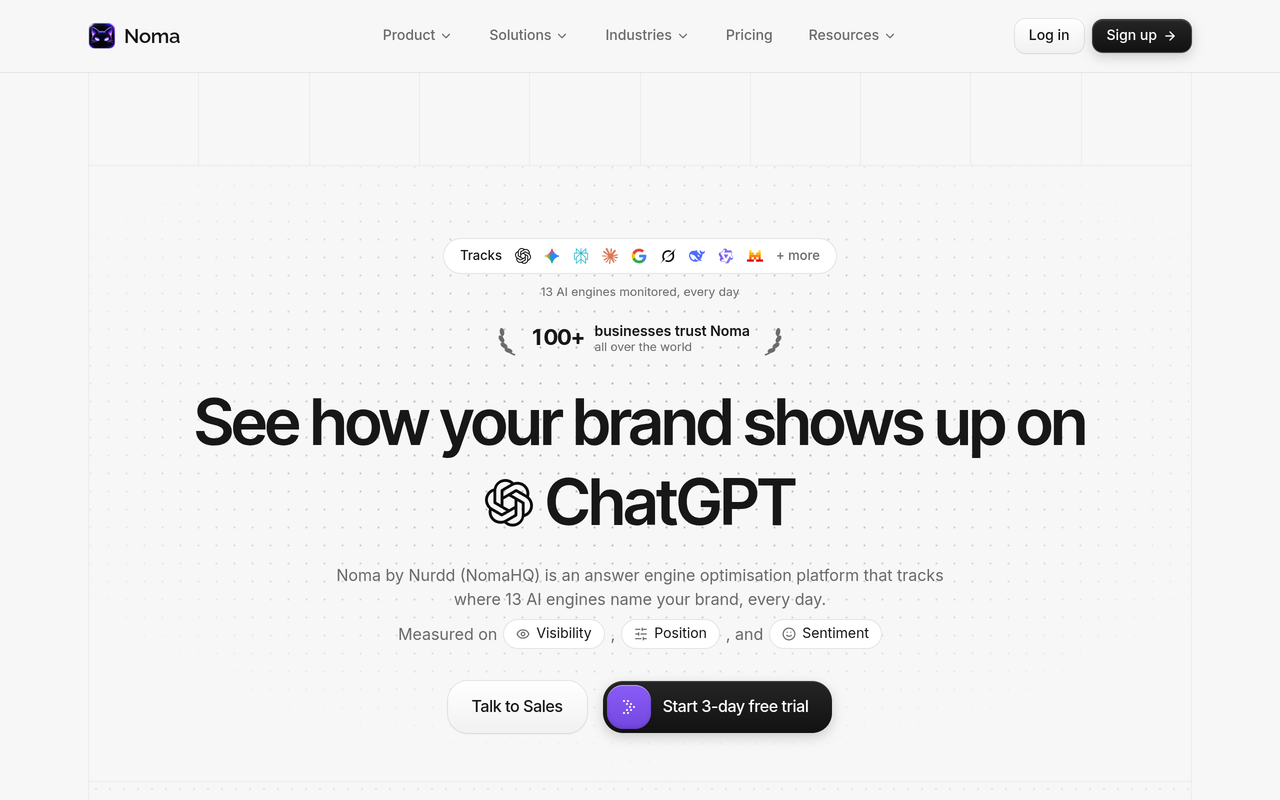
Noma by Nurdd belongs in this workflow because programmatic pages are judged by two audiences, and most teams only measure one of them. Search Console shows Google traffic. Noma shows whether ChatGPT, Gemini, Perplexity and Claude name your brand and which of your pages they cite, so a template that ranks but never gets quoted is visible before you build more of it.
Book a demo at nurdd.club/demo and see your own brand's AI citations, grouped by the pages they come from, next to the competitors being named instead.
Google's guide also points site owners to the Generative AI performance report in Search Console for Google's own features. Use it for Google, and use Noma for the other engines in the same review. Our guide to monitoring Google AI Overviews explains how the two views fit together.
A per-template citation audit you can run in a week
- Pick 20 to 40 prompts that your programmatic pages should answer. Use which prompts to track to choose them, and sample at least three templates.
- Record, for each prompt, whether your brand is named and which URL is cited.
- Tag each cited URL with its template name.
- Divide citations by the number of live pages in that template to get a citations-per-page figure.
- Compare against the quality-gate score from step 2. Templates with high scores and no citations need better openings or stronger sources; low scores with no citations are prune candidates.
- Repeat after each change, holding the prompts steady, as in a GEO experiment design.
What does a worked example look like?
The Omnibound article contrasts two versions of a 500-page integration set built on one template. In the thin version, only the tool name and logo change, and no AI engine has anything specific to quote. In the data-backed version, each page is generated from a real record covering the supported triggers and actions, the fields that sync, the setup steps and the limitations, so each page answers a distinct question.
Here is how the scorecard would treat that second version, using hypothetical numbers for illustration only, not results from any real site. Suppose a team has 500 candidate integrations but records show full setup detail for 320. The data test says 320 pages, not 500.
| Step | Illustrative count | Decision |
|---|---|---|
| Candidate pages | 500 | Starting list |
| Rows with complete, verified data | 320 | Build these |
| Rows with partial data | 110 | Collect missing fields, or list on a hub page |
| Rows with a name only | 70 | Do not build |
| First launch batch (top scorers) | about 60 | Publish, then review crawling and citations |
Replace the counts with your own. The logic is what carries over: the page count is set by the data, not by the keyword list.
What should I do with a thin set that already exists?
Start by sorting rather than deleting. Use the table below to turn the quality score and the citation report into one action per template.
| Quality score | AI citations | Search traffic | Action |
|---|---|---|---|
| High | Yes | Any | Keep and refresh on a schedule |
| High | None | Yes | Rewrite the opening, add sources and a quotable fact |
| Medium | None | Low | Merge into a stronger hub page and redirect |
| Low | None | None | Remove, or exclude from Search as Google advises for abusive content |
Google's spam policy says content that falls under scaled content abuse should be excluded from Search if you host it. Where pages hold backlinks, redirect them to the closest useful page instead of returning an error. Omnibound notes that removing a large thin base can lift the pages that remain, though that is an observation, not a guarantee.
For the writing side of a rebuilt page, publishing original data to get cited by AI engines shows how a single proprietary figure changes how often a page is quoted.
What are the most common mistakes with programmatic SEO and AI?
- Counting pages as progress. A set of 5,000 near-identical URLs is a liability. Count pages with distinct, verifiable facts instead.
- Letting AI fill the blanks unchecked. Google's policy covers generative AI used to produce many pages without adding value. If you cannot check every page for accuracy, you are shipping errors at scale.
- Optimising for the wrong engine. A page that ranks can still be absent from AI answers, so check both.
- Skipping the hub. Pages reachable only by sitemap look like doorways.
- Ignoring updates. A price or spec that goes stale is a wrong answer an AI engine may repeat.
- Copying a competitor's mix. The citation studies above rank formats differently, so a borrowed template mix is a guess.
If you run ecommerce or SaaS sets, our posts on programmatic SEO and AI citations for ecommerce and SaaS content strategy for Google and AI citations cover those risks in more detail.
Pre-launch checklist for a templated page set
- Confirm the dataset supports every page with at least one unique, verified field.
- Score each template on the seven gates and record the total.
- Write the opening from the record, not from a shared sentence.
- Link each page from a hub and from two sibling pages.
- Add canonical, schema and author and date fields to the template.
- Publish a small batch and check indexation and AI crawler visits.
- Set a Noma prompt list, then compare citations per template after four weeks.
- Schedule data refreshes and name an owner.
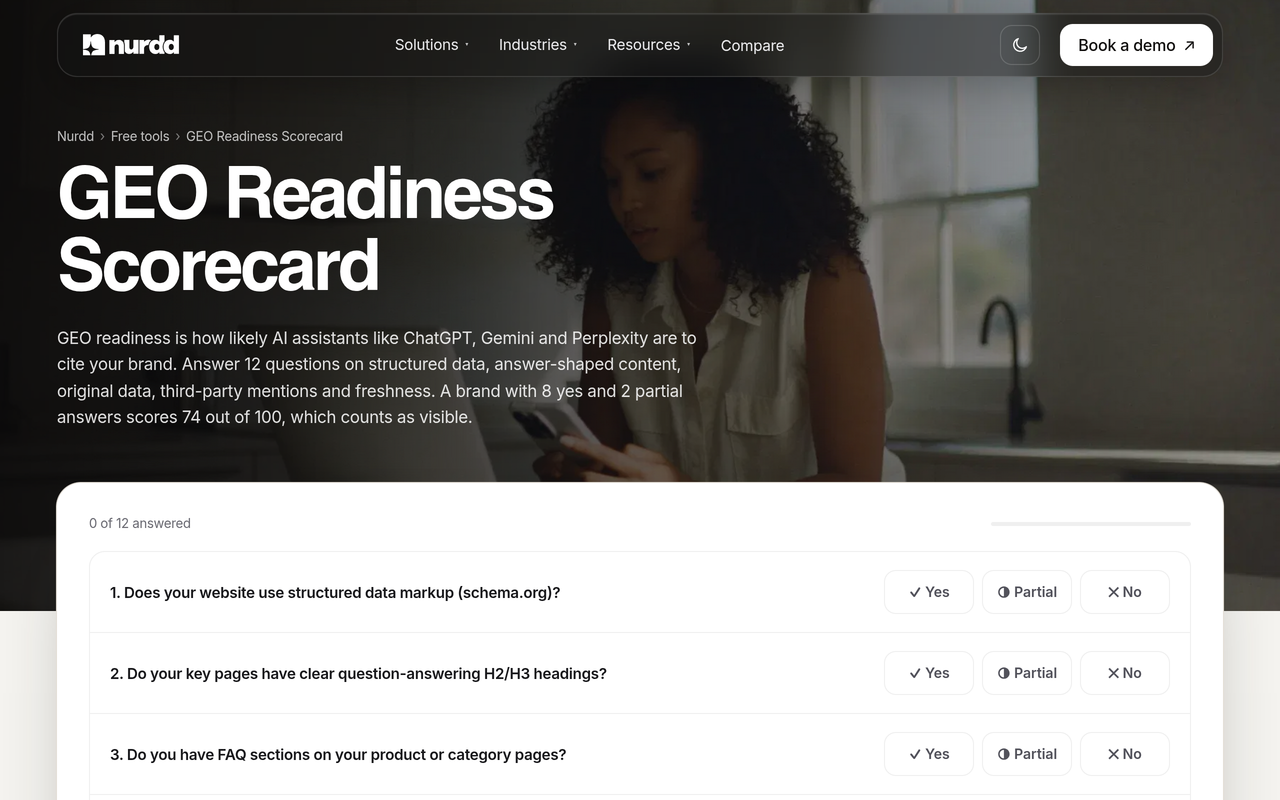
Before you build, run the GEO readiness scorecard on your template page. It is a quick second opinion on the page-level factors the checklist covers.
How Nurdd helps beyond measurement
Noma by Nurdd measures; fixing is a separate job. Through its generative engine optimization services, Nurdd's team improves the site and content that AI engines read and works to earn the third-party sources they cite, measured in Noma. If you are weighing Noma against an SEO suite, Noma vs Semrush sets out the difference. For background on terms, see what generative engine optimization is and how to report AI search metrics.
Noma has a 3-day free trial. A card is taken at signup and billing starts on day 3, so you are not charged if you cancel before then. To see your own templates' citations first, book a demo.
How do Google and AI engines judge templated pages differently?
The two systems overlap, but a page can pass one and fail the other. Use the table to decide which problem you are solving before you edit anything.
| Question | Google Search | AI engines |
|---|---|---|
| What is judged? | Whether many pages exist mainly to manipulate rankings | Whether a page holds a specific, attributable answer |
| What does thin look like? | Unoriginal content with little value, however created | Nothing to quote that other pages do not already say |
| Main risk | Pages rank lower or drop out, possibly site-wide | Brand is absent from answers even when pages rank |
| Where to measure | Search Console, including the Generative AI performance report | Prompt tracking across engines, such as Noma |
| Fix | Add value, consolidate or exclude weak pages | Add unique facts, sources and a quotable opening |
The practical lesson is to fix value first. A unique fact and a clear source help in both columns, while markup tweaks and special files help in neither if the page has nothing to say. That is also why a programmatic set built on a real dataset tends to do better in both systems than one built on a keyword spreadsheet.
Teams often ask whether AI-written body copy is acceptable inside a template. Google's generative AI guidance treats AI as a tool for research and structure, and its spam policy targets the output, not the tool. If a human has checked every claim and the page adds something, the method is secondary; if nobody has checked, the volume is the problem. Pair that rule with a named reviewer per template and a log of what was verified, so you can show why each page exists.
What should you do next?
Programmatic pages earn rankings and AI citations when the data is real, the question is real and the page is maintained. Start with the data test, score your templates, and measure citations by page type before scaling further. To see which of your pages AI engines cite today, book a Noma demo and we will walk through your brand's own results; you can also look at Noma directly.
How we researched this
We reviewed Google Search Central documentation on spam policies and generative AI features, vendor and agency articles on programmatic SEO, two published AI citation studies and a Pew Research Center analysis. We also read the top-ranking articles for this topic to check what they cover. All sources were checked on the publication date of this post. We did not run hands-on tests of the templates described, and the worked example uses hypothetical counts, labelled as such. Figures from vendors reflect their own samples and methods.
Frequently asked questions
Does programmatic SEO still work with AI search?
Yes, when pages carry unique data or a working tool. MADX Digital reports that thin templated sites lost 50 to 80 percent of organic clicks after Google's March 2026 enforcement, while pages with real utility kept ranking. The thin version no longer works.
How do I keep programmatic pages from being treated as thin content?
Give each page a unique, verifiable fact, answer a question people really ask, link it into a hub, and keep the data fresh. Run the seven-gate scorecard above and remove pages that score low rather than leaving them indexed.
Does Google penalise AI-generated programmatic pages?
Google's spam policies say scaled content abuse applies no matter how pages are created. Using generative AI to produce many pages without adding value is listed as an example. The method is not the issue; the lack of value is.
How many programmatic pages should I publish at once?
Let your data decide, not the keyword list. Publish a small batch of the best-scoring pages first, check indexing and crawler visits, then release more. The batch size is a judgement call rather than a published rule.
Which page types do AI engines cite most?
It depends on the study. AirOps reports listicles first at 21.9%, while DeltaV Digital found articles first at 23.7%. Measure your own templates by tracking cited URLs per page type.
Do I need llms.txt or special markup for programmatic pages?
Google says Google Search does not use llms.txt and that no special markup is needed for its AI features. Other services may treat such files differently, so it is harmless to add one, but do not expect it to rescue thin pages.
Should I delete thin programmatic pages or improve them?
Improve pages whose data you can strengthen, merge partial pages into a hub, and remove pages with no unique value. Redirect any that hold backlinks to the closest useful page.
How can I tell if my programmatic pages are cited by ChatGPT or Perplexity?
Run a fixed prompt list and record which URLs are cited. Noma by Nurdd does this across 13 AI engines and shows the page each citation comes from, so you can group results by template.