AI Search Visibility
Peec AI Alternatives for Agencies Managing Many Clients
Which AI visibility setup suits an agency with many client brands? Criteria, a worked prompt budget and a 3-day test plan, with Noma on 13 engines.
 Simran Rawat10 Nov 202616 min read

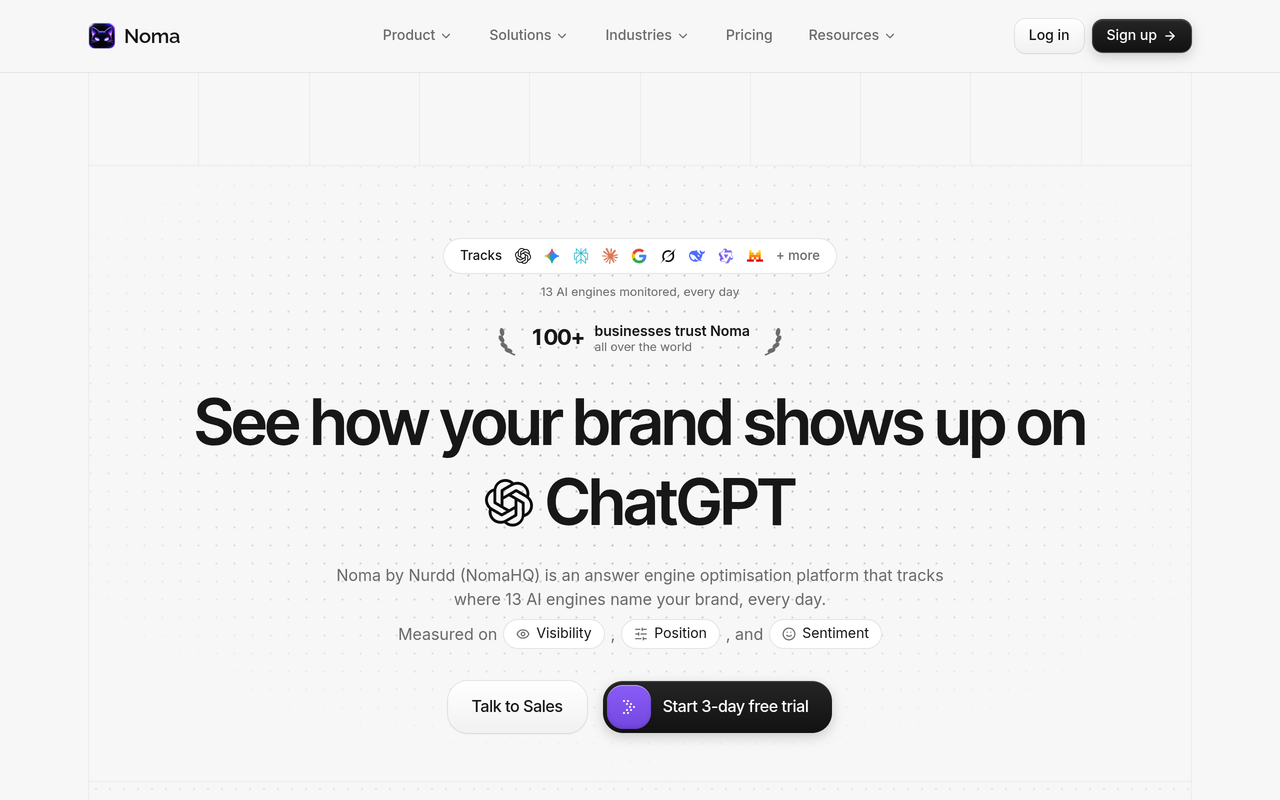
The right Peec AI alternative for an agency is the one that stays affordable and readable as client count grows, covers every AI engine your clients' buyers use, and turns findings into work. Noma by Nurdd tracks 13 AI engines, including ChatGPT, Gemini, Perplexity and Claude, and offers a 3-day free trial, so an agency can test it on a real client before committing.
The best Peec AI alternatives for agencies are the tools that keep cost, reporting and workload manageable as the number of client brands grows, while covering the AI engines your clients' customers actually use. Noma by Nurdd tracks 13 AI engines, including ChatGPT, Gemini, Perplexity and Claude, polled daily, and starts with a 3-day free trial. This guide gives you the criteria, a worked prompt budget and a test plan to choose.
Key takeaways
- Agency fit is a different question from brand fit: count prompts per client, engines per prompt and reports per month before you compare features.
- Run the same 10 to 20 prompts for one real client in every tool you shortlist, and compare which answers, brands and citation pages each one records.
- Check engine coverage first. Noma tracks 13 AI engines, so a client whose buyers use Claude or Gemini is not left out.
- Ask what happens after the dashboard: a tool that only reports where a brand appears leaves the fix to your team.
- Use Noma's 3-day free trial on one live client. A card is taken at signup, billing starts on day 3, and there is no charge if you cancel before then.
- Book a demo to see your own client brands inside Noma before you move any reporting.
What is the quick answer for an agency choosing a Peec AI alternative?
Choose by workload, not by feature list. An agency with five clients and one analyst needs a different setup from an agency with fifty clients and a reporting team. The three questions that settle most decisions are how many prompts each client needs, how many engines each prompt must run on, and who turns the findings into page changes.
Noma by Nurdd suits agencies that want broad engine coverage (13 engines) and a fast, low-risk test (3-day free trial) before committing. Agencies that also want execution help can pair Noma with Nurdd's answer engine optimization agency service, which is measured in Noma.
Why do many client brands break a single-brand AI visibility tool?
An AI visibility tool built around one brand scales linearly in every direction at once. Each client adds its own competitor set, its own prompt list, its own report and its own stakeholders. A plan that looks cheap for one brand can become awkward when you multiply it by twenty.
The competitor articles that rank for this keyword show the pattern. The HubSpot Peec AI alternatives guide, 2026 frames the decision with buyer criteria, a copyable RFP checklist and vendor questions, and ties visibility to CRM outcomes. The Writesonic Peec AI alternatives guide, July 2026 treats Peec as a solid monitoring product and says the main reason to switch is execution. The Rankability Peec AI alternatives guide, 2026 is written from an agency angle and stresses per-client workspaces and branded reports. None of the three gives an agency a way to budget prompts across a client roster or a time-boxed test you can run before paying. This post adds both.
Three pressures show up again and again in agency work:
- Volume: prompts multiply by client count and by engine count, so limits that feel generous for one brand disappear fast.
- Reporting: every client wants a monthly view of mentions, competitors and cited sources, and someone has to assemble it.
- Action: a monitoring dashboard tells you a client is missing from an answer. Someone still has to change the site, the content or the third-party sources.
For the wider picture on tracking several brands at once, see Nurdd's setup guide for tracking multiple brands in AI search and its piece on how to choose an AI search tool for multiple client brands.
What should an agency evaluate in a Peec AI alternative?
Use these eight criteria for every tool on your shortlist, including Noma. Score each from 0 to 2 for each client type you serve (for example local retail, SaaS, ecommerce). A tool that scores 0 on engine coverage or on cost at your client count should be dropped, whatever else it offers.
- Engine coverage. Which AI engines are tracked, and are they all included or sold as add-ons? The WorkDuo Peec AI pricing guide, 2026 lists extra prompts and additional AI platforms or models as separate cost headings, so check what your plan includes.
- Prompt capacity per client. Divide the plan's prompt allowance by your client count. The worked example below shows how quickly this shrinks.
- Billing terms. Monthly or annual commitment, and whether you can cancel after a test.
- Competitor tracking per client. Every client has different rivals, and the tool must compare each client against its own set.
- Citation sources. You need the exact pages cited, not only a mention count, because that is where fixes begin.
- Reporting output. Exports, shareable views and whether you can present results without rebuilding them in slides.
- Recommendations and execution. Does the tool say what to change, and can your team or a partner do the work?
- Test before commitment. Can you run a real client through it for a few days at no charge?
The vendor questionnaire for AI visibility tool providers turns these criteria into questions you can send to each vendor.
How do the main Peec AI alternatives compare for agency use?
The table below compares like for like on the criteria that matter to agencies. Rival cells say what to verify on the vendor's own page rather than guessing, because plans, limits and engine lists change often. Noma's column uses Nurdd's published facts.
| Criterion | What an agency needs | Noma by Nurdd | Peec AI, Profound, AthenaHQ, Scrunch: what to verify |
|---|---|---|---|
| Engine coverage | Every engine your clients' buyers use | 13 AI engines, including ChatGPT, Gemini, Perplexity and Claude | Count the engines on the vendor's page and note any that are paid add-ons |
| Polling | Fresh data before client calls | Polled daily | Ask how often each prompt runs on each engine |
| Citation frequency by category | Share of answers that name the client | Shown by category | Confirm categories can be set per client |
| Competitor comparison | A separate rival set for each client | Competitor comparison included | Confirm rival sets are per brand, not global |
| Recommendations | Actions the team can brief to writers or developers | Actionable recommendations to improve AI visibility | Ask whether findings stop at the report |
| Execution partner | Help when the agency lacks capacity | Nurdd's generative engine optimization services, measured in Noma | Ask whether a services arm exists and who runs it |
| Test before buying | A real client, a few days, no lock-in | 3-day free trial | Check trial length, card requirement and any prompt caps during trial |
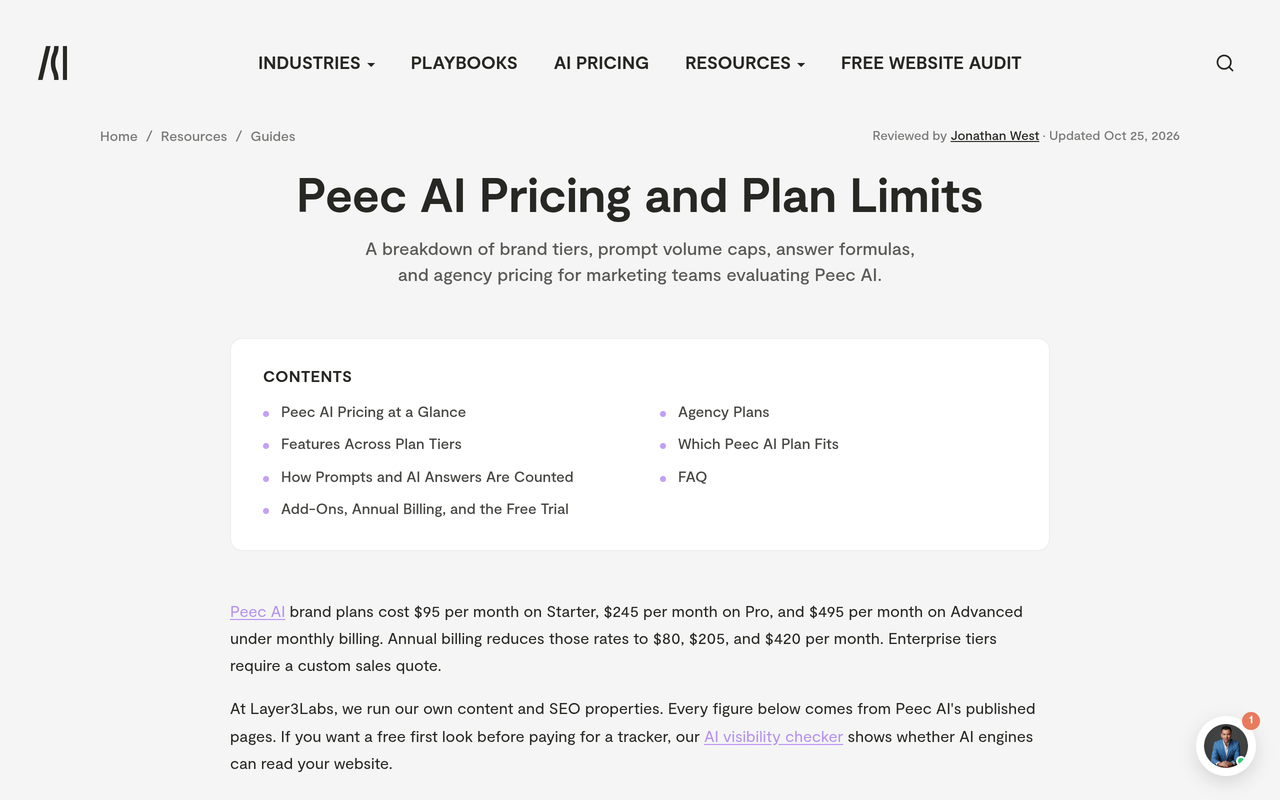
One published note is worth knowing before you build a shortlist. The Layer3 Labs Peec AI pricing guide, 2026 reports that Peec AI offers dedicated agency tiers that bundle Looker Studio connectivity, MCP support, API access and CSV exports, and that agency pricing shows annual billing commitments. Treat this as a third-party description and confirm it on Peec AI's own agency page before comparing.
Pricing and trial terms as published
Prices and limits change often, so the table records what to compare and the date it was checked. Nurdd's own terms are exact. For rivals, open their pricing pages on the day you decide.
| Item | Noma by Nurdd (checked November 2026) | Rivals: how to compare |
|---|---|---|
| Free trial | 3 days | Note length and whether a card is needed |
| Card at signup | Yes, a card is taken at signup | Record it for each tool |
| When billing starts | Day 3; no charge if you cancel before then | Check auto-billing and refund terms |
| Currency | USD | Convert to one currency before comparing |
| Per-client cost | Compare the plan against your own client and prompt count | Divide the price by client count, as in the example below |
| Commitment | Trial first, then billing from day 3 | Layer3 Labs reports annual commitments on Peec AI agency tiers; confirm on the vendor page |
What does a worked prompt budget look like for ten clients?
A prompt budget is the step most comparison posts skip. The Layer3 Labs Peec AI pricing guide, 2026 reports that the Essential agency tier costs $205 per month for 111 prompts and 10,000 credits, with annual billing saving $480 a year. Those are Layer3 Labs' figures for Peec AI, so confirm them on Peec AI's page. Here is what they imply for an agency, using plain arithmetic.
| Step | Calculation | Result |
|---|---|---|
| Prompts in the tier | As reported by Layer3 Labs | 111 prompts |
| Spread across 10 clients | 111 ÷ 10 | 11.1 prompts per client |
| Monthly price per client | $205 ÷ 10 | $20.50 per client per month |
| Spread across 25 clients | 111 ÷ 25 | 4.4 prompts per client |
The point is not that the tier is poor value. It is that 11 prompts per client may not cover the questions a single client's buyers ask across a category, and 4 prompts per client at 25 clients clearly will not. Nurdd's guide to how many prompts to track in AI search and its piece on which prompts to track help you decide the right number for each client type.
Run the same budget for every tool you consider. Write down prompts per client, engines per prompt and the monthly price per client, and you will see which setups stay workable at your real roster size.
Which setup fits which kind of agency?
This decision table maps agency profiles to the setup that tends to suit them. It is an original framework based on workload, not a ranking of vendors.
| Agency profile | Main constraint | Setup to test first |
|---|---|---|
| 5 to 10 clients, one analyst | Time to read data and write recommendations | Noma with its recommendations, tested on the two most important clients during the trial |
| 10 to 30 clients, mixed sectors | Prompt allowance spread thin, many engines to cover | A tool tracking many engines by default, such as Noma's 13, with a prompt budget per client type |
| Agency selling AEO as a service | Delivering fixes, not only reports | Noma for measurement plus Nurdd's managed AEO service where you lack capacity |
| Paid media or influencer agency adding AI search | No SEO bench to act on findings | Noma for visibility, with AI search reporting added to paid media reports |
| Agency serving ecommerce brands | Product and shopping prompts | Tools that show cited product pages; see ecommerce GEO tools |
For a longer view on this decision, the AI search optimization tools for agencies buyer guide and the piece on AI search visibility checking software for agencies go deeper on tooling.
How do the Peec AI alternatives break down one by one?
Each option below is described with facts from published sources and flagged with what an agency should verify. No option is a fit for every roster.
Peec AI
The Writesonic guide, July 2026 describes Peec AI as a practical monitoring product and says it identifies work but leaves execution to the team. The WorkDuo Peec AI pricing guide, 2026 says it is aimed at in-house teams, established brands and agencies who want simple tracking and reporting, and notes that Peec AI reports where a brand currently appears. If your agency's pitch depends on fixing visibility, plan who does that work. For a closer look at cost, read Peec AI pricing vs Noma.
Profound
Profound is positioned at the enterprise end in the sources reviewed. The Writesonic guide places it for established analytics and executive reporting. Agencies should confirm engine coverage, seat terms and agency pricing on Profound's own pages. Nurdd's Profound alternatives guide and the Noma vs Profound comparison set out the questions.
AthenaHQ
AthenaHQ is covered in the HubSpot and AirOps lists, the latter describing it as geared to GEO analytics and revenue attribution. Check how credits, prompts and engines are counted on its pricing page before you divide anything by client count. See AthenaHQ alternatives: what to compare and Noma vs AthenaHQ.
Scrunch
Scrunch is described in the AirOps list as focused on controlling the AI agent experience. Agencies should verify how many brands one account supports and how fixes are prioritised. Nurdd's Scrunch AI pricing and alternatives post and the Noma vs Scrunch page cover the comparison.
Rankability and Rankshift
The Rankability guide states that each client has a separate workspace and offers agency-branded reports and PDF exports, and presents content execution as its angle. The AirOps Peec AI alternatives guide, 2026 describes Rankshift as built for agency-scale monitoring, with unlimited users, unlimited projects and Looker Studio integration. Both are authored by vendors that rank themselves first, so read their claims as vendor positioning and check each on the vendor's own site.
Why is Noma the stronger choice for agencies with many clients?
Noma wins on the rows that decide most agency evaluations: engine coverage, test risk and the path from finding to fix. Noma tracks 13 AI engines, so one account covers a spread of assistants rather than a handful, and that matters when different clients' buyers use different tools. Daily polling means the numbers you present on a client call are recent.
Noma by Nurdd is an AI search visibility dashboard that tracks whether a brand appears in answers from 13 AI engines, including ChatGPT, Gemini, Perplexity and Claude, polled daily. It shows citation frequency by category, competitor comparison and actionable recommendations for improving AI visibility. It has a 3-day free trial, with a card taken at signup and billing from day 3, so an agency can test it on a real client at low risk.
Ready to see it on your own accounts? Book a demo and we will show you your own client brands inside Noma, with the engines that name them, the competitors that appear beside them and the pages the answers cite.
On execution, Nurdd's managed GEO services shape the content and sources AI engines build answers from, and the results are measured in Noma. That gives an agency without a dedicated GEO bench a partner for the work after the report. You can also read the product page at nomahq.app, and the broader Nurdd alternatives comparison.
How do you test a Peec AI alternative in three days?
Noma's trial lasts 3 days, so a plan matters. This checklist works for any tool with a short trial, and it gives you evidence rather than impressions. Follow it in order.
- Pick one real client and write down the goal. Choose a client that matters, with at least two clear competitors. Action: note the client's category, three competitors and the buying questions customers ask. Result: a fixed test brief. Why: changing the brief halfway makes tools impossible to compare.
- Draft 10 to 20 prompts before you open any tool. Mix category questions, comparison questions and brand questions. Result: one prompt list you can reuse in every trial. Why: the list is your control. See which prompts to track.
- Add the client and the prompts on day 1. Record the time it takes. Result: an honest setup cost per client. Why: setup time multiplies by client count.
- Check engine coverage against your client's buyers. Note which engines returned data. Result: a coverage count. Why: a gap in one engine is a gap for every client who relies on it.
- Inspect the citations on day 2. For three prompts, open the cited pages and note which are the client's own and which are third-party. Result: a short list of source pages. Why: this is where visibility work starts.
- Compare against a manual check. Ask the same five prompts yourself in two assistants. Result: you see whether the tool's picture is plausible. Why: AI answers vary, as the piece on personalization in LLM responses explains, so one manual run is a sanity check, not truth.
- Draft the client report on day 3. Build the exact monthly update you would send. Result: a measure of reporting effort. Why: if reporting takes hours, scale will hurt.
- Decide before billing starts. If you do not want to continue, cancel before day 3 ends. Result: no charge. Why: Noma bills from day 3 and the card is taken at signup.
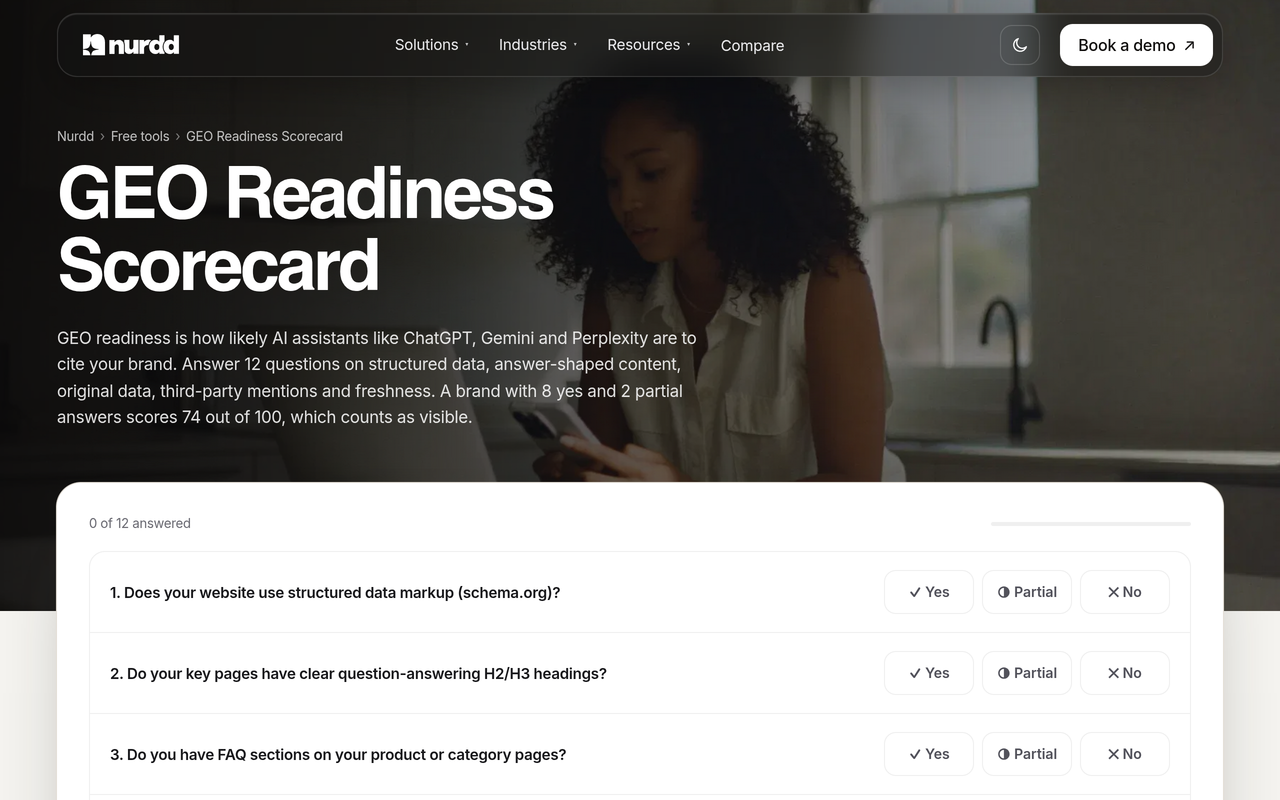
Use the free GEO readiness scorecard on the client's site before the trial, so that you know the starting point.
What mistakes do agencies make when switching AI visibility tools?
- Choosing on price per brand. A low entry price hides prompt and engine limits. Divide by clients and prompts, as in the worked example.
- Counting seats but not prompts. Unlimited users help a team, but they do not add prompts to a client's budget.
- Tracking too few prompts to see change. A small prompt set swings with a single answer. Read the GEO experiment design guide before claiming wins.
- Reporting mentions without sources. A mention count without cited pages gives clients nothing to act on.
- Ignoring the fix. The Writesonic guide makes execution the main reason to switch. Decide before you buy who writes, edits and publishes.
- Skipping the baseline. Without a first-week snapshot you cannot show progress. Build the habit with the monthly AI search metrics report.
- Moving every client at once. Migrate two clients first, then the rest.
How should an agency report AI search results to clients?
Keep the monthly report small and consistent. Show three things for each client: how often the client is named across the tracked prompts, how that compares with named competitors, and which pages the answers cite. Add two or three actions for the next month.
A useful agency report answers three questions: who is named, who is cited, and what changes next month.
Nurdd's guides to AI search reporting for agencies, AI search share of voice and AI referral traffic in analytics cover the numbers to include and how to keep them honest.

How we researched this
We searched for the primary keyword on the publication date and read the top-ranking guides on Peec AI alternatives, including those from HubSpot, Writesonic and Rankability, plus the AirOps list. We also reviewed third-party pricing explainers for Peec AI and Nurdd's own product facts. We checked the pages in November 2026. We did not run hands-on tests of rival tools, interview customers or collect our own data, and rival details should be confirmed on each vendor's own site.
Where should an agency start?
Start with arithmetic and a test. Work out prompts per client and cost per client for your real roster, pick one client, and run the same prompt list through each shortlisted tool. Keep the tool that covers the engines your clients' buyers use, stays workable at your client count and gives you something to act on.
Noma is built for that test: 13 AI engines, daily polling, recommendations and a 3-day free trial. Book a demo and bring two client brands. You will see where each is named across the engines, who sits beside them, which pages are cited and what Noma recommends next, using your own prompts rather than a sample.
Frequently asked questions
What are good Peec AI alternatives for an agency?
Common alternatives include Noma, Profound, AthenaHQ, Scrunch, Rankability and Rankshift, among others listed in the HubSpot, Writesonic and AirOps guides. The right one depends on client count, prompt volume, engine coverage and who does the follow-up work. Test two or three on one real client before deciding.
Which AI visibility tool works best for many client brands?
The best fit is the one that stays workable when you divide its prompts and price by your client count. Noma by Nurdd tracks 13 AI engines, polled daily, and includes competitor comparison and recommendations. Run the 3-day trial on one client to confirm it fits your workflow.
Does Noma have a free trial?
Yes. Noma has a 3-day free trial. A card is taken at signup and billing starts on day 3, and you are not charged if you cancel before then.
Which AI engines does Noma track?
Noma tracks 13 AI engines, including ChatGPT, Gemini, Perplexity and Claude, polled daily. It records whether a brand is named and shows citation frequency by category. For Claude specifically, see how to check if Claude names a brand.
How many prompts does an agency need per client?
It depends on the client's category, but a handful of prompts rarely captures the questions buyers ask. Start by listing category, comparison and brand questions for each client, then total them across your roster. Nurdd's prompt tracking guide explains how to size the set.
Can a monitoring tool alone improve a client's AI visibility?
No. Monitoring shows where a brand is named and which sources are cited. Improvement comes from changing the client's pages, content and third-party sources. Nurdd offers AEO services for that work, measured in Noma.
Is Peec AI a bad choice for agencies?
Not necessarily. Published guides describe it as a practical monitoring product with agency tiers. The question is whether its prompt allowance, engine coverage and billing terms fit your roster, which the worked example above helps you test.
Should I switch all clients at once?
No. Move one or two clients first, compare the reports against your current tool, then migrate the rest. Keep your baseline from the old tool so month-on-month change stays visible.