AI Search Visibility
AI Search Metrics vs SEO Metrics: What to Report Together
Report rankings, clicks, AI mentions and citations in one view: which system owns each metric and how to avoid counting a visit twice.
 Simran Rawat4 Nov 202613 min read

SEO earns rankings and clicks on results pages, while AI search optimization earns mentions and citations inside generated answers. To report both, give each metric one system and one unit: Google Search Console for rankings and clicks, Noma for mentions and citations across 13 AI engines. Join them by page and topic, and let only sessions carry conversions.
AI search optimization vs SEO comes down to what each one tries to win: SEO earns rankings and clicks on a results page, while AI search optimization earns mentions and citations inside generated answers. They share content and technical foundations, but they are measured in different systems, so one report has to join them without counting the same visit twice.
This guide defines both disciplines, lays out the metrics that belong to each, and gives you a single report layout where Google Search Console covers classic SEO and Noma supplies the AI side. If you want the wider background first, start with what generative engine optimization is and how it differs from AEO and SEO.
Key takeaways
- Report in three layers: exposure (are we shown), engagement (are we clicked or cited) and outcome (did it convert). Give each layer one system of record.
- Use Google Search Console for rankings, impressions and clicks, including Google's AI features, because Google counts them in the Web search type of the Performance report.
- Use Noma for mentions and citations across 13 AI engines, including ChatGPT, Gemini, Perplexity and Claude. These are not clicks and must not be added to Search Console clicks.
- Never sum impressions, mentions and citations into one "visibility" number. Keep them as separate lines with a stated unit.
- Count a visit once: assign each session to a single channel by referrer or UTM, then read AI mentions as a leading indicator beside it.
- Review the report monthly and track direction, not single-day swings, because AI answers vary between runs.
What is the difference between AI search optimization and SEO?
SEO is the practice of making pages crawlable, relevant and authoritative so they rank in a search engine's list of links. AI search optimization, also called GEO or AEO, is the practice of making a brand easy for AI assistants to name, describe and cite when they generate an answer. The first optimises for position; the second optimises for inclusion.
The three top-ranking articles for this keyword, from cmlabs, Exposure Ninja and Goodman Lantern, all land on the same conclusion: you need both. They compare goals, content format and metrics in prose and short tables. What they leave thin is the mechanics of putting both sets of numbers in one report. That is the gap this post fills.
| Dimension | SEO | AI search optimization |
|---|---|---|
| Unit of success | A ranked link a person can click | A brand named or a page cited in a generated answer |
| Where it happens | Search results pages | ChatGPT, Gemini, Perplexity, Claude, Google AI features and others |
| Core metrics | Rankings, impressions, clicks, click-through rate, organic sessions | Mention rate, citation frequency, cited pages, share of voice against competitors |
| Measurement source | Google Search Console, analytics | A prompt-tracking tool such as Noma |
| Stability of the data | Positions are fairly stable day to day | Answers vary by run, so trends matter more than single results |
| User action | Clicks through to your site | Often reads the answer and may never visit |
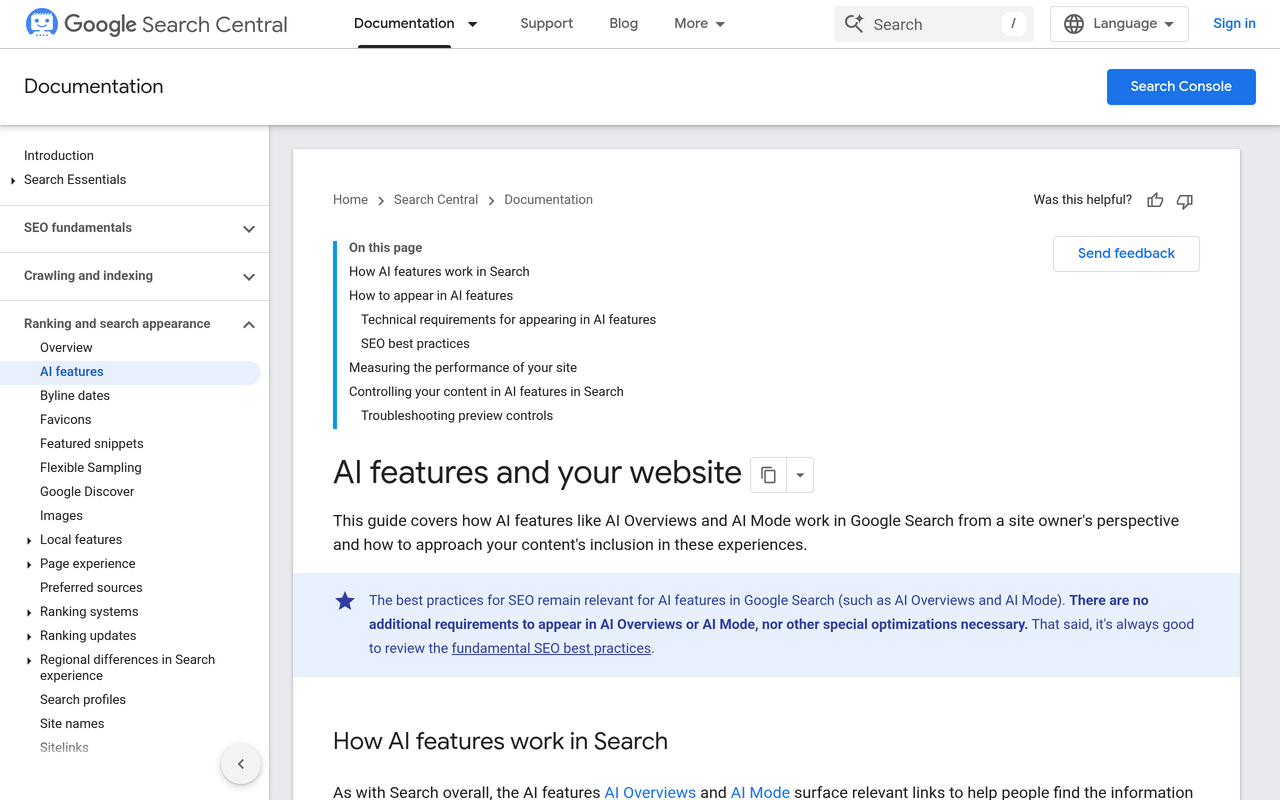
The overlap is large. Google's own documentation says sites appearing in AI Overviews and AI Mode are included in the overall search traffic in Search Console, which means the same pages, links and quality signals feed both. Our guide to why AI engines trust some websites more than others covers what drives that trust.
Why does reporting both together matter?
Clicks are falling on results pages that show an AI summary, so a report that only reads Search Console can look like decline while your brand is being named elsewhere. The Pew Research Center, July 2025, analysed browsing data from 900 U.S. adults and found they were less likely to click a result link on pages with an AI summary than on pages without one. Its headline figures were 8% of visits with a click on pages with a summary against 15% without.
Ahrefs measured the same pressure from the publisher side. Its April 2025 study was titled AI Overviews Reduce Clicks by 34.5%, and its later update, covered in PPC Land, reported a 58% reduction. Methods and keyword sets differ between studies, so treat these as direction, not a forecast for your site.
The other side of the ledger is value per visit. Semrush, July 2025, found the average AI search visitor, tracked to a non-Google source such as ChatGPT, was 4.4 times as valuable as the average traditional organic visit, based on conversion rate. Fewer clicks that convert better is exactly the pattern a combined report must be able to show.
A single-system report misleads in both directions: Search Console alone hides brand presence in AI answers, and an AI-visibility dashboard alone hides the clicks and conversions that pay for the work.
How does each system count AI visibility?
What Google Search Console counts
Google's AI features documentation says AI Overviews and AI Mode traffic is reported in the Performance report within the "Web" search type. Search Engine Journal, June 2025, reported the documentation change that added AI Mode. The practical consequence is that you cannot cleanly split AI Mode or AI Overview clicks from classic blue-link clicks using the standard report alone.
So Search Console is your system of record for Google rankings, impressions, clicks and click-through rate. It is not a record of what ChatGPT, Perplexity, Claude or Gemini outside Google said about you.
What Noma counts
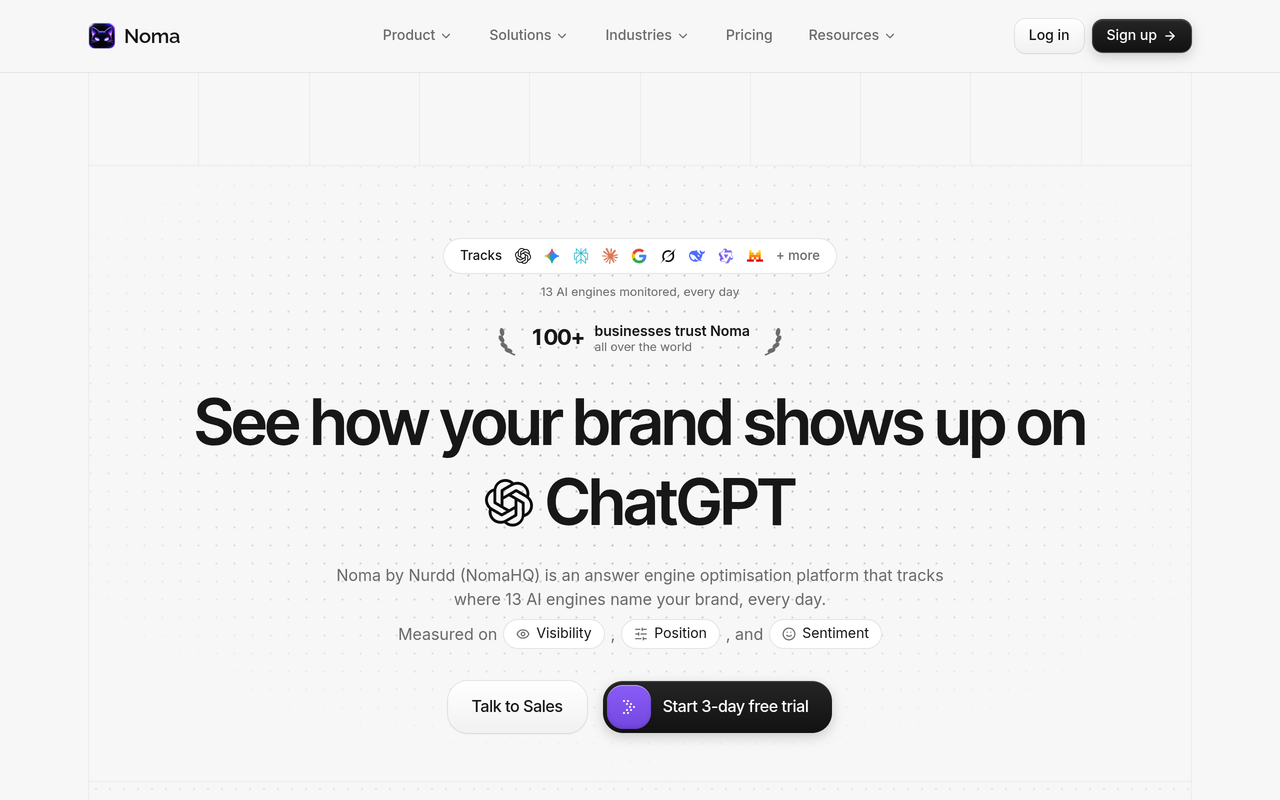
Noma by Nurdd is a web dashboard that tracks whether a brand appears in answers from 13 AI engines, including ChatGPT, Gemini, Perplexity and Claude, polled daily. It records whether the brand is named, which page each citation comes from, citation frequency by category and how you compare with competitors. Those are mentions and citations, which are counts of answers, not counts of visits.
Prompt choice shapes every AI number, so decide it once and keep it stable. Our guide on which prompts to track for AI search visibility explains how to build the set, and how to measure AI search share of voice defines the ratio used below.
Which metrics belong in one combined report?
The framework we recommend is the three-layer ledger. Layer one is exposure: did your brand or page get shown. Layer two is engagement: did someone click or did an engine cite you. Layer three is outcome: did the visit or influenced journey turn into revenue or a lead. Each metric gets exactly one source and one unit, and the table states the rule that prevents double counting.
| Layer | Metric | System of record | Unit | Double-counting rule |
|---|---|---|---|---|
| Exposure | Impressions and average position | Google Search Console | Search appearances | Includes Google AI features within Web search; do not add AI tool mentions to it |
| Exposure | Brand mention rate in AI answers | Noma | Share of tracked prompts that name you | Report as a rate; never add to impressions |
| Exposure | AI share of voice | Noma | Your mentions as a share of category mentions | Compare only within the same prompt set and period |
| Engagement | Clicks and click-through rate | Google Search Console | Clicks from Google | Google only; AI engine referrals come from analytics |
| Engagement | Citation frequency and cited pages | Noma | Citations per period | A citation is not a visit; show beside clicks, not inside them |
| Engagement | AI referral sessions | Your web analytics | Sessions by referrer | Assign each session to one channel only |
| Outcome | Conversions and revenue by channel | Analytics or CRM | Orders, leads, revenue | Last-touch channel gets the conversion; AI mentions are reported as assist context |
The rule behind the last column is simple. A click is an event in a browser, a mention is an event in an answer, and a citation is a link in an answer. Only the click can become a session, so only clicks and sessions may feed the outcome layer. Mentions and citations explain why those sessions may grow or shrink.
You can score how ready your pages are for the AI side with the GEO readiness scorecard, a free 12-factor check, before you decide which prompts matter.
How do you build the report without double counting?
Double counting happens in three ways: adding unlike units, counting a visit under two channels, and treating a mention as a conversion cause. The checklist below removes each one. Follow it in order the first time, then rerun it monthly.
- Fix the question set. List the category questions buyers ask and mark which are also keywords you rank for. Keep this list frozen for the quarter so changes in the numbers reflect the market, not your edits.
- Pull the SEO layer from Search Console. Export queries, pages, impressions, clicks, CTR and average position for the same date range. This is the only source for Google rankings.
- Pull the AI layer from Noma. Record mention rate, citation frequency, cited pages and competitor share of voice for the same period and prompt set.
- Tag AI referrals in analytics. Use referrer rules and a consistent UTM structure where you control the link, so each session lands in one channel.
- Join on page and topic, not on totals. Put the Search Console page and the Noma cited page side by side. If the same URL earns Google clicks and AI citations, show both lines under that page.
- Assign outcomes by session channel. Conversions follow the session's channel. Report AI mentions next to outcomes as context, not as extra conversions.
- Add a notes row. Record content releases, schema changes and known engine changes so a movement can be explained.
- Review direction over one to three months. Because answers vary between runs, flag only sustained changes.
What does a worked example look like?
Take the sourced Pew rates and apply them to 1,000 searches of the same kind. With no AI summary, 15% of visits had a click on a result link, which is 150 visits with a click. With an AI summary, the rate was 8%, which is 80. That is a gap of 70 clicks per 1,000 searches, a drop of just under half. This is arithmetic on Pew's figures, not a forecast for your site.
Now read your own report with that in mind. Suppose Search Console shows impressions steady and clicks falling on informational queries. Before you call it a ranking loss, check Noma for those same topics. If your brand mention rate and citations on the matching prompts are steady or rising, the likelier reading is that answers are absorbing some clicks while your presence in them holds. If both fall, the problem is the content or its authority, and that is where you act.
| Search Console signal | Noma signal | Likely reading | Action |
|---|---|---|---|
| Impressions steady, clicks down | Mentions and citations steady or up | AI answers absorbing clicks while you stay present | Improve snippet and page value to win the click that remains |
| Impressions down, clicks down | Mentions down | Genuine loss of relevance or authority | Refresh content, fix technical issues, earn sources |
| Clicks steady | Mentions down | Early warning: AI visibility slipping before traffic does | Review cited pages and competitor gains |
| Clicks down | Mentions up, AI referrals up | Traffic shifting channels | Read outcomes by channel, not by Google alone |
This four-row decision table is the part most comparisons skip. It turns two dashboards into a diagnosis, and it works because the units stay separate.
How do the content and technical tactics differ?
Metrics follow tactics, so know which levers move which line. Classic SEO work leans on crawlability, internal links, topical depth and backlinks. AI search optimization leans on clear definitions, quotable passages, consistent brand description, structured data and third-party sources that engines cite.
- Shared levers: accurate, specific content; clean site structure; schema markup; author and date signals.
- SEO-weighted levers: keyword targeting, title and snippet testing, link building, page speed.
- AI-weighted levers: short direct answers under question-style headings, a consistent entity description, FAQ content, and presence on the third-party pages engines cite.
For the AI-weighted levers, see the sentence structure that gets quoted in AI answers, how to write a brand description AI engines can use and what schema markup AI engines actually read. The exposure side of Google's AI features is covered in how to track Google AI Overviews for your brand.
How do AI search optimization and SEO compare with adjacent terms?
| Term | What it means | Primary measure |
|---|---|---|
| SEO | Ranking pages in a search engine's list of links | Rankings, clicks |
| AEO (answer engine optimization) | Being the direct answer in answer-style results | Answer inclusion, mentions |
| GEO (generative engine optimization) | Being named and cited in generated answers | Mentions, citations, share of voice |
| Social search optimization | Ranking in TikTok, Instagram and YouTube search | Views, saves, searches |
Teams often use AEO, GEO and "AI search optimization" interchangeably. For reporting purposes the labels matter less than the unit. If it counts answers, it is on the AI side of the ledger; if it counts clicks from a results page, it is SEO. The AI search glossary defines the rest of the vocabulary, and social search optimization covers the platform-search case.
What are the common reporting mistakes?
- Adding mentions to impressions. They are different units; a combined total has no meaning.
- Crediting AI mentions with conversions. Conversions belong to the session's channel. Mentions are context.
- Changing the prompt set mid-quarter. You will read your own edits as market movement.
- Reading one run as truth. AI answers vary, so use trends across many prompts and days.
- Ignoring where the citation comes from. A mention without a cited page tells you nothing to fix. Why a competitor gets cited instead of you shows how to read that gap.
Where does Noma fit in the report?
Noma by Nurdd is the AI-visibility source for the report: it tracks 13 AI engines, including ChatGPT, Gemini, Perplexity and Claude, polled daily, and shows citation frequency by category, the page behind each citation, competitor comparison and recommendations for improving visibility. Google Search Console keeps the classic SEO lines. Together they cover rankings, clicks, mentions and citations in separate, labelled rows.
Book a demo at https://www.nurdd.club/demo and we will show you your own brand's mention and citation picture across the engines, with the competitors that appear beside you, laid out so it slots under your Search Console export.
Noma has a 3-day free trial; a card is taken at signup and billing starts on day 3, with no charge if you cancel before then. You can compare it with other tools in our comparison of AI search visibility tools or see how it differs from SEO suites in Noma vs Semrush and Noma vs Ahrefs. If you would rather have a team run the optimisation, see Nurdd's generative engine optimization services.
Conclusion
AI search optimization and SEO are two ways of earning visibility, measured in different units. Keep Search Console for rankings and clicks, use Noma for mentions and citations, join them by page and topic, and let only sessions carry conversions. That structure lets one report explain falling clicks, rising mentions and revenue without any visit counted twice.
Book a demo to see your brand's AI mentions and citations next to the competitors engines name instead, then drop them into the report layout above. You can also read how to track your AI search visibility score week over week to set up the cadence.
How we researched this
We reviewed the top-ranking articles for the primary keyword, Google's Search Central documentation, a Pew Research Center analysis, and studies from Ahrefs and Semrush. All sources were checked on the publication date of this post. We did not run hands-on tests, interviews or customer studies for this article. The Pew arithmetic is our own calculation on its published rates, and the three-layer ledger is our framework, not an industry standard.
Frequently asked questions
What is the difference between AI search optimization and SEO?
SEO aims to rank pages in a list of links so people click through. AI search optimization aims to get a brand named and cited in answers generated by assistants such as ChatGPT, Gemini, Perplexity and Claude. SEO is measured in rankings and clicks; AI search optimization in mentions, citations and share of voice.
How do I measure both SEO and AI search together?
Use three layers: exposure, engagement and outcome. Take rankings, impressions and clicks from Google Search Console, mentions and citations from a tool such as Noma, and conversions from analytics by session channel. Keep each metric in its own unit and join the sources by page and topic.
Does Google Search Console show AI Overviews and AI Mode?
Google's documentation says sites appearing in AI features are included in overall search traffic and reported in the Performance report under the Web search type. That means you cannot cleanly separate them from classic results in the standard report. Treat them as part of your Google data.
Can I add AI mentions to my organic traffic?
No. A mention is an appearance inside an answer, while organic traffic counts visits. Adding them mixes units and double counts any visitor who saw you in an answer and then clicked. Report mentions beside traffic as a leading indicator.
Is AI search traffic worth more than organic traffic?
Semrush, July 2025, found the average AI search visitor was 4.4 times as valuable as the average traditional organic visitor, based on conversion rate. That is an average from its study, so check conversion by channel in your own analytics before assuming the same ratio.
Do I still need SEO if I do AI search optimization?
Yes. Both draw on the same content quality, site structure and authority, and Google's AI features report through Search Console alongside classic results. Dropping SEO would also remove the clicks that remain on results pages.
How often should I report AI search metrics?
Monthly works for most teams, with a weekly look at mention rate for your most important prompts. Answers vary between runs, so decisions should rest on sustained trends across many prompts, not one check.
What does Noma track that Search Console does not?
Noma tracks whether a brand appears in answers from 13 AI engines, including ChatGPT, Gemini, Perplexity and Claude, and which page each citation comes from. Search Console only reports Google search data, so it cannot show what other assistants say about you.