AI Search Visibility
Publish Original Data to Get Cited by AI Engines
A step-by-step guide to turning first-party data into a page AI engines can cite, and to testing whether it earns citations.
 Sheetal Shakshi1 Nov 202618 min read

Publishing original statistics can help AI citations, but only when the page states one clear claim per sentence, shows its method and date, sits on a stable, crawlable URL, and is the primary source for the number. Evidence is strongest for retrieval and weaker for guaranteed citation, so test each page against a fixed prompt set. Noma by Nurdd tracks that across 13 AI engines.
To publish original data to get cited by AI, put one specific, dated claim on a stable, server-rendered URL, explain how you measured it, and name your brand as the source in the same sentence as the number. AI engines retrieve passages, not pages, so every statistic has to make sense on its own. Then test the page against a fixed set of prompts to see whether it earns citations.
Key takeaways
- Original data is a retrieval magnet, not a guarantee. Peec AI's October 2026 experiment and a Princeton-led research paper both point to statistics helping visibility, but neither promises citations for every page. For the wider discipline, see what generative engine optimization is.
- Write each number as a stand-alone sentence with the source, year and method beside it, so a passage can be quoted out of context.
- Make the page fetchable. Server-rendered HTML, an indexable URL, and robots.txt rules that allow OAI-SearchBot and Google Search are the minimum. The free GEO readiness scorecard gives a quick read on your site.
- Keep the URL stable and the date honest. Update the same page each year rather than publishing a new URL per edition.
- Test before you celebrate. Fix a prompt set, record a baseline, publish, and re-check weekly in Noma across 13 AI engines. Our guide to tracking your AI search visibility score week over week shows the routine.
- Never publish numbers you cannot defend. Fabricated statistics can be cited too, which makes accuracy your only real differentiator.
Does publishing original statistics help AI citations?
Yes, with limits. The best-known academic evidence is the Generative Engine Optimization paper from Princeton, Georgia Tech and the Allen Institute of AI, which Search Engine Land, 2024 summarised as finding that adding relevant statistics, quotations and citations can boost visibility in generative engines by up to 40%. That is a ceiling from a controlled test, not a promise for your site.
The more recent, more practical evidence comes from Peec AI. In an Peec AI, October 2026 write-up, GEO researcher Metehan Yesilyurt describes a site of 50,000 deliberately fake statistics pages that kept being fetched by ChatGPT after Google stopped showing it. His own caution matters: he shared it as research, not as a playbook, and there is no guarantee the behaviour continues.
Read together, these sources support a narrower claim than most blog posts make. Specific numbers are what models look for when they need to fill a gap, so a page that contains clean, attributable numbers is more likely to be retrieved. Whether it is then cited depends on relevance, freshness, clarity and competition.
| Source | What it found | What it does not prove |
|---|---|---|
| Princeton-led GEO paper, via Search Engine Land (2024) | Adding statistics, quotations and citations can lift visibility by up to 40% | That your page will gain 40%; the test used a benchmark, not your category |
| Peec AI experiment (October 2026) | A statistics-only site was fetched, cited and linked to by 330+ referring domains | That the tactic persists; the author says it may stop working |
| AirOps study, via Search Engine Land (2026) | ChatGPT retrieved about 6x as many pages as it cited | Which specific page features cause a citation |
Why is it hard to get an original data page cited?
The gap between being retrieved and being cited is large. A study by AirOps, reported by Search Engine Land, 2026, found ChatGPT retrieved about 6x as many pages as it cited, and 85% of retrieved pages were never cited. It also found roughly 30 domains capture 67% of citations within a topic.
The same study reported that 58% of cited URLs were cited only once, and that pages recurring across prompts were usually category roundups, comparison pages or broad guides. For a data page, this means a narrow statistic on a thin page can be cited once and vanish, while a page that answers several related questions gets repeat citations.

Three further obstacles apply specifically to original data:
- Retrieval is not ranking. Peec AI reports that its fake-stats site lost Google visibility yet kept drawing ChatGPT retrieval, so a strong Google position is neither required nor sufficient.
- Models do not verify. Peec AI argues that rerankers score relevance, not truth, which means your accurate number competes with confident, unchecked ones.
- Concentration. With a small group of domains taking most citations in a topic, a new page needs a claim the incumbents do not already make.
This is why the angle matters more than the format. A page that repeats a figure from a well-known report adds nothing a model cannot already find. A page that says something nobody else says can become the primary source.
How do I publish original data to get cited by AI? (7 steps)
Step 1: Choose a claim only you can make
Action: List the data your business already holds and pick the one finding a journalist, analyst or AI assistant would want. Result: a headline claim tied to your brand as the source. Why: Peec AI's guidance is that aggregated stats may earn a few citations, but saying something no one else does is what makes you the primary source.
Use the decision table below to match your data to a publishable claim type.
| If you hold this first-party data | Publishable claim | Prompt it can answer | Watch out for |
|---|---|---|---|
| Customer survey responses | Share of respondents who do or prefer something, with sample size | What do buyers in [category] prefer? | Small or self-selected samples; state them |
| Product or order data (aggregated) | Average basket, repeat rate, seasonality pattern by category | When do people buy [product type]? | Privacy; publish only aggregated, non-identifying figures |
| Support tickets or search logs | Most common questions or failure causes, ranked | What are the most common problems with [topic]? | Ranking without counts looks vague |
| Campaign or ad performance | Benchmarks for your own accounts over a stated period | What is a normal result for [channel]? | Do not generalise to the whole industry |
| A repeatable test you ran | Before and after result with method and dates | Does [tactic] work? | One test is a result, not a law |
Step 2: Write the claim as a stand-alone sentence
Action: Draft each statistic as one sentence that names your brand, the measure, the population, the period and the number. Result: a passage an AI engine can lift without the paragraph around it. Why: Peec AI notes that retrieval works on passages, and a number that needs the paragraph above it to make sense probably will not be pulled.
Here is the pattern, using placeholders so you can see the structure without invented figures:
[Brand] analysed [N] [units] between [start date] and [end date] and found that [measure] was [number] for [segment]. Method: [one-line method]. Last updated [date].
Compare that with a weak version: Our research shows engagement is up significantly this year. It has no number, no period, no population and no named source, so nothing in it can be quoted accurately. Our post on the sentence structure that gets quoted in AI answers goes deeper on the grammar.
Step 3: Publish the method next to the number
Action: Add a short method block: sample size, collection dates, inclusion and exclusion rules, how you calculated the figure and known limits. Result: a page that a careful reader, and a careful model, can judge. Why: a model cannot verify your number, but a human editor deciding whether to link to you will read the method, and links and mentions are how a data page gets corroborated.
A method block of five to eight lines is usually enough. Put it directly under the headline finding, not in a PDF, because the next steps are about making sure everything is crawlable.
Step 4: Give the page a stable URL and a visible date
Action: Choose a permanent, descriptive URL without the year in it, show a visible published date and a visible last-updated date, and refresh the same page each cycle. Result: one URL that accumulates links, mentions and citation history. Why: Peec AI says freshness is a real signal and that a stale stats page will lose to a newer one, but a new URL every year throws away the history the old one built.
Put the year in the title and headings if the data is annual, since models often add the year to their search queries. Keep the slug generic, and change the on-page date only when the numbers actually change.
Step 5: Make the data easy to fetch
Action: Serve the statistics in server-rendered HTML text, not inside images, tabs, scripts or an embedded chart alone. Check robots.txt, CDN and firewall rules. Result: retrieval bots can read the page. Why: both OpenAI and Google state technical eligibility conditions.
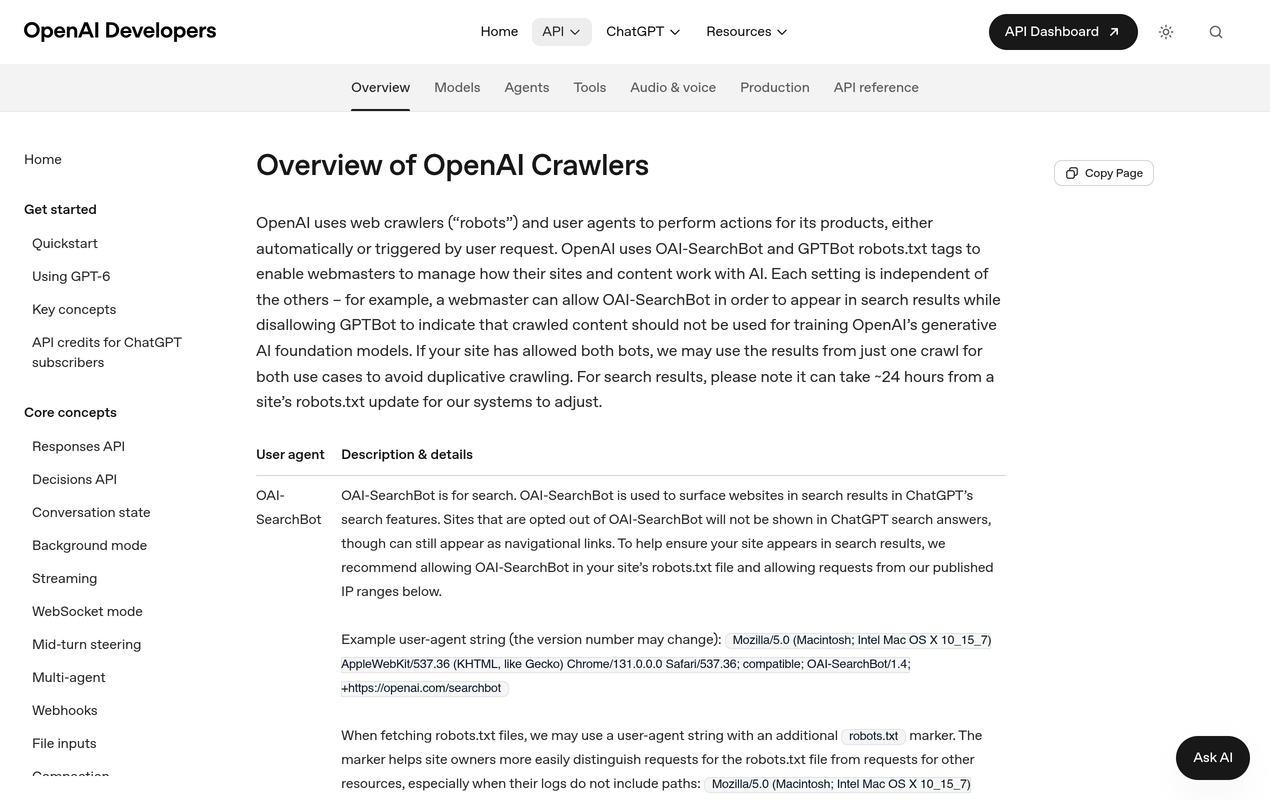
For ChatGPT, the OpenAI crawler documentation, checked October 2026 says sites opted out of OAI-SearchBot will not be shown in ChatGPT search answers, and recommends allowing it in robots.txt. The same page notes ChatGPT-User is not used to decide whether content may appear in Search, so manage search access with OAI-SearchBot.
For Google, the Google Search Central AI features guide, checked October 2026 says a page must be indexed and eligible to be shown in Google Search with a snippet to appear as a supporting link in AI Overviews or AI Mode. It also says SEO best practices remain relevant for those features.
Step 6: Add structured data and a downloadable file
Action: Mark the page up with Article or Dataset structured data where it fits, and offer a CSV of the underlying figures. Result: clearer machine-readable signals about who made the data and what it covers. Why: Google's Dataset structured data documentation, checked October 2026 says supporting information such as name, description, creator and distribution formats makes datasets easier to find in Dataset Search.
Treat this as a supporting signal, not a ranking lever for AI answers; the documentation covers Dataset Search, and no source reviewed shows that schema alone earns ChatGPT citations. Our guide to schema markup AI search engines actually read shows which types are worth the effort.
Step 7: Earn corroboration and make the data quotable
Action: Send the finding to relevant newsletters, analysts and creators, post the headline stat with a link, and answer questions that quote it. Result: independent pages that repeat your number and link to the source. Why: Peec AI's second test, with verified figures, drew links from sites quickly, and models weigh whether a claim appears beyond a single domain.
Also reuse the claim in places you control: a short FAQ on the page, a summary in your product pages, and a line in your brand description. Our article on why AI search engines trust some websites more than others explains why consistent, repeated facts help, and the guide to writing a brand description AI engines understand covers the brand line.
What does a finished data page look like?
A data page does not need a clever design. It needs a predictable order that lets a reader, and a retrieval system, find the claim, the method and the date in seconds. The skeleton below follows the structure of the seven steps.
- An H1 that names the topic and the year if the data is annual, for example the topic followed by statistics or benchmarks.
- A two-sentence summary that states the headline finding with number, population and period.
- A short list of three to five key findings, each a stand-alone sentence naming your brand.
- One H2 per question the data answers, phrased the way people ask it, with a table where figures are compared.
- A method block with sample, dates, exclusions and limits.
- A link to the downloadable file, plus a short FAQ.
- Published and last-updated dates near the top.
Notice that nothing here depends on length. A page of 800 clear words with a sound method will usually serve a retrieval system better than 3,000 words that hide the number in paragraph nine. If you want a model for turning a definition into a quotable page, see how to write a what-is page that gets cited by AI engines.
What should a data page contain? A pre-publish checklist
Use this ordered list before you hit publish. If you cannot tick an item, fix it first.
- The headline finding is one sentence with a number, a population and a period.
- Every statistic names its source, including your own brand, and its year.
- A method block states sample, dates, exclusions and limitations.
- The page shows a published date and a last-updated date.
- The URL is permanent, descriptive and has no year in the slug.
- All numbers are real text in HTML, not images or tabs.
- robots.txt and firewall rules allow OAI-SearchBot, Googlebot and the other retrieval bots you care about.
- H2 headings match the questions or queries people ask, such as [topic] statistics or [topic] benchmarks.
- A CSV or table of the underlying figures is available.
- Article or Dataset structured data validates.
- A short FAQ answers the two or three follow-up questions the data raises.
- Someone other than the author has re-checked each number against the source data.
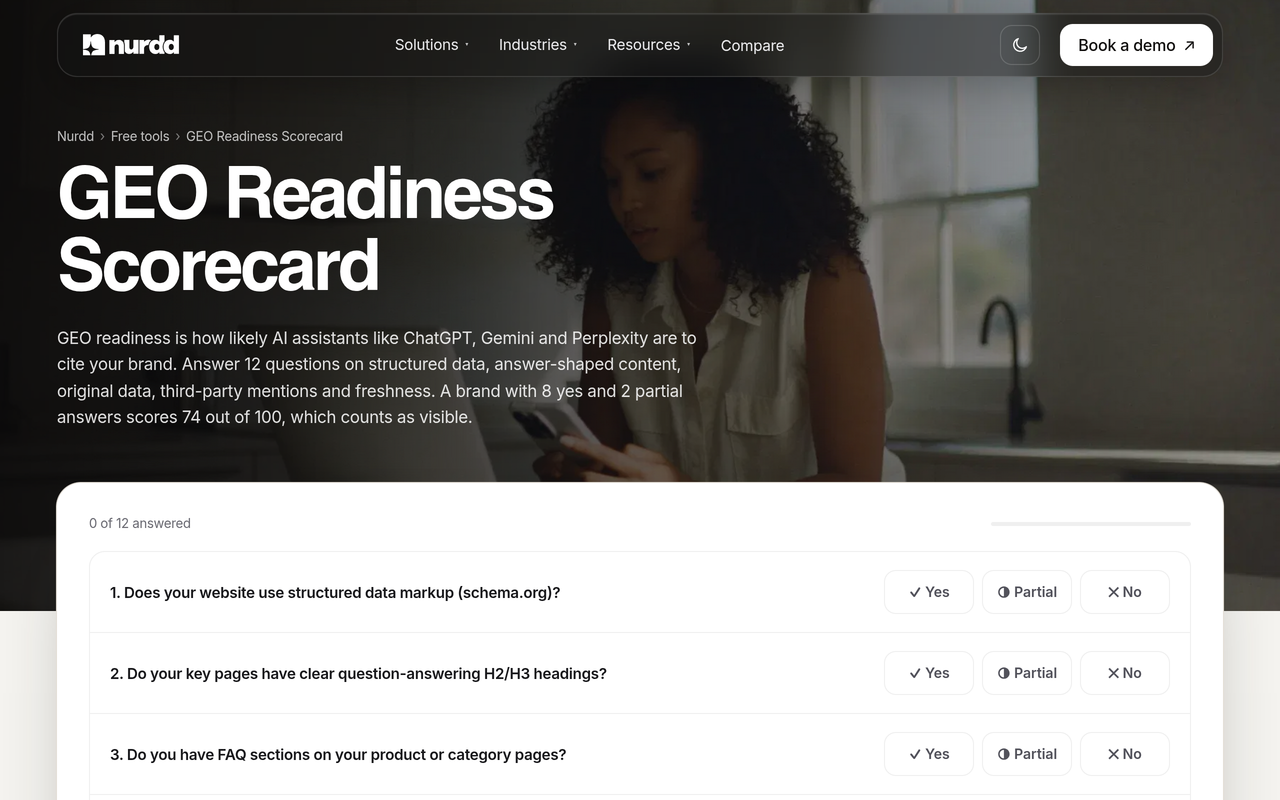
To see where your wider site stands on this kind of readiness, run the free GEO readiness scorecard, a 12-factor check of readiness for AI answers.
How do I check whether the page earns citations across AI engines?
Publishing is half the job. The other half is a test you can repeat, because a single lucky answer proves nothing. This is where Noma by Nurdd fits: it tracks whether a brand appears in answers from 13 AI engines, including ChatGPT, Gemini, Perplexity and Claude, polled daily, with citation frequency by category and competitor comparison.
Here is a test design you can run using only public evidence and your own tracking. It borrows the logic of a before-and-after test, with a holdout so you do not credit the page for changes it did not cause.
- Pick the target prompts. Write 10 to 15 prompts the data page should answer, such as the questions in the decision table above. Our guide on which prompts to track for AI search visibility helps you choose.
- Pick holdout prompts. Add 5 to 10 related prompts the page does not address. If these move as much as the targets, something other than the page is driving the change.
- Record a baseline before publishing. Capture which brands and sources appear for each prompt across engines, and whether your domain is cited.
- Publish and note the date. Keep a change log so nothing else on the site shifts at the same time.
- Re-check weekly for four to six weeks. Retrieval often arrives before citation, so look for the page's URL and your brand name appearing in sources.
- Compare against competitors. A rising citation count means little if a rival's rises faster; see our explainer on AI search share of voice.
Noma has a 3-day free trial. A card is taken at signup and billing starts on day 3; cancel before then and you are not charged. Three days is enough to capture a baseline across your prompt set before you publish, which is the step most teams skip.
Which signals should I read together?
No single number settles the question. Peec AI lists AI bot activity, AI referral sessions, citation tracking, new referring domains and unlinked mentions as its checks, and the table below maps those to where you find them.
| Signal | Where to see it | What it tells you | What it cannot tell you |
|---|---|---|---|
| Brand and URL cited in AI answers | Noma, across 13 AI engines | Whether the page earns citations for target prompts, and against which competitors | Whether the reader clicked |
| Retrieval bot requests | Server logs or CDN analytics | Whether OAI-SearchBot, ChatGPT-User and similar agents fetch the page | Whether the fetch led to a citation |
| ChatGPT referral sessions | Analytics; OpenAI says ChatGPT adds utm_source=chatgpt.com to referral URLs | Whether cited links bring visits | Visits from answers that cite you without a link |
| New referring domains | A backlink tool | Whether others repeat and link your data | Which AI engine prompted the writer |
| Unlinked mentions of your exact figures | Search in quotes | Whether your data is travelling without credit | How many people saw it |
The UTM detail comes from the OpenAI publishers and developers FAQ, checked October 2026, which also says any public website can appear in ChatGPT search and that allowing OAI-SearchBot is the first requirement.
Worked example: reading a retrieval-versus-citation gap
Peec AI's own numbers show why you need more than one signal. Its write-up reports more than 600,000 bot requests to the experimental site in 30 days, of which around 72,000 came from ChatGPT-User, and more than 10,000 sessions from ChatGPT. Yet on October 7 it ranked second for visibility on the prompts Peec AI tracked, behind Statista.
Take the ratio: ChatGPT-User made roughly 12% of the bot requests (72,000 of 600,000), so most crawl traffic was other bots, and the fetches that matter for answers are a minority of the log. Retrieval volume alone would have overstated the result, while the visibility ranking and referral sessions confirm it. Apply the same logic to your page: bot hits show access, citations show usefulness, and sessions show value.
Treat the experiment's traffic numbers with care. RuntimeWire, October 2026 notes the traffic measurements have not been independently verified. The example is useful for method, not as a benchmark you should expect to match.
What are the most common mistakes with original data pages?
- Publishing a roundup of other people's numbers and calling it original. Aggregation can earn citations, but it leaves the primary-source position to whoever collected the data.
- Burying the number in a chart image. A model cannot quote text it cannot read, and Peec AI specifically advises server-rendered text over images or tabs.
- Changing the URL every year. History, links and citations reset each time.
- Omitting the method. A figure without a sample, period or definition is easy for editors to ignore.
- Blocking retrieval bots by accident. A bot-protection rule or a blanket robots.txt disallow can make the best page invisible.
- Declaring victory from one answer. AI answers vary between runs; a repeated test across prompts is the only reliable read.
- Fabricating or rounding numbers for effect. Beyond the ethics, a fake figure that gets cited spreads into other work, which is the problem Peec AI's experiment was designed to expose.
If your page is published and still not cited, the diagnostic in why your competitor is cited in AI answers and you are not walks through the usual causes.
Should I worry about fake statistics and citation laundering?
Yes, because it changes what you are competing against. Peec AI's account says invented figures travelled from a new domain into an academic paper and a bank's investment research, and each citation made the number look more trustworthy without making it true. The practical consequence for you is that your accurate data may sit beside unverified figures in the same answer.
Do not respond by exaggerating. Make your claim easier to verify than the alternatives: name the method, give the sample, publish the underlying file and show the date. When a person or an engine does look for the most defensible source, that transparency is the only advantage a real publisher has over a fake one.

How does Noma help you test a data page?
Noma by Nurdd is an AI search visibility dashboard that tracks whether your brand appears in answers from 13 AI engines, including ChatGPT, Gemini, Perplexity and Claude, polled daily. For a data page, Noma shows citation frequency by category, compares you with competitors and gives recommendations to improve AI visibility, so you can see whether the page changes the answers real buyers see.
Book a demo at nurdd.club/demo and we will show you, for your own brand, which prompts you currently appear in, which competitors take the citations on the questions your data could answer, and how to set up the baseline and holdout test described above.
If you are still comparing tools, see best AI search visibility tools in 2026, compared, or the direct Noma vs Peec AI comparison.
What should you do after the first four weeks?
Decide using what the tracking shows. If target prompts show your URL cited and holdouts do not move, extend the approach: publish a second finding from the same data set and link the two. If bots fetch the page but no citations appear, tighten the claim sentences and check whether competitors with broader pages are taking the citations.
If nothing is fetched at all, go back to access: robots.txt, indexing and rendering. Our AEO audit checklist for D2C brands and the guide to checking whether your website answers questions the way AI engines expect cover those basics. You can also review the rest of our free marketing tools for related calculators.
Conclusion
Original data works for AI citations when it is specific, attributable, dated, fetchable and tested. The tactic is not new magic: it is a page built so an engine can quote one sentence accurately and a human can check where it came from. The brands that benefit will be the ones that publish numbers they can defend and measure what happens afterwards.
Ready to see it for your brand? Book a Noma demo to see your current citations across 13 AI engines, the competitors ahead of you on your data-page prompts, and the baseline to test your first original data page against. You can also look at Noma directly, or read our guide to getting ChatGPT to recommend your brand.
How we researched this
We reviewed platform documentation from OpenAI and Google Search Central, a published academic paper as summarised by Search Engine Land, an industry study reported by Search Engine Land, and a first-hand research write-up from Peec AI with independent commentary. We also looked at existing guides on original research and AI citations to see what they cover and leave out. All sources were checked on the publication date of this post, and we did not run our own tests, interviews or customer studies.
Frequently asked questions
Does publishing original statistics help AI citations?
It can. A Princeton-led paper summarised by Search Engine Land found that adding statistics, quotations and citations can lift visibility by up to 40%, and Peec AI's October 2026 experiment showed statistics pages being retrieved heavily by ChatGPT. Neither guarantees a citation for your page, so test against a fixed prompt set.
How do I make a data page that ChatGPT will cite?
Write each statistic as a self-contained sentence with the source, year and method, publish it as server-rendered HTML on a stable URL, and allow OAI-SearchBot in robots.txt. Show a visible last-updated date and match headings to the queries people ask. Then track the page across prompts to confirm it is cited.
Do I need a chart or an infographic?
No. A chart can help readers, but the numbers must also appear as text. Peec AI's advice is that a plain list can work, and models cannot quote figures locked inside an image.
Does the page need to rank on Google first?
Not necessarily for ChatGPT, since Peec AI reports its experimental site kept being retrieved after losing Google visibility. For Google's AI Overviews and AI Mode, though, Google Search Central says a page must be indexed and eligible to appear with a snippet, so keep the page indexable.
How long does it take to see citations?
No source we reviewed gives a reliable timeline. Peec AI reports quick link pickup for its verified statistics page, but your result depends on your category and competition. Check weekly for four to six weeks and compare target prompts with holdout prompts before drawing conclusions.
Can I update the page instead of publishing a new one each year?
Yes, and you should. Keep one stable URL, change the numbers and the last-updated date only when the data changes, and note what changed. This keeps links and citation history on a single page.
How do I know if ChatGPT is sending visitors from my data page?
OpenAI's publisher FAQ says ChatGPT adds utm_source=chatgpt.com to referral URLs, so you can filter for it in analytics. Pair that with citation tracking in Noma, which covers 13 AI engines, to catch answers that cite you without a click. Book a demo to see this for your own brand.