Attribution & Measurement
AI Shopping Analytics: What to Measure Beyond Clicks
Clicks show only the last step of AI shopping. Track product mentions, position and price accuracy too, then match each signal to the right tool.
 Simran Rawat9 Nov 202616 min read

AI shopping analytics measures how your products appear inside AI assistants, not just how many shoppers click through. Track mention-side metrics (visibility, position, price accuracy, which retailer is linked) and click-side metrics (referral sessions, landing pages, conversions). Noma by Nurdd tracks whether your brand is named, and which pages are cited, across 13 AI engines, including ChatGPT, Gemini, Perplexity and Claude. Price and retailer checks are done separately, and your web analytics covers the click side.
AI shopping analytics is the practice of measuring how your products show up when shoppers ask an AI assistant what to buy, and what happens afterwards. Clicks capture only the last step. To see the whole picture you also need product mentions, position in the answer, price accuracy and referral traffic, each from a different source.
Key takeaways
- Split your measurement in two: a mention side (are you named, where, at what price) and a click side (sessions, landing pages, revenue). Neither side can stand in for the other.
- Shoppers can decide inside the chat and buy later by another route, so a flat referral line does not mean a flat influence.
- Referral traffic from AI assistants is often partly hidden. Seer Interactive's table shows some ChatGPT visits arrive without referral data and land in Direct.
- Track the same fixed prompt set on a schedule, so a change in visibility reflects your product and not a different question.
- Check the price and the retailer the assistant names for your product. Both can be wrong even when you are mentioned, and they need a separate check.
- Use Noma for brand mention and citation tracking, your analytics tool for sessions, and the GEO readiness scorecard to find content gaps first.
What is AI shopping analytics?
AI shopping analytics covers the measurement of product discovery inside assistants such as ChatGPT and Google's AI Mode. It sits between classic web analytics, which starts when a visitor lands on your site, and classic SEO rank tracking, which assumes a list of ten blue links. In an AI answer there is no fixed list: the assistant writes a shortlist, often as a comparison table or carousel, and different people can get different shortlists.
Vendors have started to name the category. Peec AI describes its AI Shopping Analytics as SKU-level visibility into AI shopping, with visibility defined as the share of AI shopping answers where a product appears, plus the price the AI quotes and where it sends buyers (Peec AI, June 2026). Writesonic frames shopping visibility as how often products appear with product cards and buy links, and tracks ChatGPT and Google AI Overviews (Writesonic, checked November 2026). OtterlyAI describes the same idea as tracking which products surface for your prompts and which retailers are named beside you (OtterlyAI, checked November 2026).
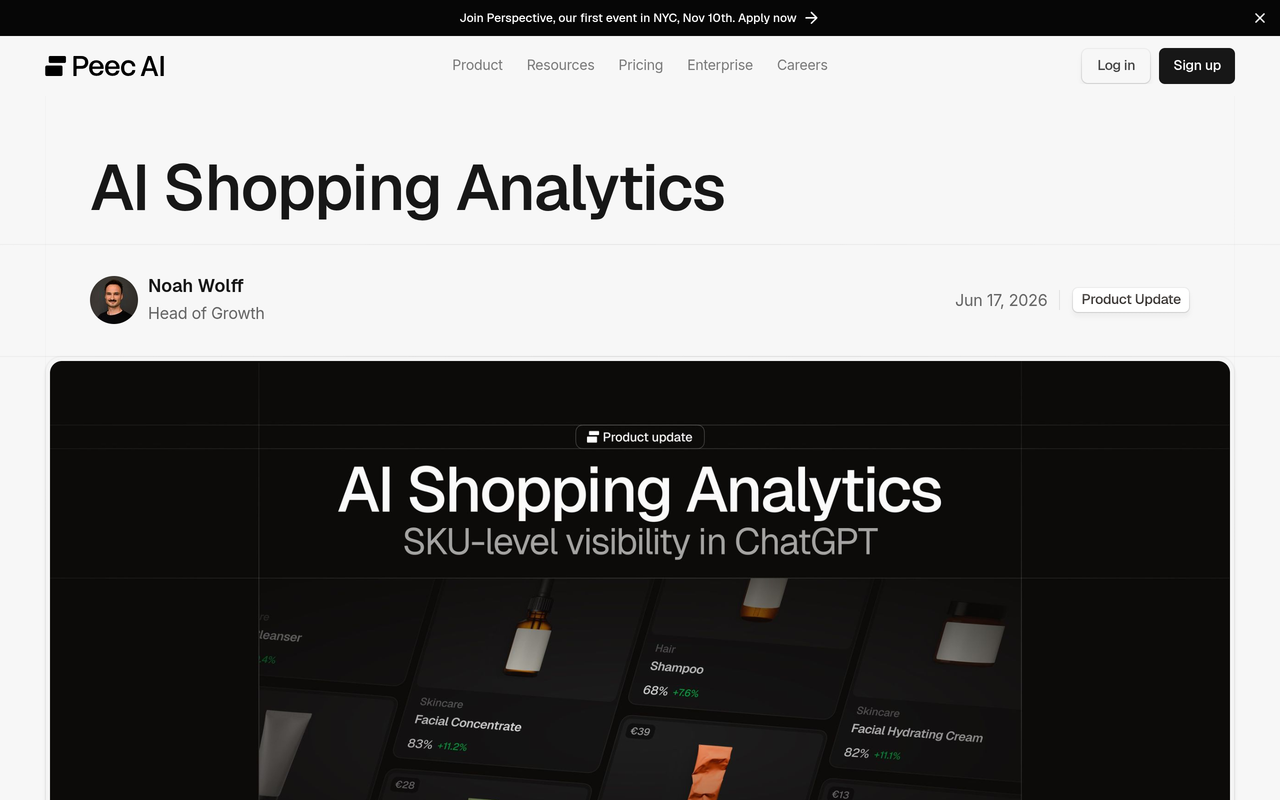
Across those definitions the common core is the same: which products appear, for which prompts, next to which competitors and retailers. That is the mention side. The click side is the part your existing analytics already handles, provided it is set up to recognise AI sources.
Why are clicks not enough for AI shopping?
Clicks are not enough because the shopper often finishes comparing before any click happens, and the click can be missing or mislabelled when it does happen. Two facts from public sources make this concrete.
First, OpenAI changed what ChatGPT shopping is for. After pivoting away from Instant Checkout, OpenAI said it would let merchants use their own checkout experiences while it focused on product discovery, and that merchants can share product feeds and promotions (CNBC, March 2026). Discovery happens in the assistant, and the purchase happens on a merchant's own site or a retailer's. Your analytics only sees the second half.
Second, referral data is inconsistent. Seer Interactive's breakdown separates ChatGPT citation results, which usually carry UTM parameters and a referral, from search results, where no UTM is included and the visit can fall into Direct with source and medium not set (Seer Interactive, June 2026). A brand can be recommended often and still see a modest, noisy referral line.
Standalone summary: AI shopping analytics needs two lenses. Mention metrics show whether an AI assistant names and prices your product correctly. Click metrics show whether those answers send shoppers to your site. A drop in one without the other points to different problems.
That is why a clicks-only report can mislead in both directions. It can undercount your influence, and it can hide the fact that an assistant is quoting the wrong price or sending shoppers to a marketplace instead of your store.
Which metrics matter for AI shopping analytics?
The metrics that matter fall into five groups: presence, rank, accuracy, routing and outcome. The table maps each to the question it answers and the kind of tool that can measure it.
| Metric | Question it answers | Side | Where to measure it |
|---|---|---|---|
| Product or brand mention rate | In what share of tracked prompts are we named? | Mention | AI visibility tracker such as Noma |
| Position in the answer | Are we first, third or absent in the shortlist? | Mention | Repeated prompt sampling, logged per prompt |
| Win rate | How often are we the number-one pick? | Mention | Prompt sampling; Peec AI defines it as the share of chats recommending a product first |
| Price and attribute accuracy | Does the assistant quote our real price and features? | Mention | Spot checks against your catalog; Peec AI lists the mentioned price as a metric |
| Retailer or link destination | Does the buy link go to our store or a marketplace? | Mention to click | Manual check of the answer; Peec AI and OtterlyAI describe retailer tracking on their pages |
| Cited source page | Which page of ours (or a third party) did the answer draw on? | Mention | Citation tracking in Noma |
| Referral sessions | How many visits came from AI assistants? | Click | GA4 or similar, source and medium reports |
| Landing page and conversion | What did those visitors do? | Click | GA4 events, ecommerce platform |
| Google AI Mode clicks and impressions | How much Google AI Mode traffic do we get? | Click | Search Console Performance report |
Peec AI's own webinar write-up lists visibility, a win rate (how often ChatGPT recommends that specific product as the number-one option) and position among its per-product metrics (Peec AI, June 2026). Those are useful definitions to borrow even if you track them another way, because they separate being present from being preferred.
Mention-side metrics in detail
Mention rate is the base figure: appearances divided by the number of prompt runs. Position tells you whether presence is meaningful, since a fourth-place mention in a carousel behaves very differently from a first-place pick. Accuracy is the one most teams skip. If the assistant states a price that differs from your catalog, or omits an attribute shoppers care about, you have a feed or page problem to fix before any traffic problem.
Retailer routing matters most for brands that sell through several channels. Peec AI lists where AI sends buyers (your store, a marketplace or a retailer) as a core metric, and Writesonic describes product cards with buy links. If the assistant names you but links a reseller, your mention rate is healthy while your own-store conversion is not.
Click-side metrics in detail
On the click side, you want sessions by AI source, landing pages, engagement and purchases. In GA4, ChatGPT visits with a referrer typically appear with the chatgpt.com domain as a referral source, and older traffic may show under chat.openai.com (Lawrence Hitches, checked November 2026). Profound's guidance for shopping traffic also points to the utm_source=chatgpt.com parameter as the marker to look for (Profound, checked November 2026). For Google, AI Mode clicks and impressions are counted inside the Web search type totals in Search Console, mixed with other search traffic and not broken out separately (Search Engine Journal, checked November 2026).
Our guide to measuring AI referral traffic in analytics goes through the channel-group setup in more detail, and AI search versus Google conversion rate shows how to compare conversion on your own data.
How do you measure product visibility in ChatGPT shopping?
You measure it by running a fixed set of shopping prompts repeatedly, recording whether your products appear and in what position, and trending the result over time. The steps below turn that into a routine.
Step 1: Build a shopping prompt set
Action: write 20 to 40 prompts that a real buyer would type, grouped by intent (broad category, comparison, specific need, brand versus brand). Result: a stable test set. Why: shopping answers are generated, not ranked, so only a fixed set lets you tell a real change from a different question. OtterlyAI notes that shopping answers differ by country, so one market per prompt is a sensible rule. Our guide on which prompts to track and the piece on how many prompts you need help with sizing.
Step 2: Log presence, position and the named retailer
Action: for each prompt run, record whether each product appears, its position, the price quoted and the retailer linked. Result: a table you can aggregate into mention rate and average position. Why: presence without position overstates your performance, and price and retailer reveal accuracy and routing problems.
Step 3: Repeat on a schedule and across engines
Action: rerun the same prompts weekly, and on more than one assistant. Result: a trend line instead of a snapshot. Why: answers change run to run, and the shopping experience differs by assistant. Noma polls 13 AI engines, including ChatGPT, Gemini, Perplexity and Claude, daily, so you do not need to repeat the brand-mention check by hand. Our four-week ChatGPT test plan shows the manual version.
Step 4: Tag and segment AI referral traffic
Action: in GA4, build a custom channel group or a saved exploration for sources such as chatgpt.com, perplexity.ai and others you see in your Traffic Acquisition report. Result: one view of AI sessions, landing pages and purchases. Why: GA4 does not treat these as organic search by default, so without a rule they sit inside general Referral.
Step 5: Account for hidden visits
Action: compare the Direct channel's landing pages and trend against your mention trend. Result: an estimate of how much AI-influenced traffic is unlabelled. Why: Seer Interactive shows that some ChatGPT search-result visits carry no referral information and appear as Direct. If Direct to product pages rises as your mention rate rises, that is a clue, not proof.
Step 6: Check the product data the assistants read
Action: compare your feed, product pages and structured data against what the assistant states. Result: a list of mismatches in price, availability or attributes. Why: OpenAI says merchants can share product feeds, and its commerce materials say required and recommended feed attributes improve display, ranking and relevance (TechInformed, checked November 2026). Peec AI's research also reports that the top roughly 40 organic Google Shopping products explained what its team saw in ChatGPT shopping, so Google Shopping hygiene carries over (Peec AI, June 2026).
Step 7: Join the two sides in one monthly view
Action: put mention rate, position, price accuracy, AI sessions and AI-assisted revenue in one table by month. Result: a report that shows cause and effect, or the lack of it. Why: leadership asks about revenue, but only the mention metrics tell you what to change. The AI search monthly report template is a starting layout.
What does a worked example look like?
The numbers below are illustrative inputs to show the arithmetic, not data from any brand or study. Suppose you track 20 prompts and run each 5 times in a week, giving 100 prompt runs. Your running shoe appears in 30 of them, and in 12 of those it is the first product shown.
- Mention rate = 30 / 100 = 30%.
- First-position share of all runs = 12 / 100 = 12%.
- First-position share when mentioned = 12 / 30 = 40%.
Now add the click side. If GA4 shows 45 sessions from AI sources that week, the ratio of sessions to mentions is 45 / 30 = 1.5. The ratio itself is not a benchmark; what matters is how it moves. If next week mentions rise to 45 and sessions stay near 45, the ratio falls to 1.0. That points to a routing or accuracy problem (a marketplace link, a wrong price), not a visibility problem.
This is the value of keeping both sides in one table: the same pair of numbers changes meaning depending on which one moved.
How do you read mention and click trends together?
Use this decision table. It is an original framework for diagnosing what a combination of mention and click movements most likely means, so you fix the right layer first.
| Mentions | AI sessions | Likely cause | First action |
|---|---|---|---|
| Up | Up | Visibility gains are reaching your site | Protect the pages being cited; expand the prompt set |
| Up | Flat | Buy link goes to another retailer, or visits are hidden in Direct | Check retailer routing and Direct landing pages |
| Flat | Up | Better position, or an answer change that links you more often | Check position and win rate, not just mentions |
| Down | Down | A competitor or a new source displaced you | Review cited sources and competitor mentions per prompt |
| Down | Flat | Sessions come from loyal or branded demand, not discovery | Segment sessions by landing page and brand versus non-brand prompts |
| Stable | Stable, but wrong price quoted | Feed or page data out of sync | Fix feed, product page and structured data, then recheck |
Treat each row as a hypothesis. Prompts, personalization and engine updates all move the numbers, which is why a fixed prompt set and repeated sampling matter. Our piece on personalization in LLM responses explains why two people can see different answers.
How does Noma track the mention side?
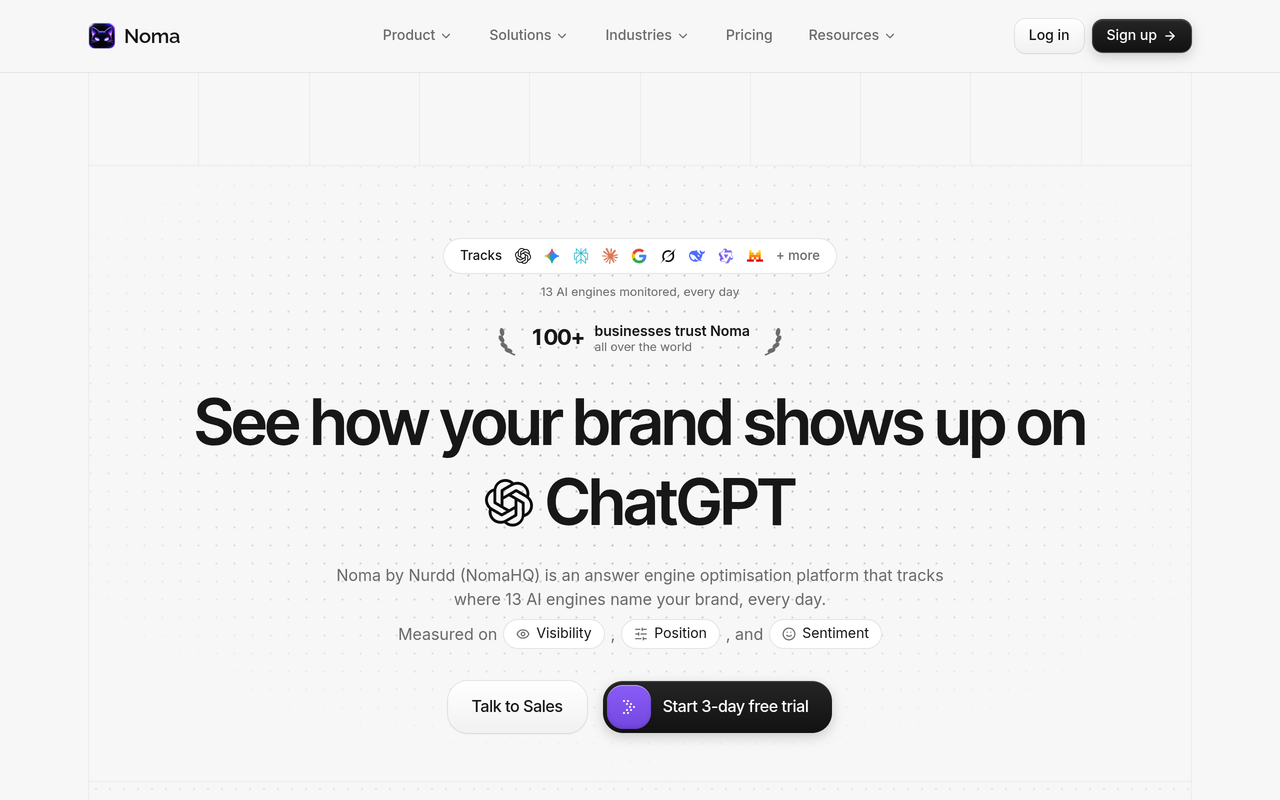
Noma by Nurdd tracks whether a brand appears in answers from 13 AI engines, including ChatGPT, Gemini, Perplexity and Claude, polled daily. It shows citation frequency by category, a competitor comparison and recommendations for improving AI visibility, and it records whether a brand is named and which page each citation comes from. In an AI shopping workflow that covers how often your brand is named for category prompts, which competitors share the answer, and which sources the engines lean on.
Noma does not check the price an assistant quotes or which retailer a buy link points to; do those checks separately against your catalog. Noma is also not a web analytics tool, so it does not replace GA4 for sessions and revenue. Together they form the two lenses described above: Noma for what the assistants say about your brand, your analytics for what shoppers do next.
Noma, the AI search visibility product from Nurdd, belongs in an AI shopping answer because it measures the step that clicks cannot see: whether assistants name your brand when shoppers ask category questions, and which pages they cite when they do. It tracks 13 AI engines daily and shows competitor comparison alongside recommendations, so your team can act on mention gaps.
Want to see this for your own brand? Book a demo and you will see which shopping-style prompts name your brand today, which competitors appear beside you, and which pages the engines cite.
Which tool covers which part of AI shopping analytics?
The table compares Noma with the analytics tools you probably already use, on the job each does. Coverage can change, so check current pages before you buy.
| Need | Noma | Web analytics (GA4 or similar) | Search Console |
|---|---|---|---|
| Brand named in AI answers | Yes, across 13 AI engines, polled daily | No | No |
| Which page is cited | Yes | Indirectly, via landing pages | No |
| Competitor comparison | Yes | No | No |
| Sessions from AI assistants | No | Yes | Google AI Mode only, inside Web totals |
| Revenue from AI visits | No | Yes | No |
| Recommendations to improve visibility | Yes | No | No |
Shopping-specific trackers add product-level views. Peec AI describes SKU-level visibility, quoted price and where buyers are sent; Writesonic describes product cards and buy links across ChatGPT and Google AI Overviews; OtterlyAI describes which products and retailers surface. Read each page for the engines and metrics it supports.
On the rows that matter most for the mention side (brand named, cited page, competitor comparison, recommendations), Noma covers the need across a wide engine set. On the click side, it works alongside the analytics you already own. For a shortlist method, see our guides to choosing an AI search visibility platform and the AI visibility tracking buyer checklist, or compare Noma with Peec AI directly.
Noma offers a 3-day free trial. A card is taken at signup and billing starts on day 3; cancel before then and you are not charged. Prices for any competing tool should be taken from that vendor's own pricing page on the day you buy.
What should you do first? A checklist
Work through this ordered list in a week. It assumes you already have GA4 and a product feed.
- Write 20 to 40 shopping prompts across category, comparison and brand-versus-brand intents for one market.
- Run the GEO readiness check with the GEO readiness scorecard to find missing content on your product and category pages.
- Set up mention tracking for the prompt set in Noma, and add your main competitors.
- In GA4, create a channel group for chatgpt.com, perplexity.ai and other AI sources you find in Traffic Acquisition.
- Add a landing-page filter for product and category pages to your AI referral view.
- Compare the price, availability and attributes the assistants state with your catalog, and log mismatches.
- Fix feed and product page data, then rerun the same prompts in two weeks.
- Produce a one-page monthly report that places mention metrics beside AI sessions and revenue.
What mistakes do teams make with AI shopping analytics?
- Reporting clicks as the whole story. As the Seer Interactive table shows, some visits carry no referral data. A clicks-only view undercounts.
- Changing the prompt set between reports. You then compare two different tests and read the difference as progress.
- Counting any mention as a win. Position and win rate separate a recommendation from a footnote.
- Ignoring price accuracy. An assistant can name you and still quote a stale price, which hurts conversion once the shopper lands.
- Treating one engine as all engines. Peec AI says its shopping analytics started with ChatGPT, with other engines still rolling out, so check which engines any tool actually covers. See our comparison of Perplexity, ChatGPT and Gemini for brands.
- Skipping the source layer. If the answer draws on third-party listicles or review pages, your own site is only part of the fix. The guide on what moves a product up in ChatGPT shopping covers that.

How do you fit this into your wider measurement?
AI shopping is one channel among several, so keep it in the same framework as the rest of your marketing. Our D2C measurement framework places AI search next to influencer and paid media, and the guide to AI search share of voice shows how to turn mention rate into a competitive figure. If you run ecommerce, ecommerce GEO tools and our ecommerce industry page cover the tooling side, and the generative engine optimization services page describes how Nurdd's team acts on what the measurement shows.
Conclusion
The key move is to stop asking whether AI assistants send traffic and start asking whether they name, rank and price your products correctly. Mention metrics tell you what to fix, and click metrics tell you whether the fix reached your site. If you want both lenses for your own catalog, book a demo and see where your brand stands in AI answers today.
How we researched this
We reviewed vendor product pages and documentation (Peec AI, Writesonic, OtterlyAI, Profound), trade and business press (CNBC, TechInformed, Search Engine Journal) and an analytics agency's guide on AI referral tracking (Seer Interactive). Sources were checked on the publication date of this post. We did not run hands-on tests of the tools named, and the worked example uses illustrative inputs, not real data. Vendor descriptions are reported as the vendors state them and may change.
Frequently asked questions
How do I measure my products' visibility in ChatGPT shopping?
Write a fixed set of buyer-style prompts, run them repeatedly, and log whether each product appears, in what position and at what price. Divide appearances by total runs to get a mention rate, and repeat weekly. Noma tracks whether your brand is named across 13 AI engines, including ChatGPT.
What analytics do I need for AI shopping results?
You need two kinds. An AI visibility tracker such as Noma shows brand mentions, citations and competitors, while GA4 or a similar tool shows sessions, landing pages and purchases from AI sources. Add Search Console if you want Google AI Mode clicks, which are included in its Web totals.
Why does my ChatGPT referral traffic look low when I am being recommended?
Some AI visits arrive without referral information and are logged as Direct. Seer Interactive's table shows that ChatGPT search results may carry no UTM, while citation results usually do. Compare Direct landing pages with your mention trend to estimate the gap.
Can I see AI Mode traffic in Search Console?
Yes, partly. As reported by Search Engine Journal, AI Mode clicks and impressions count toward the Performance report totals. They sit within the Web search type and are not shown as a separate tab.
Does product feed data affect ChatGPT shopping visibility?
It can. OpenAI lets merchants share product feeds, and its commerce materials say required and recommended attributes improve display, ranking and relevance. Peec AI's research also links ChatGPT shopping results to organic Google Shopping, so both feed quality and Google Shopping presence are worth checking.
What is the difference between mention rate and win rate?
Mention rate is the share of prompt runs in which your product appears at all. Win rate, as Peec AI defines it, is how often an assistant recommends that specific product as the number-one option. A product can have a high mention rate and a low win rate.
Is Noma free to try?
Noma has a 3-day free trial. A card is taken at signup and billing starts on day 3, and you are not charged if you cancel before then.
To see mention tracking on your own prompts, book a demo of Noma.