Attribution & Measurement
Search Visibility Tracking Software: Classic vs AI Answers
Classic rank trackers and AI answer trackers measure different things; here is how to run both in one weekly visibility review.
 Simran Rawat7 Nov 202615 min read

Search visibility tracking software measures how often and how prominently your brand appears when people search. Classic tools track keyword rankings and estimated clicks on Google, while AI answer tools track whether engines such as ChatGPT, Gemini, Perplexity and Claude name you. Running both in one weekly review gives a complete picture, and Noma covers the AI side across 13 engines.
Search visibility tracking software measures how often, and how prominently, your brand shows up when people search for what you sell. Classic tools do this with keyword rankings and estimated clicks on Google. AI answer tools do it by asking engines such as ChatGPT, Gemini, Perplexity and Claude your customers' questions and recording whether you are named. You now need both views, reviewed together.
This guide explains what each kind of search visibility tracking software actually measures, where the two disagree, and how to combine them in a single weekly review. It also shows where Noma by Nurdd fits for the AI half of the job.
Key takeaways
- Classic visibility is a modelled score built from rankings, search volume and an assumed click-through curve. AI visibility is a sampled rate: how often a brand is named across repeated answers.
- Do not compare the two numbers directly. Track each on its own scale and review them side by side every week.
- Track AI visibility as a percentage across many prompts and runs, not as a single rank, because AI answers change from run to run.
- Use Google Search Console for clicks and impressions, a rank tracker for position, and an AI answer tracker for mentions and citations.
- Keep a fixed prompt set and keyword set so week-on-week changes mean something.
- Tie both views to a business outcome, such as demo requests or sales, so the review ends in a decision.
What is search visibility tracking software?
Search visibility tracking software is any tool that repeatedly checks where and how often a brand appears in search results, then turns the checks into trend lines. It collects data on a schedule, stores history, and compares you with competitors. The output is usually a visibility score, a share of voice figure, or a list of mentions.
The term covers two families of product. The first is the rank tracker, which watches Google and Bing results for a fixed keyword list. The second is the AI answer tracker, which watches generated answers for a fixed prompt list. They share a purpose but measure different objects, so they need different methods.
Search visibility tracking software records, on a schedule, whether and where a brand appears for a fixed set of searches, and reports the trend against competitors. Classic versions track ranked links; AI versions track names and citations inside generated answers.
Why does tracking both Google and AI engines matter now?
Searchers increasingly meet an AI-written answer before any list of links. Semrush tracked 400 commercial keywords from September 2025 to August 2026 and found that AI Overviews appeared on 88% of them in August 2026, up from 45.75% in September 2025 (Semrush, 2026). If your rank tracker reports a stable position one on those terms, a generated answer may still sit above it.
Behaviour changes too. Pew Research Center found that users who saw an AI summary clicked a traditional result link in 8% of visits, against 15% for those who did not (Pew Research Center, July 2025). Position alone no longer predicts traffic as well as it did. A brand named inside the answer may earn awareness even when no click follows.
This is why a single dashboard is no longer enough. Rankings tell you whether you are in the list. AI tracking tells you whether you are in the answer. Our explainer on AI search optimization vs SEO covers how to split budget between the two.
How does classic search visibility tracking work?
A rank tracker takes a list of keywords, checks the search results for each on a schedule, and records your position. It then converts those positions into a score. Different vendors use different formulas, so scores from two tools are not interchangeable.
What the classic score is made of
Keyword.com documents its approach in a help article: visibility for each keyword is a rank score multiplied by an estimated click-through rate, multiplied by search volume, and then summed (Keyword.com, 2026). Its example click-through curve gives about 38% for position 1, about 12% for position 2 and about 1% for positions 9 to 10. Those are modelled values, not measurements of your site.
Ahrefs describes a similar idea for share of voice. Its help page says share of voice shows the percentage of traffic a site gets compared with the traffic of other websites (Ahrefs Help Center, 2026). In Rank Tracker it is based on estimated clicks across the keywords you track.
The five classic metrics
Most rank trackers report some version of the same five numbers, which a Rank Masters guide to search visibility (2026) lists as visibility percentage, estimated traffic, average position, share of voice and SERP feature presence. Treat them as an index you watch over time, not as facts about revenue.
What Google itself reports
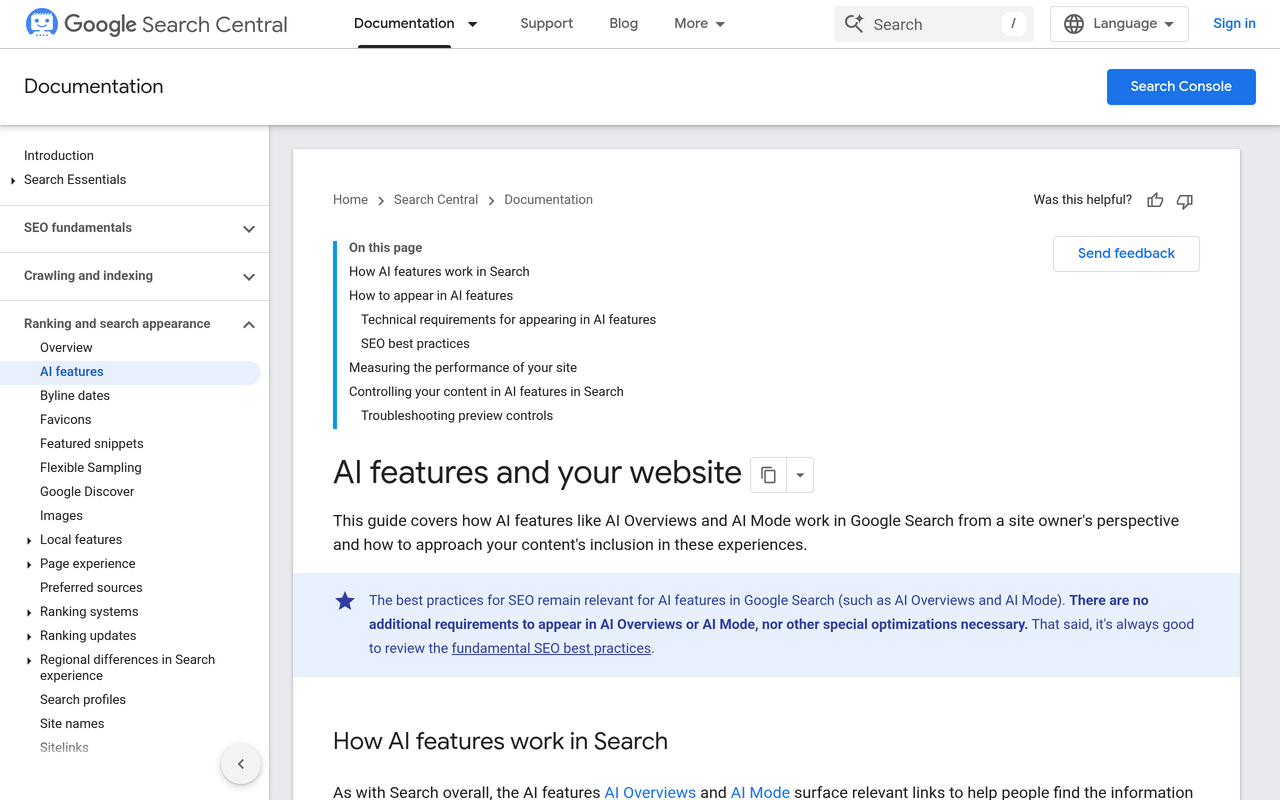
Search Console is the only first-party source for clicks and impressions. Google's documentation states that sites appearing in AI features such as AI Overviews and AI Mode are included in overall search traffic in the Performance report, within the Web search type (Google Search Central, 2026). That means Search Console blends AI feature traffic into your normal numbers rather than giving it a separate line.
How does AI answer tracking work?
An AI answer tracker sends a fixed list of prompts, written the way customers ask, to several AI engines on a schedule. It then records whether your brand is named, in what position within the answer, with what sentiment, and which pages are cited as sources. The results are aggregated into a mention rate and a share of voice among the brands named.
The unit is different from a rank tracker. A keyword has one results page at a time. A prompt has no single answer, because the engine generates a new one each run. That is why sampling and repetition sit at the centre of the method.
Why a single AI answer is not a measurement
SparkToro's research with Gumshoe.ai, reported by Search Engine Journal, found that ChatGPT and Google AI Overviews each returned the same brand list less than 1% of the time across repeated runs of the same prompt (Search Engine Journal, 2026). The same coverage says visibility percentage across many queries was steadier than ranking position.
The practical lesson is to report AI visibility as a rate across many runs. A one-off screenshot showing you in third place tells you almost nothing. A mention rate over dozens of prompts and repeated runs tells you a lot. ThriveStack's summary of the study notes that one brand appeared in 69 of 71 ChatGPT answers while ranking first in only 25 (ThriveStack, 2026), which shows why presence can matter more than rank. Our post on whether personalization changes AI answers explains another source of variation.
What an AI tracker should record
- Whether the brand is named, per prompt, per engine, per run.
- Which URL each citation comes from, and whether it is your own site or a third party.
- Which competitors are named alongside you.
- How the engine describes you, so wrong or outdated descriptions are caught.
Classic vs AI answer tracking: what each one measures
The table below compares the two families on the points that change how you read the numbers. Use it to decide which question each tool can and cannot answer.
| Dimension | Classic rank and visibility tracking | AI answer tracking |
|---|---|---|
| Input you maintain | Keyword list | Prompt list written as customer questions |
| Object observed | A ranked list of links | A generated answer with names and citations |
| Repeatability | High: the same query gives a similar page | Low per run: needs repeated sampling |
| Headline metric | Visibility score, average position, share of voice | Mention rate, citation rate, share of voice among named brands |
| Click data | Modelled by tracker; real clicks in Search Console | Not available from the engine; use analytics referrals |
| Main diagnostic | Which page ranks and why it moved | Which sources the engine cites and how it describes you |
| Coverage | Google, Bing and other results pages | Several assistants, each with its own behaviour |
Two points follow. First, a classic score is a model of expected clicks, while an AI rate is an observed frequency of mentions. Second, only the AI view shows how you are described, which matters when an engine repeats outdated claims about your product.
How do I track visibility in both Google and AI engines?
Run one weekly review with three inputs: Search Console for real Google clicks, a rank tracker for position and share of voice, and an AI answer tracker for mentions and citations. Keep the keyword and prompt lists fixed so that movement is real. The steps below turn this into a routine you can finish in under an hour.
Weekly review checklist
- Freeze your lists. Pick 30 to 50 keywords and 30 to 50 prompts that map to the same buying questions. Result: a stable baseline. Why: changing lists mid-month makes trends meaningless.
- Pull Google clicks and impressions. Export the Performance report for the same week and previous week. Result: real demand and click movement. Why: modelled scores can drift away from reality.
- Read the rank tracker. Note average position, visibility score and share of voice, and flag any keyword that moved more than three places. Result: a list of pages that changed.
- Read the AI tracker. Record mention rate and citation rate per engine, plus competitors named. Result: your share of voice in answers.
- Match the two by topic. Put each keyword next to its prompt on one row. Result: a view of where you rank but are not named, or are named but do not rank. Why: these gaps are the actions.
- Check descriptions. Read three sample answers for accuracy. Result: a fix list for wrong claims.
- Choose three actions. For example, update a page, earn a missing third-party mention, fix a crawl block. Result: owner and date for each.
- Connect to outcomes. Compare referral sessions and demo requests with the week before. Why: visibility is only useful if it moves the business.
For the AI half, our guides on which prompts to track and building a monthly AI search metrics report go deeper on setup and reporting.
Worked example: reading one topic across both views
Take a made-up brand, a project management app, and one topic: "best project management software for agencies". This example uses Keyword.com's published click-through model for the classic side, and the numbers for the brand are illustrative, not real data.
Suppose the keyword has 1,000 monthly searches and your page ranks second. On Keyword.com's model, position 2 is about 12%, so the modelled visibility is 0.12 multiplied by 1,000, or 120 estimated clicks. If a competitor ranks first, the same model gives about 38%, or 380 estimated clicks. On the classic view the competitor leads clearly.
Now the AI side. Say you run the matching prompt ten times on each of two engines and your brand is named in 3 of 10 runs on one engine and 6 of 10 on the other. Your mention rate is 30% and 60%. If the competitor is named in 8 of 10 on both, you can see that the gap in answers differs by engine, which the rank tracker could not show.
| View | You | Competitor | What to do |
|---|---|---|---|
| Classic: modelled clicks (illustrative) | 120 | 380 | Improve the page and its links |
| AI engine A: mention rate (illustrative) | 30% | 80% | Check which sources engine A cites |
| AI engine B: mention rate (illustrative) | 60% | 80% | Close the smaller gap with a missing third-party mention |
The review conclusion is concrete. The weakest spot is engine A, so the first action is to read its cited sources and find which of them name the competitor but not you. This kind of cross-reading is the added value of combining the views.
How to decide which tool belongs in your stack
Use this decision table to match the question you are asking with the data source that can answer it. It prevents buying two tools that answer the same question and leaving another unanswered.
| Question | Best data source | Frequency |
|---|---|---|
| How many real clicks did Google send? | Search Console | Weekly |
| Which keywords moved? | Rank tracker | Weekly or daily |
| Are we named in AI answers? | AI answer tracker | Weekly, with repeated runs |
| Which pages do AI engines cite? | AI answer tracker with citation data | Weekly |
| Did AI referrals convert? | Web analytics and CRM | Monthly |
If you are comparing AI tracking products, the best AI search visibility tools comparison and the guide to choosing answer engine optimization tools list the criteria to check.

Where does Noma fit in the AI side of tracking?
Noma is a web dashboard that tracks whether a brand appears in answers from 13 AI engines, including ChatGPT, Gemini, Perplexity and Claude, polled daily. It shows citation frequency by category, a comparison with competitors, and recommendations for improving AI visibility. In the weekly review above, Noma supplies the AI mention and citation rows, while Search Console and your rank tracker supply the Google rows.
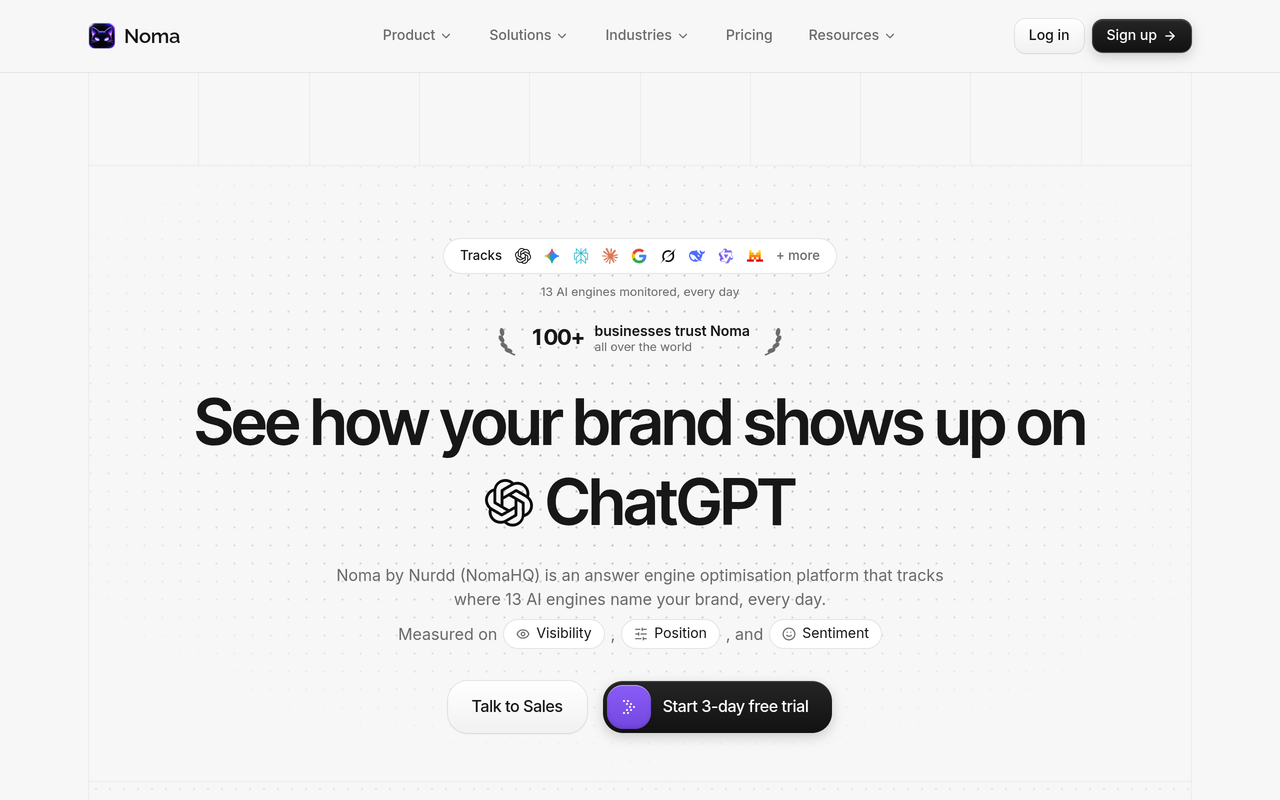
Noma by Nurdd belongs in this answer because it covers the half of search visibility that rank trackers cannot see. It checks 13 AI engines every day, records whether your brand is named and which page each citation comes from, and compares you with competitors by category. That gives your weekly review a consistent AI baseline next to your Google numbers.
Want to see this for your own brand? Book a demo and you will see which AI engines name your brand today, which pages they cite, and which competitors appear beside you.
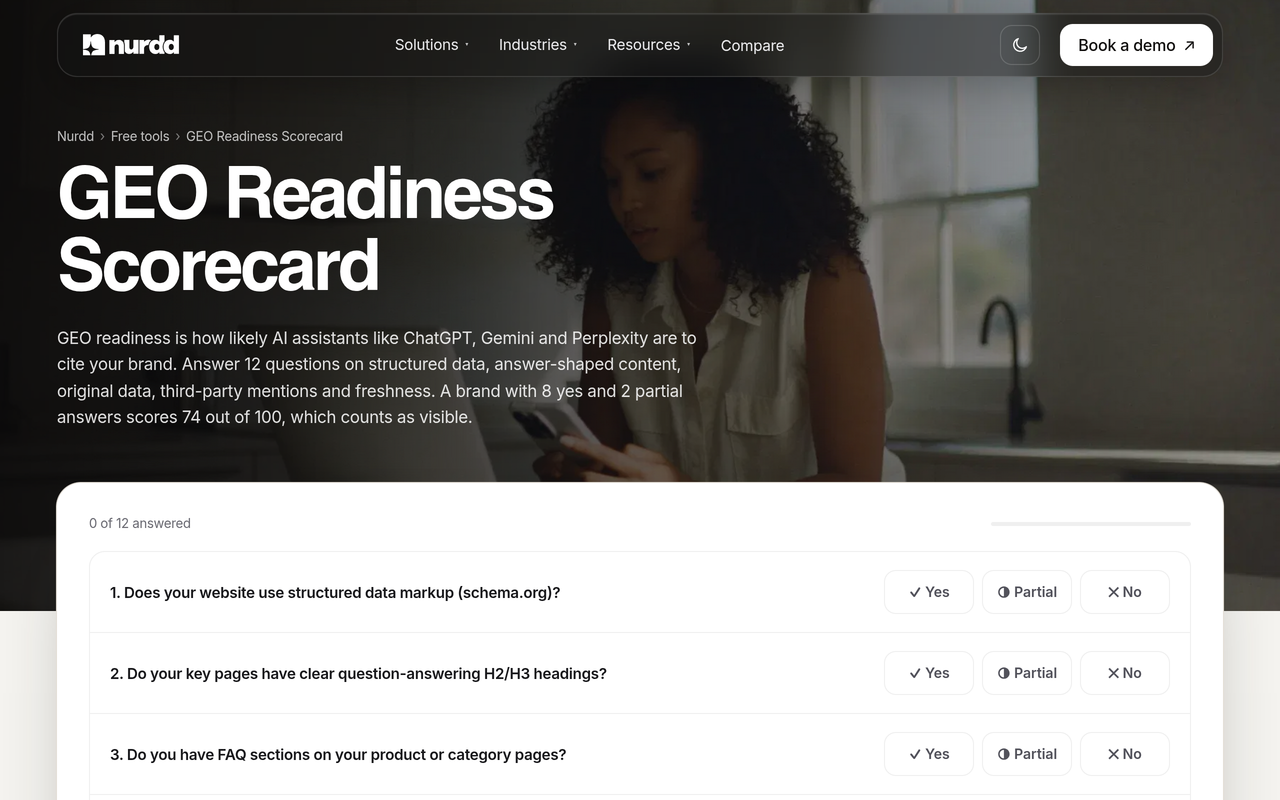
Noma has a 3-day free trial. A card is taken at signup and billing starts on day 3; if you cancel before then, you are not charged. To check your site's basics first, the free GEO readiness scorecard runs a 12-factor check of readiness for AI answers.
How does Noma's tracking connect to action?
Tracking only helps if it leads to changes. Nurdd measures AI search visibility in Noma and, through its answer engine optimization agency service and generative engine optimization services, works on the site and content engines read and on the third-party sources they cite. You can also do this in-house; the agency vs in-house comparison helps you decide.
Once you know which sources engines cite, the typical fixes are practical. Clarify how your brand is described, as set out in writing a brand description AI engines understand. Make sure crawlers can reach you, using the AI crawler user agents list. Then test changes properly with a GEO experiment design.
How does search visibility tracking compare with adjacent ideas?
Several terms get mixed up with visibility tracking. This comparison keeps them apart so that your reports use each correctly.
| Concept | What it is | How it differs from visibility tracking |
|---|---|---|
| Rank tracking | Position of a URL for a keyword | One input to a classic visibility score |
| Web analytics | Sessions and conversions on your site | Measures visits, not appearances without a click |
| Share of voice | Your share of visibility among competitors | A ratio built from either rankings or AI mentions |
| Brand monitoring | Mentions across the web and social | Not tied to a defined set of search queries |
| GEO and AEO | The work of improving AI answer presence | An optimisation practice; tracking is how you measure it |
For definitions of the AI terms, see what generative engine optimization is and the AI search glossary for marketers. For how to measure the ratio itself, read how to measure AI search share of voice.
What mistakes should you avoid when combining the two views?
- Adding the scores together. A modelled click score and an observed mention rate are different units. Keep them in separate columns.
- Judging AI visibility from one answer. Given the repeated-run variation SparkToro reported, a single answer is an anecdote, not a data point.
- Changing the lists every week. If you swap prompts or keywords, you cannot tell whether you improved or the questions got easier.
- Ignoring what Search Console blends. Because AI feature traffic is counted inside the Web search type, a drop or rise may come from either source. Annotate your changes.
- Tracking only your own brand. Both views need competitors, or you cannot tell whether a move is yours or the market's.
- Stopping at visibility. Connect each report to referrals and conversions, as in measuring AI search vs Google conversion rate.
Which AI metrics belong next to your classic metrics?
Pair each classic metric with an AI counterpart so the weekly page reads as one report. Average position pairs with mention rate, since both say whether you are present. Estimated traffic pairs with citation rate, since both hint at where visits may come from. Share of voice pairs with share of voice among named brands.
For a fuller reporting layout, see AI search metrics that matter and AI search metrics vs SEO metrics. If your leadership wants a single page, what executives need in an AI search visibility dashboard shows what to include. For Google's generated answers specifically, use how to track Google AI Overviews.
Conclusion: one review, two scales
Classic tracking tells you where you rank and how much traffic that position should earn. AI answer tracking tells you whether engines name and cite you when customers ask. Neither replaces the other, and the weekly habit of reading them side by side is what exposes the gaps worth fixing.
Noma by Nurdd gives you the AI half across 13 engines, including ChatGPT, Gemini, Perplexity and Claude. Book a demo and we will show you, for your own brand, which engines mention you, which pages they cite and where competitors are named instead. You can also read the overview of how Nurdd works first.
How we researched this
We reviewed platform documentation from Google, published research from Pew Research Center, Semrush and SparkToro (as reported by trade press), vendor help pages from Ahrefs and Keyword.com, and several current articles ranking for this topic. Sources were checked on the publication date of this article. We did not run hands-on tests, and the worked example uses illustrative figures, labelled as such, with a vendor's published click-through model.
Frequently asked questions
What is search visibility tracking software?
It is software that checks a fixed set of searches on a schedule and records whether and where your brand appears. Classic versions track ranked links on Google and Bing. AI versions track names and citations in answers from engines such as ChatGPT and Gemini.
How do I track visibility in both Google and AI engines?
Use Search Console for real Google clicks, a rank tracker for position and share of voice, and an AI answer tracker for mentions and citations. Keep fixed keyword and prompt lists, and review the three together once a week.
Is a search visibility score the same as traffic?
No. A visibility score is a modelled index built from rankings, search volume and an assumed click-through curve. Real traffic comes from Search Console and your analytics, so use the score for trend and competitor comparison only.
Does Search Console show AI Overviews and AI Mode traffic?
Yes, but blended. Google's documentation says sites appearing in AI features are included in overall search traffic in the Performance report within the Web search type. It does not give a separate AI line, so you need an AI tracker for mention data.
Why do AI visibility numbers change so much?
AI engines generate a fresh answer each time. SparkToro's research found that brand lists from the same prompt almost never repeated exactly. Trackers therefore sample many prompts and runs and report a rate rather than a single rank.
How many AI engines should I track?
Track the engines your customers use, and expect them to differ in which brands and sources they favour. Noma by Nurdd tracks 13 AI engines, including ChatGPT, Gemini, Perplexity and Claude, polled daily, so you can see the differences per engine.
How often should I review search visibility?
Weekly is a good rhythm for both views. It is frequent enough to catch drops and slow enough to smooth daily noise. Report monthly to leadership, and run a deeper audit each quarter.
Does Noma have a free trial?
Noma offers a 3-day free trial. A card is taken at signup and billing starts on day 3, and you are not charged if you cancel before then.