Influencer Marketing
Engagement Pods and Bought Engagement: Brand Risks
Engagement pods and bought engagement inflate creator metrics; here is how they work, what they cost brands and how to spot them before you pay.
 Sheetal Shakshi14 Nov 202617 min read

Engagement services for creators are paid or reciprocal arrangements that manufacture likes and comments: bought engagement from vendors, or engagement pods where members engage with each other's posts. They inflate the engagement rate brands use to price deals, so a brand can overpay for reach that was never real. Brands can spot them by checking comment quality, timing, repeat commenters and engagement against audience size.
Engagement services for creators are paid or reciprocal arrangements that create likes and comments a creator did not earn from real followers: bought engagement from a vendor, or an engagement pod where members engage with one another's posts on a schedule. Both make a creator look more influential than the audience supports. For a brand, that means rates, shortlists and campaign forecasts built on numbers that do not describe real buyers.
This guide explains what pods and bought engagement are, how they distort the metrics you vet creators with, what the platforms and the US consumer-protection regulator say about them, and a repeatable way to spot them before money moves. It also shows where Nia by Nurdd fits into a vetting workflow.
Key takeaways
- Engagement pods and bought engagement are different problems: pods use real accounts that engage out of obligation, while bought engagement uses vendors, bots or hijacked accounts. Vet for both.
- A high engagement rate alone proves nothing. Check comment content, timing, repeat commenters and whether engagement matches the audience's size and country.
- Ask for native analytics screenshots (reach, saves, shares, profile visits), because pods and vendors cannot easily fake those.
- Put an authenticity clause in the contract and tie part of the fee to verified results, not to likes and comments.
- Score every shortlisted creator with the same checklist, so the decision does not rest on one person's gut feel.
- Run a fake follower check and an engagement rate calculation before you negotiate price.
What are engagement services for creators?
Engagement services for creators are any systems that supply interactions to a post from accounts that are not genuinely reacting to it. The term covers three things that are often lumped together: engagement pods, engagement-for-hire vendors and automation tools. They differ in who does the engaging, which changes how you detect them.
Sprout Social's glossary describes an Instagram pod as a group of users who like and comment on each other's posts to increase reach, and ties the rise of pods to Instagram's move to ranking feeds by likely interest and timeliness (Sprout Social, accessed November 2026). The logic is simple: early likes and comments signal relevance to the ranking system, so creators try to manufacture them.
Engagement pods
A pod is a group, often run on a messaging app, whose members agree to engage with each other's new posts. Tailwind's write-up of its own test describes joining a group on Telegram, where members engage with the last ten posts before dropping their own link (Tailwind, September 2025). Some groups run on a 24-hour rule, where you must interact with every post shared in the previous day.
Pod accounts are usually real people, which is why pods are harder to catch than bots. Their engagement is a favour, not interest.
Bought engagement
Bought engagement is likes, comments, views, followers or saves purchased from a vendor. The accounts doing the engaging may be bots, purpose-made fake profiles, or in some cases hijacked accounts. In 2019, Meta announced legal action against companies it said sold fake likes, views and followers to Instagram users (Meta, April 2019).
Automation and growth tools
Third-party apps that auto-like, auto-follow or auto-comment sit between the two. Instagram said it would remove inauthentic likes, follows and comments from accounts using such apps, and stated that apps generating them violate its Community Guidelines (Instagram, accessed November 2026). The comments from these tools tend to be generic, which matters for detection later.
Do engagement pods affect influencer marketing results?
Yes. Engagement pods affect influencer marketing results in two ways: they distort the metrics a brand uses to choose and price a creator, and the engagement they produce does not come from people likely to buy. The creator's real audience may be responding at a far lower rate than the headline number suggests.
CreatorScore, a creator-vetting vendor, gives an illustration worth borrowing: a creator showing a 6% engagement rate driven by pod activity might only have a 1.5% genuine rate (CreatorScore, March 2026). That is the vendor's example, not a measured average. The arithmetic is still instructive: if genuine engagement is one quarter of the reported figure, you are paying about four times too much per genuine interaction.
An engagement rate is only as trustworthy as the accounts producing it. A pod can raise the number without adding a single potential customer.
Five ways the damage shows up
- Overpayment. Rate cards track engagement and follower tiers, so inflated engagement lifts the price you accept.
- Wrong shortlist. Discovery filters sorted by engagement rate will surface creators who game it.
- Broken forecasts. Any ROI model fed pod-inflated rates will overestimate sales.
- Unreadable creative tests. If comments are scripted, you cannot learn which content resonated.
- Platform and reputation risk. Tailwind notes that fake engagement is against Instagram's community guidelines, and that pods can be filled with spammy material (Tailwind, September 2025).
How do pods and bought engagement distort creator metrics?
They distort the exact numbers that influencer vetting leans on: engagement rate, comment counts, early-hour velocity and follower growth. Each distortion leaves a different fingerprint, which is what makes detection possible.
For a baseline of what normal looks like, Nurdd's benchmark page cites IQFluence (September 2026) putting the median Instagram engagement rate at 2.79% for nano and 0.97% for micro creators; see engagement rate benchmarks by platform. A micro creator far above the tier median is not automatically cheating, but the gap is a reason to look closer.
Where each service shows up in the data
| Metric | Pod effect | Bought engagement effect | What to check |
|---|---|---|---|
| Engagement rate | Raised on most posts | Spiky: high on some posts, normal on others | Rate per post across the last 12 to 20 posts |
| Comments | On-topic-looking but repetitive, from the same accounts | Generic, emoji-only or off-language | Read 30 comments; count repeat commenters |
| Likes | Modest lift | Large lift, often with no matching reach | Likes against views or reach |
| Timing | Burst right after posting, from the same accounts | Burst at odd hours or in one block | Time stamps on first comments |
| Commenter profiles | Real creators, often from the same niche circle | Empty, private or foreign accounts | Open 10 commenter profiles |
| Reach and saves | Do not rise with likes | Do not rise with likes | Native insights screenshots |
Why pod engagement does not convert
CreatorScore describes pod members as engaging out of obligation, not interest, so they are not the creator's actual audience and are unlikely to buy or visit a site (CreatorScore, March 2026). That is a vendor's explanation rather than a controlled study, but it matches the mechanics: a pod member's incentive is to complete a task, not to evaluate a product.
The practical consequence is that engagement metrics and sales can come apart completely. A creator can look strong on a report and still deliver nothing at the till, which is the pattern described in why a best-performing creator post got zero sales.
Do pods even work for the creators who use them?
Not very well, according to the one hands-on test in the public sources reviewed. Tailwind's team ran two experiments and the results are a useful worked example of what pod engagement is worth, even though it is a small test by one account.
| Test (Tailwind) | Effort | Result from the pod |
|---|---|---|
| Experiment 1: a 10x group on Telegram | Engage with the last ten posts first | 37 likes and 10 comments in total, with copy-pasted comments of poor quality |
| Experiment 2: a 24-hour pod | Liked and commented on 51 links, nearly an hour of work | 17 likes and 5 comments from the pod, against 44 likes from regular followers |
Source: Tailwind, September 2025. In the second test, regular followers gave more than double the likes the pod did. Read the first line again from a brand's view: even where a pod adds comments, the comments are low quality, which is exactly the signal a vetting process can catch.
The pod is a poor use of a creator's time and a worse signal for a brand. If creators were rewarded for real reach, few would bother.
Is buying engagement illegal for brands and creators?
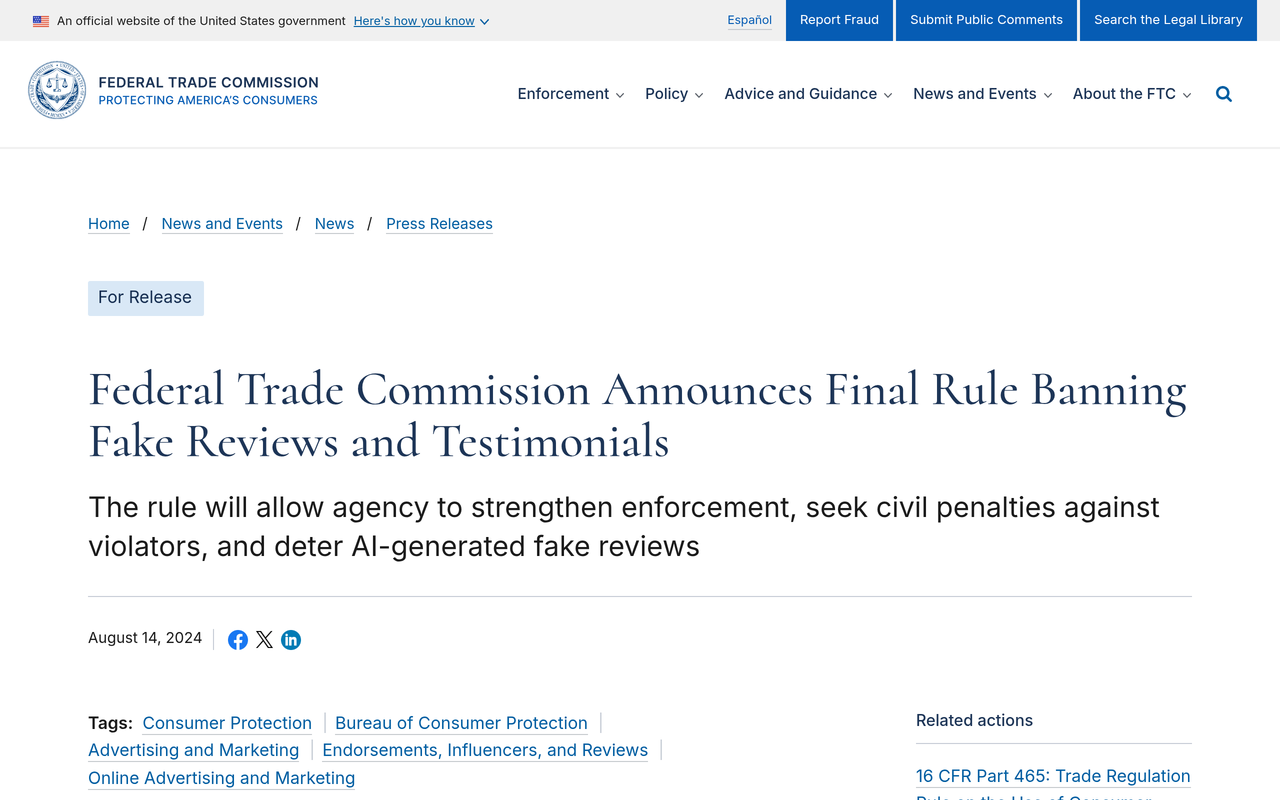
It can be, depending on where you operate, and it is always against platform rules. In the United States, the Federal Trade Commission's final rule on consumer reviews and testimonials, announced in August 2024, covers fake indicators of social media influence as well as fake reviews (FTC, August 2024). The press release says the rule lets the agency seek civil penalties against knowing violators.
A law-firm analysis explains the detail: the rule prohibits selling, distributing or buying fake indicators such as followers, likes, views, saves, shares and comments, where the person knew or should have known they were fake and they could be used to misrepresent influence for commercial purposes (BCLP, 2024 analysis). The same analysis reports that the FTC said it was not seeking to hold businesses liable for unknowingly hiring an influencer who has fake followers or likes.
The word "unknowingly" matters. Once a brand has seen red flags and proceeds anyway, the "should have known" standard becomes harder to argue around. A documented vetting process is both a commercial safeguard and evidence of reasonable care. This is general information, not legal advice; check with counsel for your market.
How can a brand tell if a creator buys engagement?
A brand can tell if a creator buys engagement by combining three checks: the quality of the comments, the pattern of engagement over time, and whether engagement lines up with audience size and reach. No single sign is proof, so score several together and ask the creator for native analytics.
Sprout Social's guide to fake influencers advises reading the comments manually and looking for emoji-only and generic remarks that could sit under any post, such as short praise with no reference to the content (Sprout Social, accessed November 2026). It also flags an unusually low engagement rate against a large follower count, which points to a purchased audience rather than purchased interactions.
A decision table: organic, pod or bought?
Use this table as a quick triage. It is an original framework drawn from the signals above, not a validated scoring model, so treat it as a prompt for questions.
| Signal you see | Most likely explanation | Next step |
|---|---|---|
| Specific comments that reference the content, from varied accounts | Organic | Proceed to audience-fit checks |
| The same 15 to 30 accounts comment on most posts, in the same niche | Pod or friend circle | Ask for reach and saves; check whether those accounts match your buyers |
| Short generic comments, emoji strings, comments in unrelated languages | Bought comments or automation | Open commenter profiles; reject if they are empty or spammy |
| Huge likes on a few posts, normal likes on the rest | Purchased likes on selected posts | Compare likes with views and reach on those posts |
| High follower count, very low engagement | Purchased or inactive followers | Run a follower authenticity check |
| Comments arrive in a tight burst within minutes of posting, then stop | Pod timing | Check time stamps across several posts |
| Engagement fine, but zero clicks or sales from past brand deals | Engagement not from buyers | Ask for past campaign link clicks or code redemptions |
The CreatorScore tests worth copying
CreatorScore describes two detection methods that a human reviewer can approximate: network overlap, where the same accounts keep appearing in a creator's engagement regardless of topic, and timing analysis, since natural engagement tends to arrive after posting and then taper (CreatorScore, March 2026). You can do a rough manual version by listing the commenters on five posts and counting who repeats.
What is the step-by-step checklist for vetting a creator for pods and bought engagement?
Follow this ordered checklist for every creator you consider, and record the answers in a shared sheet or your influencer platform so the decision is auditable. It takes about 20 to 30 minutes per creator by hand.
- Calculate the real engagement rate. Use the last 12 to 20 posts, not the best three. The Instagram engagement rate calculator handles both followers-based and reach-based rates.
- Compare against the tier. Check the result against published benchmarks; a rate far above the tier median needs an explanation.
- Estimate fake or inactive followers. Run the account through the fake follower checker, then follow up with the steps in the fake follower audit checklist.
- Read 30 comments across five posts. Mark each as specific, generic or spam. Note the share of generic ones.
- List repeat commenters. If the same accounts show up on most posts, open their profiles and see whether they fit your target customer.
- Check timing. Look at when the first ten comments land on several posts.
- Request native analytics. Ask for screenshots of reach, saves, shares and profile visits, taken in the last 30 days, and for the audience's country and age split.
- Test against past results. Ask for link clicks or code redemptions from previous brand work.
- Write the contract. Include an authenticity warranty, the right to audit analytics, and payment tied in part to verified delivery.
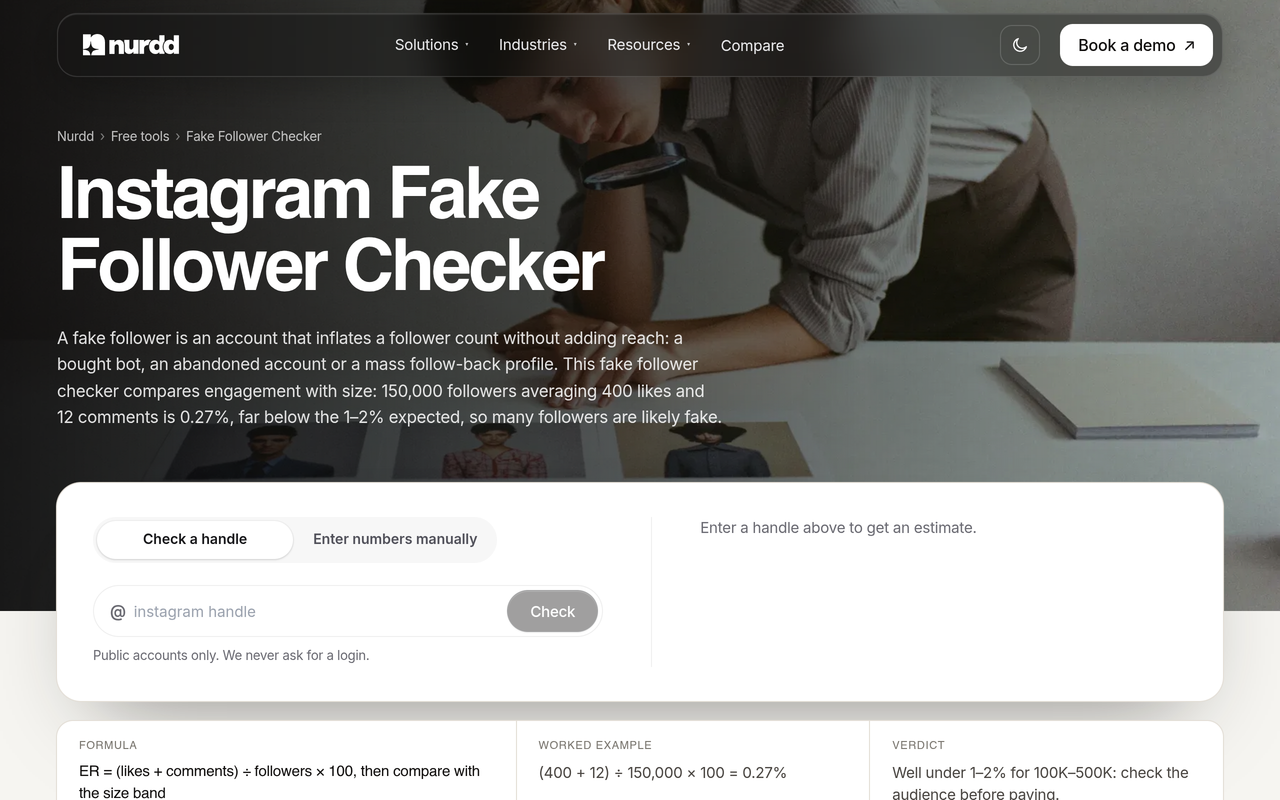
For deeper manual spotting, see fake follower red flags in creator comments and growth and how to spot fake followers on Instagram manually.
Worked example: scoring two creators with the same checklist
Here is how the checklist changes a decision. The inputs below are hypothetical, chosen to show the method, and are not data from any real creator or customer.
| Check | Creator A | Creator B |
|---|---|---|
| Engagement rate vs tier | Close to the tier median | Several times the tier median |
| Generic comments in a 30-comment sample | A few | Most |
| Repeat commenters across five posts | Low overlap | The same group on every post |
| Reach and saves in native insights | Consistent with engagement | Low relative to likes |
| Past campaign clicks | Provided | Declined to share |
On headline engagement, Creator B looks stronger. After the checklist, Creator A is the safer buy, and Creator B needs either a lower, performance-linked offer or a pass. Using the CreatorScore illustration above, if Creator B's reported rate were 6% and genuine rate 1.5%, a flat fee priced on 6% would cost four times as much per genuine interaction as the same fee priced on the real figure.
How do pods and bought engagement compare with organic engagement and paid creator partnerships?
Pods and bought engagement are often confused with legitimate tactics, so here is where the line sits. The test is whether real people chose to react to the content, not whether money or coordination was involved.
| Tactic | Who engages | Platform status | Brand risk |
|---|---|---|---|
| Organic engagement | Real followers who chose to react | Normal | Low |
| Engagement pod | Real accounts, reciprocal obligation | Fake engagement is against Instagram's community guidelines, per Tailwind | High: inflated metrics, off-brand or spammy groups |
| Bought likes and comments | Bots, fake or hijacked accounts | Violates Instagram's Community Guidelines | Very high: platform removal, legal exposure, wasted spend |
| Automation apps | Scripts acting from the creator's account | Targeted for removal by Instagram | High: generic comments and account risk |
| Paid creator partnership with disclosure | Real followers reacting to sponsored content | Allowed with disclosure | Manageable with vetting |
| Giveaway or comment-to-win | Real people, motivated by a prize | Allowed within platform rules | Medium: engagement is real but not purchase intent |
Sources for the platform column: Tailwind, September 2025 and Instagram, accessed November 2026. Giveaway rules vary by platform and country, so check current terms before you run one.
How does Nia by Nurdd support creator vetting?
Nia by Nurdd builds vetting into the same influencer workflow that handles discovery and campaigns, so authenticity is checked before a creator is briefed rather than in a separate spreadsheet. Nia searches a database of 10M+ creator profiles across Instagram and other platforms and filters by niche, audience quality, engagement authenticity and brand match score.
Each shortlisted creator is scored with TruAI, Nurdd's fake follower detection built into Nia. Nia then produces a pre-spend ROI forecast and, after the campaign closes, attributes product-level sales to specific creators. That last step is the counterweight to pods: engagement can be faked, but sales credited to a creator cannot. TruAI is a fake follower detector; for pod-specific signals such as repeat commenters and timing, keep the manual checklist above in your process.

Nia by Nurdd is an AI-native creative studio with influencer marketing built in: it finds creators from 10M+ profiles, scores audiences for fake followers with TruAI, forecasts return before spend and attributes sales to each creator afterwards. It is priced below comparable platforms. A brand that has been burned by inflated metrics gets vetting, forecasting and attribution in one workflow.
Want to see this on your own shortlist? Book a demo and we will walk through how creators in your category score on audience quality, engagement authenticity and forecast return, using your brand's niche.
For evaluation criteria when comparing platforms, see the influencer discovery and qualification scorecard, how to evaluate influencer discovery software, and the best fake follower checkers compared by method.
What are the common mistakes brands make with engagement vetting?
- Trusting engagement rate alone. A single percentage cannot show who is engaging. Pair it with comment and reach checks.
- Checking only the best posts. Creators pick their strongest examples. Sample the latest 12 to 20.
- Treating pods as harmless. A pod may look like networking, but it breaks the link between engagement and purchase intent.
- Skipping the contract. Without an authenticity clause and audit rights, you have no remedy if the numbers prove false.
- Forgetting the follow-up. If a campaign underperforms, compare delivered results with the vetting file. The guidance in what to do when an influencer doesn't deliver covers next steps.
- Measuring only engagement afterwards. Use influencer performance attribution so that sales, not likes, judge the result.
How should brands price and negotiate once they suspect inflated engagement?
Treat suspicion as a reason to restructure the deal, not necessarily to walk away. A creator with a real but modest audience and a pod habit may still be worth hiring, at a price based on the audience that actually exists.
Compare the rate quote to published benchmarks. Nurdd's pricing hub cites OpenSponsorship (July 2026) putting the median paid cost per deliverable at $134 for nano and $2,727 for mega creators; see influencer pricing rate benchmarks by tier. Use the influencer rate card estimator and the guidance on reading a creator's rates to anchor the discussion. Then:
- Offer a lower base fee plus a bonus tied to tracked clicks or sales.
- Pay on reach delivered, verified from native analytics.
- Use trackable links and codes, following the UTM naming guide for influencer campaigns.
- Run the numbers through the influencer ROI calculator before you sign.
How we researched this
We reviewed platform announcements from Instagram and Meta, the US Federal Trade Commission's announcement of its fake reviews and testimonials rule, a law-firm analysis of that rule, and published guides and experiments from social media software vendors. We also read the top-ranking articles on engagement pods and fake engagement to identify gaps. Sources were checked on the publication date of this post. We did not run our own tests, interview creators or collect customer data, and the creator scenarios above are hypothetical illustrations.
Frequently asked questions
What are engagement pods and do they affect influencer marketing results?
Engagement pods are groups whose members like and comment on each other's posts to boost visibility. They affect results because they inflate engagement rates, which brands use to choose and price creators, while the interactions come from members rather than likely buyers. A pod-heavy creator can look better on paper than on sales.
How can a brand tell if a creator buys engagement?
Read comments across several posts for generic or emoji-only remarks, list repeat commenters, check the timing of early comments, and compare likes with reach and saves. Ask for native analytics and past campaign click data. No single sign proves it, so combine several.
Is joining an engagement pod against Instagram's rules?
Tailwind notes that fake engagement is against Instagram's community guidelines, and Instagram has said it removes inauthentic likes, follows and comments from accounts that use third-party apps to boost popularity. Pods sit in a grey area in practice, but the risk to a creator's account and credibility is real.
Can a brand be fined for working with a creator who bought followers?
The FTC's rule targets the sale and purchase of fake indicators of social media influence where the person knew or should have known they were fake. A law-firm analysis reports the FTC said it was not seeking liability for businesses that unknowingly hire an influencer with fake followers. Documenting your vetting helps, and you should ask counsel about your market.
What engagement rate is suspiciously high?
There is no universal cutoff. Compare against the creator's tier and platform benchmarks, then look at consistency across posts. A rate far above the tier median, paired with generic comments or flat reach, deserves a closer look.
Are pods the same as fake followers?
No. Fake followers are accounts in a creator's audience that do not belong to real, interested people. Pods use real accounts that engage on a schedule. A creator can have a real audience and still use a pod, or have fake followers and no pod, so test both.
Can a creator with a pod history still be a good partner?
Sometimes. If their real audience matches your customers and past campaigns converted, a pod habit may not be disqualifying. Price on verified reach, tie part of the fee to results and require disclosure of any engagement services in the contract.
What should a brand ask a creator to prove authenticity?
Ask for native insights screenshots covering reach, saves, shares, profile visits and audience location from the last 30 days, plus link clicks or code redemptions from previous brand deals. Creators with a real audience can usually provide these quickly.
Conclusion
Engagement services for creators, whether pods, vendors or automation, break the link between engagement and buying. The brand's defence is a consistent vetting process: calculate the rate, read the comments, check repeats and timing, request native analytics and tie payment to verified results.
See how Nia by Nurdd handles creator discovery, TruAI audience scoring, ROI forecasts and sales attribution for your own category. Book a demo and we will show you how your shortlisted creators score before you commit budget. You can also explore influencer marketing measurement and the free tools in the meantime.