Influencer Marketing
Influencer Discovery and Qualification: A Vendor Scorecard
A weighted scorecard for judging influencer discovery and qualification vendors on audience quality, fit, rates and proof of sales, with tests you can run.
 Sheetal Shakshi4 Nov 202617 min read

Influencer discovery and qualification works when a vendor can show that the audience is real, the creator fits your brand, the rate is fair against published medians, and sales trace back to the post. Score each vendor on those four areas plus workflow and compliance, then test every claim with creators you already know. Nia by Nurdd covers discovery, fake follower detection, ROI forecasting and sales attribution, and is priced below comparable plans.
Influencer discovery and qualification works when a vendor can show four things: the audience is real, the creator fits your brand, the rate is fair against published medians, and sales can be traced back to the post. Score each vendor on those four areas, weight them, and test the claims with creators you already know before you sign anything.
This guide gives you a weighted scorecard, six steps for using it, three tests you can run in a demo, a worked example built on published pricing data, and a checklist. It also shows Nia by Nurdd set against the same criteria, including the areas where you should verify what it documents.
Key takeaways
- Score vendors on five areas: audience quality, fit, rates, proof of sales, and workflow and compliance. Weight proof of sales and audience quality highest.
- A large creator database is a starting point, not a result. Ask how the vendor scores audience authenticity, and ask to see it on accounts you already know.
- Check any suggested rate against a published benchmark. OpenSponsorship, July 2026 reports a median of $134 per deliverable for nano creators and $2,727 for mega creators.
- Run three tests: plant known-bad accounts, ask for a past campaign's sales trail, and rebuild a rate from the vendor's own data.
- Qualification does not end at the shortlist. Disclosure and fake-engagement rules mean the brand carries risk for creators it hires.
- Keep the shortlist to three vendors and give each the same creators, the same brief and the same questions.
What should you score when a vendor claims discovery and qualification?
Score five areas. Four come from the buying question itself: audience quality, fit, rates and proof of sales. The fifth, workflow and compliance, decides whether the first four survive contact with a real campaign calendar.
Discovery means finding creators who could work. Qualification means proving, before money moves, that a specific creator is worth the rate. Most vendors are strong on the first and vague on the second, so the scorecard puts the weight on qualification.
| Area | Suggested weight | What the vendor must show | Red flag |
|---|---|---|---|
| Audience quality | 25 | A score for fake or inactive followers and engagement authenticity, shown per creator, with the method explained | Only follower count and a single engagement rate |
| Fit | 20 | Search by niche, audience and content, plus a brand match score you can inspect | Filters limited to follower range and location |
| Rates | 15 | Rate guidance tied to tier and format, comparable to public benchmarks | A rate with no source or range |
| Proof of sales | 25 | Forecast before spend and attribution to creator and product after the campaign | Reach and likes presented as results |
| Workflow and compliance | 15 | Briefing, approvals, disclosure checks and exports your team can use | Discovery lives in one tool, contracts in another, nothing connects |
The weights are our suggestion, not a measured industry standard. Change them to match your category: a brand under regulated claims should raise workflow and compliance, and a direct-to-consumer brand with a tight payback window should raise proof of sales.
Why is influencer discovery and qualification so hard to buy?
Because vendor pages tend to use the same words. Search, filters, AI matching, audience insights and analytics appear on many product pages, and none of them tells you whether the data underneath is accurate for the creators you actually want.
The three guides we reviewed show the pattern. CreatorIQ's guide to discovery tools gives a short five-question list covering data freshness, content search, audience vetting, scale and workflow. Meltwater's article ranks five tools and places its own first. Iriscale's guide offers a weighted rubric and a pilot design, centred on conversion economics. This post adds two things we did not find in those three: a test you can run on a vendor's audience scoring, and a step that ties a suggested rate back to a public pricing benchmark.
The cost of getting qualification wrong is real: you pay for reach that was never there and cannot trace a sale to the spend. Use the tests below to find out before you pay, rather than relying on any single fraud statistic.
Discovery answers "who exists?" Qualification answers "who is worth paying, and how will we know?" A vendor that cannot answer the second question has sold you a directory.
How do you evaluate influencer discovery platforms, step by step?
Follow six steps. Each one has an action, a result and a reason, so you can run them in a single vendor-selection week.
Step 1: Write the sales question before you open a demo
Action: Write one sentence that states the outcome, such as the number of orders, the payback window and the product being sold. Result: You have a yardstick for every vendor claim. Why: A vendor demo is built to show breadth. A written outcome forces each vendor to show depth on the part you care about.
Include your category and market. A skincare brand selling in several countries needs audience geography checked at creator level. A software brand selling to a narrow buyer needs niche matching more than raw reach.
Step 2: Fix the shortlist and the test set
Action: Choose three vendors and a test set of five creators: two who performed well for you, one who disappointed, and two accounts you suspect are inflated. Result: Every vendor is judged on the same inputs. Why: Comparing vendors on different searches rewards whoever has the nicest interface.
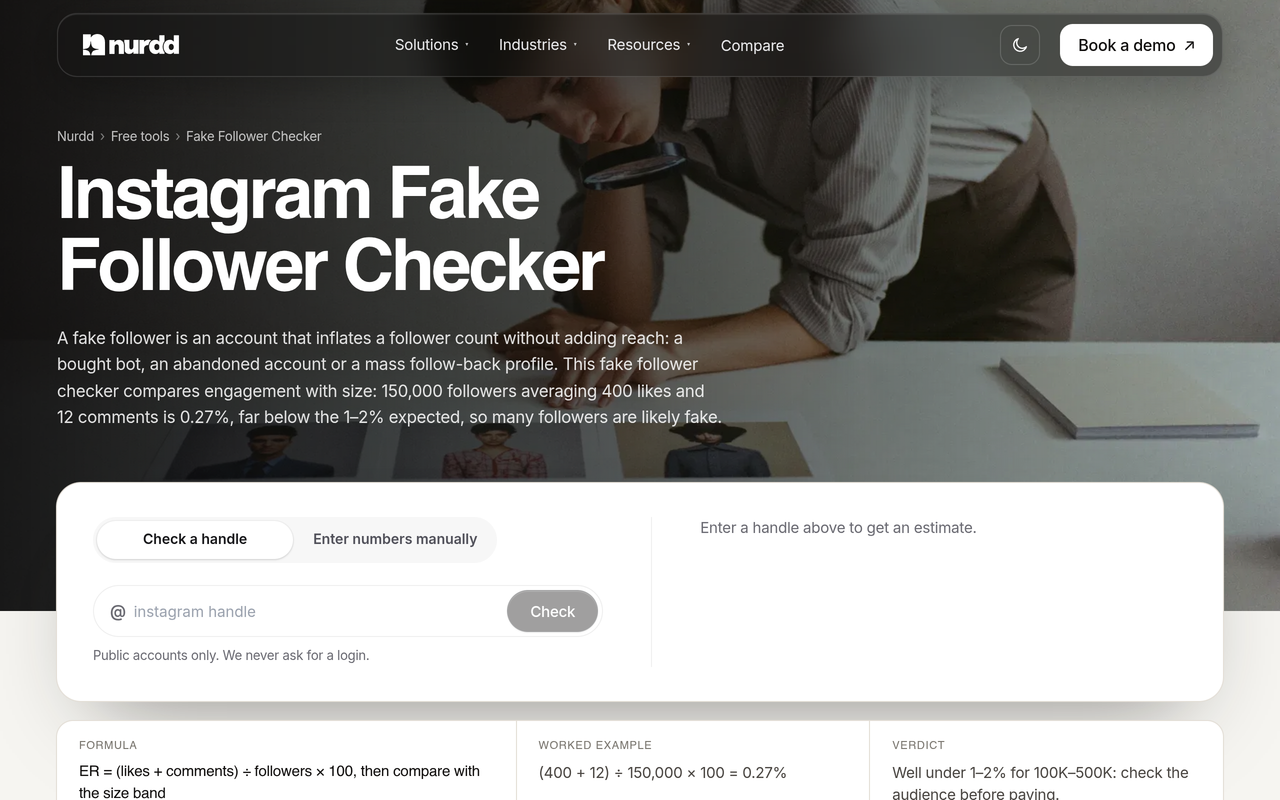
The fake follower checker gives you a quick independent estimate for the suspect accounts, so you are not relying on a vendor to tell you what a bad account looks like.
Step 3: Score audience quality with a planted-account test
Action: Ask each vendor to open the five test creators and show the audience quality score, the method behind it and the signals it reads. Result: You see whether the score separates your good creators from your suspect ones. Why: A score that rates everything as acceptable is marketing, not a filter.
Give 0 to 3 points. A zero is a follower count only. A three is a per-creator authenticity score, an explanation of the signals, and a clear difference between your good and suspect accounts. Our fake follower audit checklist lists the manual signals to compare against the vendor's output.
Also check engagement, because a vendor's number should reconcile with yours. The Instagram engagement rate calculator computes it by followers and by reach, so you can see whether the vendor's figure uses the same denominator.
Step 4: Score fit on content and audience, not only on metrics
Action: Describe your brand in plain language, run the same search in each tool, and review the first twenty results by hand. Result: You count how many are genuinely on brief. Why: Filters on followers and location return many creators that look right and are not.
Look for three things: whether the tool searches by niche and audience, whether the brand match score can be explained, and whether results include creators below the headline tiers. Our guide to vetting an influencer's audience before paying covers the buyer-intent checks that software cannot do for you.
Step 5: Score rates against a public benchmark
Action: Ask each vendor what it would expect to pay for your test creators, then compare it with a published median for the same tier. Result: You see whether the guidance is anchored in data. Why: Rates are where the most budget leaks, and a vendor that offers no range gives you no leverage in negotiation.
Use the influencer rate card estimator for published USD rates by tier and format, and read what a rate card should include before you negotiate. The worked example below shows how to turn a benchmark into a decision.
Step 6: Score proof of sales by tracing one past campaign
Action: Ask for a past campaign, anonymised if needed, and have the vendor show the path from forecast to creator-level and product-level sales. Result: You see whether attribution exists as a feature or as a slide. Why: Reach and engagement report activity. Only sales attribution reports whether the creator paid back.
Score a three only when the vendor can show a forecast made before spend and an attributed result after. Our posts on influencer performance attribution and incrementality explain what a defensible trail looks like and where it breaks.

What criteria qualify an influencer before hiring?
Qualify a creator on six criteria: audience authenticity, audience match, content fit, a rate you can defend, a record of delivery, and compliant disclosure. A platform should surface the first four. The last two usually need your own review.
- Audience authenticity. The share of followers that look fake or inactive, and whether engagement behaves like real people.
- Audience match. Country, age and interests that overlap with your buyers.
- Content fit. The creator's recent posts already sit near your category and would not look forced.
- Defensible rate. The ask sits within a published range for the tier and format.
- Delivery record. Past partnerships were delivered on time and posts stayed up.
- Disclosure. The creator discloses material connections clearly.
The last point is a legal and brand risk, not a style choice. Advertising regulators in many markets, including the US Federal Trade Commission, expect paid relationships to be disclosed clearly, and a platform's built-in disclosure tool is not a substitute for checking the post yourself. Put disclosure wording in the brief and the contract, and confirm the current rules for your market with counsel.
Fake engagement is also a compliance topic. Morgan Lewis, August 2024 summarises the FTC's final rule as prohibiting the sale, distribution or purchase of fake indicators of social media influence, such as followers, likes and views, where the buyer knew or should have known they were fake. This is general information, not legal advice, and you should ask counsel how it applies to your market.
How do you turn the scorecard into a number?
Give each area a score from 0 to 3, multiply by its weight, divide by 3, and add the results. The maximum is 100. The calculation is simple on purpose, because you will need to defend it to whoever signs the contract.
The example below is an illustration of the arithmetic using invented scores, not data about any real vendor.
| Area | Weight | Vendor A score (0 to 3) | Vendor A points | Vendor B score (0 to 3) | Vendor B points |
|---|---|---|---|---|---|
| Audience quality | 25 | 3 | 25.0 | 2 | 16.7 |
| Fit | 20 | 2 | 13.3 | 3 | 20.0 |
| Rates | 15 | 1 | 5.0 | 2 | 10.0 |
| Proof of sales | 25 | 3 | 25.0 | 1 | 8.3 |
| Workflow and compliance | 15 | 2 | 10.0 | 2 | 10.0 |
| Total | 100 | 78.3 | 65.0 |
Vendor B has the better search and loses because it cannot show proof of sales. That is the point of weighting: a polished discovery experience should not outscore a vendor that can show whether creators paid back.
If two vendors land within five points, break the tie on the area that matters most to your outcome sentence from step 1, not on price.
How should you adjust the weights for your business?
Adjust the weights to the risk you carry. The table below shows starting adjustments by situation; each row still totals 100 and every change is a judgment, not a measured standard.
| Your situation | Raise | Lower | Reason |
|---|---|---|---|
| Tight payback window, direct-to-consumer | Proof of sales | Workflow | You need to know quickly which creators paid back |
| Regulated or claims-sensitive category | Workflow and compliance | Rates | Approvals and disclosure matter more than a small saving |
| Past experience with inflated accounts | Audience quality | Fit | A well-matched fake audience still wastes the budget |
| Niche B2B or specialist product | Fit | Rates | The right few creators matter more than broad reach |
Agree the weights with whoever approves the budget before you see any demo. Changing weights after you have seen the vendors invites the scorecard to confirm a decision already made.
Worked example: what a published benchmark does to a rate negotiation
A published benchmark can change a creator budget in a few minutes. Take the pricing data from OpenSponsorship, July 2026, which analysed 1,527 completed, paid creator deliverables that ran on its platform between January 2025 and June 2026.
| Creator tier | Deliverables | Median cost per deliverable | Median views | Median cost per view |
|---|---|---|---|---|
| Nano (under 10K) | 146 | $134 | 1,115 | $0.13 |
| Micro (10K to 50K) | 349 | $150 | 989 | $0.14 |
| Mid (50K to 250K) | 513 | $417 | 2,606 | $0.19 |
| Macro (250K to 1M) | 441 | $517 | 6,974 | $0.10 |
| Mega (1M+) | 53 | $2,727 | 20,123 | $0.07 |
Now apply it. Suppose a vendor shortlists a creator in the 50K to 250K tier and the creator asks for $1,200 per post. The median for that tier is $417, so the ask is nearly three times the median. That does not make the creator wrong, but it means the vendor should be able to explain why this creator's audience quality and past results justify the premium.
Next, test a budget split. One mega deliverable at the $2,727 median would cost about the same as 20 nano deliverables at $134 (20 × $134 = $2,680). At the median of 1,115 views each, those 20 posts would deliver roughly 22,300 views, against a median of 20,123 for the single mega post. These are medians across different deals, so treat the comparison as a starting hypothesis, not a forecast.
The same source adds two cautions. It reports that mega creators had the cheapest median cost per view, while nano and micro creators had a lower cost per engagement, at about $3.05 to $3.11 against $5.00 for mega and $7.07 for the mid tier. It also calls the 50K to 250K tier a poor performer on both measures and describes deals over $7,500 as the least efficient and most volatile band. A good vendor should let you filter on those trade-offs rather than defaulting to a follower range.
What tests should you run in a vendor demo?
Run three tests. Each takes under an hour, and each is hard to fake in a scripted demo.
Test 1: The planted-account test
Give the vendor your two suspect accounts and your two proven creators without saying which is which. Ask them to open all four and explain the audience quality output. A credible tool separates the groups and tells you why. A tool that rates all four as fine, or cannot explain its score, gets a 0 or 1.
Test 2: The sales-trail test
Ask for one past campaign and watch the path: forecast, spend, creator-level result, product-level result. If the vendor can only show reach, impressions and engagement, the proof of sales score stays at 0 or 1. If it shows the trail but cannot say how a sale was linked to a creator, score a 2 at most.
You can prepare for this on your side too. Our UTM structure guide for influencer campaigns shows how to label links so whichever tool you choose receives clean data.
Test 3: The rate-rebuild test
Ask the vendor to explain a suggested rate from its own data, then compare the result with a public benchmark and with the influencer ROI calculator, which projects revenue and ROAS from a creator budget. If the vendor's logic and the benchmark disagree, the discussion about why is your negotiation material.
Checklist: how to run a discovery and qualification evaluation
- Write the outcome sentence: product, orders, payback window and market.
- Set weights for the five areas and agree them with whoever approves the budget.
- Shortlist three vendors and prepare a five-creator test set.
- Run each vendor through the planted-account test and record scores for audience quality.
- Run the same brand search in each tool and count how many of the first twenty results are on brief.
- Ask each vendor for a rate on two test creators and compare it with a published median.
- Request one past campaign trail from forecast to attributed sales.
- Check that approvals, contracts and disclosure reminders live in the workflow.
- Total the scores, apply the five-point tie-break rule, and note what you could not verify.
- Pilot with a small budget and a tracked link or code for every creator before scaling.
What mistakes do buyers make when comparing discovery tools?
- Counting database size as quality. A bigger database means more records to check. It says nothing about whether the scoring is accurate.
- Accepting an engagement rate without a denominator. Rates by followers and rates by reach differ. Ask which one the vendor shows. The engagement rate calculator compares your figure with tier ranges.
- Skipping the fit check. Audience overlap is a number. Content fit is a judgment. You need both.
- Treating rate guidance as a quote. A suggested rate is a range to start from. Confirm it against a benchmark.
- Paying for discovery and buying attribution later. If sales proof is a separate project, you will run campaigns you cannot judge. Our guide to picking influencers on predicted sales shows why the forecast belongs before the brief.
- Ignoring disclosure. The brand is accountable for what creators publish on its behalf. Build disclosure into the brief.
For a wider view of platform categories, see how to pick an influencer marketing platform, our influencer discovery software evaluation guide and the broader best influencer marketing platforms comparison.
How does Nia by Nurdd score on the same scorecard?
Nia by Nurdd is an AI-native creative studio with influencer marketing built in. It searches more than 10 million creator profiles across Instagram and other platforms, scores each shortlisted creator with TruAI fake follower detection, forecasts return before anyone is briefed, and attributes product-level sales to creators once campaigns close. It is priced below comparable plans.
Book a demo at https://www.nurdd.club/demo to see Nia.
| Scorecard area | What Nia by Nurdd documents | What to verify yourself |
|---|---|---|
| Audience quality (25) | TruAI, Nurdd's fake follower detection, scores each shortlisted creator before a rate is agreed. Search filters include audience quality and engagement authenticity. | Run your planted-account test and ask which signals separate your good and suspect creators. |
| Fit (20) | Search across 10M+ profiles by niche, audience quality, engagement authenticity and brand match score. | Review the first twenty results for your brand and count how many are on brief. |
| Rates (15) | Nia documents pre-spend ROI forecasting, which shows expected return before a brief goes out. Rate guidance tied to public benchmarks is not documented for Nia. Nurdd offers a separate free rate card estimator with USD rates by tier and format. | Ask how a rate for your test creators would be set, and compare it with the public medians above. |
| Proof of sales (25) | A projected revenue range with confidence scores from your budget, then product-level sales attributed to each creator after the campaign. | Ask how the forecast-to-attribution path works for a campaign. |
| Workflow and compliance (15) | Manages the full campaign workflow without needing an agency, with the creative studio in the same product. Approvals and disclosure checks are not documented in the product information we used. | Ask directly about approvals and disclosure reminders and check them against your own process. |
Nia is a paid product, priced below comparable plans. You can read more on the Nia overview page or on our comparison pages. If you would rather hand the work over, Nurdd also runs creator campaigns on Nia through its influencer marketing agency service.
Nurdd publishes reference figures, such as the OpenSponsorship medians above, on its benchmarks hub, so you can sanity-check any vendor's numbers against sourced ones. Nurdd's other calculators on the tools page can be used without a vendor conversation.
Conclusion
Buy influencer discovery and qualification the way you would buy any system that moves budget: define the outcome, weight the criteria, test the claims. The vendor that wins is the one that shows a real audience, a defensible rate and a sales trail on creators you chose, not the one with the largest database.
Take your scorecard and outcome sentence into the vendor conversations. Book a demo to see Nia by Nurdd and fill in the scorecard from evidence rather than a slide.
How we researched this
We reviewed three published guides on influencer discovery and vetting, from CreatorIQ, Meltwater and Iriscale, to see which sections they cover and what they leave out. We also reviewed a published pricing analysis from OpenSponsorship and a law firm summary of the FTC's final rule on fake indicators of influence. All sources were checked on the publication date of this post. We did not run hands-on tests of rival products, and the scorecard weights and the example vendor scores are our own framework, not measured data. Nia details come from Nurdd's own product information.
Frequently asked questions
How do I evaluate influencer discovery platforms?
Score each platform on audience quality, fit, rates, proof of sales and workflow, then test the claims with creators you already know. Use the same five-creator test set and the same brand search on every vendor. A platform that cannot explain its audience score or show a sales trail should lose points regardless of database size.
What criteria qualify an influencer before hiring?
Check audience authenticity, audience match, content fit, a rate that sits within a published range, a delivery record and clear disclosure. Software can surface the first four. Review the last two yourself, and put disclosure expectations in the brief and the contract.
What is the difference between influencer discovery and influencer qualification?
Discovery finds creators who could work for your brand. Qualification confirms that a specific creator is worth the rate, by checking audience quality, fit and expected return before spend. Many vendors do discovery well and treat qualification as a smaller feature.
How many influencer platforms should I compare?
Three is usually enough. More than that makes it hard to run the same tests on each, and the scores stop being comparable. Choose vendors that cover the areas you weight highest, and run all three through the same demo script.
Is follower count still a useful qualification signal?
It is a starting filter, not a result. OpenSponsorship, July 2026 reports that nano creators generated views equal to 19.9% of their follower count, against 1.1% for mega creators, so audience size says little about how far content travels. Pair it with an authenticity score and engagement.
How do I check whether a creator's rate is fair?
Compare the ask with a published median for the same tier and format, then ask the creator or vendor what justifies any gap. The rate card estimator and the OpenSponsorship medians give you two reference points. Treat them as ranges and not as fixed prices.
Does Nia by Nurdd detect fake followers?
Yes. Nia uses TruAI, Nurdd's proprietary fake follower detection, to score each shortlisted creator before a rate is agreed. You can see the product by booking a demo at nurdd.club/demo.
Can a platform guarantee that an influencer will drive sales?
No platform can guarantee it. A good one forecasts a revenue range with confidence scores before spend and attributes sales to creators afterwards, so you can judge each partnership on evidence and drop what does not pay back.