Influencer Marketing
Influencer Rate Card Negotiation: Reading a Creator's Rates
Read a creator's rate card line by line, price usage rights, exclusivity and add-ons, and negotiate scope before price with sourced numbers.
 Simran Rawat12 Nov 202618 min read

To read an influencer's rate card, split it into five blocks: deliverables, rights, restrictions, process and payment. Then price each block against the base fee, because rights and whitelisting are usually quoted as a percentage of that base, per 30-day window. Negotiate scope and duration before you negotiate the headline price.
Influencer rate card negotiation starts with reading the card correctly: the headline price is only the base fee for one piece of content, and everything that lets you reuse, boost or lock up that content is priced separately. Split any card into deliverables, rights, restrictions, process and payment, price each against the base, then negotiate scope before price.
Key takeaways
- Treat the headline number as the base fee only. Paid usage, whitelisting, exclusivity and extensions are usually separate lines, often quoted as a percentage of that base.
- Ask for an itemised quote. Gigapay, October 2026, notes that quotes bundling creation, usage and whitelisting into one number hide the markup.
- Buy rights in 30 to 90 day blocks with extension prices agreed up front, not a perpetual buyout you will probably retire early.
- Trade scope (an extra Story, a longer usage window) before you trade price, and write the usage rights into the first brief, not after the content performs.
- Keep the agreed terms and the campaign results in one place so you can judge each rights fee against what it produced.
Why is a creator's rate card so easy to misread?
A rate card looks like a price list, but it is closer to a menu with a base dish and a long list of extras. A creator who quotes a fee for a Reel is quoting the creative fee for one organic post. The moment you want to run that Reel as an ad, keep it on your site for a year or stop the creator working with a competitor, you are buying different things.
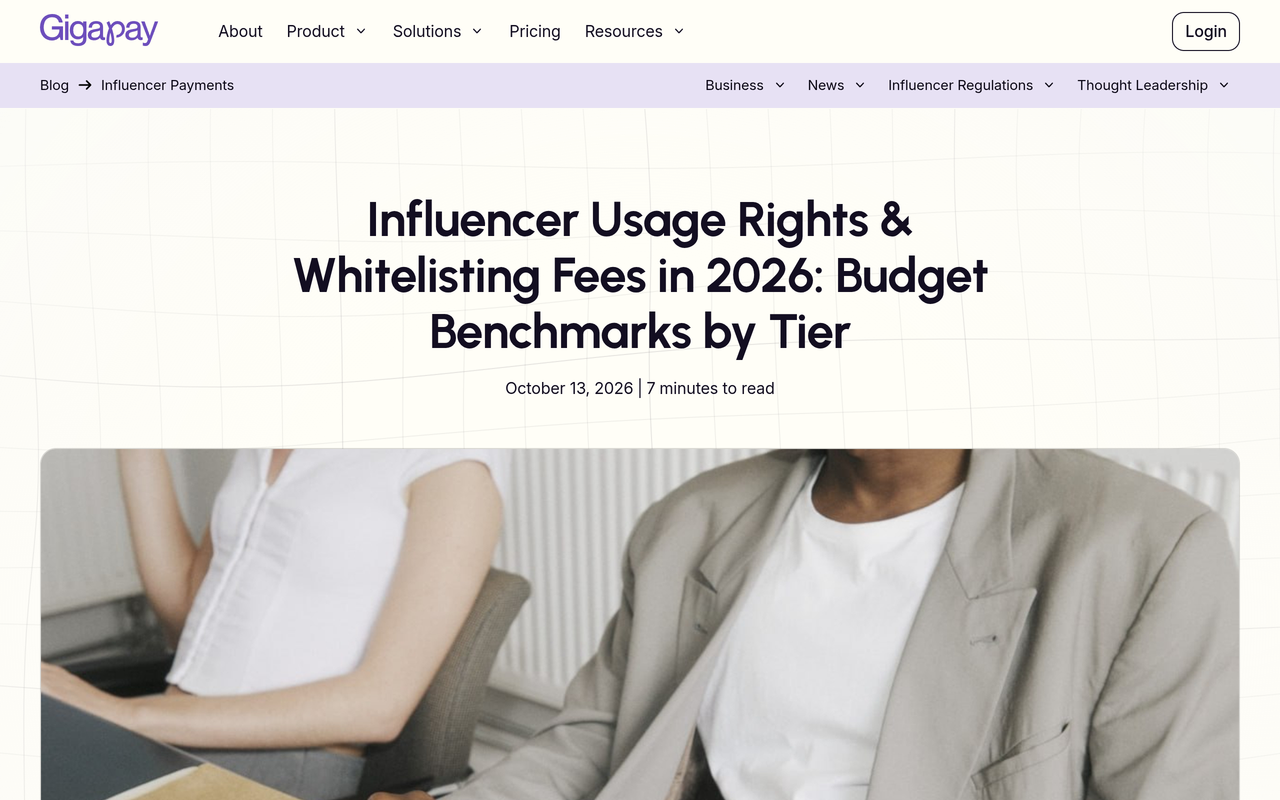
Most existing guides on this topic are written for creators building their own card. Sprout Social covers what to include, pricing models and average rates by platform. impact.com frames the card as a conversation starter and explains the difference between a media kit and a rate card. Cheerful, updated October 2026, gives negotiation moves and a factor table. None of them walks a buyer through a quote line by line, converts percentage add-ons into dollars, or gives a checklist for the questions to ask. This guide does that. If you are building your own card instead, see our guide on what to include in an influencer rate card.
How do I read an influencer's rate card? The five-block method
Use this five-block read on every card, whether it arrives as a PDF, a link in a bio or a few lines in an email. Each block answers one question, and each has its own pricing logic.
| Block | Question it answers | Lines you will see | How it is usually priced |
|---|---|---|---|
| 1. Deliverables | What exactly do I get? | Feed post, Reel, Story set, video, number of posting dates | Flat fee per item |
| 2. Rights | What can I do with it afterwards? | Organic repost, paid usage, whitelisting, website and email, buyout | Percentage of base per time window, or a flat access fee |
| 3. Restrictions | What is the creator barred from doing? | Category exclusivity, competitor lock-out period | Uplift on base or on total deal value |
| 4. Process | How much back-and-forth is included? | Revision rounds, approval windows, rush turnaround, raw footage | Included up to a limit, then extra fees |
| 5. Payment | When and how do they get paid? | Deposit, net terms, cancellation, late fees | Terms that move the price indirectly |
Read in this order because each block depends on the one before it. You cannot price rights until the deliverable is exact, and you cannot judge exclusivity until you know how long the rights run.
Block 1: Deliverables
Check that every item is specific: format, platform, length, number of posting dates and whether the creator posts to their own feed, a collab post or both. Cheerful, updated October 2026, makes the same point from the negotiation side: a scoped deliverable such as one Reel plus two Stories, with the product in the first three seconds and a link in bio for a week, is negotiable, while 'a post' is not.
Also check what is missing. A card that lists a Reel but says nothing about a link in bio, a pinned comment or a Story reshare is leaving those for a later conversation, usually a more expensive one.
Block 2: Rights
Rights are where cards diverge most and where budgets grow. Gigapay, October 2026, describes usage rights as priced on three dimensions: channel, duration and exclusivity. Each added channel, month and restriction raises the price.
On a card, rights usually appear as several separate lines. Read each one for what it permits, for how long, and on which platforms.
Block 3: Restrictions
Exclusivity is the creator agreeing not to work with competitors for a period. It has a real opportunity cost for them, so it is priced. Check three things: how the category is defined ('skincare' is far broader than 'vitamin C serum'), how long it lasts, and whether it starts at posting or at signing.
Block 4: Process
Revision rounds, approval windows and rush turnaround vary by creator, and the sources reviewed for this guide give no figures for them. Treat them as scope. A card that includes one round of revisions and charges for more is normal; a card that says nothing means you should ask before signing.
Block 5: Payment
Payment terms change the price indirectly. Gigapay, October 2026, says creators price slow payers higher and that terms stretching to 120 days push creators to pad quotes as insurance. Paying fast and in full is therefore a negotiating asset. If you can offer quicker payment, say so before you counter on the fee.
What add-on fees should I expect in an influencer rate card?
Expect five families of add-on: organic reuse, paid usage, whitelisting access, exclusivity, and extensions or extra channels. The table below converts each into a typical range, using figures reported by Gigapay, October 2026, which attributes them to named benchmark providers such as UGC Bloom and InfluencerFee. Treat them as ranges to test a quote against, not as fixed prices.
| Add-on line | What it permits | Typical range (as reported) | Basis |
|---|---|---|---|
| Organic repost rights | Brand shares the content on its own profiles | 0 to 15% of base; many creators include 30 to 90 days | Of base fee |
| Paid usage, standard ads | Brand runs the content as an ad from its own account | 15 to 30% of base per 30 days | Of base fee |
| Whitelisting or Spark Ads access | Ads run from the creator's handle | 25 to 50% of base per 30-day window | Of base fee |
| Website and email, 12 months | Content on owned channels | 20 to 35% of base | Of base fee |
| Category exclusivity | Creator avoids competitors | 15 to 30% of total deal value for 30 days; 25 to 50% for 90 days | Of total deal |
| Dark posting | Ads from the handle that never show on the organic feed | Adds 10 to 20% | Surcharge |
| Cross-platform rights | Access on both Meta and TikTok | 1.4 to 1.7 times the single-platform rate | Multiplier |
| Perpetual buyout, all channels | Unlimited time and channels | 150 to 300% of base creative fee | Of base fee |
Two caveats matter. First, these are reported benchmarks that mix brand-side and creator-side sources, and Gigapay notes that creator-side guidance runs higher than brand-side benchmarks. Second, the percentages are not additive in a simple way: a creator who bundles whitelisting with owned-channel rights may quote a combined figure, which Gigapay, citing InfluencerFee, puts at 80 to 150% of base.
How does the fee change with the length of the licence?
Duration is the lever that moves paid usage most. Gigapay cites UGC Bloom's August 2026 pricing guide for paid social usage at 20 to 30% of the base fee for 30 days, 30 to 45% for 90 days and 70 to 100% for 12 months.
| Paid social usage window | Share of base fee (UGC Bloom, via Gigapay) | On a $4,000 base |
|---|---|---|
| 30 days | 20 to 30% | $800 to $1,200 |
| 90 days | 30 to 45% | $1,200 to $1,800 |
| 12 months | 70 to 100% | $2,800 to $4,000 |
Note how a 90-day window costs only about 1.5 times the 30-day one, while the licence is three times as long. If you know an ad will run for a quarter, buying the longer window up front is cheaper per day than renewing monthly. The dollar column is our own arithmetic on the cited percentages.
Why do whitelisting and usage rights cost different amounts?
Whitelisting differs from a standard content licence in one respect: the ads appear to come from the creator, not the brand. On Meta this runs through Partnership Ads, and on TikTok through Spark Ads codes valid for 7, 30 or 60 days, according to Gigapay.
Gigapay also reports a platform premium over the base rate, citing InfluencerFee's 2026 platform data: Instagram Partnership Ads at +50 to 100%, TikTok Spark Ads at +30 to 60%. Daily ad spend is a separate cost paid to the platform.
How do base rates differ by creator tier?
Percentages only mean something against the base. Gigapay cites Click Analytic's 2026 Instagram estimates, updated September 2026, for per-feed-post anchors.
| Tier | Followers | Per feed post (Click Analytic, via Gigapay) |
|---|---|---|
| Nano | 10K to 50K | $114 to $679 |
| Micro | 50K to 100K | $899 to $1,500 |
| Mid-tier | 100K to 500K | $2,600 to $5,700 |
| Macro | 500K to 1M | $5,900 to $12,200 |
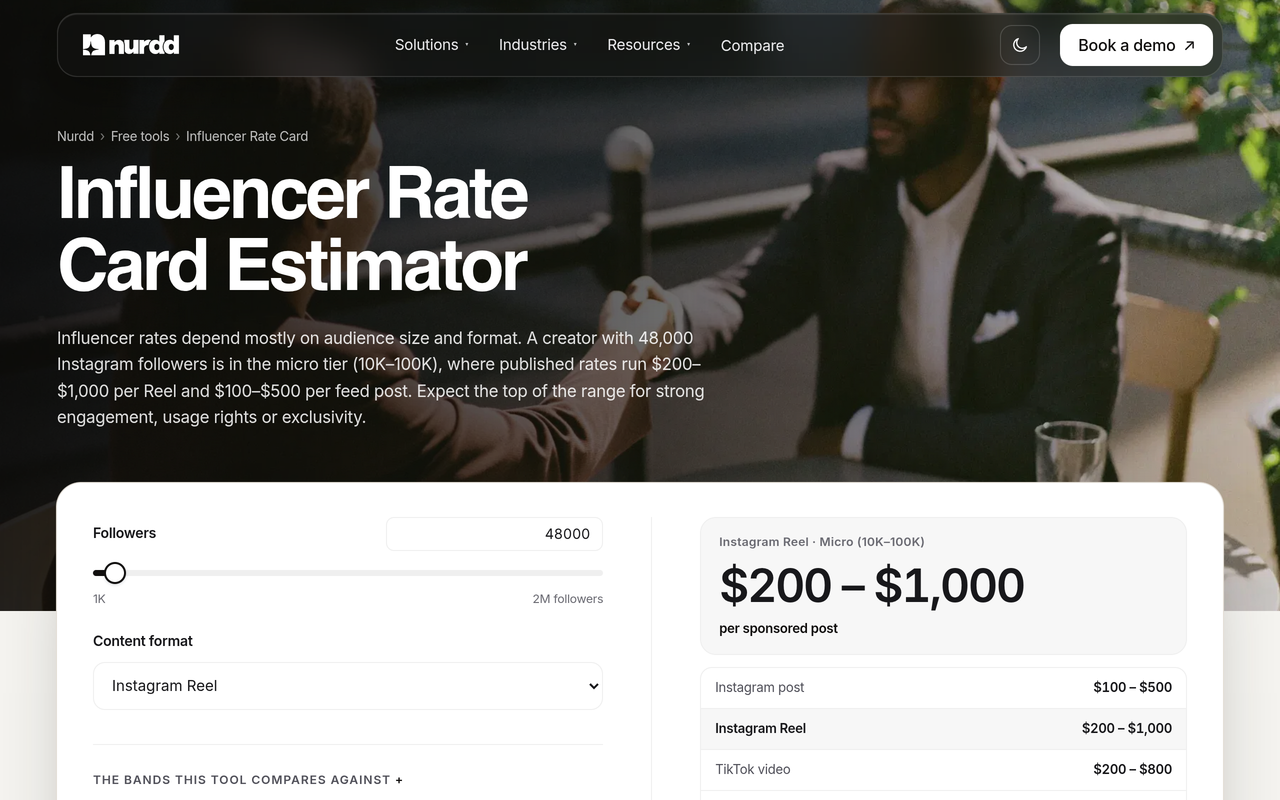
If a quote sits far outside the row for the creator's tier, ask what is bundled in. Our influencer rate card estimator gives a second reference point by tier and format.
Are there other pricing models you may be quoted?
Yes. Beyond a percentage of base, Gigapay describes a percentage of ad spend, typically 3 to 5%. It needs care: it aligns incentives on long performance campaigns but grows with your media budget. Gigapay's own example is that 4% of a $500,000 media budget is $20,000, far above most flat-fee quotes.
A different structure comes from Superfiliate, which suggests negotiating a lower upfront fee combined with a commission on engagement or revenue. That shares risk with a creator whose audience converts, and it makes tracking per creator essential.

What does a rate card cost in real dollars? A worked example
Percentages are hard to feel until you apply them. This example uses figures from Gigapay, October 2026, and assumes a mid-tier creator on Instagram. It is an illustration of the arithmetic, not a quote from a real creator.
Take a base fee of $4,000, the figure Gigapay uses in its own applied maths for a mid-tier creator. There, a 35% whitelisting fee on that base costs $1,400 per 30-day window, or $4,200 for a quarter, before any ad spend. For paid usage, UGC Bloom's August 2026 guide, as cited by Gigapay, gives 30 to 45% of base for 90 days, which is $1,200 to $1,800. Category exclusivity for 90 days is 25 to 50% of total deal value, per InfluencerFee as reported by Gigapay.
| Line | Calculation | Low case | High case |
|---|---|---|---|
| Base creative fee | One Reel | $4,000 | $4,000 |
| Paid usage, 90 days | 30% and 45% of $4,000 | $1,200 | $1,800 |
| Whitelisting, 3 x 30 days | 35% of $4,000 x 3 | $4,200 | $4,200 |
| Subtotal before exclusivity | Sum of the lines above | $9,400 | $10,000 |
| Category exclusivity, 90 days | 25% of $9,400; 50% of $10,000 | $2,350 | $5,000 |
| Total | Subtotal plus exclusivity | $11,750 | $15,000 |
The headline $4,000 became $11,750 to $15,000 once rights and restrictions were priced, roughly three to nearly four times the content fee. That is consistent with Gigapay's observation that as programmes mature, rights and amplification fees overtake content fees as the dominant cost. Ad spend is on top of every figure in this table, and a creator who bundles paid usage into the whitelisting fee would quote lower, which is exactly why you ask for the lines separately.
When is a buyout cheaper than renewing?
Gigapay cites a UGC Bloom worked example showing that a 150% perpetual buyout only beats 90-day pricing if the asset stays in active use for roughly 338 days. Gigapay adds that most creator ads are retired well before that, so for most brands renewable windows are the safer buy. Run the same test on any buyout you are offered: divide the buyout price by the window price and compare it with how long you realistically run the ad.
How do I negotiate once I can read the card?
Negotiate in the order of cheapest concession for the creator. Cheerful's guide, updated October 2026, says to trade scope before price, because an extra Story or a longer usage window costs the creator less than a discount. It also reports a typical creator ask of a median $500 at 10K to 50K followers and $1,500 at 50K to 250K, with brands in the same threads offering a median $200 and $650, and a first ask running about twice what the brand ends up willing to pay.
A creator's first ask is the opening of the conversation, not the price. Scope, duration and payment speed are all open before the headline fee is.
Here is a sequence that works from the card itself.
- Ask for the card before you share a budget. Action: request their rate card first. Result: you see how they price and what they bundle. Why: you learn their anchor before you reveal yours.
- Itemise any bundled number. Action: ask them to split creation, usage and whitelisting. Result: you can compare each line with benchmarks. Why: Gigapay notes bundled quotes hide the markup.
- Fix the duration. Action: choose a 30 or 60 day window with extension pricing written in. Result: you pay for the time you will use. Why: mid-flight extensions negotiated after launch cost 60 to 75% of the original rate according to CreatoHunt data cited by Gigapay.
- Put rights in the first brief. Action: include 90-day paid usage as standard. Result: no surprise ask once the content performs. Why: Gigapay reports that rights requested after content performs cost more.
- Counter with data, not adjectives. Action: bring engagement, audience fit and comparable rates. Result: the counter has a reason attached. Why: Cheerful says a comparable-rate counter moves rates and 'that seems high' does not.
- Offer volume or speed. Action: propose a multi-month retainer or faster payment. Result: lower per-month rights fees. Why: Gigapay says creators discount rights fees for multi-month retainers and repeat collaborations.
Before you counter on price at all, check that the audience is real and the creator's engagement justifies the base. Our engagement rate calculator and fake follower checker give you numbers to bring into the conversation, and the guide to vetting an influencer's audience before paying explains what to look for.
What should I check on each line before I sign?
Use this table as a decision aid. Each row is a line you will meet, what to ask, and the red flag that means the line needs rewording before you sign.
| Line on the card | Ask this | Red flag | Fix |
|---|---|---|---|
| 'Usage rights included' | Organic or paid? Which channels? How many days? | No duration stated | Name channel and end date |
| 'Whitelisting available' | Per 30 days? Which platform? Who controls the ad code? | One price for unspecified access | Price per window, per platform |
| 'Exclusivity on request' | Which category, how long, from when? | Broad category, open end date | Narrow the category, set dates |
| 'Revisions as needed' | How many rounds are included, and what counts as one? | No limit, or no mention | One or two rounds, then a stated fee |
| 'Rush fee applies' | What turnaround triggers it? | Undefined 'urgent' | Set a turnaround threshold |
| 'Raw files on request' | Is this included or an add-on? | Priced after the shoot | Decide before the shoot |
| 'Edits and cutdowns' | Can I crop, recaption and re-cut for ad variations? | Silent on derivatives | Write it in; Gigapay says derivative edits are often free if written into the original agreement and contested if requested later |
| 'Payment net terms' | When are they paid, and what happens if I cancel? | Very long terms or no cancellation language | Shorten terms, state kill terms |
How do I put it together? A step-by-step checklist
Run this checklist on every creator quote, in order. It works for a single post or a 50-creator programme.
- Write the deliverable in one sentence: format, platform, number of posts and posting dates.
- Record the base fee on its own line, separate from every right and add-on.
- List each rights line with channel, duration and platform.
- Convert every percentage into dollars against the base fee.
- Convert any 30-day fee into the number of windows you will actually run.
- Check exclusivity: category, length, start date and whether it applies to total deal value or base.
- Count included revision rounds and note the fee for extra rounds.
- Ask whether derivative edits, cutdowns and raw files are included.
- Agree extension prices now, as a rate per extra 30 days.
- Confirm payment timing, deposit and cancellation language.
- Confirm disclosure expectations in writing.
- Record the final terms where the campaign team and finance can both find them.
On disclosure, the FTC's Endorsement Guides (16 CFR 255.5) say that a connection between a creator and a brand that might materially affect the weight or credibility of an endorsement, and that the audience would not reasonably expect, must be disclosed clearly and conspicuously. Such material connections can include a business, family or personal relationship, monetary payment, or free or discounted products. If you are in the United States, make disclosure a contract line and not a creator-side assumption. Other markets have their own rules, so check local guidance.
What are the most common mistakes when reading a rate card?
- Comparing headline prices. Two creators at $2,000 are not equal if one includes 90 days of paid usage and the other includes none.
- Buying a buyout by default. As the 338-day break-even above shows, perpetual rights only pay back if the asset stays in use for most of a year.
- Asking for rights after the post performs. The creator now knows the content's value, so the price goes up.
- Accepting bundled quotes. One number covering creation, usage and whitelisting cannot be benchmarked line by line.
- Ignoring the agency layer. Gigapay cites CreatoHunt putting agency markups at 30 to 50%, and up to 60% on macro or performance campaigns, so ask whether a card is the creator's own price or an agency's.
- Skipping vetting. A fair rate on a creator with an inflated audience is still a bad buy. Our fake follower audit checklist shows what to run before you pay.
- Losing the terms. Rights windows expire quietly. If nobody tracks the end date, you either run unlicensed ads or renew at a worse price.
Most of these mistakes share a cause: the buyer negotiated one number when the deal contained many. Keep the conversation on the lines, and the headline figure becomes the result of agreed scope instead of the starting point.
How does rate card negotiation fit into judging return?
A rate card is a cost input, so read it next to what the campaign should deliver. Before you commit, project the return with our influencer ROI calculator and plan how the total, including rights, splits across channels in the marketing budget planner. After the campaign, compare what each creator cost with what they sold; our guides on influencer performance attribution and calculating influencer campaign incrementality explain how.
Clean tracking makes this possible. Agree a UTM structure for influencer campaigns in the brief, so each creator's link and code is tied to the fee you agreed. If whitelisted ads run on Meta, Pulse by Nurdd reads Meta and Google ad performance in plain language, which helps you judge whether the access fee was worth it.
How can Nia by Nurdd help?
Nia by Nurdd is an AI-native creative studio at getnia.studio, with influencer marketing built in. It discovers creators from a database of 10M+ profiles, detects fake followers with TruAI, forecasts ROI before you spend, manages the campaign workflow and attributes product-level sales to creators after a campaign closes. It is priced below comparable plans.
Book a demo at https://www.nurdd.club/demo and we will walk through a creator shortlist for your own brand, showing how audience checks, pre-spend ROI forecasts and sales attribution sit alongside the campaign you are negotiating.
The practical benefit for a buyer reading rate cards is continuity. The creator you vetted, the terms you agreed and the sales you can attribute to that creator stay part of one campaign workflow, instead of being split across a spreadsheet, an email thread and a dashboard. That makes it easier to see which rights fees earned their cost and which creators deserve a retainer. You can compare how this differs from marketplaces on our pages for Nia vs Collabstr and Nia vs Grin, or read how to pick an influencer marketing platform.
If you are choosing creators on predicted return rather than follower count, how to pick influencers based on predicted sales pairs well with this guide, and our playbook for when an influencer does not deliver shows why contract language on revisions and cancellation matters. Creators reading from the other side can start at Nurdd for creators.
How we researched this
We reviewed publicly available pages on influencer rate cards, usage rights, whitelisting and negotiation, including articles currently ranking for the primary keyword, benchmark compilations and the FTC's consumer information on influencer disclosures. The Gigapay and Cheerful pages were fetched and read in full on 31 October and 1 November 2026, and every figure attributed to them in this post was compared with the text of those pages. Other sources were reviewed through search results and are used only for general descriptions. Several figures are secondary compilations that Gigapay attributes to named benchmark providers, and we have not checked those providers' original reports. We did not run hands-on tests, interview creators or use customer data, and we have not published prices for any rival or for Nia.
Frequently asked questions
How do I read an influencer's rate card?
Split it into five blocks: deliverables, rights, restrictions, process and payment. Treat the headline number as the base fee for one organic piece of content and price every rights and restriction line against it. Ask for an itemised version if the creator has bundled several things into one price.
What add-on fees should I expect in an influencer rate card?
Expect separate lines for paid usage, whitelisting access, exclusivity, extensions and cross-platform rights. Gigapay's October 2026 compilation reports paid usage at 15 to 30% of base per 30 days and whitelisting at 25 to 50% of base per 30-day window. Revision rounds, rush fees and raw files vary by creator, so ask for them in writing.
What is the difference between usage rights and whitelisting?
Usage rights let a brand reuse a creator's content, for example as an ad from the brand's own account. Whitelisting lets the brand run ads from the creator's own handle, through Meta Partnership Ads or TikTok Spark Ads. Whitelisting is priced higher because the ad appears to come from the creator.
Should I accept a buyout instead of 30 to 90 day usage?
Usually not. Gigapay cites a worked example in which a 150% perpetual buyout only beats 90-day pricing if the asset is used for roughly 338 days. Buy short windows with agreed extension prices unless you know the asset will run for most of a year.
Is it acceptable to negotiate a creator's rate?
Yes, and creators expect it. Cheerful reports that a first ask runs about twice what the brand ends up willing to pay, so treat it as an opening position. Negotiate scope and duration first, then price, and offer faster payment or a retainer in return for lower rights fees.
Does a lower base fee mean a cheaper deal?
Not necessarily. A creator with a low base but high percentage add-ons, or one who charges for extra revisions and raw files, can cost more than a creator with a higher all-in price. Convert each line into dollars and compare totals, not headlines.
Do I need to track results against the fee I paid?
Yes. Without per-creator tracking you cannot tell whether a rights or whitelisting fee paid back. Use unique links or codes, record the window dates and compare sales by creator after the campaign closes.
Read the card, then see the whole campaign
A rate card is only the first document in a creator deal. The terms you negotiate matter most when you can see them next to the results they produced. To see this for your own brand, book a demo at https://www.nurdd.club/demo: we will show Nia by Nurdd shortlisting creators for your category, checking audience quality with TruAI, forecasting ROI before spend and attributing sales after the campaign. You can also try Nurdd's calculators and tools or read the Nia overview first.