Influencer Marketing
Creator Engagement Services: What Brands Should Buy
Which engagement services for creators are worth paying for, and which add platform, legal and measurement risk to influencer campaigns.
 Simran Rawat15 Nov 202616 min read

Engagement services for creators are worth paying for when they create real human attention: briefing, human community management, platform-approved paid amplification, audience audits and attribution. Services that sell likes, comments, followers or pod places break platform rules and, in the US, can draw FTC enforcement. Nia by Nurdd lets brands vet creators and measure sales without engagement shortcuts.
Engagement services for creators are worth paying for when they produce real human attention around a creator campaign: briefing, comment moderation, authorised paid amplification, audience audits and sales attribution. Services that sell likes, comments, followers or pod membership are not worth buying, because they break platform rules and, in the US, can attract FTC enforcement.
Key takeaways
- Buy services that make real people respond: creator briefs, community management, platform-approved paid amplification, audience audits and attribution.
- Never buy likes, comments, views, followers or pod places for a creator or for your own brand account. The FTC, August 2024 rule targets the sale and purchase of fake social media indicators.
- Audit a creator's engagement before you pay, using a free fake follower checker and a read of the comments, not the headline engagement rate.
- Write a "no bought or pod engagement" clause into every creator contract, and ask for the right to audit the post.
- Judge the campaign on saves, shares, qualified clicks and attributed sales, not likes.
What engagement services for creators are worth paying for?
The phrase "engagement services for creators" covers two very different things. One is a set of legitimate services that help a brand and a creator get real conversation around a post. The other is a set of shortcuts that manufacture the appearance of conversation.
The first group is worth budget. It includes creator briefing, human community management, comment moderation, whitelisting or partnership-style paid amplification through the platform itself, audience audits, and measurement. The second group, covering bought engagement, engagement pods and automation-driven "organic growth" retainers, adds risk and little else.
Rule of thumb: pay for services that change what real people see and do. Do not pay for services that change the number displayed under a post.
The rest of this guide gives a decision table, a worked example with arithmetic you can reuse, a vetting checklist and seven steps for buying only what is safe. If you want the short version of the risks, the Nurdd article on engagement pods and bought engagement covers the brand-side exposure.
Why is buying engagement around creator campaigns a problem?
Brands usually reach for engagement services for three reasons: a creator post looks quiet, a client wants a bigger number in the report, or a creator's own agency offers "engagement support". Each is a pressure point, and each can lead to paying for activity that no customer ever produced.
There are three distinct exposures: platform enforcement, legal exposure, and measurement damage. They stack, so it helps to look at each one.
Platform enforcement
Instagram announced that it would remove inauthentic likes, follows and comments from accounts that use third-party apps to boost popularity, and that apps generating them violate its Community Guidelines and Terms of Use (About Instagram, November 2018). Instagram also said people using such apps share their username and password, which makes those accounts less secure. In practice, a brand that lets a creator or vendor use these tools is exposing a partner account to removal of activity and security risk.
Meta has gone further than removing activity. Facebook and Instagram filed a federal lawsuit against a company and three people who sold fake likes, views and followers to Instagram users (Meta, April 2019).
Legal exposure
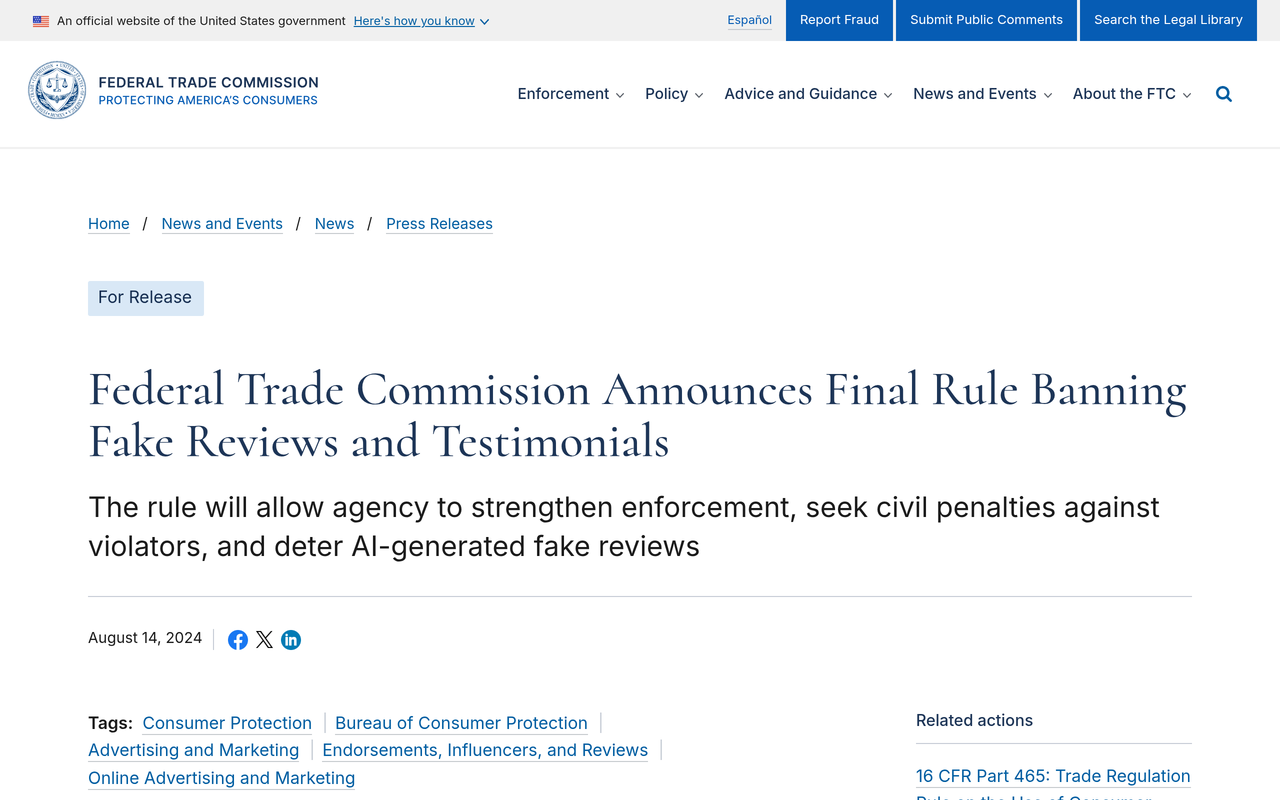
The US Federal Trade Commission's final rule on reviews and testimonials prohibits selling or buying fake indicators of social media influence, such as followers or views generated by a bot or hijacked account. The prohibition applies where the buyer knew or should have known the indicators were fake and that they misrepresent the buyer's influence or importance for a commercial purpose (FTC, August 2024). The same release says the rule allows the agency to seek civil penalties against knowing violators.
The FTC's plain-language Endorsement Guides FAQ adds that "likes" from non-existent people, or from people with no experience of the product, are deceptive, and that both the purchaser and the seller of fake likes could face enforcement action (FTC, July 2025 update). The same page says that where enforcement is needed, the agency's focus is usually on advertisers or their ad agencies and public relations firms, not only on individual creators. That matters to a brand that assumes the creator carries the risk.
Measurement damage
Bought engagement corrupts the data a brand needs for its next decision. If a creator's post carries purchased comments, the reported engagement rate no longer predicts what the next post will deliver, and any rate card built on it overstates value. HubSpot's own explainer notes that the vast majority of purchasable followers are bots or inactive accounts, and that buying them breaches Instagram's Community Guidelines (HubSpot, 2026).
The cost can also show up in retainers. A 2026 article by marketer Lilach Bullock says she has seen businesses paying £1,500 to £4,000 a month for "organic growth" that produced follower growth barely better than consistent posting (Lilach Bullock, August 2026). That is one author's observation, not a study, but it explains why a growth retainer needs a measurable test before renewal.
Which engagement services should a brand buy, test or avoid?
Most articles on this topic say "do not buy fake engagement" and stop. That is correct but not sufficient, because a brand still has a campaign to run and a list of services on offer. The table below is a decision framework built from the platform and regulator sources above. It sorts services by what they change: real behaviour, or the number on the screen.
| Service | What you get | Verdict | Why | Test before you pay |
|---|---|---|---|---|
| Bought likes, comments, views or followers | Numbers added to a creator post or profile | Never buy | Breaches platform rules and falls within the FTC's fake-indicator rule where the buyer knew or should have known | None. Walk away |
| Engagement pods and comment groups | Members trade likes and comments on each other's posts | Never fund or allow | Produces comments from people with no interest in the product, which distorts engagement and audience quality | Ask the creator in writing whether any pod, group or automation is used |
| "Organic growth" retainers that need your login | Automated following, liking and commenting | Avoid | Instagram says apps like this require shared credentials and violate its guidelines | Ask what the method is. If it is not described plainly, decline |
| Human community management | Replies, moderation and conversation handled by trained staff | Buy | Changes what real people experience and answers real questions | Review 20 sample replies for tone and accuracy |
| Creator briefing and content direction | A brief that sets the hook, the call to respond and the claims allowed | Buy | Drives saves, shares and questions at the source | Compare briefed and unbriefed posts from the same creator |
| Platform-approved paid amplification of creator posts | Brand budget behind a creator's post through the platform's own tools | Buy with conditions | Reaches real people, but needs creator permission and disclosure | Run a small spend on the best organic post first |
| Audience audit and fake follower detection | A score for how much of a creator's audience looks inauthentic | Buy, or use free tools first | Protects the fee before it is paid | Run two tools on the same account and compare |
| Gifting and seeding programmes | Product sent to creators for honest posts | Buy with conditions | Needs clear disclosure of the material connection | Check the creator's past posts for disclosure habits |
| Owned community platform | A space for customers, events and courses | Buy with conditions | Builds an audience you control, but needs a dedicated owner | Name the person who will run it for six months |
| Attribution and reporting | Sales, clicks and revenue linked to each creator | Buy | Replaces likes with outcomes | Ask for a sample report on a past campaign |
Two patterns stand out. Every "buy" row involves people reading, replying or purchasing, and every "never" row involves a counter. If a vendor cannot explain in one sentence which real people see the activity they sell, treat it as a counter.
How do you buy only safe engagement services? Seven steps
Step 1: Decide what "engagement" has to prove
Action: Write one sentence naming the outcome the campaign needs, such as qualified clicks, saved posts, product questions in the comments or attributed sales. Result: a short list of the metrics that matter, so no one buys a service to chase likes. Why: Most requests for engagement services start as a vague worry about a quiet post. A named outcome turns the worry into a test.
Write the metric and the threshold together before the creator posts. For example, "at least a set number of saves by day seven" can be checked. "Good engagement" cannot.
Step 2: Sort every offered service with the decision table
Action: Put each service from a creator, agency or vendor proposal into the table above and mark it buy, test or avoid. Result: a proposal cut down to the lines worth paying for. Why: Proposals often bundle one legitimate service, such as reporting, with one risky one, such as "engagement boosting", under a single price.
Ask for the bundle to be unbundled. If the vendor refuses to say how the engagement is produced, remove that line entirely.
Step 3: Audit the creator's existing engagement before you pay
Action: Run the checklist below on the last 12 to 20 posts of every shortlisted creator. Result: a pass, query or reject decision on each creator. Why: It is far cheaper to reject a creator before signing than to unpick a campaign whose engagement turns out to be hollow.
- Calculate the real engagement rate with the Instagram engagement rate calculator, using both followers and reach, and compare it with tier ranges on the marketing benchmarks hub.
- Run the account through the fake follower checker and record the estimate.
- Read 30 comments across three posts. Count how many are generic (single emojis, "nice pic", "great post") against specific replies that mention the product or the content.
- Check timing. Clusters of comments within a minute or two of posting, from accounts with no posts, are a pod signature.
- Compare likes to comments to saves. A post with very high likes and almost no comments or saves is out of balance.
- Look at follower growth over time for sudden steps that do not match a viral post or a campaign.
- Check that the commenting accounts match the audience you want, by language and region.
- Ask the creator in writing whether any pod, giveaway group, bought engagement or automation has been used. Record the answer.
The Nurdd fake follower audit checklist and the guide to fake follower red flags in comments and growth go deeper on steps three to six. If you need to compare tools, see best fake follower checkers compared by method.
Step 4: Pay for the services that create real conversation
Action: Allocate budget first to a proper brief, human community management for the first 48 hours after each post, and a small amount of platform-approved paid amplification behind the creator's strongest post. Result: engagement that comes from real viewers and is traceable. Why: Early replies and clear prompts invite genuine responses. Lilach Bullock's 2026 guidance recommends replying to every comment in the first hour and putting a small boost behind the best-performing organic post (Lilach Bullock, August 2026). That is practitioner advice rather than platform documentation, so test it on your own account.
A strong brief for this purpose includes four lines: the question the creator will ask the audience, the one claim they can make about the product, the link or code that is used, and the date when the brand will reply to comments. Without those, "engagement" is left to chance.
Community management also means answering questions about sizing, ingredients, delivery or pricing, which is where comments turn into sales. Many brands leave creator comment sections unattended, which wastes the most valuable moment of a campaign.

Step 5: Put the rules into the contract
Action: Add four clauses to each creator agreement: no bought or pod engagement, disclosure of the paid relationship on every post, the right to audit post analytics, and a remedy if the audit fails. Result: a documented standard that protects the brand if something goes wrong. Why: The FTC has said that, where enforcement is needed, its focus is usually on advertisers or their agencies, so a brand cannot hand compliance to the creator (FTC, July 2025 update).
When rates are negotiated, link the fee to deliverables you can verify. The guide to reading a creator's rate card and the influencer rate card estimator help set a fee without paying for an inflated engagement claim. For context, OpenSponsorship (July 2026) puts the median paid cost per deliverable at $134 for nano and $2,727 for mega creators, as summarised in Nurdd's benchmarks hub.
Step 6: Measure outcomes, not likes
Action: Tag every creator link with its own UTM parameters or code, then report saves, shares, qualified clicks and attributed sales per creator. Result: a report that can show which creators drove revenue. Why: Likes are the easiest number to inflate, so they are the least useful number to pay for.
Use the UTM structure guide for influencer campaigns to name links consistently, and read influencer performance attribution to track sales by creator. For a fuller view, influencer campaign incrementality shows how to separate sales the creator caused from sales that would have happened anyway. The influencer marketing measurement hub lays out all four steps: forecast, vet, attribute and report.
Step 7: Audit mid-campaign and act on red flags
Action: At the halfway point, review comment quality and analytics for each live post, and pause further payments if the audit shows pod or bought signals. Result: a decision while there is still money to hold back. Why: Contract remedies only work if you check in time to use them.
If a post fails the audit, ask the creator for an explanation in writing, request a replacement deliverable, and keep the screenshots. Do not "fix" the post with more purchased engagement. That turns a creator's problem into the brand's.
What does a worked example look like?
The numbers below are illustrative arithmetic, not data from a study. They show how a high engagement rate can mislead, and how to read it. Use the same method with your own creators' figures.
Imagine two creators with 100,000 followers each. Creator A averages 1,200 likes and comments per post, an engagement rate of 1.2% (1,200 divided by 100,000). Creator B averages 9,000, a rate of 9%.
For reference, IQFluence (September 2026) puts the median Instagram engagement rate at 2.79% for nano and 0.97% for micro creators, as summarised on Nurdd's marketing benchmarks hub. Creator B's 9% is far above both medians. A high figure is a prompt to check, not a reason to hire.
| Check | Creator A | Creator B |
|---|---|---|
| Average interactions per post | 1,200 | 9,000 |
| Engagement rate | 1.2% | 9% |
| Comments that mention the product or content (sample of 30) | Most | Few, mostly single emojis |
| Comment timing | Spread across the day | Clustered in the first two minutes |
| Saves and shares relative to likes | Present | Almost none |
| Decision | Pass | Query in writing, run the fake follower checker, then decide |
If Creator B confirms in writing that no pod is used and the checker returns a clean result, the brand can proceed. If the answer is evasive, the brand has saved the fee. In both cases the decision rests on evidence a reader can reproduce, not on the headline number.
What are the common mistakes?
- Treating a high engagement rate as proof of quality. Unusually high rates need the same audit as unusually low ones.
- Letting the creator's agency decide how engagement is "supported". The brand is still the advertiser, and the FTC's focus is usually on advertisers and their agencies.
- Handing over account logins. Instagram's own announcement links third-party growth apps to shared credentials and weaker account security.
- Buying a bundle without unbundling it. One legitimate line can hide a risky one.
- Skipping the comment section after launch. Real questions go unanswered while the brand pays for reach.
- Reporting likes to the client. It rewards the numbers that are easiest to fake.
- Running giveaways without checking the rules. Contests can pull in people who want a prize, not the product. Check each platform's promotion rules before you run one.
Do community platforms count as engagement services?
Some do. Owned community platforms give a brand or creator a place for events, courses, resources and member conversation outside the main social feeds. GroupApp's 2026 comparison of nine community platforms describes the typical feature set as community spaces, event hosting, communication, member profiles, courses and a resource library (GroupApp, September 2026). GroupApp sells one of the platforms it ranks, so read its ranking as vendor content.
These platforms suit brands that want long-term relationships with customers and fans. They do not replace creator campaigns, and they need staff time. The decision comes back to the same test: will real people be talking, and who will answer them?
How does Nia by Nurdd help you run creator work without engagement shortcuts?
Nia by Nurdd is an AI-native creative studio, and influencer marketing is built into it. It covers discovery, fake follower detection, ROI forecasting, campaign management and sales attribution, so a brand can judge creators on evidence before and after it spends.
In practice, that maps to the steps above. Nia searches a database of 10M+ creator profiles across Instagram and other platforms, and filters by niche, audience quality, engagement authenticity and brand match score. TruAI, Nurdd's fake follower detection inside Nia, scores each shortlisted creator before a rate is agreed. Nia then forecasts expected return before anyone is briefed, and attributes product-level sales to specific creators after the campaign closes.
Nia by Nurdd gives brands a way to run creator campaigns on authentic audiences, without buying engagement shortcuts. It combines creator discovery, TruAI fake follower detection, pre-spend ROI forecasts and sales attribution in one app, and it is priced below comparable plans. It also makes short films, product ads and UGC ads, casting real and AI creators together.
Book a demo and bring one creator shortlist: you will see how Nia scores those creators' audiences, what its forecast says about the budget, and how sales would be attributed to each.
You can read more on the Nia overview page, see how it stacks up on the comparison hub, or learn how to pick an influencer marketing platform. If you would rather hand the work over, the influencer marketing agency service runs creator campaigns on Nia. The vetting steps above rely on free tools, so you can start them today.
What should a brand do next?
Start with a short audit. Take your next three creator candidates, run the checklist, and drop any service from a proposal that cannot explain which real people it reaches. Add the four contract clauses to your template, and set up creator-level tracking before the first post goes live.
Brands that do this end up buying less and understanding more. They pay for briefs, replies, authorised amplification and measurement, and they refuse the line items that only change a number. To see your own shortlist scored, book a demo of Nia by Nurdd.
How we researched this
We reviewed regulator guidance (the US Federal Trade Commission), platform announcements from Instagram and Meta, vendor and practitioner articles on bought engagement, engagement pods and community platforms, and Nurdd's own published benchmark summaries. We also read the three articles that currently rank for related searches and noted what they leave out: mainly a decision framework, a worked example and a vetting checklist. All sources were checked on the publication date of this post. We did not run hands-on tests, interview customers or collect original data, and the worked example uses illustrative numbers that are labelled as such. This article is general information, not legal advice.
Frequently asked questions
Should brands buy engagement services for influencer campaigns?
Brands should buy services that create real engagement: briefing, human community management, platform-approved paid amplification, audits and attribution. They should not buy likes, comments, views, followers or pod membership. The FTC's 2024 rule prohibits buying or selling fake indicators of social media influence where the buyer knew or should have known they were fake.
Is buying Instagram likes or comments illegal?
It breaches Instagram's rules, and in the US it can also draw FTC attention. The FTC's rule covers fake indicators such as bot-generated followers or views when used for a commercial purpose, and its FAQ says both buyer and seller of fake likes could face enforcement. Laws differ by country, so ask a lawyer about your market.
Are engagement pods safe for creators or brands?
No. Pods are groups, often of 10 to 100 or more members according to ShadowPhone, 2026, who agree to like and comment on each other's posts. The comments come from people with no interest in the product, which distorts engagement and weakens audience quality signals. Ban them in the contract.
How can I tell if a creator has bought engagement?
Look for generic comments, clusters of comments within minutes of posting, high likes with almost no saves or comments, and sudden follower steps. Then run a fake follower checker and ask the creator in writing. The guide on vetting an influencer's audience before paying adds more checks.
What is a fair way to pay for engagement from creators?
Pay for deliverables and verified outcomes, not for a promised number of likes. Set the fee against published rate ranges, add performance terms linked to saves, clicks or attributed sales, and keep an audit right. The influencer ROI calculator projects revenue and return from a creator budget before you commit.
Does paid amplification of a creator post count as buying engagement?
Not when it runs through the platform's own advertising tools and reaches real people. That is paid reach, and the engagement that follows comes from viewers. It becomes a problem only if the spend is used to buy fake interactions or if the creator has not agreed to it.
What does Nia by Nurdd offer for creator campaigns?
Nia by Nurdd offers influencer discovery across 10M+ profiles, TruAI fake follower detection, pre-spend ROI forecasts, campaign management and product-level sales attribution. It is priced below comparable plans. You can book a demo to see it scored against your own creator shortlist.